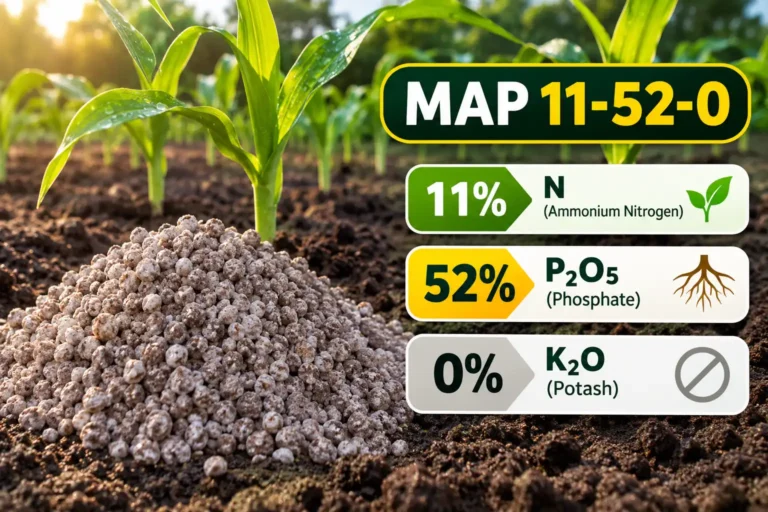
32-0-0 Fertilizer: UAN 32 Rates, Uses, and Lawn Options
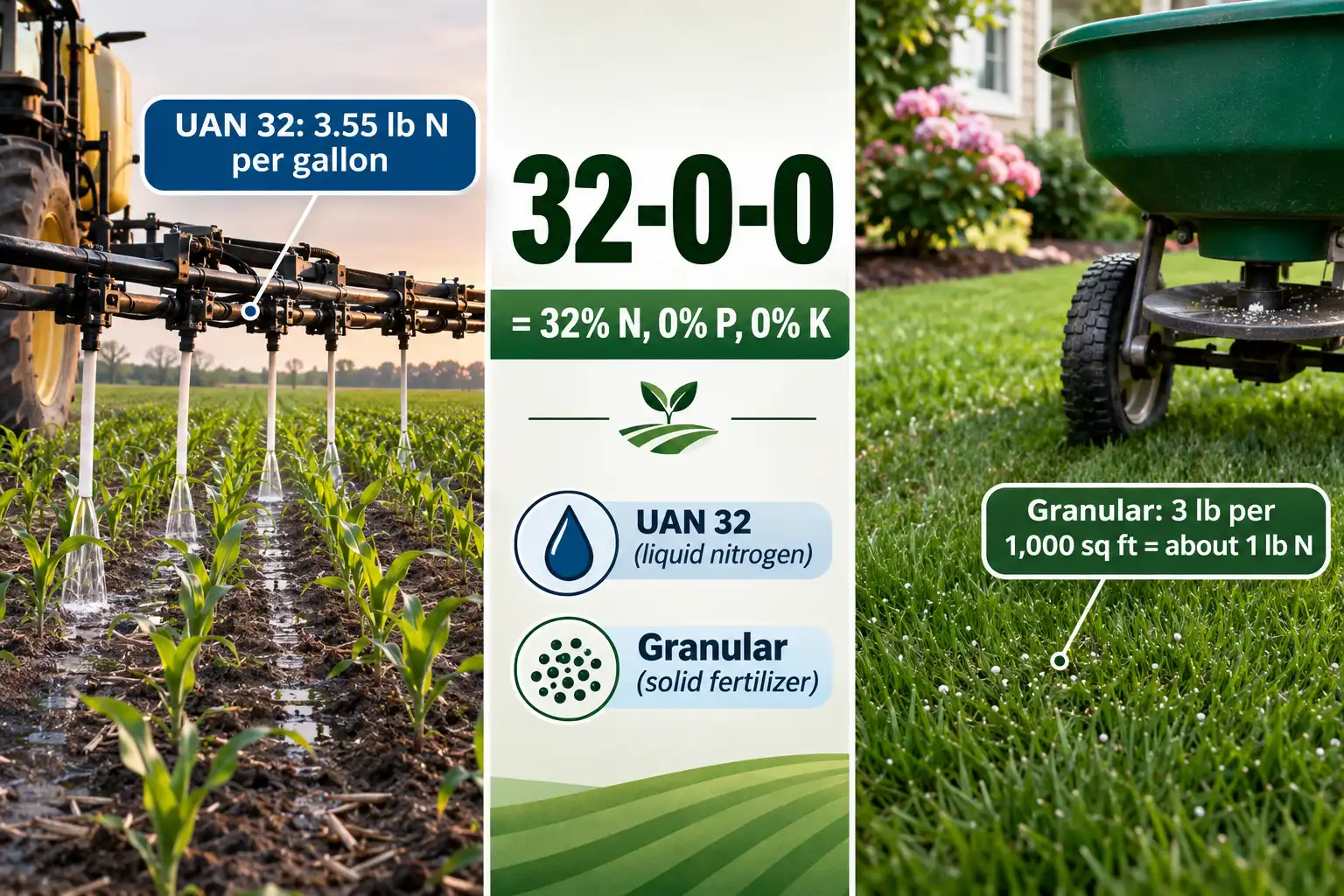
32-0-0 fertilizer is a straight nitrogen source. Farms buy it as liquid UAN 32 for corn, wheat, and pasture. Lawn owners buy it as granules. Each form needs different rate math, equipment, and care to avoid losing the nitrogen you paid for.
For soil short on nitrogen alone, 32-0-0 fertilizer supplies 32% nitrogen and no phosphorus or potassium. Liquid UAN 32 delivers 3.55 pounds of nitrogen per gallon, per CF Industries. Lawn granules can add coated urea for slower release.
What Is 32-0-0 Fertilizer?
32-0-0 fertilizer is any product guaranteed to hold 32% nitrogen, 0% phosphate, and 0% potash by weight. So 100 pounds of product carries 32 pounds of actual nitrogen. The rest is water, salts, or coating, depending on the form.
You will find it sold two ways:
- Liquid UAN 32. UAN fertilizer is urea ammonium nitrate dissolved in water. Growers also call it 32% nitrogen, 32 nitrogen, or UAN-32, and British spelling renders it liquid UAN fertiliser. It goes on through sprayers, toolbars, and irrigation systems.
- Granular 32-0-0. Turf products are mostly urea, and some add a coated slow-release share. You apply it with a rotary or drop spreader.
Because it carries no phosphorus or potash, read your soil test report before you rely on it alone. If phosphorus and potassium test low too, a balanced 10-10-10 blend or a separate P and K product fills that gap.
Liquid UAN 32 or Granular 32-0-0: Which Fits Your Job?
Pick the form by acreage and equipment, not by the analysis. Both supply the same 32% nitrogen.
| Your situation | Better fit | Why |
|---|---|---|
| Corn, wheat, or pasture across several acres | Liquid UAN 32 | Sprays, injects, or rides with herbicide in one pass |
| Winter wheat topdress in spring | UAN with streamer bars, or dry urea | K-State trials found the two equally effective |
| Home lawn or sports turf | Granular 32-0-0 | Spreads evenly at 1 lb N per 1,000 sq ft |
| Raised beds and small plots | Granular 32-0-0 | Easy to weigh out by the ounce |
| Bulk tank stored outside in freezing weather | UAN 28 instead | Stays liquid to 0°F, while UAN 32 salts out at 32°F |
In short, liquid UAN suits anyone with a sprayer and acres to cover. Granules suit anyone with a spreader and a lawn.
What’s Inside UAN 32?
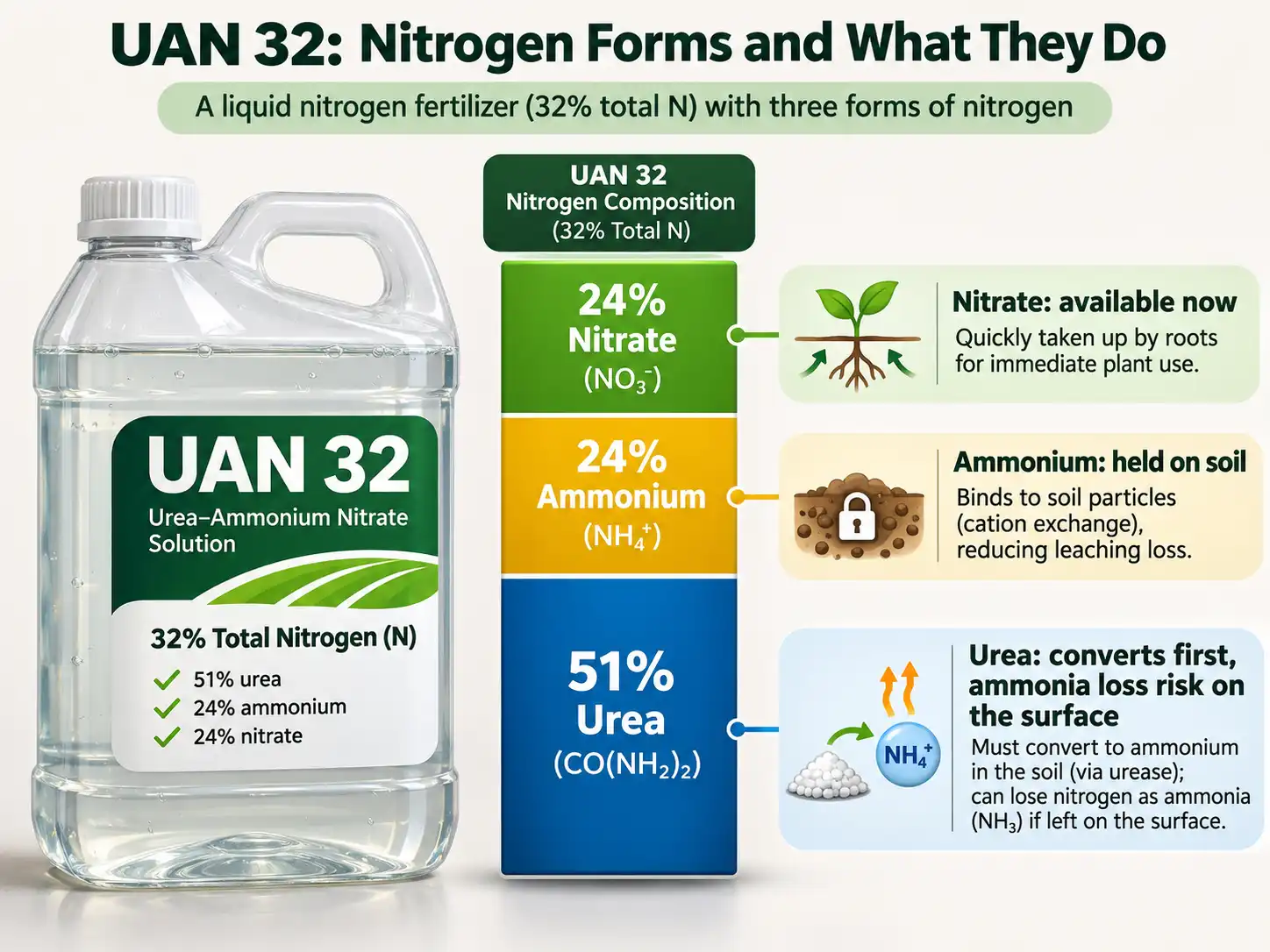
UAN 32 holds three forms of nitrogen in one clear liquid. CF Industries specifies 32.6% to 38% urea and 41% to 48% ammonium nitrate by weight, with water making up the rest. Simplot’s UAN 32 spec sheet breaks the nitrogen out per gallon:
| Nitrogen form | Pounds per gallon | Share of total N | How it behaves |
|---|---|---|---|
| Urea | 1.82 | About 51% | Soil enzymes convert it to ammonium. Left on the surface, part can escape as ammonia gas. |
| Ammonium | 0.86 | About 24% | Holds on clay and organic matter until soil microbes turn it into nitrate. |
| Nitrate | 0.86 | About 24% | Roots take it up right away, but it moves with water and can leach. |
That mix explains how UAN 32 acts in the field. The nitrate gives a fast start, while ammonium and urea keep feeding later. However, the urea half also carries the main loss risk. Purdue Extension agronomist Jim Camberato notes that half of UAN is urea. So its volatilization losses typically run about half those of straight urea.
UAN 28 vs UAN 30 vs UAN 32
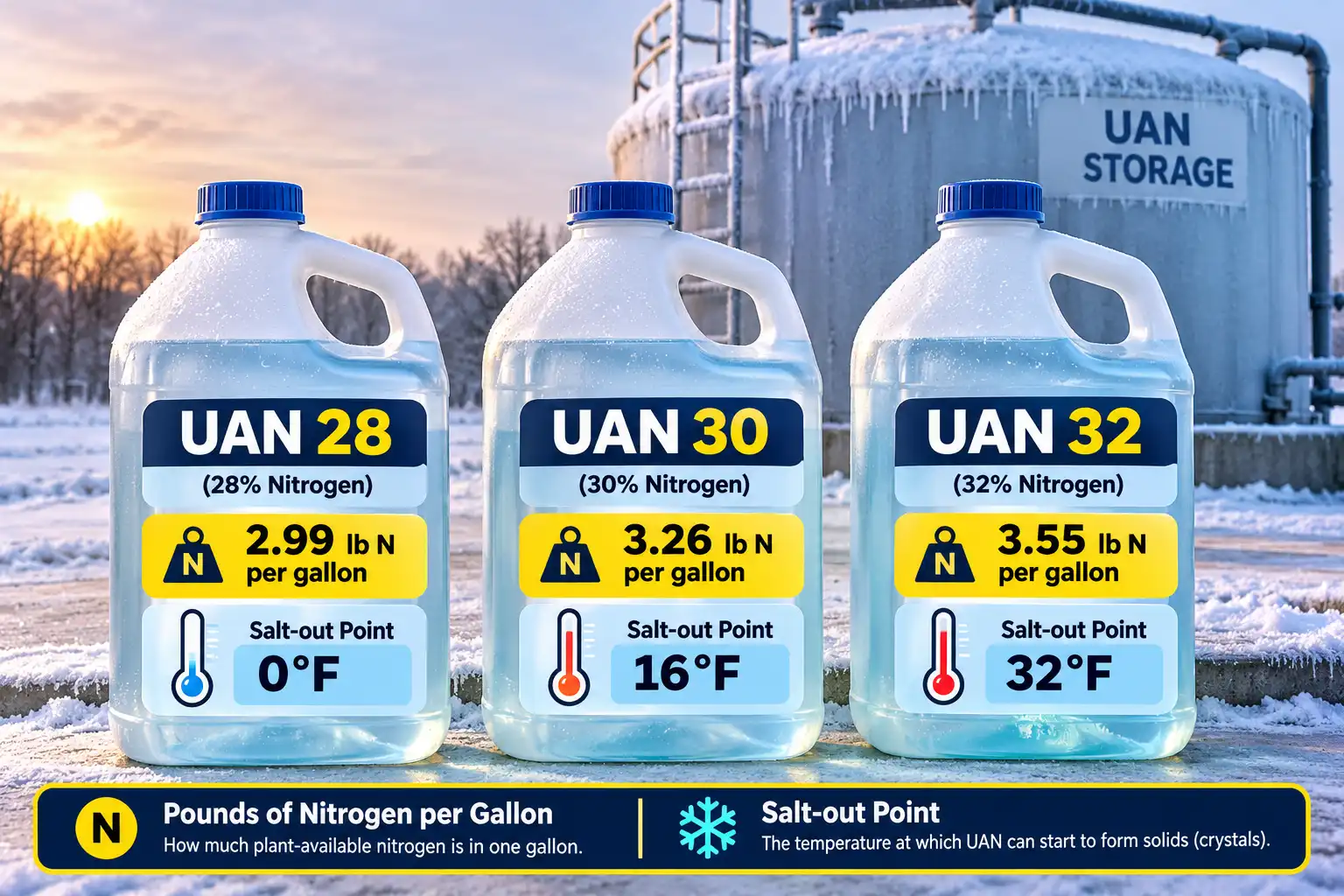
The three grades differ mainly in water content. Less water means more nitrogen per gallon. But it also means salts crystallize at a warmer temperature. CF Industries lists these specifications:
| Grade | Pounds per gallon (60°F) | Pounds N per gallon | Gallons per ton | Salt-out temperature |
|---|---|---|---|---|
| UAN 28 | 10.67 | 2.99 | 187.4 | 0°F |
| UAN 30 | 10.86 | 3.26 | 184.2 | 16°F |
| UAN 32 | 11.08 | 3.55 | 180.5 | 32°F |
So UAN 32 carries about 19% more nitrogen per gallon than UAN 28. That means fewer refills and less tank space per acre. The trade-off is cold tolerance. Below 32°F, UAN 32 starts to salt out, and the crystals can plug strainers and nozzles.
A simple rule follows. Buy UAN 32 for in-season use or warm storage. Choose UAN 28 when a tank sits outside through a cold winter.
Also, rates don’t transfer gallon for gallon. Ten gallons of UAN 28 supply 29.9 pounds of nitrogen. Ten gallons of UAN 32 supply 35.5 pounds.
32-0-0 vs Other Nitrogen Fertilizers
UAN 32 sits in the middle of the common nitrogen sources for concentration.
| Product | Analysis | Form | Pounds N per ton |
|---|---|---|---|
| Anhydrous ammonia | 82-0-0 | Pressurized gas, injected | 1,640 |
| Urea | 46-0-0 | Dry granule | 920 |
| UAN 32 | 32-0-0 | Liquid | 640 |
| UAN 28 | 28-0-0 | Liquid | 560 |
| Ammonium sulfate | 21-0-0-24S | Dry granule | 420 |
Concentration is only half the comparison, though. Placement matters as much. Camberato’s Purdue review found surface-applied urea often underperforms UAN, while urea worked into the soil matches it or does slightly better.
To compare price quotes, convert each one to cost per pound of nitrogen:
- UAN 32: price per ton ÷ 640
- Urea: price per ton ÷ 920
- Anhydrous ammonia: price per ton ÷ 1,640
- UAN 32 by the gallon: price per gallon ÷ 3.55
Then add the cost of the trip, any stabilizer, and the equipment each source needs.
How to Calculate UAN 32 Rates
Set the nitrogen rate first, then convert it to product. Start from a nitrogen rate for corn per acre or your state’s wheat guideline, minus soil test and previous-crop credits. Then run two divisions:
- Gallons per acre = pounds of N needed ÷ 3.55
- Pounds of product per acre = pounds of N needed ÷ 0.32
| N needed (lb/acre) | UAN 32 (gal/acre) | UAN 32 (lb/acre) |
|---|---|---|
| 30 | 8.5 | 94 |
| 50 | 14.1 | 156 |
| 100 | 28.2 | 313 |
| 150 | 42.3 | 469 |
| 180 | 50.7 | 563 |
Check Your Sprayer With the Real Solution
Spray tips are rated with water. UAN 32 is heavier, with a specific gravity of 1.33 per CF Industries, so the same tip puts out less volume. To correct for it, divide the water rating by the square root of 1.33, which is about 1.15. For example, a tip set for 20 gallons per acre of water delivers about 17.3 gallons of UAN 32. Catch-test the nozzles with the solution itself before you trust the setting.
Scale It Down to Lawns and Beds
One pound of nitrogen per 1,000 square feet equals 43.6 pounds per acre. Use that factor to shrink any field rate:
| Area | N at 1 lb per 1,000 sq ft | Granular 32-0-0 | Liquid UAN 32 |
|---|---|---|---|
| 1 acre | 43.6 lb | 136 lb | 12.3 gal |
| 1,000 sq ft | 1 lb | 3.1 lb | 36 fl oz |
| 100 sq ft | 1.6 oz | 5 oz | 3.6 fl oz |
| 4 by 8 ft raised bed | 0.5 oz | 1.6 oz | 1.2 fl oz |
Double the rate, and every figure doubles. On small plots, keep liquid UAN off the leaves. Simplot’s label says not to spray UAN 32 full strength on crops other than pasture, so dilute it and apply it to the soil.
How to Apply UAN 32
Get UAN 32 into the soil fast. Injection works best, a surface band comes next, and broadcast spray carries the most risk. Simplot’s label lists preplant plow-down, sidedress injection or banding, and sprinkler, drip, flood, or furrow irrigation as uses.
| Method | Best use | Loss and burn risk |
|---|---|---|
| Knife or coulter injection | Corn sidedress, preplant | Lowest. In an Illinois trial Purdue cites, injected UAN gave the top yield, 148 bu/acre. |
| Surface band (dribble or streamer) | Sidedress, wheat topdress | Lower. Banded UAN out-yielded broadcast by 5 to 6 bu/acre in Illinois studies. |
| Broadcast spray | Preplant, herbicide carrier | Highest for both volatilization and leaf burn |
| Fertigation | Irrigated crops | Moves in with the irrigation water |
Corn
UAN fits preplant, at-planting, and in-season passes on corn. It can also carry preemergence herbicide, the “weed and feed” use on Simplot’s label, but check the pesticide label first. For the in-season pass, timing follows the sidedress window for corn. Then inject or coulter-band it so the urea half stays below the surface.
Winter Wheat Topdress
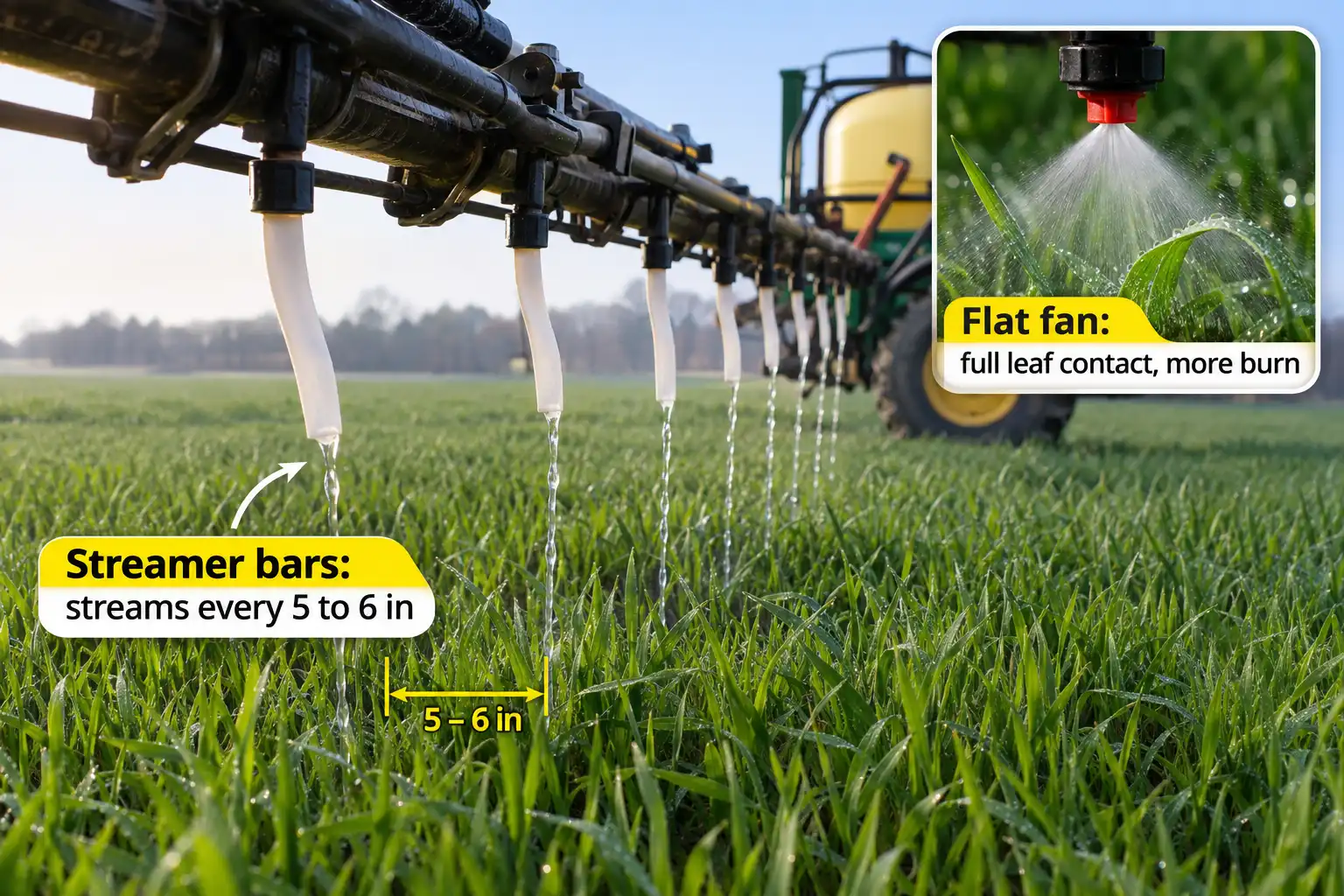
K-State Research and Extension trials have found UAN and dry urea equally effective for topdressing wheat. So the method matters more than the source. K-State warns that broadcast UAN above 10 gallons per acre can burn young wheat. Streamer bars cut that burn sharply. They are 10 to 15 inch plastic bars that lay a solid stream every 5 to 6 inches.
Do the gallon math before you load. Because K-State’s threshold is set in gallons, UAN 32 fits 35.5 pounds of nitrogen under it, compared with 29.9 for UAN 28. A 40-pound topdress takes 11.3 gallons of UAN 32, which crosses the line unless you use streamers.
There are two limits. If you tank-mix herbicide, K-State notes you must broadcast. And once heads emerge, the burn risk from broadcast UAN outweighs any yield gain. A spring topdress is routine when growing wheat, so set up the boom before green-up.
Common UAN 32 Problems and Fixes
Most UAN 32 failures come from nitrogen lost to the air, scorched leaves, or cold storage.
| Problem | Likely cause | Fix |
|---|---|---|
| Weak crop response after a surface pass | Urea half lost as ammonia gas | Inject, band, or apply ahead of forecast rain |
| Brown, scorched leaf tips | Broadcast spray on foliage, high rate, surfactant in the mix | Switch to streamers, cut the rate, or dilute |
| Plugged strainers in cold weather | Salt-out below 32°F | Store it warm, or switch to UAN 28 |
| Corroded fittings | Copper or brass parts | Replace with stainless steel, aluminum, or approved fiberglass |
Why Surface-Applied Nitrogen Disappears
Under the worst conditions, Camberato reports up to 60% of urea nitrogen can volatilize. Still, losses of 30% or less are more common. Risk climbs with high soil pH, sandy soils low in clay and organic matter, heavy residue, no-till, and warm, moist weather. At 75°F or warmer, the window for rain to move urea in can be as short as 24 hours.
A urease inhibitor with NBPT delays urea conversion for a week or two, per Purdue. But it only buys time. If no rain falls before it wears off, the loss still happens.
Why Leaves Burn
K-State’s study of UAN with wheat herbicides (MF2903) found that 12 gallons per acre caused moderate to severe injury in all three years. Adding a nonionic surfactant made the burn worse. On the other hand, diluting UAN 50% with water reduced burn in two of three years. Wheat regained normal color within about three weeks.
Storing and Handling UAN 32
Keep UAN 32 above 32°F, away from copper, and out of contact with aqua ammonia.
- Temperature. CF Industries and Simplot both list a 32°F salt-out point. If crystals form, talk with your supplier before you pump. Don’t run them through the sprayer.
- Tanks and plumbing. Simplot lists mild steel, stainless steel, aluminum, and certain fiberglass as suitable. Never use copper or brass fittings.
- Corrosion. CF Industries calls UAN corrosive. Its UAN 32 carries 150 to 250 ppm of corrosion inhibitor to protect carbon steel, so inspect older steel tanks and welds each season.
- Mixing. Simplot warns that blending UAN with aqua ammonia creates a very corrosive mix. Also check each pesticide label before you tank-mix.
- Safety. UAN 32 irritates eyes. Protect your eyes and wash thoroughly after handling, as the Simplot label directs.
Using Granular 32-0-0 on Lawns
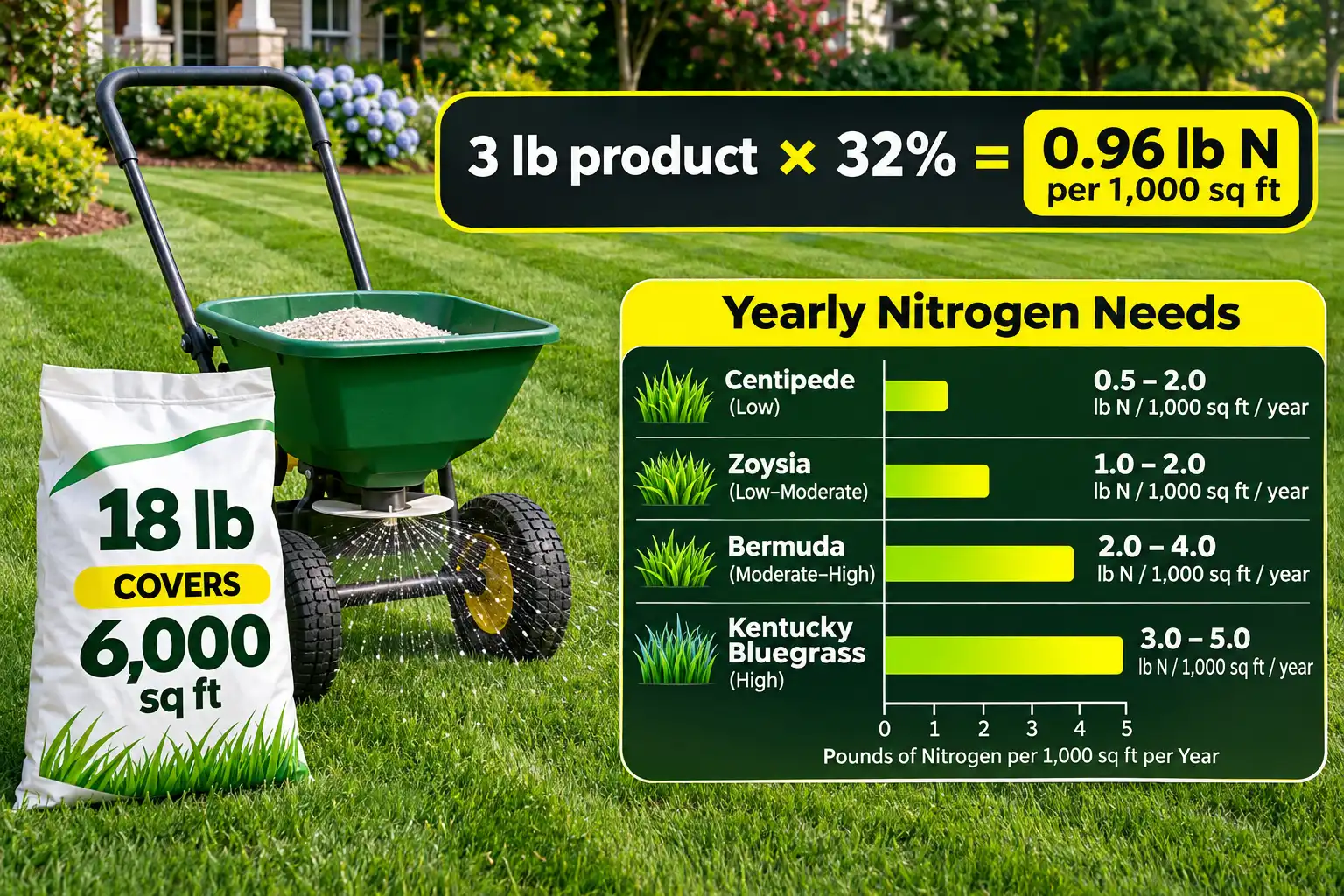
About 3 pounds of granular 32-0-0 per 1,000 square feet supplies roughly 1 pound of nitrogen. That matches Purdue Extension’s advice to keep any single application at or below 1 pound of nitrogen per 1,000 square feet.
Here is the math: 3 × 0.32 = 0.96 pound of N. At that rate, an 18-pound bag covers 6,000 square feet. So divide your lawn’s square footage by 6,000 to get the bags needed per feeding.
How Many Feedings Per Year?
Your grass type sets the yearly total. Divide it by about 1 pound per feeding to get the number of passes.
| Grass | Yearly N (lb per 1,000 sq ft) | Feedings at 3 lb product | Main feeding season |
|---|---|---|---|
| Kentucky bluegrass, well kept | 3.5 to 4 | 4 | Fall, plus a light late-spring feeding |
| Tall fescue | About one third less than bluegrass | 2 to 3 | Fall |
| Bermudagrass | 2 to 5 | 2 to 5 | May to August |
| St. Augustinegrass | 2 to 5 | 2 to 5 | May to August |
| Zoysiagrass | 2 to 3 | 2 to 3 | May to August |
| Centipedegrass | 1 to 2 | 1 to 2 | May and July |
The cool-season figures come from Purdue’s turf program, and the warm-season figures from UGA Extension. Notice the spread. A label interval of every 6 to 8 weeks fits bermudagrass or bluegrass. On centipedegrass, though, it would add far more nitrogen than UGA recommends.
How to Apply It
The Andersons gives these directions for its 32-0-0:
- Mow first, then spread on dry, actively growing turf.
- Apply in the morning or evening, not in the heat of the day.
- Water in with at least 0.2 inch to move the granules into the soil.
- Skip the application if heavy rain is forecast.
- Sweep granules off driveways and sidewalks.
On acreage lawns or food plots, a tow-behind spreader covers ground faster. Calibrate it to 3 pounds per 1,000 square feet before the first pass.
Best 32-0-0 Lawn Fertilizer: What to Check Before You Buy
A granular 32-0-0 earns its place only when nitrogen is the real shortage. First, confirm the lawn is pale from low nitrogen, not drought, disease, or low potassium. Then check three things on the bag:
- Slow-release share. The guaranteed analysis lists any “slowly available nitrogen”. More of it means steadier color and less surge growth.
- Particle size. Smaller granules put more particles on each square foot at a light 3-pound rate.
- Coverage per bag. Divide your lawn’s square footage by the bag’s coverage so you know how many bags each feeding takes.
The Andersons Professional Pure Nitrogen 32-0-0 (18 lb)
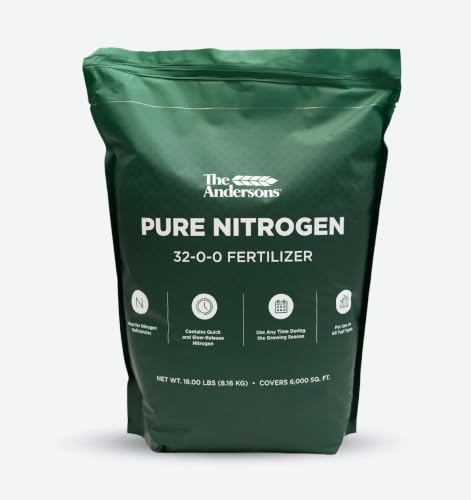
- Ideal for lawns with nitrogen deficiencies
- Contains both quick- and slow-release nitrogen
- Can be used any time during the growing season
Quality label: Top pick for nitrogen-only lawn feeding
This granule targets lawns short on nitrogen, such as yellow or tan turf under summer stress. It pairs urea for quick green-up with polymer-coated sulfur-coated urea for slower feeding. At the labeled 6,000 square feet per bag, each pass delivers 0.96 pound of nitrogen per 1,000 square feet. The small prill helps a spreader lay that light rate evenly. Owner reports consistently note greening within one to two weeks and darker, thicker turf. Still, a quarter of effectiveness ratings were not positive, so confirm nitrogen is the actual problem first.
Pros
- Quick and slow release
- Small, uniform prills
- About 1 lb N per pass
- Labeled for all turf
Cons
- One bag covers only 6,000 sq ft
- No phosphorus, potassium, or iron
Specifications
- Analysis: 32-0-0
- Nitrogen sources: urea, polymer-coated sulfur-coated urea
- Coverage: 6,000 sq ft per 18 lb bag
- Form: small granules
Owner evidence: Buyers rate quality 92% positive and appearance 100% positive. Effectiveness sits at 75% positive, with greening reported within one to two weeks.
FAQs About 32-0-0 Fertilizer
Is UAN 32 the same as 32-0-0?
Yes, UAN 32 is the liquid form of 32-0-0, made from urea, ammonium nitrate, and water. Granular products carry the same grade but use urea and coated urea instead of a solution.
Can I spray liquid UAN 32 on my lawn?
Not at full strength. Simplot’s label says not to spray UAN 32 undiluted on crops other than pasture, so granular 32-0-0 is the simpler way to feed a lawn evenly and safely.
Will 32-0-0 burn my lawn?
It can if you overapply it or spread it on wet grass. The Andersons directs applying its 32-0-0 to dry turf at 18 pounds per 6,000 square feet, outside the heat of the day, then watering in 0.2 inch.
Can you dilute UAN 32 with water?
Yes, and dilution can reduce leaf burn. K-State research found that diluting UAN 50% with water lessened foliar burn on wheat in two of three years, though you must recalculate nitrogen per gallon of mix.
How fast does 32-0-0 green up grass?
Owner reports for The Andersons 32-0-0 describe visible greening within one to two weeks. Response depends on watering in, soil temperature, and whether nitrogen was actually the limiting factor in the first place.
Is UAN 32 better than urea?
It depends on placement. Purdue’s review found surface-applied urea often underperforms UAN, while urea worked into the soil matches or slightly beats it, so compare cost per pound of nitrogen and your application method.
What temperature does UAN 32 salt out?
UAN 32 salts out at 32°F, according to both CF Industries and Simplot specifications. UAN 28 stays liquid down to 0°F, which is why it suits tanks that sit outside through freezing weather.
Key Points for Your Field
Set the nitrogen rate from your state’s guideline first. Then divide by 3.55 for gallons of UAN 32, or by 0.32 for pounds of product. Get the urea half into the soil with injection, a band, or timely rain. On wheat, switch to streamers once a broadcast pass tops 10 gallons per acre. On lawns, keep each pass near 1 pound of nitrogen per 1,000 square feet, and match the yearly total to your grass.