When to Sidedress Nitrogen on Corn: V4 to V8, Ideally Near
Corn takes up most of its nitrogen in a few summer weeks. Sidedressing works best when that N is already in the root zone as uptake climbs. Below: when to sidedress nitrogen on corn, how to confirm the stage, and how much to apply.
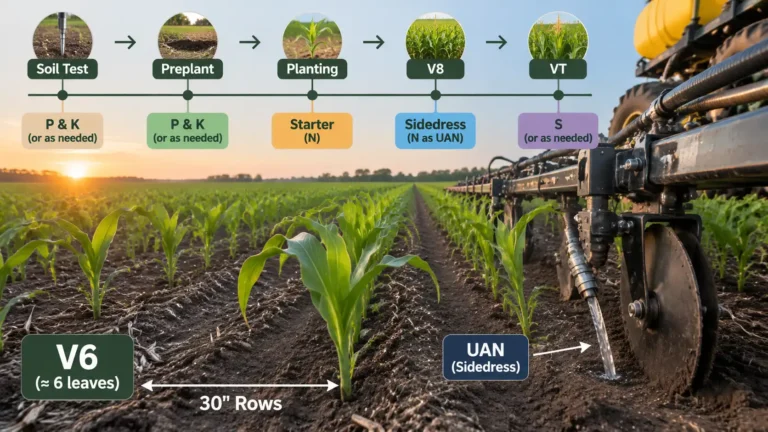
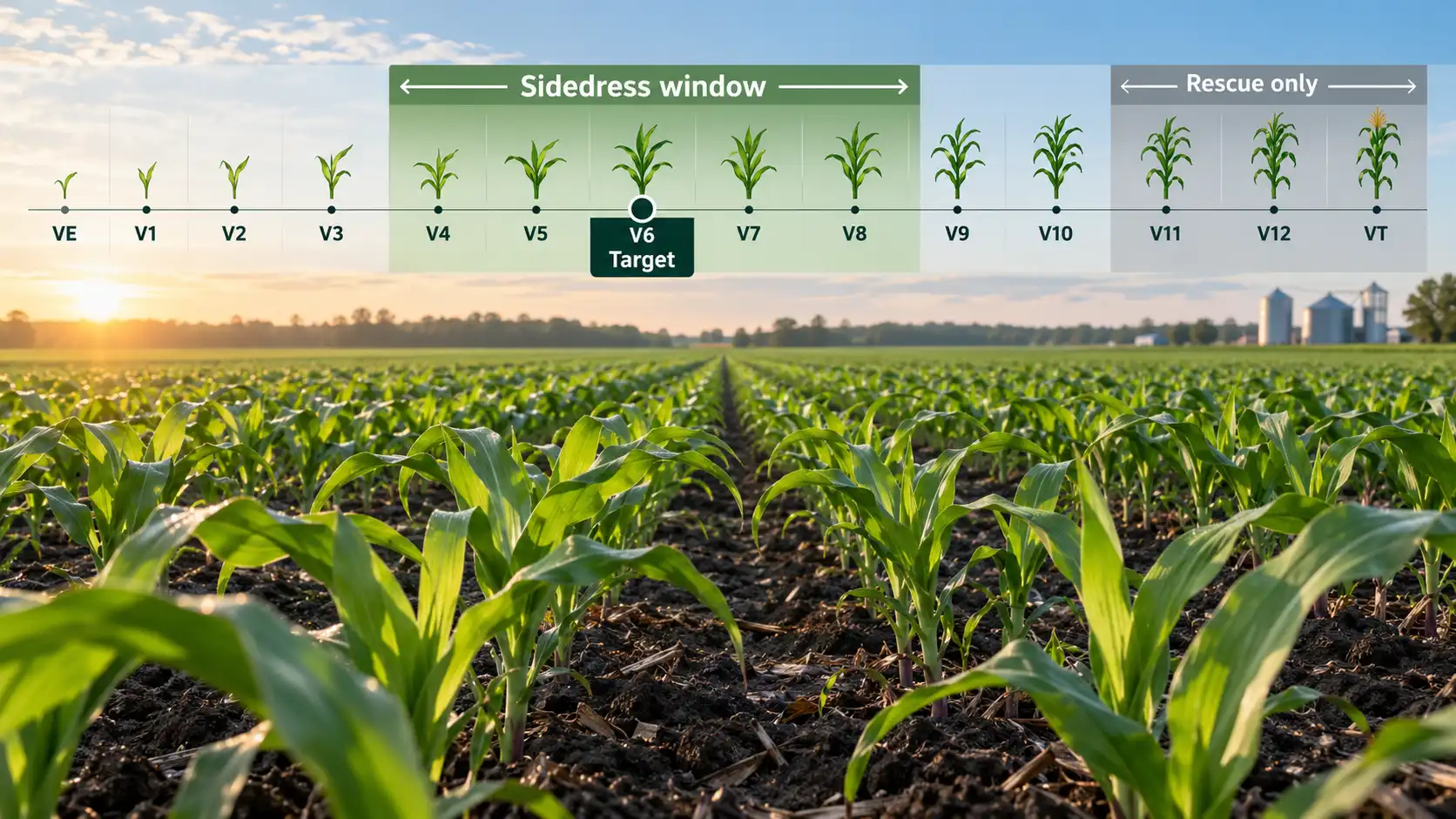
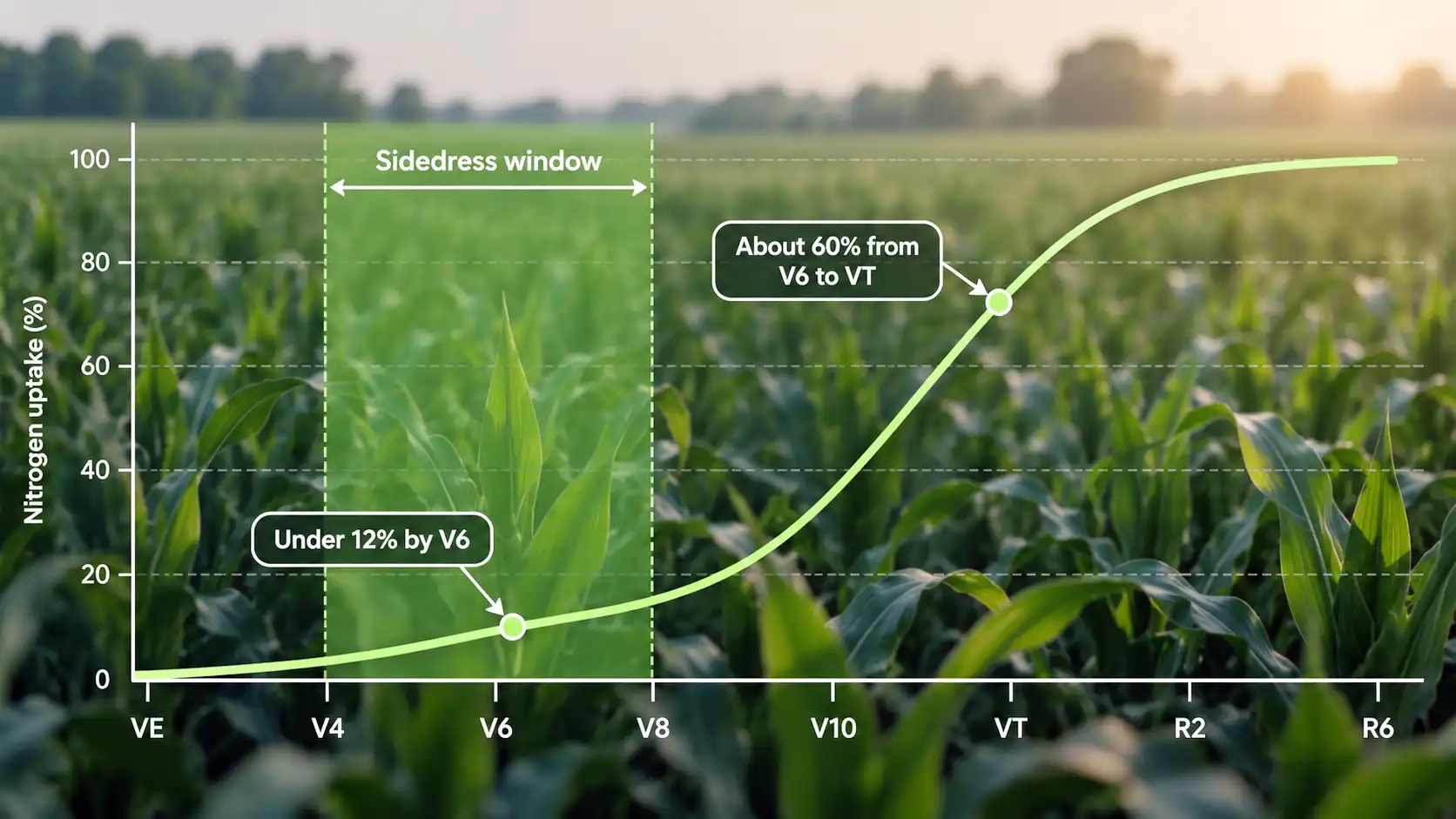
Sidedress nitrogen on corn between V4 and V8, before rapid uptake begins. University of Minnesota Extension rates that window best, and Tennessee trials pointed to V6. Minnesota found no gain from waiting past V10.
When Should You Sidedress Nitrogen on Corn?
Sidedress between V4 and V8, with V6 as the practical target. University of Minnesota Extension rates V4 to V8 as the best window in Minnesota. Tennessee data agree. University of Tennessee Extension trials from 2022 to 2024 pointed to V6 as the best single timing.
The window follows the way corn grows. Before V6, plants take up less than 12% of their season’s nitrogen, per University of Tennessee Extension. Then about 60% moves in between V6 and tasseling. Around tasseling, Iowa State University Extension puts uptake at 5 to 7 pounds of N per acre per day.
So the goal is not feeding a V6 plant. It is having N in the root zone before demand climbs. N applied near V6 still has time to move down before the surge. By contrast, N applied at planting sits through spring rains first. Iowa State notes that excess moisture drives N loss through leaching and denitrification.
Sidedress Timing by Growth Stage
Match your field’s stage to the job. Purdue Extension’s rule of thumb sets the GDD column: corn emerges about 115 to 120 growing degree days (GDD) after planting. Then it adds a leaf collar every 82 GDD through V10.
| Stage | Approx. GDD after planting | Status | What fits now |
|---|---|---|---|
| V2 to V3 | 285 to 365 | Early | Hold off; N waits weeks for uptake |
| V4 to V5 | 450 to 530 | Window open | Inject anhydrous or UAN; sample soil nitrate at V5 |
| V6 | 610 | Target | Dribble UAN between rows; injecting now risks root damage |
| V7 to V8 | 695 to 775 | Closing | Dribble UAN; finish planned N by V8 to V9 |
| V9 to V10 | 860 to 940 | Late | Planned sidedress should be done |
| V11 to VT | Over 940 | Rescue only | 30 to 60 lb N through Y-drops or drop tubes |
The window and method notes come from University of Minnesota Extension. The sampling stage and rescue rates come from Iowa State University Extension.
How to Confirm V6 in the Field
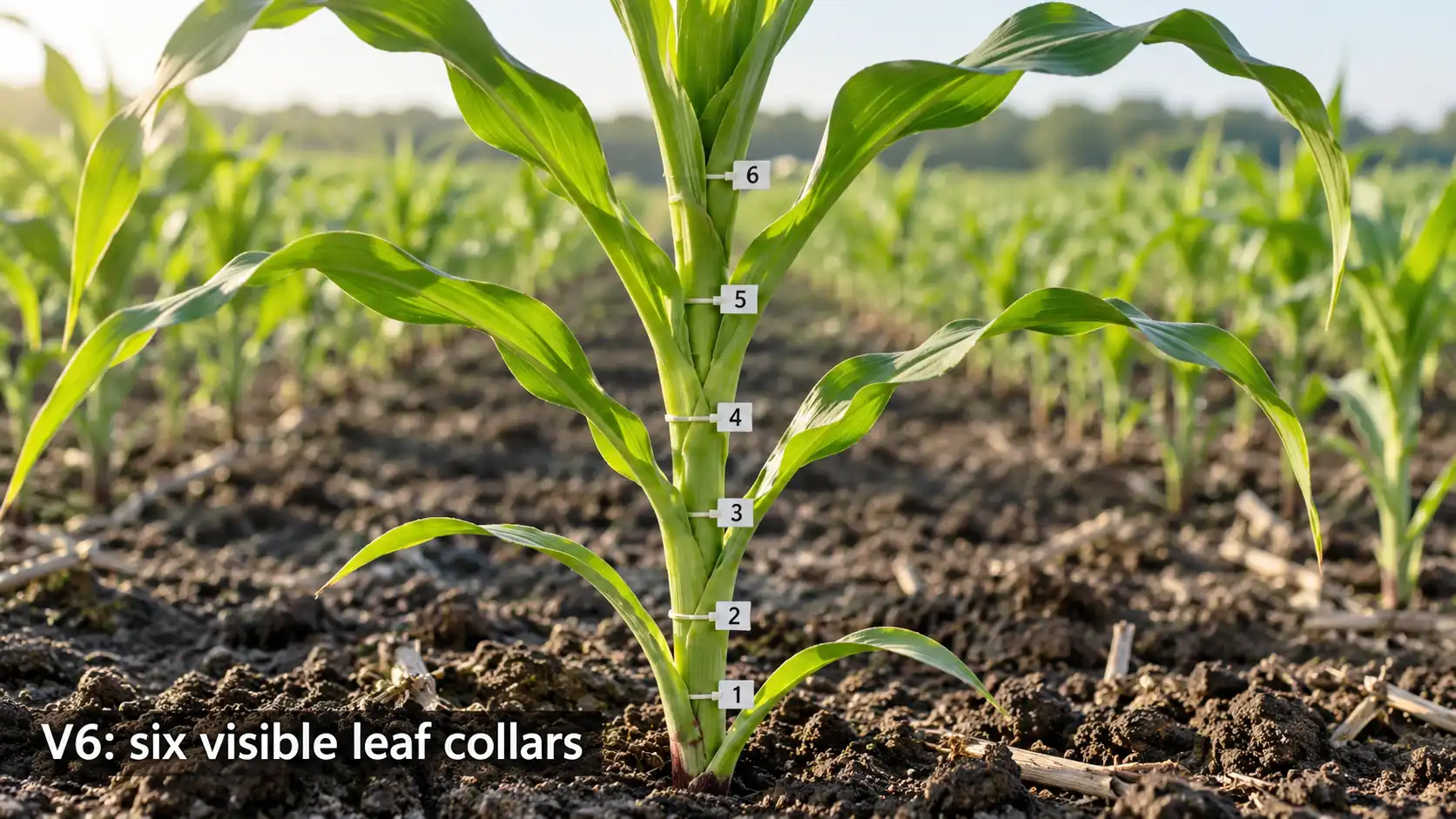
Count leaves with a visible collar, the light-colored band at the base of each leaf blade. Start from the short, round-tipped first leaf, and skip leaves still rolled in the whorl. Six visible collars means V6.
Dead lower leaves still count, according to Purdue Extension. Once they drop off, split a stalk lengthwise on V7 and older corn. Find the fifth leaf’s node, count the collared leaves above it, and add five. Stage plants in several spots, since stages vary across a field.
Test Soil Nitrate Before You Sidedress
A soil nitrate test shows whether the field still needs N, and roughly how much. Iowa State University Extension calls its version the late-spring soil nitrate test (LSNT). Penn State Extension runs the pre-sidedress soil nitrate test (PSNT), which it recalibrated in 2024.
| Iowa State LSNT | Penn State PSNT | |
|---|---|---|
| Use on | Corn after corn or soybean with prior N fertilizer | Fields manured in 2 or more of the last 5 years, not counting this year |
| Sample when | Corn 6 to 12 inches tall (ground to whorl center), usually V5 to V6 | Corn 12 inches tall, about V5 |
| Core depth | 12 inches | 12 inches |
| No more N when | Nitrate-N tests above 25 ppm | The formula returns zero or less |
The two disagree because each state calibrated on its own trials. Penn State’s new formula rests on 47 site-years of no-till fields, and it dropped the old 21 ppm cutoff. So use the version your state supports.
Weather shifts the reading, too. Iowa State lowers its 25 ppm critical value by 3 to 5 ppm after a wet spring. Its trigger is rainfall about 20% above normal before sampling. Iowa State also advises sampling by June 10 to 15, even if late-planted corn is under 6 inches.
Sampling errors are easy to make. Nitrate moves little sideways, Iowa State notes, so cores must cover injection bands in proportion. Penn State says to skip sampling right after a heavy rain, then dry or refrigerate the sample at once. A soil sampling probe marked at 12 inches keeps every core at the calibrated depth.
How Much Nitrogen to Sidedress
Sidedress the gap between your season’s total N rate and what is already on. Sidedress N is the last step in a soil fertility plan, so subtract preplant, starter, and manure N first. For example, if your state’s total is 150 pounds and 40 went on preplant, sidedress 110.
A soil test can set the number instead. Here is the same 15 ppm reading run through both state methods:
- Iowa State: (25 minus 15) × 8 = 80 pounds of N per acre.
- Penn State, manured field, 180-bushel goal: (0.72 × 180) minus (5.1 × 15) = 53 pounds of N per acre.
The 27-pound gap comes from calibration, not chemistry. So use your own state’s method rather than picking the lower figure. Iowa State also cautions that its test predicts when no more N is needed better than it predicts an exact rate.
Scale It to Your Field
Divide by the fertilizer’s N content to get product weight. Urea is 46% N, so 80 pounds of N takes about 174 pounds of urea per acre. Here is that same rate at smaller scales:
| Area | Actual N | Urea (46-0-0) |
|---|---|---|
| 1 acre | 80 lb | 174 lb |
| 1,000 sq ft | 1.8 lb | 4.0 lb |
| 100 ft of row, 30-inch spacing | 7.3 oz | 1.0 lb |
| 4 × 8 ft raised bed | 0.9 oz | 2.0 oz |
Weigh small amounts on a kitchen scale instead of guessing by volume. Then band the urea beside the row and water it in. University of Minnesota Extension says surface urea needs a quarter inch of rain or irrigation within four days.
How Soil, Rotation, and Rain Change the Plan
The V4 to V8 window holds across fields. What changes is how much N you save for it.
Sandy soils. Lighter-textured soils carry more risk of losing spring-applied N. Minnesota research has consistently found they benefit from a larger sidedress share, per University of Minnesota Extension. On finer soils, a timely split may or may not pay in a given year.
Corn after corn. Heavy residue can tie up N early and cause deficiency. So University of Minnesota Extension advises a higher preplant rate for corn on corn. Corn after soybean, by contrast, can carry a larger sidedress share.
Wet springs. Minnesota found splits more likely to raise yield in excessively wet years and in spots that stay wet. Wet weather also keeps rigs out of the field, so plan enough early N to bridge a delay.
Starter and preplant N. The N you apply early sets your deadline. University of Minnesota Extension says 40 pounds per acre preplant usually carries corn to sidedress. The catch: you must finish by V8 to V9. University of Tennessee Extension settled on 60 pounds at planting for no-till, dryland corn. Each figure comes from local trials, so use the one closer to your conditions instead of averaging them.
Match the Sidedress Method to Crop Height
Pick the method by how tall the corn is. University of Minnesota Extension’s core rule is simple: keep fertilizer off the leaves.
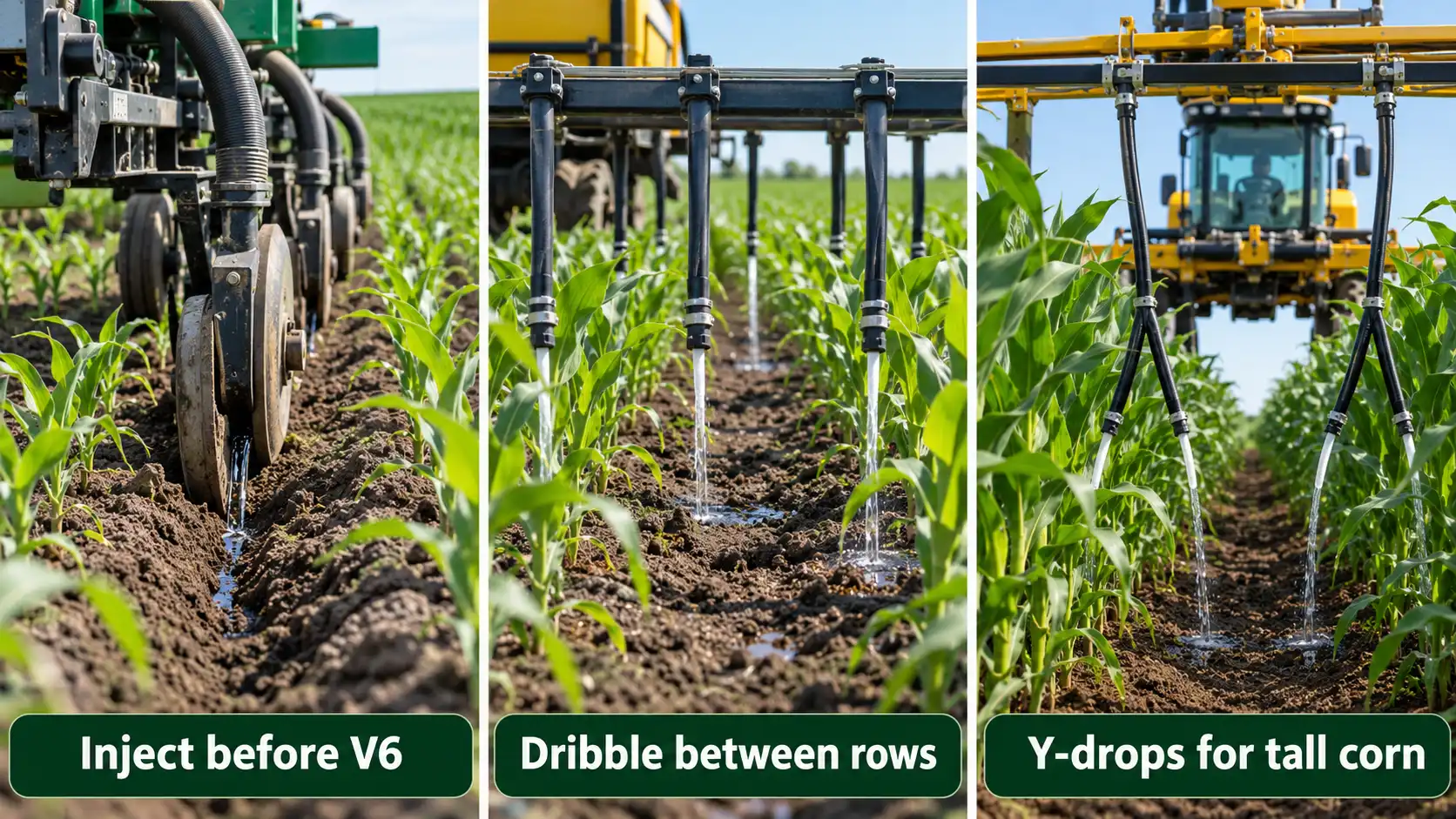
Anhydrous ammonia or injected UAN. Inject before V6, so plan injection for V4 to V5. Minnesota Extension warns that later injection causes excessive root damage. Placing N below the surface also prevents volatilization loss.
Dribbled UAN. Dribble UAN on the soil between rows instead of spraying it over the top. Keep in mind that UAN is half urea, so it can still volatilize. South-central Minnesota research found small yield gains from adding a urease inhibitor to dribbled UAN.
Broadcast urea. A spin fertilizer spreader is probably the fastest in-season option, per University of Minnesota Extension. Spread before a large whorl forms, because the whorl funnels granules, and never onto wet leaves. Then the urea needs a quarter inch of rain or irrigation within four days. A urease inhibitor stretches that to about 10 days.
Y-drops or drop tubes. For late or rescue passes, Iowa State University Extension recommends UAN through Y-drops or drop tubes. Both place N near the base of the plant. Iowa State advises against broadcast urea, ammonium nitrate, ammonium sulfate, or low-rate foliar sprays at that stage.
Is It Too Late to Sidedress Corn?
Not until about silking, but past V10 it becomes a rescue, not a plan. Iowa State University Extension says rescue N can still recover yield in N-short corn up to tasseling. Its effect drops sharply after R1 and fades fast after R2. Iowa State also notes that responses to rescue N vary.
Earlier still beats later. University of Minnesota Extension found in-season N after V10 never out-yielded earlier applications, and sometimes yielded less. In University of Tennessee Extension trials, waiting until V10 cost 7% in 2023. Waiting until V14 cost 15% in 2022 and 40% in 2023.
Signs Corn Needs Rescue N
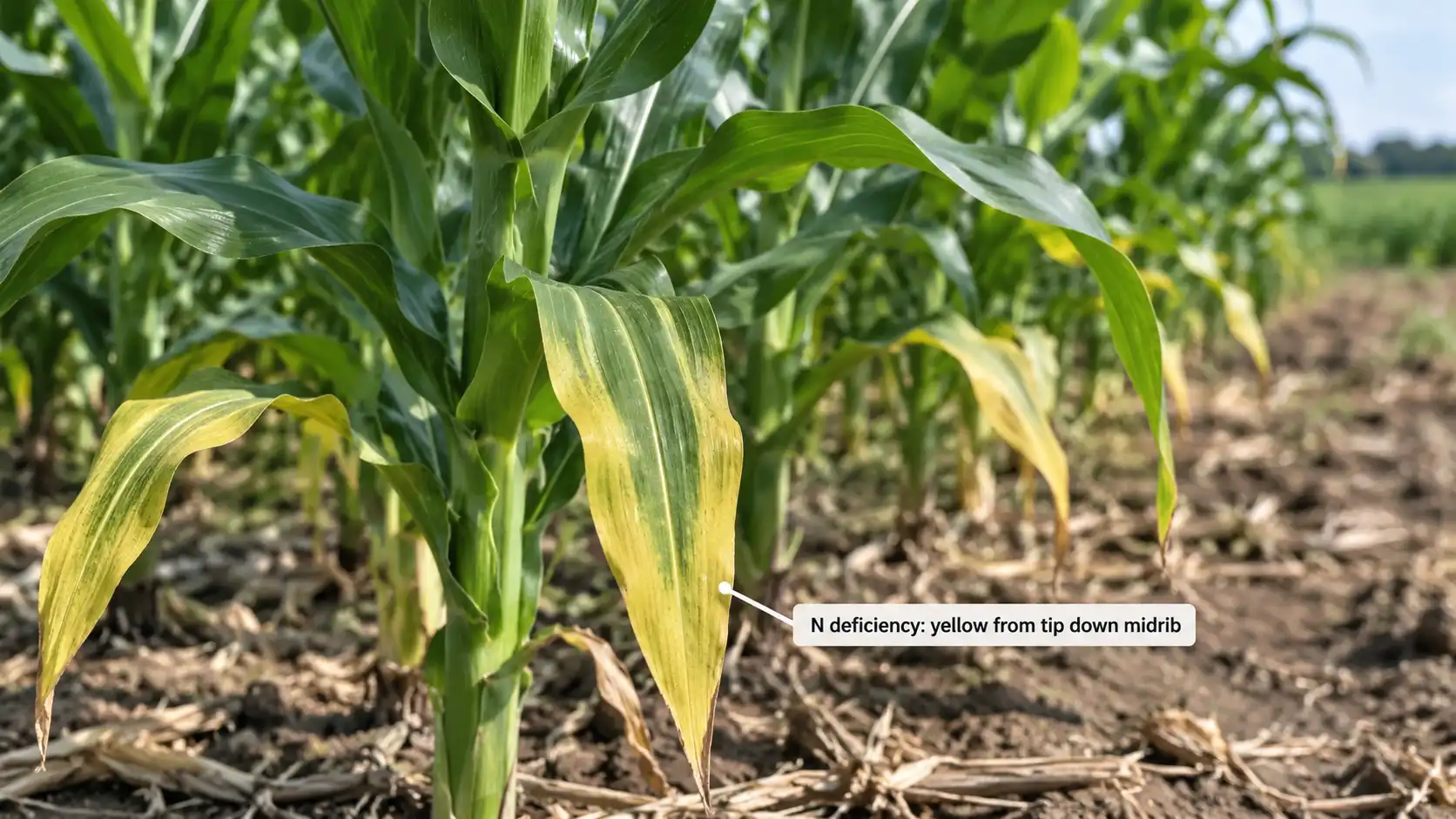
Look for pale green plants and firing of the lower leaves, the classic signs Iowa State lists. Penn State Extension describes the pattern as yellowing that starts at the leaf tip and runs down the midrib. Before you buy N, confirm the stand still has strong yield potential.
Rescue Rate and Method
Iowa State suggests 30 to 60 pounds of N per acre, applied as UAN through Y-drops or drop tubes. More than that is unlikely to pay this late, because the uptake window is closing. A small rain afterward helps the N reach roots. Dry soil, by contrast, limits uptake even in deficient corn.
FAQs about Sidedressing nitrogen on corn
Can you sidedress corn too early?
Yes, in practice, because early N waits weeks for the crop to use it. University of Tennessee Extension notes uptake stays limited before V8, leaving V2 applications exposed to rain losses.
Is the LSNT the same as the PSNT?
Mostly, since both measure nitrate in the top foot of soil around V5 to V6. The difference is calibration: Iowa State uses a 25 ppm cutoff, and Penn State’s 2024 formula starts from yield goal.
Does sidedressing always beat preplant nitrogen?
No, because the payoff depends on soil and weather. University of Minnesota research favors sidedressing on lighter soils and in wet years, but a split may not pay on finer soils.
How much nitrogen does corn take up per day at peak?
About 5 to 7 pounds per acre per day around tasseling, per Iowa State University Extension. Soil mineralization in a normal July supplies 1 to 2 pounds, leaving a daily gap of 3 to 6 pounds.
Should you sidedress right before a heavy rain?
A moderate rain helps by moving surface urea and UAN into the soil, per University of Minnesota Extension. A downpour on saturated ground is riskier, since Iowa State links excess moisture to leaching and denitrification.
Key Points for Your Field
Stage the field by leaf collars and test soil nitrate around V5 to V6. Then get planned N on between V4 and V8, injecting before V6 if you inject at all. Keep fertilizer off the leaves, and time surface urea ahead of rain. Past V10, N becomes a rescue tool: 30 to 60 pounds, and only where the crop shows deficiency. When state guidance differs, follow your own state’s calibration and confirm local rates with your county extension office.