How to Grow Corn: 50°F Soil, Four-Row Blocks, and Harvest Timing
Corn yields come down to a few timely decisions. Pick the right type, plant into warm soil, set rows in blocks, then feed and water by growth stage. Below, each step of how to grow corn comes with figures scaled from a field down to a raised bed.
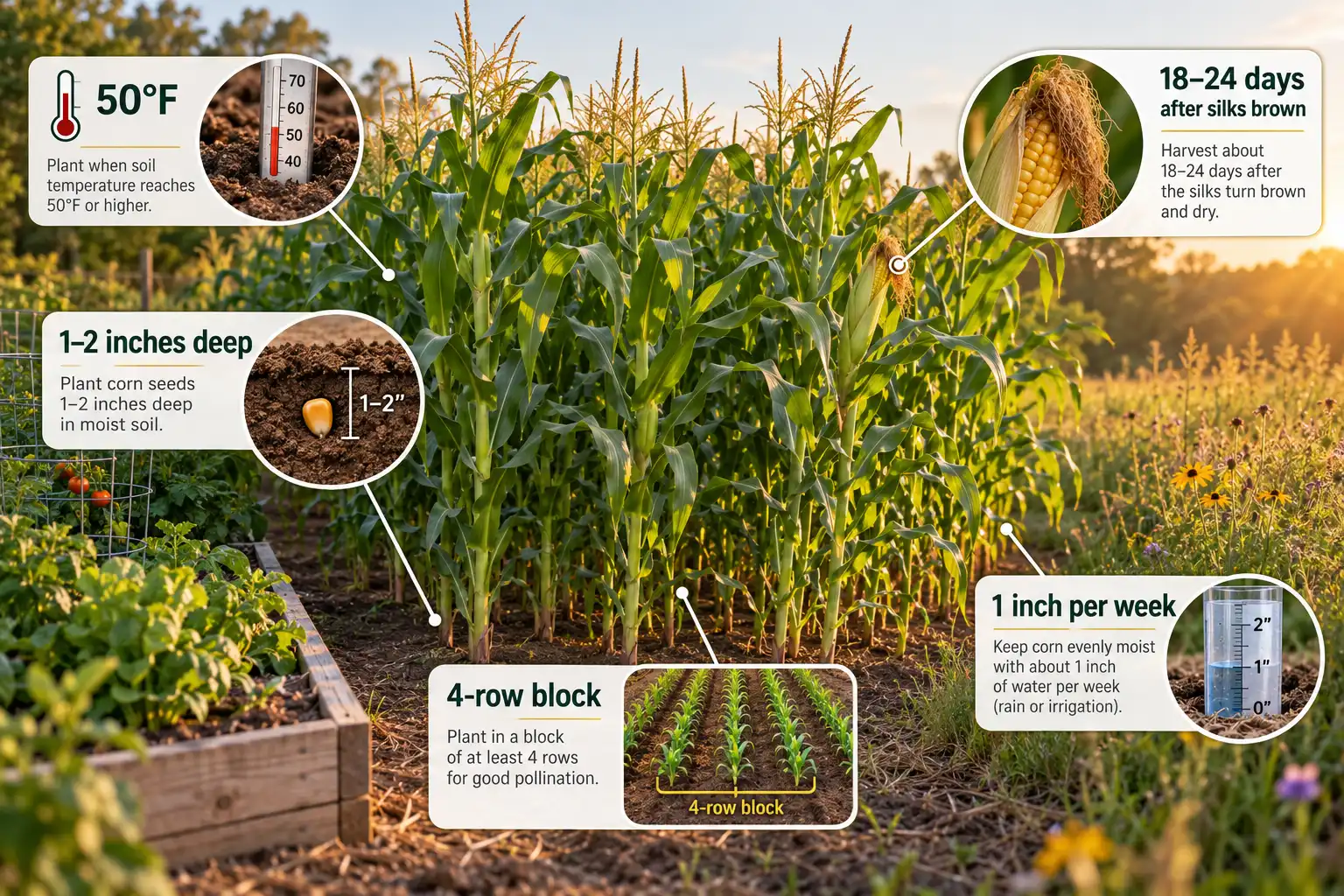
The first rule of how to grow corn is timing: plant once soil holds 50°F and rising (60°F for supersweet). Sow 1 to 2 inches deep in blocks of four or more rows, and water steadily through silking.
Which Type of Corn Should You Grow?
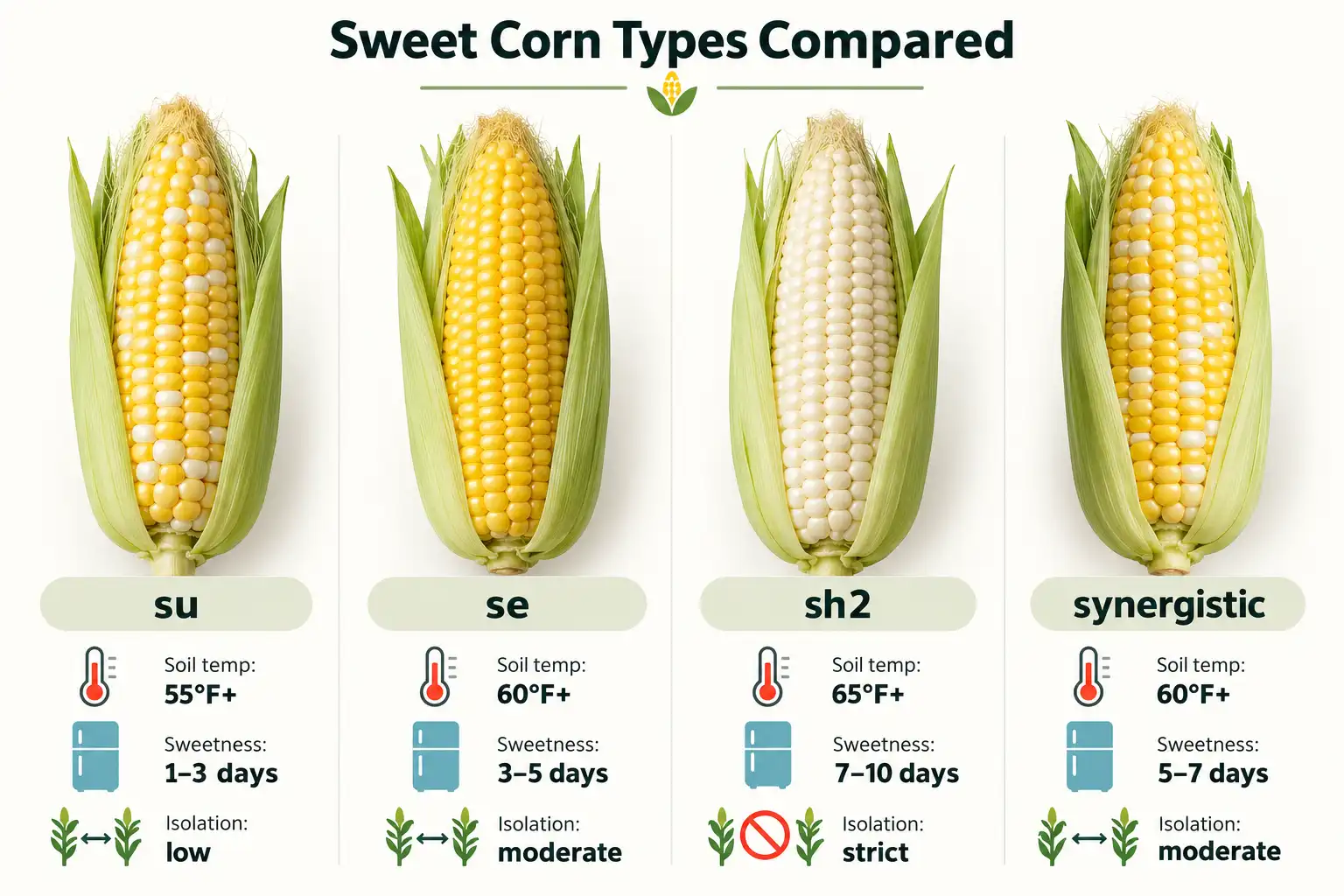
Grow sweet corn to eat fresh, and grow field corn or popcorn to harvest dry. For sweet corn, read the gene code on the seed packet. It sets sweetness, shelf life, and the soil temperature the seed needs.
| Packet code | Eating quality and storage | Soil temperature for good germination | Example varieties |
|---|---|---|---|
| Standard sugary (su) | Classic flavor; quality holds 1 to 2 days | 55 to 60°F | Silver Queen, Early Sunglow |
| Sugary enhanced (se) | Sweeter and more tender; keeps 1 to 2 days longer than su | 55 to 60°F | Bodacious, Incredible |
| Supersweet (sh2) | Crisp and very sweet; keeps up to a week refrigerated | 60°F or warmer | Northern Xtra Sweet, How Sweet It Is |
| Synergistic (sy) | Sweet, creamy, and tender; stores well | 55 to 60°F | Montauk |
The table follows Iowa State University Extension’s home garden guide. University of Minnesota Extension sets a higher bar for supersweets, though, listing 65°F as the minimum for most varieties. So if the packet says sh2, wait for the warmer reading. Augmented supersweets (shA) follow the same sh2 rules, per Iowa State.
When to Plant Corn
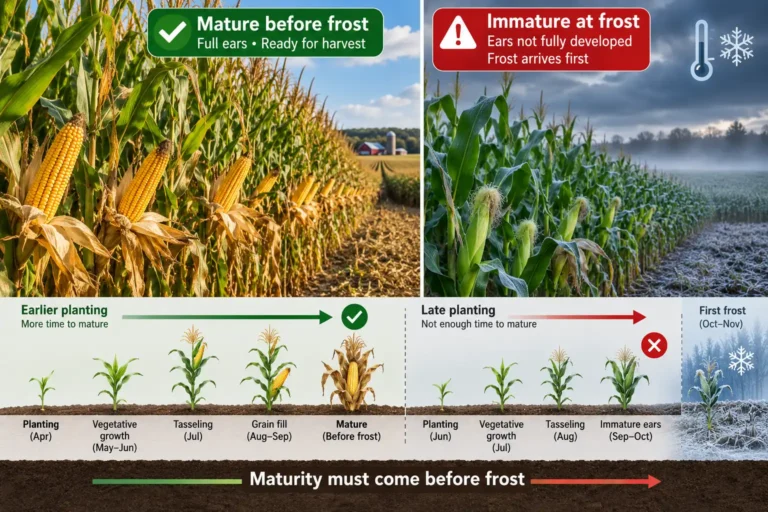
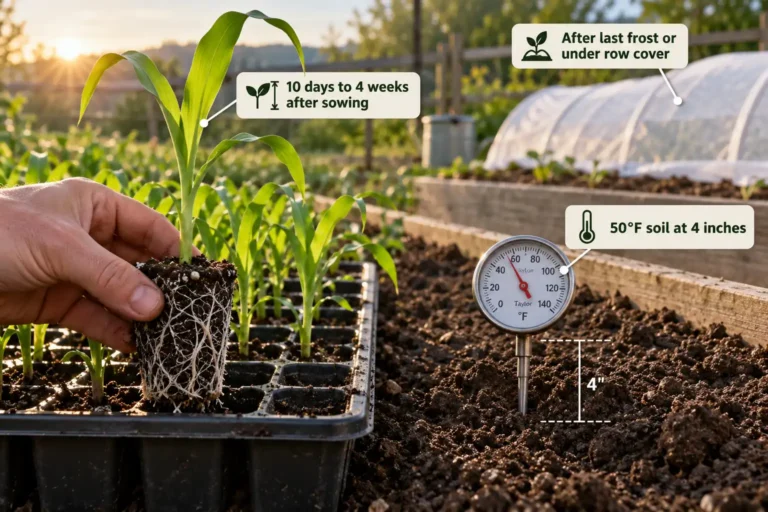
Plant corn once the soil reaches 50°F and the forecast keeps it warming, the trigger Iowa State University Extension uses. Below 50°F, seed soaks up water but starts no root or shoot growth, per Iowa State. That idle stretch gives insects and seed rot time to attack.
UGA Extension sets a higher bar in Georgia: at least 55°F at the 2-inch depth. Seed sprouts slowly at 55°F and promptly at 60°F, according to UGA. For sweet corn, use the type temperatures in the table above.
Frost risk is lower than it looks. The growing point stays underground until V5, per University of Minnesota Extension, or V6, per Iowa State. Until then, UGA says corn can usually take a hard frost without yield loss.
Corn Planting Dates by Region
Optimum windows open on March 1 on the Georgia Coastal Plain but not until late April in Minnesota. Each window comes from that state’s own trials, so use the row nearest your ground.
| Region | Optimum window | Note | Source |
|---|---|---|---|
| Georgia Coastal Plain | March 1 to April 28 | Plant once 2-inch soil holds 55°F | UGA Extension |
| Northwest Georgia (Limestone Valley) | April 1 to May 10 | Same 55°F soil rule | UGA Extension |
| Indiana | April 20 to May 10 | Shift a week earlier in the south, later in the north | Purdue Extension |
| Iowa | April 11 to May 18 | Yield potential falls fast after May 18 | Iowa State |
| Minnesota | Late April to early May | April 21 to May 6 came within 1% of top yield at Lamberton | University of Minnesota |
Missing the window costs yield gradually at first. Purdue Extension estimates yield potential drops about 0.3% a day after May 1, and 1% a day by late May.
Sweet corn follows the same soil logic. In central Iowa, Iowa State plants su types in late April, with se and synergistic types a week later. Supersweets wait until mid-May, and the last practical date for early varieties is July 1.
How to Prepare Soil for Corn
Prepare corn ground with a soil test, a pH in range, and plenty of organic matter. Give the crop full sun and fertile, well-drained soil, too. Iowa State targets pH 6.0 to 6.5 for sweet corn, while University of Minnesota Extension accepts 5.8 to 7.0.
Before you buy fertilizer, check the pH, phosphorus, and potassium lines on your soil test report. University of Minnesota Extension notes that many Minnesota soils already hold enough phosphorus. So it advises a low- or no-phosphorus product unless the test calls for more.
Organic matter helps as well. Work well-rotted manure or compost into the bed in spring or fall, as Minnesota Extension advises. Skip fresh manure, because it can carry harmful bacteria and add weed problems.
Corn Spacing and Seeding Rate
Space sweet corn 8 to 12 inches apart in rows 30 to 36 inches apart. Iowa State and University of Minnesota Extension both give that range. Field corn goes in much tighter. University of Minnesota Extension puts the most profitable final stand at 32,000 to 34,000 plants per acre. It recommends seeding 34,000 to 36,000 to cover losses. In Iowa State studies, 3 to 7 percent of seed failed to produce a plant.
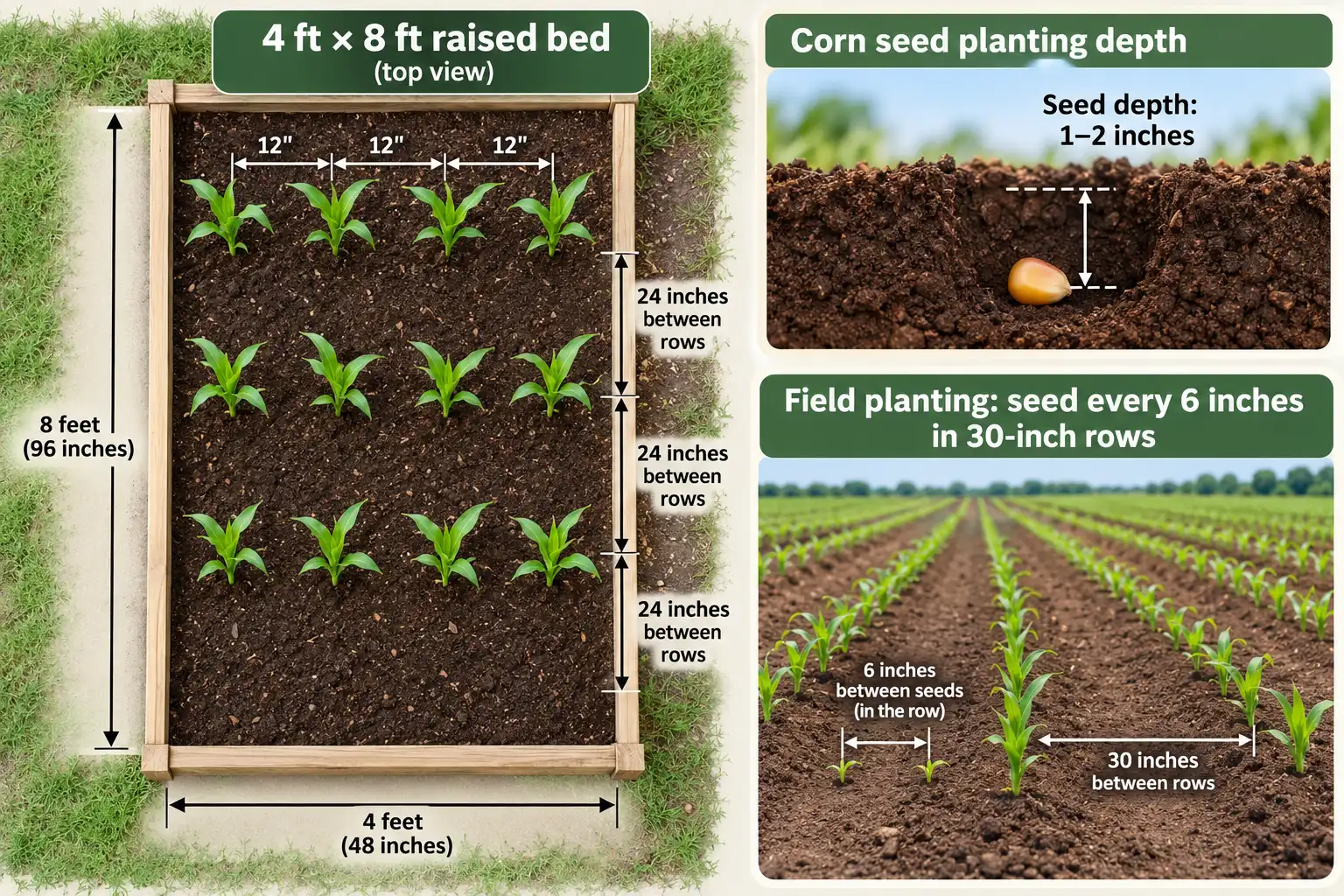
UGA Extension’s planter formula converts seeds per acre to seeds per row foot. Multiply by row width in feet, then divide by 43,560. At 35,000 seeds in 30-inch rows, that is 2 seeds per foot, or one every 6 inches.
Scale the Spacing to Your Bed or Field
Garden spacing works out to about 14,500 to 26,000 plants per acre, well below field stands.
| Area | Sweet corn, 8 to 12 inches apart | Field corn, 34,000 to 36,000 seeds per acre |
|---|---|---|
| 1 acre | 14,500 to 26,000 plants | 34,000 to 36,000 seeds |
| 100 feet of row | 100 to 150 plants | 195 to 207 seeds in 30-inch rows |
| 4 by 8 ft bed | 11 to 19 plants | 25 to 26 seeds |
In a 4 by 8 bed, run four short rows across the bed 24 inches apart. Set plants 12 inches apart in each row. That gives 16 plants at 2 square feet each, inside the sweet corn range, in a block four rows deep. Since Iowa State counts on one good ear per stalk, expect about 16 full ears plus smaller second ears.
How to Grow Corn From Seed: Planting Steps
- Check soil temperature at seed depth. Wait for the reading your corn type needs. Purdue Extension says corn needs 100 to 120 growing degree days to emerge. That can take as little as 4 days in warm soil or as long as four weeks in cold soil.
- Set the depth by soil and type. Iowa State’s standard field depth is 1.5 to 2 inches. One of its field specialists targets 2, since shallow seed causes more season-long problems. For sweet corn, Iowa State suggests 1 inch in heavy soil and up to 2 inches in sandy soil.
- Go shallow with supersweet seed. University of Minnesota Extension says to plant sh2 kernels no deeper than 3/4 to 1 inch. They absorb up to twice as much water, so keep the seedbed moist until shoots appear.
- Keep depth and spacing even. University of Minnesota research found a plant one leaf stage behind its neighbors yielded 20 percent less. Two stages behind cost 51 percent.
- Plant blocks, not single rows. Set at least four rows side by side so wind carries pollen onto the silks.
- Cover the seedbed if birds raid it. Minnesota Extension suggests a floating row cover until plants emerge, because crows and other birds dig up seed.
- Stagger plantings for a longer harvest. Iowa State suggests early, midseason, and late varieties, or the same variety every two weeks.
Why Corn Needs Block Planting for Pollination
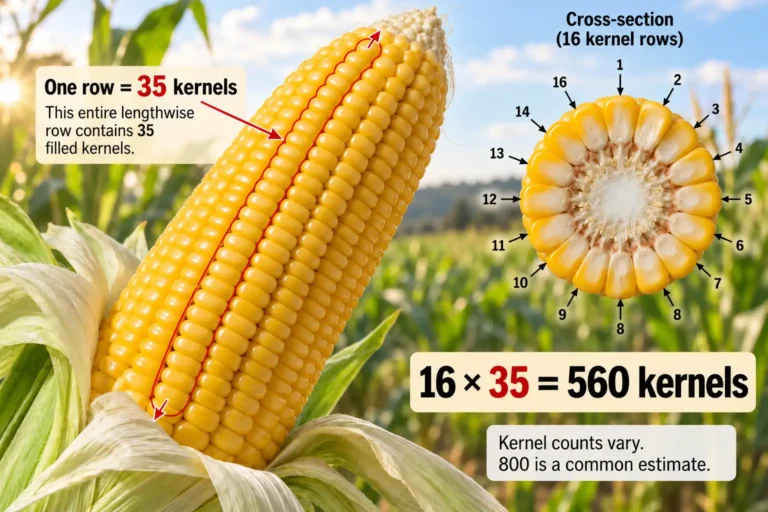
Corn needs blocks because wind carries its pollen from the tassel to the silks. Every potential kernel grows its own silk, according to Purdue Extension. Each silk must catch pollen for that kernel to form. A single long row loses much of its pollen downwind. University of Minnesota Extension says that leaves ears with blank patches.
Timing matters as much as layout. Silks stay receptive for up to 10 days but decline quickly after about 5, per Purdue. Severe drought also delays silk emergence, which can leave silks out of step with pollen shed. Iowa State adds that hot, dry winds and dry soil hurt pollination. So water during silking if the soil is dry.
Keep Sweet Corn Types Apart
Keep sweet corn away from other corn, because cross-pollination lowers quality. Iowa State warns that sweet corn pollinated by popcorn turns tough and starchy. Both services isolate supersweets from every other type. Iowa State also keeps sugary enhanced away from standard and synergistic types, while Minnesota Extension isolates se only from supersweets.
For distance, Iowa State suggests at least 250 feet between sweet corn types and 300 feet from popcorn. University of Minnesota Extension also asks for 300 feet from a large cornfield. Short on room? Separate tasseling times by at least 14 days, per Iowa State. Color crosses, too: white varieties grow yellow kernels from yellow or bicolor pollen, Iowa State notes.
How Much Nitrogen Corn Needs
Field corn in most of Iowa needs about 137 pounds of nitrogen per acre after soybeans and 180 after corn. Those figures come from Iowa State’s Corn Nitrogen Rate Calculator at 2022 prices. Because the calculator weighs grain and fertilizer prices, rerun it each spring. On fields, much of that N can wait for a sidedress near V6 instead of going on all at planting.
Sweet corn needs high nitrogen but only moderate phosphorus and potassium, per Iowa State. Its garden program has two steps. Before planting, work 2 to 3 pounds of 10-10-10 per 100 square feet into the top 3 to 4 inches. Then band 1 to 2 pounds of balanced fertilizer per 100 feet of row at 5 to 10 inches tall. On sandy soil, Iowa State splits that band between those two heights. University of Minnesota Extension sidedresses later, once plants stand a foot tall.
| Area | 10-10-10 before planting | Balanced fertilizer at sidedress |
|---|---|---|
| 1,000 sq ft in 30-inch rows | 20 to 30 lb | 4 to 8 lb |
| 100 feet of row, 30-inch spacing | 5 to 7.5 lb | 1 to 2 lb |
| 4 by 8 ft bed, 16 feet of row | 10 to 15 oz | 2.5 to 5 oz |
With a 10-10-10 product, that garden program adds up to roughly 100 to 165 pounds of N per acre. That lands close to Iowa State’s field rate after soybeans.
How Much Water Corn Needs
Corn needs about 1 inch of water a week from rain or irrigation. That is the garden baseline from both Iowa State and University of Minnesota Extension. Demand climbs before tassels appear, though. Iowa State modeling for central Iowa put average peak use near 0.2 inch a day around V18. Extreme days reached 0.4 inch. So a 1-inch week covers early growth but runs short at peak. Over a season, a 200-bushel crop uses about 20 inches, per the same Iowa State analysis.
| Area | 1 inch a week | Peak use at 0.2 inch a day |
|---|---|---|
| 1 acre | 27,154 gallons | about 5,430 gallons a day |
| 100 feet of 30-inch row | about 156 gallons | about 31 gallons a day |
| 4 by 8 ft bed | about 20 gallons | about 4 gallons a day |
Soil type changes the schedule. An inch of water wets sandy soil about 10 inches deep but heavy clay only about 6, per Minnesota Extension. So water sandy beds more often. To check, dig with a trowel; if only the top inch or two is wet, keep watering.
Weed Control and In-Season Care
Keep corn weed-free while it is small, then let the canopy take over. University of Minnesota Extension recommends frequent, shallow hoeing that cuts weeds just below the surface. Sweet corn roots shallowly, so work gently near the row. Once plants form a full canopy, their shade discourages new weeds.
Check product labels before you treat a mixed garden. Minnesota Extension warns against using trifluralin, a garden herbicide sold under several trade names, near sweet corn.
Leave the suckers alone. These side shoots, called tillers, are a normal part of corn growth, per Purdue Extension. Purdue also reports that removing them has little if any effect on yield.
Roots that form above the soil at the base of the stalk are normal, too. Minnesota Extension says these brace roots steady the plant but take up little water or nutrients.
Corn Growth Stages and Timing
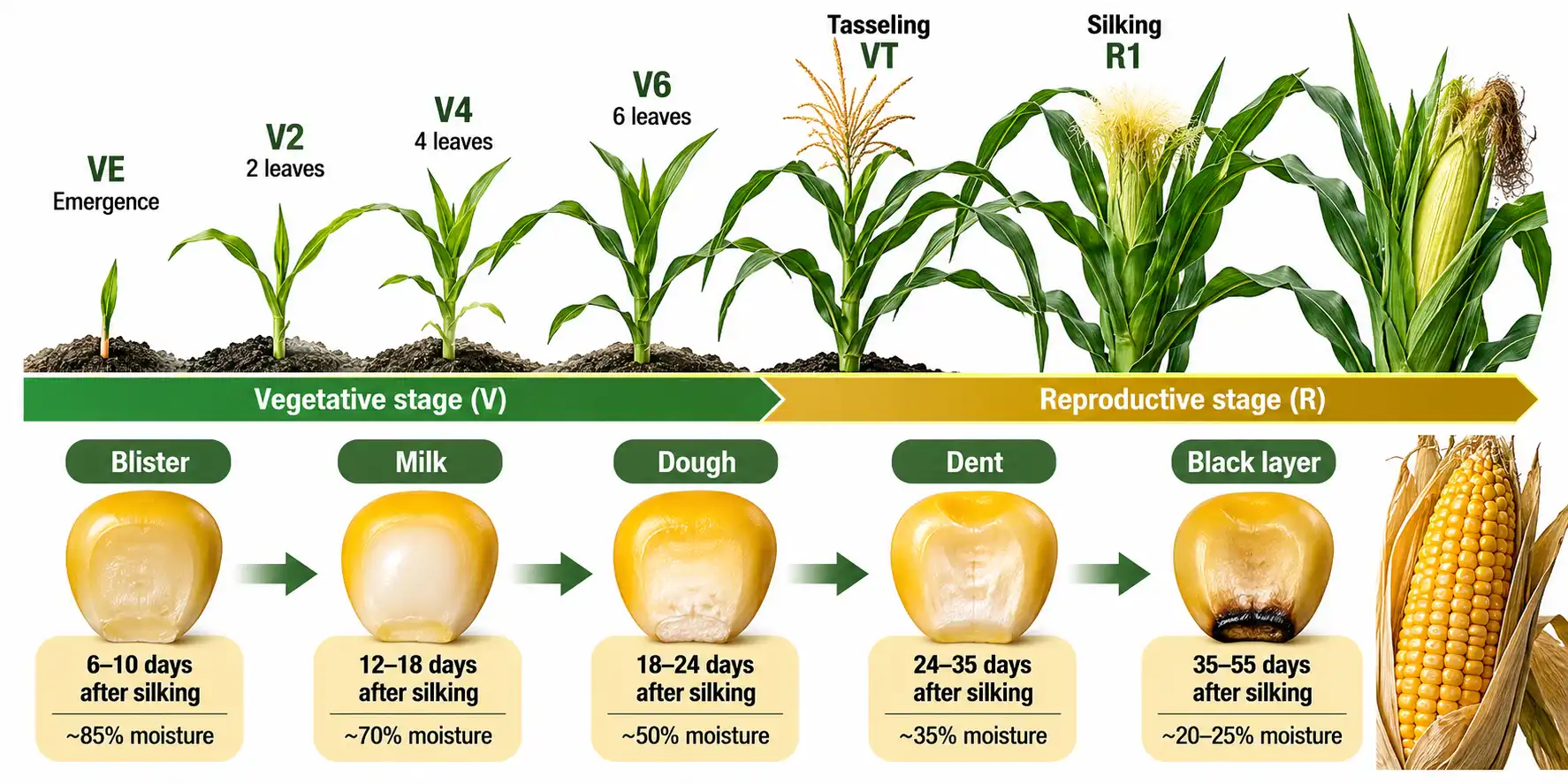
Corn moves through leaf stages, counted by visible leaf collars, then reproductive stages from silking (R1) to black layer (R6). The kernel timeline below follows Purdue Extension’s grain fill guide.
| Stage | What you see | Timing | Why it matters |
|---|---|---|---|
| VE | Shoot breaks the soil | 100 to 120 GDD after planting | Late emergers fall behind for the season |
| V5 to V6 | Five to six leaf collars | Roughly knee high at V6 | Growing point leaves the soil; field sidedress window |
| R1 (silking) | Silks out of the husk | Silks receptive up to 10 days | Pollination; water if soil is dry |
| R2 (blister) | White kernels, clear fluid | 10 to 12 days after silking | Severe stress can abort kernels |
| R3 (milk) | Yellow kernels, milky fluid | 18 to 20 days after silking | Sweet corn picking stage |
| R4 (dough) | Doughy kernel fluid | 24 to 26 days after silking | Kernel abortion becomes much less likely |
| R5 (dent) | Kernels dented at the crown | 31 to 33 days after silking | Kernels hold only about 45% of final dry weight |
| R6 (black layer) | Black layer at the kernel tip | 55 to 65 days after silking | Maximum dry weight, about 30% moisture |
Purdue’s milk stage timing lines up with the sweet corn harvest window in the harvest section below. Dent is not the finish line, either. About 30 days of grain fill remain after R5 begins, per Purdue.
Common Corn Growing Problems
Most corn problems show up on the ear. Match what you see to the likely cause before you treat anything.
| What you see | Likely cause | What to do |
|---|---|---|
| Blank patches or missing kernels | Single-row planting, dry soil, or hot wind at pollination | Plant blocks of four or more rows; Iowa State advises watering during pollination if soil is dry |
| Missing kernels near the tip, chewed silks | Japanese beetles feeding on green silks | Iowa State suggests handpicking or an insecticide |
| A caterpillar and chewed kernels at the ear tip | Corn earworm or European corn borer | Minnesota Extension says cut off the damaged tip and cook the rest |
| Ears stripped overnight | Raccoons | Iowa State suggests a two-wire electric fence at 4 to 6 and 12 inches, up 2 weeks before milk stage |
| Gray-white swollen galls | Common smut | Minnesota Extension says cut galls out before they release spores, then bury them |
| Orange powdery streaks on leaves | Common rust | Minnesota Extension calls resistant varieties the best control |
| Patchy, uneven stand | Cold soil or uneven planting depth | Iowa State ties both to uneven stands; wait for warm soil and keep depth uniform |
| Tough, starchy sweet corn | Cross-pollination or late picking | Isolate types and pick at milk stage, per Iowa State |
Minnesota Extension adds that planting around early May, with varieties under 80 days, helps sweet corn dodge both ear pests.
When and How to Harvest Corn
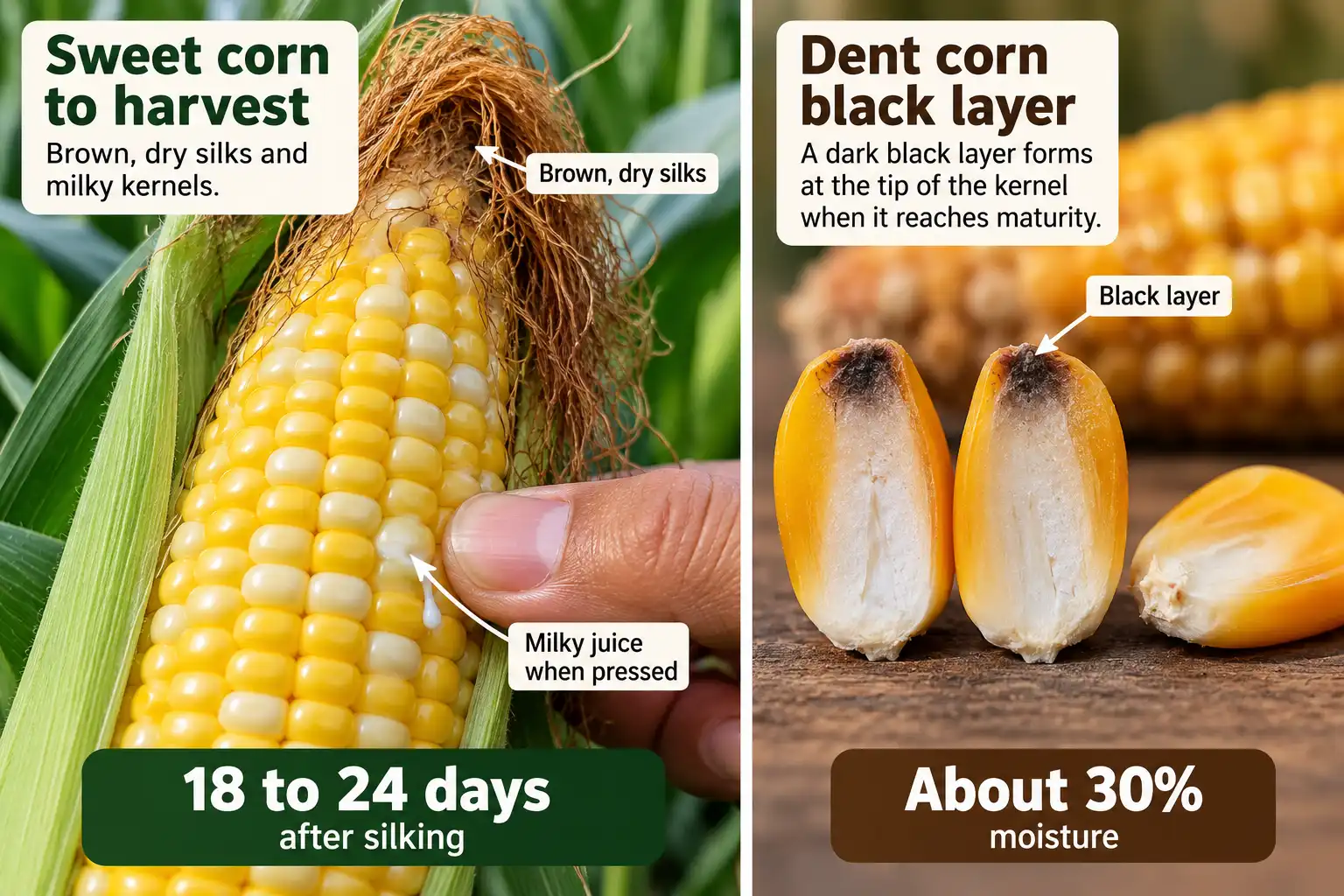
Harvest sweet corn at the milk stage, about 18 to 24 days after silking. Let field corn reach black layer and dry down first.
Sweet Corn
Pick when silks are brown and dry at the tip and a punctured kernel releases milky juice. Iowa State puts that point 18 to 23 days after silks appear. University of Minnesota Extension says 18 to 24.
Clear, watery juice means the ear needs more time. Tough, doughy kernels mean it went too far. Above 85°F, Iowa State says ears stay prime for only 1 or 2 days, so check often. To pick, grasp the ear at its base and twist downward.
Chill the harvest right away. Iowa State notes standard su types can lose half their sugar within 12 hours without refrigeration. It recommends storing ears at 32°F and 95 percent relative humidity.
Field Corn and Popcorn
Field corn reaches physiological maturity at black layer, when kernels average about 30 percent moisture, per Purdue Extension. Purdue puts harvest maturity near 25 percent. Field drydown runs 0.5 to 1 point a day in mid to late September in Indiana, then slows in October.
Iowa State says to dry corn to 15 percent moisture for winter storage. For storage into summer, dry it to 13 percent. Popcorn stays on the stalk until kernels are hard and husks are completely dry, per Iowa State. Then cure the ears in mesh bags until test kernels pop well, at the ideal 13 to 14 percent moisture.
FAQs about Growing Corn
How long does corn take to grow?
Sweet corn takes about 63 to 92 days, depending on the variety, per University of Minnesota Extension’s variety list. UGA Extension lists 95 to 130 days to maturity for field corn, before it dries down for harvest.
Can you grow corn in a raised bed?
Yes, as long as you plant a block instead of a single row, since corn relies on wind pollination. A 4 by 8 bed fits four short rows of four plants, spaced 24 by 12 inches.
Should you remove suckers from corn?
No, leave them in place, because they rarely hurt the main stalk. Purdue Extension reports that pulling tillers has little if any effect on yield, and the main stalk usually outcompetes them.
How many ears does a corn plant produce?
Most sweet corn plants make one good ear and at least one smaller ear, according to Iowa State University Extension. The upper ear usually ripens a day or two before the lower one, so pick in two passes.
Can sweet corn cross with field corn or popcorn?
Yes, and the cross shows up in this year’s ears as tough, starchy kernels, per Iowa State. University of Minnesota Extension advises planting sweet corn 300 feet from the nearest cornfield.
Why did my corn come up unevenly?
Two common causes are cold soil and uneven planting depth, both flagged by Iowa State. University of Minnesota research found a plant one leaf stage behind its neighbors lost 20 percent of its yield.
Key Points for Your Field
Plant once soil holds 50°F and rising, or the warmer reading your sweet corn type needs. Set rows in blocks of four or more, keep depth even, and split nitrogen with a sidedress on larger plantings. Keep water steady through tasseling and silking. Then pick sweet corn at the milk stage, and let field corn reach black layer before it dries down. For rates and dates that fit your county, check with your local extension office.