How Long Does Corn Seed Last? Shelf Life, Storage, and Testing
Leftover seed from last spring can plant a full stand, or it can cost you one. How long corn seed lasts depends on the seed type, the storage temperature, and the moisture in the kernel. Here is what each one does to germination, and how to test old seed.
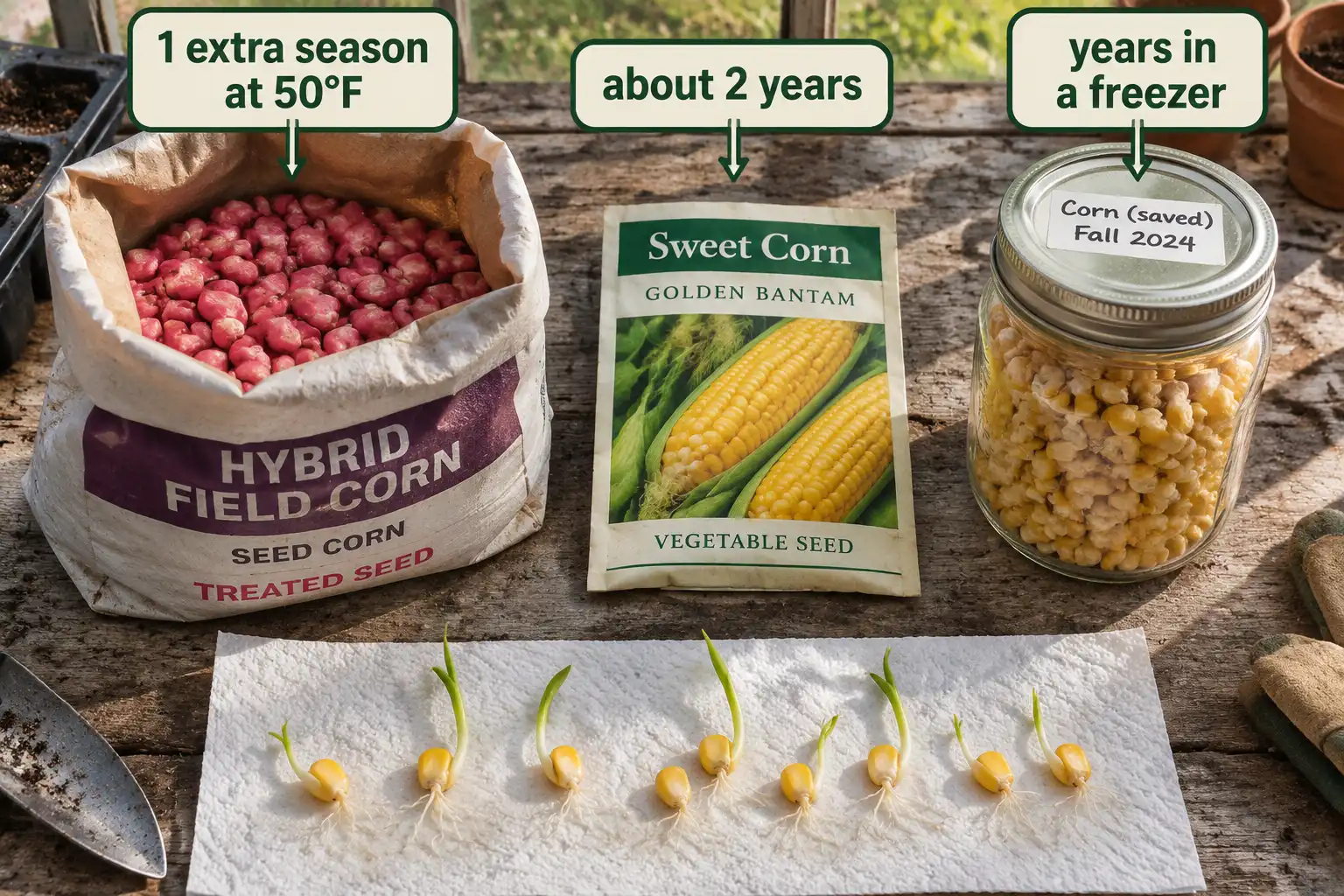
Sweet corn seed lasts about two years in cool, dry storage, per UNL Extension. Hybrid field corn has no fixed shelf life. Bags held near 50°F and 12.5% moisture usually carry over one season, but test every carryover lot.
How Long Does Corn Seed Last by Seed Type?
Corn seed lasts anywhere from one season to several years. The type of seed sets the starting point, and storage decides how much of it you keep.
| Seed type | Typical life, cool and dry | What shortens it | Your next step |
|---|---|---|---|
| Hybrid field corn, carryover bags | One extra season in climate-controlled storage | Hot sheds, damp floors, insects | Retest every lot each year |
| Sweet corn, su and se types | About 2 years | Warm drawers, humid basements | Test before year 2 planting |
| Supersweet sweet corn, sh2 | About 2 years at best; few trials | Same, plus weak starts in cool soil | Test every lot |
| Saved open-pollinated corn, sealed jar | Up to 5 years cold; longer frozen | Sealing seed before it is dry | Dry first, then seal |
For sweet corn, the UNL Extension seed storage guide lists a relative longevity of 2 years under cool, dry conditions. It also lists 75% as the federal minimum germination for sweet corn seed.
Field corn is different. No extension service publishes a fixed shelf life for hybrid seed corn in years. Instead, the industry retests. The Iowa State University Seed Lab reports that carryover corn kept cool and dry generally holds its viability and vigor well. Low-vigor lots or poorly stored seed, though, can slip month to month.
Published data comparing storage life across su, se, and sh2 seed is limited, and the few small studies do not agree. So treat 2 years as a ceiling for supersweets, not a promise.
Why Corn Seed Loses Germination in Storage
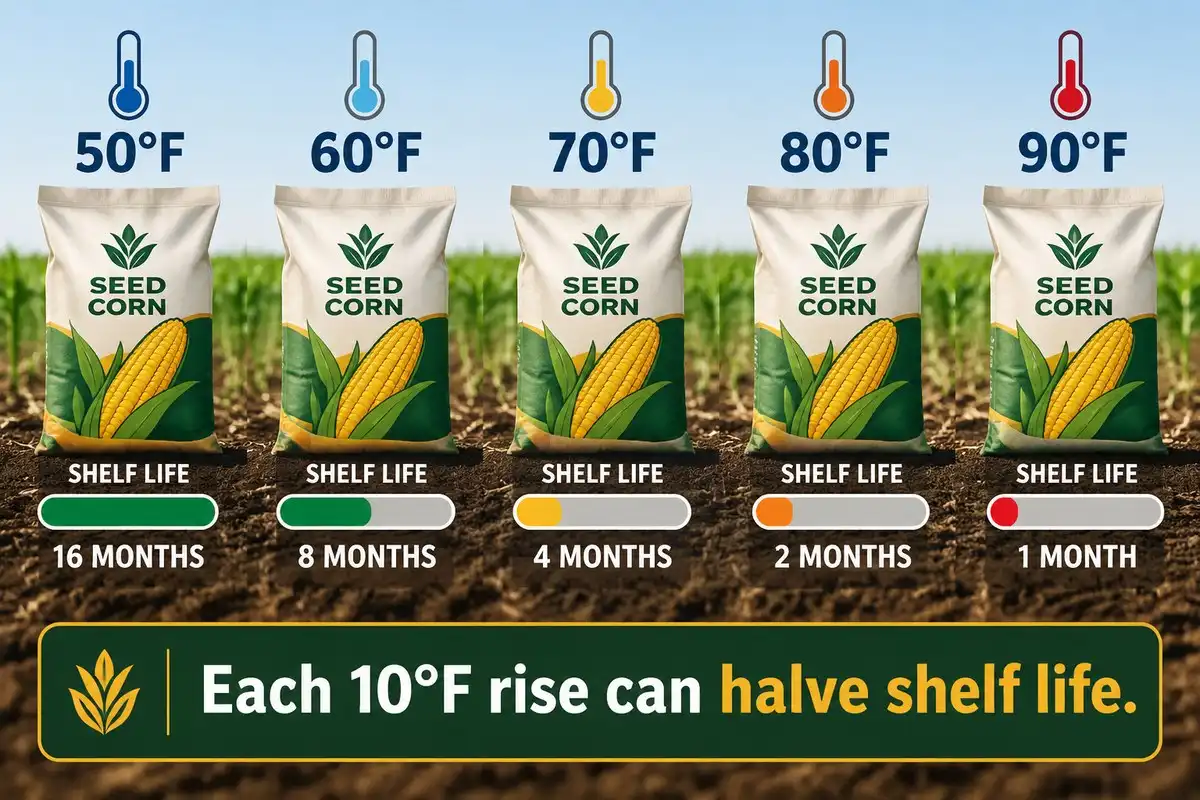
Heat and moisture age seed, and they work together. Pioneer’s carryover guidance sets the target at 12.5% seed moisture and 50°F. Above that, each 10°F rise can cut shelf life by up to half. Each point of moisture above 12.5% can do the same.
Here is that worst case worked out for a bag held at different temperatures.
| Average storage temperature | Shelf life left, worst case (vs. 50°F) |
|---|---|
| 50°F | 100% |
| 60°F | 50% |
| 70°F | 25% |
| 80°F | 12.5% |
| 90°F | About 6% |
So a bag in a 90°F shed all summer can age many times faster than one in a cool room. Pioneer also notes that seed stored above 50°F draws more insect damage, because insects are more active in the heat.
Vigor Fades Before Germination Does
Old seed often still sprouts. It just sprouts weakly. Pioneer explains that seed kept out of cold storage has more DNA damage to repair once it takes up water. That repair work costs vigor.
That is why a warm germination test can look fine while the field stand does not. The weak kernels emerge late, or rot in cold, wet soil before they emerge at all.
How to Store Leftover Seed Corn Bags Until Spring
Keep bags where the temperature in °F plus the relative humidity stays at or below 100. USDA ARS seed storage guidance calls this the “100s rule.” It gives adequate life for commercial seed held under 5 years.
The rule makes any room easy to score. A cool room at 50°F and 45% humidity totals 95, so it passes. A summer machine shed at 85°F and 60% humidity totals 145, so it fails badly. An inexpensive temperature and humidity meter tells you which one you have.
Once you know the room, follow these steps:
- Ask about returns first. Many seed companies take back unopened bags. Pioneer, for one, moves returned seed straight into climate-controlled storage, which beats almost any farm building.
- Pick the coolest dry room you have. A basement or insulated storeroom works. A heated shop or a grain bin does not.
- Set bags on pallets. Concrete floors hold moisture, and torn bags let it in.
- Control rodents and insects. Bait stations and sealed doors protect bags through winter.
- Record the tag. Write down each lot number, germination percent, and test date.
- Retest in late winter. Do it before you book a planting date.
Keeping seed yourself also shifts the risk to you. Pioneer states that it cannot warrant carryover seed, and that carryover is not eligible for its replant protection. If a stand fails, the replant seed comes out of your pocket.
How to Store Sweet Corn Seed and Saved Seed at Home
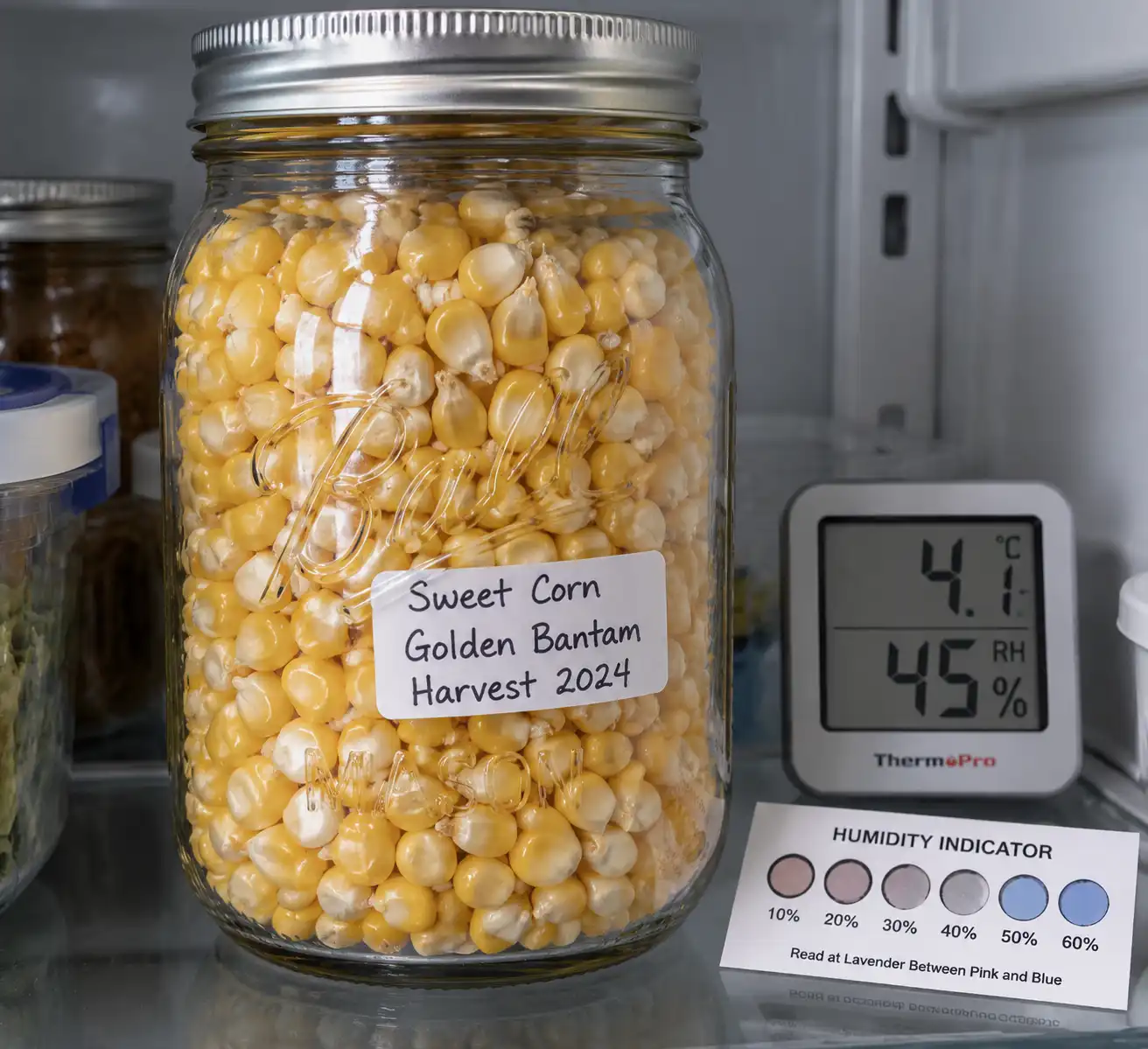
Seal dry seed in an airtight jar, then keep it in the refrigerator or freezer. USDA ARS seed storage guidance puts the gain plainly. Seed held at 0°F keeps four to five times longer than seed held at 41°F.
Paper packets are not moisture-proof. So drop opened packets into a glass jar with a tight lid. USDA ARS lists glass, foil laminate, and metal cans as moisture-proof options.
For open-pollinated corn you saved yourself, dryness comes first. USDA ARS recommends drying seed above 18% moisture down to about 12% quickly, before it goes into a sealed container. Seed sealed wet keeps aging, and freezing wet kernels can injure them.
Then follow this order:
- Shell fully dry ears and discard cracked, moldy, or insect-damaged kernels.
- Confirm moisture near 12% with a grain moisture tester, if you have one.
- Seal kernels in a labeled jar with the variety and harvest year.
- Store the jar in the refrigerator, or in the freezer for long holds.
- Let a cold jar reach room temperature before opening it. Cold glass pulls condensation from room air.
Supersweet Seed Needs Warmer Soil
Aged supersweet seed has a second hurdle. Iowa State University Extension says sh2 and augmented supersweet types need soil at least 60°F for good germination. Standard su and se types do well at 55 to 60°F. So hold off planting corn from older sh2 seed until soil reaches that mark.
How to Test Old Corn Seed Before Planting
A home germination test tells you in about a week whether old seed is worth planting. Run it a few weeks ahead, so you still have time to buy seed if it fails.
Check the Tag Date First
The tag shows when the seed was tested, not when it expires. Under Federal Seed Act rules, which USDA AMS enforces, the label must show the month and year of the germination test. For interstate shipment, that test can be no more than 5 calendar months old.
So the germination figure on last year’s tag describes seed that is now well over a year past testing. Treat it as a starting point, not a current reading.
Run a Rag Doll Test at Home
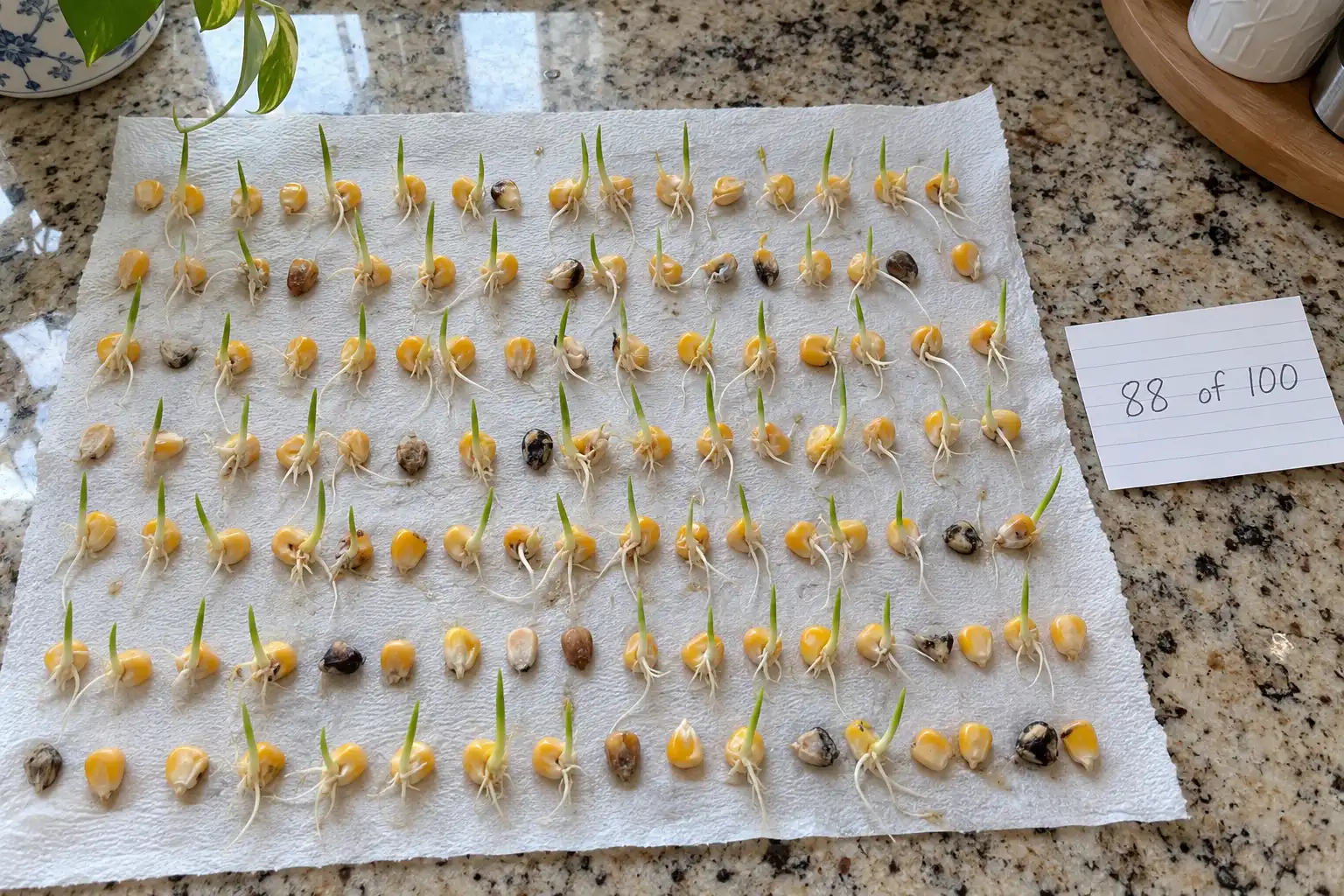
UNL Extension’s home method uses moist towels kept at 70 to 75°F. Follow these steps:
- Count out 100 kernels taken from several spots in the bag. Smaller lots can use 25 or 50.
- Lay them on two moist paper towels, roll loosely, and seal the roll in a plastic bag.
- Keep the bag at 70 to 75°F and check that the towels stay damp.
- Unroll and count after 7 days, the usual length of the Iowa State Seed Lab’s corn germination test.
- Count only kernels with a healthy root and shoot. Rotted, stubby, or twisted sprouts count as failures.
Your germination percent is healthy seedlings divided by kernels tested, times 100. For a garden packet, test 10 seeds. Then each sprout counts for 10%.
When a Lab Cold Test Is Worth It
A warm towel test shows the best case. Cold, wet soil is harder, and weak seed fails there first. The Iowa State Seed Lab notes that cold tests correlate well with field emergence for most lots. It also treats an 82% tray cold test as the usual minimum for marketing a corn seed lot.
For carryover bags headed to many acres, a lab cold test is cheap insurance. Refuge-in-bag seed adds a wrinkle. For carryover RIB corn, the lab asks for 5 to 8 pounds of seed and runs a separate test on the refuge kernels.
How to Adjust Your Seeding Rate for Older Seed
Divide your target stand by the germination rate. The result is how many kernels to drop per acre.
Seeds per acre = target plants per acre ÷ (germination % ÷ 100)
Say your target plant population is 34,000. New seed testing 95% needs 35,800 seeds per acre. Carryover testing 85% needs 40,000. That gap also changes how many acres a bag covers.
| Germination | Seeds per acre for 34,000 plants | Acres per 80,000-kernel bag |
|---|---|---|
| 95% | 35,800 | 2.24 |
| 90% | 37,800 | 2.12 |
| 85% | 40,000 | 2.00 |
| 80% | 42,500 | 1.88 |
On 100 acres, dropping from 95% to 85% seed takes about 421,000 extra kernels. That is roughly five more bags.
The same math works in a garden. If you want 30 sweet corn plants and your test shows 60%, sow 50 seeds. Or sow two seeds per spot and thin to the stronger one.
When to Buy New Seed Instead
More seed replaces dead kernels. It does not fix weak ones. Weak seed emerges late and unevenly, and a heavier rate only plants more of it.
So replace field corn that falls below 82% on a lab cold test, the same bar the seed trade uses to market a lot. For sweet corn, a result under 75% sits below the federal minimum for sale, per UNL Extension. That also makes a sensible cutoff for a home packet.
Can You Carry Over Treated Seed Corn?
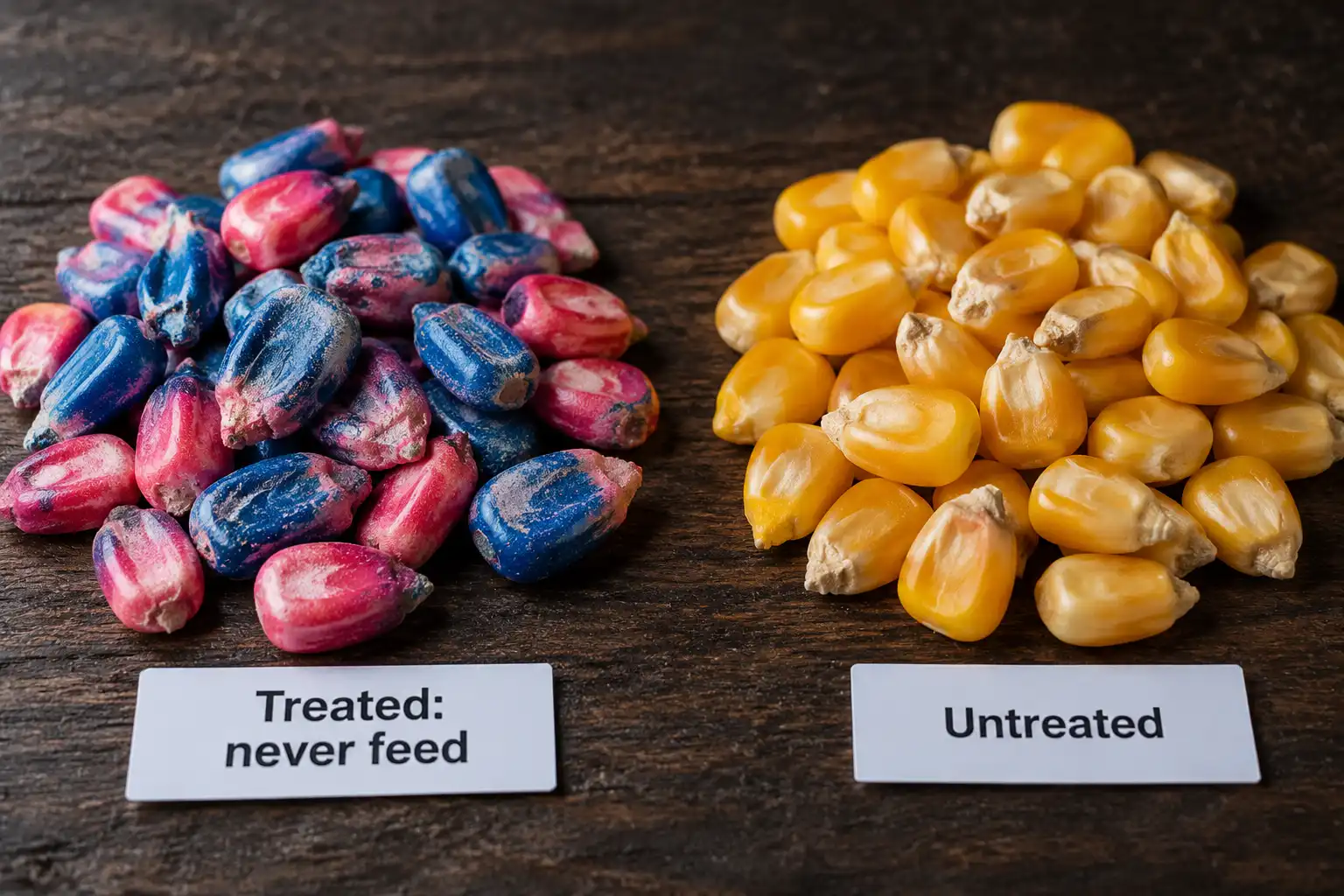
Yes, but expect a lower cold test, and never let it reach feed or grain. The colored coating on treated seed corn is a fungicide, an insecticide, or both.
Iowa State University seed scientists tested carryover lots in a 2009 study. Lots treated with fungicide plus a seed-applied insecticide scored lower on the cold test than fungicide-only lots. Once the treatments were washed off, that gap disappeared. So tell the lab which treatment your seed carries before it runs a cold test.
If you will not plant it, the University of Minnesota Extension lists these routes:
- Return unopened lots, if your supplier accepts them
- Plant it, following the seed tag and label limits
- Take it to an approved landfill or waste-to-energy facility after calling ahead
- Bury it on your own land, 200 feet from private wells and tile inlets and 1,000 feet from public wells
UMN Extension also warns that treated seed must stay out of the food and feed chain.
Troubleshooting Old Seed Corn
Most seed problems show up either in the bag or in the stand. This table matches each sign to its likely cause.
| What you see | Likely cause | What to do |
|---|---|---|
| Musty smell or mold on kernels | Seed took on moisture | Discard it |
| Small holes, dust, or webbing | Storage insects, worse above 50°F | Test; discard heavy damage |
| Good towel test, poor stand | Low vigor meeting cold, wet soil | Cold test next time; plant into warmer soil |
| Emergence spread over a week or more | Mixed vigor within the lot | Replace the lot |
| Low cold test on insecticide-treated seed | Treatment lowering the reading | Tell the lab the treatment |
If a thin stand shows up anyway, check your date against corn replant timing before you decide to plant again.
FAQs About Carryover Seed Corn
Can you plant 3-year-old seed corn?
Often yes, if it stayed cool and dry, but test it first. Run a 100-kernel rag doll test, then raise your seeding rate or replace the seed if germination falls well below the tag.
Does freezing seed corn kill it?
Not if the kernels are dry. USDA ARS guidance shows seed at 0°F keeps four to five times longer than at 41°F, but dry it near 12% moisture before you seal and freeze it.
Is last year’s sweet corn seed still good?
Usually, yes. UNL Extension gives sweet corn seed about two years of life in cool, dry storage, so a packet kept in a sealed jar should still sprout well in its second spring.
Does seed corn have an expiration date?
No. The tag shows the month and year of the last germination test, and federal rules cap that test at 5 months old for interstate shipment, so an old tag needs a fresh test.
Can you feed leftover seed corn to livestock?
Not if it is treated. UMN Extension warns that pesticide-treated seed must stay out of the food and feed chain, so plant it, return it, or use an approved disposal route instead.
Why did my old seed corn sprout on a towel but not in the field?
Low vigor is the usual cause. A warm towel test shows the best case, while cold, wet soil exposes weak seed, which is why the Iowa State Seed Lab ties cold tests to field emergence.
Is carrying over seed corn worth the savings?
Only if you can store it near 50°F and dry. Pioneer does not warrant carryover seed or cover it under replant protection, so any stand loss from aged seed falls on you.
What to Check Before You Plant
Start with where the seed spent the summer. If the room ran above 50°F, or failed the 100s rule, trust a cold test over the tag.
Next, run a 100-kernel rag doll test a few weeks before planting. Then set your rate with the formula above. Replace sweet corn packets past two years that test poorly, and any field corn under 82% on a cold test.
Seed is the first input in growing corn, and it is the cheapest one to check.