How to Plant Sweet Corn: Soil Temperature, Spacing, and Blocks
Sweet corn punishes three planting mistakes. Cold soil rots supersweet seed. A single long row leaves ears half filled. Nearby field corn can turn kernels starchy. Here is how to plant sweet corn so none of them happen.
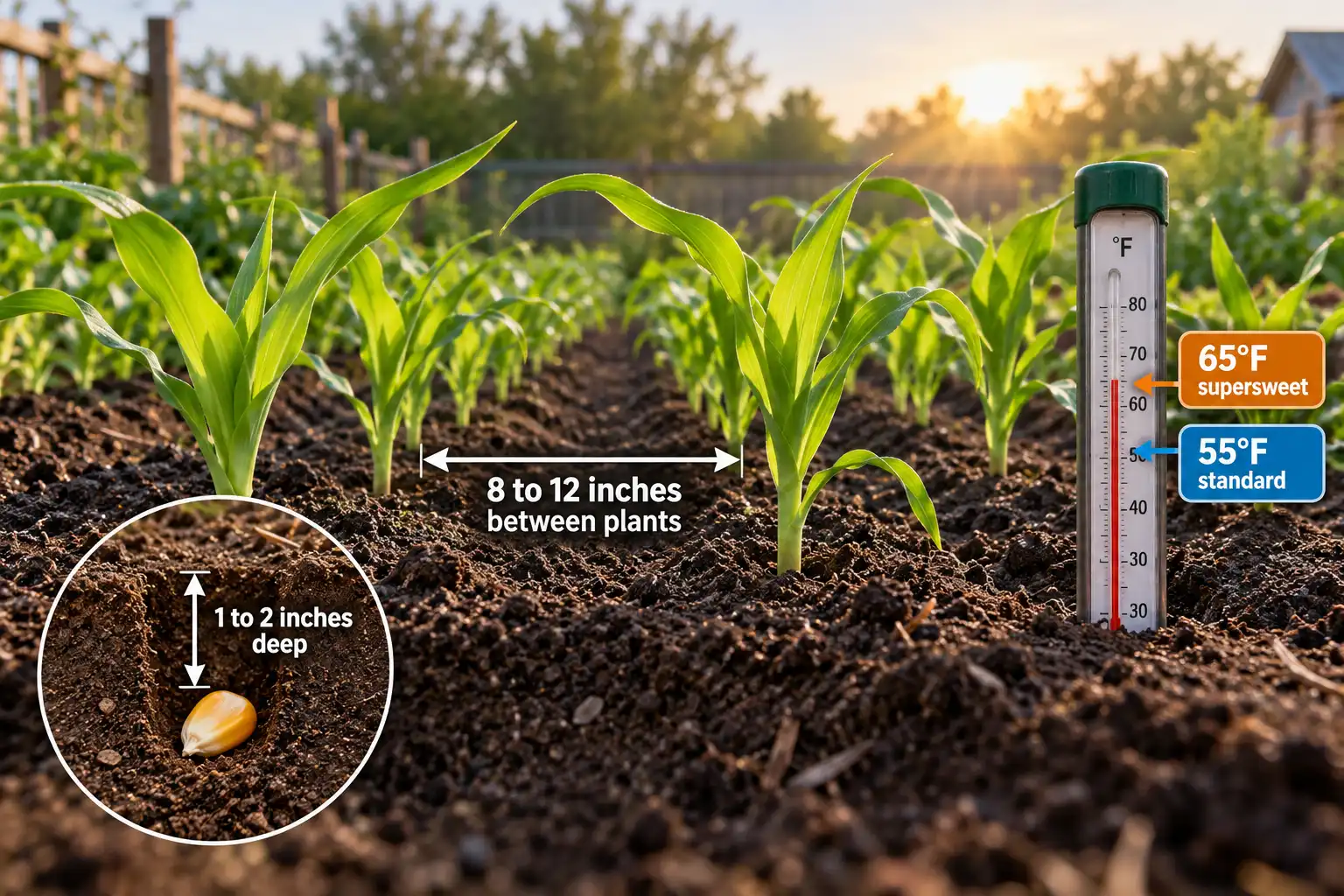
Plant sweet corn when soil reaches 55°F for standard types, 60°F for sugar-enhanced, and 65°F for supersweets, per K-State. Sow 1 to 2 inches deep, 8 to 12 inches apart, in blocks of four or more short rows.
Start With the Sweet Corn Type
The gene code on the seed packet sets your planting date and your isolation plan. Sweetness genes cut the starch a kernel stores. That makes a sweeter ear but a weaker seed, so the sweetest types need the warmest soil.
Most of the mechanics match planting corn in general. Sweet corn adds two problems of its own: fragile seed in cold soil, and pollen that spoils other types.
| Type (packet code) | Minimum soil temperature | Keep away from | Example cultivars |
|---|---|---|---|
| Standard (su) | 55°F | Supersweets, field corn, popcorn | Silver Queen, Seneca |
| Sugar-enhanced (se) | 60°F | Supersweets, field corn, popcorn | Bodacious, Ambrosia, Peaches & Cream |
| Synergistic (sy) | 55 to 60°F | Supersweets, field corn, popcorn | Montauk, Mattapoisett |
| Supersweet (sh2) | 65°F | All other types, field corn, popcorn | How Sweet It Is, Affection |
| Triplesweet (se and sh2 kernels on one ear) | 65°F | Field corn, popcorn | Honey Select, Serendipity |
Soil temperatures are K-State Research and Extension figures, except the synergistic range, which comes from Iowa State University Extension. Isolation groups follow Penn State Extension. Purdue Extension adds that triplesweets need no isolation from other sweet corn.
Why pay for warmer soil? Shelf life. UF/IFAS Extension puts it at 1 to 3 days for standard types. Sugar-enhanced types last 3 to 5 days, and supersweets 5 to 10.

When to Plant Sweet Corn: Soil Temperature First
Plant when soil at seed depth holds your type’s minimum temperature, whatever the calendar says. Take the reading 2 inches down in the early morning, when soil is coolest.
Services agree on the order of types but not on the exact figures. K-State sets supersweets at 65°F. Iowa State’s home garden guide accepts 60°F, yet its planting FAQ warns that sh2 seed germinates poorly below 65°F. Purdue gives 50°F as the floor for any sweet corn and 60 to 95°F as the optimum. So treat the low figures as a survival line, not a target.
Frost-date rules split even further. K-State allows planting one week before the average last frost. Purdue waits 10 days to 2 weeks after it, and UGA Extension waits at least two weeks. Soil temperature settles the gap, because it tracks this spring rather than an average one.
| Region | Typical planting window | Source |
|---|---|---|
| South Florida | September to March | UF/IFAS |
| Central Florida | January to April | UF/IFAS |
| North Florida | February to April | UF/IFAS |
| Southern Pennsylvania | Early to mid-April | Penn State |
| Eastern and central Kansas | Mid-April to early May | K-State |
| Central Iowa | Late April (su), early May (se), mid-May (sh2) | Iowa State |
| Northern Pennsylvania | Mid to late May | Penn State |
Keep Supersweets Away From Other Corn
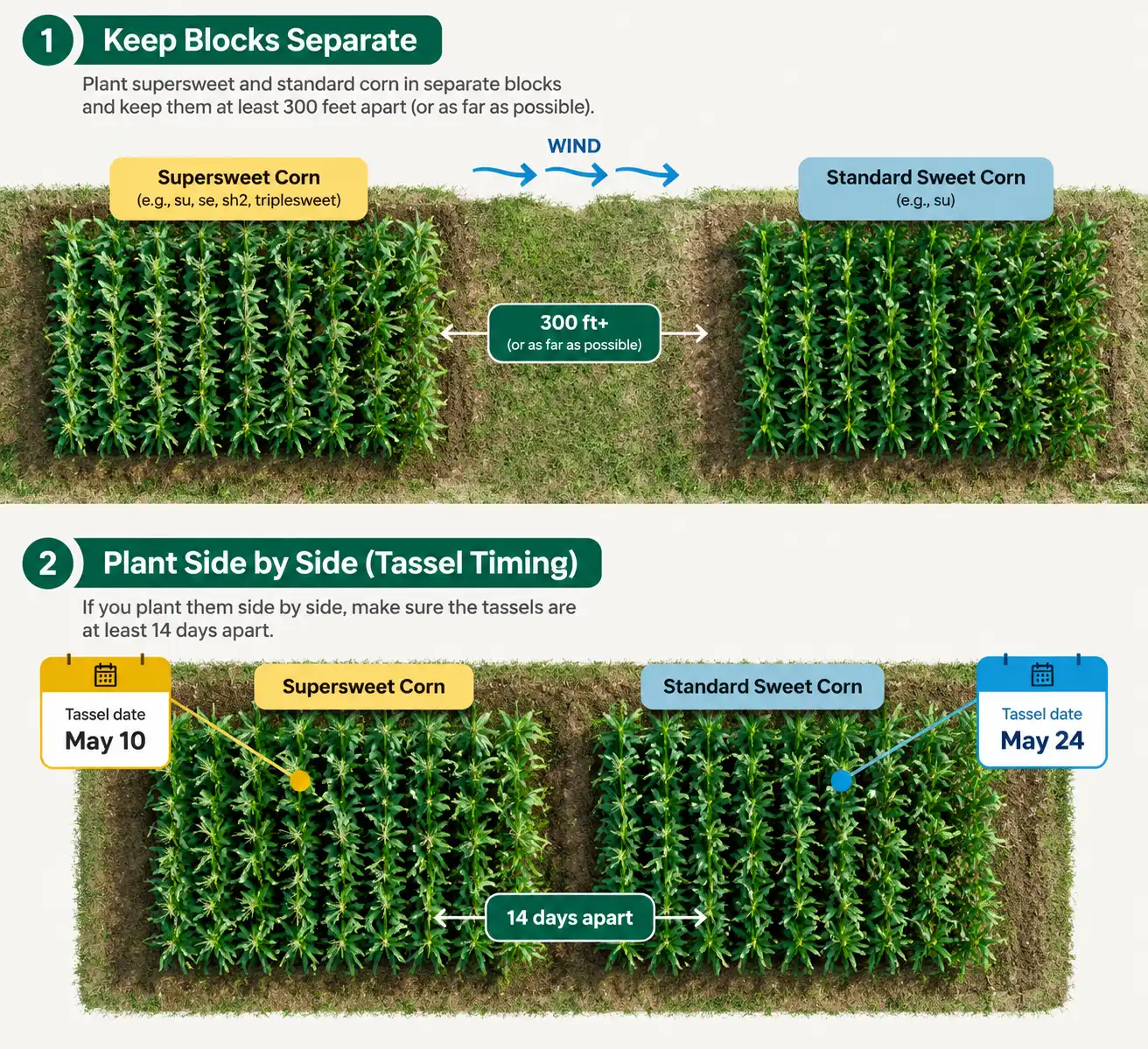
Supersweets need distance from standard, sugar-enhanced, and synergistic types. Every sweet corn also needs distance from field corn and popcorn. Iowa State warns that a cross between sh2 and su or se corn ruins the quality of both. Kernels turn starchy and tough. Unlike most crops, corn shows the damage the same season, because pollen changes the kernel it fertilizes.
How far is far enough depends on the service:
- K-State: 50 to 100 feet between types
- Iowa State: at least 250 feet
- Penn State: at least 500 feet
- Purdue: 700 feet for complete isolation
Purdue says complete isolation matters only for research and seed breeding. For a dinner crop, the shorter distances are workable.
Time works when space does not. Iowa State and Purdue want at least 14 days between the tasseling of two types. Penn State accepts a 12-day gap in silking dates. Purdue adds that two to five border rows between types catch stray pollen. Keeping one planting out of the other’s prevailing wind also helps.
For most home gardens, the simplest fix is one isolation group per season. Standard, sugar-enhanced, and synergistic types count as one group, so they can share a bed. Supersweets form the other group.
Prepare the Soil and Starter Fertilizer
Test the soil before you fertilize, as Purdue advises. If you already have results, interpreting a soil test shows which lines set your rate. Iowa State recommends fertile, well-drained ground in full sun. K-State adds that sandy soil warms faster, so it suits the earliest plantings.
Without a test, three services give starter rates per 100 square feet:
- Iowa State: 2 to 3 pounds of 10-10-10, mixed into the top 3 to 4 inches
- Purdue: 3 to 4 pounds of 12-12-12
- K-State: 2 to 4 cups of 10-10-10 or 12-12-12, worked in before tilling
On a 4 by 8 raised bed (32 square feet), Iowa State’s rate comes to about 10 to 15 ounces of 10-10-10. Scaled up to an acre, the same rate is roughly 870 to 1,310 pounds of product. That equals 87 to 131 pounds of nitrogen. At that scale, let a soil test set the rate instead.
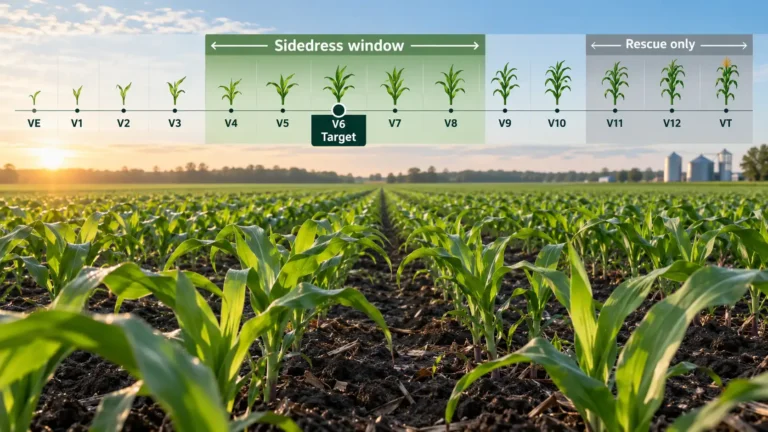
Nitrogen goes on again after emergence. Iowa State sidedresses when plants are 5 to 10 inches tall, and K-State at 8 to 12 inches. Purdue uses one-third pound of actual nitrogen per 100 feet of row. On a 10-foot row, that is about 1.6 ounces of 33-0-0. Purdue then repeats the feeding a week after tassels appear, well past the usual nitrogen sidedress window for field corn.
How to Plant Sweet Corn, Step by Step
- Confirm soil temperature. Wait until morning readings at 2 inches hold your type’s minimum. Cold, wet soil rots seed before it emerges, and supersweets fail first.
- Lay out a block, not a row. Mark four or more short rows side by side. Iowa State spaces rows 2.5 to 3 feet apart, which leaves room to walk and hoe.
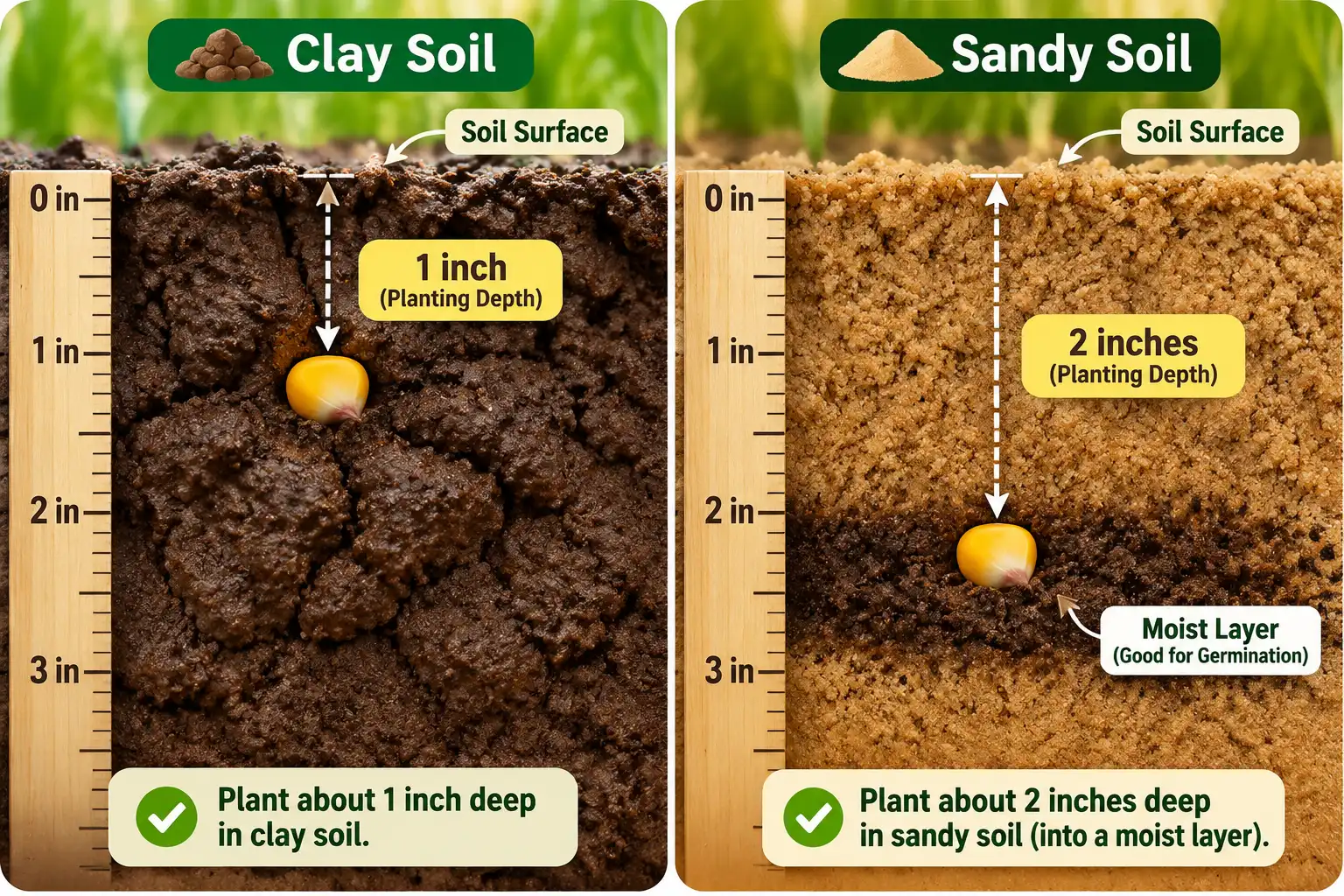
- Set depth by soil type. Iowa State and Purdue set furrows 1 inch deep in heavy soil and up to 2 inches in light, sandy soil. Sandy surfaces dry fast, so deeper seed stays in moisture. Heavy soil stays cold and crusts, so shallow seed emerges sooner.
- Space the seed. Drop seed 8 to 12 inches apart. Purdue sets early cultivars 8 to 10 inches apart and gives taller, late cultivars 9 to 12. For comparison, UF/IFAS plants commercial Florida fields at 6 to 8 inches, in rows 28 to 36 inches apart.
- Cover and firm. Pull soil over the furrow and press it down with your palm or a hoe blade. Firm contact lets seed draw water evenly. Then water if the soil is dry.
- Thin to one plant per spot. If you sowed extras, keep the strongest seedling. Snip the others at soil level so the keeper’s roots stay intact.
How to Plant Corn in Blocks for Full Ears
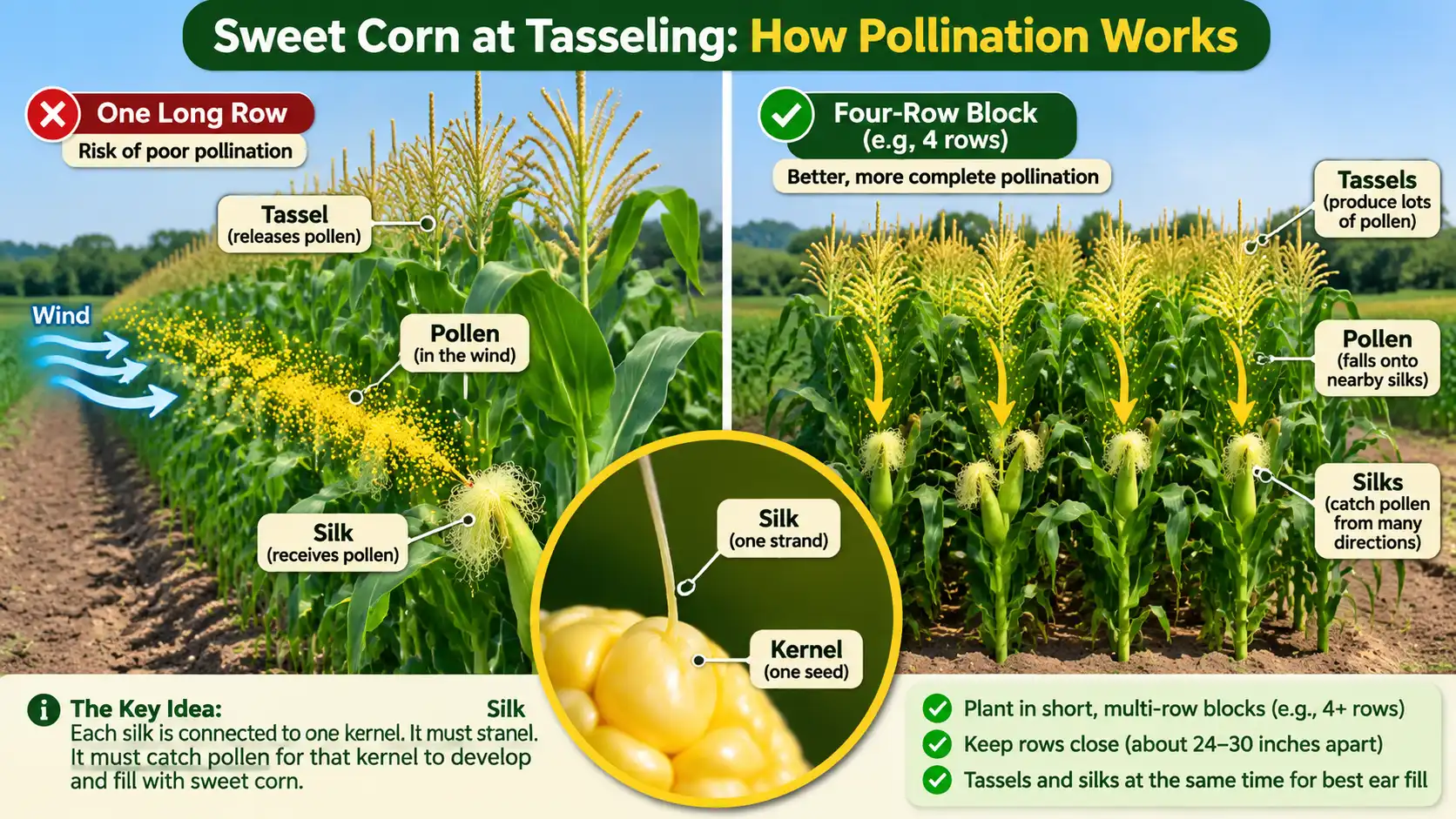
Plant corn in a block of at least four short rows side by side. That way, falling pollen lands on silks in every direction. Iowa State, Purdue, and UGA all recommend this layout.
The reason is simple. Each silk leads to one kernel, and a silk that catches no pollen leaves a gap on the cob. In a single long row, most pollen drifts past the silks and lands in the walkway. A block keeps silks downwind of tassels no matter which way the breeze blows.
K-State sizes the block for a household. Three to four rows, each 25 feet long, supply an average family, at about 30 ears per row.
Sweet Corn Block Layouts for Beds and Patches
Published spacing assumes rows 28 to 44 inches apart, built for foot or tractor traffic. Raised-bed layouts are scarce in extension guides, so match plant density instead of row width.
Penn State targets 14,000 to 24,000 plants per acre. UF/IFAS targets 24,000 to 32,000 for Florida’s commercial crop. On a 32-square-foot bed, that works out to 10 to 18 plants at Penn State’s density, or 18 to 24 at UF/IFAS’s.
| Planting space | Layout | Plants | Density per acre |
|---|---|---|---|
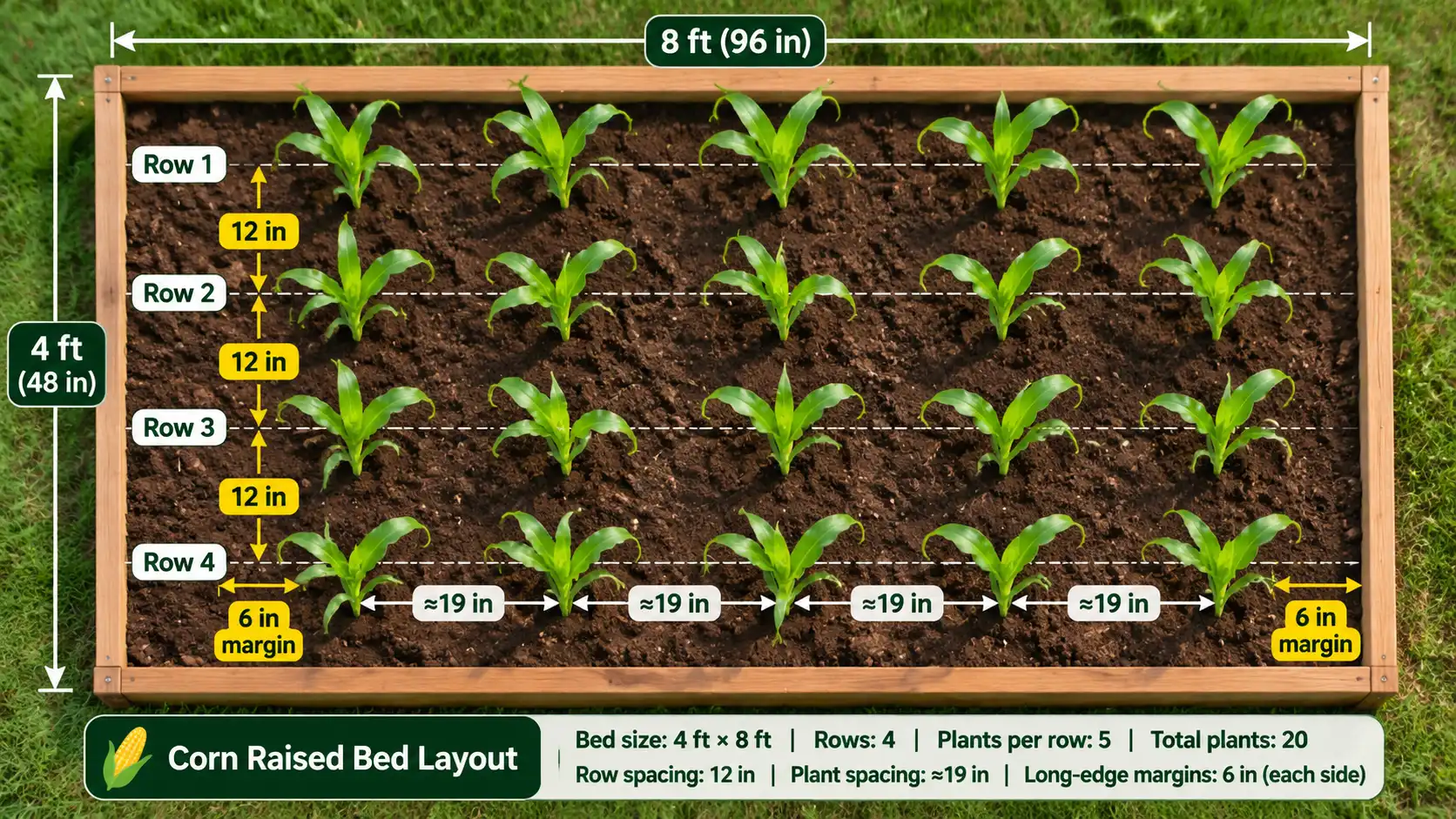
| 4 by 8 ft raised bed | 4 rows 12 in apart, plants about 19 in apart | 20 | About 27,000 |
| 10 by 10 ft garden patch | 4 rows 30 in apart, plants 10 in apart | 48 | About 21,000 |
| K-State family block | 4 rows 25 ft long, 30 to 40 in apart, plants 8 to 12 in apart | 104 to 152 | 13,000 to 26,000 |
The 20-plant bed sits inside the UF/IFAS range and above Penn State’s. If ears come in small, drop to 16 plants next season by setting four per row. Acreage growers run the same math in reverse when they set corn plant populations.
Plant Again Every Two Weeks for a Longer Harvest
Plant a new block every two weeks, or sow early, mid, and late cultivars on the same day, as Iowa State recommends. K-State uses a different trigger: plant the next block once the previous one is 1 to 2 inches tall. That rule adjusts for weather, because a cold spell slows both the soil and the earlier planting.
Cultivar choice spreads the harvest too. K-State groups early cultivars at 65 to 75 days and mid-season ones at 75 to 85. So one sowing of each stretches picking by about 10 days.
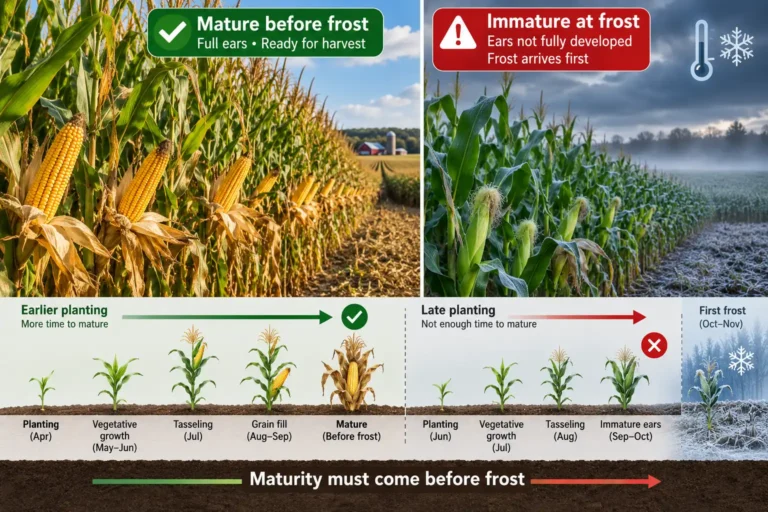
Watch two things when you stagger. First, a 14-day gap at planting can shrink by tasseling, since later blocks grow in warmer weather. So give mixed types a few extra days of margin. Second, late blocks run out of season. Iowa State puts the last practical date for early cultivars at July 1 in Iowa. Farther south the window runs later, so check planting corn late in the season against your own first frost date.
Troubleshooting Poor Stands and Gappy Ears
These five problems start on planting day. Match what you see to its likely cause:
| What you see | Likely planting cause | Fix next time |
|---|---|---|
| Seed rots, patchy emergence | Soil below the type’s minimum, worst with sh2 | Wait for morning soil readings at 2 inches to hold the minimum |
| Seedlings emerge days apart | Uneven depth or crusted heavy soil | Keep furrows level and plant 1 inch deep in clay |
| Ears with missing kernels | One long row or too few plants | Four or more short rows side by side |
| Starchy, tough kernels | Pollen from field corn or another type | Distance or a 14-day tasseling gap |
| Small ears, barren stalks | More plants than the bed’s water and fertility can carry | Thin to 8 to 12 inches, or set fewer plants per bed |
Gaps in a stand are usually best left alone. Seed sown weeks later grows in the shade of older plants. It may also silk after the block has finished shedding pollen, which brings back the missing-kernel problem.
FAQs About Plant Sweet Corn
Does sweet corn need full sun?
Yes, Iowa State University Extension says sweet corn performs best in full sun with fertile, well-drained soil. Pick your sunniest spot, and place the block where its tall stalks will not shade shorter crops.
How many sweet corn seeds go in each hole?
In rows, drop one seed every 8 to 12 inches, as Iowa State recommends. For hills 3 feet apart, Purdue sows 5 or 6 seeds and thins to the 3 strongest.
Can you start sweet corn indoors and transplant it?
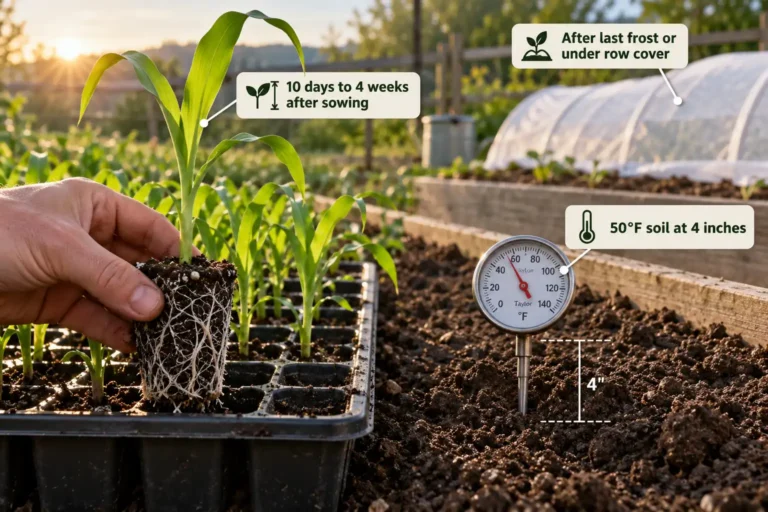
Yes, for a small early crop, though Penn State Extension calls transplants impractical beyond an acre. Set seedlings out before they reach 12 to 18 days old, after which they establish poorly.
How many ears does one sweet corn plant produce?
Plan on roughly one good ear per plant when deciding how much to sow. K-State Research and Extension expects about 30 ears from 25 feet of row planted 8 to 12 inches apart.
How long does sweet corn take from planting to harvest?
Common garden cultivars run about 64 to 92 days from planting. UGA Extension lists ‘Seneca’ at 64 days and ‘Silver Queen’ at 92, so cultivar choice shifts harvest by a month.
Do you need two varieties for sweet corn to pollinate?
No, a block of one variety pollinates itself, because each plant carries both tassels and silks. What matters is block shape, since four or more short rows put silks under the falling pollen.
What to Check Before You Plant
Read the gene code on the seed packet first. It sets your soil temperature, 55°F to 65°F, and tells you what to keep apart. Then check soil at seed depth instead of trusting the calendar. Lay out four or more short rows, even in a raised bed. If you grow two isolation groups, separate them by distance or a 14-day tasseling gap.
Once seedlings are up, the rest of the corn growing season takes over: water, sidedressing, and pest checks.