How to Plant Corn: Depth, Spacing and Timing by Region
Learning how to plant corn starts with choosing the right seed, checking soil temperature, and setting accurate planting depth and spacing. Sweet corn and field corn need different planting conditions. Getting these decisions right helps seeds emerge evenly and supports healthy root development.
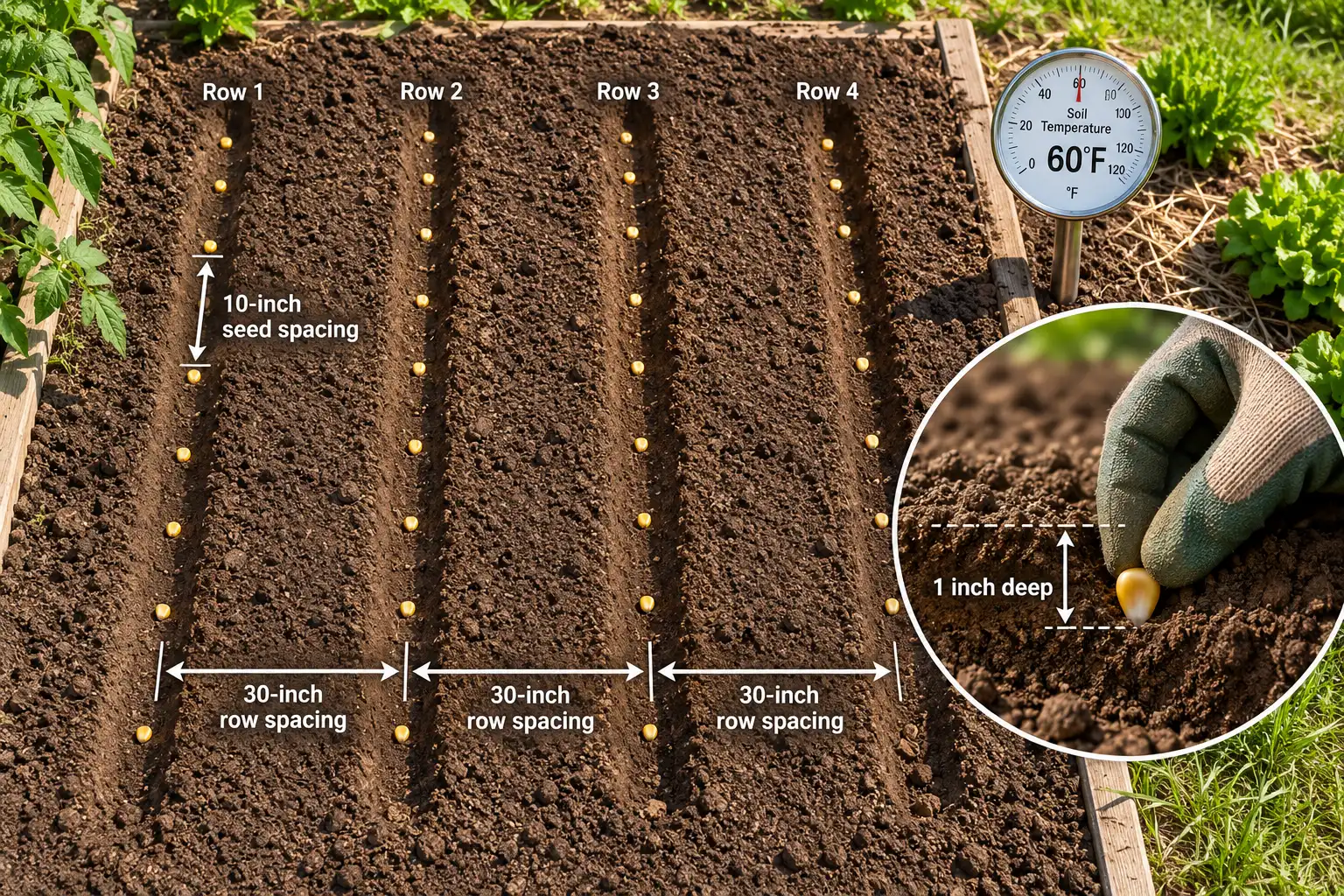
To plant corn, first match your seed type to the soil temperature. For sweet corn, wait for soil near 60°F, sow about 1 inch deep, space seeds 8 to 12 inches apart, and plant four short rows for pollination.
Choose the Right Type of Corn Before Planting
Sweet corn is grown for tender ears eaten fresh, while field corn is commonly grown for grain or silage. Their planting temperatures, seed depths, and populations differ.
| Corn type | Soil temperature at planting | Seed depth | Spacing or planting rate |
|---|---|---|---|
| Standard sweet corn (su) | About 55°F to 60°F | 1 inch in heavier soil, up to 2 inches in sandy soil | 8 to 12 inches between seeds; 30 to 36 inches between rows |
| Sugar-enhanced sweet corn (se) | Usually 55°F to 60°F, depending on cultivar | About 1 inch, adjusted for soil | 8 to 12 inches between seeds; 30 to 36 inches between rows |
| Supersweet corn (sh2) | Preferably 65°F or warmer for many varieties | 3/4 to 1 inch | 8 to 12 inches between seeds; 30 to 36 inches between rows |
| Field corn for grain or silage | About 50°F and warming | Usually 1.75 to 2 inches | Population depends on hybrid, rainfall, soil productivity, and region |
These are starting guidelines, not substitutes for the seed label.
According to University of Minnesota Extension, Butter & Sugar is a standard sweet corn with approximately 75 days to maturity. Northern Xtra Sweet is a supersweet variety with a shorter listed maturity of 63 days but needs warmer planting soil.
Choose a cultivar that can mature before your expected fall frost. For grain corn, match the hybrid’s relative maturity to local growing degree days.
When Is the Best Time to Plant Corn?
Plant corn when the soil is warm enough for the seed type, sufficiently dry to work, and unlikely to experience damaging cold weather immediately afterward.
For garden sweet corn, wait until the danger of frost has passed. Field corn can be planted earlier under suitable conditions.
Corn Planting Dates by U.S. Region
Planting dates vary considerably across the United States.
Iowa State Extension recommends different spring dates for standard and supersweet corn in central Iowa. University of Minnesota Extension provides later dates for northern gardens.
University of Georgia Extension and UF/IFAS Extension document much earlier planting seasons in warmer regions.
| Region | Typical planting window | Important consideration |
|---|---|---|
| Minnesota and Upper Midwest | Mid-May to mid-June for garden sweet corn | Wait for warmer soil and reduced frost risk |
| Central Iowa | Late April for standard sweet corn; mid-May for supersweet | Supersweet seeds are more sensitive to cold |
| Minnesota field corn | Late April to early May | Soil near 50°F and expected to warm |
| Mid-Atlantic | After the last spring frost | Use soil temperature rather than a fixed date |
| Southern Georgia | Feb. 15 to Apr. 15; July 15 to Aug. 30 | Regional commercial sweet corn windows |
| North Florida | March to April; August | Check spring frost and late-summer conditions |
| Central Florida | January to April | Avoid unusually cold or saturated soil |
| South Florida | October to March | Cooler-season production avoids some summer stress |
These are regional guides, not guaranteed planting dates for every county.
Check Soil Temperature Before Sowing
Use a soil thermometer at approximately the intended seed depth.
Check the temperature over several mornings and review the weather forecast. A single warm afternoon does not mean the seedbed will remain warm.
Cold, saturated ground can cause seed rot and uneven emergence.
Prepare the Soil for Corn Planting
Corn establishes best in full sun, fertile soil, and a seedbed that drains without forming a hard crust.
University of Maryland Extension recommends at least six hours of direct sunlight, with eight to ten hours preferred.
For garden sweet corn, Iowa State Extension identifies a preferred soil pH of 6.0 to 6.5.
Before planting:
- Remove established weeds and crop debris that interfere with seeding.
- Test soil pH and nutrient levels.
- Incorporate finished compost where organic matter is low.
- Loosen compacted garden soil without destroying its structure.
- Rake the surface level and break up large clods.
Use soil test results to identify nutrient needs before adding fertilizer.
Avoid working wet soil. A handful squeezed firmly should crumble when released rather than form a sticky, smeared mass.
University of Minnesota Extension warns that tilling or planting wet fields can compact soil around the seed and restrict root development. Established no-till fields need minimal soil disturbance, not unnecessary cultivation.

How Far Apart Should You Plant Corn?
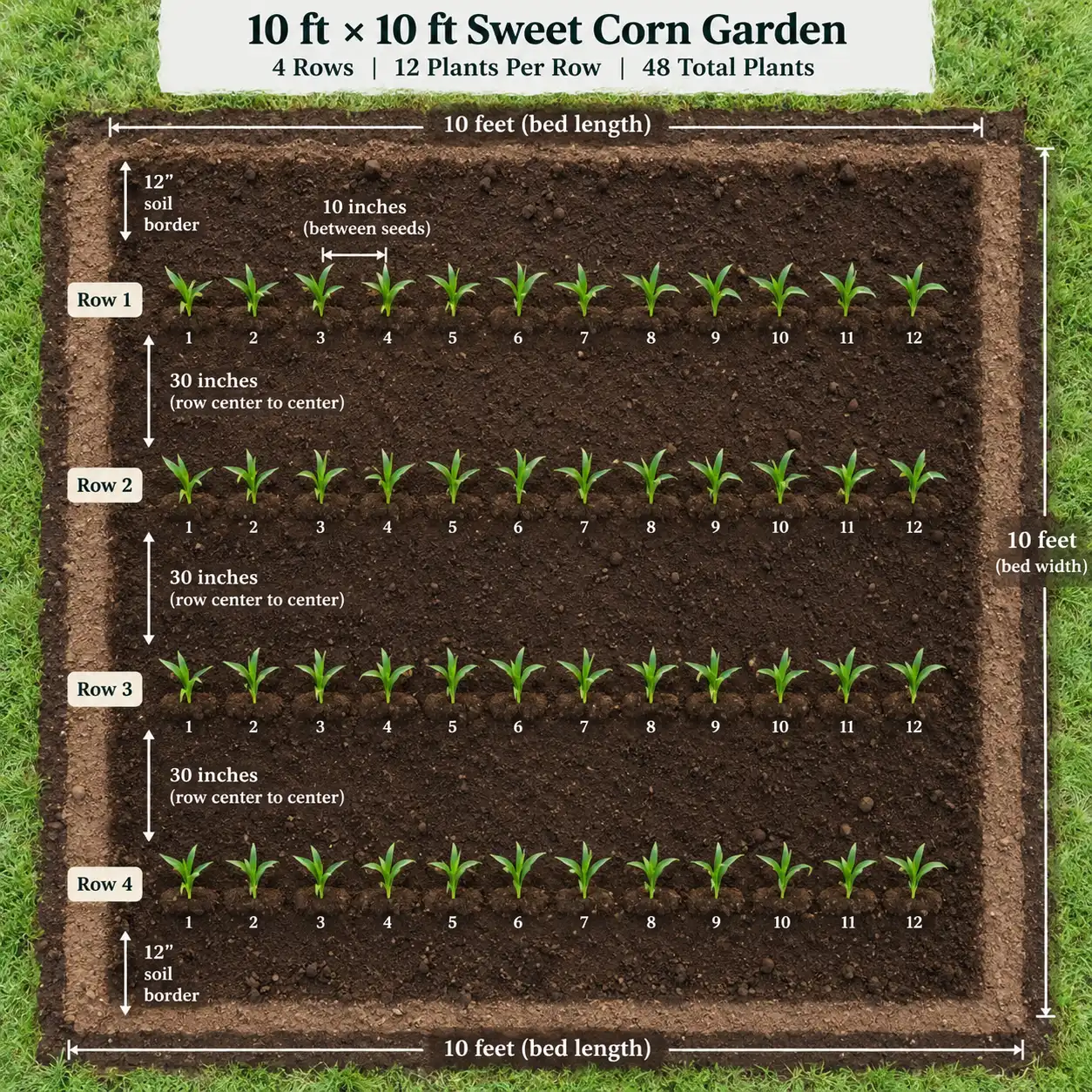
For most home garden sweet corn, space seeds 8 to 12 inches apart within rows that are 30 to 36 inches apart.
Plant several short rows together instead of one long row. Corn is wind-pollinated, so neighboring plants help distribute pollen from tassels to silks.
Recommended Four-Row Garden Layout
A practical starting layout for a small sweet corn patch is:
| Measurement | Example layout |
|---|---|
| Number of rows | 4 |
| Length of each row | 10 feet |
| Row spacing | 30 inches |
| Seed spacing | 10 inches |
| Total planting positions | 48 |
Four rows spaced 30 inches apart span 7.5 feet between the outer row centers. A plot about 10 feet wide allows additional space along both edges.
Why not plant closer? Crowded sweet corn competes for sunlight, nitrogen, and moisture. This can reduce ear size.
For large field-corn plantings, population is calculated per acre instead of using garden spacing. The two systems should not be treated as interchangeable.
How Many Corn Seeds Do You Need?
Calculate seed requirements from row length and in-row spacing, rather than guessing how much seed a plot will hold.
For a straight row:
Planting positions = row length in inches ÷ seed spacing in inches
A 100-foot row contains 1,200 inches.
- At 8-inch spacing: approximately 150 positions.
- At 10-inch spacing: approximately 120 positions.
- At 12-inch spacing: approximately 100 positions.
For acres, use:
Seeds per acre = 6,272,640 ÷ (row spacing in inches × seed spacing in inches)
| Row spacing | Seed spacing | Approximate seeds per acre |
|---|---|---|
| 30 inches | 12 inches | 17,424 |
| 30 inches | 10 inches | 20,909 |
| 30 inches | 6.15 inches | 34,000 |
The acre calculations assume uniform spacing across the planted area without allowances for field boundaries or headlands.
University of Minnesota Extension reports that approximately 34,000 to 36,000 planted seeds per acre can be economically favorable for many Minnesota grain-corn fields. The appropriate rate elsewhere depends on the hybrid and available moisture.
These figures describe seed placement, not guaranteed surviving plants.
How to Plant Corn Seeds Step by Step
Direct-sow corn in a moist, workable seedbed. Consistent seed depth and firm soil contact support uniform germination.
Step 1: Mark the Planting Rows
Use a measuring tape and string to lay out straight rows.
For sweet corn, arrange four or more short rows. For field corn, set the planter according to the intended row width and seeding population.
Step 2: Open the Seed Furrow
Make a furrow at the required planting depth.
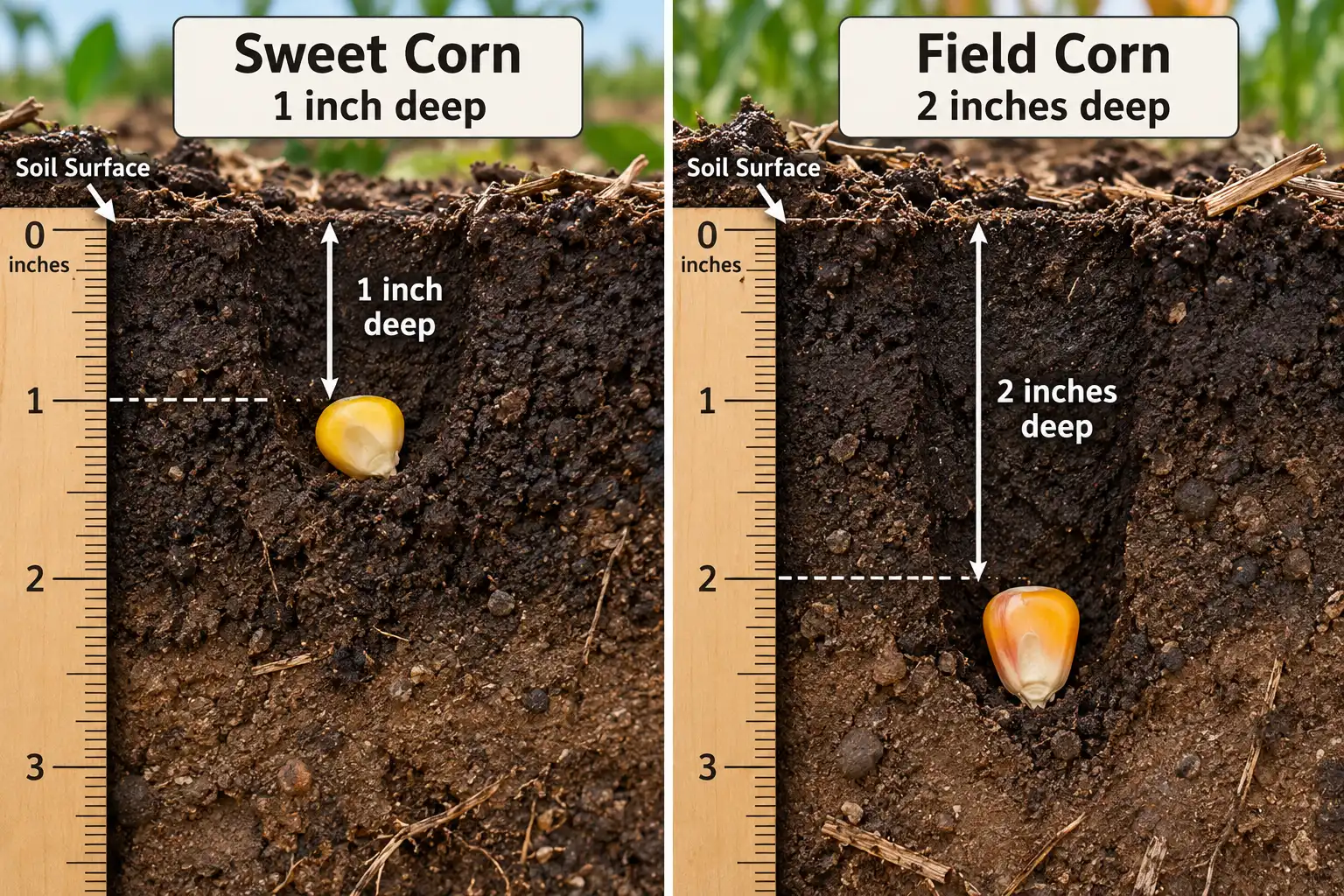
Iowa State Extension recommends planting sweet corn about 1 inch deep in heavier soil and up to 2 inches in light sandy soil.
For field corn, University of Minnesota Extension generally favors a 2-inch planting depth. A depth near 2.5 inches may be appropriate when necessary to reach moisture in dry fields.
Step 3: Place the Seeds
Place seeds at the planned intervals.
Use fresh, viable seeds. Follow seed packet instructions for unusually small, delicate, or treated seed.
Step 4: Cover the Seeds
Pull soil over the furrow and press gently.
Eliminate large air pockets without packing the soil into a hard layer.
Step 5: Water the Seedbed
Water gently when soil moisture is insufficient.
Moisten the seed zone without saturating it or washing seeds out of place.
Step 6: Check Planting Accuracy
Dig up a few planted seeds to verify depth and contact with moist soil.
For field planters, check multiple row units and adjust depth, downforce, or closing wheels when needed.
Water and Fertilize Corn After Planting
Keep the seed zone moist during germination, then provide enough water to support steady root and leaf growth.
Iowa State Extension suggests approximately 1 inch of combined rainfall and irrigation weekly for garden sweet corn under typical conditions. Purdue Extension provides a broader recommendation of 1 to 1.5 inches during dry weather.
Actual irrigation needs change with rainfall, temperature, soil texture, and crop growth.
For scale:
- A 100-square-foot garden receiving 1 inch of water gets approximately 62 gallons.
- One acre receiving 1 inch gets approximately 27,154 gallons.
These are rainfall-equivalent volumes, not fixed irrigation prescriptions. Use soil moisture and crop water requirement calculations to refine watering.
Corn also needs adequate nitrogen.
Apply phosphorus and potassium according to soil testing. Plan nitrogen around crop demand and local recommendations.
Young corn commonly receives additional nitrogen around the 8-to-12-inch growth stage. Field schedules should account for soil nitrogen supply, rainfall, and expected yield.
For acreage-scale planning, use corn fertilizer calculations and the appropriate nitrogen side-dressing stage.
What Happens During the First 30 Days?
Warm soil, adequate moisture, and uniform planting depth help corn establish a consistent stand during its first month.
The following timeline is approximate because emergence and leaf development depend strongly on temperature.
| Time after planting | Expected progress | What to check |
|---|---|---|
| Days 1 to 5 | Seeds absorb water and germination begins | Seed-zone moisture and drainage |
| Days 7 to 14 | Seedlings commonly emerge in warm soil | Missing plants, crusting, uneven emergence |
| Days 14 to 21 | Leaves and roots develop | Weed competition, stand uniformity, soil moisture |
| Days 21 to 30 | Plants continue vegetative growth | Nutrient needs, insect damage, developing roots |
Cool soils can delay emergence beyond these approximate intervals.
Count surviving seedlings once rows become visible. Early inspection helps distinguish poor germination from damage after emergence.
Keep weeds small through shallow cultivation or careful hand removal. Avoid disturbing developing corn roots.
Do not remove healthy side shoots simply because they appear beside the main stalk. University of Maryland Extension notes that removing corn tillers does not generally improve production.
Prevent Poor Pollination When Planting Sweet Corn
Sweet corn must receive enough compatible pollen to fill the kernels on each ear.
Planting four short rows together improves pollen distribution compared with one isolated row.
However, planting different genetic types near each other may change kernel quality.
Standard sweet corn, supersweet corn, popcorn, and field corn can cross-pollinate when their flowering periods overlap.
Iowa State Extension recommends separating incompatible corn types by at least 250 feet or ensuring a minimum 14-day difference in tasseling times.
University of Maryland Extension gives a more conservative distance of 400 yards for genetic isolation. The recommendations differ in how much cross-pollination risk they allow.
Neither distance guarantees complete isolation under every wind condition.
For smaller gardens, growing one genetic type is generally the simplest solution. If planting different types, plan around actual pollen-shedding periods rather than assuming different sowing dates provide isolation.
Why Are Corn Seedlings Not Growing Evenly?
Uneven emergence often results from cold soil, inconsistent planting depth, poor seed contact, or surface crusting.
Inspect affected planting positions before deciding whether to replant.
| Problem | Possible cause | What to do |
|---|---|---|
| Seeds fail to sprout | Cold, saturated soil or poor seed viability | Dig up several seeds and check for decay |
| Seedlings emerge at different times | Uneven planting depth or soil moisture | Check depth and planter settings |
| Shoots cannot break the surface | Hard soil crust following rain | Carefully loosen the crust without damaging shoots |
| Sections of a row are missing | Planter skips, seed damage, insects, or birds | Locate remaining seeds and inspect for damage |
| Seedlings appear weak or yellow | Waterlogging, root damage, or nutrient stress | Examine roots and soil before adding fertilizer |
| Young plants fall or lean | Weak rooting, shallow planting, or saturated soil | Check root development and drainage |
Purdue Extension advises against filling isolated gaps in an older sweet corn planting. Younger replacement plants often remain shaded and flower out of step with neighboring plants.
When establishment is extremely poor, replanting the entire block may produce a more uniform crop.
For grain corn, compare the surviving stand, expected yield, and planting delay before deciding to replant.
Can You Plant Corn More Than Once per Season?
Yes. Successive sweet corn plantings can extend the harvest beyond a single short picking period.
Iowa State Extension recommends sowing additional blocks about every two weeks or growing cultivars with different maturity dates.
For example, planting an early-maturing cultivar alongside a later cultivar can spread harvest dates without requiring multiple planting sessions.
Each new block still needs enough neighboring stalks for pollination.
Stop succession planting when the remaining warm season is too short for the chosen variety to mature. Use its listed maturity and the local fall frost risk as guides.
Late-season plantings also need careful attention to moisture and ear-feeding insects.
FAQs about Plant Corn
Can you plant corn in a raised bed?
Yes, a raised bed works if it fits several short rows and receives sufficient sunlight. A narrow bed with only one corn row may provide too little nearby pollen for consistently filled ears.
Should you start corn seeds indoors?
Direct sowing is usually more reliable because corn grows rapidly and root disturbance can slow establishment. If a short season requires transplants, use deep cells and move young seedlings without damaging their root balls.
Can you replant seeds saved from hybrid sweet corn?
Hybrid sweet corn seeds may germinate, but the resulting plants will not necessarily reproduce the parent variety’s characteristics. Fresh, labeled seed is generally more dependable for consistent emergence, ear quality, and sweetness.
How long does corn take to germinate?
Sweet corn often emerges about 7 to 10 days after planting in moist, warm soil. Cooler temperatures can delay emergence, so check soil conditions and inspect seeds before deciding that a slow planting has failed.
How many ears of corn grow from one seed?
One corn seed normally establishes one stalk, and one full sweet corn ear per stalk is a reasonable expectation. Some varieties produce a smaller second ear, depending on growing conditions, pollination, and plant development.
Key Points for Planting Corn Successfully
Check soil warmth, drainage, seed depth, and spacing before planting. Keep sweet corn in compact blocks, ensure seeds contact moist soil, and inspect emergence before changing your management plan.
The planting stage establishes the crop’s foundation. For later vegetative growth, ear development, and harvest, follow the complete corn growing guide.