How to Cut Seed Potatoes: Size, Eyes, and Curing Time
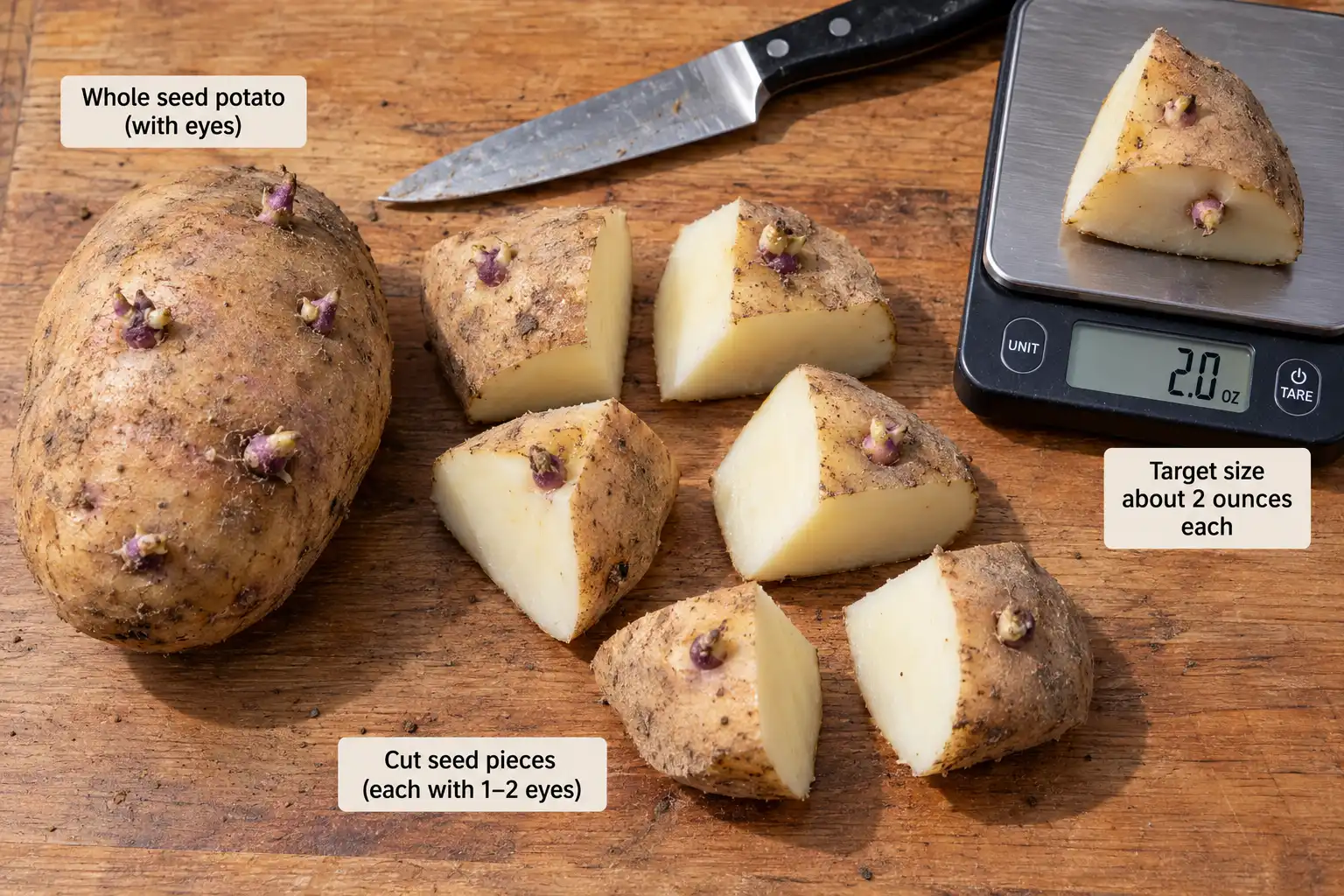
How to cut seed potatoes correctly depends on their size, eye placement, and condition. Each piece needs enough stored energy to sprout and establish roots. Cutting pieces too small or planting them into wet soil increases the risk of poor growth and rot.
Cut large seed potatoes into firm, blocky pieces weighing 1.5 to 2 ounces, each with one or two healthy eyes. Leave small potatoes whole. Use a clean knife, allow cut surfaces to heal, and plant in well-drained soil.
Should You Cut Seed Potatoes or Plant Them Whole?
Small seed potatoes usually grow better when planted whole. Cutting is mainly useful for dividing larger tubers into several planting pieces.
Every cut creates a wound that must heal. Unnecessary cutting increases the exposed surface area and gives decay organisms more opportunities to enter.
University of Maine Cooperative Extension recommends sizing seed potatoes before cutting.
| Whole potato weight | Recommended preparation |
|---|---|
| Under 1.5 ounces | Avoid using as undersized seed |
| 1.5 to under 3 ounces | Plant whole |
| 3 to 5 ounces | Cut into 2 pieces |
| 5 to 7 ounces | Cut into approximately 3 pieces |
| Over 7 ounces | Divide into suitably sized pieces only if each retains an eye |
These guidelines are starting points, not fixed cutting patterns. Eye placement determines whether a particular potato can be divided successfully.
Keep a 2-ounce potato whole, even if it has several eyes. It already provides a suitable planting piece without introducing wounds.
How Many Eyes Should Each Cut Seed Potato Have?
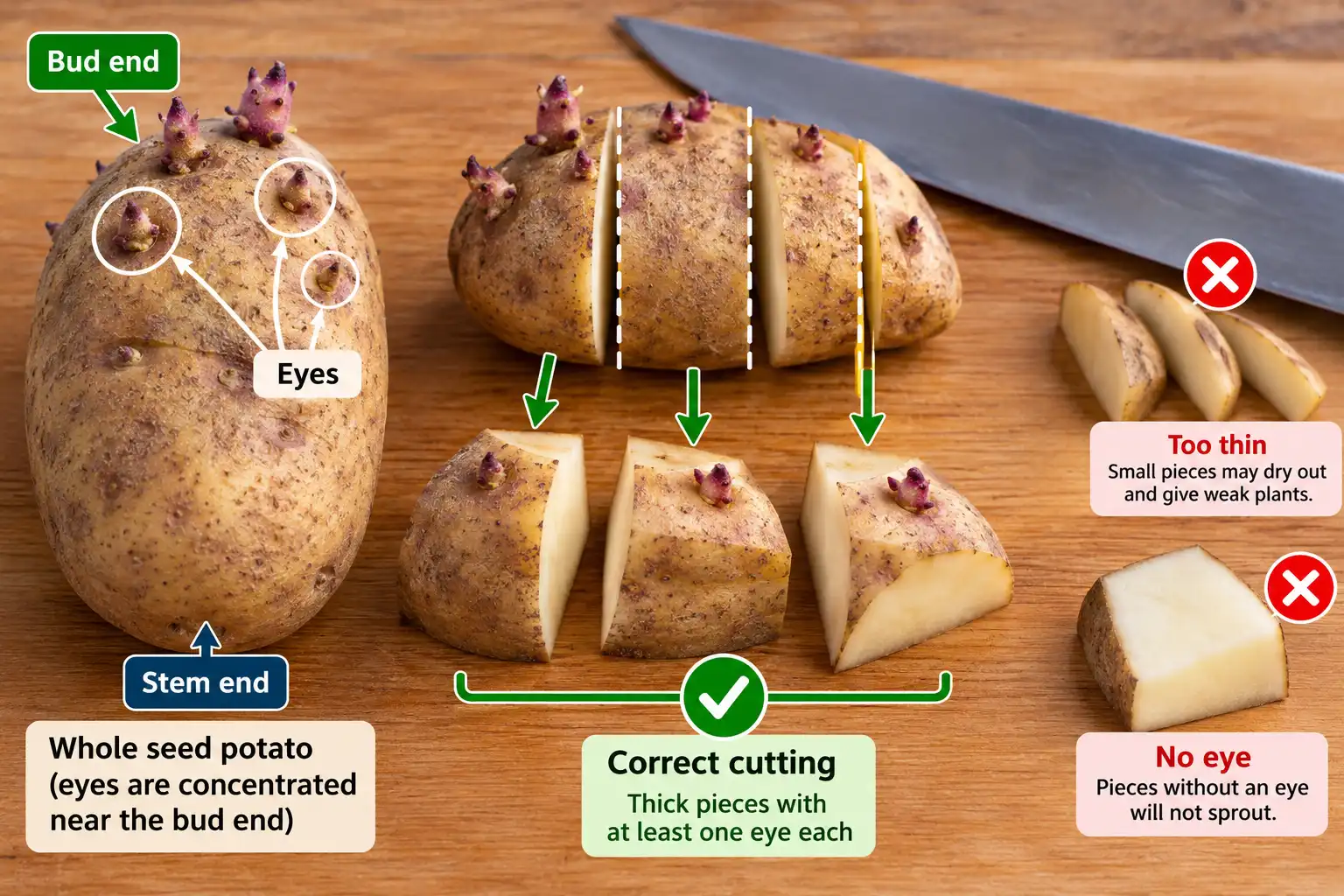
Each seed potato piece needs at least one healthy eye. One or two eyes per piece is a practical target for most plantings.
Eyes are small buds located in shallow indentations on the tuber’s skin. They produce the shoots that develop into potato plants.
You can identify them by looking for:
- Small dimples or slightly raised buds.
- Short white, pink, or purple sprouts.
- Clusters of eyes near one end of the potato.
The end with the most concentrated eyes is called the bud end. The opposite end, where the tuber was attached to the plant, is the stem end.
UF/IFAS Extension explains that potatoes can be cut before their eyes sprout. However, visible sprouts make bud identification easier.
Never assume that every slice will grow. A piece without a viable eye cannot produce a normal potato shoot.
How to Cut Seed Potatoes Without Damaging the Eyes
Use a clean, sharp knife to produce thick pieces with smooth surfaces. Examine the eyes before making the first cut.
Step 1: Select Healthy Seed Potatoes
Choose firm, certified seed tubers with healthy skin. Reject potatoes showing soft rot, leaking tissue, mold, or extensive damage.
Avoid cutting diseased sections away and using the remainder. Some infections extend beyond visible symptoms.
Step 2: Prepare Your Knife and Workspace
Use a sharp, straight-edged knife and a clean cutting surface.
Sanitize the knife before cutting and between seed lots. Clean it again after contacting suspicious tissue.
Remove loose soil without washing the tubers.
Step 3: Locate the Eyes
Rotate the potato and examine all sides.
Identify the bud end and plan cuts that leave at least one eye on each section. Avoid cutting directly through an eye.
Step 4: Make the First Cut
For a larger oval potato, a lengthwise cut may divide the eyes more evenly.
Cut firmly through the tuber. Avoid jagged edges, crushing, or repeated sawing.
Step 5: Divide Larger Sections
Cut remaining sections only if they are large enough.
Aim for blocky pieces weighing approximately 1.5 to 2 ounces. A small kitchen scale improves consistency.
Step 6: Inspect Every Piece
Check that each piece contains healthy flesh, an intact eye, and enough weight.
Discard thin slivers, eyeless sections, and damaged pieces. Keep the acceptable pieces ready for healing or planting.
What Size Should Cut Seed Potato Pieces Be?
Most cut seed potato pieces should weigh 1.5 to 2 ounces. This is roughly a 1.5-inch cube, although weight is more reliable than shape.
Iowa State University Extension recommends pieces weighing approximately 1.5 to 2 ounces with one or two eyes.
Piece size matters because the tuber supplies energy and nutrients before the new plant develops its own leaves and roots.
Very small pieces have fewer reserves. As a result, they may emerge slowly or fail under stressful conditions.
Varieties can also influence cutting decisions.
- Atlantic and Shepody: Eyes may be unevenly distributed. Maine Extension suggests pieces closer to 2 ounces.
- Russet Burbank: Maine Extension recommends larger pieces averaging approximately 2 to 2.5 ounces.
- Other common varieties: Use the standard 1.5 to 2-ounce range unless regional guidance recommends otherwise.
Do not sacrifice a healthy eye simply to achieve an exact weight.
When Should You Cut Seed Potatoes Before Planting?
For most home gardens, cutting one or two days before planting allows time for the exposed surfaces to begin healing.
However, the right schedule depends on soil temperature, moisture, seed condition, and storage facilities.
If the Potatoes Have Already Sprouted
Handle sprouted tubers carefully. Long, fragile sprouts can break during cutting.
If you plan to chit potatoes, let them develop short, sturdy sprouts while still whole. Chitting means encouraging sprouts before planting.
Utah State University Extension recommends green sprouting before cutting because cutting first can increase moisture loss.
If Planting Is Delayed
Keep whole seed potatoes intact until the planting date becomes reasonably certain.
For larger commercial plantings, early cutting is possible under controlled storage conditions. However, cutting far ahead without suitable temperature and humidity can cause dehydration, decay, or premature aging.
How to Cure Cut Seed Potatoes Before Planting
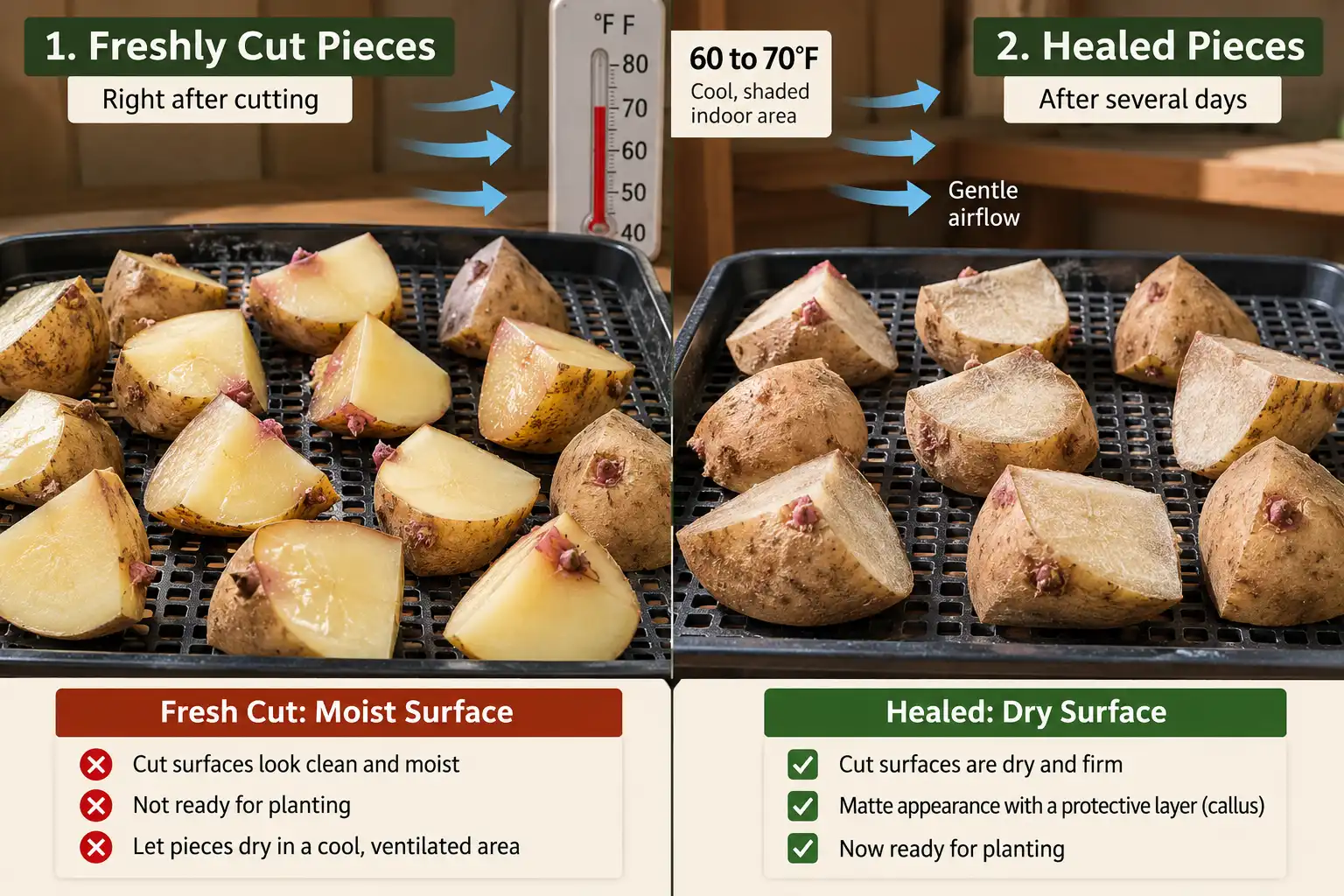
Cure cut seed potatoes by keeping them in a humid, ventilated environment until the fresh wounds develop a protective surface.
This healing process is called suberization. It forms protective tissue that reduces moisture loss and helps resist infection.
Simple Curing Method for Home Gardens
- Arrange the pieces in a single layer on a clean tray or shallow crate.
- Keep them away from direct sunlight.
- Maintain approximately 60 to 70 degrees F with adequate humidity and airflow.
- Allow about 1 to 2 days for initial healing.
- Check that the surfaces are firm rather than wet, slimy, or moldy.
Iowa State Extension recommends this short healing period. Avoid sealed plastic bags, standing water, and excessively dry heated rooms.
A healed cut should look slightly dull and feel firmer than freshly exposed potato flesh.
Can You Plant Seed Potatoes Immediately After Cutting?
Yes, freshly cut seed potatoes can be planted immediately when soil conditions are favorable. However, allowing wounds to heal generally provides additional protection.
Utah State Extension permits immediate planting. The University of Maine’s organic potato production guidance also allows freshly cut seed in suitable soil.
These recommendations do not mean that uncured seed tolerates cold, saturated soil.
| Situation | Recommended action |
|---|---|
| Warm, moderately moist, well-drained soil | Freshly cut seed may be planted |
| Cool spring conditions | Allow cut surfaces to heal first |
| Waterlogged planting area | Delay planting and improve drainage |
| Planting delayed several days | Hold pieces in humid, ventilated storage |
| Cut surfaces become slimy or rotten | Discard affected pieces |
Commercial curing takes longer in some systems. Maine Extension describes 6 to 10 days of controlled storage at 38 to 40 degrees F with 85% to 95% relative humidity.
That storage procedure should not be confused with short, warmer curing in a home garden.
Does Seed Potato Preparation Change by Region?
The cutting method stays similar across the United States, but planting conditions and preferred seed-piece sizes vary.
| Region | Extension guidance | Practical adjustment |
|---|---|---|
| Iowa and nearby Midwest | Iowa State recommends 1.5 to 2-ounce pieces and short healing | Avoid planting into saturated spring soil |
| Northeast, including Maine | Maine Extension uses controlled curing for commercial seed | Match storage and cutting schedules to seed age |
| Mid-Atlantic, including Maryland | Maryland Extension recommends soil at least 45 degrees F | Give pieces several days to heal when conditions are cool |
| Florida and similar warm regions | UF/IFAS recommends 2 to 2.5-ounce pieces | Plant during the cooler growing season and provide drainage |
| Utah and similar interior regions | Utah State identifies 50 to 60 degrees F as favorable soil temperatures | Avoid wet soils below 45 degrees F |
Soil temperature is more useful than a fixed calendar date.
For example, Iowa State places typical potato planting from late March in southern Iowa to mid or late April in northern Iowa.
Meanwhile, Florida produces potatoes during winter and spring, when temperatures are more favorable.
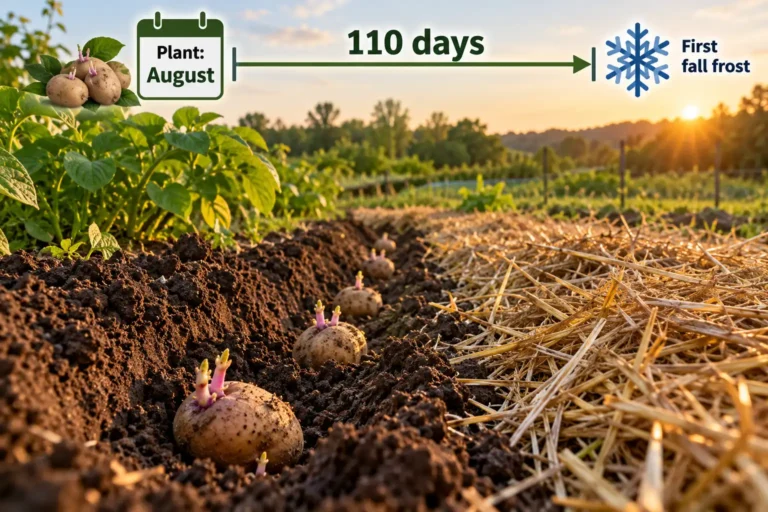
Use the regional potato planting schedule to coordinate seed preparation with the upcoming planting window. If planning a second crop, check the fall potato planting window before cutting.
How to Plant Cut Seed Potatoes
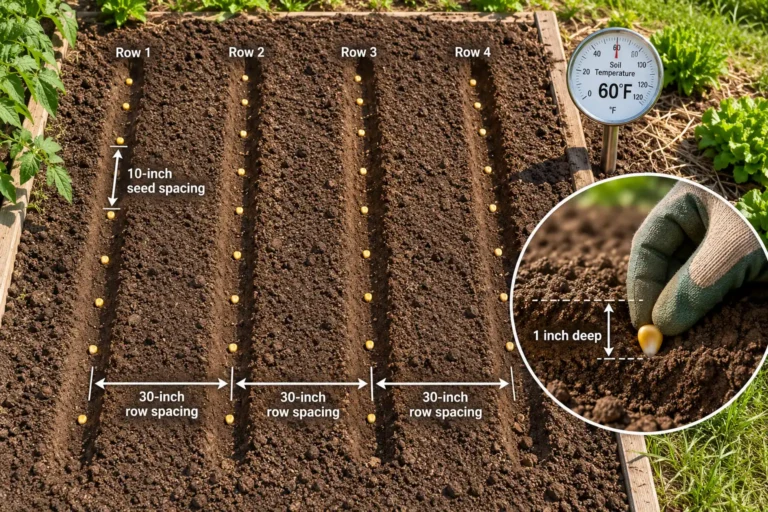
Plant the pieces with their cut surfaces facing down and their eyes pointing upward. Choose loose, well-drained soil that is moist but not saturated.
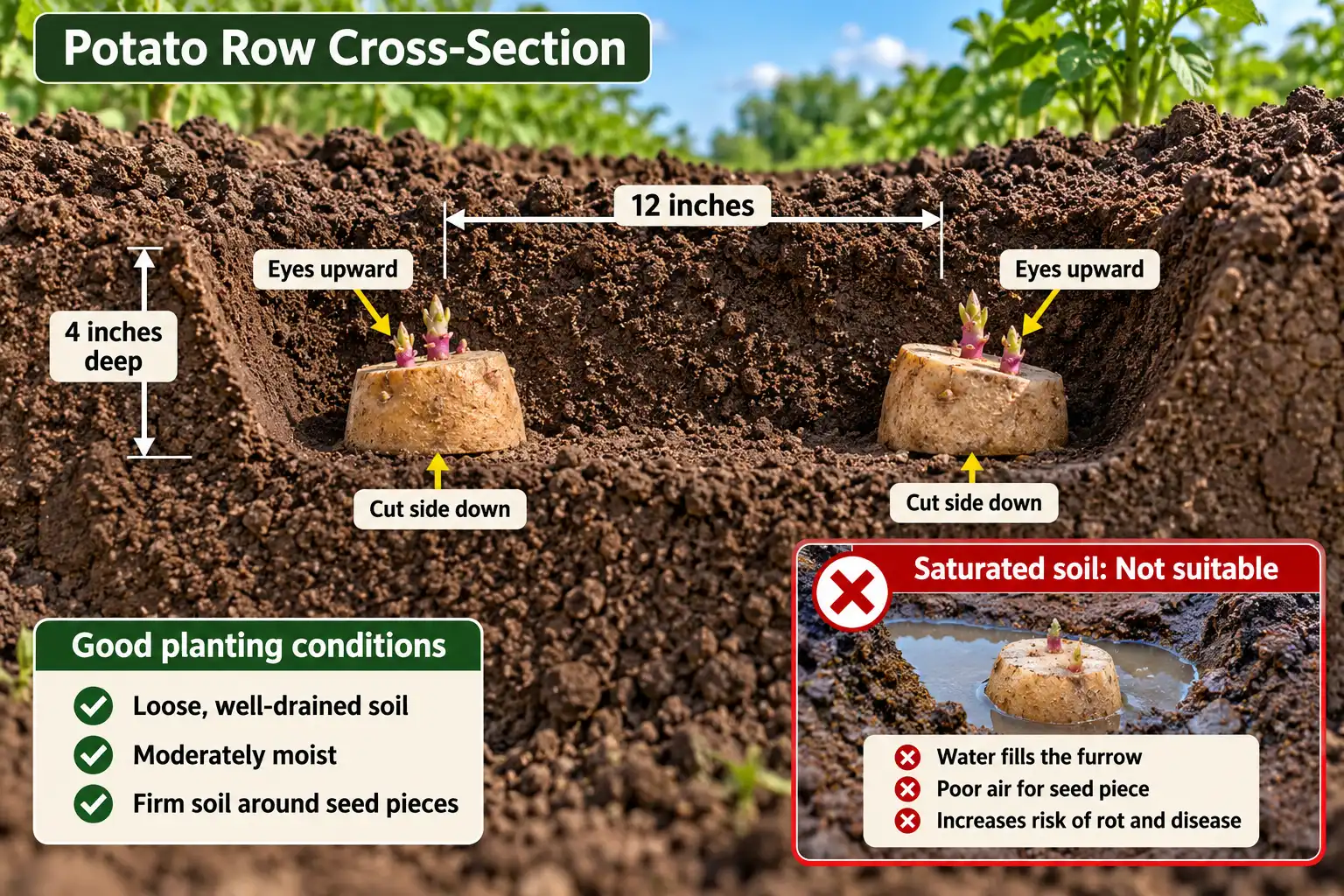
For a typical home garden, use these starting measurements:
| Planting detail | Recommended measurement |
|---|---|
| Furrow depth | 3 to 4 inches |
| Spacing within rows | 10 to 12 inches |
| Spacing between rows | 30 to 36 inches |
| Seed pieces per position | One |
University of Maryland Extension recommends planting seed pieces 3 to 5 inches deep, with adjustments for planting season and conditions.
Cover the pieces gently without compacting the soil. As plants grow, hill soil around the stems to protect developing tubers from sunlight.
How Much Cut Seed Potato Do You Need?
Calculate seed requirements using the number of planting positions and the average weight of each piece.
For an average 2-ounce piece:
| Planting area | Approximate pieces | Seed weight |
|---|---|---|
| 8-foot row, 12-inch spacing | 8 | 1 lb. |
| 4-by-8-foot bed, 2 rows | 16 | 2 lb. |
| 50-foot row, 12-inch spacing | 50 | 6.25 lb. |
| 100-foot row, 12-inch spacing | 100 | 12.5 lb. |
| 1 acre, 36-inch rows and 12-inch plant spacing | 14,520 | 1,815 lb. |
The bed example assumes two 8-foot rows, approximately 24 inches apart, with 12 inches between pieces.
Use this calculation:
Seed required (lb.) = Number of planting positions × Seed-piece weight (oz.) ÷ 16
For example, a 100-foot row with plants 12 inches apart needs about 100 pieces.
100 × 2 ÷ 16 = 12.5 pounds of seed potatoes.
For an acre, calculate planting positions from row and in-row spacing before converting the seed weight. The example above matches the spacing-based figures in Maine Extension’s seed requirement table.
These figures exclude sorting losses. Keep some additional certified seed available for damaged or rejected pieces.
Common Seed Potato Cutting Mistakes and How to Fix Them
Most failures result from undersized pieces, damaged eyes, infected seed, or unsuitable moisture conditions.
| Problem | Likely cause | What to do |
|---|---|---|
| Piece has no eyes | Incorrect cutting pattern | Reject the eyeless piece |
| Cut piece is very small | Too many cuts | Keep future pieces at least 1.5 ounces |
| Piece becomes shriveled | Warm, dry storage | Improve humidity and shorten storage |
| Cut surface becomes slimy | Decay or excessive moisture | Discard affected pieces |
| Seed rots after planting | Cold, wet soil or infected seed | Improve drainage and planting conditions |
| Sprouts break while cutting | Overgrown, fragile sprouts | Handle gently and cut with care |
Do not try to rescue rotten seed by trimming away discolored flesh.
For repeated seed decay, review seed quality, soil drainage, and planting temperature before making another planting.
Healthy seed and suitable soil conditions matter more than producing the maximum number of pieces from every tuber.
FAQs about Cut Seed Potatoes
Can I Cut Seed Potatoes Before the Eyes Sprout?
Yes, seed potatoes can be cut before visible sprouts appear if you can identify healthy eyes. Look for small buds or shallow dimples, and make sure every planting piece retains at least one.
Should I Wash Seed Potatoes Before Cutting?
No, washing seed potatoes before cutting is generally unnecessary and introduces extra surface moisture. Brush away loose soil, reject suspicious tubers, and use clean cutting equipment to reduce the risk of spreading disease.
Can I Use Grocery Store Potatoes as Seed Potatoes?
Certified seed potatoes are preferable because grocery-store potatoes may carry diseases or contain sprout inhibitors. Even potatoes that appear healthy can introduce pathogens, so choose inspected planting stock from a reliable seed supplier.
Can I Cut Seed Potatoes a Week Before Planting?
Yes, but holding cut pieces for a week requires suitable temperature, humidity, and ventilation. Without controlled storage, cutting closer to planting is preferable because the pieces can lose moisture, develop rot, or age prematurely.
Do I Need Sulfur or Wood Ash on Cut Seed Potatoes?
No, neither material is required for every healthy seed piece. Start with certified seed, clean cuts, and suitable curing conditions. If a seed treatment is necessary, use only products labeled for potatoes.
Key Points for Preparing Seed Potatoes
Start with firm, certified seed and inspect the eyes before cutting. Keep small tubers whole, make larger pieces thick and blocky, and avoid unnecessary wounds.
For most home gardens, allow a short healing period and plant only when the soil is workable and adequately drained. Consistent seed-piece size and careful handling support more uniform emergence.