When to Plant Fall Potatoes: 110 Days Before Your First Frost

A fall potato crop has to sprout in late-summer heat and size its tubers before frost. That leaves a narrow window. Below is when to plant fall potatoes by state, how to count back from your frost date, and how to get seed that sprouts.
Plant fall potatoes about 110 days before your average first fall frost, per Texas A&M AgriLife. In most of Texas and Georgia, that means planting in August. Use small, whole seed potatoes that have already sprouted.
When to Plant Fall Potatoes
Plant about 110 days before the average first fall frost for your location, Texas A&M AgriLife advises. In most of Texas, that lands in mid-August.
The count matters because frost ends the season. Potato tops cannot withstand frost, per Texas A&M AgriLife, so the vines need to finish first. Texas A&M puts most varieties at 95 to 110 days from planting to digging. Clemson Extension, by contrast, gives potatoes 100 to 120 days to mature.
A true fall crop fits only part of the country. Where frost arrives in mid-October, 110 days back lands in late June. That is a late spring planting, not a second crop. Meanwhile, in the warmest regions, potatoes become a fall and winter crop, as the state table below shows.
Fall Potato Planting Dates by State
Extension services split on fall potatoes. Texas and Georgia publish August windows, while South Carolina advises against a fall crop.
| State or region | Fall planting guidance | Source |
|---|---|---|
| Texas, most areas | About 110 days before first frost, or mid-August | Texas A&M AgriLife |
| Texas, Lower Rio Grande Valley | Mid-December to late January instead | Texas A&M AgriLife |
| North Georgia | About 2 weeks earlier than middle Georgia, near August 1 | UGA Extension |
| Middle Georgia (Columbus to Augusta) | No later than August 15 | UGA Extension |
| Extreme south Georgia | Up to 2 weeks later than middle Georgia | UGA Extension |
| North Florida | January to February only | UF/IFAS Extension |
| Central Florida | November to February | UF/IFAS Extension |
| South Florida | October to January | UF/IFAS Extension |
| South Carolina | Not recommended | Clemson Extension |
| Mississippi | Grown mainly in spring; fall seed hard to find | Mississippi State Extension |
The split comes down to seed and pests, not the crop itself. Clemson Extension cites a higher risk of pest and disease problems in fall. Mississippi State Extension says good seed potatoes are impossible to find for fall planting. Texas A&M and UGA, meanwhile, publish fall dates and advise presprouting the seed. If your state is missing, use the count-back method below, then confirm the date with your county extension office.
How to Count Back From Your First Frost Date
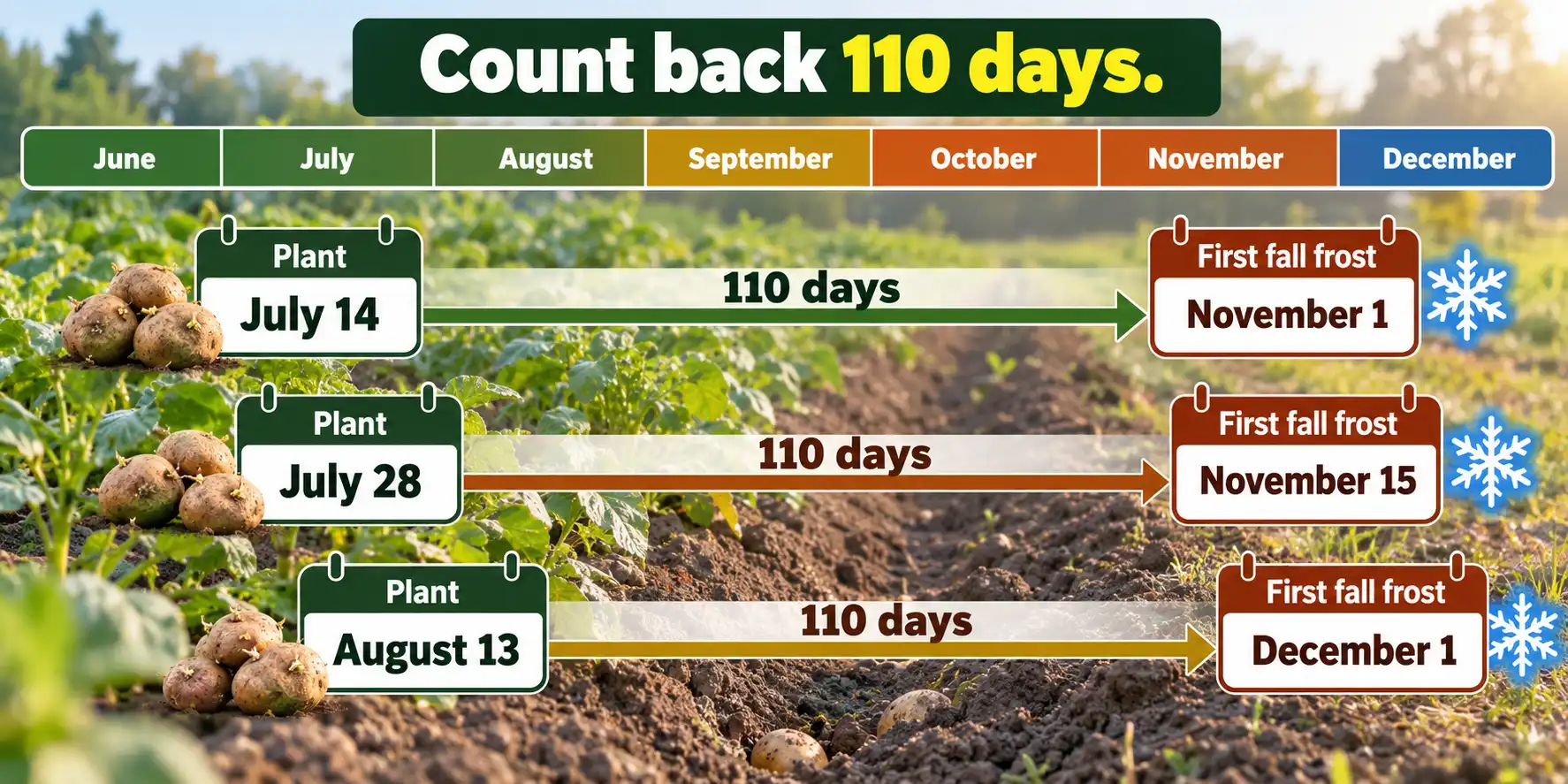
Count back 110 days from your average first fall frost, and plant on or before that date.
- Find your frost date. Many National Weather Service offices, part of NOAA, publish average first 32°F dates by station from 1991 to 2020 records.
- Subtract 110 days. That figure comes from Texas A&M AgriLife.
- Adjust for your variety. UGA Extension’s fall rule counts back a crop’s days to maturity plus 18 days. For a 95-day potato, that gives 113 days, close to Texas A&M’s figure. A 120-day potato, however, needs 138 days.
| Average first fall frost | Plant by (110 days earlier) |
|---|---|
| October 15 | June 27 |
| November 1 | July 14 |
| November 15 | July 28 |
| December 1 | August 13 |
| December 15 | August 27 |
So a November 15 frost means planting by late July. Frost dates are averages, though, and UGA Extension notes that not every year follows them. The NWS tables also show an earlier date, reached by the first freeze in only 1 year out of 10. For a safety margin, count back from that date instead.
How to Get Seed Potatoes That Sprout in August
Buy seed in spring, then break its dormancy before planting. Seed is the hardest part of a fall crop.
Buy Seed in Spring and Hold It Cold
Certified seed potatoes are easier to find in spring than in fall, per Texas A&M AgriLife. So buy extra in spring, and keep the fall share in a cool, humid spot, such as the bottom of a refrigerator.
Saving tubers from your own spring crop is riskier. Clemson Extension calls home-saved seed generally not worthwhile, because viruses and diseases often show up the next year. Texas A&M AgriLife also warns against saving seed potatoes for more than a year, since viruses build up and cut yield.
Presprout Small Whole Tubers for 2 Weeks
A freshly dug potato has a rest period, and it will not sprout until that breaks. Texas A&M AgriLife says small, mature tubers break rest most easily. So pick seed about 1.5 inches across. Then hold it warm and damp for 2 weeks, in shade under moist burlap bags or mulch. At planting, each tuber should show small sprouts. UGA Extension allows 2 to 3 weeks for sprouting.

How to Plant Fall Potatoes in Hot Soil
Plant small seed potatoes whole, mulch the bed, and keep moisture steady through late-summer heat.
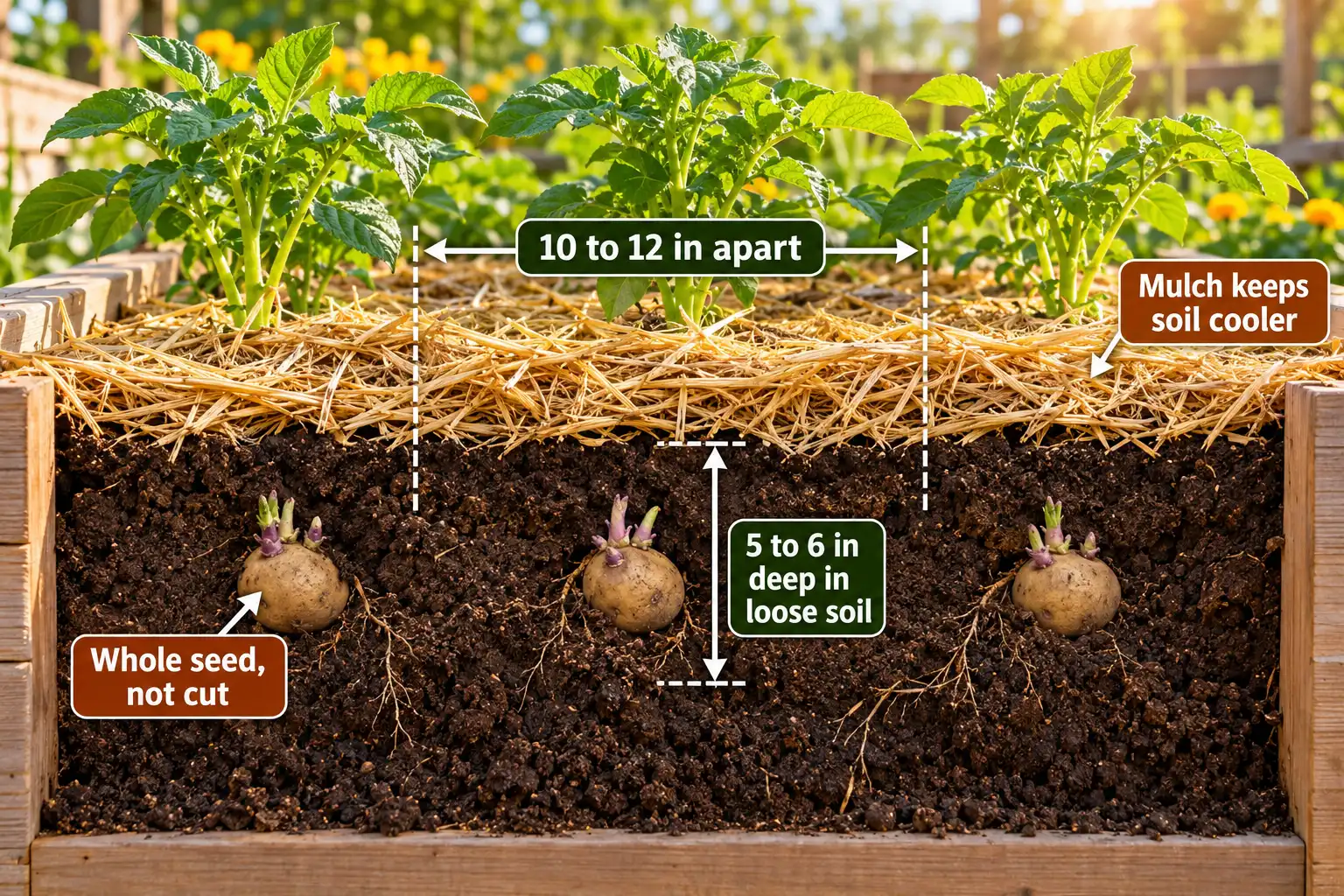
First, keep the seed whole. Texas A&M AgriLife notes that uncut potatoes resist rotting in hot weather better than cut pieces. So save cutting and curing seed pieces for spring.
Next, match planting depth to your soil. Clemson Extension plants potatoes 3 to 5 inches deep, but later crops 5 to 6 inches. Texas A&M AgriLife covers seed about 3 inches, though, and warns that deeper cover slows emergence and invites decay. So go deeper in loose, dry soil, which stays cooler and moister below the surface. In heavy or wet ground, stay shallow on a raised bed.
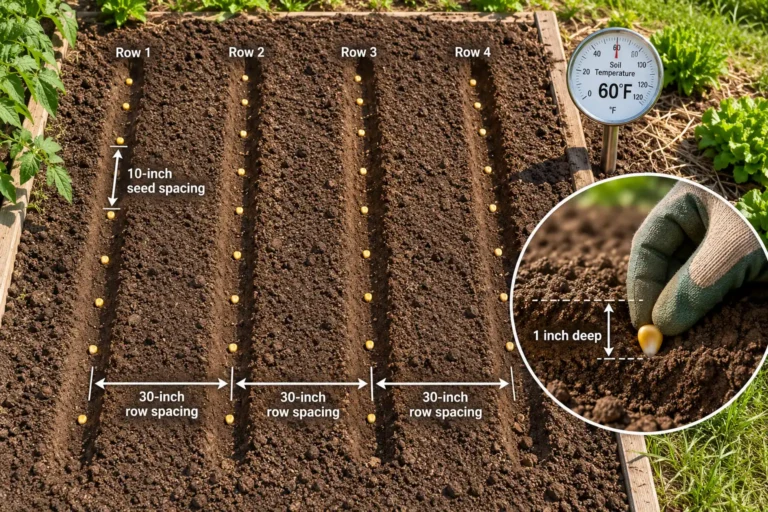
Space seed 10 to 12 inches apart, per Mississippi State Extension, or 8 to 10 inches, per Clemson.
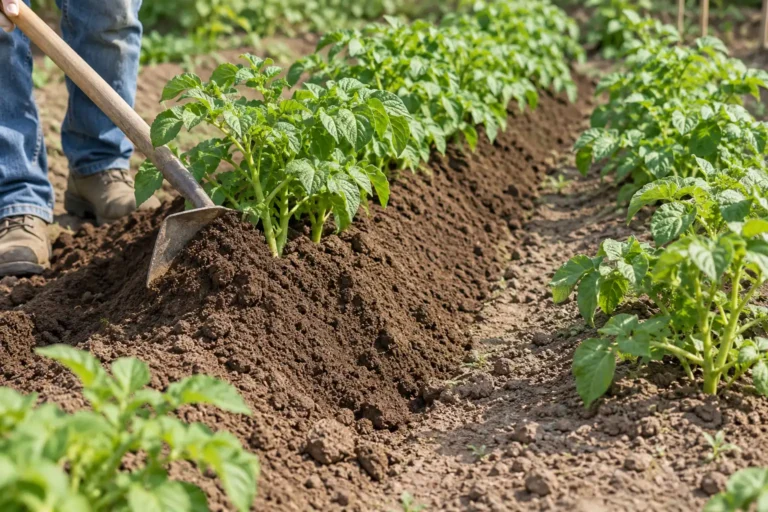
Then mulch. Clemson says mulch keeps soil cooler, and cool soil lets potatoes grow longer for a bigger harvest. Texas A&M adds a thick layer once plants reach 8 to 10 inches tall.
Finally, water evenly. Texas A&M warns that drought followed by watering cracks tubers. If the bed is dry at planting, UGA Extension suggests watering the open furrow, then planting and covering.
Before fertilizing, read your soil test, since Clemson calls it the best guide to a potato crop’s needs.
How Much Seed You Need for a Bed, Row or Acre
Plan on 10 to 12 pounds of seed potatoes per 100 feet of row. Mississippi State Extension gives the low end, and Clemson Extension the high end. Here is that range at other scales.
| Planting area | Row length | Seed potatoes |
|---|---|---|
| 4 by 8 ft bed, two rows | 16 ft | 1.6 to 1.9 lb |
| 100 ft of row | 100 ft | 10 to 12 lb |
| 1 acre, 36-inch rows | 14,520 ft | 1,450 to 1,740 lb |
That bed holds 16 to 20 small tubers at 10 to 12 inch spacing. Commercial plans run heavier, though. UF/IFAS Extension budgets 2,000 to 3,000 pounds per acre, with larger 2.5 to 3 ounce seed pieces at 7 to 10 inch spacing.
Why Fall Potato Crops Fail
Most fall failures trace back to heat, wet soil or seed that never broke dormancy. Match the symptom to its fix below.
| What you see | Likely cause | What to change |
|---|---|---|
| Seed rots before plants emerge | Cut seed in hot soil, or heavy, wet ground | Plant small whole seed on a raised bed |
| No sprouts after several weeks | Seed still dormant, or sprout-treated grocery potatoes | Presprout certified seed 2 weeks before planting |
| Frost kills vines before tubers size | Planted too late for the variety | Count back 110 days, or more for a late variety |
| Tubers sprout in the ground | Rain during hot weather broke their rest | Mulch and keep moisture even |
| Cracked or knobby tubers | Drought followed by heavy watering | Water on a steady schedule |
| Colorado potato beetle, leafhopper or blight damage | Higher fall pest and disease pressure | Scout weekly and rotate beds |
Mississippi State Extension ties seed piece rot to clay, wet soils. Texas A&M AgriLife links tuber sprouting to rain in hot weather, and cracking to uneven moisture. Clemson Extension, meanwhile, names pest and disease risk as its reason to skip fall planting. For rotation, Texas A&M plants potatoes in the same spot only once every 3 years.
When to Harvest Fall Potatoes
Dig storage potatoes about two weeks after the vines die, per Clemson Extension. In a fall crop, frost usually ends the vines for you.
Before digging, check the skin. Texas A&M AgriLife calls the skin set when it no longer scrapes off under your thumb. Then dig when the soil is moist but not wet. Wet soil sticks to tubers, while dry clods bruise them, Texas A&M notes.
For storage, Clemson suggests 40 to 50°F with about 90% relative humidity, which holds potatoes six to eight months. Warmer storage, by contrast, invites sprouting.
FAQs About Planting Fall Potatoes
Can you plant grocery store potatoes in the fall?
No, buy certified seed potatoes from a garden center or seed supplier. Mississippi State Extension warns that store potatoes may carry a sprout-suppressing treatment and may be a variety poorly suited to your area.
Can I replant potatoes from my spring harvest?
Only after their rest period breaks, and small, mature tubers break it most easily, per Texas A&M AgriLife. Even then, Clemson Extension discourages home-saved seed, because viruses and diseases often appear the next year.
How late can you plant fall potatoes?
Plant no later than about 110 days before your average first frost, per Texas A&M AgriLife. In middle Georgia, UGA Extension sets August 15 as the last date, with north Georgia about two weeks earlier.
Can you plant potatoes in September?
Only where your average first frost falls after about December 20, by Texas A&M AgriLife’s 110-day rule. Farther south, UF/IFAS Extension starts south Florida plantings in October and central Florida plantings in November.
Which potato varieties suit a fall crop?
Pick an early variety so the vines finish before frost; Mississippi State Extension lists Norland and Norchip as early types. None of the guides cited here names varieties tested for August planting, though.
What to Check Before You Plant
Start with your average first frost date, then count back 110 days. If that date lands in June, your area suits a spring crop instead. Otherwise, check your state’s guidance, since Clemson Extension advises against a fall crop in South Carolina. Then buy certified seed in spring and presprout small whole tubers for two weeks. Beyond timing, a fall crop follows spring potato growing with three changes: whole seed, presprouting and mulch.