What Is Field Corn? Definition, Uses, and Key Differences
Field corn is the starchy corn grown across millions of American acres. Unlike sweet corn, it is primarily grown for livestock feed, ethanol, and processed foods. Its kernels usually mature and dry before harvest, although some crops are harvested earlier for silage.
Field corn is maize grown mainly for its mature, starch-rich grain rather than fresh eating. Most U.S. field corn is dent corn, used for animal feed, ethanol, and food processing. Some is harvested as whole-plant silage.
What Is Field Corn and Why Is It Called Dent Corn?
Field corn is a type of maize (Zea mays) grown mainly for grain production, livestock feed, and industrial processing.
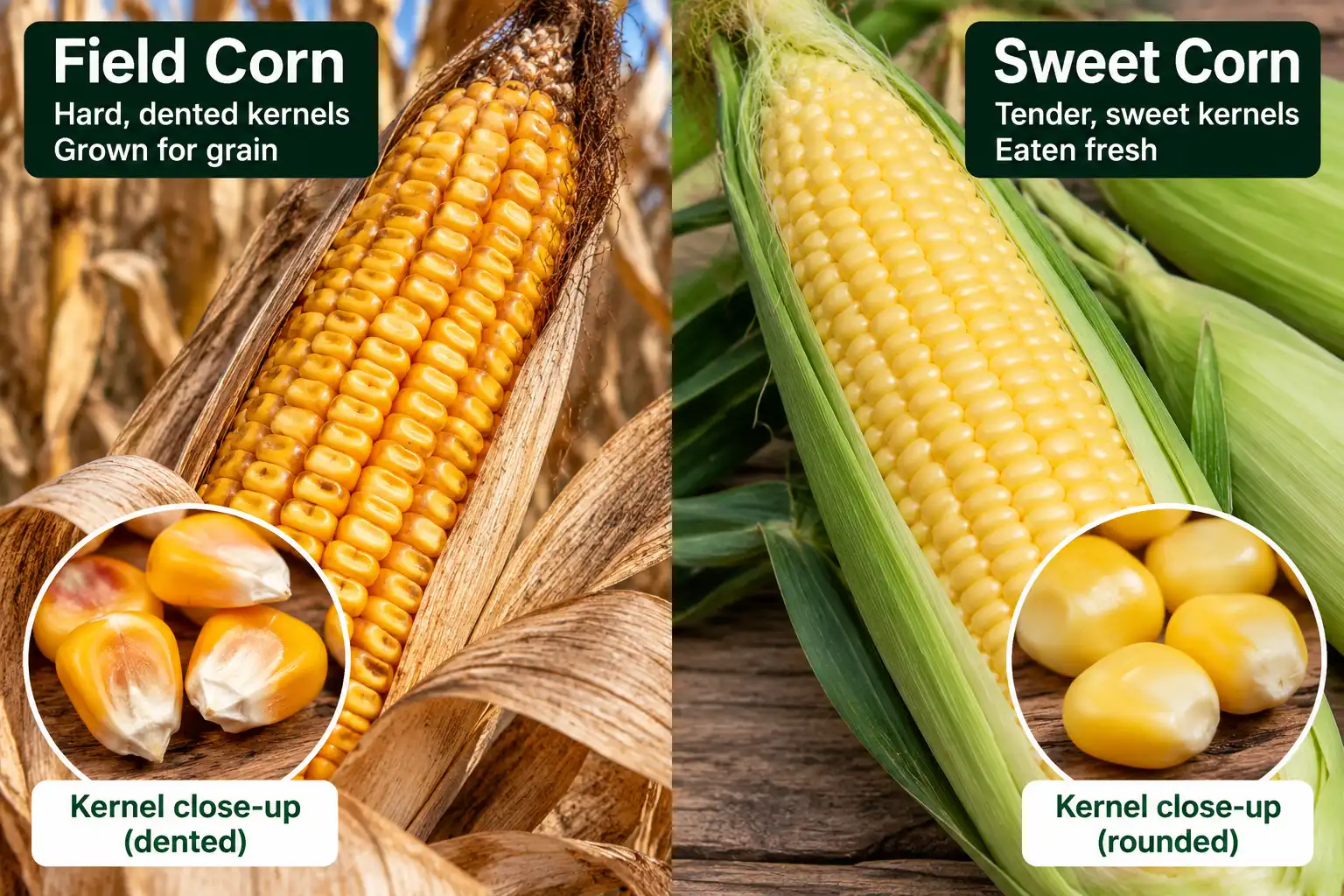
Most commercial field corn in the United States is yellow dent corn. Its name comes from the small indentation that develops at the top of each kernel as it matures.
This dent forms because the softer starch inside the kernel shrinks during drying. The result is a hard, starch-rich grain that stores well after drying.
Field corn typically has these characteristics:
- Hard kernels containing substantial amounts of starch.
- Large ears with tightly packed kernels.
- Green stalks that eventually turn brown as the crop matures.
- Kernels commonly harvested after reaching physiological maturity.
Not every field corn variety has yellow kernels. White dent corn and specialty grain varieties are also grown for particular food and processing markets.
As Mississippi State University Extension explains, field corn supplies animal feed, ethanol, cereals, cornmeal, and other processed products.
The term field corn describes the crop’s agricultural use. Dent corn describes a particular kernel type.
Field Corn vs. Sweet Corn vs. Popcorn
Field corn, sweet corn, and popcorn belong to the same species, but they differ in kernel composition, harvest timing, and intended use.
| Feature | Field corn | Sweet corn | Popcorn |
|---|---|---|---|
| Main characteristic | Starchy kernels | Sugary, tender kernels | Kernels that expand when heated |
| Harvest stage | Usually mature and relatively dry | Immature milk stage | Mature and dried |
| Kernel texture | Hard after drying | Soft and juicy when fresh | Hard with a strong outer hull |
| Main purpose | Feed, fuel, processed foods | Fresh, canned, frozen foods | Popped snacks |
| Fresh eating | Not preferred | Yes | No |
Why Is Sweet Corn Sweeter?
Sweet corn contains genetic traits that slow the conversion of sugar into starch during kernel development.
Field corn develops more starch and contains less sugar at the comparable immature stage.
According to Penn State Extension’s sweet corn production guide, sweet corn varieties differ in their sugar-related genetics.
For example, Silver Queen is a traditional sugary sweet corn cultivar. Vision belongs to a supersweet breeding category.
Neither behaves like ordinary yellow dent corn.
As a result, picking field corn early does not turn it into sweet corn.
What Is Field Corn Used For?
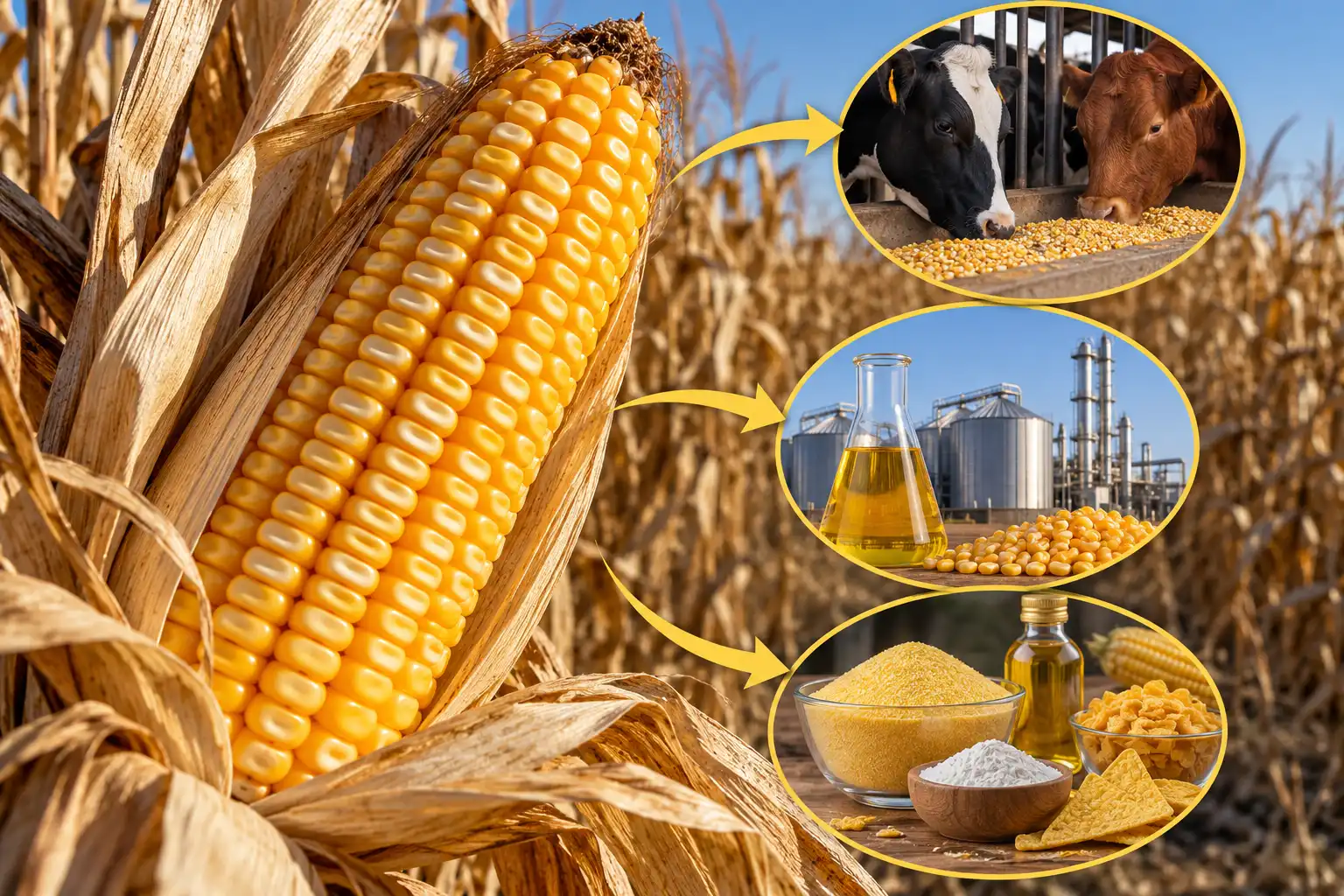
Field corn supplies livestock feed, transportation fuel, food ingredients, and industrial raw materials.
The USDA Economic Research Service identifies livestock feed and fuel ethanol as major U.S. corn markets. Feed accounts for approximately 40% of domestic corn use, while ethanol is the largest industrial outlet.
1. Livestock Feed
Field corn provides an energy-rich ingredient for cattle, pigs, and poultry.
It can be processed into ground feed, cracked grain, or other feed products. The whole plant can also be chopped and fermented into corn silage, particularly for dairy and beef cattle.
Corn ethanol processing produces distillers grains, another livestock feed ingredient.
2. Ethanol Production
Fuel ethanol is produced by fermenting sugars obtained from corn starch.
The ethanol is primarily used as a component of gasoline blends. Processing also produces feed ingredients and other recoverable products.
3. Human Food Products
Food-grade field corn is used to manufacture familiar foods.
Dry milling produces cornmeal, grits, corn flour, and certain breakfast cereals.
Wet milling separates components used to manufacture corn starch, glucose, sweeteners, and corn oil.
White and yellow dent corn can also be processed for particular food markets.
Therefore, field corn is not simply animal feed. Many corn-based foods originate from field corn rather than sweet corn.
4. Industrial Products
Corn starch and other corn-derived materials are used in adhesives, paper processing, fermentation products, and selected biodegradable materials.
The intended market influences grain quality requirements and the processing methods used.
How Does Field Corn Grow and Reach Maturity?
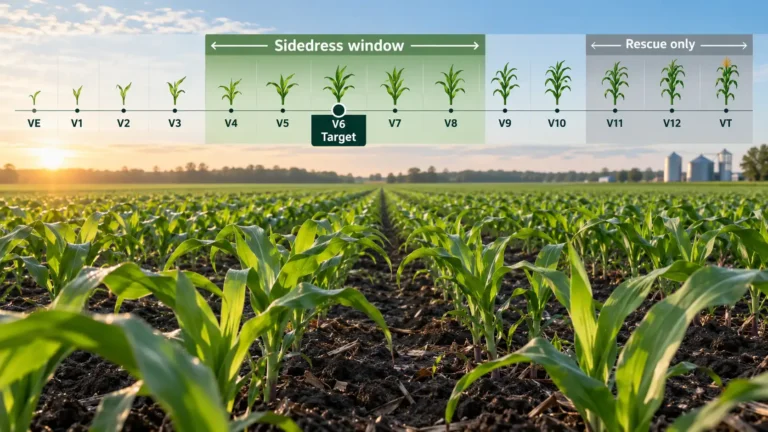
Field corn develops through vegetative growth, pollination, grain filling, and physiological maturity.
After emergence, the plant produces leaves and roots before developing a tassel. The tassel releases pollen, which fertilizes silks emerging from the ears.
The resulting kernels accumulate starch as the crop matures.
Field Corn Growth and Harvest Stages
The University of Minnesota Extension’s corn development guide describes these reproductive stages.
| Growth stage | Approximate timing | What happens |
|---|---|---|
| R1: Silking | Beginning of reproductive growth | Pollination and kernel formation begin |
| R3: Milk | 18 to 20 days after silking | Kernels contain milky liquid |
| R5: Dent | 35 to 42 days after silking | Kernels develop dents and continue filling |
| R6: Physiological maturity | 55 to 65 days after silking | Kernel dry matter reaches its maximum; black layer develops |
| Grain harvest | After R6 and additional drying | Mature grain is collected by combine |
These figures describe development after silking, not days after planting.
Weather, hybrid maturity, and soil moisture influence how quickly the crop reaches each stage.
Importantly, physiological maturity does not mean the grain is dry enough for safe storage.
How Is Field Corn Harvested for Grain and Silage?
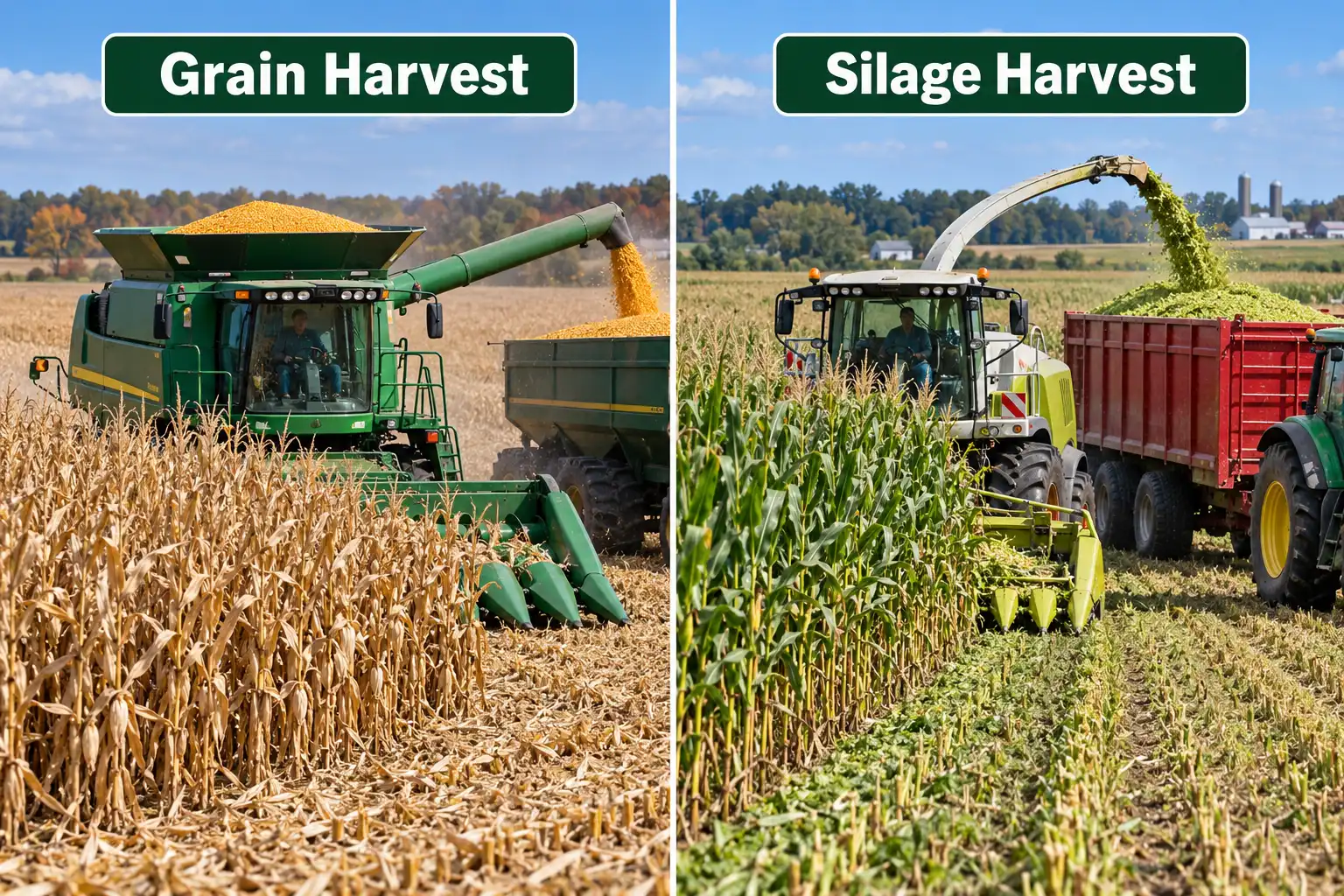
Field corn has two major harvest paths: collecting mature kernels for grain or chopping the whole plant for silage.
Field Corn Grain Harvest
A combine removes ears, separates kernels from the cob, and collects shelled grain.
Growers may harvest at approximately 20% to 25% kernel moisture when suitable drying equipment is available. Others allow additional field drying.
Storage moisture depends on storage duration and temperature.
Iowa State University Extension recommends approximately 14.5% to 15.5% grain moisture for corn stored into summer under Iowa conditions.
Field Corn Silage Harvest
Corn silage uses the chopped stalks, leaves, cobs, and kernels.
It is harvested while the plant still contains enough moisture for effective packing and fermentation.
Penn State Extension recommends 65% to 70% whole-plant moisture for horizontal silos. Conventional upright silos have a lower recommended range of 63% to 68%.
These percentages measure moisture in the entire chopped crop, not just the kernels.
For silage, test whole-plant moisture instead of judging harvest readiness by leaf color alone.
Where and How Is Field Corn Grown in the United States?
Field corn grows throughout much of the United States, especially across the Corn Belt, but planting dates vary considerably by region.
Regional Planting Differences
| Region | Typical planting consideration |
|---|---|
| Mississippi and the Mid-South | Corn planting commonly begins in mid- to late March |
| Iowa and central Corn Belt | Plant during spring when soils are warm and workable, often from mid-April into May |
| New York and Northeast | Late April or early May planting is favorable when soil conditions permit |
| Minnesota and northern Corn Belt | Late April or early May is generally favorable; delayed planting may require earlier-maturing hybrids |
These windows reflect guidance from Mississippi State Extension, Iowa State Extension, Cornell University, and University of Minnesota Extension.
Soil condition matters more than following a date alone.
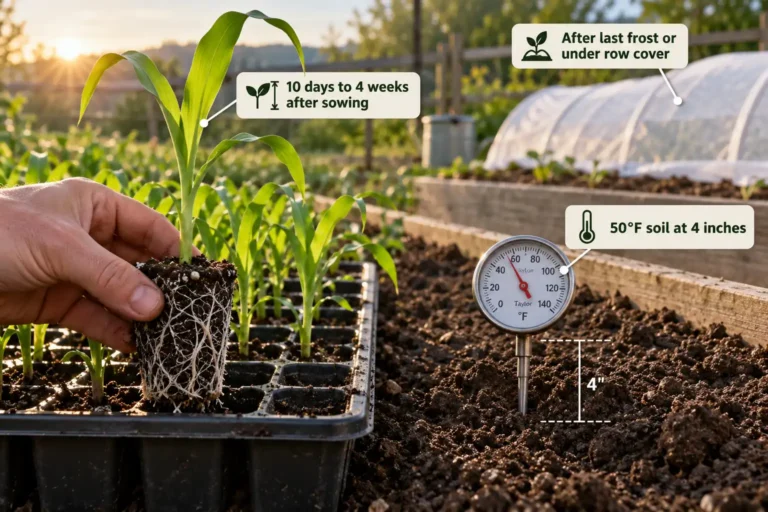
Iowa State recommends corn planting when soil temperatures rise above approximately 50°F, with a warming forecast over the following 3 to 7 days.
For planting depth, Minnesota Extension recommends approximately 1.75 to 2 inches under most conditions. Cornell’s guidance ranges from 1.5 to 2.5 inches across different soils and planting dates.
Avoid compacting wet soil during planting.
Before selecting a hybrid, review corn establishment and seasonal care and confirm that its relative maturity fits the local frost-free season.
How Much Field Corn Is Planted Per Acre?
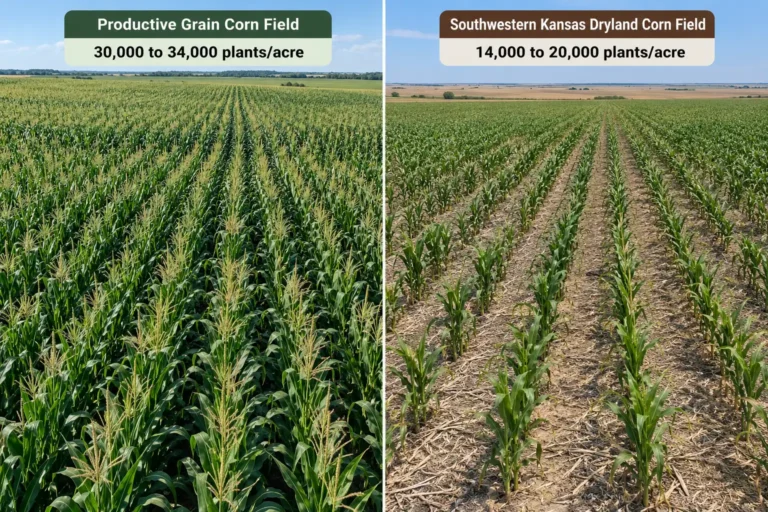
Field corn planting density depends on soil productivity, hybrid characteristics, and the expected growing conditions.
The University of Minnesota Extension recommends approximately 34,000 to 36,000 planted seeds per acre for many Minnesota fields.
Cornell reports that 26,000 to 28,000 harvested plants per acre can be economically appropriate on many New York soils.
These figures differ because one describes seeds planted and the other describes established plants. Local yield potential also differs.
Example: Convert Seeds Per Acre to Row Spacing
Assume a planting rate of 34,000 seeds per acre with 30-inch rows.
A 30-inch row spacing occupies 2.5 feet of field width.
Row length per acre:
43,560 square feet ÷ 2.5 feet = 17,424 linear row feet.
Seeds per 100-foot row:
34,000 ÷ 17,424 × 100 = approximately 195 seeds.
That equals roughly 6.2 inches between planted seeds within each row.
This calculation converts an example planting rate, not a universal recommendation.
For fertility planning, start with interpreting a soil test and calculating fertilizer requirements per corn acre.
Nitrogen management must also match crop demand and field conditions. The timing of an in-season nitrogen application can influence how effectively the crop uses applied fertilizer.
How Is Field Corn Yield Measured?
U.S. field corn grain yields are commonly reported in bushels per acre.
According to Penn State Extension’s grain marketing guidance, the standard corn bushel represents 56 pounds of shelled grain at 15.5% moisture.
For example:
180 bushels per acre × 56 pounds = 10,080 pounds of standardized shelled grain per acre.
This is a unit conversion, not a predicted field yield.
Actual production depends on hybrid performance, plant population, weather, soil fertility, pests, and harvest losses.
Whole-plant silage is measured differently, commonly in tons of harvested forage or dry matter per acre.
Therefore, grain bushels and fresh silage tons should not be compared as though they measure the same product.
What Problems Can Affect Field Corn Quality?
Field corn can lose yield or quality through poor emergence, incomplete pollination, stalk damage, and grain deterioration.
Uneven Plant Emergence
Cold soil, saturated conditions, and inconsistent planting depth can delay emergence.
Check seed placement and soil conditions before assuming a problem is caused by poor seed quality.
Missing or Poorly Developed Kernels
High temperatures and drought around silking can interfere with pollination and kernel development.
Inspect several ears throughout the field. Missing tip kernels do not automatically indicate nutrient deficiency.
Ear Rot and Grain Contamination
Fungal diseases can damage field corn before or after harvest.
Mississippi State Extension’s aflatoxin guidance explains that hot, stressful growing conditions increase contamination risks in the Mid-South.
Aflatoxin cannot be ruled out by visual inspection alone.
Test suspect grain before using it for food or feed, and follow applicable safety standards. Dry harvested grain promptly to reduce storage deterioration.
Stalk Lodging Before Harvest
Weak stalks can fall before a combine reaches them.
Check stalk strength as the crop dries. Waiting for lower grain moisture may reduce drying expense but increase harvest losses when standability is poor.
FAQs about Field Corn
Can People Eat Field Corn?
Yes, food-grade field corn can be eaten after suitable processing and cooking, including as cornmeal, hominy, grits, or tortillas. However, untreated fresh ears are much starchier than sweet corn, and treated seed or contaminated grain must never be consumed.
Is All Field Corn Genetically Modified?
No, both genetically engineered and non-genetically engineered field corn varieties exist. The USDA Economic Research Service reports that more than 90% of U.S. corn acreage uses genetically engineered varieties, but individual seed genetics determine the crop’s status.
Can Field Corn Cross-Pollinate With Sweet Corn?
Yes, windblown pollen from field corn can affect kernel quality on sweet corn ears when flowering overlaps. Penn State Extension recommends adequate isolation, including 500 feet or a 12-day difference in silking for certain sweet corn types.
Can You Grow Field Corn in a Home Garden?
Yes, you can grow field corn in a garden with sufficient space, warmth, and fertile soil. Plant several adjacent rows for effective pollination, and select a grain variety if you intend to dry or mill the harvested kernels.
Does Field Corn Become Sweet Corn if Picked Early?
No, harvesting immature field corn does not change its genetic characteristics. Its young kernels may be softer than mature grain, but they generally lack the sweetness and tenderness of varieties specifically bred for fresh eating.
Is Field Corn the Same as Feed Corn?
Feed corn generally refers to corn intended for animal nutrition, and most conventional feed corn is field corn. However, field corn also supplies ethanol and food-processing markets, so the two terms do not describe exactly the same end uses.
Choosing Corn for the Intended Harvest
Choose sweet corn for tender ears and fresh eating. Choose field corn when the goal is mature grain, livestock feed, food-grade milling, or silage.
Before planting field corn, confirm the intended market, hybrid maturity, planting density, and harvest method. Make sure you can dry, store, or deliver the crop under suitable conditions.