When to Transplant Corn Seedlings: 10 Days to 4 Weeks, 50°F Soil

Corn is usually direct-seeded, but plug trays can give short-season and early-market growers an earlier harvest. Timing decides whether that works. Knowing when to transplant corn seedlings means tracking two clocks: roots in the cell and warmth in the soil.
Transplant corn seedlings 10 days to 4 weeks after sowing, before roots circle the cell. Set them out once soil at 4 inches reaches 50°F and frost has passed, or row cover is on hand. Smaller cells mean earlier moves.
When to Transplant Corn Seedlings: The Two Clocks
Transplant when the seedling and the bed are both ready. If either one lags, the plant stalls.
- The seedling clock: roots hold the plug together but have not started circling.
- The soil clock: soil at 4 inches reads 50°F or more, and frost has passed or row cover is ready.
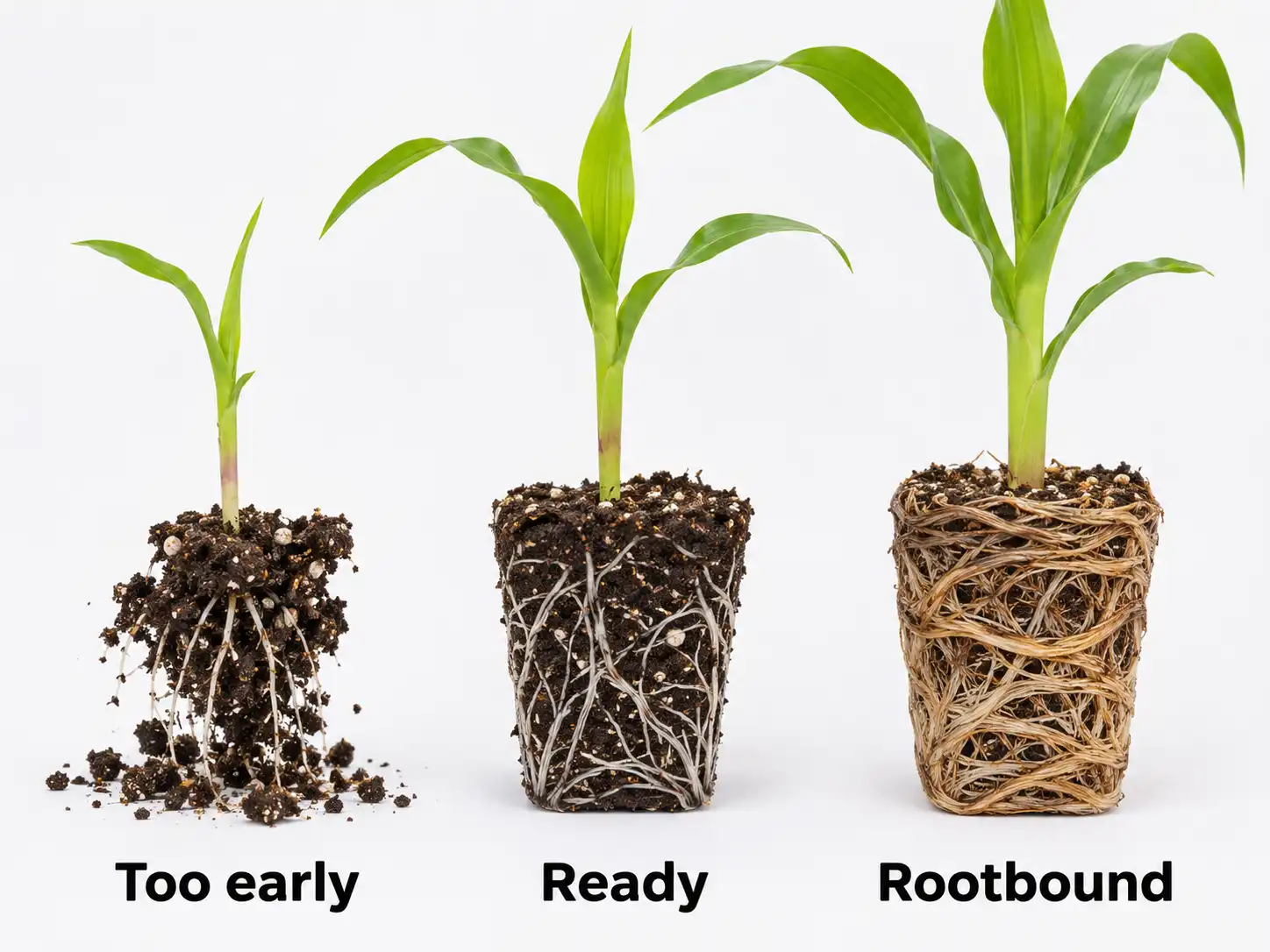
The seedling clock is the one you cannot pause. UConn Extension notes that growers who transplant sweet corn often end up with stunted plants. The cause is roots overcrowding the cells. So build the schedule around the plug’s deadline.
How Old Should Corn Seedlings Be at Transplant?
Corn seedlings are ready 10 days to 4 weeks after sowing. The range is wide because each extension guide assumes a different cell size.
| Source | Cell or container | Age at transplant |
|---|---|---|
| UNH Cooperative Extension | Cell large enough to avoid rootbinding (size not given) | 10 to 14 days |
| UVM Extension | 128-cell tray, 2-inch-deep cells | 14 to 18 days, up to 20 for slow varieties |
| UConn Extension | Deep 72-cell plug tray | 2½ to 4 weeks |
| MSU Extension | Not specified | 3 to 4 weeks |
Read the table as a rule about root room, not a disagreement about corn. More soil per cell buys more days. For example, a UVM Extension case study found plugs from roomier 98-cell trays easier to handle than plugs from 162-cell trays. They also grew faster after transplanting.
Variety shifts the date, too. UVM Extension found vigorous varieties such as Temptation and Arrowhead ready at about 16 days. Kristine and Mystique, on the other hand, needed up to 20 days.
Signs a Corn Seedling Is Ready
A ready seedling lifts out of its cell with the root ball intact. Before you plant, check three things:
- The plug slides out whole when you tug the stem gently.
- White roots reach the bottom and sides of the cell but do not spiral.
- Height suits the cell. At a UConn Extension case-study farm, plugs from deep 72-cell trays stood 6 to 10 inches tall. Expect shorter plugs from smaller cells.
None of these guides gives a leaf count for readiness. Instead, published advice tracks age and roots, so judge by the roots.
How Warm Should the Soil Be for Corn Transplants?
Soil should read at least 50°F at a 4-inch depth. Clemson Cooperative Extension sets that floor for sweet corn. Likewise, UNH Cooperative Extension gives the same 50°F minimum for germination and growth, and calls 60 to 85°F ideal.
Transplants change the picture for supersweet corn. Clemson advises waiting for 65°F soil before sowing extra-sweet (sh2) varieties, which germinate poorly in cold ground. A plug, however, has already germinated in the tray. That is why UVM Extension lists avoiding cold-soil germination problems as a main reason to transplant. In short, the 65°F rule is a seed rule, while the 50°F floor still applies to roots.
Even so, roots grow slowly near that floor. When the forecast allows, aim closer to 60°F, the bottom of UNH’s ideal range.
To measure, push a soil thermometer 4 inches deep. Then read it early in the morning, when soil is coolest, for three or four days running.

Can Corn Transplants Survive a Frost?
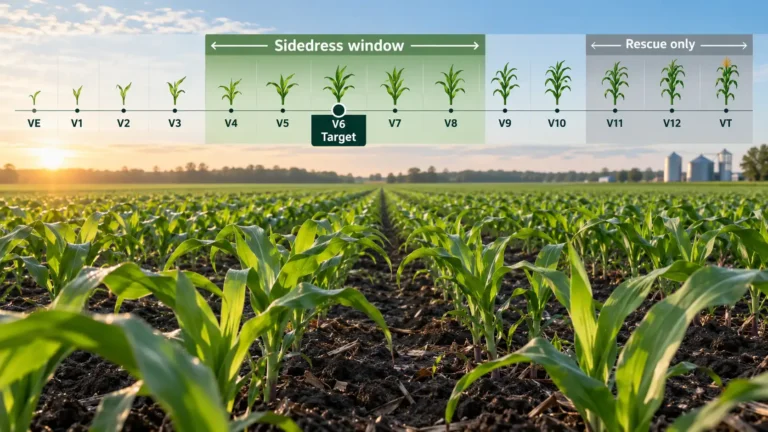
Yes, young corn usually survives a light frost. UNH Cooperative Extension explains that outer leaves shelter the growing point. Purdue Extension adds that the growing point stays below the soil surface until about the V5 stage. Still, Purdue warns that 28°F or colder for several hours can reach it, especially in dry soil.
That gives a working rule. If the forecast reads 28°F or lower, cover the planting or wait. At a farm profiled by UConn Extension, floating row cover protected transplants to 28°F. On colder nights, overhead irrigation took over.
After a hard night, wait several days before you judge the damage. Purdue Extension says a healthy growing point stays firm and yellowish-white, while mushy or discolored tissue signals trouble.
How Long to Keep Row Cover On
Keep row cover on for 3 to 4 weeks, until plants outgrow it, per UNH Cooperative Extension. In UVM Extension’s case study, the grower pulls it aside at two to three weeks for cultivation and sidedressing nitrogen. Then he puts it back for a couple more weeks.
How to Time Your Sowing Date
Count back from the field date, not forward from the seed packet.
- Pick the field date. Choose the week soil at 4 inches holds 50°F and your average last frost has passed. With row cover on hand, you can go a little earlier.
- Subtract seedling age. Use the age for your cell size from the table above.
- Fit hardening off inside that window. The last several days happen outdoors.
- Stagger trays. The UConn Extension case-study farm sows a new round every 10 days from April 1, which also spreads out harvest.
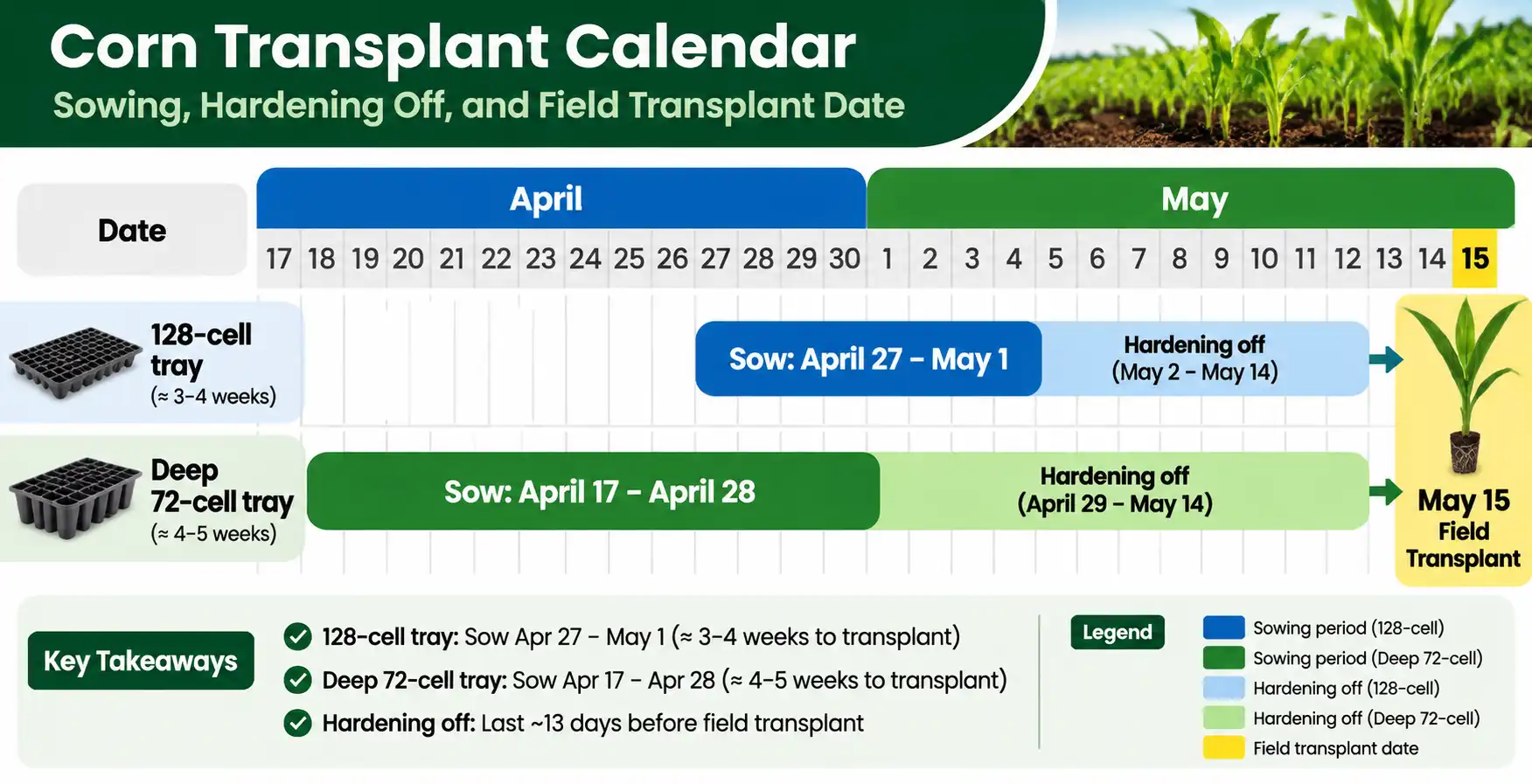
For a May 15 field date, the math looks like this. In 128-cell trays at UVM’s 14 to 18 days, sow between April 27 and May 1. In deep 72-cell trays at UConn’s 2½ to 4 weeks, sow between April 17 and April 28.
Sometimes plugs hit their window a few days before soil reaches 50°F. In that case, black plastic and row cover beat holding the plugs. UConn Extension notes that both warm the soil and air, while a longer hold only crowds the roots.
How to Harden Off and Plant Corn Transplants
- Harden off for several days. Move trays outdoors once weather settles. UVM Extension’s case study also limits water at this stage so seedlings stiffen for handling.
- Water the day before. Moist plugs slide out whole and hold together in the hole.
- Set plugs level with the soil. UConn Extension cautions against burying the top of the plug and the growing point.
- Water in right away. The UConn case-study farm waters in with 10-52-10 starter at 3 pounds per 150 gallons. In a watering can, that works out to about 1/3 ounce by weight per gallon.
- Cover if nights stay cool. Lay floating row cover the same day, and leave slack for growth, as UNH Cooperative Extension advises.
How Far Apart to Plant Corn Transplants
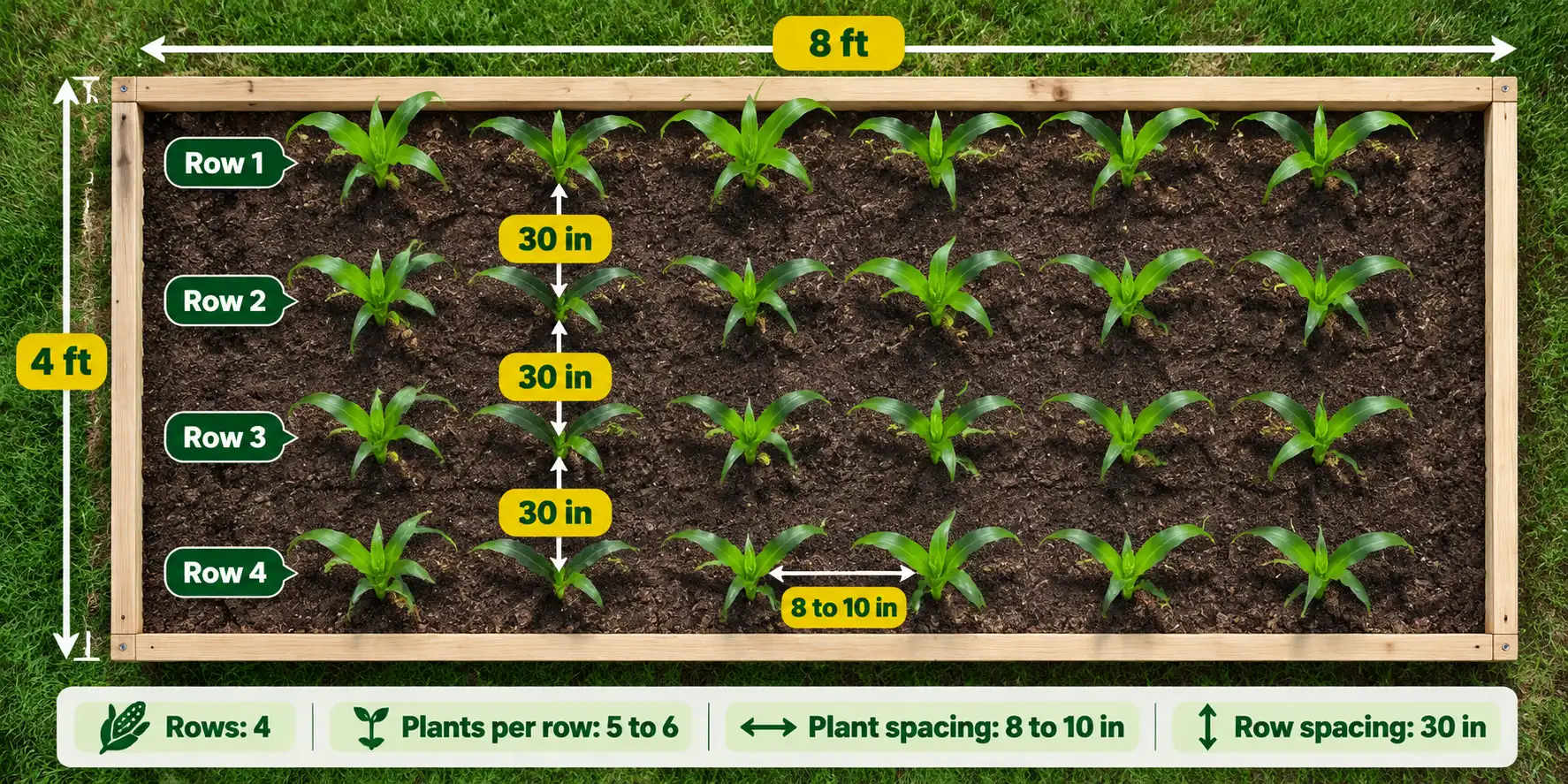
Space transplants 8 to 10 inches apart in rows 2½ to 3 feet apart, per UNH Cooperative Extension. Also, plant a block of short rows instead of one long row. Corn is wind-pollinated. Clemson Cooperative Extension notes that blocks of several rows give fuller ears than one or two long rows.
Fitting Transplants in a 4 by 8 Raised Bed
Run the rows across the 4-foot width, not down the 8-foot length. At UNH’s 30-inch row spacing, four short rows fit in 8 feet. Each 4-foot row then holds 5 or 6 plants at 8 to 10 inches apart. That gives 20 to 24 transplants in a compact block.
MSU Extension’s square-foot guide packs tighter, at one plant per square foot, or 32 per bed. Clemson also spaces early, small varieties closer. So use the lower count for full-size varieties and the higher count for short, early ones. Because UNH puts home-garden yield at one to two ears per plant, one bed returns roughly 20 to 64 ears.
Also, start a half dozen extra plugs. They replace any seedling that fails and serve as same-age fillers for gaps.
Can You Transplant Corn Into Gaps in a Row?
Yes, but only with plugs as old as their neighbors, and only within about two weeks of planting. A plant that starts behind rarely catches up. The National Corn Handbook guide on uneven emergence, hosted by Purdue Extension, measured the cost. Stands where some plants emerged 1½ weeks late lost 6 to 8 percent of yield. Still, the same guide says filling in a thin stand can work within 2 weeks of the original planting.
The move from tray to soil can also slow a plug for a few days. So sow backup plugs the day you seed the bed, and fill gaps as soon as the stand emerges. For a field with large gaps, weigh a replant against the yield cost of planting corn late instead.
Is Transplanting Corn Worth It?
For early sweet corn, often yes. For field corn, rarely.
UVM Extension’s case study found transplanted sweet corn reached harvest about two weeks ahead of direct seeding. Against direct seeding under row cover, though, the lead shrank to about one week. Transplants also gave a fuller stand and a head start on weeds.
The cost is trays and labor. At UVM’s spacing of 16 inches in 36-inch rows, one acre took 82 trays of 128 cells, roughly 21,000 plants. Producing them added about 50 percent to the cost of direct seeding under row cover.
That trade can pay for July sweet corn sold by the dozen. However, it rarely pays for field corn, which needs higher plant populations per acre and sells by the bushel. Where margins are thin, direct seeding corn under row cover captures about half the head start for far less work.
Climate matters as well. Both case studies come from New England, where cold May soil slows direct-seeded corn. Where soil warms early, as across much of the South, the payoff shrinks.
Why Corn Transplants Stall
Most transplant failures trace back to timing. Match the symptom to its cause below.
| Symptom | Likely cause | What to do |
|---|---|---|
| Short plants with ears near the ground | Plugs held too long, so roots crowded the cell | Transplant on schedule or use deeper cells (UConn Extension) |
| Bleached or brown leaves after a cold night | Frost on leaf tissue | Wait several days, then check for a firm, yellowish-white growing point (Purdue Extension) |
| Plants wilt or snap at planting | Hardening off skipped or cut short | Give trays several days outdoors with less water (UVM Extension) |
| Gap fillers stay small with poor ears | Set out behind their neighbors | Use same-age plugs within 2 weeks of planting (National Corn Handbook) |
| Seedlings chewed in the tray | Rodents | Raise trays on benches and set traps (UVM Extension) |
FAQs About Transplant Corn Seedlings
Can you transplant corn seedlings?
Yes, UNH Cooperative Extension says corn transplants successfully, and New England growers use plugs for early sweet corn markets. The catch is moving plugs before roots crowd the cell, usually 10 days to 4 weeks after sowing.
How tall should corn seedlings be before transplanting?
Plugs from deep 72-cell trays go out at 6 to 10 inches tall, per UConn Extension. Smaller cells reach readiness younger and shorter, so judge by whether the root ball holds together rather than by height.
How long can corn seedlings stay in cell trays?
About 14 to 18 days in 128-cell trays and up to 4 weeks in deep 72-cell trays, per UVM and UConn Extension. Held longer, roots crowd the cell and plants stunt after transplanting.
Should I transplant supersweet corn instead of direct seeding?
Often, yes, where springs run cool, since Clemson Cooperative Extension says extra-sweet seed needs 65°F soil. A transplant has already germinated, and UNH puts the floor for root growth at 50°F.
Will a light frost kill corn transplants?
Usually not, because the growing point stays below ground until about V5, per Purdue Extension. Frost mostly burns leaves, but cover plants or delay planting if the forecast reaches 28°F or colder.
How much earlier does transplanted corn ripen?
About two weeks earlier than direct-seeded corn, according to a UVM Extension case study. Direct seeding under row cover closes about half that gap, leaving transplants roughly one week ahead.
What to Check Before You Plant
Check the plug first. If the root ball lifts out whole and roots have not started circling, the seedling is ready. Next, confirm 50°F soil at 4 inches and no forecast at 28°F or below. Once all three line up, plant in short blocks and water in. From there, transplants need the same water, nitrogen, and weed control as growing corn from seed.