Is It Too Late to Plant Corn? Cutoff Dates by State
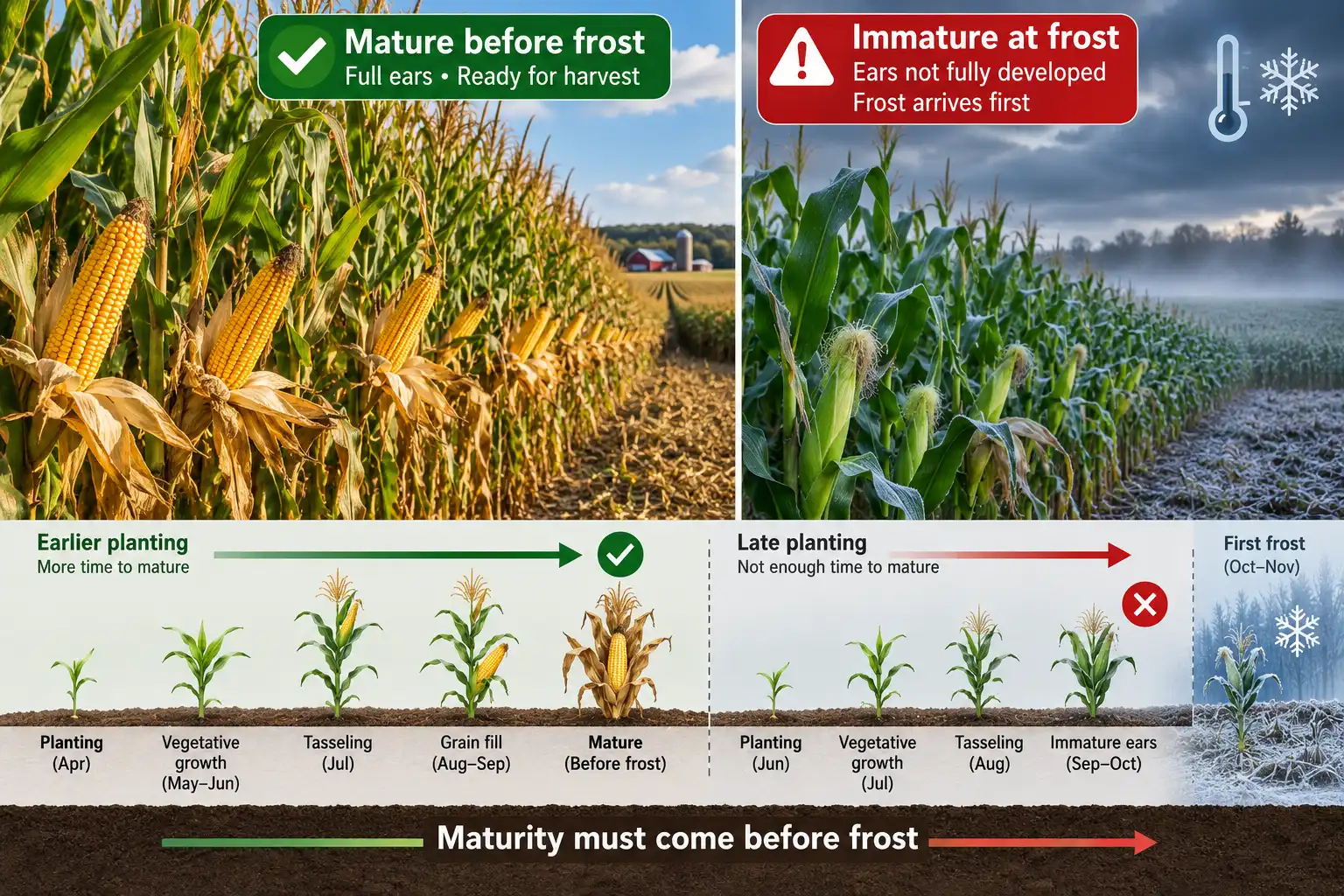
A June planting may still produce field corn in some states, while southern growers have separate fall sweet corn seasons. Your decision depends on local frost dates, remaining growing time, and the type of corn you intend to harvest.
It is not always too late to plant corn. Grain corn becomes increasingly risky after May or early June across much of the northern United States. Sweet corn can sometimes be planted in July or later farther south, provided it matures before frost.
When Is It Too Late to Plant Corn in Your Region?
There is no single planting deadline for the United States. Northern states generally have shorter growing windows, while some southern regions support a second corn crop.
University of Minnesota Extension sets separate late-planting dates for grain and silage corn. NC State Extension describes conditional opportunities for June grain corn in North Carolina.
Meanwhile, UGA Cooperative Extension documents a summer planting window for fall sweet corn in southern Georgia.
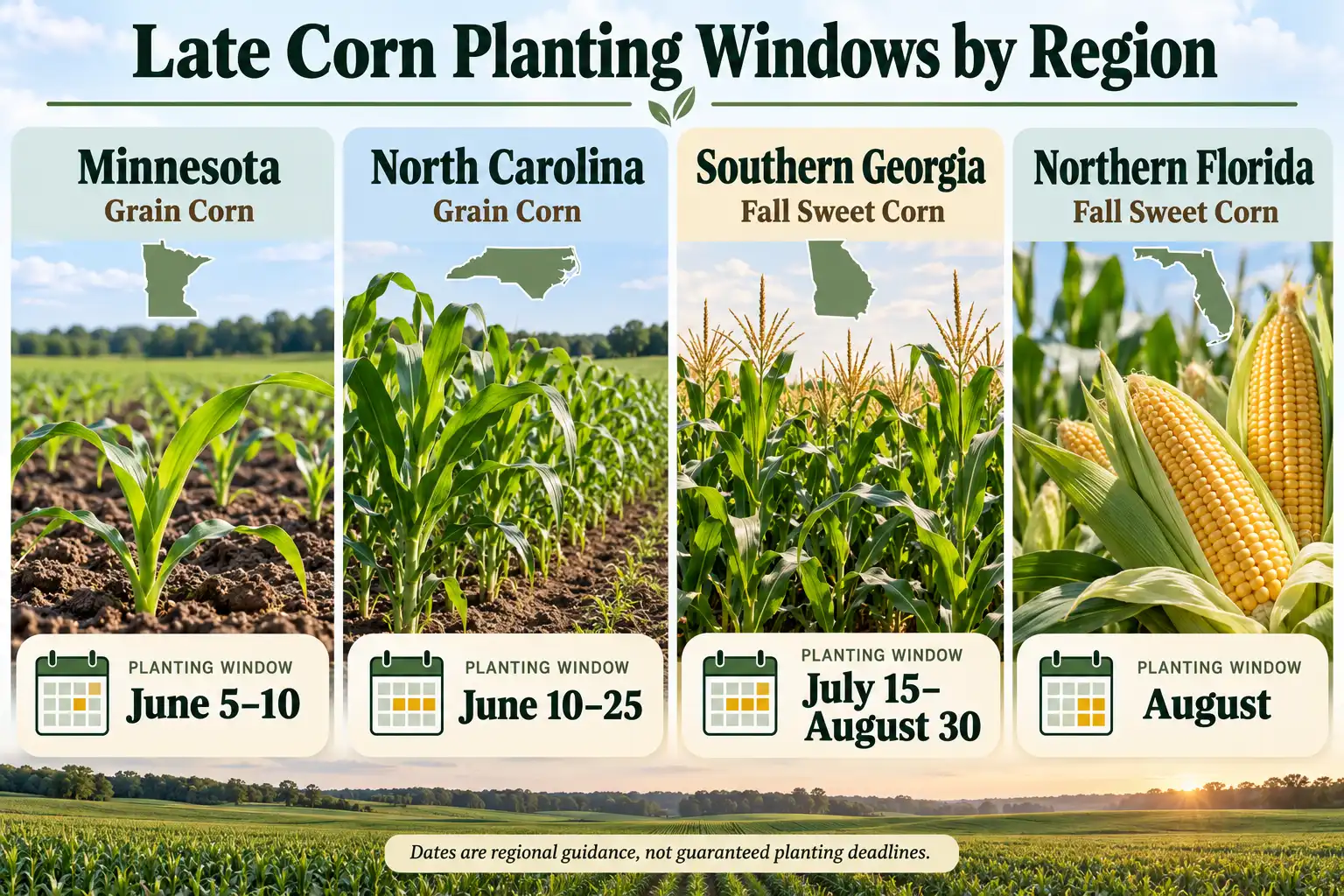
Regional Corn Planting Cutoffs
| Region | Corn type | Late planting guidance |
|---|---|---|
| Central and northern Minnesota | Grain | June 5 |
| Southern Minnesota | Grain | June 10 |
| Minnesota | Silage | June 12 in central/north; June 20 in south |
| Iowa | Grain | Early June remains possible, with increasing yield and frost risk |
| Iowa | Sweet corn | July 1 is a conservative cutoff; some fall guidance extends into mid-July |
| Ithaca, New York | Sweet corn | June 30 for medium-season; July 15 for early-season varieties |
| North Carolina | Grain | June 10 to June 25 under suitable conditions |
| Southern Georgia | Fall sweet corn | July 15 to August 30 |
| Northern Florida | Fall sweet corn | August |
| Central Florida | Sweet corn | January through April |
| Southern Florida | Sweet corn | October through March |
These dates are regional recommendations, not guarantees of successful harvests.
For Iowa, the fall vegetable planting calendar suggests early to mid-July, while Iowa State’s dedicated sweet corn guidance identifies July 1 as the last practical date for early cultivars. The earlier date provides a more conservative target.
Cornell Cooperative Extension provides the New York dates, while UF/IFAS Extension documents Florida’s different regional seasons.
For western valleys, mountain areas, and other regions not listed, calculate the remaining frost-free growing period rather than borrowing another state’s deadline.
Is It Too Late to Plant Corn From June Through October?
June can still support corn planting in several states, but opportunities narrow considerably through summer. By September, outdoor planting is too late across most of the country.
Planting Corn in June
June planting remains possible, particularly with earlier-maturing hybrids.
However, northern grain growers face increasing frost risk and reduced yield potential. Iowa State University reports that later planting can also raise harvest moisture and drying costs.
Planting Corn in July
July may still work for early-maturing sweet corn where the first fall frost comes sufficiently late.
For grain production across much of the Corn Belt, July planting generally carries substantial maturity and economic risks. Do not assume that a short-season hybrid will overcome a severely shortened growing period.
Planting Corn in August
August planting makes sense primarily in suitable southern sweet corn production areas.
Southern Georgia’s published fall planting window extends through August 30. Northern Florida also lists August for sweet corn. These windows should not be applied to the Midwest or northern states.
Planting Corn in September or October
September is generally too late for outdoor corn across most U.S. regions.
October is also too late in most states. However, southern Florida has an established October through March sweet corn planting season.
Even there, planting must match local temperature, moisture, and pest conditions.
How to Calculate Your Last Safe Corn Planting Date
Calculate the remaining growing period before buying seed. Sweet corn uses estimated days to harvest, while grain corn requires a more detailed heat-unit calculation.
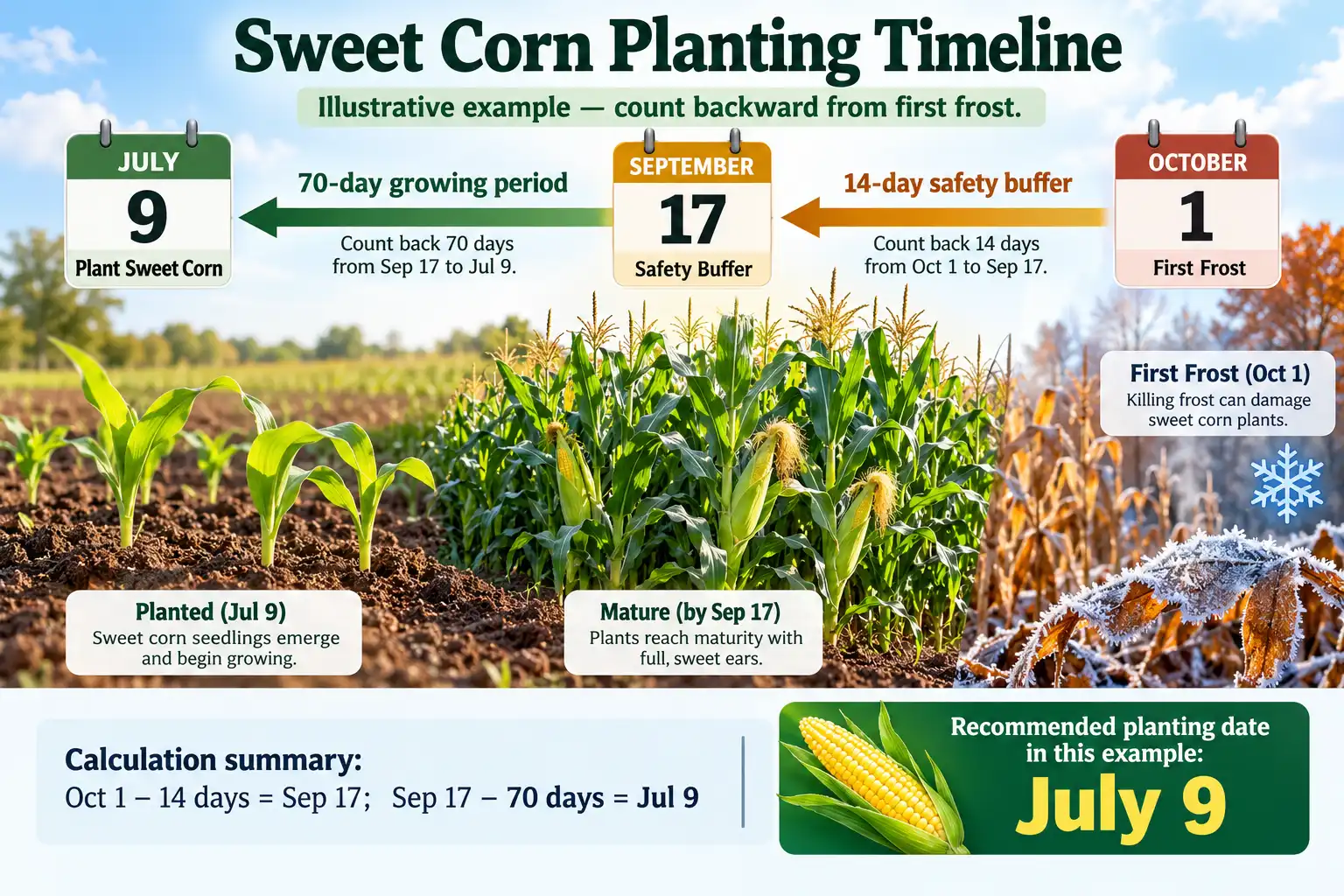
For Sweet Corn: Count Backward From the First Frost
Start with your local average first fall frost date. Subtract the variety’s estimated growing time and a reasonable harvest buffer.
For example, assume:
| Factor | Example |
|---|---|
| Average first fall frost | October 1 |
| Sweet corn maturity | 70 days |
| Extra harvest and weather buffer | 14 days |
| Total time required | 84 days |
| Calculated latest planting date | July 9 |
Calculation: October 1 minus 84 days = July 9.
This is an illustrative calculation, not a recommended date for every location.
A 10 to 14-day buffer helps account for slower autumn growth and earlier-than-average frost. Greater uncertainty calls for a larger margin.
If the calculated planting date has already passed, choose a faster-maturing variety only if it still has sufficient time to develop ears.
For Field Corn: Calculate Growing Degree Days
Grain corn development depends on accumulated heat, not simply calendar days.
The University of Minnesota Extension’s corn hybrid selection guidance explains the growing degree day (GDD) method.
Corn GDDs use a base temperature of 50°F. Daily highs are capped at 86°F, and lows below 50°F are treated as 50°F.
For example, with a high of 88°F and a low of 62°F:
Daily GDD = (86 + 62) ÷ 2 – 50 = 24
Add daily GDDs to estimate seasonal heat accumulation.
Suppose a hybrid requires 2,100 GDDs to reach physiological maturity, but local projections provide only 1,900 before the frost-risk cutoff. The crop faces a 200-GDD shortfall.
Use the hybrid’s actual heat requirement, not its relative maturity number as a literal number of calendar days.
For grain corn, Minnesota Extension recommends selecting hybrids expected to mature at least 10 days before the average first 32°F frost.
Does Corn Type Change How Late You Can Plant?
Yes. Grain corn, sweet corn, silage corn, and popcorn have different harvest requirements.
Grain Corn
Grain corn must reach physiological maturity, also called black layer, before severe frost stops grain filling.
A shorter-season hybrid reduces the heat required for maturity, but may not restore the yield potential of an earlier planting.
In Minnesota, Extension recommends increasingly shorter relative maturity hybrids after approximately May 22.
Sweet Corn
Sweet corn is harvested while kernels are tender and immature.
It can therefore fit into shorter remaining growing periods than corn grown for dry grain. Early varieties are especially useful for late summer planting.
For example, Iowa State identifies ‘Early Sunglow’ as an early sweet corn choice. It is a standard sugary (su) type, while ‘Bodacious’ belongs to the sugar-enhanced (se) group.
Sweetness classification does not establish maturity speed. Always compare the actual seed packet’s maturity estimate.
Silage and Popcorn
Silage corn is harvested as whole-plant forage before dry grain harvest. This provides a somewhat longer planting opportunity in certain regions.
Popcorn needs fully developed, dryable kernels. It should not be treated like sweet corn harvested at the milk stage.
How to Plant Corn Successfully When the Season Is Running Short
Late planting calls for dependable emergence, suitable maturity, and careful moisture management. Additional fertilizer cannot replace lost growing time.
1. Plant Into Warm, Workable Soil
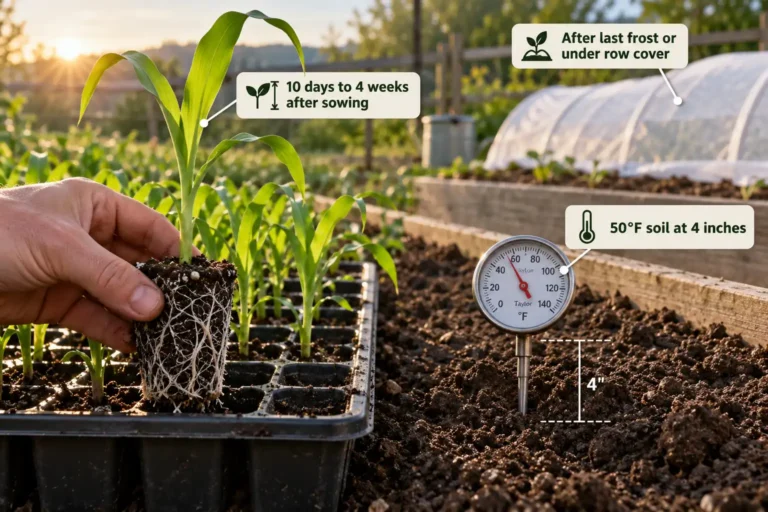
Field corn generally needs soil temperatures near 50°F or higher for dependable germination.
Standard sweet corn germinates more readily around 55°F to 60°F. Supersweet types are more sensitive to cold soil.
For sweet corn, plant approximately 1 inch deep in heavier soil or up to 2 inches in light sandy soil. Field corn is commonly planted about 1.75 to 2 inches deep.
Avoid planting into saturated ground simply to save a day.
2. Choose Spacing That Supports Pollination
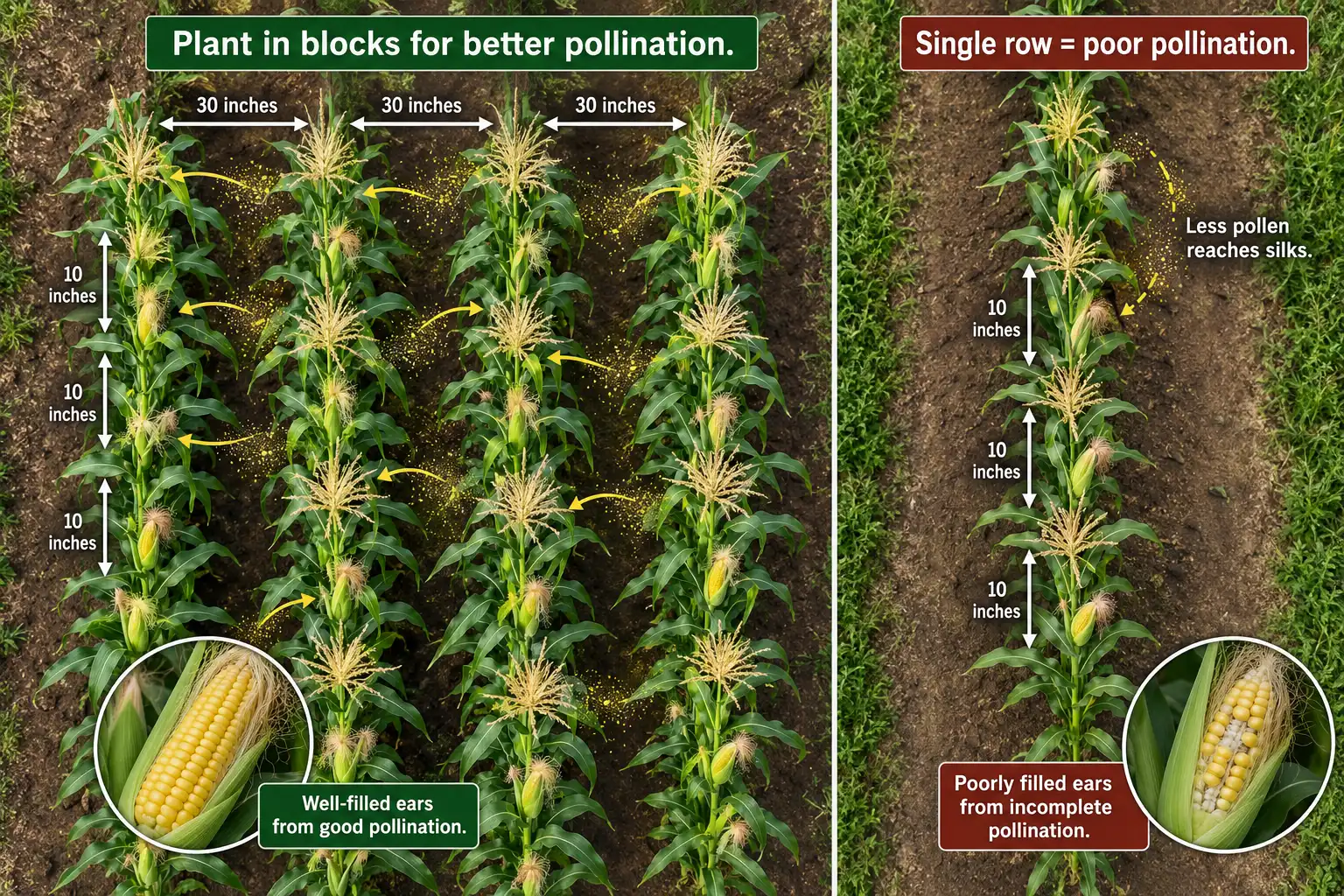
Sweet corn needs wind to move pollen from tassels to silks.
Plant at least four short rows together instead of one long row. Iowa State recommends approximately 8 to 12 inches between sweet corn plants and 30 to 36 inches between rows.
For example:
- Four rows measuring 20 feet each
- Plants spaced 10 inches apart
- Approximately 96 planting positions
- At 30-inch row spacing, roughly 20,900 positions per acre
These are planting positions, not guaranteed surviving plants. Adjust seeding for expected germination and field emergence.
For general seedbed preparation, see the corn planting and growing requirements.
3. Protect Moisture During Tasseling and Silking
Dry soil during pollination can leave ears with missing kernels.
Iowa State recommends approximately 1 inch of weekly water from rainfall and irrigation for garden sweet corn, adjusted to conditions.
A 10-by-20-foot planting area needs approximately 125 gallons to receive 1 inch of water, before accounting for rainfall.
For larger acreage, calculate crop water requirements using weather, growth stage, and soil conditions.
4. Reconsider Fertilizer and Pest Management
Late corn may have lower yield potential, so fertilizer spending should match realistic production expectations.
Use soil test results and appropriate corn fertilizer rates per acre rather than assuming the original spring plan remains suitable.
Also scout for corn earworm, corn borer, foliar diseases, and other locally important pests. Later planting can expose tasseling and silking corn to higher insect pressure.
What Problems Make Late-Planted Corn Fail?
The largest threats are insufficient heat before frost, dry conditions during pollination, and increasing insect pressure.
| Problem | Likely cause | What to do |
|---|---|---|
| Uneven emergence | Cold, wet, compacted, or dry seedbed | Check soil temperature and moisture before seeding |
| Small or poorly filled ears | Drought, high temperatures, or weak pollination | Maintain soil moisture and plant sweet corn in blocks |
| Heavy earworm damage | Later insect populations | Scout regularly and use locally recommended, labeled controls when justified |
| Green plants approaching frost | Insufficient growing degree days | Assess remaining maturity and alternative harvest uses |
| Late, wet grain harvest | Delayed black layer and drying | Compare expected drying costs with grain value |
NC State Extension identifies heat stress, drought, and insect damage as important challenges for late-planted corn in North Carolina.
For field corn, poor timing also affects harvest logistics. Grain reaching maturity late in autumn may require additional drying, increasing costs.
When Should You Stop Planting Corn and Choose Another Crop?
Stop when the crop cannot reasonably reach its intended harvest stage within your local growing window.
Planting becomes difficult to justify when:
- Projected growing degree days fall below the hybrid’s maturity requirement.
- Sweet corn will likely reach harvest after damaging fall frost.
- Water availability cannot support establishment and pollination.
- Expected yield no longer covers seed, fertilizer, irrigation, harvest, and drying costs.
For insured grain acreage, check your crop insurance policy before planting beyond its final planting date. Insurance deadlines are different from biological crop maturity limits.
If corn no longer fits, consider an earlier-maturing crop or a fall planting suited to your region. The crop selection guide can help compare alternatives.
FAQs about Late Corn Planting
Does a USDA hardiness zone tell me the last date to plant corn?
No. Hardiness zones describe typical annual extreme minimum winter temperatures, not the first autumn frost or remaining summer heat. Use local freeze records, corn maturity requirements, and regional Extension guidance instead.
Will a 60-day sweet corn variety always mature in 60 days?
No. The advertised maturity period is an estimate under suitable growing conditions, not a harvest guarantee. Cooler temperatures, uneven emergence, and moisture stress can delay development, making extra time before frost valuable.
Can I plant corn in one long row if garden space is limited?
You can, but a single row increases the chance of incomplete wind pollination and poorly filled ears. Arrange corn in a block of several short rows whenever possible, even in a small garden.
Should I plant corn immediately after heavy rainfall?
No. Wait until the soil is workable rather than sticky or saturated. Planting wet ground can create compaction and uneven seed placement, reducing emergence quality and eliminating the benefit of getting seed planted slightly earlier.
Can late-planted grain corn be harvested as silage instead?
Sometimes. A suitable market or livestock feeding need may make silage a practical alternative when grain maturity becomes doubtful. Assess whole-plant moisture, forage quality, available harvest equipment, and any crop insurance restrictions first.
Is the crop insurance deadline the same as the last agronomic planting date?
No. Crop insurance dates affect coverage and prevented planting provisions, while agronomic planting limits reflect frost, heat, and yield risk. Check your policy and speak with your insurance agent before planting after the insured deadline.
Key Points for Your Corn Planting Decision
Corn planting is too late when the remaining season cannot support its intended harvest.
For grain, compare the hybrid’s growing degree day requirement with available heat before frost. For sweet corn, count backward from the first expected fall freeze, including a harvest buffer.
Use regional planting dates as guidance, not guarantees. When maturity or profitability looks doubtful, switching crops may be the more practical decision.