How Long Does It Take Corn to Grow? Timelines by Type
Most sweet corn is ready within two to three months, while field corn needs more time to mature. The exact growing period depends on the variety, soil temperature, weather, and whether you are harvesting fresh ears or dry grain.
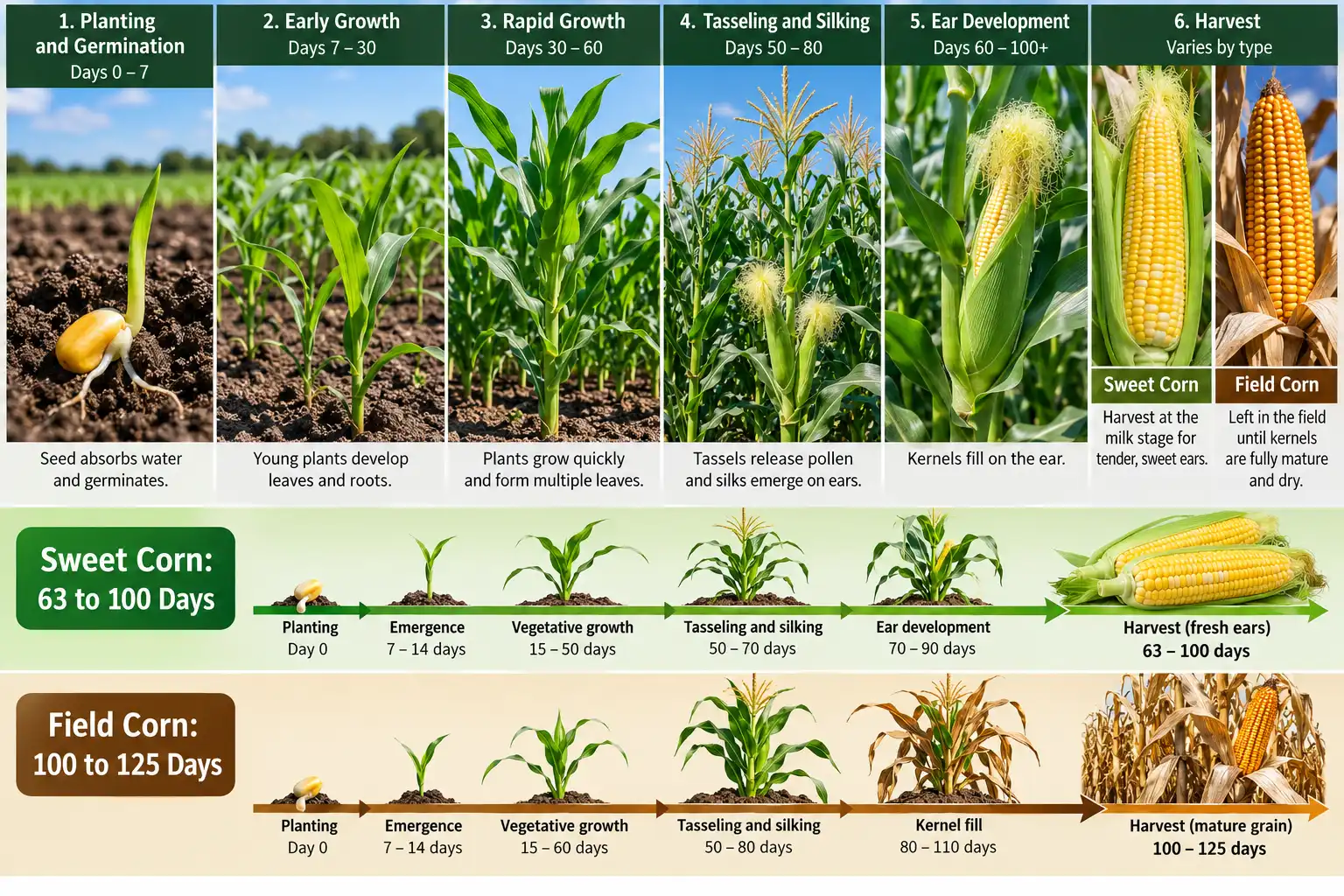
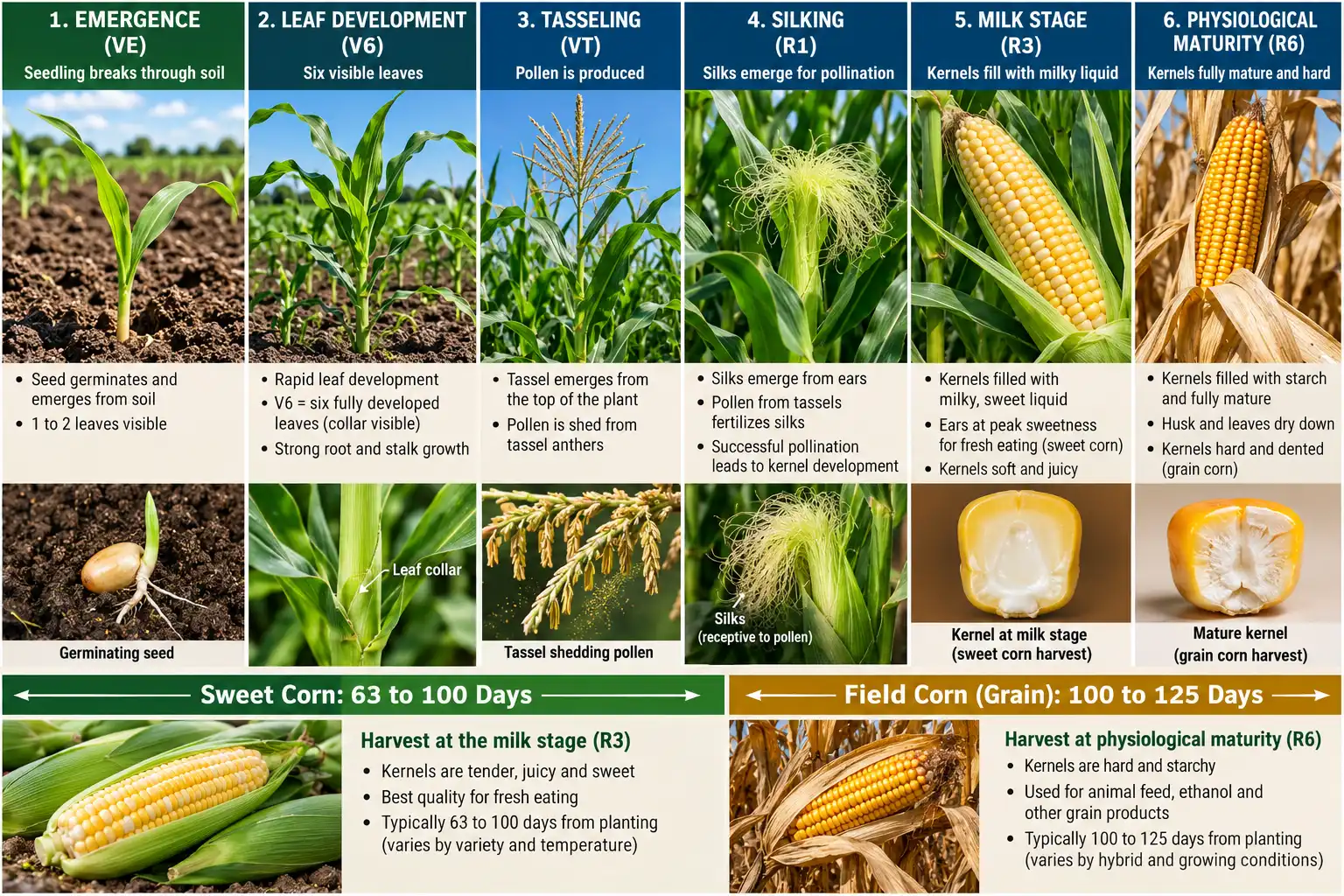
How long does it take corn to grow? Sweet corn generally needs 63 to 100 days from seed to picking. Field corn often needs 100 to 125 days to mature, then additional time to dry for grain harvest.
How Long Does It Take Corn to Grow by Type?
Corn typically takes 60 to 125 days or longer to mature, depending on its type and intended use.
The University of Maryland Extension lists sweet corn maturity at 63 to 100 days. The University of Georgia Extension provides a 100 to 125-day planning range for field corn.
| Corn type | Typical growing time | Harvest stage |
|---|---|---|
| Sweet corn | 63 to 100 days | Tender kernels filled with milky juice |
| Field corn (dent corn) | About 100 to 125 days, sometimes longer | Physiological maturity, followed by grain drying |
| Popcorn | 90 to 120 days | Hard, mature kernels that require further drying |
| Silage corn | Depends on hybrid and growing conditions | Whole plants harvested at the appropriate moisture level |
The University of Minnesota Extension confirms that most popcorn varieties require 90 to 120 days to mature.
Corn grown for silage follows a different harvest schedule. Its whole-plant moisture matters more than a fixed day count.
The main difference: Sweet corn is harvested while its kernels are still developing. Grain corn remains in the field until the kernels reach their maximum dry weight.
Corn Growth Stages: From Planting to Harvest
Corn develops through vegetative stages, marked V, and reproductive stages, marked R.
Understanding these stages helps you estimate harvest dates more accurately than counting calendar days alone.
According to University of Minnesota Extension’s corn growth guide, grain corn typically reaches physiological maturity about 55 to 65 days after silking.
| Growth stage | Approximate timing | What happens |
|---|---|---|
| Germination and emergence (VE) | Around 10 to 12 days in 60°F soil; longer in cold soil | Seed germinates and the first shoot emerges |
| Vegetative growth (V1 to Vn) | Several weeks after emergence | Leaves, roots, and stalk develop |
| Tasseling (VT) | Depends on variety and accumulated heat | Tassel becomes visible and releases pollen |
| Silking (R1) | Beginning of reproductive development | Silks emerge from ears and receive pollen |
| Blister (R2) | 10 to 14 days after silking | Small kernels contain clear liquid |
| Milk (R3) | Around 3 weeks after silking | Kernels fill with milky liquid; sweet corn reaches its eating stage |
| Dough and dent (R4 to R5) | About 24 to 42 days after silking | Starch accumulates and kernels become firmer |
| Physiological maturity (R6) | 55 to 65 days after silking | Kernels reach maximum dry weight; black layer forms around this stage |
These timings are guides, not fixed deadlines. Field corn hybrids, weather, and nutrient availability affect how quickly plants move between stages.
Sweet corn is commonly harvested 17 to 24 days after the first silks appear, before the kernels become hard.
Does Every Corn Variety Take the Same Time to Grow?
No. Corn genetics determine much of the growing period.
Early sweet corn varieties can produce harvestable ears several weeks before full-season varieties.
The University of Minnesota Extension’s sweet corn guide provides these examples:
| Sweet corn variety | Type | Days to maturity |
|---|---|---|
| Northern Xtra Sweet | Supersweet (sh) | 63 |
| Quickie | Sugary enhanced (se) | 67 |
| Ambrosia | Sugary enhanced (se) | 75 |
| Silver Queen | Standard sugary (su) | 92 |
For short growing seasons, Quickie or Northern Xtra Sweet may be more suitable than Silver Queen.
However, Northern Xtra Sweet requires warmer soil for reliable establishment. Minnesota Extension lists a minimum planting soil temperature of 65°F for that variety.
One important difference: Field corn relative maturity (RM) ratings are not exact planting-to-harvest day counts.
A 95-day RM hybrid does not necessarily mature 95 calendar days after planting. Minnesota Extension explains that these ratings describe relative maturity and are closely associated with heat requirements.
How Do Temperature and Weather Affect Corn Growth?
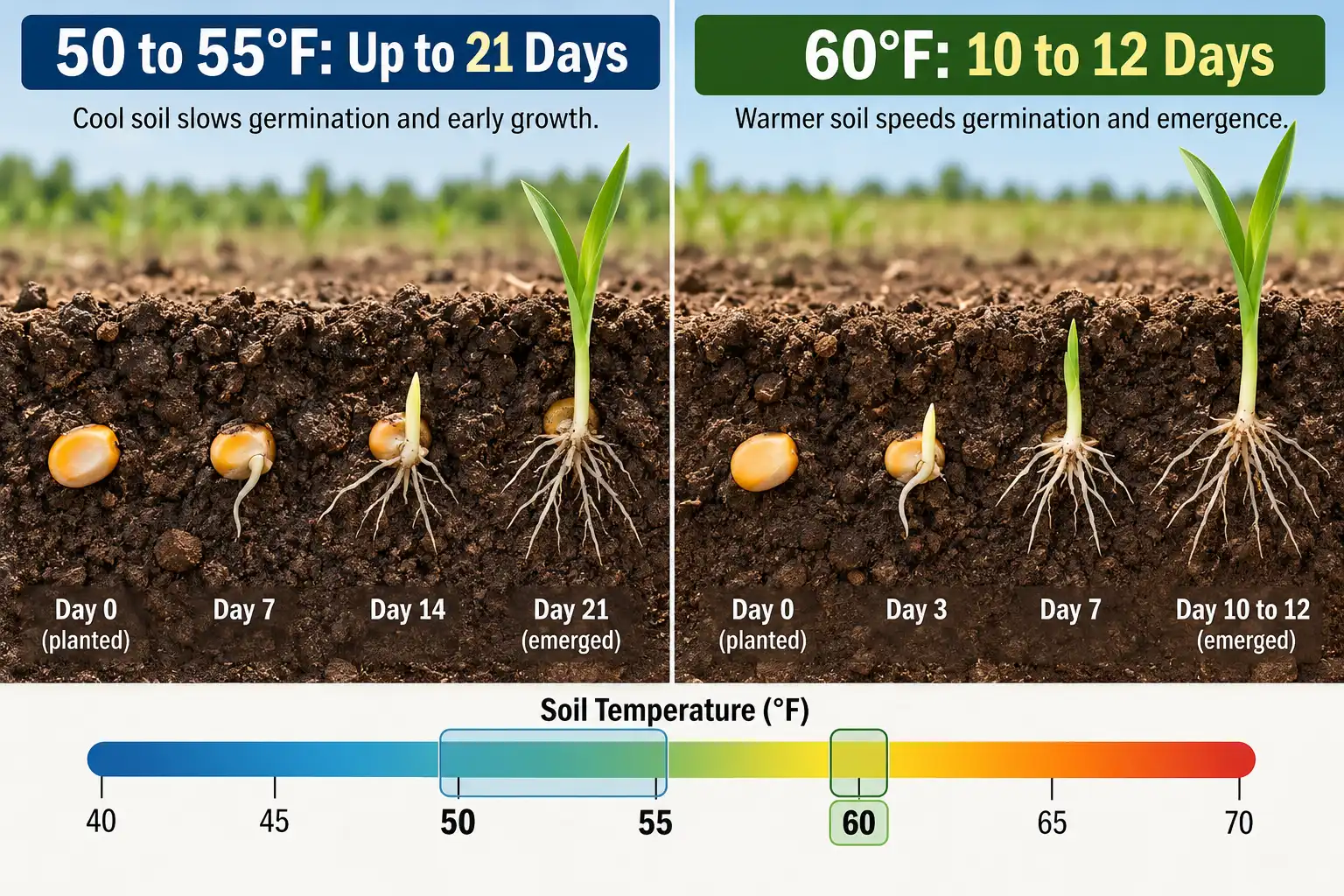
Temperature strongly influences how quickly corn germinates, produces leaves, and reaches maturity.
Soil temperature determines emergence speed
Corn seeds germinate slowly in cold soil.
Iowa State University Extension reports these emergence differences:
| Average soil temperature | Approximate emergence time |
|---|---|
| 50 to 55°F | Up to 21 days |
| Around 60°F | 10 to 12 days |
For sweet corn, wait until the soil is sufficiently warm for the selected variety. Many standard varieties establish near 60°F, while supersweet types often need about 65°F.
Corn development depends on accumulated heat
Agronomists use growing degree days (GDD) to estimate crop development.
For corn, the daily calculation uses 50°F as the lower temperature limit and 86°F as the upper limit.
For example:
- Daily high: 80°F
- Daily low: 60°F
- Average temperature: 70°F
- Growing degree days: 70 – 50 = 20 GDD
According to University of Minnesota Extension, a 95-day relative-maturity grain hybrid generally needs approximately 2,350 to 2,400 GDD from planting to physiological maturity.
Therefore, a warmer growing season may advance crop development. A cooler season can delay harvest.
Extreme heat is different. Temperatures above 95°F, especially with low humidity, can interfere with corn pollination.
How Long Does Corn Take to Grow in Different U.S. Regions?
Corn growing calendars vary by region because soil warming, frost dates, and accumulated heat differ.
A variety that matures during a long southern growing season may struggle to finish before frost in a northern location.
| Region | Typical planting guidance | Growing-season consideration |
|---|---|---|
| Southern Georgia | February 15 to April 15 for spring commercial sweet corn; July 15 to August 30 for fall | Long warm season can support two sweet corn crops |
| Minnesota | Around May 20 as an initial sweet corn planning date | Many planned varieties mature in 70 to 85 days |
| Pennsylvania | Mid-April to late May for field corn, depending on maturity zone | Cooler areas use shorter-season hybrids |
The southern Georgia dates come from University of Georgia Extension. Minnesota’s schedule comes from its 2026 vegetable crop planning guide.
Penn State Extension identifies field corn maturity zones ranging from roughly 90 to 130 relative-maturity units. These are hybrid ratings, not guaranteed harvest-day counts.
For your location: Choose corn that can finish within the local frost-free season. Use soil temperature and hybrid maturity requirements rather than USDA hardiness zone numbers alone.
Can Water and Fertilizer Affect How Fast Corn Grows?
Yes. Water shortages and nutrient deficiencies can slow development and reduce ear formation.
Water supply
Corn needs consistent moisture, especially before and during pollination.
The University of Georgia Extension recommends at least 1 inch of water per week for normal sweet corn development, with close attention to pollination and ear filling.
For irrigation planning:
- 1 inch of water over 1 acre equals approximately 27,154 gallons.
- 1 inch over a 4-by-20-foot garden bed equals approximately 50 gallons.
These amounts describe water volume, not a fixed irrigation prescription. Subtract useful rainfall and account for soil moisture.
For larger fields, use crop water requirement calculations rather than applying the same amount regardless of weather.
Nutrient availability
Nitrogen shortages can restrict leaf development, reduce growth, and limit kernel production.
Corn absorbs substantial nitrogen during rapid vegetative growth. Waiting until plants are severely deficient can reduce the benefit of later applications.
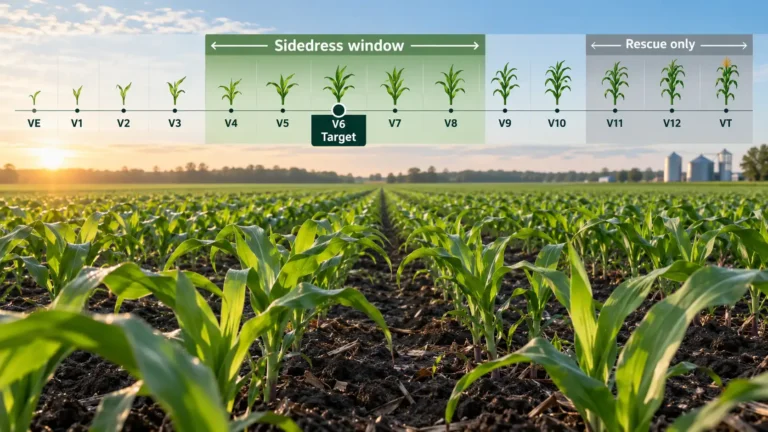
Use appropriate corn nitrogen sidedressing timing and calculate fertilizer requirements per acre from soil tests and realistic yield goals.
Extra fertilizer does not automatically shorten the genetic maturity period.
How to Estimate Your Corn Harvest Date
Start with the planting date and your variety’s expected days to maturity.
Estimated harvest date = planting date + days to maturity
For example, suppose you plant a 75-day sweet corn variety on May 20.
| Event | Estimated date |
|---|---|
| Planting | May 20 |
| Expected sweet corn maturity | 75 days |
| First estimated harvest | August 3 |
| Actual harvest decision | Based on silk and kernel development |
This is a planning estimate, not a guaranteed harvest date.
If the first silks appear July 12, the ears may become ready around July 29 to August 5, based on the 17 to 24-day silking-to-harvest range.
Begin checking ears as that window approaches.
For grain corn, use the hybrid’s GDD requirement and observed growth stage. Allow additional time after physiological maturity for grain drying.
How Can You Tell When Corn Is Ready to Harvest?
The right harvest signs depend on whether you are growing sweet corn, popcorn, or field corn.
Sweet corn harvest signs
Sweet corn is ready when the kernels are plump, tender, and filled with milky juice.
Check these signs:
- The husks remain mostly green and the ears feel full.
- Most silks have turned brown and started drying.
- Kernels have filled toward the tip of the ear.
- A punctured kernel releases milky liquid.
Clear liquid generally means the kernels are immature. Thick, pasty contents or little juice indicate that the ideal eating stage may have passed.
Do not wait for the entire plant to turn brown. Sweet corn reaches eating quality while the stalk remains green.
Field corn and popcorn harvest signs
Grain corn is physiologically mature when kernel dry matter accumulation ends, around the black-layer stage.
At this stage, kernel moisture is often approximately 30 to 35%. Additional drying is generally needed before grain harvest or safe storage.
Popcorn should develop hard, shiny kernels and dry husks. It also needs further drying for good popping quality.
Silage corn is different again. Check whole-plant moisture rather than judging the crop by kernel color alone.

Why Is Your Corn Taking Longer Than Expected?
Delayed corn development can result from cold soil, moisture stress, unsuitable varieties, or nutrient deficiencies.
| What you notice | Possible reason | What to check |
|---|---|---|
| No seedlings after two weeks | Cold soil, poor germination, or seed decay | Check soil temperature and examine a few planted seeds |
| Small, pale plants | Poor nutrition, saturated soil, or root problems | Check drainage and soil test results |
| Tassels appear but ears develop poorly | Moisture stress or unsuccessful pollination | Check silk emergence, irrigation, and planting arrangement |
| Sweet corn ears remain small | Incomplete pollination or limited water | Examine kernel development and soil moisture |
| Field corn remains immature near frost | Hybrid needs more accumulated heat | Compare current stage with remaining GDD potential |
A soil test interpretation can help identify nutrient limitations.
Poorly filled ears may also indicate a pollination problem rather than slow growth.
For sweet corn, growing several short rows together improves wind pollination. The complete corn planting and growing guide covers seed spacing, planting arrangements, and seasonal care.
FAQs about Corn Growth Timeline
Can corn grow in just 60 days?
Some early sweet corn can approach a 60-day harvest, but most published early varieties need slightly longer. University of Minnesota Extension lists Northern Xtra Sweet at 63 days and Quickie at 67 days.
How long after tasseling does corn produce harvestable ears?
Sweet corn usually becomes ready about 17 to 24 days after silks first appear, not after tassels appear. Tasseling generally begins before or near silking, so start your harvest countdown when visible silks emerge.
Can you grow two crops of corn in one year?
Yes, two sweet corn crops are possible in regions with sufficiently long warm seasons and reliable water. Southern Georgia has both spring and fall planting windows, but the second crop must mature before damaging frost.
Does one corn plant keep producing ears throughout the season?
No, a corn stalk does not continuously produce new ears after harvest. Most plants produce one primary ear, although favorable growing conditions can support a smaller second ear that may mature somewhat later.
Can corn continue maturing after a frost?
Corn that reaches physiological maturity before frost has already completed grain dry matter accumulation and can continue drying afterward. A killing frost before that stage may interrupt grain filling and reduce yield or grain quality.
How long does popcorn take to dry after harvesting?
Popcorn commonly requires additional drying after the ears have fully matured, sometimes for several weeks. Iowa State University Extension recommends testing small batches until they pop well, then storing properly dried kernels in airtight containers.
Plan Your Corn Harvest
Choose a variety that fits your available growing season. Use its maturity rating to estimate the harvest date, then confirm readiness by inspecting silks and kernels.
For fresh eating, harvest at the milk stage. For grain, allow corn to reach physiological maturity and dry sufficiently before harvest.