How to Fertilize Corn: Rates, Timing, and Liquid N Methods

Corn needs more nitrogen than any other nutrient you buy, and it takes most of that nitrogen up in a few midsummer weeks. Learning how to fertilize corn means matching rate, product, placement, and timing to that demand, whether you grow a backyard block or 300 acres.
Test the soil, set nitrogen with your state’s rate calculator, apply some early, and sidedress the rest by V8. That is how to fertilize corn for yield without wasting product. Phosphorus, potassium, and sulfur follow the soil test.
Corn Fertilizer Requirements: The Four Nutrients That Matter
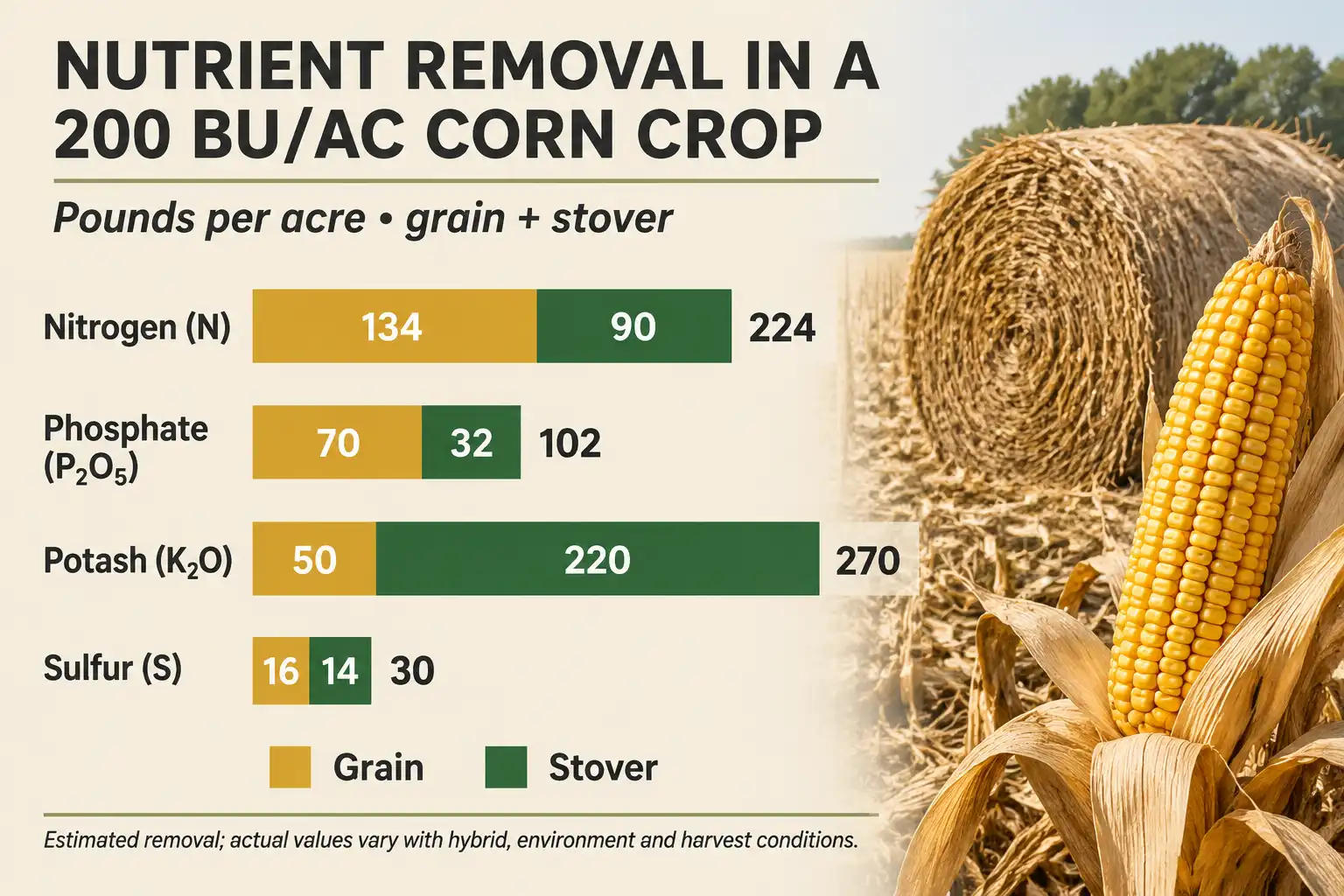
Corn fertilizer requirements come down to four nutrients: nitrogen, phosphorus, potassium, and sulfur. Nitrogen goes on every year. The other three depend on the soil test and on what the last crop removed.
Iowa State University Extension’s PM 1688 puts grain removal at 0.32 pound of P2O5 and 0.22 pound of K2O per bushel. A 200 bushel crop therefore removes about 64 pounds of P2O5 and 44 pounds of K2O per acre. Baling the stover raises the potassium loss sharply, because stover holds about 18 pounds of K2O per ton, according to Iowa State.
Sulfur is the newer concern. Where a deficiency is likely, Iowa State suggests 15 pounds of sulfur per acre on fine-textured soils and 25 pounds on coarse, sandy soils. The same service notes that no sulfur soil test has been calibrated for Iowa crops. That leaves soil texture, field history, and leaf symptoms to guide the decision.
| Nutrient | How the rate is set | Usual timing |
|---|---|---|
| Nitrogen | Rate calculator, previous crop, in-season test | Split between preplant or planting and sidedress |
| Phosphorus (P2O5) | Soil test plus crop removal | Before planting, plus any starter band |
| Potassium (K2O) | Soil test plus crop removal | Before planting |
| Sulfur | Soil texture and field history | Spring, as a sulfate source |
Step 1: Test the Soil Before Buying Fertilizer
Get a soil test before you get a fertilizer quote. The test sets your phosphorus, potassium, and lime needs, and it stops you paying for nutrients the field already holds.
Iowa State interprets results for a 6-inch sampling depth, so pull your cores to that depth. Also sample at the same time of year each round, so one test can be compared with the next.
Next, read the category the lab assigns, not only the number. Iowa State’s system works like this:
- Very low or low: apply more than the crop removes, to build the soil up
- Optimum: apply about what the crop removes
- High or very high: added P or K very seldom pays a profit
Labs use different extractants and units, so two reports for the same field can look different. If your report is hard to follow, start with reading a soil test report before you order anything.
Step 2: Set the Nitrogen Rate Without a Yield Goal
Drop the old yield-goal formula. It multiplied expected bushels by 1.2 pounds of N and then subtracted credits. Iowa State University Extension now calls yield-based N rates a poor system, because yield does not predict how much nitrogen a field needs.
Use the Corn Nitrogen Rate Calculator instead. It draws on hundreds of replicated N rate trials across the Corn Belt. You enter your state, previous crop, nitrogen price, and corn price. It then returns the Maximum Return to Nitrogen (MRTN) rate, plus a range of rates that earn within $1 per acre of it.
Iowa State ran the calculator in spring 2022 with corn at $6.50 per bushel and anhydrous ammonia at $1,400 per ton. These were the results:
| Iowa region | Previous crop | MRTN rate (lb N/acre) | Profitable range |
|---|---|---|---|
| Most of the state | Soybean | 137 | 127 to 147 |
| Most of the state | Corn | 180 | 171 to 189 |
| Southeast Iowa | Soybean | 146 | 137 to 156 |
| Southeast Iowa | Corn | 196 | 183 to 208 |
Two details matter. First, the benefit of the soybean crop is already built into the corn-after-soybean rate, so Iowa State says not to subtract a second credit. Second, fertilizer and grain prices move the answer, so run the calculator again with this season’s prices. Rates by previous crop and by product are worked through in how much fertilizer corn needs per acre.
Step 3: Choose a Nitrogen Source
Compare nitrogen products by the price per pound of actual N, not the price per ton of product. Then match the product to the equipment you have and to the losses you can control.
| Source | Analysis | How it goes on | Main loss risk |
|---|---|---|---|
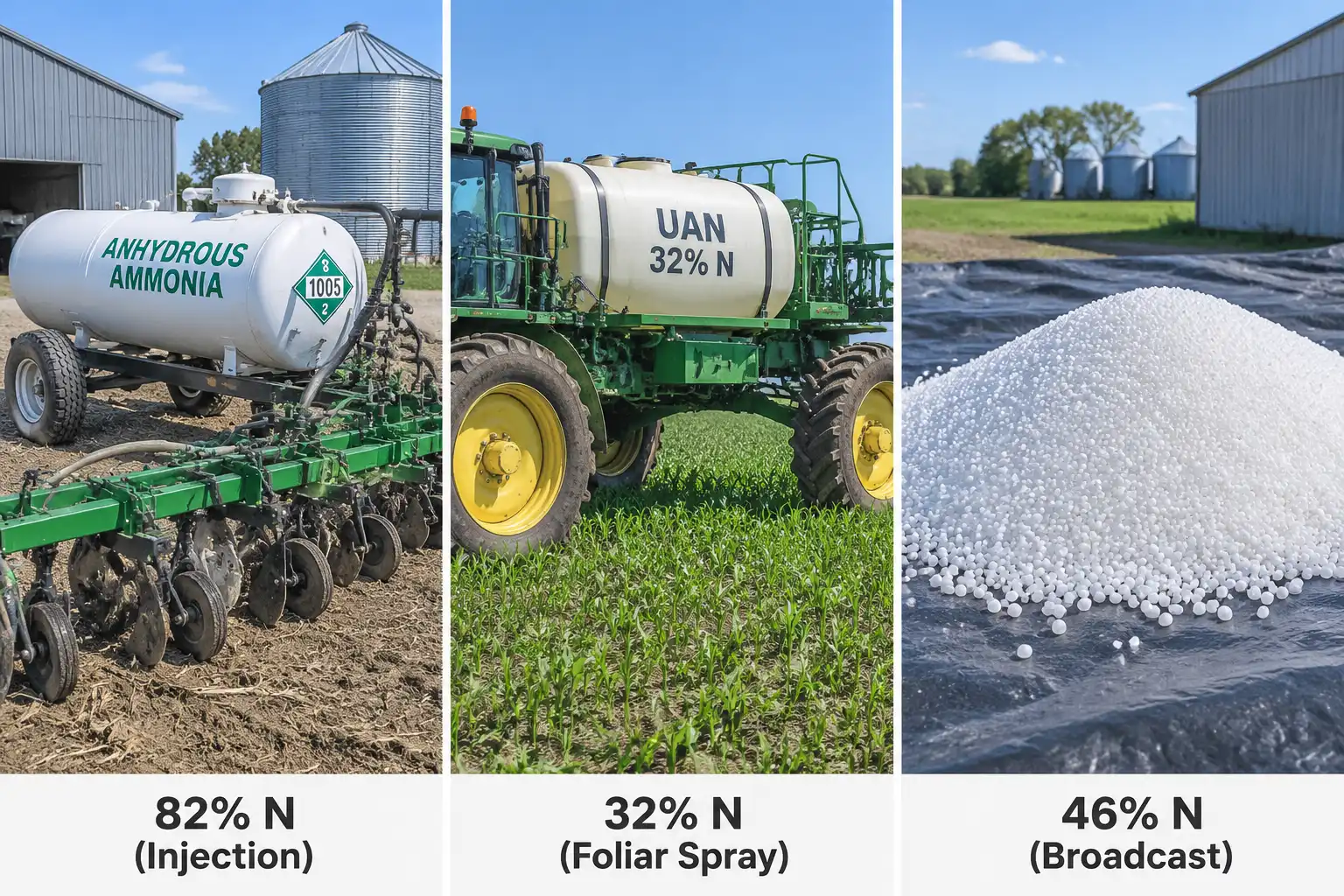
| Anhydrous ammonia | 82-0-0 | Injected into the soil | Gas escapes if the knife slot does not seal |
| UAN solution | 28-0-0 to 32-0-0 | Sprayed, dribbled, or injected | Urea portion volatilizes; nitrate portion can leach |
| Urea | 46-0-0 | Broadcast or incorporated | Volatilizes if left on the surface |
| Ammonium sulfate | 21-0-0-24S | Broadcast | Low volatilization; also supplies sulfur |
Anhydrous ammonia carries the most N per pound of product. In an Iowa State example, 151 pounds of anhydrous supplies 124 pounds of N. If you apply it in fall, Iowa State advises waiting until soil temperatures stay below 50°F, which slows the conversion to nitrate that can leach.
UAN is the most flexible source because it works preplant, at planting, and in-season. Urea spreads easily, but it loses N as ammonia gas if it sits on the surface. Ammonium sulfate is a good fit where sulfur is also short.
How Often to Fertilize Corn
Most field corn gets one to three nitrogen passes a season. Phosphorus and potassium usually go on once before planting. In a corn and soybean rotation, Iowa State tables also allow a single P and K application every two years.
Nitrogen is split for one reason. Corn uses little N early and then takes it up fast. Purdue research places the start of that rapid uptake at about V6 to V8, and demand stays high through silking. So N applied in April has weeks to leach or denitrify before the roots need it.
| Program | Passes | When | Best fit |
|---|---|---|---|
| Single preplant | 1 | Spring before planting, or fall anhydrous | Medium and fine soils with low leaching risk |
| Preplant plus sidedress | 2 | Part before planting, the rest at V4 to V8 | Most rain-fed fields |
| Starter, sidedress, late | 3 | At planting, V4 to V8, then by drops | Sandy or irrigated ground |
| Home garden | 3 | Worked in before planting, knee-high, first tassel | Raised beds and garden blocks |
University of Minnesota Extension finds V4 to V8 the best sidedress window in that state. The exact sidedress timing for corn still shifts with soil type, rainfall, and how much N went on early.
Every extra pass costs fuel and time. On sandy or irrigated ground, however, a single early pass carries the highest risk of losing N.
Starter Fertilizer at Planting
Starter is a small amount of fertilizer placed close to the seed. Early growth often responds to the phosphorus in it, even on soils with optimum P, according to Iowa State. A yield response is less reliable. Iowa State lists early planting, cool soils, no-till, continuous corn, and fields with no preplant N as the cases where starter is most likely to pay.
How Much Can Go in the Furrow?
Sources differ on the in-furrow (pop-up) limit, so here are both:
- Iowa State: the traditional rule of thumb is less than 10 to 12 pounds of N plus K2O per acre.
- University of Nebraska-Lincoln: usually less than 5 to 7 pounds of N plus K2O per acre.
The gap comes down to soil and moisture. Salt injury gets worse in dry, sandy, low organic matter soils. So stay at the low end on light ground or in a dry spring.
What Never Goes on the Seed
Keep urea and ammonium thiosulfate (12-0-0-26S) out of the furrow. Both UNL and University of Minnesota Extension warn against placing them in contact with the seed. If you need a higher rate, move the band away from the seed. Minnesota finds that keeping at least 2 inches of soil between the band and the seed row reduces starter injury. This is why so many planters run a 2×2 band.
How to Apply Liquid Fertilizer to Corn
Liquid nitrogen for corn is almost always UAN. It can go on at four points: preplant, at planting, as a sidedress, or late in the season through drops. Placement decides how much of it actually reaches the crop.
Preplant and at Planting
Inject or incorporate whenever you can. Purdue Extension summarizes Illinois studies in which banded 28% UAN yielded 5 to 6 bushels per acre more than broadcast UAN. In the same Purdue summary, injected UAN beat surface-applied urea treated with a urease inhibitor by 23 bushels per acre.
Sidedress With Coulters or Drops
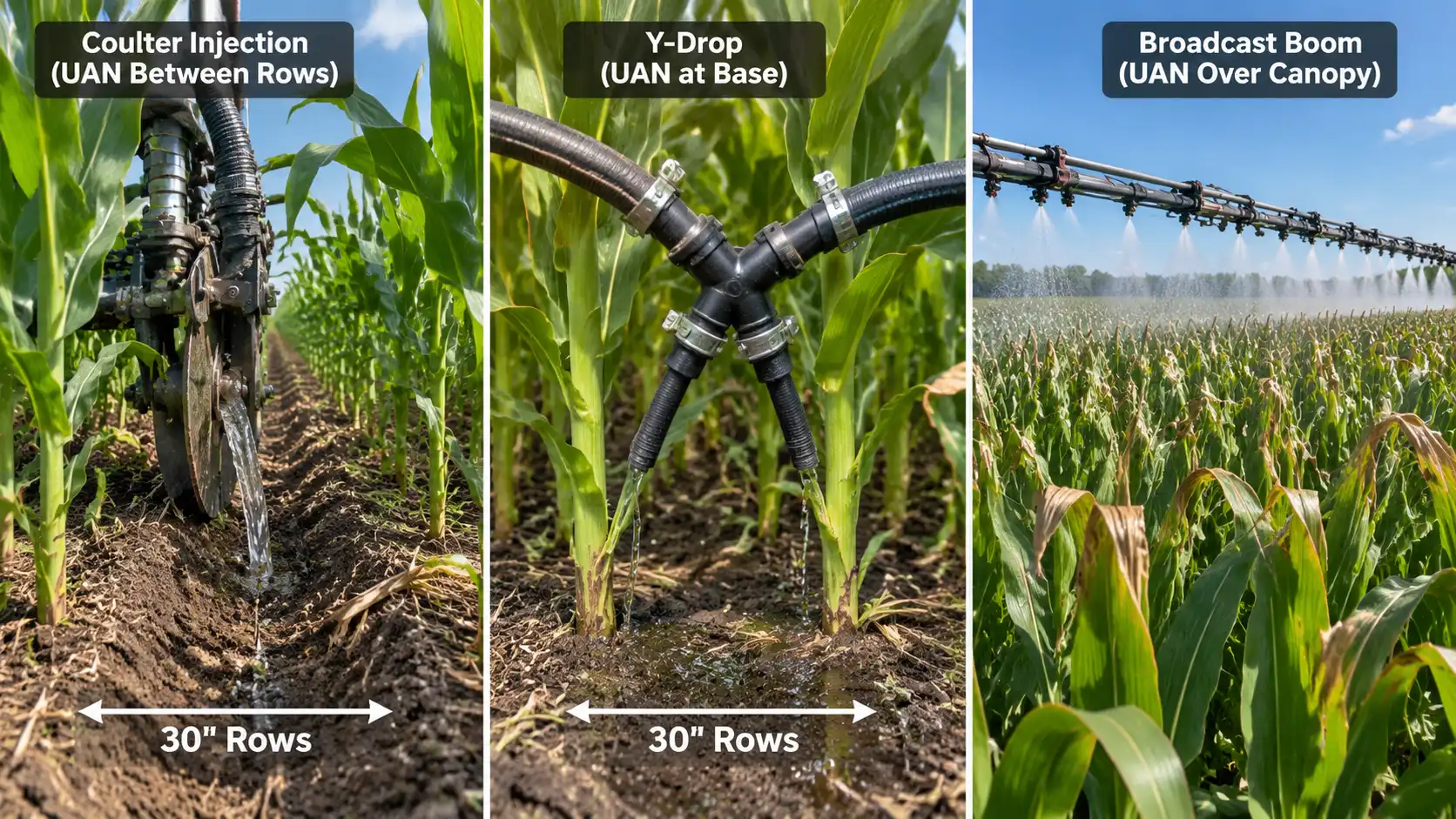
Coulter injection between the rows puts UAN below the residue, where it cannot volatilize. Streamer nozzles and Y-drop units dribble it onto the soil surface at the base of the plants. Either method keeps the solution off the leaves.
Keep UAN Off the Leaves
Spraying UAN over the top burns leaf tissue. Burn gets worse as the rate goes up and the plants get bigger, and some herbicide tank mixes make it worse again. Once the corn is past a few leaves, switch to coulters, streamers, or drop hoses.
Convert Pounds of N to Gallons
Divide the pounds of N you want by the pounds of N in a gallon of your product. UAN spec sheets list 28% at about 10.7 pounds per gallon, which is roughly 3.0 pounds of N per gallon. The 32% grade weighs about 11.1 pounds per gallon and carries about 3.5 pounds of N.
Worked example: a 60 pound sidedress needs 60 ÷ 3.0 = 20 gallons of 28% per acre. With 32%, it needs 60 ÷ 3.54 = about 17 gallons. The stronger grade also salts out in cold weather, a point covered in the profile of 32-0-0 liquid nitrogen.
Surface Urea: Cut the Volatilization Loss
Urea left on the soil surface turns into ammonia gas. Purdue Extension reports losses as high as 60% of the applied N, although losses of 30% or less are more common. Because half of UAN is urea, Purdue puts UAN losses at about half those of urea.
You have three ways to stop most of that loss:
- Incorporate it. Purdue says placing urea an inch or two deep with a knife or coulter is the most effective fix.
- Time it before rain. Purdue notes that a half inch or more of rain within 24 hours of application lowers the risk. University of Minnesota Extension sets the bar a little lower, at a quarter to a half inch within 24 hours. Aim for the higher figure on heavy residue.
- Add a urease inhibitor. NBPT delays urea conversion for about a week or two, per Purdue. So it buys time for rain, but it does not protect the urea indefinitely.
Freshness matters as well. University of Minnesota Extension reports that pure NBPT lost about half of its active ingredient after 20 weeks stored at room temperature. Treat urea close to the day you spread it, rather than months ahead.
Check Nitrogen Mid-Season With a Soil Nitrate Test
A soil nitrate test shows whether the N already in the soil is enough before you pay for a sidedress. Iowa State calls it the late spring soil nitrate test (LSNT). Penn State and other states call it the pre-sidedress nitrate test (PSNT).
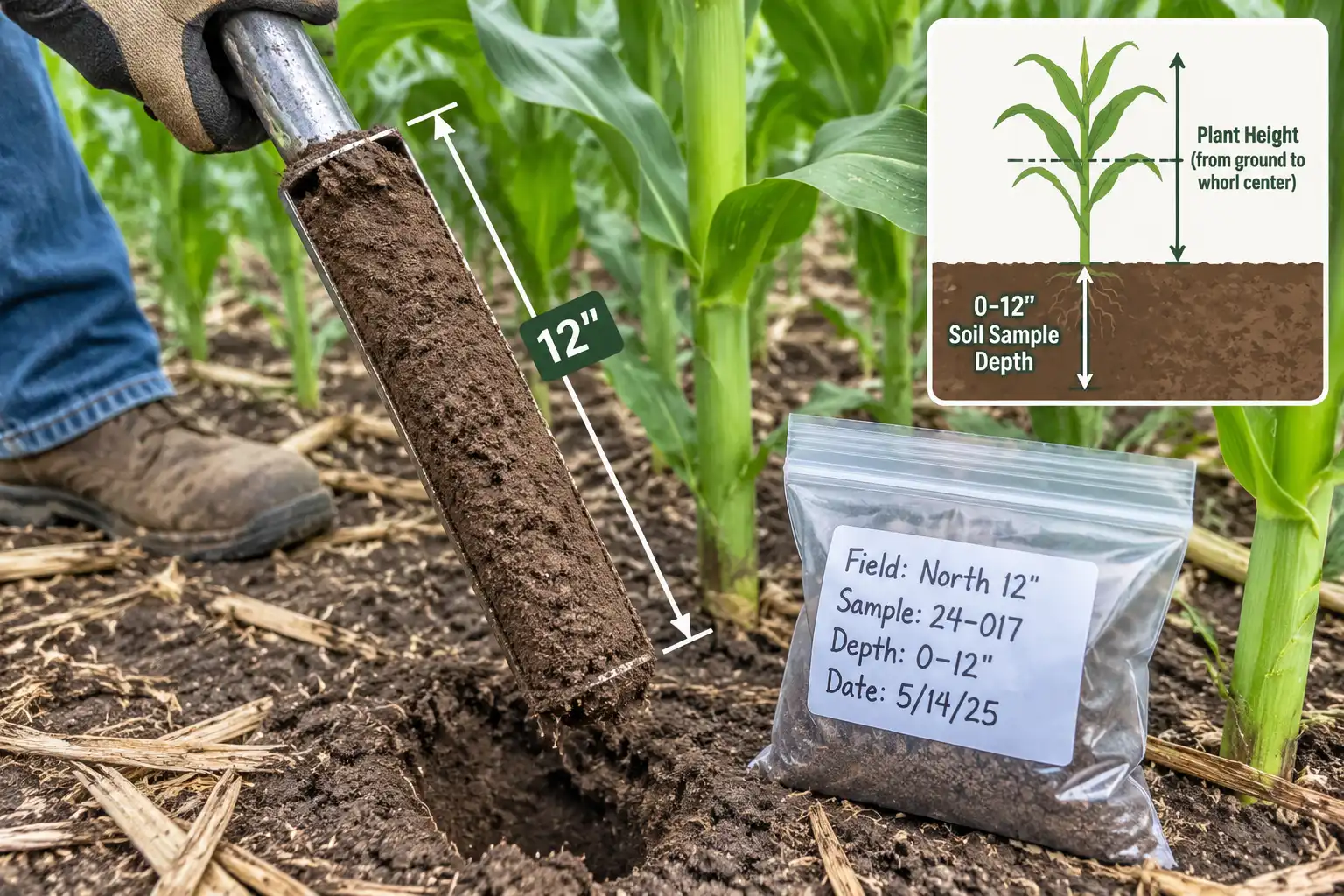
For the sample, take soil from the top 12 inches when the corn is 6 to 12 inches tall, measured from the ground to the center of the whorl. Iowa State puts that at about V5 to V6.
Iowa State and Penn State turn the result into a rate in different ways:
| Iowa State LSNT | Penn State PSNT (2024 calibration) | |
|---|---|---|
| Cutoff | 25 ppm nitrate-N; 20 to 22 ppm after a wet spring | No fixed cutoff |
| Rate formula | 8 lb N for each ppm below the cutoff | (0.72 × yield goal) minus (5.1 × ppm) |
| Result at 15 ppm, 180 bu goal | 80 lb N/acre | 53 lb N/acre |
The difference comes from the trial fields behind each formula, not from a mistake. Penn State’s new calibration came from no-till sites, including fields after cover crops. Iowa State lowers its cutoff when rainfall since April 1 runs more than 20% above normal. Use your own state’s version, and do not average the two.
How Late Can You Still Add Nitrogen?
Plan to finish by V8. Treat anything later as a rescue. How late a rescue still works depends on where you farm.
University of Minnesota Extension reports that in-season applications after V10 have never produced higher yields in its trials, and that they sometimes reduced yield. Purdue Extension research by Bob Nielsen and Jim Camberato found something different in Indiana. There, corn recovered from significant N deficiency when the sidedress went on as late as V13 to V15.
Both results hold up. Season length explains most of the gap, because a longer season gives a stressed crop more time to use late N. So the decision rule depends on your season:
- Northern, short-season ground: rescue odds after V10 are low. Put the money into getting the early N right.
- Central Corn Belt and longer seasons: a deficient crop with good yield potential can still respond up to about V15.
- Equipment: past V8 you need high-clearance rigs with drop hoses or Y-drops, so line them up before the season starts.
How to Fertilize Sweet Corn
Sweet corn needs its own rates. It is picked immature, and University of Minnesota Extension notes that about half the N it takes up is still in the stover at harvest.
Minnesota sets sweet corn N by previous crop, soil organic matter, and expected yield in tons per acre. After soybeans, the rates are:
| Expected yield (tons/acre) | Under 6 | 6 to 7 | 8 to 9 | 10 plus |
|---|---|---|---|---|
| Low organic matter (under 3%) | 100 | 120 | 140 | 160 |
| Medium or high organic matter (3% plus) | 70 | 90 | 110 | 130 |
Pounds of N per acre, per University of Minnesota Extension.
On medium and fine soils, Minnesota allows a single application in most cases. On irrigated sandy soil, apply 10 to 20 pounds of N as starter at or just before planting. Then split the rest between the 4 to 6 leaf stage and the 10 to 12 leaf stage.
Starter needs extra care with sweet corn. Minnesota has not tested pop-up rates for sweet corn, and using dent corn rates can cost you stand. So keep any in-furrow product low, and keep urea, thiosulfates, and boron off the seed.
After harvest, plant oats or winter rye to hold the leftover N. Minnesota research credits sweet corn with 20 to 25 pounds of N for the following crop. More on seedbed and spacing is in the guide to planting sweet corn.
How to Fertilize Corn Plants in a Home Garden
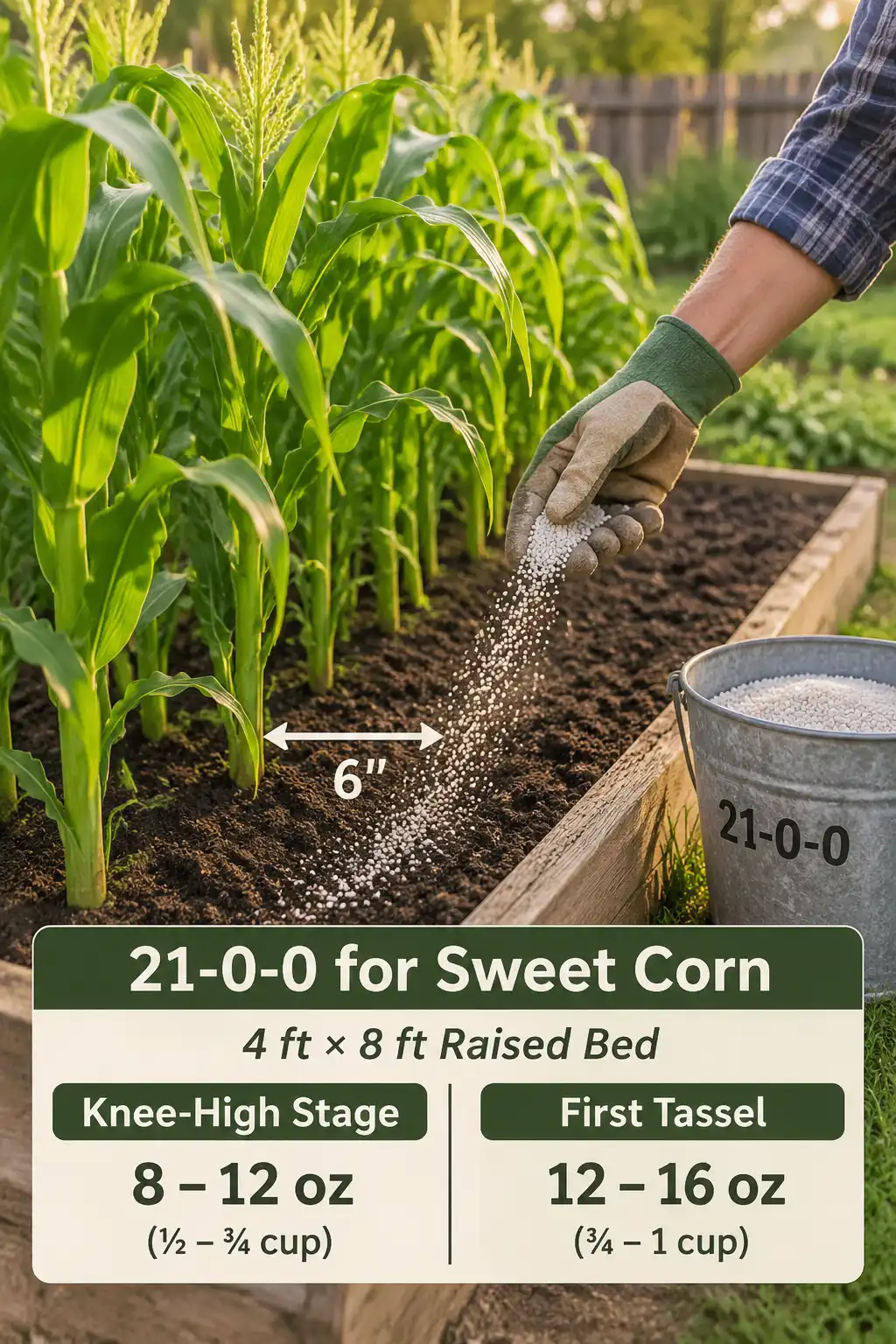
Utah State University Extension recommends working organic matter and a complete fertilizer into the bed before planting. After that, sidedress twice:
- Knee-high (8 to 10 leaves): ½ pound of 21-0-0 per 100 square feet
- First tassels or silks: another ¼ pound per 100 square feet
Spread the fertilizer 6 inches to the side of the plants and water it in.
Scaled to a 4 by 8 raised bed (32 square feet): use about 2.6 ounces of 21-0-0 at knee-high and 1.3 ounces at first tassel. Together, the two doses work out to roughly 69 pounds of N per acre.
That is well below the field rates above. For comparison, Minnesota’s 140 pound sweet corn rate on a 4 by 8 bed comes to about 1.6 ounces of actual N. That equals roughly 3.6 ounces of urea or 7.8 ounces of ammonium sulfate. Garden programs rely on compost and the preplant fertilizer to cover the difference.
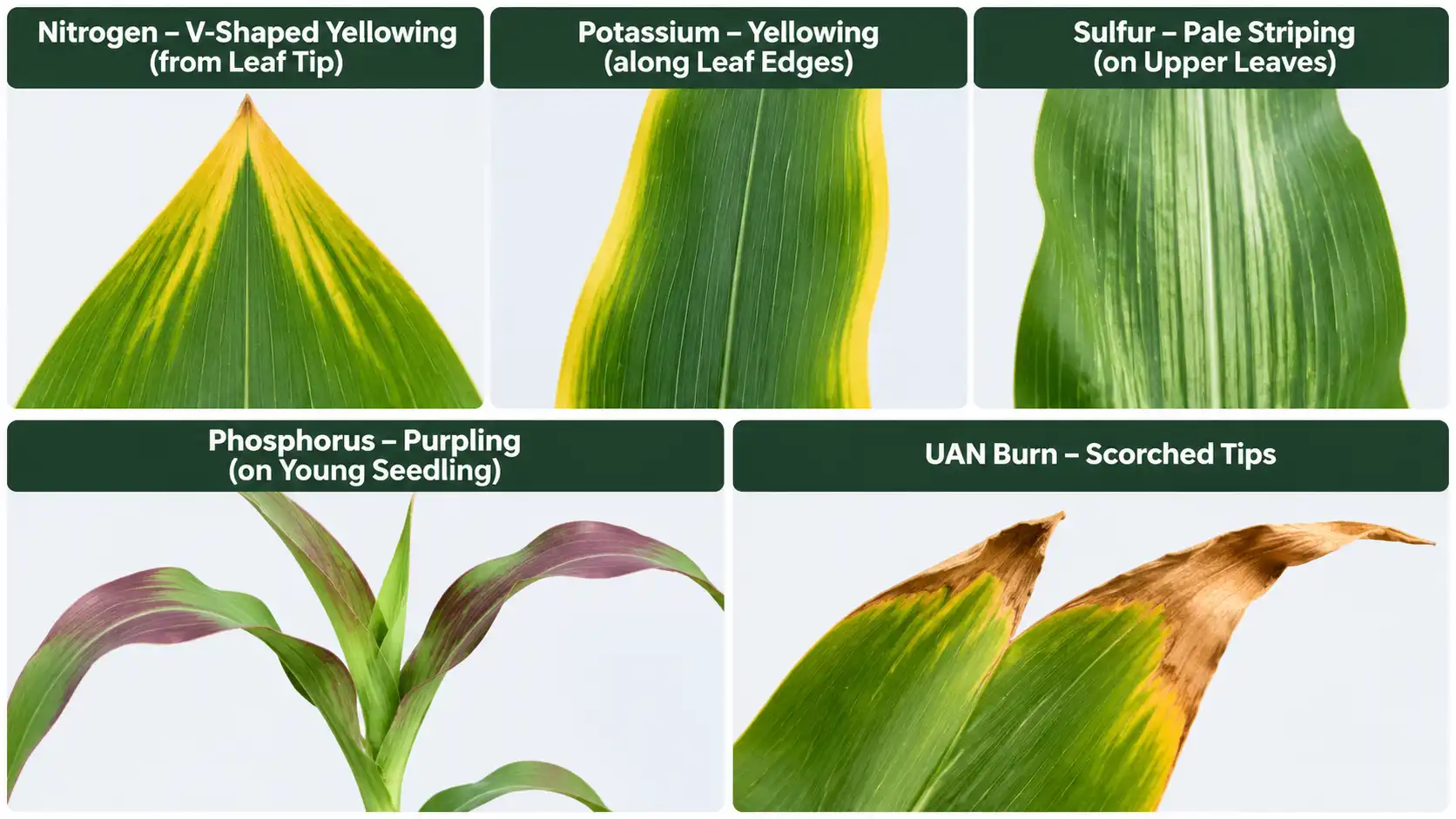
Common Corn Fertilizing Mistakes and What They Look Like
Most fertility problems show up in a few recognizable ways. Match the symptom to its likely cause, then confirm with a soil test or tissue test before you buy more product.
| What you see | Likely cause | What to do |
|---|---|---|
| Gaps in the row, stunted seedlings | Salt or urea injury from in-furrow starter | Cut the in-furrow rate or move to a 2×2 band |
| Purple seedlings in cold soil | Slow P uptake in cold soil | Usually outgrown; check soil-test P |
| Yellow V on lower leaves, moving up | Nitrogen shortage | Run a soil nitrate test; sidedress or rescue |
| Yellow, firing leaf edges on lower leaves | Potassium shortage | Check soil-test K, especially after stover removal |
| Pale striping on upper leaves | Sulfur shortage | Apply sulfate sulfur next season |
| Scorched leaf tips after a sidedress | UAN sprayed over the canopy | Use coulters or drops next time |
| Yellowing after a wet June despite full N | Leaching or denitrification | Test the soil and plan a supplemental pass |
FAQs
Can you put too much fertilizer on corn?
Yes. Rates above the MRTN range cost more than the extra grain is worth, and surplus nitrate can leach into groundwater. Too much in-furrow starter also kills seedlings, so stay within your state’s limits.
What is the best fertilizer for corn?
No single product is best. Anhydrous ammonia carries the most N per pound, UAN fits split programs, and ammonium sulfate adds sulfur. Choose on price per pound of actual N and on the equipment you already run.
Do I need to fertilize corn after soybeans?
Yes, but less. Iowa State’s calculator suggests about 40 to 50 fewer pounds of N per acre after soybeans than after corn. The soybean effect is already counted in that rate, so do not subtract a second credit.
Can I use 10-10-10 on sweet corn?
Yes, as a preplant base in a garden. After that, sidedress with a nitrogen-only product such as 21-0-0, because corn’s midsummer demand is mostly for N, and repeated P and K can build up past what the crop needs.
Why is my corn yellow after I fertilized?
Heavy rain often pushes nitrate below the roots, and saturated soil can turn nitrate into gas. Cold soil also slows uptake. A soil nitrate test taken when the corn is 6 to 12 inches tall will tell you whether you need more N.
Does foliar fertilizer work on corn?
Not as a nitrogen source. A foliar spray can carry only a few pounds of N before it burns the leaves, and that is far below what a corn crop needs. For a rescue, dribble UAN at the base of the plants through drops instead.
When should I stop fertilizing corn?
Plan to finish by V8 to V10. In longer-season areas, Purdue research shows late N can still rescue a deficient crop up to V15. University of Minnesota trials, however, found no yield gain from applications after V10.
Key Points for Your Field
Start with a soil test and set P, K, and sulfur from it. Set nitrogen with your state’s rate calculator and this season’s prices, not a yield goal. Split the N so most of it is in the root zone by V8, and inject or band liquids rather than spraying them over the leaves. If the spring turns wet, a soil nitrate test tells you whether a second pass will pay before you spend the money.