When to Plant Spring Wheat: Best Dates and Soil Temperature
Knowing when to plant spring wheat helps you avoid two costly mistakes: sowing into unsuitable soil and delaying growth until summer heat arrives. Planting dates vary across the United States, but soil temperature, moisture, and regional growing conditions determine the right starting point.
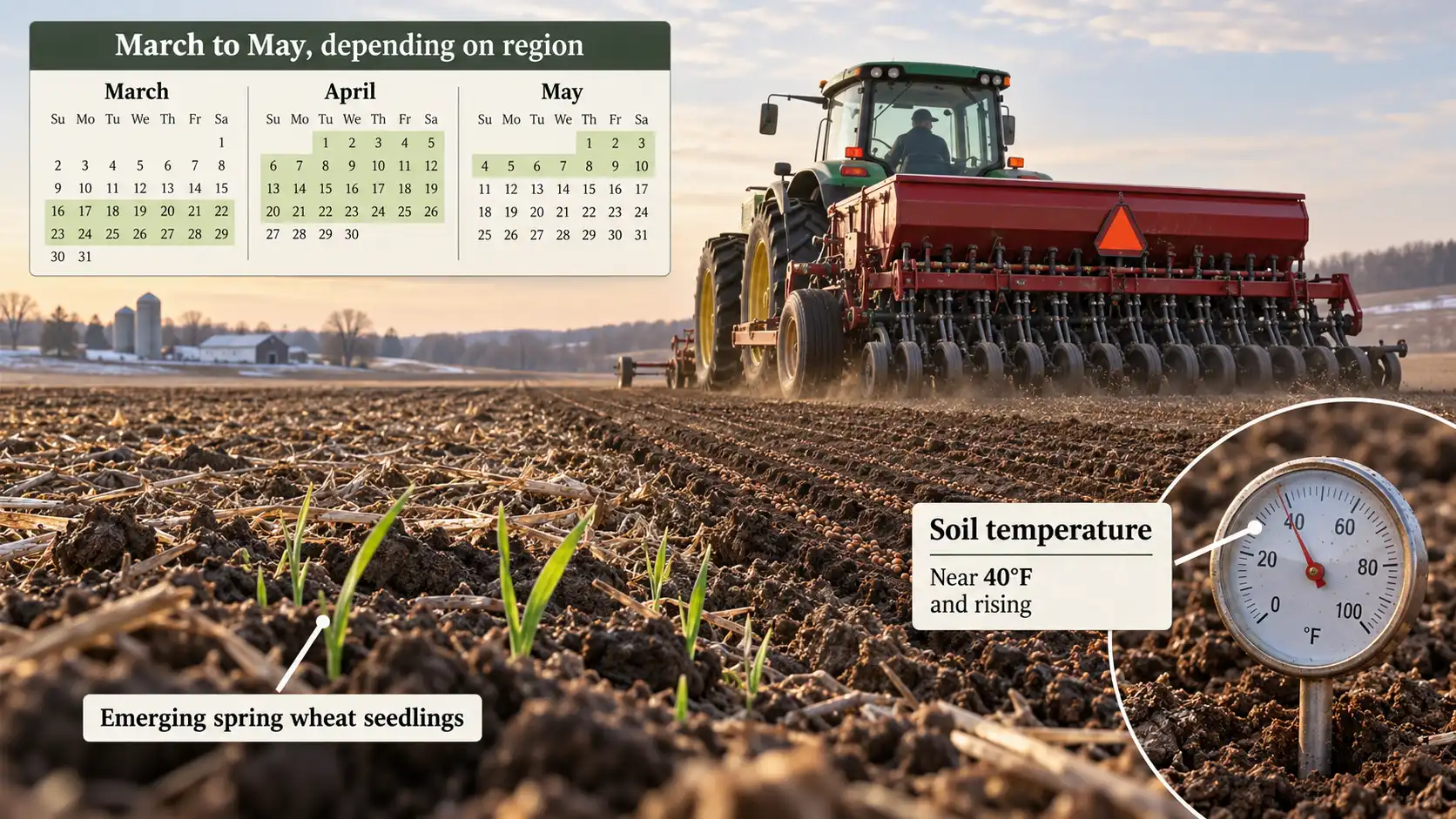
When to plant spring wheat depends on region: usually March through May, as soon as soil is workable. Seeds can germinate at 34 to 36°F, although emergence is quicker near 40°F. Early frost is not a reason to wait.
When to Plant Spring Wheat by Region
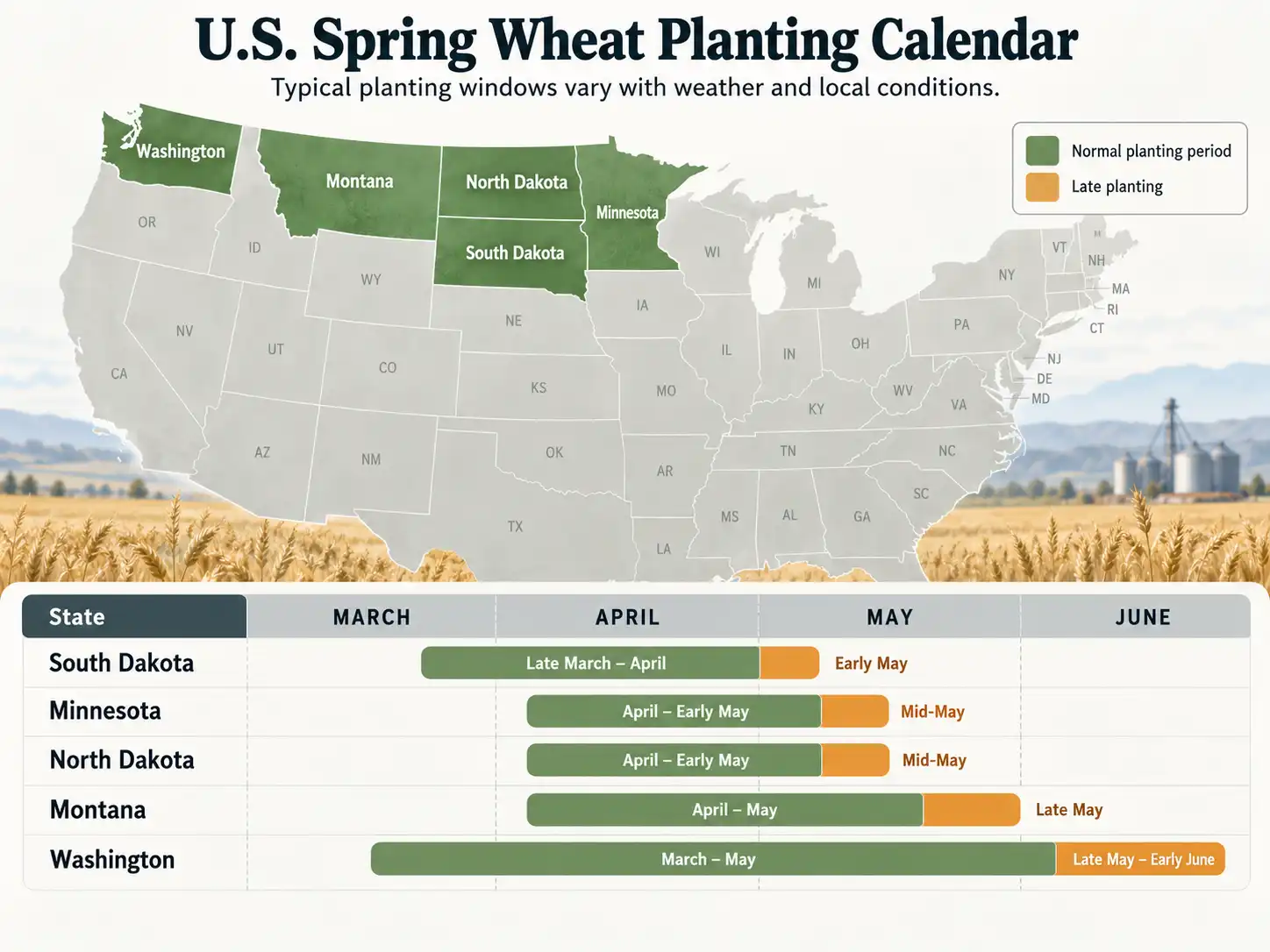
Spring wheat planting begins in late March in some southern growing areas and extends into May farther north.
The University of Minnesota Extension planting calendar provides regional dates for Minnesota and North Dakota. SDSU Extension provides more detailed planting windows for South Dakota.
| Region | Preferred planting period | Last recommended period |
|---|---|---|
| South Dakota, south central | March 25 to April 15 | May 9 |
| South Dakota, southeast | March 25 to April 10 | May 11 |
| South Dakota, northern areas | April 8 to April 27 | May 12 to May 19 |
| Southern Minnesota, south of US Highway 12 | First week of April | First week of May |
| Far northern Minnesota | First week of May | First week of June |
| North Dakota, south of Interstate 94 | Third week of April | Third week of May |
| Far northern North Dakota | First week of May | First week of June |
| Montana | April to May | Varies by local conditions |
| Washington | March to May | Varies by local conditions |
The Montana Wheat & Barley Committee identifies April and May as the usual spring wheat planting months. The Washington Grain Commission reports planting from March through May, depending on soil moisture.
These dates are regional guides, not guarantees. Soil conditions and short-term weather still determine whether planting should begin.
What Soil Temperature Is Best for Planting Spring Wheat?
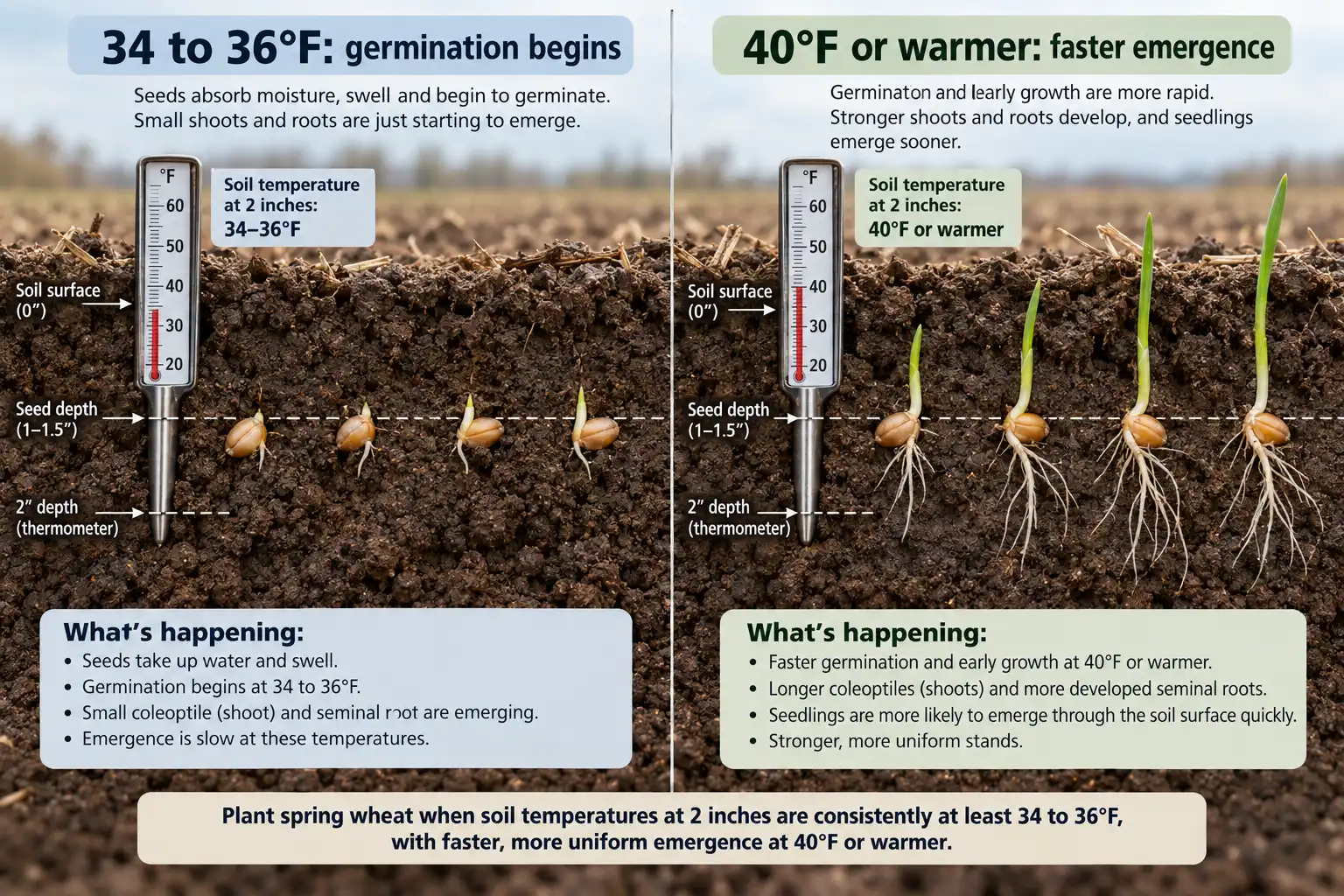
Spring wheat can begin germinating at 34 to 36°F, but temperatures near 40°F generally support faster, more consistent emergence.
There are differences between university recommendations.
According to SDSU Extension’s soil temperature guidance, spring wheat can germinate when the three-day average soil temperature reaches 34 to 36°F.
However, the Montana State University Wheat Production Guide recommends planting when the average soil temperature at a 2-inch depth exceeds 40°F.
These recommendations reflect different planting priorities. The lower range identifies when germination can begin, while the warmer threshold favors more vigorous emergence.
| Soil temperature | What to expect |
|---|---|
| Below 34°F | Germination is very limited or delayed |
| 34 to 36°F | Germination can begin, but emergence may be slow |
| 37 to 39°F | Germination is possible, with continued cold-soil risk |
| 40°F or warmer | More favorable for prompt, uniform emergence |
Use a three-day average rather than a single warm afternoon reading. SDSU Extension accepts measurements from bare soil at a 4-inch depth, while Montana’s guidance specifically uses 2 inches.
Always consider whether soil is too wet for planting equipment.
Can You Plant Spring Wheat Before the Last Frost?
Yes. Spring wheat can be planted before the final spring frost when the soil is suitable.
The growing point remains below the soil surface during early development. This provides protection from short periods of freezing weather.
University of Minnesota Extension explains that the growing point stays near the crown until approximately the five-leaf stage.
Its planting guidance reports that young wheat crowns can tolerate temperatures around 28°F and sometimes brief exposure near 22°F.
However, frost tolerance is not unlimited.
- Young seedlings generally tolerate light frost better than wheat approaching reproductive growth.
- Severe freezing can damage the crown and kill seedlings.
- Once the growing point rises above the soil during stem elongation, freeze injury becomes more serious.
After a frost, inspect the crown and watch for fresh growth. Damaged leaf tips alone do not prove the plants are dead.
Waiting for every frost risk to disappear can unnecessarily delay planting.
How to Know When Your Field Is Ready for Spring Wheat
The field is ready when seed can be placed into moist soil at a consistent depth without causing compaction.
Check these conditions before planting:
- Soil moisture: The seed zone should contain enough moisture for germination. Avoid saturated ground that smears or forms compacted clods.
- Soil temperature: Check recent readings and the weather forecast. Colder planting conditions increase the risk of delayed emergence.
- Seedbed condition: Verify that the drill can maintain uniform seed depth and firm seed-to-soil contact.
- Field preparation: Check weeds, crop residue, drainage, and nutrient requirements before sowing.
How Deep Should You Plant Spring Wheat?
A planting depth near 1.5 inches is a useful starting point, with adjustment for local moisture and seedbed conditions.
In its 2026 wheat guidance, SDSU Extension recommends approximately 1 to 1.5 inches. University of Minnesota Extension recommends 1.5 to 2 inches for small grains under most conditions.
Deeper planting can delay emergence, particularly with shorter, semi-dwarf wheat varieties.
Use a properly calibrated grain drill or no-till drill for consistent placement. Check actual seed depth behind the openers.
Before applying fertilizer, use your soil test results to identify nutrient needs rather than assuming every field requires the same rate.
Why Early Planting Improves Spring Wheat Yield Potential
Early planting helps spring wheat complete important growth stages before high summer temperatures arrive.
Spring wheat produces tillers, develops heads, flowers, and fills grain during a relatively short growing season.
Cool conditions during early growth support the formation of productive tillers and spikelets.
University of Minnesota Extension explains that spikelet development occurs around the four- to 5.5-leaf stages. Hotter temperatures during this period can reduce the number of spikelets formed.
Delaying planting also shifts flowering and grain filling toward hotter weather.
This increases the likelihood of heat and moisture stress, particularly in dryland fields.
The advantage of early planting does not justify driving onto saturated ground. Soil compaction and poor seed placement can reduce stand establishment.
The aim is to plant at the earliest suitable opportunity, not simply the earliest calendar date.
How Late Can You Plant Spring Wheat?
Spring wheat can sometimes be planted in May or early June, but yield risk increases after the local recommended planting window.
University of Minnesota Extension’s late-planting guidance reports average yield reductions around 1% per day after the preferred date.
SDSU Extension reports a North Dakota study suggesting losses around 1.5% per day. These estimates differ because of the studies and growing conditions involved.
Neither percentage predicts the exact loss in an individual field.
What Happens When Planting Is Delayed?
Late-planted wheat usually develops faster in warmer conditions, leaving less time to build yield.
Potential effects include fewer productive tillers, smaller heads, reduced grain weight, and greater exposure to heat during grain filling.
A cool, adequately moist summer can reduce these losses. Hot, dry weather can make them worse.
If the last recommended date has passed, compare expected wheat returns with alternatives.
Choosing another crop suited to the remaining growing season may be more economical than planting spring wheat very late.
How to Adjust Spring Wheat Seeding Rates for Late Planting
Increasing the seeding rate can partly compensate for fewer tillers when spring wheat is planted late.
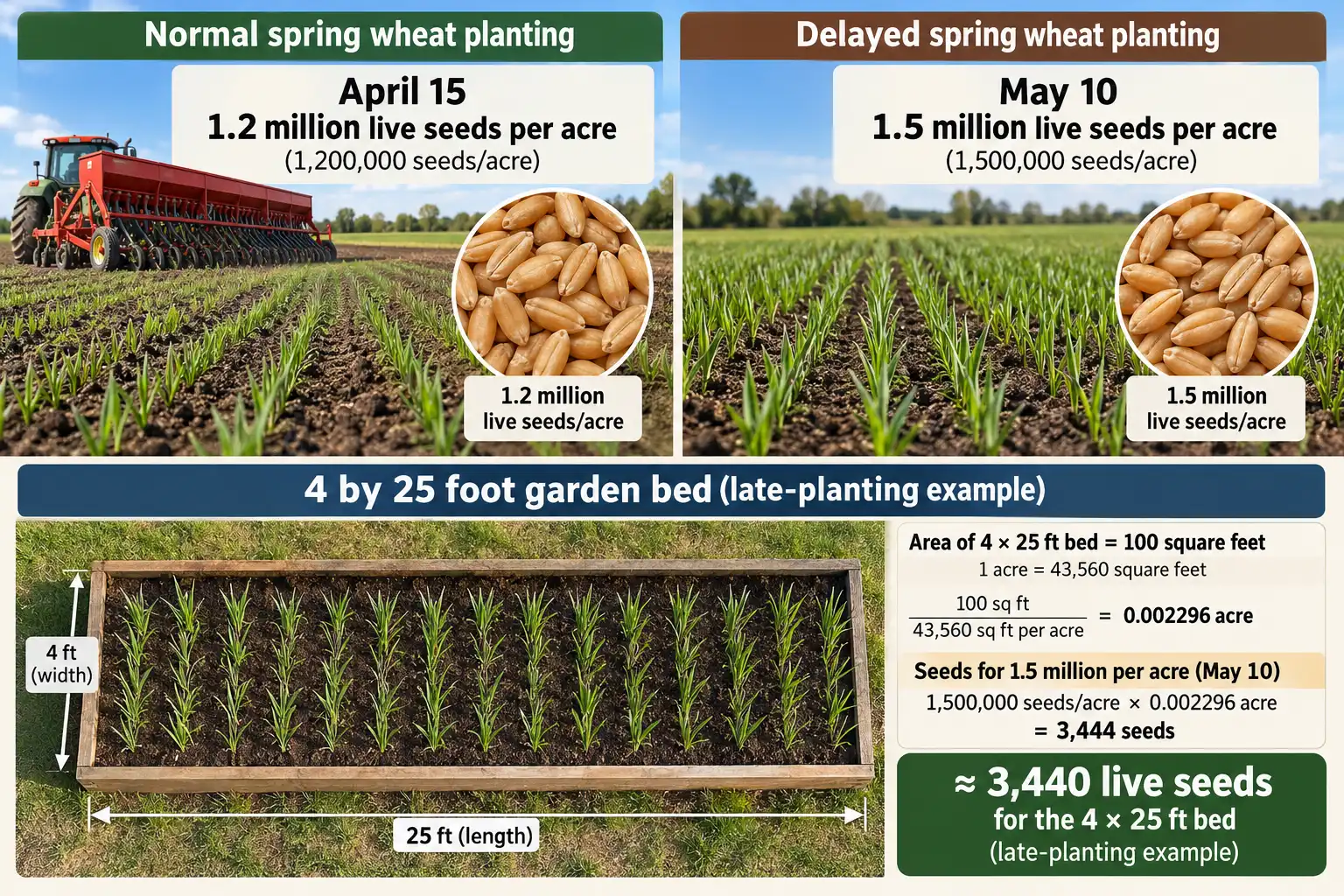
SDSU Extension recommends increasing its normal seeding rate by approximately 1% for each day beyond the preferred planting date.
Consider its published example:
| Planting detail | Normal planting | 25 days late |
|---|---|---|
| Planting date | April 15 | May 10 |
| Seeding rate | 1.2 million live seeds/acre | 1.5 million live seeds/acre |
| Live seeds per square foot | 27.5 | 34.4 |
| Live seeds per 100-square-foot bed | 2,755 | 3,444 |
The calculation is:
1,200,000 × 1.25 = 1,500,000 pure live seeds per acre
For a 4 × 25-foot bed, multiply the acre rate by 100 ÷ 43,560.
With 15,000 kernels per pound and 95% germination, the late rate requires approximately 105 pounds of seed per acre, or 3.9 ounces per 100-square-foot bed.
These are example seed-lot values, not a universal weight recommendation.
SDSU Extension caps its recommendation at 1.8 million seeds per acre. University of Minnesota Extension uses a lower ceiling of 1.6 million. Follow the guidance for your region, field moisture, and variety.
Common Spring Wheat Planting Problems
Most establishment problems result from poor seed placement, unsuitable moisture, cold conditions, or delayed sowing.
| Problem | Likely cause | What to do |
|---|---|---|
| Slow emergence | Cold soil or excessive planting depth | Check soil temperature and seed depth |
| Uneven seedlings | Dry patches or inconsistent seed contact | Inspect seed placement and moisture |
| Soil crust after rain | Surface sealing during emergence | Assess stand damage before deciding to replant |
| Yellow or damaged leaf tips after frost | Cold injury to exposed leaves | Check the crown and monitor new growth |
| Thin late-planted stands | Reduced emergence or tillering | Evaluate plant population before making further decisions |
| Poor emergence under heavy residue | Cooler seed zone or inconsistent drill depth | Check temperature and adjust drill setup |
For irrigated fields, estimate crop water requirements before committing to late planting.
Additional irrigation may improve moisture availability, but it cannot fully remove the effects of high temperatures on wheat development.
Spring Wheat and Winter Wheat Have Different Planting Seasons
Spring wheat is planted in spring, while winter wheat is normally planted during fall.
The distinction involves more than the planting calendar.
Winter wheat generally requires exposure to cold temperatures, known as vernalization, to progress normally toward flowering. True spring wheat varieties do not have that requirement.
Hard red spring wheat, durum wheat, and spring-type soft white wheat can all be spring-planted, depending on regional adaptation.
Choose a variety suited to your climate, disease pressures, and grain market. Do not substitute fall planting recommendations for a spring-type variety without appropriate local guidance.
FAQs about Plant Spring Wheat
Can I plant spring wheat in March?
Yes, March planting can work in milder parts of South Dakota and Washington when soil is workable and moisture is adequate. Northern Minnesota and North Dakota usually need to wait until April or May.
Can I plant spring wheat in June?
Early June is a last recommended window for the far northern Minnesota and North Dakota bands in University of Minnesota guidance, not a general target. Most areas face higher heat and yield risks by then.
Does spring wheat need cold weather to produce grain?
No, spring wheat does not require the cold exposure that triggers reproductive development in winter wheat. Select a true spring-type variety, because planting winter-type seed in spring can delay or prevent normal heading.
How many days does spring wheat take to germinate?
Under favorable weather, spring wheat can emerge in about eight to ten days after planting. Colder seedbeds, poor seed contact, or saturated soil slow emergence and increase the chance of a patchy stand.
Can spring wheat grow in a small garden bed?
Yes, spring wheat can be grown in a small bed with the same soil and temperature checks used for fields. Measure square footage and use a seed count, not a handful-based estimate, to set the rate.
Does spring wheat come back every year?
Spring wheat is an annual, so it will not produce another grain crop from the same plants the following spring. Volunteer seedlings may appear from spilled kernels, but they should not be treated as a reliable stand.
Key Points for Your Spring Wheat Planting Plan
Use your regional planting window to identify the earliest suitable date, then check soil temperature, moisture, and seed placement before sowing.
Aim to establish the crop early enough for tillering and head development under cooler conditions. When planting is delayed, recalculate the seed rate and reassess the remaining growing season rather than relying on the calendar alone.