When to Plant Winter Wheat: Best Dates by Region
Knowing when to plant winter wheat starts with your location and growing conditions. Fall planting gives wheat time to establish roots before winter, but planting too early or late can reduce grain yield and winter survival.
The best time to plant winter wheat is September through October across much of the northern and central United States. Southern regions often plant in October or November. Follow local planting dates and sow seeds 1 to 1.5 inches deep.
When to Plant Winter Wheat by State and Region
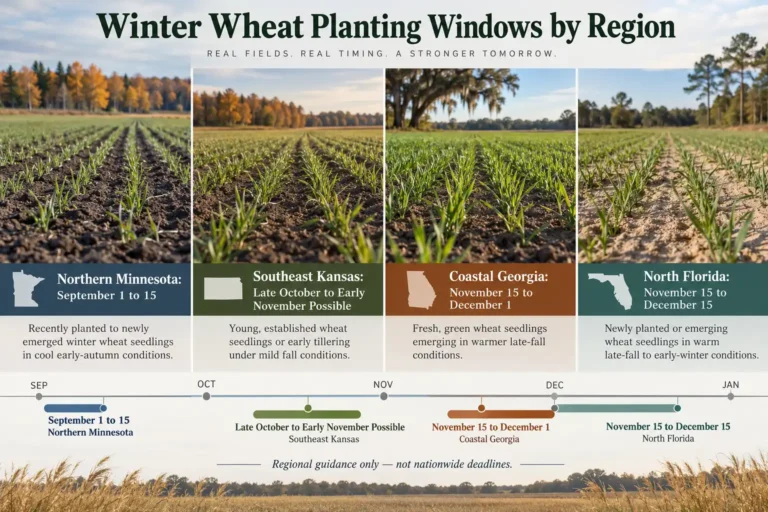
Winter wheat planting dates vary because fall temperatures, soil moisture, and winter conditions differ across growing regions.
Northern states generally require earlier planting to establish sufficient growth before freezing weather. Warmer southern regions allow later planting.
The following table summarizes grain-production planting windows from university extension recommendations.
| State or growing region | Recommended planting time |
|---|---|
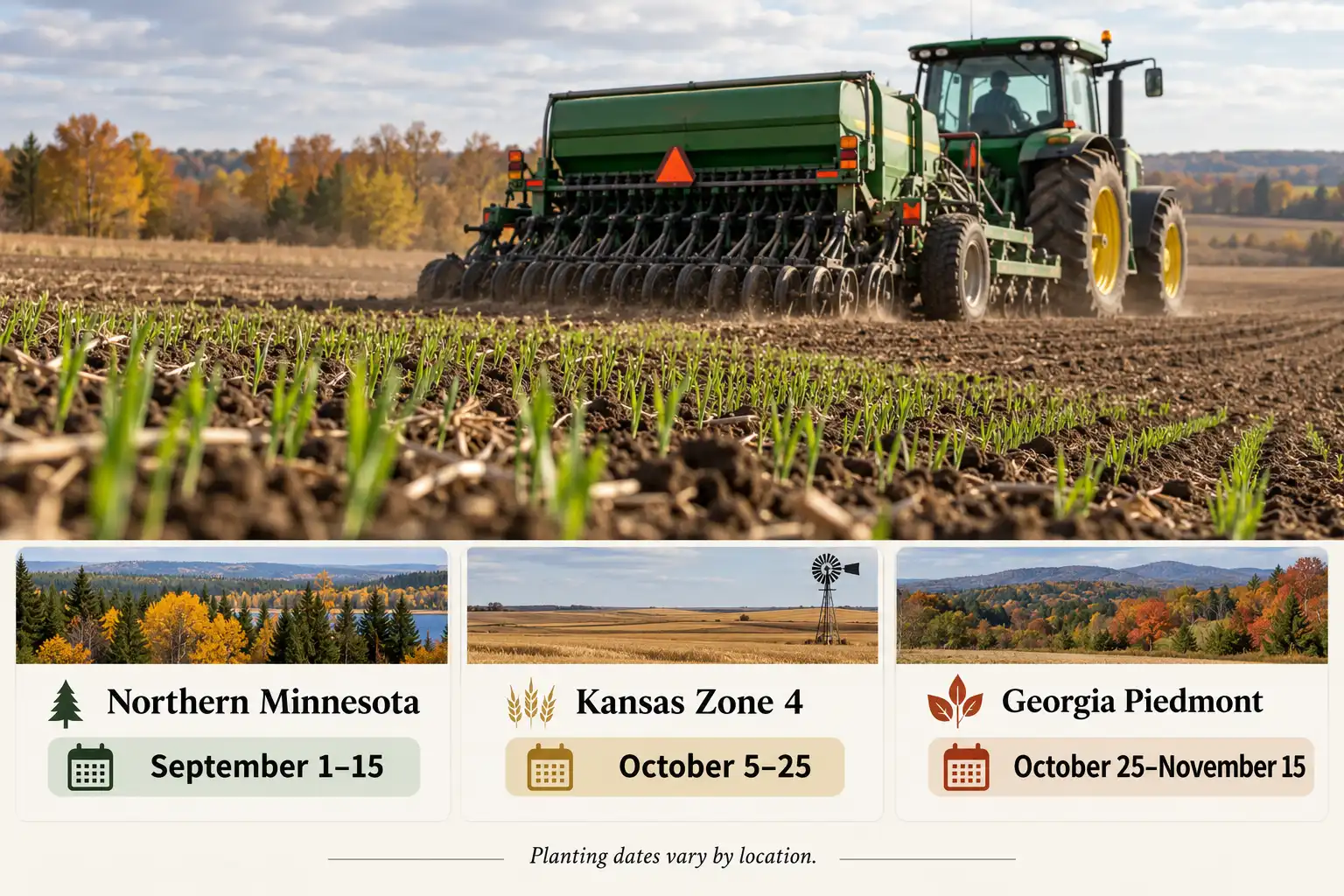
| Northern Minnesota, north of I-94 | September 1-15 |
| Southern Minnesota, south of I-90 | September 20-October 10 |
| Kansas, Zone 1 | September 10-30 |
| Kansas, Zone 4 | October 5-25 |
| Ohio | Late September to mid-October, following county fly-safe dates |
| Central and eastern Virginia | Mid-October through late October |
| Georgia Piedmont | October 25-November 15 |
| Georgia Upper Coastal Plain | November 7-December 1 |
| Dry inland Oregon and Washington | Late August to mid-September when moisture allows; October planting is common in dry no-till systems |
The University of Minnesota Extension provides separate dates for northern and southern Minnesota. Similarly, K-State Research and Extension identifies four Kansas planting zones.
Ohio State University Extension recommends planting shortly after the county’s Hessian fly-safe date.
In Virginia, Virginia Cooperative Extension found similar yields from mid-October and late-October planting across six site-years.
The later southeastern dates follow UGA Cooperative Extension. Oregon State University Extension documents why dryland planting dates depend heavily on seed-zone moisture.
These are regional examples, not universal deadlines. Confirm your county’s current recommendation before planting.
Why Does Winter Wheat Planting Time Matter?
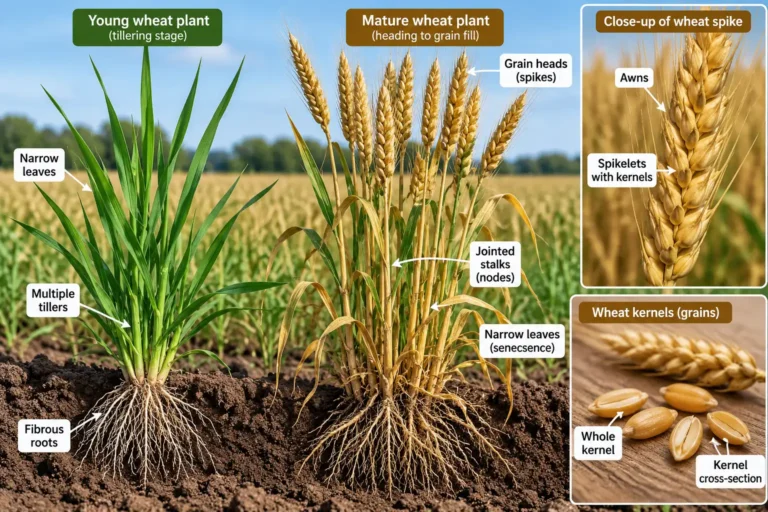
Planting at the right time allows wheat to develop roots and productive shoots, called tillers, before winter dormancy.
A well-established plant is better prepared for freezing conditions and spring growth. However, planting excessively early or late creates different risks.
What happens when wheat is planted too early?
Early planting can increase insect and disease pressure, particularly during warm autumn weather.
Important risks include:
- Hessian fly: Early seedlings may be exposed to egg-laying adults.
- Wheat streak mosaic: Wheat curl mites can carry viruses from volunteer wheat into new plantings.
- Barley yellow dwarf virus: Aphids may infect wheat during early fall growth.
- Excessive growth: Large fall canopies can consume soil moisture needed during spring.
K-State recommends using the local Best Pest Management Planting Date, formerly called the Hessian fly-free date, when scheduling grain wheat.
Destroy volunteer wheat before planting to interrupt the movement of insects and viruses between crops.
What happens when wheat is planted too late?
Late-planted wheat has less time to establish roots and produce tillers before cold weather.
As a result, plants may enter winter with limited root development and greater exposure to winter injury.
However, a late planting does not automatically fail. Warm autumn temperatures may allow adequate establishment.
In Virginia trials conducted during 2024 and 2025, late-October wheat yielded similarly to mid-October wheat. Mid-November planting produced lower average yields.
How to Plant Winter Wheat Step by Step
Winter wheat establishes most consistently when you use suitable seed, prepare the field, and maintain uniform planting depth.
1. Choose the right winter wheat variety
Select winter wheat adapted to your growing region and intended market.
Common wheat classes include:
| Wheat class | Common growing region | Main distinction |
|---|---|---|
| Hard red winter wheat | Central and Southern Great Plains | Typically used for bread flour |
| Soft red winter wheat | Eastern United States | Often used for cookies, crackers, and pastries |
| Soft white winter wheat | Pacific Northwest | Commonly used for cakes, pastries, and other products |
Choose varieties with suitable winter hardiness, disease resistance, maturity, and grain quality. Also check the seed lot’s germination percentage.
2. Prepare the field and check soil fertility
Winter wheat grows best in a firm, well-drained seedbed with adequate soil moisture.
Before planting:
- Remove actively growing weeds and volunteer wheat.
- Test soil pH and nutrient availability.
- Check phosphorus, potassium, and residual nitrogen.
- Avoid drilling into saturated or heavily compacted soil.
- Maintain a firm seedbed for consistent seed-to-soil contact.
Use soil test interpretation to identify nutrient needs rather than applying a fixed fertilizer amount.
Winter wheat commonly follows soybeans in grain rotations. Planting into corn residue can increase Fusarium head blight risk.
Consider harvest dates and disease history when choosing crops for rotation.
3. Plant with a grain drill
A grain drill places seeds at a consistent depth and spacing. This improves establishment compared with uneven surface broadcasting.
For conventional grain production:
- Use approximately 7 to 7.5-inch row spacing where locally recommended.
- Set the drill to the calculated seeding rate.
- Check seed placement behind several drill openers.
- Ensure the furrow closes around the seed.
- Inspect emergence and stand uniformity after planting.
No-till drills can establish wheat directly into suitable crop stubble. In colder regions, standing stubble also helps retain insulating snow.
Winter Wheat Planting Depth: How Deep Should You Plant?
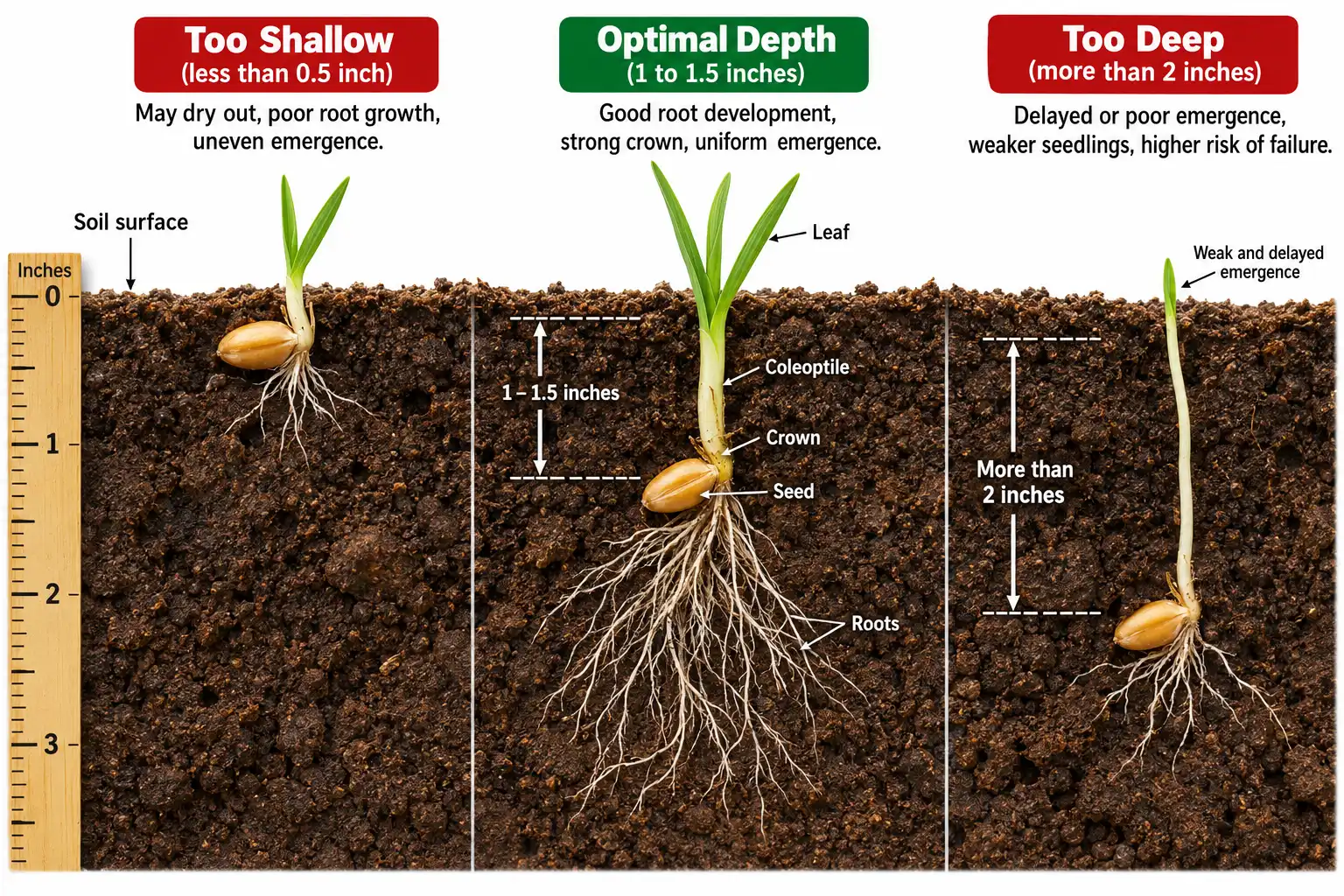
Plant winter wheat 1 to 1.5 inches deep under typical conditions.
This depth provides seed coverage while allowing seedlings to emerge without excessive difficulty.
Both K-State and the University of Minnesota recommend this range for winter wheat establishment.
Planting depth affects root and crown development, particularly before winter.
| Planting depth | Possible outcome |
|---|---|
| Less than 1 inch | Greater risk of dry seed placement, shallow crowns, and winter injury |
| 1-1.5 inches | Recommended range for uniform emergence |
| More than 2 inches | Slower emergence and increased risk of stand loss |
Deep planting is especially risky with short-coleoptile wheat varieties. The coleoptile protects the emerging shoot as it moves toward the soil surface.
Some dryland systems use different depths based on soil moisture and drill design. Follow local guidance before making that adjustment.
How Much Winter Wheat Seed Should You Plant Per Acre?
Winter wheat seeding rates depend on growing region, seed size, planting date, and expected establishment.
There is no single pounds-per-acre recommendation suitable for every field.
For example, K-State’s 2026 guidance gives different seed populations for western and eastern Kansas.
| Region | Typical on-time seeding rate |
|---|---|
| Western Kansas | 750,000-900,000 seeds/acre |
| Eastern Kansas | 1,125,000-1,350,000 seeds/acre |
| Ohio | 1,200,000-1,600,000 seeds/acre |
These differences reflect production conditions, including rainfall and tillering potential.
How to calculate seed requirements
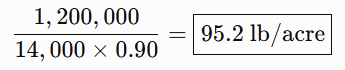
Use seeds per pound and the seed lot’s germination percentage.
Formula:

For example, assume:
- Target: 1,200,000 germinable seeds/acre
- Seed count: 14,000 seeds/lb
- Germination: 90%
- Seed purity: 100%
The calculation is:
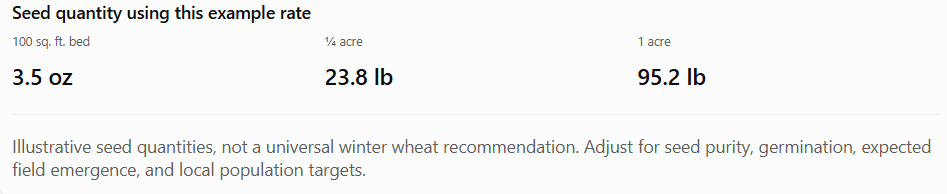
For larger operations, calibrate the grain drill before planting. Check actual seed delivery instead of relying entirely on the manufacturer’s setting chart.
Is It Too Late to Plant Winter Wheat?
Planting after the local recommended window may still produce grain, but the risks increase as autumn temperatures decline.
The decision depends on soil moisture, expected weather, and how far the planting date has moved beyond the regional window.
Should you increase seeding rates when planting late?
Yes, increasing the seeding rate can partially compensate for reduced fall tillering.
K-State’s October 2026 recommendations suggest increasing seeding rates for each week beyond the local optimum window by approximately:
- Western Kansas: 150,000-225,000 additional seeds/acre.
- Eastern Kansas: 225,000-300,000 additional seeds/acre.
These adjustments are specific to Kansas production conditions.
Higher seed rates cannot fully replace the root and tiller development lost through delayed planting. Excessive seeding may also increase lodging and competition for moisture.
Should you plant into dry or wet soil?
Avoid planting into saturated soil that smears or compacts around the seed.
For very dry soil, K-State describes planting at the normal depth and allowing seed to remain dormant until rainfall arrives. This is commonly called dusting in wheat.
However, delayed rainfall can also delay emergence. Check the forecast, soil profile, and crop insurance planting deadlines before deciding.
When Is Winter Wheat Harvested?
Winter wheat is generally harvested from May through August, depending on the region, variety, and seasonal weather.
Wheat planted in fall resumes active growth in spring. It then progresses through stem elongation, heading, flowering, grain filling, and maturity.
The approximate grain harvest periods are:
| Growing region | Typical harvest period |
|---|---|
| Southeastern states | May-June |
| Kansas and Southern Plains | June-July |
| Ohio and much of the Corn Belt | Late June-July |
| Northern wheat-growing regions | July-August |
| Pacific Northwest | July-August |
These are seasonal guides, not fixed harvest dates.
How do you know winter wheat is ready to harvest?
Mature wheat typically has straw-colored stems and heads, with hard kernels that no longer accumulate dry matter.
However, appearance alone cannot establish safe grain moisture.
The University of Minnesota Extension recommends combining wheat around 13-14% moisture when conditions permit. Higher-moisture grain requires appropriate drying before storage.
Harvest promptly after maturity to reduce weathering, preharvest sprouting, and grain losses.

Common Winter Wheat Planting Problems
Poor stands often result from planting depth, seed quality, soil conditions, or pest damage rather than planting date alone.
| Problem | Likely cause | What to check |
|---|---|---|
| Uneven emergence | Variable planting depth or moisture | Inspect seed placement and soil moisture |
| Thin seedlings | Low germination, crusting, or seedling disease | Check seed quality and affected roots |
| Yellowing plants | Nutrient deficiency, waterlogging, or disease | Compare soil conditions and symptoms |
| Patchy winter death | Shallow crowns, poor drainage, or winter injury | Inspect crowns after spring green-up |
| Weak spring tillering | Late planting or inadequate fall establishment | Count surviving plants and tillers |
Do not assume every yellow or stunted seedling needs fertilizer. First, compare symptoms with common crop disease problems and inspect soil conditions.
Northern growers should also consider winter-hardy varieties and standing stubble where snow retention is important.
FAQs about Plant Winter Wheat
Can you plant winter wheat in November?
Yes, November planting can fit the normal growing season in warmer regions, including parts of Georgia and Alabama. In northern states, November is generally beyond the preferred grain window, increasing the risk of poor winter establishment.
Should winter wheat be planted before the first frost?
Yes, aim to establish roots and several leaves before prolonged freezing weather. However, the first frost alone is not a reliable planting guide because local pest-management dates, soil moisture, and seasonal temperatures also affect establishment.
Can you plant winter wheat in the spring?
Spring planting is generally unsuitable for winter wheat varieties requiring substantial cold exposure before heading. If the fall window is missed, select locally adapted spring wheat rather than assuming a winter variety will produce a normal grain harvest.
Does winter wheat germinate in cold soil?
Yes, wheat can begin germinating at soil temperatures near 39°F, according to UGA Cooperative Extension. However, emergence becomes slower under colder conditions, so fall establishment depends on moisture, temperature, planting depth, and available growing time.
Can winter wheat be used as a cover crop?
Yes, winter wheat can protect soil and absorb residual nutrients during the colder months. However, cover crop planting dates and seeding rates may differ from grain production, particularly when fall ground coverage is the primary goal.
How long does winter wheat take to grow?
Winter wheat is planted in fall and usually completes its grain-producing cycle the following late spring or summer. The duration depends on planting date, weather, and variety, so determine harvest readiness from crop maturity rather than a fixed day count.
Key Points for Your Wheat Field
Choose your winter wheat planting date using county-level recommendations, then check soil moisture and the upcoming weather.
For grain production, prioritize a uniform 1 to 1.5-inch planting depth, locally appropriate seed population, and healthy fall establishment. Adjust delayed planting carefully rather than relying on extra seed alone.