Common Crop Diseases: 16 to Know in Corn, Soybeans, Wheat, and Gardens
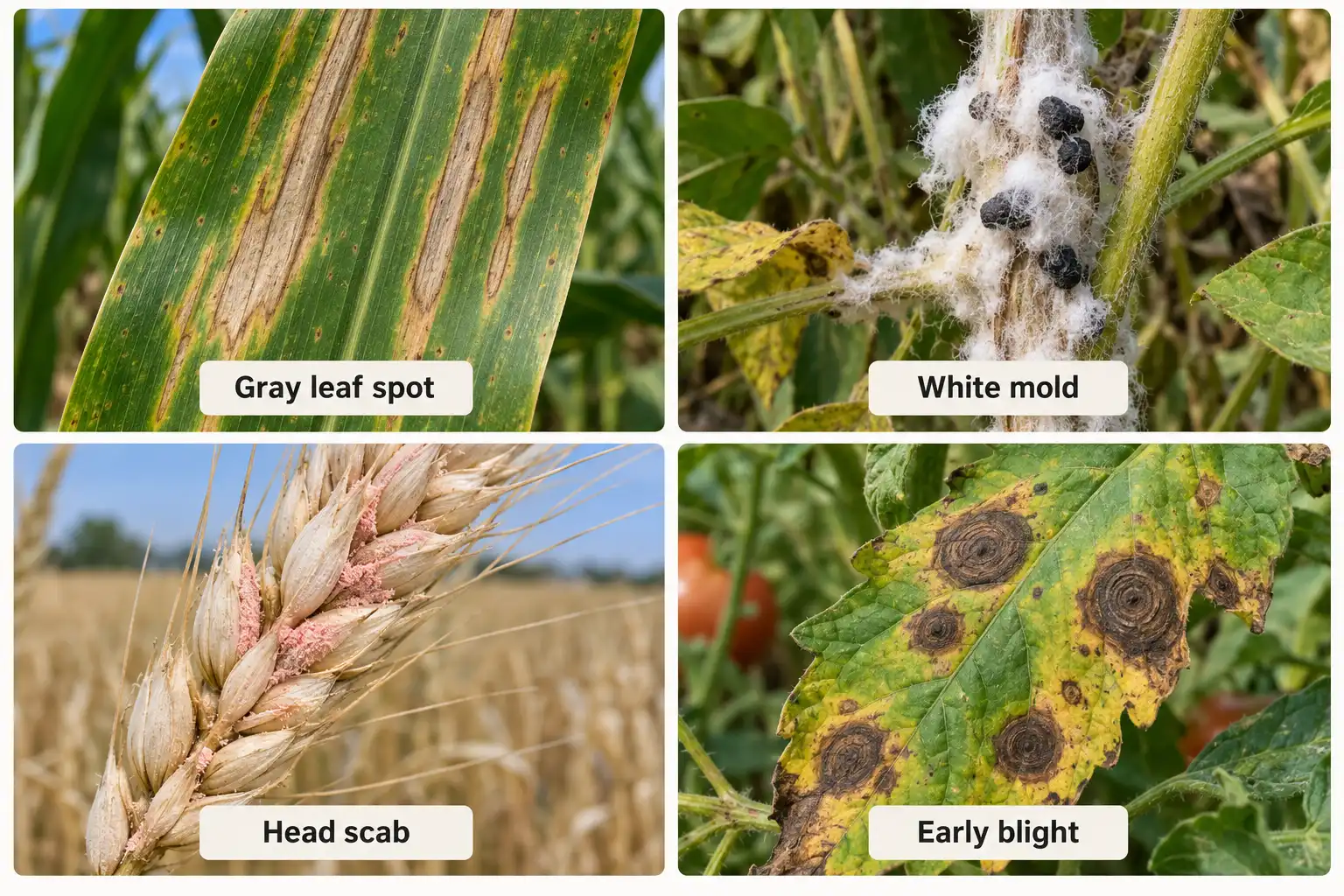
Leaf spots, blights, rusts, and mildews can look alike, yet each needs a different response. Here are the common crop diseases of corn, soybeans, wheat, and vegetables. For each one, you get the symptoms, the weather that triggers it, and the control that works.
Gray leaf spot, tar spot, and southern rust rank among common crop diseases in corn. Soybeans face cyst nematode and white mold, and wheat faces head scab. In gardens, watch tomatoes for early and late blight and squash for mildews.
What Causes Crop Diseases?
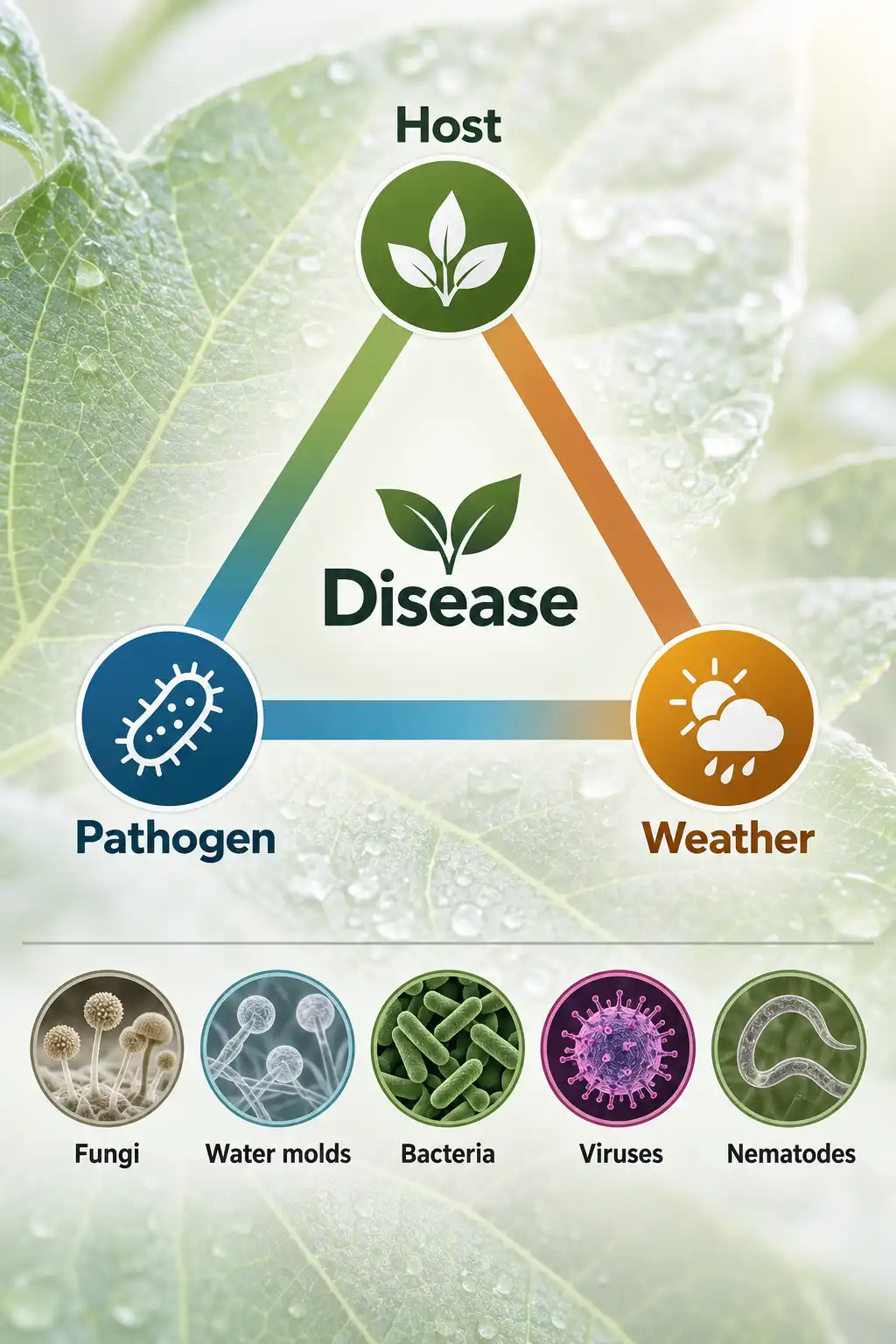
A crop disease needs three things at once: a susceptible plant, a pathogen, and weather that favors it. Plant pathologists call this the disease triangle. Take away one side, and the disease stalls. That is why resistant varieties, rotation, and dry leaves all cut losses.
The pathogen type matters just as much, because it decides which tools can work. For example, Penn State Extension and K-State Research and Extension both say fungicides fail against bacterial leaf streak in corn. Likewise, K-State reports no recommended insecticide for the wheat curl mite, which spreads wheat streak mosaic.
| Pathogen type | Examples | How it survives or spreads | What works against it |
|---|---|---|---|
| Fungi | Gray leaf spot, tar spot, rusts, white mold, early blight | Infected residue, soil, or spores blown north each summer | Resistant varieties, rotation, well-timed fungicide |
| Water molds | Late blight, downy mildew | Spores carried on wind and rain | Targeted fungicides, prompt removal of infected plants |
| Bacteria | Bacterial leaf streak, bacterial spot | Multiply fast in warm, wet weather | Certified seed, rotation, dry leaves; fungicides fail on leaf streak |
| Viruses | Wheat streak mosaic complex | Wheat curl mites riding the wind from volunteer wheat and grassy hosts | Killing volunteer wheat before planting |
| Nematodes | Soybean cyst nematode | Persists in soil for years | Soil tests, resistant varieties, rotation |
Each row sums up guidance cited in the crop sections below.
Common Corn Diseases
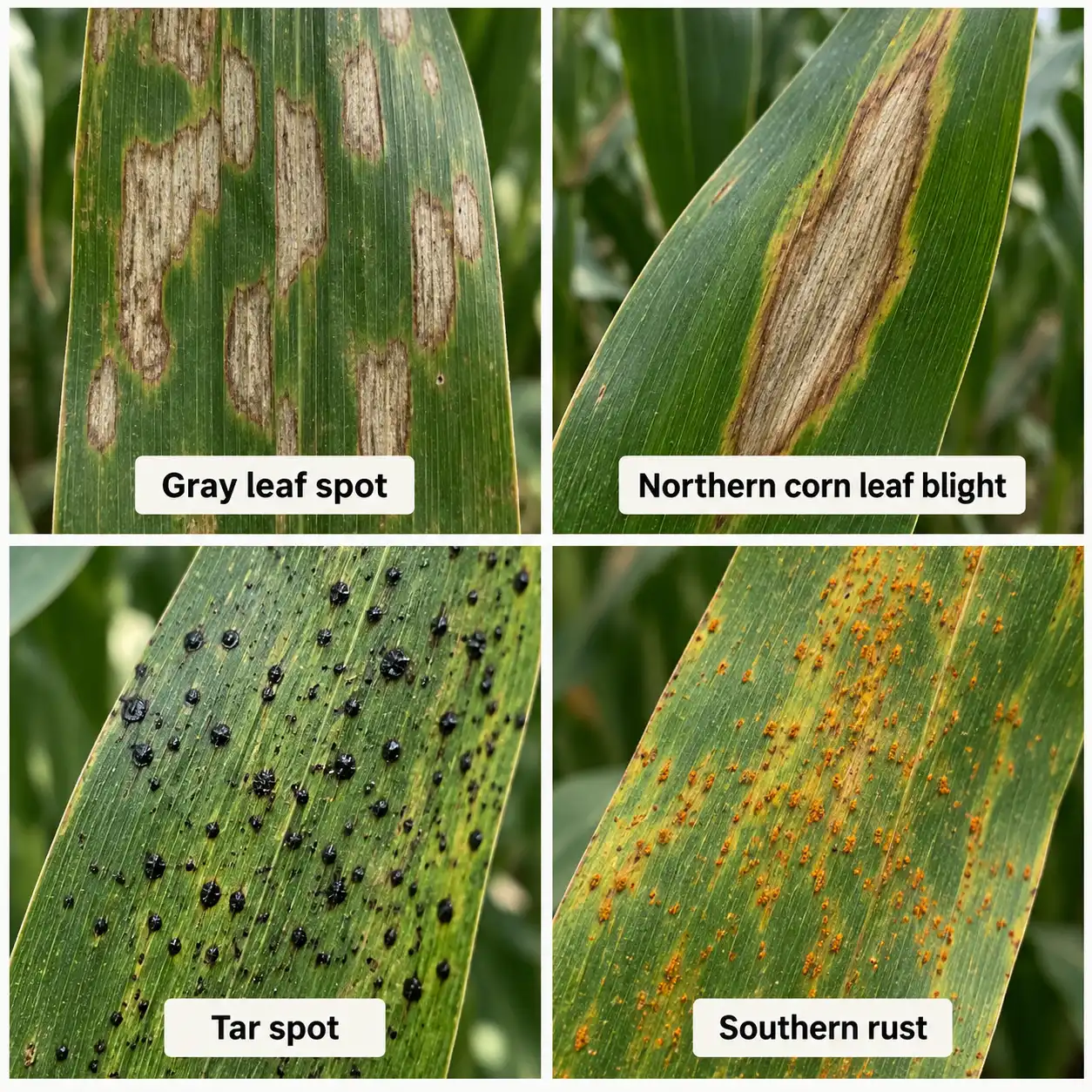
Scout corn for four fungal leaf diseases: gray leaf spot, northern corn leaf blight, tar spot, and southern rust.
| Disease | What you see | Weather that favors it |
|---|---|---|
| Gray leaf spot | Rectangular tan to gray lesions, 1 to 2 inches long, boxed in by leaf veins | Rainy or humid weather; worst in river bottoms and near trees |
| Northern corn leaf blight | Cigar-shaped, gray-green to tan lesions up to 6 inches long | Wet, humid weather |
| Tar spot | Small, raised, shiny black spots that will not rub off | Mild temperatures, high humidity, leaves wet over 7 hours |
| Southern rust | Bright orange pustules, often in dense clusters, on the upper leaf surface only | Warm days and nights above 80°F, high humidity |
Penn State Extension supplies the lesion descriptions and the leaf blight weather, and K-State’s 2026 scouting guide the rest. Penn State adds that gray leaf spot and northern corn leaf blight can surge in no-till or continuous corn. That fits K-State’s finding that gray leaf spot and tar spot survive in corn residue. Southern rust, by contrast, blows in from the South each year.
Tar spot is the newcomer. Purdue Extension traces the first US confirmations to 2015, in northwest Indiana and north-central Illinois. In a 2018 epidemic, some fields lost 20 to 60 bushels an acre. The services differ slightly on its weather. Purdue, citing Latin American data, gives 59 to 70°F with 85% humidity. K-State uses 60 to 73°F and humidity above 75%. Both flag leaf wetness over 7 hours.
When Does a Corn Fungicide Pay?
A corn fungicide is most likely to pay when disease shows up on a susceptible hybrid near tasseling. With no disease or light pressure, K-State advises holding off, because protection fades within three to four weeks. Hybrids rated more susceptible respond more to a spray, K-State adds, but only when disease pressure is high enough.
K-State’s 2026 timing guidance runs by disease:
- Gray leaf spot: spray at VT to R1, and start scouting about two weeks before tassels emerge.
- Tar spot: make the first pass at V10 to VT, then a second at R1 to R3 if needed. A lone V6 to V8 spray will not hold up.
- Southern rust: a VT to R3 spray may suppress it.
- Late pressure: an R2 spray can still pay when disease arrives after tasseling.
If corn growth stages are new to you, VT is tasseling and R1 is silking.
Common Soybean Diseases
Soybean cyst nematode (SCN), sudden death syndrome (SDS), and white mold are the soybean diseases to plan around. Two of them start underground, long before a leaf shows a symptom.
| Disease | What you see | What favors it |
|---|---|---|
| Soybean cyst nematode | Often nothing; sometimes stunting, yellowing, and tiny white females on roots | Susceptible varieties grown year after year |
| Sudden death syndrome | Yellow spots between veins that turn brown, mostly on upper leaves; leaflets drop while petioles stay attached; rotted roots | Cool, wet soil at planting, SCN, compaction, heavy rain in early reproductive stages |
| White mold | White cottony growth and hard black sclerotia on bleached stems, 6 to 14 inches up | Flowering during wet, humid weather below 85°F; dense canopy |
The SCN and SDS rows draw on Iowa State University Extension and K-State. The white mold row comes from University of Nebraska-Lincoln Extension.
SDS has no rescue spray. Iowa State says there are no in-season options, so prevention starts with variety choice. K-State reports the most susceptible varieties yield 40 to 50% less than resistant ones where SDS is present. It recommends ILeVO (fluopyram) or Saltro (pydiflumetofen) seed treatment only in fields with an SDS history.
White mold strikes at flowering. Nebraska Extension advises a fungicide during bloom where white mold has struck before. Sprays cannot save plants already infected. Its sclerotia survive in soil for several years, so rotate with corn or wheat. In problem fields, 30-inch rows also delay canopy closure.
Why Soybean Cyst Nematode Needs a Soil Test
SCN often takes yield without showing a sign. K-State calls it the number one yield-limiting pathogen of soybean. Yet in a recent Kansas survey, fewer than 10% of soybean growers had tested for it.
Iowa State research shows what that costs. In a central Iowa trial, a resistant variety outyielded a susceptible one by 10%, even though plant height never differed. Iowa State has also documented losses up to 40% with no aboveground symptoms.
Run the math on your own field. At 60 bushels an acre, a hidden 10% gap costs 6 bushels an acre, or 960 bushels across 160 acres. At the 40% extreme, the same field gives up 24 bushels an acre.
So test right after harvest, which K-State calls the best time. Walk each quarter of the field in a Z pattern. Pull 10 to 20 cores, 6 to 8 inches deep. Then mix them and send about a pint of field-moist soil to a plant diagnostic lab.
Common Wheat Diseases
Watch wheat for Fusarium head blight (head scab), wheat streak mosaic, leaf rust, and stripe rust.
| Disease | What you see | What favors it |
|---|---|---|
| Fusarium head blight | Bleached spikelets on green heads, sometimes with pink to orange spores; shriveled, light kernels | Two or three days of light to moderate rain from flowering through early dough |
| Wheat streak mosaic complex | Green and yellow streaks on leaves; stunted plants with fewer tillers | Volunteer wheat carrying wheat curl mites; symptoms build fastest above 70°F |
| Leaf rust | Circular to oval orange pustules | Wet, humid weather at 60 to 70°F |
| Stripe rust | Yellow pustules in lines that run parallel with the leaf veins | Wet, humid weather at 50 to 60°F |
Purdue Extension supplies the head scab row and K-State the wheat streak row. The rust rows come from Nebraska Extension.
How to Time Wheat Disease Control
Each wheat disease has its own control window. Stop wheat streak before planting, scout rust-prone varieties in spring, and guard heads from scab at early flowering.
Before planting: wheat streak. K-State calls wheat streak mosaic one of the most economically devastating wheat diseases in Kansas. Infections in the fall after planting cause more severe losses. The wheat curl mite spreads the viruses, but it survives only about 4 days without a living host. So volunteer wheat bridges mites to the new crop. K-State’s 2026 guidance sets a 30-day wheat-free window, with all volunteer dead, right before the optimal planting date. K-State recommends no insecticide for the mite.
Spring: leaf and stripe rust. Check variety ratings before you spray. K-State’s 2026 variety guide scores resistance from 1, highly resistant, to 9, highly susceptible. In its April 2026 update, K-State noted that many Kansas varieties rate 4 or better for leaf rust. Those likely would not benefit from a fungicide. Fields planted to varieties rated 5 or higher deserve closer scouting.
Flowering: head scab. Purdue Extension warns that wheat planted into corn stubble faces much higher risk, since the fungus overwinters in corn residue. As flowering nears, check the scab risk map at wheatscab.psu.edu, which K-State uses in its disease updates. Purdue finds triazole fungicides work best at early flowering (Feekes 10.5.1). The fungus also makes DON (vomitoxin), which can run high even when scab looks light.
Common Vegetable Diseases
Learn tomato blights and vine crop mildews first. Penn State Extension notes wet weather, poor drainage, and poor airflow often encourage them.
| Disease | Crops | What you see | What favors it |
|---|---|---|---|
| Early blight | Tomato, potato | Brown spots with bull’s-eye rings, starting on lower leaves | Leaves wet from dew or rain |
| Septoria leaf spot | Tomato | Small spots with tan centers and tiny dark specks | 68 to 77°F, high humidity, wet foliage |
| Late blight | Tomato, potato | Dark, water-soaked spots with white mold underneath | Cool, wet weather |
| Powdery mildew | Squash, pumpkin, cantaloupe, cucumber | White, talc-like patches on both leaf surfaces | Humid air at 68 to 81°F; no leaf wetness needed |
| Downy mildew | All vine crops | Pale yellow spots on top, purplish fuzz underneath | Cool, wet weather |
Penn State supplies every row but powdery mildew, which comes from Purdue Extension.

Late blight is the emergency. Penn State warns plants can lose every leaf within 14 days of the first symptoms. Throw out infected plants rather than composting them, and refuse spotted transplants. For potato growers, curing cut seed potatoes also helps block rot at planting.
Early blight usually stays in the lower third of the plant. At its first sign, Penn State suggests stripping leaves within 12 inches of the ground. Never remove more than 20% of the foliage.
Downy mildew does not overwinter in Pennsylvania. Instead, Penn State reports its spores can ride the wind more than 600 miles in 48 hours. So start preventive sprays when reports show it nearby.
How to Tell Look-Alike Problems Apart
Compare one telltale feature before you treat anything: lesion edges, pustule placement, or what grows under the leaf.
| Look-alikes | The telltale difference | Source |
|---|---|---|
| Gray leaf spot vs. bacterial leaf streak | Gray leaf spot has sharp, vein-bound edges and looks opaque when backlit; leaf streak has wavy edges and looks translucent | K-State |
| Gray leaf spot vs. northern corn leaf blight | Rectangular and 1 to 2 inches vs. cigar-shaped and up to 6 inches | Penn State |
| Southern rust vs. common rust | Bright orange pustules, often clustered, upper surface only vs. reddish-brown pustules scattered on both surfaces | Penn State |
| Tar spot vs. dead-leaf molds | Tar spot will not rub off; molds on dead tissue wipe away | Purdue |
| SDS vs. brown stem rot | Split the stem: brown pith means brown stem rot, while SDS rots the roots | Iowa State, K-State |
| Downy vs. powdery mildew | Purplish fuzz under the leaf vs. white patches on both sides | Penn State, Purdue |
| Early blight vs. Septoria leaf spot | Bull’s-eye rings vs. many small tan-centered spots with dark specks | Penn State |

Some problems are not infections at all. Penn State groups blossom end rot with environmental stresses, since it traces to calcium and uneven moisture. In corn, pale plants with yellowing lower leaves may point to a nitrogen shortfall instead. The reverse happens too: Iowa State shows SCN causing the marginal leaf yellowing typical of potassium deficiency. When a symptom fits none of these diseases, reading a soil test can rule nutrient problems in or out.
How to Prevent Crop Diseases at Any Scale
Prevention beats rescue, because fungicides protect healthy tissue but do not cure infected plants. These steps cut the risk of common crop diseases from a raised bed to a quarter section.
- Plant resistance first. Check hybrid and variety ratings for the diseases in your area before you buy seed.
- Rotate away from the host. Penn State’s rule keeps tomatoes, potatoes, peppers, and eggplant out of the same spot more than once in three years.
- Manage corn residue. Gray leaf spot, tar spot, and head scab all carry over on it, per K-State and Purdue.
- Break the green bridge. Kill volunteer wheat before the wheat-free window, as K-State advises.
- Keep leaves dry. Space plants so they do not touch, mulch, and avoid wetting foliage, Penn State advises. Where white mold has hit soybeans, skip irrigation during flowering, per Nebraska Extension.
- Start clean. Buy certified seed, refuse spotted transplants, and dip pruners in 1 part bleach to 9 parts water, per Penn State.
- Scout and test on a schedule. Check corn two weeks before tassels emerge, and test soybean fields for SCN after harvest, as K-State advises.
On a garden scale, rotation is simple. Give the tomato family its own bed and move it one bed each spring. With three or four beds, each bed hosts the family every third or fourth year, which meets Penn State’s rule.
FAQs About Common Crop Diseases
Can a fungicide cure a diseased plant?
No, a fungicide mainly protects healthy tissue and cannot heal leaves already showing symptoms. Penn State finds downy mildew sprays far more effective when applied before infection than after symptoms appear.
Can late blight spread from potatoes to tomatoes?
Yes, late blight attacks both crops, and its spores move between plants and gardens on wind and rain. Penn State Extension calls it especially damaging in cool, wet weather, so pull infected plants once you confirm it.
Why didn’t my fungicide work?
It likely went on at the wrong time or hit a disease fungicides cannot control. K-State notes corn fungicide protection fades within three to four weeks, and fungicides have no effect on bacterial leaf streak.
Does crop rotation prevent all crop diseases?
No, rotation curbs diseases tied to one crop’s residue but not ones that blow in or live on other crops. K-State finds rotation has limited effect on SDS, and Purdue says windborne powdery mildew makes rotation impractical at times.
Can squash powdery mildew spread to other plants?
Not beyond the squash family, per Purdue Extension, since the cucurbit powdery mildew fungus infects no other plant family. Mildews from tomatoes, roses, or other families also leave squash, pumpkins, and cucumbers alone.
Are any wheat varieties resistant to head scab?
Only partly, since no commercial wheat variety is highly resistant to Fusarium head blight, per Purdue Extension. Moderately resistant varieties exist, but Purdue adds that no single tactic controls scab when the weather favors it.
Key Points for Your Field
Identify before you spray, because the pathogen type decides whether a fungicide can help at all. Then lean on prevention: resistant varieties, rotation, dry leaves, and clean seed. Test soybean fields for SCN after harvest, and kill volunteer wheat at least 30 days before the optimal planting date. If a symptom fits none of these diseases, send a sample to your county extension office.