How to Prevent Blossom End Rot: 6 Steps for Tomatoes and Peppers
Blossom end rot turns the bottoms of tomatoes, peppers, and squash black and leathery. It usually does not mean your soil lacks calcium. It means too little calcium reached the fruit. You can prevent blossom end rot by managing water, roots, and nitrogen before the first fruit sets.
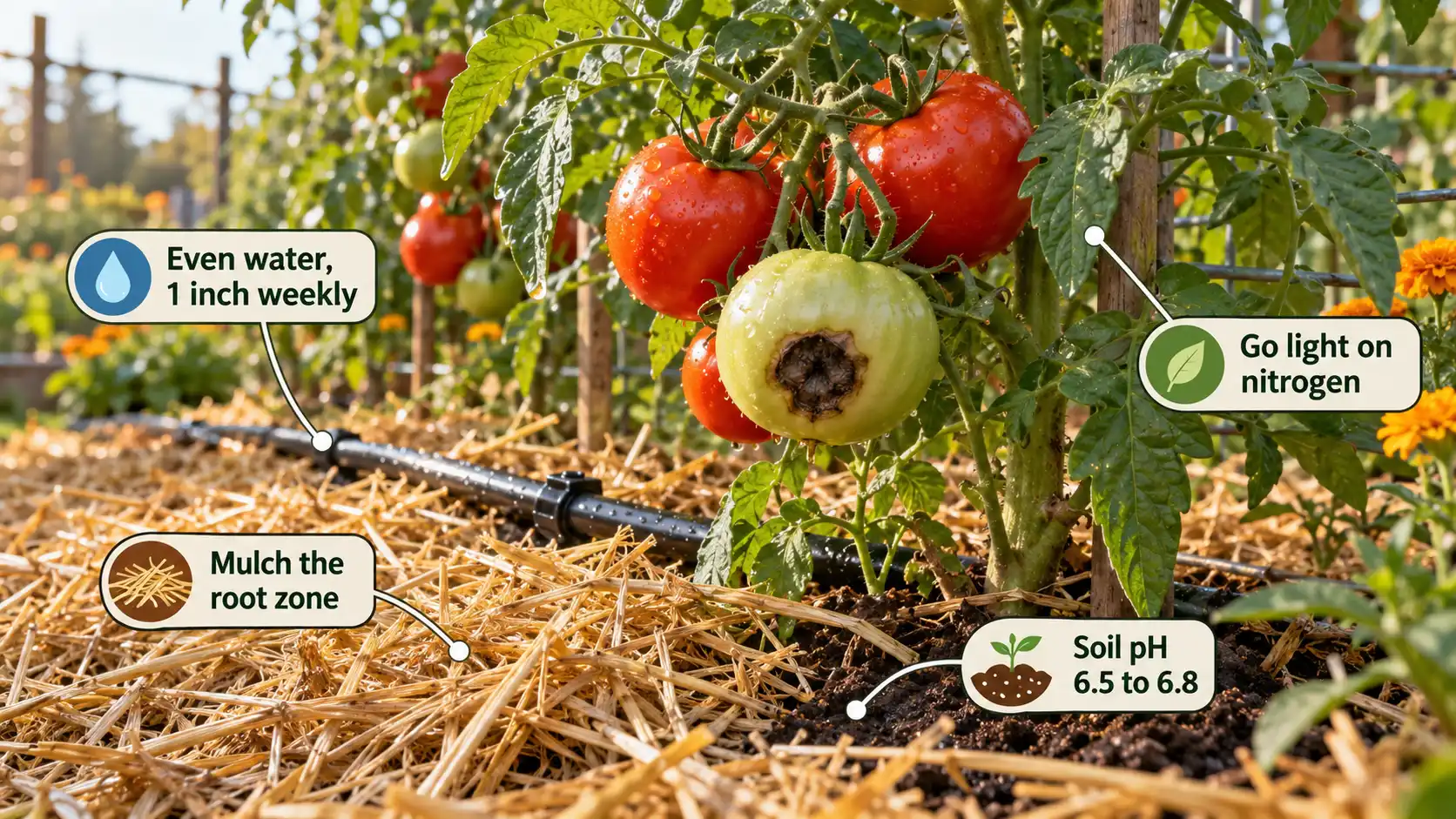
To prevent blossom end rot, keep soil evenly moist and mulch the root zone. NC State Extension calls for at least 1 inch of water weekly. Go light on nitrogen, and lime only if a soil test says so.
Why Blossom End Rot Happens
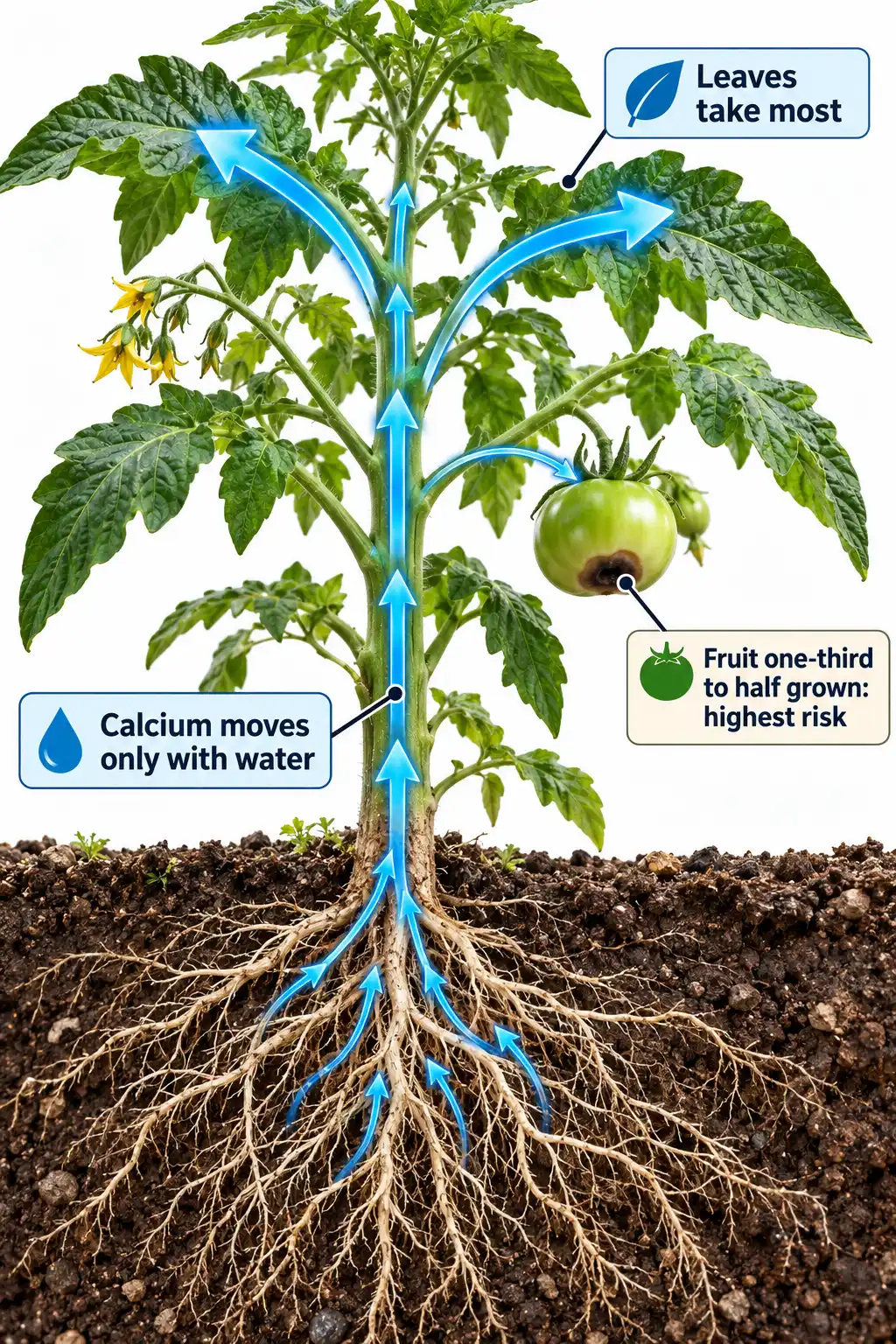
Blossom end rot happens when too little calcium reaches a fruit while it grows. Calcium travels only in water moving up the plant’s xylem, University of Georgia (UGA) Extension explains. Leaves lose more water than fruit, so they draw most of the calcium. Once it settles in a leaf, it cannot move back out to the fruit.
So a soil test can show plenty of calcium while fruit still rots. Clemson Extension notes that blossom end rot appears even when soil calcium is adequate. University of Minnesota Extension (UMN) names the usual triggers:
- Swings between dry and wet soil
- Heavy nitrogen fertilizer
- Injured roots
- Hot weather that pushes fast growth
Too much potassium, magnesium, ammonium, or sodium also limits the calcium a plant can take up, UMN adds. UC ANR’s IPM program says salty soil makes it worse, and the disorder is more common on sandy soils. Clemson lists tomatoes, peppers, watermelon, eggplant, squash, and cucumbers among the crops it hits.
When Fruit Is Most at Risk
Risk peaks early in each fruit’s life. UMN reports it is most common when fruit is one-third to one-half grown. The first fruit often suffers most. UGA points to the stretch from bloom until fruit reaches golf ball size as the critical window. So prevention has to be in place before the first flowers open. By the time a black spot shows, the shortfall has already happened. Fruit that sets later on the same plant can come through unaffected, UMN notes.
How to Prevent Blossom End Rot in 6 Steps
Steps 1 to 4 apply once plants are in the ground. Steps 5 and 6 belong before you plant.
1. Water Deeply and on a Schedule
Clemson calls uniform soil moisture the most effective prevention. NC State Extension says plants need at least 1 inch of water per week from rain or irrigation. Excess moisture favors blossom end rot too, NC State warns.
To time it, UMN suggests digging down and watering when soil is dry 2 inches below the surface. Per UMN, sandy soil may need water twice a week, while clay and rich loam can go once a week. UF/IFAS Extension advises light, frequent watering for young plants and heavier, less frequent soaks for mature ones. Clemson recommends drip irrigation on a timer to keep that rhythm steady.
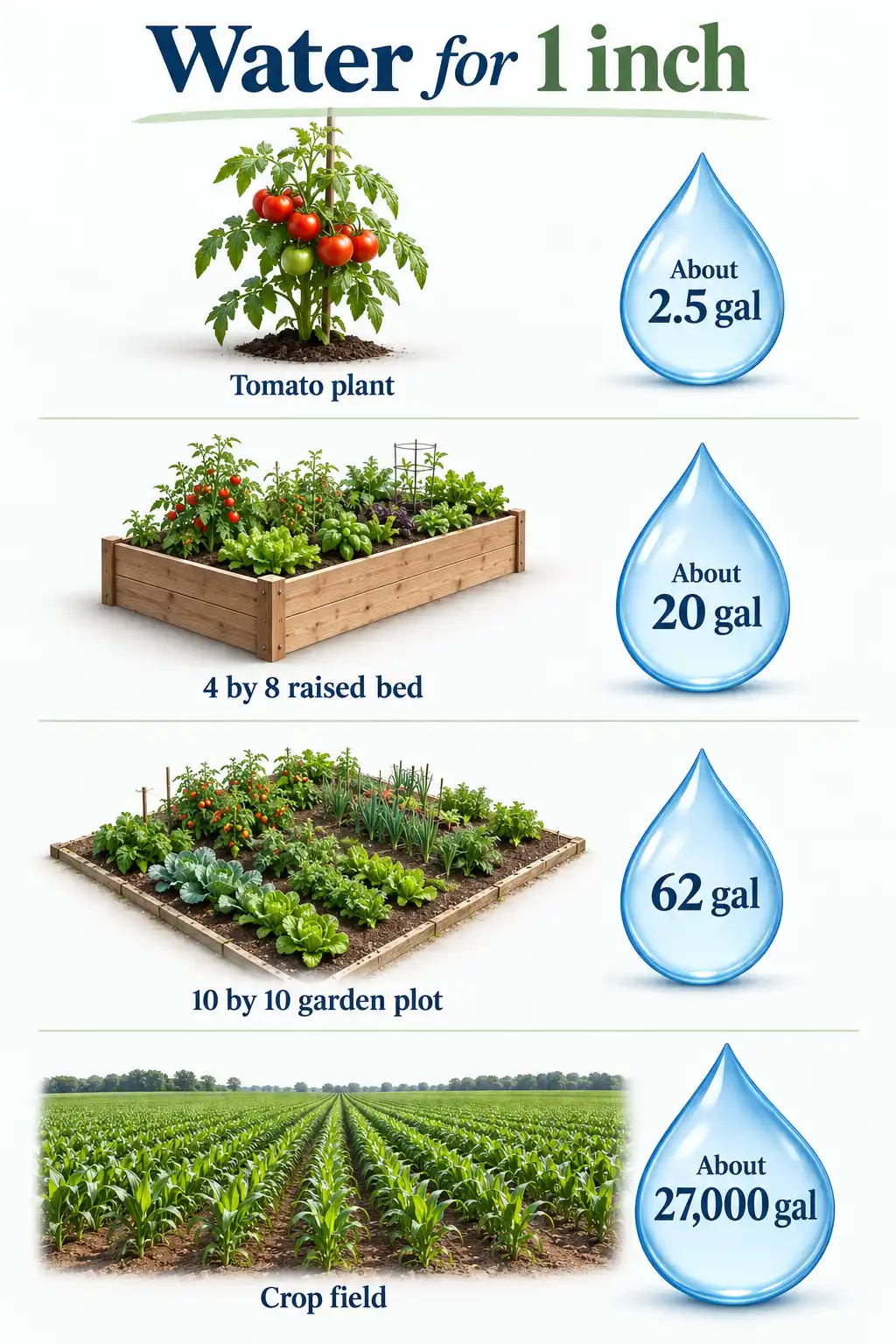
UMN puts 1 inch of water at 62 gallons per 100 square feet. Here is that rate at common scales:
| Growing area | Water for 1 inch |
|---|---|
| One plant on a 2 by 2 foot spot | About 2.5 gallons |
| 4 by 8 raised bed | About 20 gallons |
| 100 square feet | 62 gallons |
| 20 by 30 foot garden | 372 gallons |
| 1 acre | About 27,000 gallons |
On sandy ground, UMN advises splitting that into two half-inch waterings, or 31 gallons per 100 square feet each time.
2. Mulch the Root Zone
Mulch slows evaporation, which keeps the root zone from swinging between wet and dry. Clemson recommends a layer of mulch or pine straw around the plants. Because mulched soil holds water longer, UMN notes you may need to water less often. UC ANR’s Master Gardeners in Contra Costa County advise keeping mulch off the base of the plants. On plastic mulch, lay drip line first, since UMN notes plastic makes watering harder otherwise.
3. Feed the Fruit, Not the Leaves
Heavy nitrogen builds lush leaves, and new leaves win the competition for calcium. UGA calls excess nitrogen and potassium during early bloom a major contributor to blossom end rot. Fertilize to a soil test rather than by habit, UMN advises.
The form of nitrogen matters too. Ammonium competes with calcium at the roots, per UGA, so UF/IFAS recommends avoiding ammonium-based sources. When top growth runs heavy, UGA suggests cutting nitrogen and potassium rates. It also suggests switching to calcium nitrate, which supplies nitrogen and calcium together.
4. Protect the Roots
Damaged roots take up less water, and less water means less calcium. UMN advises against cultivating within 1 foot of the base of the plant. Pull weeds by hand there instead, or let mulch smother them. If you must hoe beyond that, keep it shallow, as NC State recommends.
Waterlogged soil hurts roots too. Saturated ground holds little oxygen, UMN explains, and it suggests raised beds where heavy rain is common. UF/IFAS also lists nematodes, root diseases, and heavy pruning as root stresses behind the disorder.
5. Test Soil pH and Calcium Before You Plant
A soil test shows whether calcium is the problem at all. Clemson advises testing well before planting and following the lime and fertilizer recommendations. NC State adds that lime and gypsum should go down several months ahead. Read the report this way:
| Soil test result | What to do | Source |
|---|---|---|
| pH below the report’s target | Lime at the report’s rate, usually to pH 6.5 to 6.8 | NC State Extension |
| Calcium low | Add gypsum at 500 to 1,000 lb per acre (about 1 to 2 lb per 100 sq ft), alongside any lime the report calls for | NC State Extension |
| Calcium at 801 lb per acre or higher, especially at pH 6.0 or above | Skip added calcium; check nitrogen and watering | UGA Extension |
| Calcium at 250 to 300 ppm or higher | Enough for most crops; check water, nitrogen, and roots | UF/IFAS Extension |
Gypsum is calcium sulfate, so it supplies calcium without raising pH the way lime does. On a 4 by 8 bed, NC State’s gypsum rate works out to about 6 to 12 ounces. To scale any per-acre rate on your report to that bed, divide by 1,361, then multiply by 16 for ounces.
Labs report calcium in pounds per acre or in ppm, so match the row to your report’s units. UGA’s figures are Georgia benchmarks and UF/IFAS’s are Florida ones, so check your state lab’s ranges if they differ.
6. Grow Less Prone Varieties
Fruit type changes the odds. UMN reports that large slicing tomatoes are usually more prone than cherry types. The Contra Costa Master Gardeners single out paste tomatoes. All but cherry types can show it when conditions favor it, they add. If one variety keeps rotting, switch it next season, as UMN suggests.
Field-Scale Prevention for Market Growers
Yield losses range from a trace to more than 50 percent without control measures, NC State reports. On drip-irrigated fields, UGA advises delivering calcium through the irrigation water. Growers routinely inject calcium nitrate, it notes, and early research covers calcium thiosulfate. Injections should run from bloom until fruit reaches about golf ball size. UGA also gives tissue and soil benchmarks:
- Leaf calcium at early bloom: 1.25 to 3.20 percent in tomato, 1.0 to 2.5 percent in bell pepper
- Leaf nitrogen and potassium at early bloom: 4.0 to 6.0 percent; higher readings may signal excess fertilizer
- Soil along the row and out to the bed shoulders: moist enough to form a ball that holds together
Watch pump capacity, too. If pumps run nonstop and soil still won’t form a ball, UGA says the system may be too small.
Do Calcium Sprays and Home Remedies Work?
Mostly no. Extension services split on calcium sprays, and most home remedies miss the real cause.
Calcium Sprays: Where Extension Services Split
NC State supports one spray, for tomatoes only. It recommends anhydrous calcium chloride at 4 pounds per 100 gallons of water per acre, applied weekly four times. Start when the second fruit cluster forms or when symptoms first appear. Spray in cool morning hours, and never exceed the rate. In a 1-gallon sprayer, that rate equals about 0.64 ounce (18 grams) by weight.
Clemson and UF/IFAS disagree. Both say foliar calcium does not work. Leaves cannot pass calcium on to fruit, and fruit skin takes up little or none. UGA calls the research inconclusive and advises supplying calcium through irrigation water instead.
The newer guidance favors water management over sprays. Clemson’s note dates to 2020 and UGA’s review to 2022, while NC State’s factsheet dates to 2013. If you try a spray, treat it as a stopgap on tomatoes, not a substitute for steady moisture.
Eggshells, Epsom Salt, and Other Remedies
Most kitchen fixes add calcium that the soil often already has.
| Remedy | Verdict | Why |
|---|---|---|
| Eggshells, antacids, bone meal | Rarely the fix | Soil calcium is often adequate; the shortfall sits in the fruit (Clemson) |
| Epsom salt | Can make it worse | It adds magnesium, which cuts calcium availability (UMN) |
| Gypsum | Helps only on low-calcium soil | NC State recommends it for calcium-deficient soils |
| Calcium nitrate in place of ammonium fertilizer | Worth the swap | Supplies nitrogen without ammonium, which competes with calcium (UGA) |
What to Do When You Spot Blossom End Rot
Remove affected fruit, then fix the watering. UMN advises picking damaged fruit right away. It will not develop normally, and removing it lets the plant put energy into healthy fruit. NC State calls removal especially worthwhile for tomatoes.
Skip the fungicide. UC ANR notes that no pathogen causes the disorder, so no pesticide treats it. UGA stresses a correct diagnosis for the same reason, since needless fungicide sprays cost money and change nothing.
Is It Blossom End Rot or Something Else?
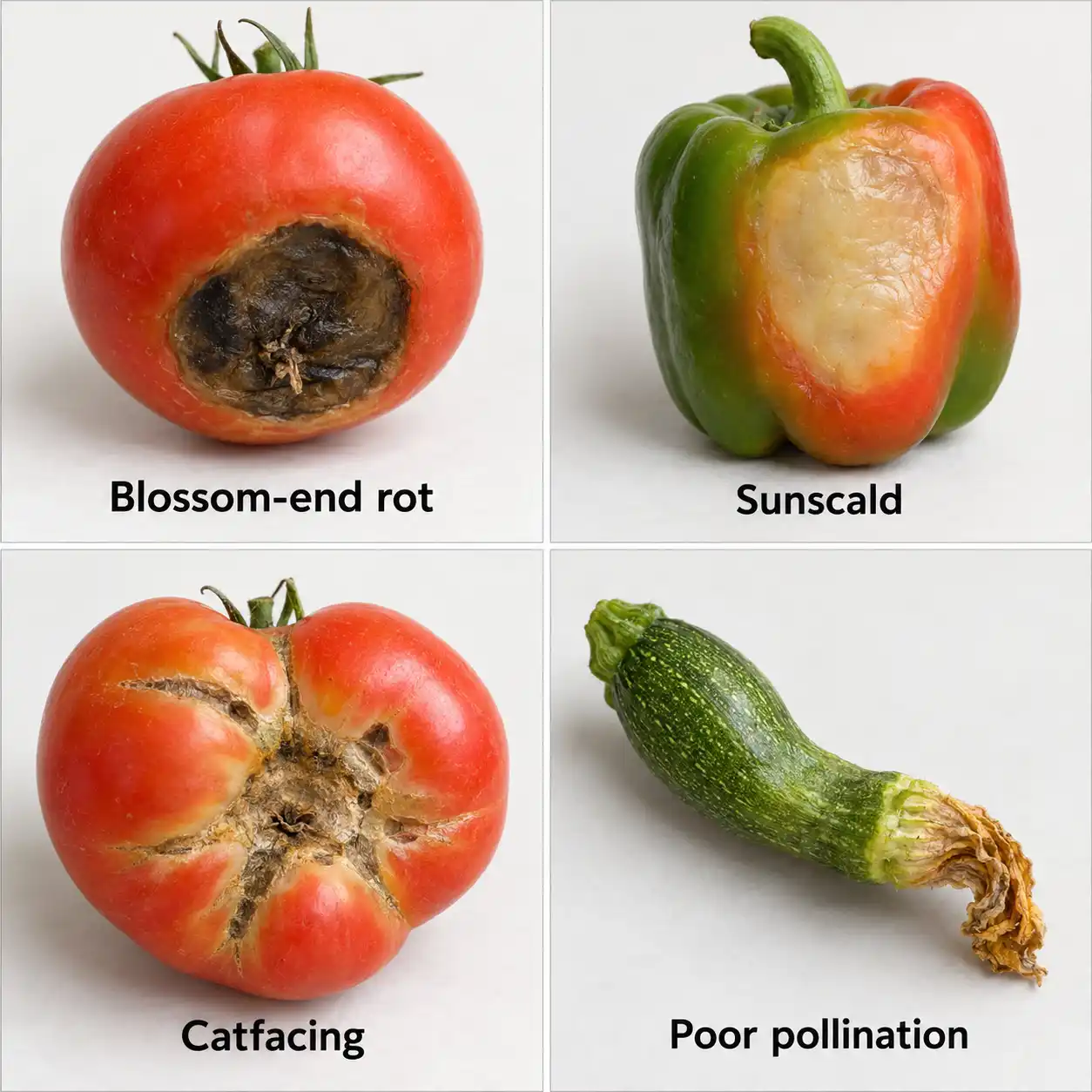
It is blossom end rot if the dark spot starts at the blossom end or lower side wall. Per UGA, it never starts at the stem end. UGA describes it as uniformly dark brown to black, and it can climb a third to halfway up the fruit. Other problems leave different marks:
| Problem | Crops | How to tell it apart | Source |
|---|---|---|---|
| Sunscald | Tomato, pepper | Pale patch on the side facing the sun; on pepper it starts white, then turns tan | UMN, NC State |
| Anthracnose | Tomato, pepper | Lesions on the side walls only | UGA |
| Catfacing | Tomato | Flattened fruit with a corky brown scar and cavities at the base | UMN |
| Poor pollination | Squash, other vine crops | Fruit grows an inch or two, then dies | UF/IFAS |
UGA also names buckeye rot, a Phytophthora fruit rot, as a less common look-alike. Blossom end rot has no link to soil contact, per UC ANR. Rot that starts where fruit rests on soil points to another cause. If the pattern fits none of these, your county extension office can confirm the cause.
FAQs about Blossom end rot prevention
Can you eat a tomato with blossom end rot?
Yes, as long as the damaged area has not started to grow mold. UC Master Gardeners in Contra Costa County advise cutting away the discolored end and eating the rest of the fruit.
Does blossom end rot spread to other plants?
No, because no pathogen causes it, per UC ANR, so there is nothing to pass between plants. Still, plants in one bed share the same watering, so one affected plant warns of trouble nearby.
Can overwatering cause blossom end rot?
Yes, because excess moisture favors blossom end rot just as a shortage does, according to NC State Extension. Saturated soil starves roots of oxygen, UMN notes, so aim for soil that stays moist but never soggy.
Why does blossom end rot hit the first tomatoes hardest?
Early fruit sets while the plant is still pushing new leaves, and those leaves pull calcium away from the fruit. UC Master Gardeners note the disorder is more likely early in the season, during rapid growth.
How long after fixing watering does blossom end rot stop?
Look for clean fruit from flowers that open after the fix, since damaged fruit never recovers. UGA puts the critical window between bloom and golf ball size, though it gives no exact day count.
Do you prevent blossom end rot on peppers the same way?
Yes, because UGA Extension traces pepper and tomato cases to the same water and nitrogen causes. The one exception is spraying, since NC State Extension suggests calcium chloride for tomatoes only.
Key Points to Carry Into the Field
Blossom end rot is a delivery problem: the soil often holds enough calcium, but too little reaches the fruit. Hold moisture steady from bloom through early fruit growth, keep nitrogen moderate, and leave roots alone. Before next season, test the soil and add lime or gypsum only when the report calls for it. If damaged fruit keeps appearing once watering is steady, take a sample to your county extension office.