Do Grapes Grow on Trees? No, Here’s How Grapevines Really Grow

Shaggy old trunks and wild grapes in forest canopies make it look that way. Grapes climb. That habit explains why vines need a trellis and how to space them. It also explains why a few unrelated “grapes” do grow on trees.
Grapes do not grow on trees or bushes. They grow on woody, climbing vines in the genus Vitis that grip supports with tendrils. Wild vines climb trees; cultivated vines grow on trellises. So-called grape trees, like jaboticaba, are unrelated.
Do Grapes Grow on Trees or Vines?
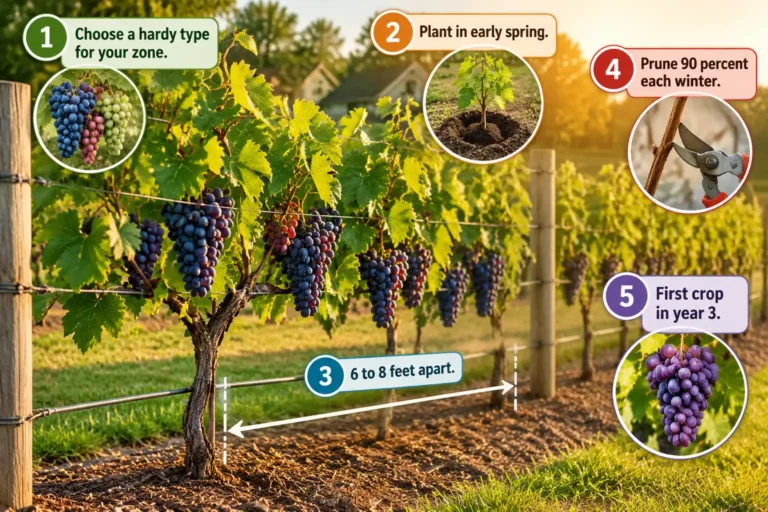
Grapes grow on vines. University of Minnesota Extension classifies grapes botanically as vines that climb as they grow. They use tendrils to hold on to trellises in vineyards, or to trees and other plants in the wild.
A grapevine has a woody trunk, but it cannot hold up its own canopy the way a tree does. So it leans on whatever it grips. Botanists call this kind of woody climber a liana.
Tendrils do the gripping. Each one is a thin, curling strand that wraps around any wire, twig, or fence it touches. Once it coils, the shoot can keep climbing toward light.
Grapevines are also perennial. The same trunk and roots return each spring. So a vine behaves more like an orchard crop than a garden crop. That sets it apart from cucumbers, which also climb with tendrils but die at the first hard frost.
Why Grapes Look Like They Grow on Trees
Grapes look like tree fruit for three reasons. In each case, the vine borrows height from something else.
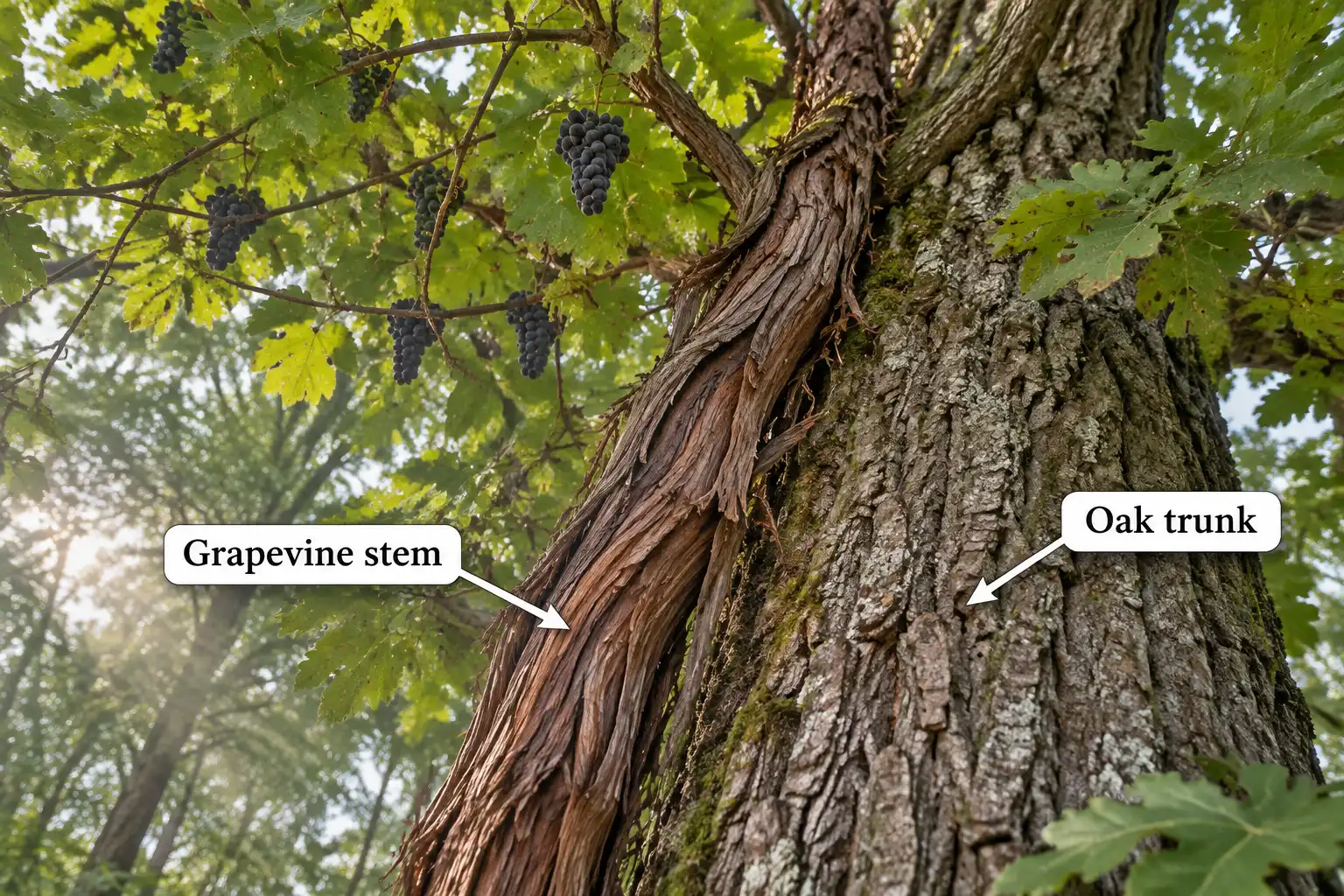
- Wild vines in the canopy. NC State Extension describes riverbank grape (Vitis riparia) as a vine up to 75 feet long. It climbs tree trunks into the canopy. From the ground, the clusters seem to hang from the tree itself.
- Old, thick trunks. A vine trained to one trunk for decades builds shaggy bark that peels in long strips. In winter, with the leaves gone, it can pass for a small tree.
- Arbors and pergolas. On an overhead frame, fruit hangs above your head under a roof of leaves, just like fruit on a tree.
Neglect adds to the confusion. Oregon State Extension notes that an unpruned vine can end up high in a tree or across a shed roof. The tree pays for it, too. NC State warns that a heavy wild grape canopy can shade out and kill small trees and shrubs.
Still, cut the support away and each of these vines would slump to the ground.
Do Grapes Grow on Bushes?
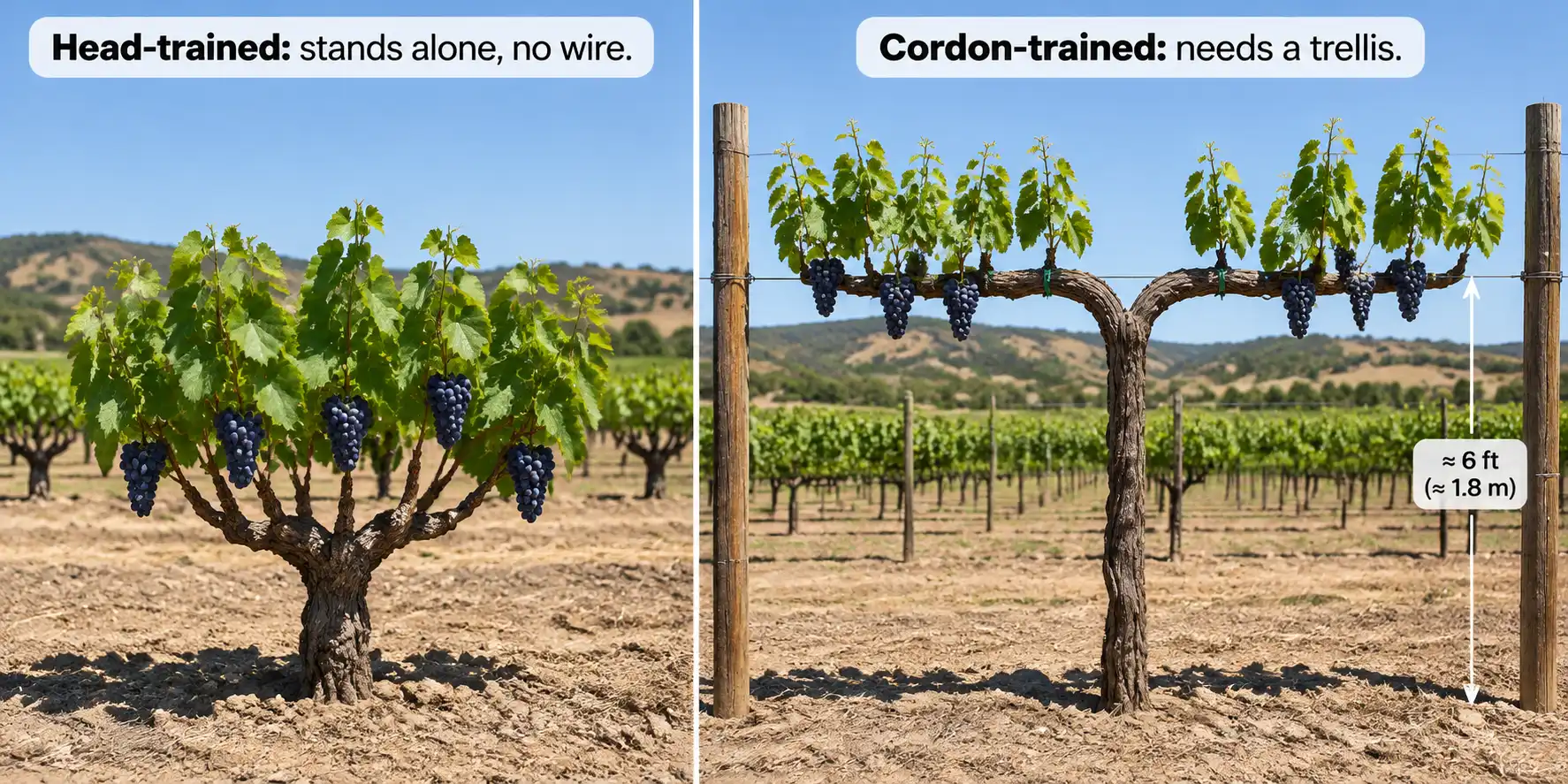
No, grapes do not grow on bushes, though growers can prune a vine to look like one. Oregon State Extension explains that head training can use a self-supporting trunk with no trellis at all.
A head-trained vine stays short. Its fruiting spurs grow from the top of the trunk, so the vine forms a low goblet shape. Wine growers often call these “bush vines.”
That shape comes from pruning, not from the plant’s nature. Skip a winter of pruning and long canes shoot out in every direction. Without a wire or a tree to climb, those canes sprawl over the ground instead.
Some shrubs do carry grape-like clusters, however. Oregon grape is the best-known example, and it is not a grape at all (see the table below).
How a Grapevine Is Built
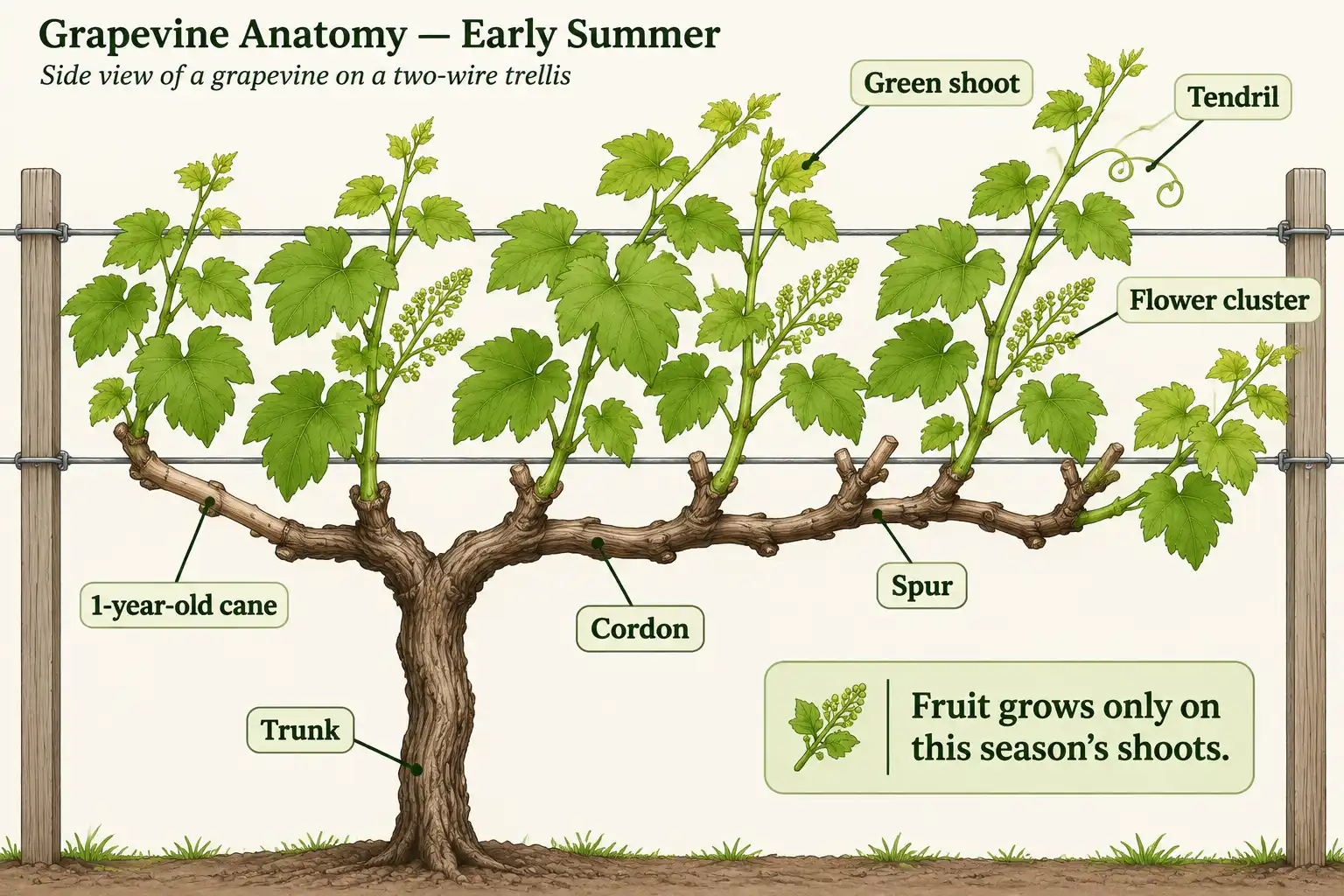
A grapevine has a permanent woody frame plus new growth every year, and only the new growth bears fruit. Oregon State Extension defines the parts this way:
- Trunk: the permanent woody stem rising from the roots.
- Cordon: an extension of the trunk trained along a wire, from which spurs grow.
- Spur: a cane pruned back to one to five buds.
- Cane: a mature shoot after harvest and leaf fall.
- Shoot: new green growth with leaves, tendrils, and often flower clusters.
Fruit forms on the current season’s shoots. Meanwhile, the buds for next year’s crop sit on 1-year-old canes, per Oregon State Extension. So grapes never form on the old trunk wood itself.
That is why growers prune grapevines hard every winter. University of Minnesota Extension describes a typical pruned vine as one or two trunks with two to four cordons. Short spurs on those cordons hold next season’s buds.
Plants Called Grapes That Grow on Trees or Shrubs
A few plants carry “grape” in their name and really do grow on trees or shrubs. None of them belongs to the grape family (Vitaceae). The first row shows the true grape for comparison.
| Common name | Scientific name | Plant family | Growth form | Hardiness | True grape? |
|---|---|---|---|---|---|
| Grape (bunch and muscadine) | Vitis species | Vitaceae | Woody climbing vine | Varies by type | Yes |
| Jaboticaba (Brazilian grape tree) | Plinia cauliflora | Myrtaceae | Tree, often 10 to 15 ft in Florida; fruit on the trunk | USDA zones 9a to 11 | No |
| Sea grape | Coccoloba uvifera | Polygonaceae | Tree or large shrub, 35 to 50 ft | USDA zones 10A to 11 | No |
| Oregon grape | Mahonia (Berberis) aquifolium | Berberidaceae | Evergreen shrub, 3 to 10 ft | USDA zones 5B to 8 | No |
UF/IFAS Extension supplies the jaboticaba and sea grape figures, plus the Oregon grape zones. The Oregon grape height comes from Oregon State University.
Jaboticaba is the plant most people mean by “grape tree.” UF/IFAS explains that its flowers and fruit form right on the trunk and older branches, a trait called cauliflory. The ripe fruit resembles a muscadine. However, seed-grown trees can take 8 to 10 years to bear.
Sea grape, by contrast, bears dense, grape-like clusters on female trees only. UF/IFAS notes the fruit makes good jelly. Oregon grape, meanwhile, is a barberry relative with dark, berry-like fruit.

Grape Types Grown in the US and How They Differ
Every cultivated grape climbs, but the types differ in cold hardiness, disease pressure, and how much room each vine needs. Pick the type before you build anything, because it sets the trellis and the spacing.
| Type | Species | Example cultivars | What sets it apart | In-row spacing |
|---|---|---|---|---|
| American | Vitis labrusca | Concord, Niagara | Slip skin, foxy flavor; more cold hardy and disease resistant than other bunch types | 6 to 8 ft |
| European | Vitis vinifera | Cabernet, Merlot | Tight clusters, thin skin; less cold hardy, prone to powdery mildew and bunch rot | 6 ft |
| Cold-climate hybrids | Vitis hybrids | Marquette, Frontenac, La Crescent | Bred for USDA zone 4 and warmer | 6 to 8 ft |
| Muscadine | Vitis rotundifolia | Carlos, Noble, Scuppernong | Native to the Southeast; injured below 0°F | 10 ft minimum, 20 ft preferred |
Oregon State Extension supplies the American and European traits and the bunch grape spacing. Its guide also notes that Concord and Niagara need at least 2,000 growing degree days to ripen fully. The hybrid cultivars come from the University of Minnesota breeding program.
Muscadines are the Southern outlier. NC State Extension says they thrive where winter lows seldom drop below 10°F. The North Carolina Coastal Plain fits that profile. Even so, hardier cultivars such as Carlos and Magnolia survive north into Virginia.
What a Grapevine Needs Instead of a Tree
A grapevine needs a support you build, sized to its type. Oregon State Extension says most training systems require a trellis. It must carry a vigorous vine and a heavy crop.
For bunch grapes trained to hang downward, Oregon State sets a single wire at about 6 feet. For muscadines, NC State recommends a single wire 5 to 6 feet off the ground. It also asks for at least a 10 by 6 foot space per vine.
Build the support early. Oregon State advises putting up the trellis in the first growing season. That way you train the vine to wire, not a stake. For muscadines, NC State goes further and says to finish the trellis before planting.
Arbors and pergolas work too. However, NC State warns that vines over an arch decline in yield unless you keep each cordon in order.
Soil matters as much as the frame, since a vine holds its spot for decades. Oregon State notes that heavy clay with poor drainage, or a clay pan below the topsoil, is not ideal. So test before you plant. Interpreting your soil test report shows whether pH or nutrients need correcting first.
Spacing From a Backyard Fence to an Acre
The table runs the published spacing out to vines per acre (43,560 square feet) and vines per 20-foot fence.
| Grape type | In-row spacing | Row spacing | Square feet per vine | Vines per acre | Vines on a 20-ft fence |
|---|---|---|---|---|---|
| European | 6 ft | 9 to 10 ft | 54 to 60 | About 725 to 805 | 3 |
| American and hybrids | 6 to 8 ft | 9 to 10 ft | 54 to 80 | About 545 to 805 | 2 to 3 |
| Muscadine | 10 to 20 ft | 8 ft minimum | 80 to 160 | About 270 to 545 | 1 to 2 |
Row spacing for bunch grapes comes from Oregon State, while muscadine figures come from NC State. Wider rows for a mower lower the per-acre count.
Yield scales the same way. Oregon State puts a mature, well-managed table grape vine at 15 to 35 pounds. So three table grape vines on that 20-foot fence can return roughly 45 to 105 pounds a year.
Water young vines with the same care. University of Minnesota Extension calls for 1/2 to 1 inch per week for the first two seasons. That equals about 5 gallons over a 3 by 3 foot area per inch. On a full acre, one inch equals about 27,150 gallons, the base unit for calculating crop water needs at field scale.
How Long Before a Grapevine Produces Grapes?
Expect a light crop in the third year and a full crop in the fourth year or later. Sources differ on the full-crop date, so plan for the later one if your vines grow slowly.
University of Minnesota Extension (2026 training guide) lays out the first four years:
- Year 1: Train shoots up a training rod to the wire. Remove any clusters.
- Year 2: Keep one or two trunks and start the cordons. Remove clusters again.
- Year 3: Choose one cordon per side. Remove all clusters, or half-crop a vigorous vine at one cluster per shoot.
- Year 4 on: Carry a full crop of at least two clusters per shoot.
Oregon State Extension is more conservative. It expects full production in the fifth or sixth year.
The payoff lasts. With proper care, Oregon State says grapevines live 50 to 100 years. That long life is one more trait grapes share with trees, even though they never grow like one.
FAQs About Grapes Grow on Trees
Are grapes berries?
Yes, botanically speaking, a grape is a true berry. Each one forms from a single flower’s ovary, holds its seeds inside the flesh, and ripens in a cluster on the vine.
Will a grapevine climb a tree in my yard?
Yes, a grapevine left near a tree will climb it, but the fruit ends up out of reach. NC State Extension also warns that a heavy grape canopy can shade out and kill small trees and shrubs.
Can grapes grow without a trellis?
Yes, if you head-train the vine, which Oregon State Extension describes as a self-supporting trunk with no trellis. Otherwise a vine needs a wire, fence, or arbor, or it sprawls on the ground.
What is a grape tree?
A grape tree usually means jaboticaba, a Brazilian tree in the myrtle family that fruits directly on its trunk. UF/IFAS Extension rates it for USDA zones 9a to 11, which limits it to the warmest parts of the US.
How tall does a grapevine grow?
A wild grapevine can run up to 75 feet into tree canopies, according to NC State Extension. Cultivated vines stay far smaller, since pruning keeps them to a trunk and arms on a 5 to 6 foot wire.
Do grapevines come back every year?
Yes, grapes are woody perennials, so a hardy vine’s trunk and roots survive winter and push new shoots each spring. With proper care, Oregon State Extension says grapevines live 50 to 100 years.
The Practical Takeaway
Treat a grapevine as a climber you plan around, not a tree you plant and leave. Match the type to your winters first. Then build the trellis to that type’s height. Space vines by type, too, since a muscadine needs more than three times the row length of a European vine. Expect a light crop in year three. The vine holds that ground for decades. So weigh it like any long-term planting when choosing crops for your farm.