
Is Eggplant a Nightshade? Yes, and Here Is What It Means for Rotation

Ask whether eggplant is a nightshade, and the botany answer takes one word. The useful part comes next: which crops share its bed, which beetles find it, and which weeds carry its diseases.
Yes, eggplant is a nightshade. Solanum melongena shares the Solanaceae family with tomatoes, potatoes, and peppers. That means shared pests and soilborne wilts. Clemson Extension advises growing nightshades on the same ground no more than once in three years.
Is Eggplant a Nightshade?
Yes. NC State Extension lists eggplant, Solanum melongena, in Solanaceae, the nightshade family, alongside tomatoes, potatoes, and peppers.
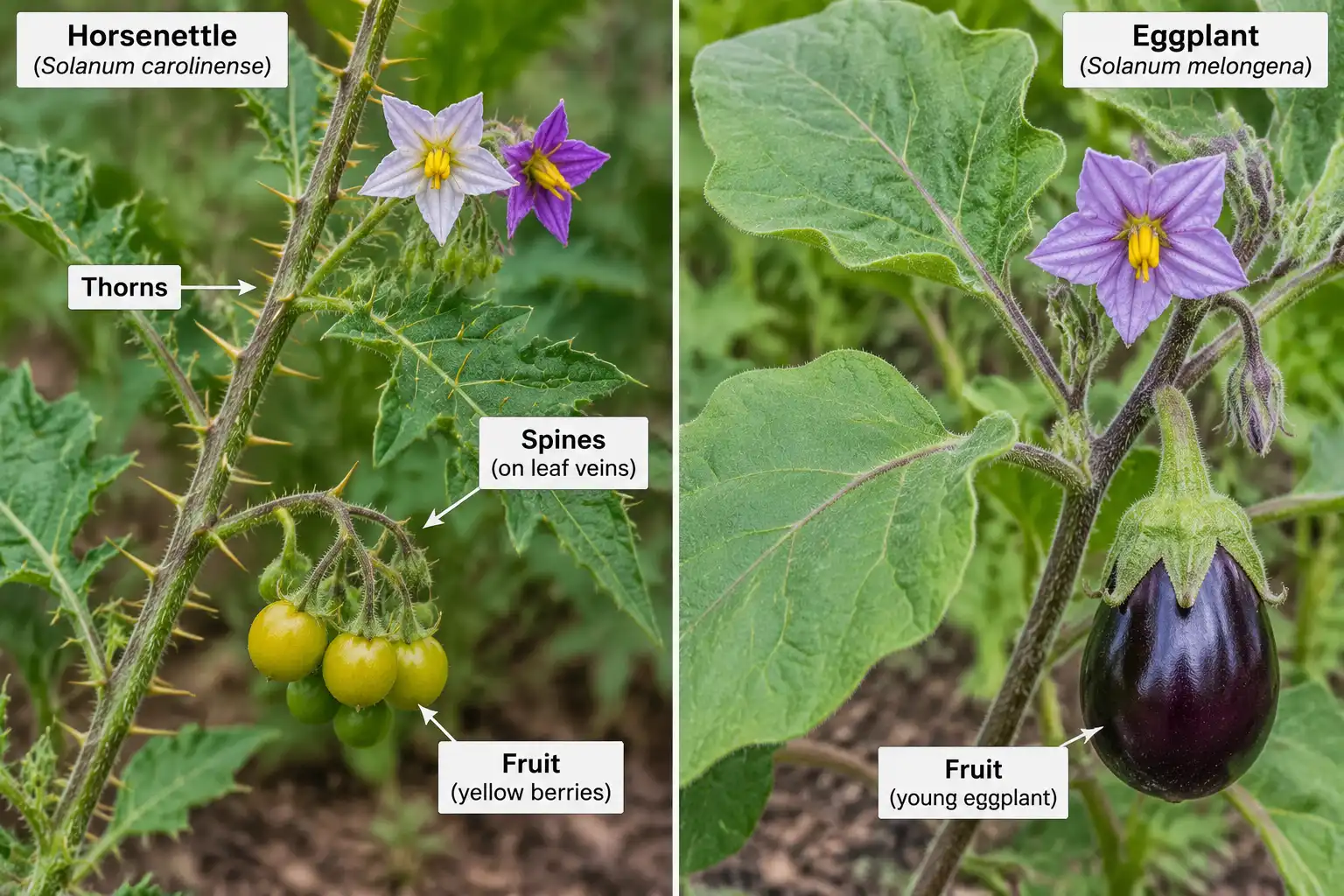
In fact, eggplant sits closer to some relatives than most growers expect. It shares the genus Solanum with tomato and potato. It also shares it with horsenettle, a thorny weed that Clemson Extension places in the same family.
“Nightshade” names a plant family, not a warning label. Deadly nightshade, Atropa belladonna, is a separate wild plant that happens to share the family. Eggplant is not that plant. Its fruit is an everyday food crop.
Also know: Eggplant Plant Look Like
Which Plants Share Eggplant’s Family?
The first six plants below belong to eggplant’s family. The last two often get lumped in by mistake, though one still shares a disease.
| Plant | Genus | Family | Role near eggplant |
|---|---|---|---|
| Tomato | Solanum | Solanaceae | Same rotation group |
| Irish potato | Solanum | Solanaceae | Same rotation group |
| Bell and chili pepper | Capsicum | Solanaceae | Same rotation group |
| Tomatillo | Physalis | Solanaceae | Same rotation group |
| Horsenettle (weed) | Solanum | Solanaceae | Hosts Colorado potato beetle |
| Black nightshade (weed) | Solanum | Solanaceae | Hosts early blight |
| Sweet potato | Ipomoea | Convolvulaceae | Different family |
| Strawberry | Fragaria | Rosaceae | Different family, but shares Verticillium wilt |
Clemson Extension supplies the two weed host roles. Penn State Extension groups garden crops by family for rotation planning. It also warns that strawberries should not follow nightshades, or the reverse, because both get Verticillium wilt. Peanuts sit outside the family too, since peanuts are legumes, not nightshades.
Know more: Eggplant Plants Height and Spread by Variety
What Eggplant Shares With Other Nightshades
A shared family means shared problems. The same insects and soilborne diseases move between eggplant, tomato, potato, and pepper. So a problem that builds on one crop waits in the soil, or in nearby weeds, for the next.
| Problem | Type | Also attacks | Source |
|---|---|---|---|
| Verticillium wilt | Soilborne fungus | Tomato, potato, pepper, strawberry | UC ANR, Penn State |
| Bacterial wilt | Soilborne bacterium | Tomato, pepper, potato, sunflower, cosmos | Clemson |
| Early blight | Fungus | Tomato, potato, black nightshade | Clemson, UF/IFAS |
| Phomopsis blight | Fungus | Survives on nightshade weeds | UF/IFAS |
| Colorado potato beetle | Insect | Potato; tomato and pepper at times | Clemson |
| Eggplant flea beetle | Insect | Potato, horsenettle | NC State |
Early blight looks milder on eggplant than on tomato. UF/IFAS Extension describes small, light spots with little of the bull’s-eye ringing. On tomato the rings stand out more, which helps when telling early blight apart from look-alike leaf spots. To limit it, UF/IFAS advises planting eggplant as far from tomato and potato fields as possible.
Phomopsis blight is the one disease aimed mostly at eggplant. UF/IFAS rates ‘Florida Market’ and ‘Florida Beauty’ resistant to its seedling tip-over stage. Still, leaf, stem, and fruit rot stages remain a serious problem on both.
Which Wilt Matters Where You Grow
Verticillium wilt and bacterial wilt favor opposite weather, so your region decides which one to plan around.
Verticillium is the long-haul problem. UC ANR’s IPM program reports that its resting structures, called microsclerotia, survive up to 14 years in soil without a host. It also favors cool air and soil temperatures.
Bacterial wilt runs the other way. Clemson Extension notes that it thrives in high heat and moisture, and that no chemical control exists. That makes it the bigger threat across the warm, humid Southeast, where Clemson and UF/IFAS both publish rotation rules for it.
Resistance is where the services split. UC ANR states there are no known eggplant varieties with Verticillium resistance. UF/IFAS and NC State Extension both list resistant varieties as a control, but neither names one for eggplant. So treat a Verticillium resistance claim on an eggplant seed packet as unconfirmed until your state service names that variety. For bacterial wilt, Clemson reports that several rootstocks for grafted eggplant have tested highly resistant.
Beetles That Follow the Family
Insects track the family too. Clemson Extension notes that the Colorado potato beetle feeds mainly on potatoes and eggplant, and only occasionally on tomatoes and peppers. So an eggplant bed beside potatoes puts the beetle’s two favorite hosts in one place.
The eggplant flea beetle is pickier. NC State Extension reports it is most common in southern states. Its known hosts are few: eggplant, potato, horsenettle, pokeweed, sugar beet, and strawberry. That short list explains why a horsenettle patch at the field edge can keep the beetle fed between crops.
Not every shared problem is a family disease, though. Blossom end rot also hits eggplant, per Clemson Extension. But it is a calcium shortfall in the fruit, not an infection, so rotating beds will not prevent it.

How Long Should Eggplant Rotate Away From Other Nightshades?
At least three years. UC ANR advises waiting a minimum of 3 years before replanting eggplant in the same field. Clemson Extension sets the same rule for the whole family. Grow tomatoes, potatoes, peppers, and eggplant on the same land no more than once in three years.
That rule counts every nightshade, not only eggplant. Potatoes count, even when the spring potato crop comes out before eggplant goes in. So does last year’s pepper row.
Rotation lowers disease pressure, but it rarely ends it. UC ANR calls rotation impractical against Verticillium in many crops, since the fungus lasts so long. Still, it reports that at least 2 years of non-host crops reduce the fungus in the soil, and longer rotations work better.
What to Plant Between Eggplant Crops
Plant crops the main wilts cannot use. Each service names its own list, so match the crop to the disease you are fighting.
| Rotation crops | Disease targeted | Source |
|---|---|---|
| Broccoli, corn, wheat, barley, sorghum, safflower | Verticillium wilt | UC ANR |
| Cucurbits, beans, grasses | Verticillium wilt | UF/IFAS |
| Grass, legume, or cucurbit crops | Bacterial wilt | UF/IFAS |
| Corn, beans, cabbage | Bacterial wilt | Clemson |
Then skip these pairings:
- Pepper right before eggplant, especially after Phytophthora blight (UF/IFAS)
- Strawberries before or after eggplant (Penn State Extension)
- Sunflower or cosmos in a bacterial wilt rotation (Clemson)
Grass crops appear on every list above, from corn to sorghum. Corn also adds large amounts of organic matter, per Clemson. In a garden, grass cover crops such as cereal rye or oats can fill the off-year slot.
Rotating Nightshades in a Small Garden
The three-year rule turns into a simple bed count. Group every nightshade (tomato, pepper, potato, and eggplant) into one bed. Then shift that group one bed each spring.
| Beds in your rotation | Nightshades return to a bed | Meets a 3-year rotation? |
|---|---|---|
| 2 | Every 2nd year | No |
| 3 | Every 3rd year | Yes, at the minimum |
| 4 | Every 4th year | Yes, with a year to spare |
The same math works by block on a farm. Split a field into four blocks, and each block carries nightshades one year in four.
With only one or two beds, the rule is hard to meet. Where bacterial wilt has already struck, Clemson suggests moving all nightshades to a separate, newly prepared site. Hose soil off tools and tiller tines before you use them there, Clemson adds.

Do Nightshade Weeds Affect Eggplant?
Yes. Weeds in the nightshade family can carry pests and disease straight through a rotation. Penn State Extension notes that weeds in a crop’s family can host the same pests. Clemson Extension singles out horsenettle, which hosts leaf spot diseases, viruses, and the Colorado potato beetle. Clemson also names black nightshade as a host of early blight. UF/IFAS adds that Phomopsis blight survives on nightshade weeds.
Horsenettle is hard to clear. Clemson reports rhizomes that run up to 3 feet. New plants also sprout from root fragments, so tilling and hand pulling spread it. Each fruit holds up to 170 seeds, and one plant can top 5,000 seeds a year.
So clear nightshade weeds from beds, fence lines, and field edges before you transplant eggplant. For established horsenettle, Clemson calls herbicide the best option and refers growers to their local extension office for product choice. Spot it by the thorns along its stems and the spines along its leaf veins.
Which Parts of an Eggplant Plant Are Toxic?
The leaves, flowers, stems, and roots. NC State Extension lists those parts as poisonous and rates the severity as high, while the fruit and seeds are edible. The toxic principle is a group of alkaloids that includes solanine.
Swallowing them can cause throat burning, nausea, vomiting, and an irregular heart rhythm, NC State warns. In severe cases, it can be fatal. NC State also flags the plant as a problem for children, dogs, cats, and horses. So keep pets out of the bed, and keep pulled plants away from grazing animals.
The fruit belongs in the kitchen, not the raw snack bowl. NC State advises cooking it by baking, stewing, or frying rather than eating it raw. Pick it young, too, since NC State notes the fruit turns stringy and bitter as it matures.

Is Eggplant the Same as Deadly Nightshade?
No. Deadly nightshade, Atropa belladonna, is a different plant in a different genus. The two share only a family. Family alone says nothing about which parts of a plant are safe. Horsenettle, for example, sits in eggplant’s own genus. Yet Clemson Extension warns that its yellow fruits are poisonous to people, horses, cattle, cats, and dogs.
Does Eggplant Count as a Nightshade on a Diet?
Yes. Any diet that cuts nightshades also cuts eggplant, along with tomatoes, potatoes, and peppers. Whether cutting them helps conditions such as arthritis is a medical question, not a growing one. Published clinical research on that link is thin, so take the question to a physician or registered dietitian.
FAQs About Eggplant and Nightshades
Is eggplant a fruit or a vegetable?
Botanically, eggplant is a fruit, since NC State Extension describes it as a large fleshy berry. Cooks treat it as a vegetable, and growers plan it with tomatoes and peppers in the nightshade rotation group.
Can you plant eggplant where tomatoes grew last year?
No, because tomatoes and eggplant share Verticillium wilt, bacterial wilt, and early blight. Clemson Extension advises growing tomatoes, potatoes, peppers, and eggplant on the same ground no more than once in three years.
Are eggplant leaves poisonous to dogs and cats?
Yes, NC State Extension flags eggplant as a problem for dogs, cats, and horses. It lists the leaves, flowers, stems, and roots as poisonous, so keep pets away from the bed.
Is a sweet potato a nightshade?
No, sweet potatoes belong to the morning glory family, Convolvulaceae, not to Solanaceae. That puts them in a separate rotation group from eggplant, Irish potatoes, tomatoes, and peppers, despite the shared name.
Do eggplant and potatoes share pests?
Yes, the Colorado potato beetle feeds mainly on potatoes and eggplant, per Clemson Extension. NC State Extension adds that the eggplant flea beetle feeds on potato, so both pests move between the crops.
Why is my eggplant bitter?
Overmature fruit is a common cause, since NC State Extension notes eggplant turns stringy and bitter as it matures. Harvest each fruit while it is still young, with smooth, glossy skin.
What to Check Before You Plant
Treat eggplant as one more member of the tomato, potato, and pepper group. Before you transplant, check three things. First, look at what grew in the bed over the last two seasons. Second, scan for horsenettle or black nightshade nearby. Third, recall whether Verticillium or bacterial wilt has killed plants there before. If it has, ask your county extension office about rotation crops and grafted plants before you commit that ground.


