
How Big Do Eggplant Plants Get? Height and Spread by Variety
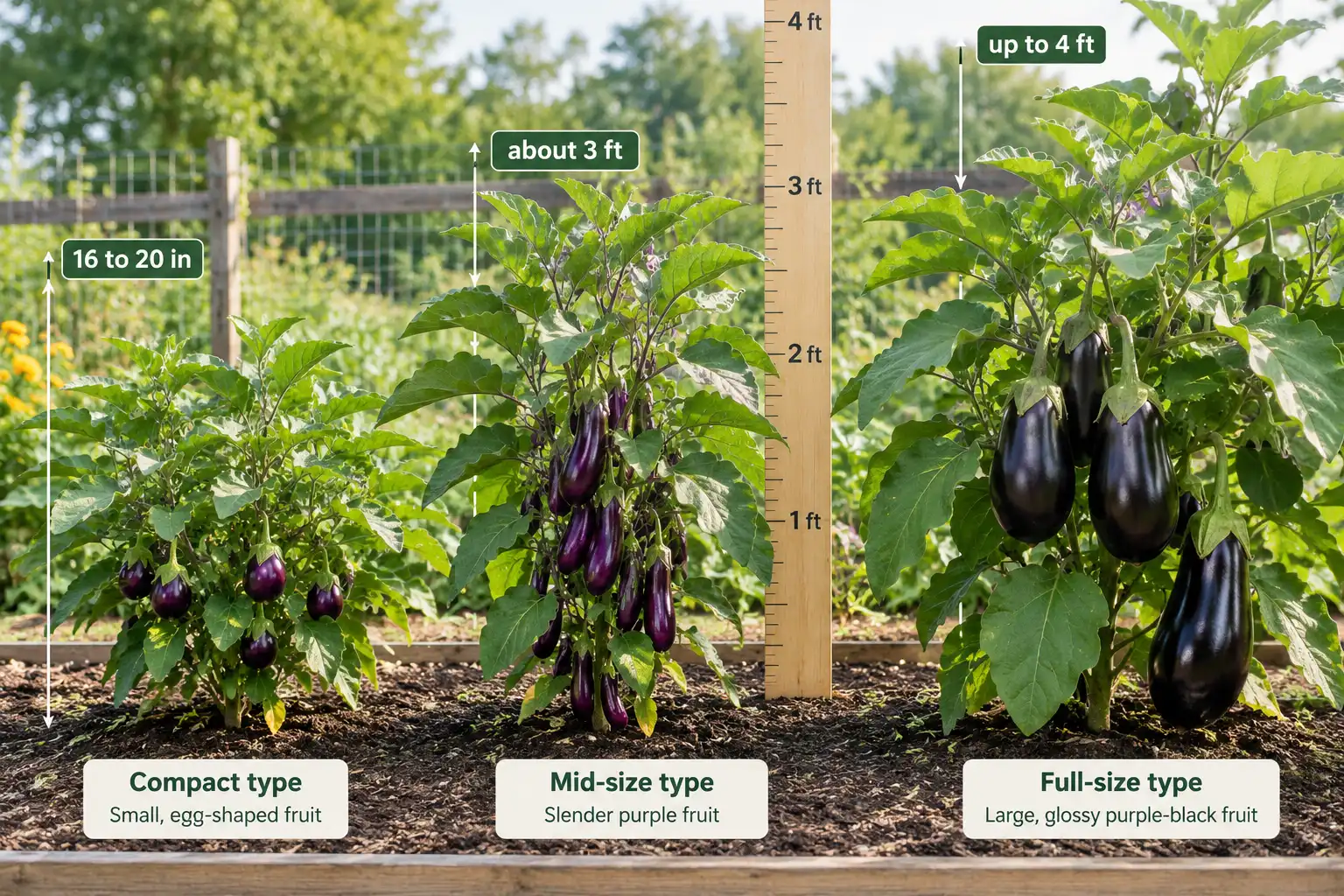
Eggplant size decides how many plants fit your space, whether you need stakes, and which pot works. So how big do eggplant plants get? The answer depends mostly on variety and the length of your warm season.
How big eggplant plants get depends on variety. Most reach 2 to 4 feet tall, per USDA NRCS. Seed-breeder specs put compact types like Patio Baby at 16 to 20 inches. Spread runs 18 to 36 inches across varieties.
How Big Do Eggplant Plants Get in One Season?
Most eggplant plants grow 2 to 4 feet tall in one season. The USDA NRCS plant guide for Solanum melongena gives that range and describes a heavily branched plant with large leaves.
Width matters just as much. PanAmerican Seed’s published specifications list mature spreads from 18 inches on compact types to 36 inches on vigorous hybrids. So a full-size plant often ends up nearly as wide as it is tall.
Growth starts slowly, then speeds up with heat. Clemson Cooperative Extension says eggplant grows best between 70 and 85°F and slows during cool periods. As a result, most of the plant’s size comes in midsummer. Clemson puts first harvest at 65 to 80 days after transplanting, and the plant keeps flowering while you pick.
Annual or perennial?
Eggplant is a frost-tender perennial that grows as an annual in temperate climates, per USDA NRCS. In frost-free spots, such as parts of USDA hardiness zones 10 and 11, a plant can survive winter and keep growing. However, published height data for multi-year plants is limited. So treat any figure above 4 feet as unconfirmed.
Eggplant Plant Size by Variety
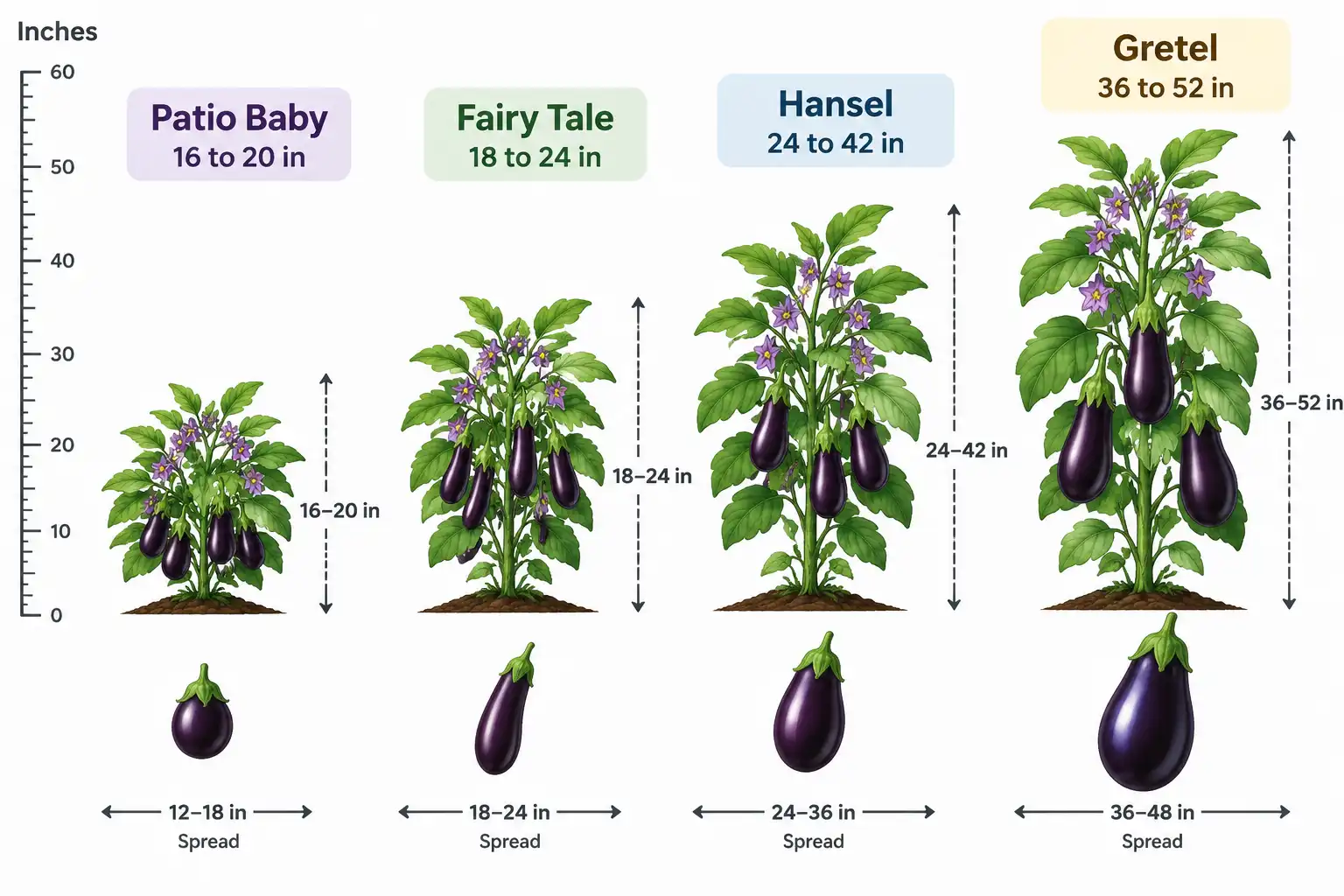
Variety sets the ceiling on plant size. Most eggplant varieties fall into three classes: compact, mid-size, and full-size. The table uses PanAmerican Seed’s specifications for four All-America Selections winners.
| Variety | Size class | Height (in) | Spread (in) | Breeder spacing (in) |
|---|---|---|---|---|
| Patio Baby | Compact | 16 to 20 | 18 to 22 | 18 to 22 |
| Fairy Tale | Compact | 18 to 24 | 18 to 24 | 20 to 30 |
| Hansel | Mid-size | 24 to 42 | 24 to 36 | 24 to 36 |
| Gretel | Full-size | 36 to 52 | 24 to 36 | 24 to 36 |
Gretel can pass 4 feet, so it ends up the tallest plant here despite its small fruit. Standard Italian types such as Black Beauty and Classic fall inside the USDA NRCS range of 2 to 4 feet. That said, published data on single heirlooms is thin. Seed-trade listings for Black Beauty give mature heights anywhere from about 24 to 48 inches. So plan for the top of that range when you set stakes and spacing.
How big the fruit gets
Fruit size follows plant size only loosely. Clemson notes standard Italian eggplants run 6 to 9 inches long. In contrast, PanAmerican Seed lists Patio Baby fruit at 2 to 3 inches and full-size Gretel fruit at 4 to 6 inches. Hansel is the flexible one: pick it at 2 to 3 inches or let it reach 6 to 10. Per USDA NRCS, you can harvest any type from one-third grown to full size, as long as the skin still shines.
What Decides How Big Eggplant Grows
Heat comes first. Eggplant stalls in cold weather, and a chilled start can cut the whole season’s growth.
University of Minnesota Extension advises waiting until overnight lows stay above 50°F before you transplant. Plants set out earlier may never recover and bear fruit. USDA NRCS also notes that eggplant handles cold worse than tomatoes or peppers, with injury possible even above freezing.
Soil temperature matters too. Black plastic mulch warms the root zone, per University of Minnesota Extension. In contrast, straw or grass clippings laid too early keep soil cool, and USDA NRCS links that to slow growth and shallow roots. So hold organic mulch until the soil has warmed.
Season length then sets how long plants keep growing. Minnesota has a short summer, so University of Minnesota Extension points growers toward varieties that finish quickly. Coastal South Carolina, meanwhile, gets both an April and an August transplant window, per Clemson. More warm weeks give a plant more time to branch and spread.
How Fertilizer and Water Change Plant Size
More nitrogen builds a bigger plant, but not a better one. University of Minnesota Extension warns that too much nitrogen gives bushy, leafy plants that are slow to fruit.
Clemson bases preplant fertilizer on a soil test, so it helps to read the soil test report before you buy anything. After planting, Clemson recommends ½ pound of calcium nitrate per 100 square feet at three to four weeks, then again three to four weeks later. On a 4 by 8 bed, that works out to about 2.5 ounces per application. By Clemson’s rule that a pint of most fertilizers weighs about a pound, that is roughly a third of a cup.
Water keeps growth steady. University of Minnesota Extension recommends a deep soak at least once a week when rain falls short of 1 inch. On a 4 by 8 bed, 1 inch equals about 20 gallons. At field scale, one acre-inch is about 27,150 gallons, which helps when you work out crop water needs for a whole planting. Uneven moisture also brings bitter fruit and blossom-end rot, per the same Minnesota guide.
How Far Apart to Plant Eggplant for Its Mature Size
Plant eggplant 18 to 30 inches apart in the row, depending on variety and region. Two respected services disagree here, so we give both.
University of Minnesota Extension spaces plants 18 inches apart in rows 30 to 36 inches apart. Clemson Cooperative Extension uses 2 to 2½ feet in rows 3 to 4 feet apart. Neither explains the gap. Still, season length is the likely reason, because South Carolina plants get more warm weeks to fill wider spacing.
A UF/IFAS trial at Wimauma, Florida, in 2005 and 2006 adds a useful check. Classic eggplant on plastic-mulched beds yielded the same at 1 to 2.5 feet between plants, 18.2 to 19.9 tons per acre. Yield fell below 11 tons at 3 feet and wider. The 2-foot spacing gave the highest economic return.
| Source | In-row spacing | Between rows | Plants per acre | Plants per 4 by 8 bed |
|---|---|---|---|---|
| UMN Extension | 18 in | 30 to 36 in | 9,680 to 11,616 | 7 to 8 |
| Clemson HGIC | 24 to 30 in | 36 to 48 in | 4,356 to 7,260 | 3 to 5 |
| UF/IFAS trial | 24 in | One row per mulched bed | 4,356 | 3 |
Bed counts divide 32 square feet by the area each spacing gives one plant. In a 100-foot row, 18-inch spacing fits about 67 plants, 24 inches fits 50, and 30 inches fits 40. For a named variety, the breeder spacing in the variety table works as a tiebreaker.

How Big Eggplant Gets in a Container
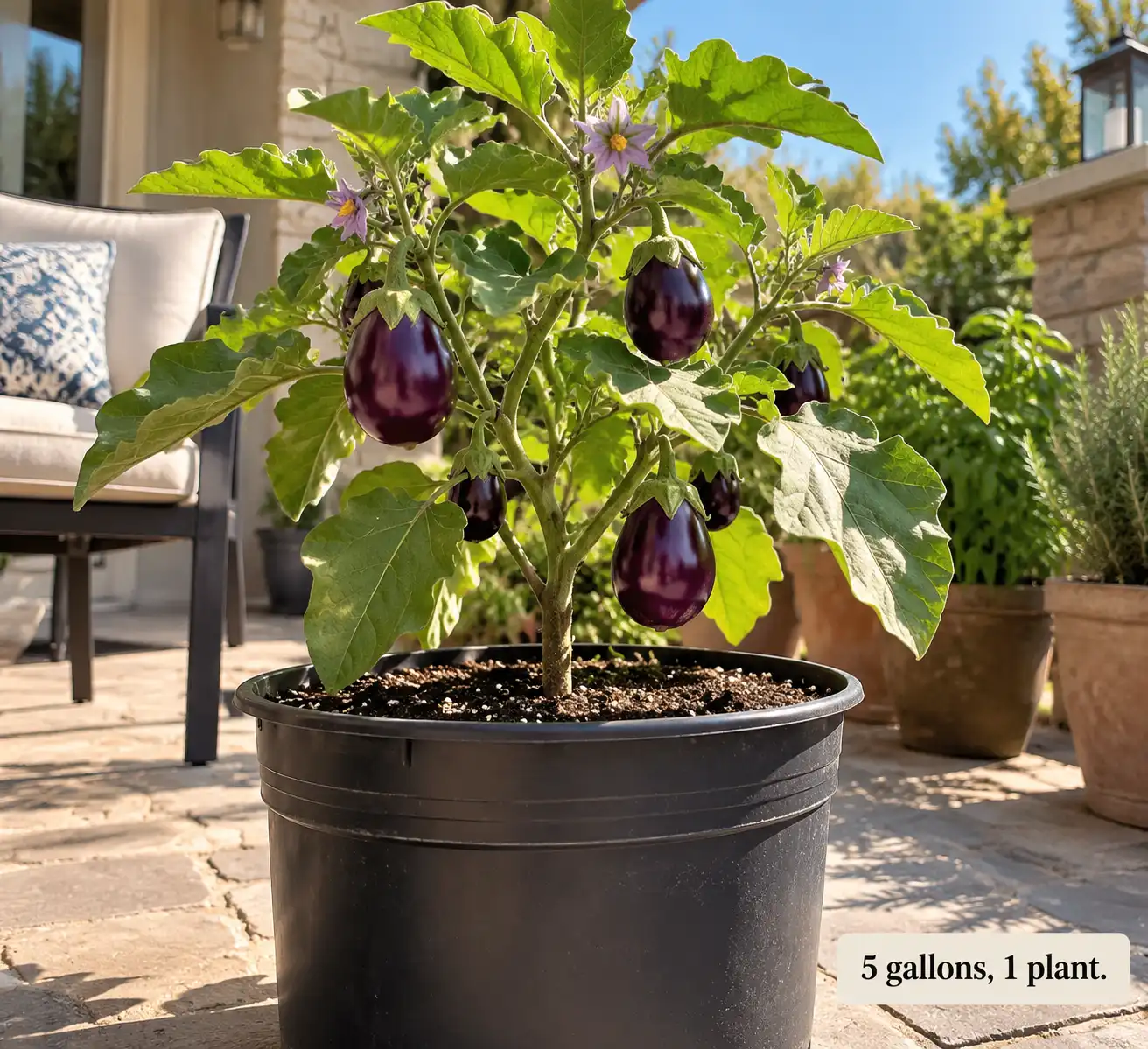
A container eggplant needs at least 5 gallons of root space. Texas A&M AgriLife Extension recommends one plant per 5-gallon container and lists Black Beauty, Florida Market, and Long Tom for pots.
Compact varieties still fit pots best, because their spread matches the container. Patio Baby tops out at 16 to 20 inches and Fairy Tale at 18 to 24 inches, per PanAmerican Seed. The breeder also rates Gretel for large containers. At 3 feet or more, though, it needs a wide, heavy pot that will not tip in wind.
A 5-gallon pot holds about two-thirds of a cubic foot of mix. So a 2-cubic-foot bag of potting mix fills roughly three pots. Containers also dry out faster than beds, and uneven moisture is what turns eggplant bitter.
When Eggplant Needs Staking
Put supports in on planting day, before the plant gets big. University of Minnesota Extension recommends installing them at transplanting. Setting them early also keeps you from driving a stake through established roots later.
Support matters most once fruit sizes up. USDA NRCS notes that rain, wind, and irrigation can break or bend loaded branches, and fruit resting on soil may spoil. So mid-size and full-size types carry the most risk.
A simple rule works for sizing: use a stake about 1 foot longer than the plant’s mature height, and drive that extra foot into the soil.
- Compact types under 2 feet: small fruit puts little strain on branches, but a short stake helps on windy sites.
- Hansel and other mid-size types: a 5-foot stake or a tomato cage covers the 42-inch top of the range.
- Gretel and standard Italian types: a 6-foot stake, since Gretel can reach 52 inches.
Tie stems loosely with soft ties, then add another tie as the plant grows.

Why Eggplant Plants Stay Small
Cold is the most likely cause of a stunted eggplant. If nights stayed warm, check the other causes in this order.
| Symptom | Likely cause | What to check |
|---|---|---|
| Little growth for weeks after transplanting | Cold nights or cold soil | Nights below 50°F (UMN Extension); organic mulch laid before soil warmed |
| Many small round holes in leaves | Flea beetles | Heavy feeding on young plants, which UMN Extension says weakens them |
| Slow growth and late fruit | Partial shade | Less than full sun; USDA NRCS says shade lowers yield and slows ripening |
| Slow start despite warm weather | Transplants set out in bloom | Flowers on the transplant, which Clemson says slow growth after planting |
| Yellow leaves curling inward, then browning | Verticillium wilt | Eggplant, tomato, potato, or pepper in that spot within 3 to 4 years |
| Big, leafy plant with few fruit | Excess nitrogen or heat | Heavy feeding; days above 90°F or nights outside 60 to 70°F (UMN Extension) |
Verticillium wilt is the most common eggplant disease, per University of Minnesota Extension, and it lives in the soil. USDA NRCS recommends long rotations with crops the disease does not attack. That same approach controls many other soilborne crop diseases, so one rotation plan covers several problems at once.
FAQs About Eggplant Plant Size
Do eggplant plants keep growing after they start fruiting?
Yes, eggplant keeps flowering and setting fruit as long as you harvest regularly, per University of Minnesota Extension. Late in the season, cold nights injure fruit left on the plant, and frost ends growth.
Can an eggplant plant grow 6 feet tall?
Rarely as a one-season annual, since USDA NRCS puts typical height at 2 to 4 feet. Taller plants mostly come from frost-free climates where eggplant survives winter, and published data on them is thin.
How much space does one eggplant plant need?
A full-size eggplant needs about 4 to 10 square feet, based on University of Minnesota and Clemson spacing. Compact types like Patio Baby need roughly 2 to 3.5 square feet at the breeder’s 18 to 22 inch spacing.
Can a full-size eggplant grow in a 5-gallon bucket?
Yes, Texas A&M AgriLife Extension lists full-size Black Beauty for a 5-gallon container holding one plant. Drill drainage holes first, and stake the plant, since a tall eggplant in a narrow bucket tips easily.
Why is my eggplant big and leafy but not fruiting?
Excess nitrogen is a common cause, since University of Minnesota Extension notes heavy feeding makes plants bushy, leafy, and slow to fruit. Heat can also stall flowering when days pass 90°F or nights fall outside 60 to 70°F.
How big should eggplant transplants be at planting?
Choose sturdy transplants up to a foot tall with stems at least as thick as a pencil, per University of Minnesota Extension. Skip plants already in bloom, because Clemson notes blossoms on transplants slow growth after planting.
Key Points for Your Field
Plan for a plant 2 to 4 feet tall unless the seed packet names a compact type. Then space to the variety’s mature spread, from 18 inches in short northern seasons to 2½ feet in long southern ones. Finally, set stakes on planting day, wait for 50°F nights, and give each container plant at least 5 gallons.


