
Where Did Eggplant Originate? From Wild Asian Nightshade to US Gardens

Tomato, potato, and pepper all came from the Americas. Eggplant did not. So where did eggplant originate, and what does that history mean for a US garden or field? The answer runs from African wild relatives to Asian farms, then through Europe to the United States.
Eggplant originated in tropical Asia, where farmers domesticated it from a wild prickly nightshade, Solanum insanum. Genome research from 2019 and 2023 points to Southeast Asia, India, or both. China holds the oldest dated record, from 59 BC.
Where Did Eggplant Originate as a Crop?
Eggplant became a crop in tropical Asia, but the two key genetic studies split on exactly where. Both camps agree on the wild ancestor. The open question is whether farmers tamed it once or twice.
A 2019 study in Molecular Biology and Evolution, led by researchers at the University of Southampton, found one domestication event. Its genome data split the wild ancestor into two groups. The eastern group spans Malaysia, Thailand, and Vietnam, while the western group covers India, Sri Lanka, and Madagascar. Cultivated eggplant descends from the eastern group. Beyond that, the team concluded that some plants that look wild in India are feral escapes from old crops.
By contrast, a 2023 analysis in The Plant Journal genotyped 3,499 genebank samples from 105 countries. It found at least two centers, one in Southeast Asia and one on the Indian subcontinent. Gene flow between the two stayed limited.
So the honest answer is a region, not a country. Notably, Southeast Asia appears in every genetic model. India is either a second birthplace or an early adopter, depending on which study you weigh. Until new work reconciles the two, treat both as live possibilities.
Learn more: Is Eggplant a Nightshade
The Wild Ancestor Has African Family Roots
Eggplant’s direct ancestor is Solanum insanum, a spiny, weedy nightshade. It grows wild across South and Southeast Asia and on Madagascar. Its fruits are small, round, and bitter. In fact, every modern eggplant traces back to that plant.
The family tree reaches further, though. The 2019 Southampton study placed the African species Solanum incanum right beside the insanum and eggplant pair. That pattern points to an African origin for the whole eggplant group, with later spread into Asia.

As a result, eggplant is an outlier among nightshade vegetables. Tomato, potato, and pepper all come from the Americas. Eggplant is the family’s major Old World vegetable, and most of its wild relatives still grow in Africa.
Wild and cultivated plants never fully separated, either. Both genetic studies found ongoing gene flow between eggplant and Solanum insanum. For breeders, that wild gene pool is still a working resource.
The Oldest Written Record Comes From China, 59 BC
The earliest reliably dated record of eggplant in cultivation is a Chinese text from 59 BC. Researchers Wang, Gao, and Knapp traced it in a 2008 Annals of Botany review of ancient Chinese writing. They called it the oldest accurately dated cultivation record known.
Beyond the date, those texts show farmers reshaping the crop for roughly 2,000 years. Selection worked on three traits: size, shape, and taste.
| Period in Chinese texts | Fruit size | Fruit shape | Taste |
|---|---|---|---|
| 5th to 6th century | Small | Round | Unpalatable |
| 12th to 13th century | Larger | Round or oval | Sweetish |
| 14th to 16th century | Larger again | Round, oval, or long | Sweeter |
| 18th to 19th century | Up to 3.4 lb (1,549 g) | Round, egg-shaped, long, and more | Sweeter still |
Of the three, taste is the trait to notice. Early cultivated fruit was described as unpalatable, much like the bitter wild plant. So the mild flesh of a modern Black Beauty is the product of centuries of selection.
By comparison, India’s timeline is harder to pin down. Indian texts also describe the plant, but none carries a date as firm as the Chinese record. That gap is one reason the domestication question stays open.
How Eggplant Spread West to Europe
Eggplant moved west through Persia and the Arab world, then entered Europe through Spain. Arab growers carried it around the Mediterranean in the early Middle Ages. By the 12th century, Ibn al-Awwam’s farming manual from Muslim Spain explained how to grow it.
In Europe, Spain adopted the crop first, and southern Italy followed. Elsewhere, though, eggplant stayed a curiosity until the 1600s.
Likewise, the names trace the same route. UF/IFAS Extension notes that aubergine, the name used across much of Europe, comes from Arabic. Meanwhile, South Asian English still says brinjal.
| When | Where | What happened |
|---|---|---|
| Prehistory | Africa to Asia | The wild eggplant group spreads east and gives rise to Solanum insanum |
| Before 59 BC | Southeast Asia, India | Farmers domesticate eggplant |
| 59 BC | China | Oldest reliably dated cultivation record |
| Early Middle Ages | Middle East, North Africa | Arab growers carry the crop west |
| 12th century | Muslim Spain | Farming manuals describe how to grow it |
| 1600s | Northern Europe | Still a curiosity outside Spain and Italy |
| Early 1800s | United States | Thomas Jefferson grows it |

When Did Eggplant Reach the United States?
UGA Extension credits Thomas Jefferson with introducing eggplant to the United States, bringing it from Europe.
However, published records on the crop’s very first arrival in the Americas are thin. So treat the Jefferson credit as the best-documented early introduction, not proof that nobody grew it sooner.
From there, the crop spread well beyond the Southeast. Today, UGA Extension says any Georgia garden can grow it. Even in the far North, University of Minnesota Extension notes that some varieties thrive in Minnesota’s short summers.
The Three Cultivated Eggplants Compared
Asia domesticated one eggplant, but Africa domesticated two more of its own. All three are separate species with separate wild ancestors.
| Crop | Species | Where domesticated | Wild ancestor | Grown for |
|---|---|---|---|---|
| Common (brinjal) eggplant | Solanum melongena | Southeast Asia, possibly India too | Solanum insanum | Fruit |
| Scarlet eggplant | Solanum aethiopicum | Tropical Africa | Solanum anguivi | Fruit, leaves, or both, by cultivar group |
| Gboma eggplant | Solanum macrocarpon | Humid West Africa and the Congo basin | Solanum dasyphyllum | Fruit, leaves, or both |
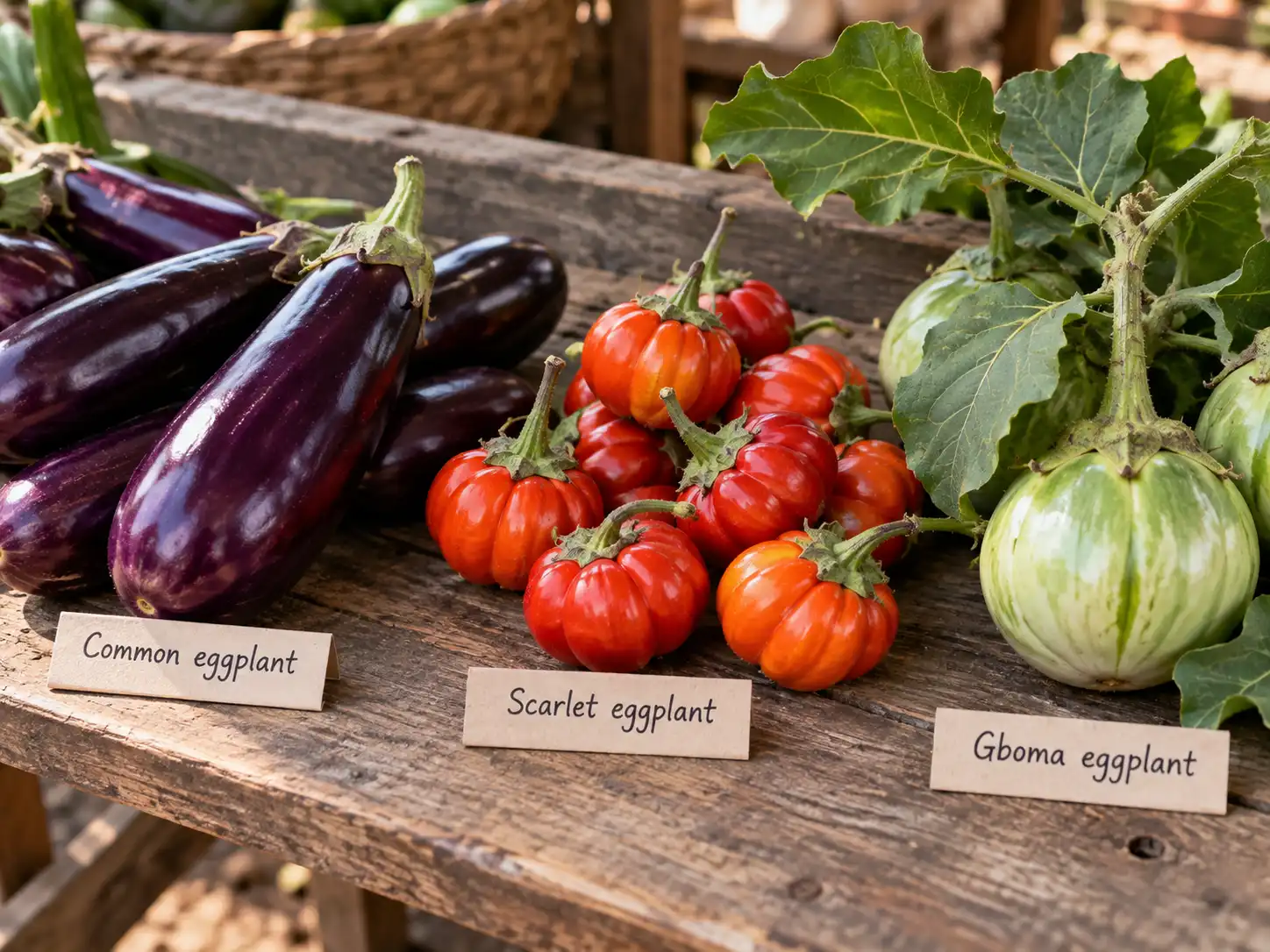
In practice, nearly every eggplant in a US seed rack is Solanum melongena. That includes the types UF/IFAS Extension recommends for Florida, such as Black Beauty and Ichiban, plus Thai and Japanese varieties. By contrast, scarlet and gboma eggplants remain uncommon in US gardens.
What a Tropical Origin Means for Your Planting Date
A crop from tropical Asia wants warm soil and warm nights. Plant it into cold ground and it stalls, sometimes for good.
Temperature Thresholds Before You Plant
University of Minnesota Extension calls eggplant much less cold hardy than tomato. So it advises waiting until night lows stay above 50°F, because chilled transplants may never recover and bear fruit. UGA Extension adds a soil target: wait for 65 to 70°F before setting plants out.
At the other end, heat has limits too. UMN Extension links poor flowering to nights below 60°F or above 70°F, and to dry spells above 90°F. Similarly, UF/IFAS Extension puts the preferred range at 70 to 85°F and warns that hot, dry weather turns fruit bitter. In the North, black plastic mulch helps warm the soil, per UMN Extension.

Planting Windows by Region
In turn, the same tropical needs produce very different calendars across the country.
| Region | Planting guidance | Source |
|---|---|---|
| South Florida | Plant August through February, cool season only | UF/IFAS |
| Central Florida | January to February, or August to September | UF/IFAS |
| North Florida | February to March, or August | UF/IFAS |
| South Georgia | Start seed indoors about the third week of February | UGA |
| North Georgia | Start seed indoors about the last week of March | UGA |
| Minnesota | Transplant once night lows hold above 50°F | UMN |
South Florida shows it best. There, summer heat is the problem, so growers shift eggplant into the cool season.
Water and Rotation
Beyond temperature, steady moisture matters as much as heat. UGA Extension calls for 1 to 2 inches of water per week. On a 4 by 8 raised bed, that works out to about 20 to 40 gallons weekly. On an acre, it is roughly 27,000 to 54,000 gallons. For larger blocks, calculating crop water needs from local evapotranspiration gives a tighter number. Also, UMN Extension warns that uneven watering makes fruit bitter, cuts yield, and can trigger blossom end rot.
Finally, rotation follows from family ties. UMN Extension advises a three to four year rotation. So keep eggplant off ground that recently grew tomatoes, potatoes, peppers, or eggplant. The same guide names Verticillium wilt, a soilborne crop disease, as the most common eggplant problem.
FAQs About Eggplant Origin
Is eggplant native to India?
India is one likely birthplace of eggplant, but genetic work has not confirmed it. A 2023 Plant Journal study names India a domestication center, while a 2019 study favors Southeast Asia.
Did eggplant come from Africa?
Its distant wild family did, but the cultivated crop itself did not. The eggplant group traces back to African wild species, yet farmers first domesticated eggplant from Solanum insanum in tropical Asia.
Why is it called eggplant?
The name comes from early white varieties whose fruits looked like hen’s eggs. UF/IFAS Extension calls eggplant the newer name in North America and Australia, while Europe mostly says aubergine.
Why was eggplant called the mad apple?
Medieval Italian folklore held that eating the fruit could drive a person insane. An English herbal from 1597 still called it the mad or raging apple, showing how slowly Europe trusted it.
Is eggplant related to tomatoes and potatoes?
Yes, all three are nightshades in the family Solanaceae and share several soilborne diseases. But eggplant is the Old World member, domesticated in Asia, while tomato and potato come from the Americas.
Key Points to Carry Into the Field
Eggplant’s tropical Asian roots explain its planting rules. It wants 65 to 70°F soil, nights above 50°F, and steady moisture, and it stalls when any of those slip. In South Florida, that even means a cool-season crop instead of a summer one. For spacing, staking, and pest control, the eggplant growing guides pick up where this history ends.


