
What Does an Eggplant Plant Look Like? Leaves, Flowers, and Fruit
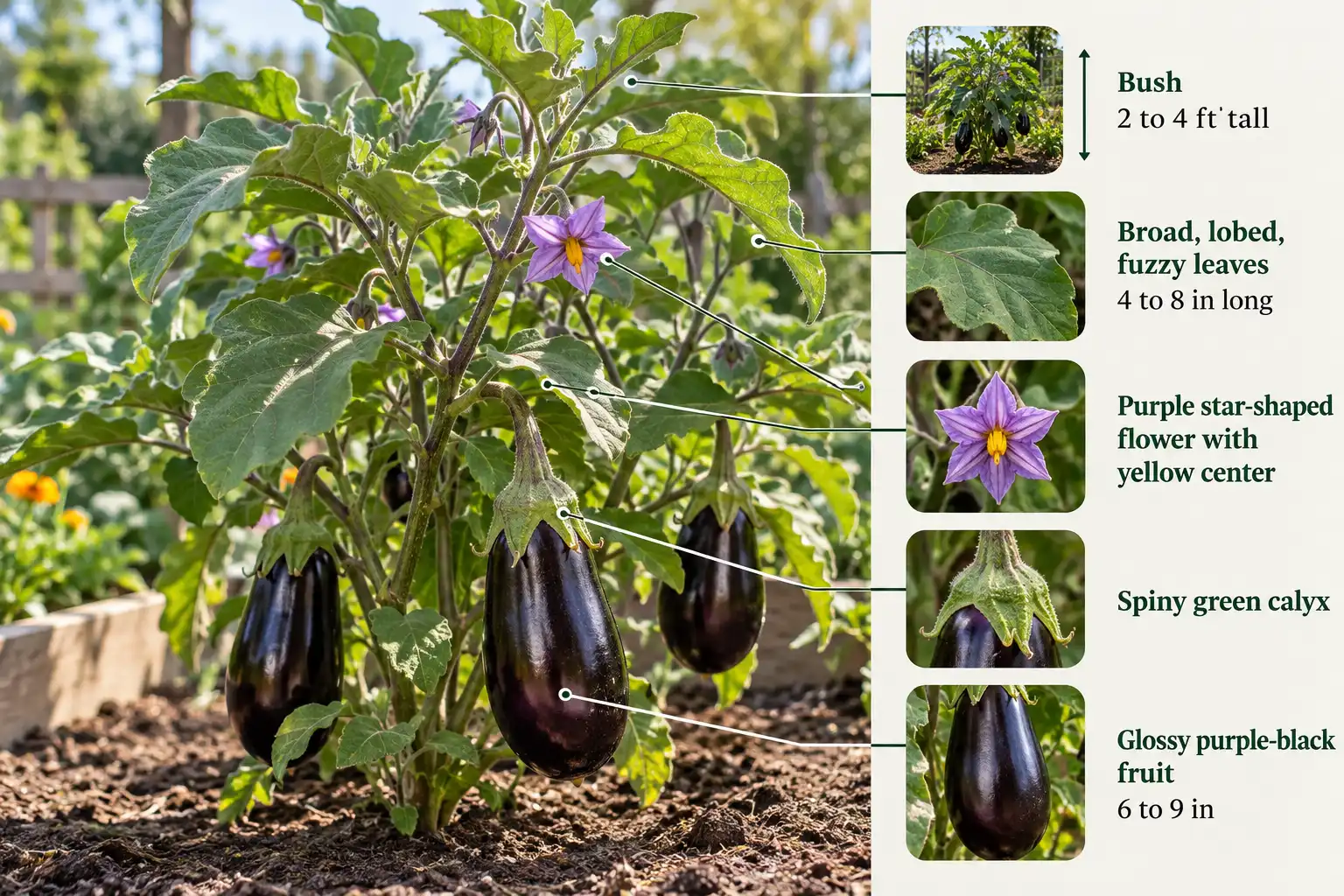
Knowing what an eggplant plant looks like helps you confirm a seedling, tell it apart from tomatoes and peppers, and catch leaf trouble early. Below, you get each part of the plant with the sizes extension services publish, from leaf to calyx.
An eggplant plant is an upright, branching bush 1 to 4 feet tall. It has large, lobed, fuzzy leaves up to 8 inches long, star-shaped purple flowers with yellow centers, and glossy fruit hanging beneath a green, often spiny cap.
How Big Does an Eggplant Plant Get?
Most eggplant plants grow 1 to 4 feet tall and form an upright, branching bush rather than a vine. Purdue Extension’s Plant ID Pal lists 1 to 3 feet. By contrast, the NC State Extension Gardener Plant Toolbox gives 2 to 4 feet tall and 1 to 3 feet wide. Variety and growing conditions account for the gap.
The main stem branches low and turns slightly woody as the plant matures, per NC State. Still, a heavy fruit load can bend or snap branches late in the season. That is why UNL Extension suggests staking once the fruit starts to build.
How Much Room One Plant Fills
Spacing advice varies, so the full range is more useful than one number. University of Minnesota Extension spaces plants 18 inches apart in rows 30 to 36 inches apart. Clemson Extension goes wider, at 24 to 30 inches in 36-inch rows. Its reason is airflow, which dries leaves faster and cuts foliar disease. UNL Extension sits at the top, with 2 to 3 feet between plants and 3 to 4 feet between rows.
At your scale, that range works out like this:
- 100-foot row: about 66 plants at 18 inches, 40 to 50 at 24 to 30 inches, about 33 at 3 feet
- 4 by 8 raised bed, one center row: 5 plants at 18 inches, 3 or 4 plants at 24 to 30 inches
What Do Eggplant Leaves Look Like?
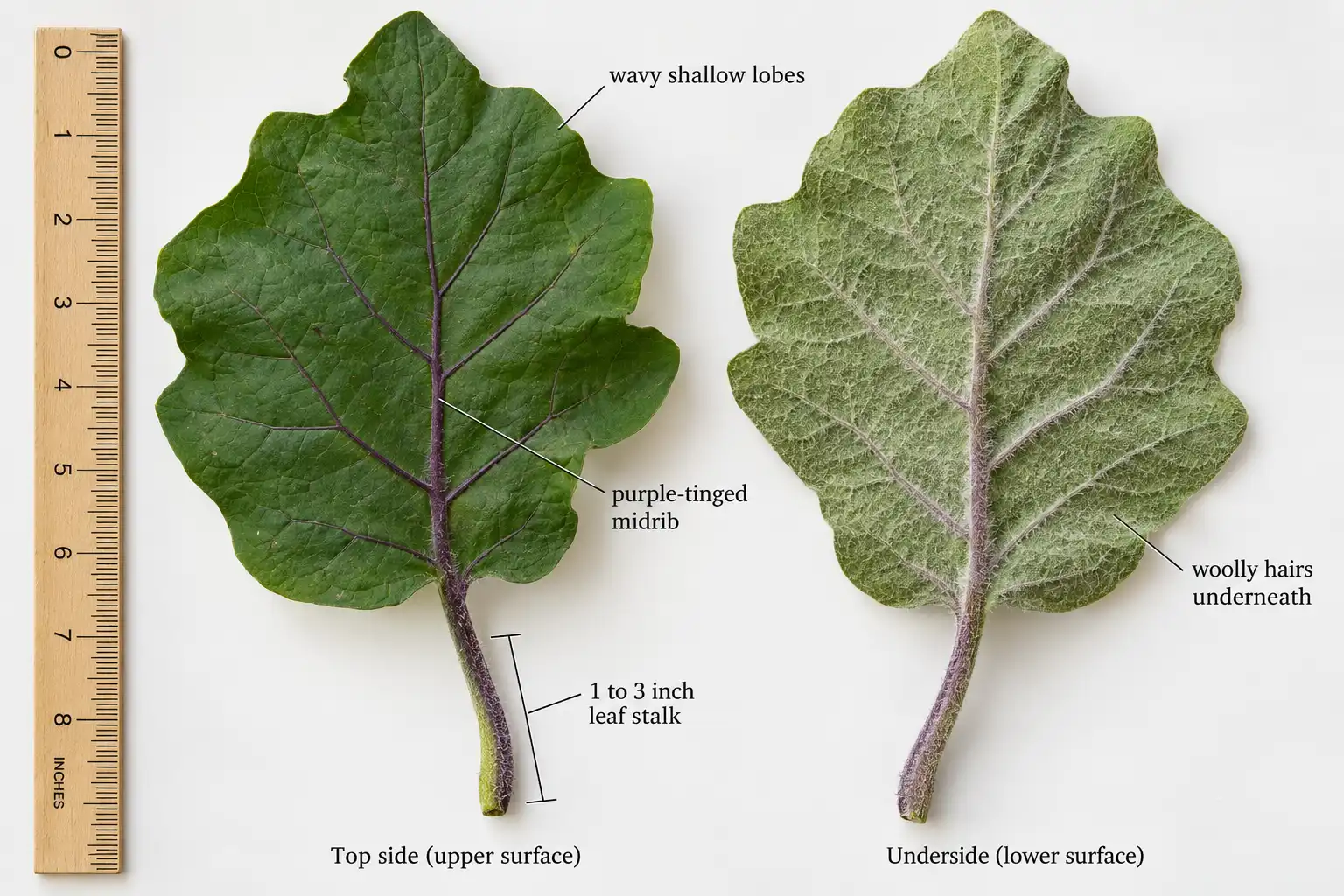
Eggplant leaves are large, broad ovals with wavy, shallow lobes and a soft, fuzzy surface. Purdue Extension measures them at 4 to 8 inches long. NC State Extension describes a typical leaf as about 8 inches long and 4 inches wide. Its edge is either smooth or cut into 5 to 9 wavy lobes.
The fuzz is the fastest clue. NC State notes that star-shaped hairs cover both the leaves and the stems. Also, UNL Extension says most varieties carry dense, wool-like hairs underneath. As a result, the bottom of the leaf feels softer than the top.
Check these traits next:
- Arrangement: one leaf per node, alternating up the stem
- Leaf stalk: 1 to 3 inches long
- Color: bright green or tinged purple
- Prickles: present on some plants, absent on others
All four traits come from the NC State Plant Toolbox entry.
Is a Purple Tint on Eggplant Leaves a Problem?
Usually not. NC State lists purplish-tinged leaves as normal for the species. However, if the whole plant shifts color suddenly, confirm the cause with a soil test before adding fertilizer. Knowing how to work through a soil test report keeps you from feeding a shortage that is not there.
One safety note: treat the foliage as inedible. NC State rates eggplant leaves, flowers, stems, and roots as highly poisonous because of alkaloids that include solanine.
Eggplant Stems and Spines
Eggplant stems are thick, hairy, and sometimes prickly. NC State Extension describes them as coated in star-shaped hairs, with prickles on some plants. They also turn slightly woody as the plant matures.
The sharpest spines usually sit right above the fruit. UNL Extension notes that the short stem joining each fruit to its branch often carries sharp spines. So wear gloves at harvest.
Those stems are tough, too. Clemson Extension calls them tough and heavy and advises cutting fruit free with a sharp knife or hand pruners. Pulling instead can damage both the fruit and the plant, per UMN Extension.
What Do Eggplant Flowers Look Like?
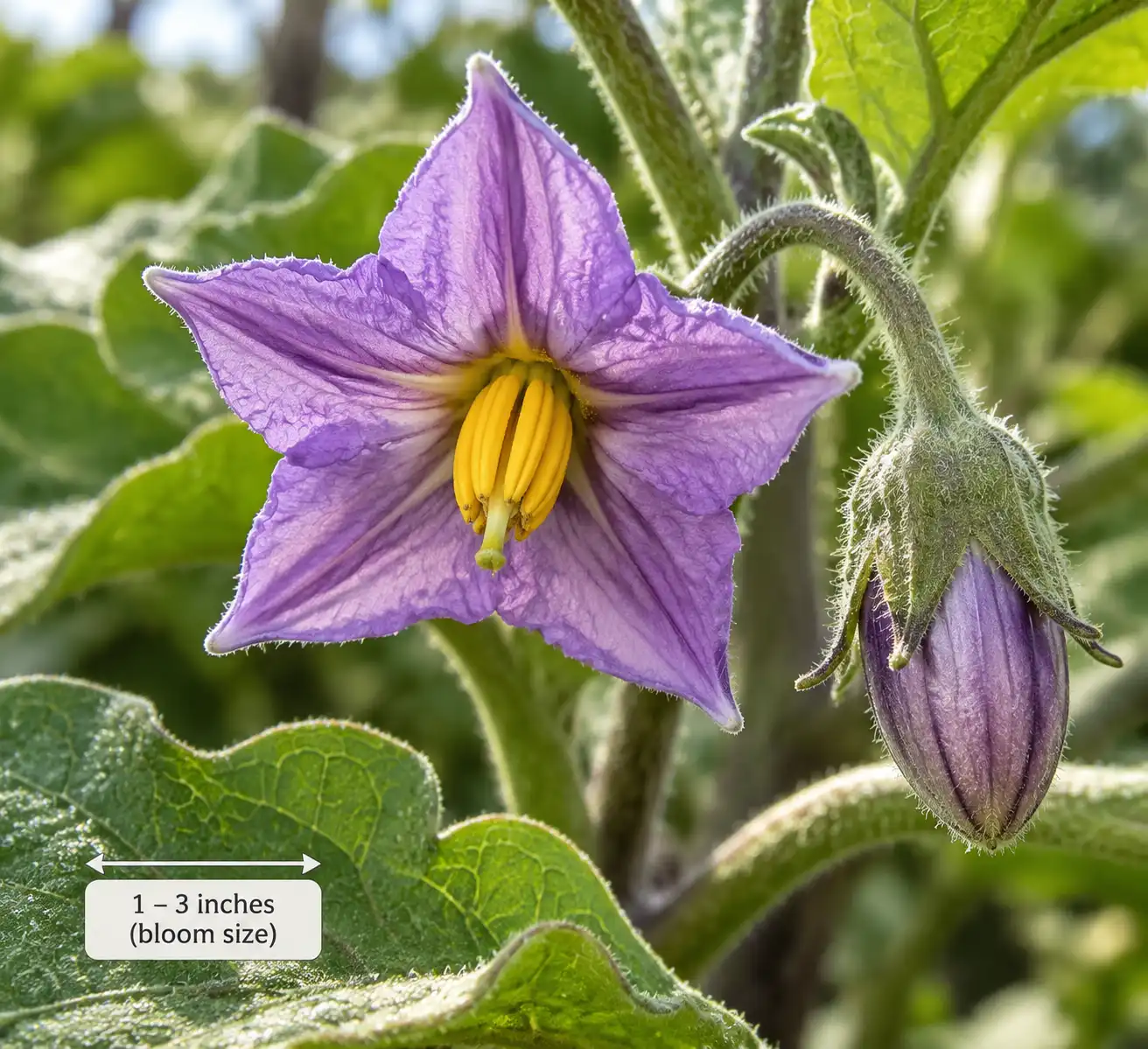
Eggplant flowers are star-shaped and usually purple, with a bright yellow cone of stamens in the center. Purdue Extension describes fused petals in purple or sometimes white. NC State Extension adds that each bloom is funnel-shaped with 5 or 6 pointed lobes. It also places the flower in its 1 to 3 inch size class, larger than a tomato or pepper bloom.
Blooms open singly or in clusters of two or more, per UNL Extension. So a branch carrying several flowers can set a small cluster of fruit.
Why Eggplant Flowers Drop Without Setting Fruit
Weather is often behind it. UMN Extension ties poor flowering to drought, days above 90°F, and nights below 60°F or above 70°F.
Timing matters as well. Both UNL and Clemson advise buying transplants that are not yet in bloom. According to Clemson, early blossoms slow growth after transplanting and can lower yield. If your own seedlings flower indoors, UMN suggests pinching off those clusters until the plants are in the garden.
What Does Eggplant Fruit Look Like on the Plant?
Eggplant fruit is a glossy berry that hangs from a short, tough stem under a green cap called the calyx. Shape and color depend on the variety. UNL Extension lists shapes from round and oval to long and oblong. Skin runs from purple-black to red, white, green, or streaked.
Grouped by look, the main types compare like this:
| Type | Example varieties | What the fruit looks like |
|---|---|---|
| Italian | Black Beauty, Dusky, Epic | Oval, glossy, purple-black, 6 to 9 inches (Clemson) |
| Asian | Ichiban, Ping Tung Long | Long and slender; Ping Tung Long reaches 18 by 2 inches (NC State) |
| Striped | Rosa Bianca, Calliope, Fairy Tale | White skin streaked with lavender or purple (NC State, UNL) |
| White | Casper, Easter Egg | Casper is a 6-inch white cylinder; Easter Egg matches a hen’s egg (UNL) |
| Round green | Kermit | Small, round, green and white (Clemson) |
| Miniature | Hansel | Finger-sized purple fruit in clusters (UNL) |
What Ripe and Overripe Eggplant Fruit Look Like
Ripe fruit is full-sized, shiny, and evenly colored. For Italian types, Clemson says a light thumbnail press that leaves a dent means the fruit is ready. That point usually arrives 65 to 80 days after transplanting. By contrast, UNL Extension says overripe fruit turns dull and spongy, and its seeds harden and darken.
Two other marks can show up on the skin. White patches often mean sunscald, which UMN Extension links to fruit lacking leaf cover in hot, dry weather. Also, uneven soil moisture can cause blossom end rot, per UMN, and blossom end rot prevention starts with steady watering.
How an Eggplant Plant Changes From Seedling to Harvest
An eggplant looks least like its adult form in the first three weeks. After that, it mostly gets larger, then flowers and fruits.
| Stage | Timing | What you see | Source |
|---|---|---|---|
| Emergence | 8 to 12 days after sowing | Two seed leaves on a bent stem that soon straightens | NC State, UNL |
| First true leaf | 15 to 20 days after sowing | A broad, fuzzy true leaf opens above the seed leaves | UNL |
| Transplant | 4 to 10 weeks after sowing | Sturdy plant up to 1 foot tall, pencil-thick stem, closely spaced leaves | UNL, Clemson, UMN |
| Flowering | Can begin before transplant | Purple star flowers, single or in small clusters | UMN, UNL |
| First harvest | 65 to 80 days after transplanting | Glossy, full-sized fruit under a green cap | Clemson |
The transplant window varies by source, so the table gives the full span. UNL Extension sows 4 to 6 weeks before setting plants out. Clemson sets out 6 to 8 week old transplants, while UMN starts seed about 8 weeks ahead.
Whatever the age, a good transplant looks the same. UMN describes a sturdy plant up to a foot tall. Its stem is at least as thick as a pencil, with leaves closely spaced. In contrast, Clemson warns against tall, spindly plants. If your own seedlings lean or stretch, UMN says they need brighter light directly overhead.
Eggplant vs Tomato vs Pepper Leaves
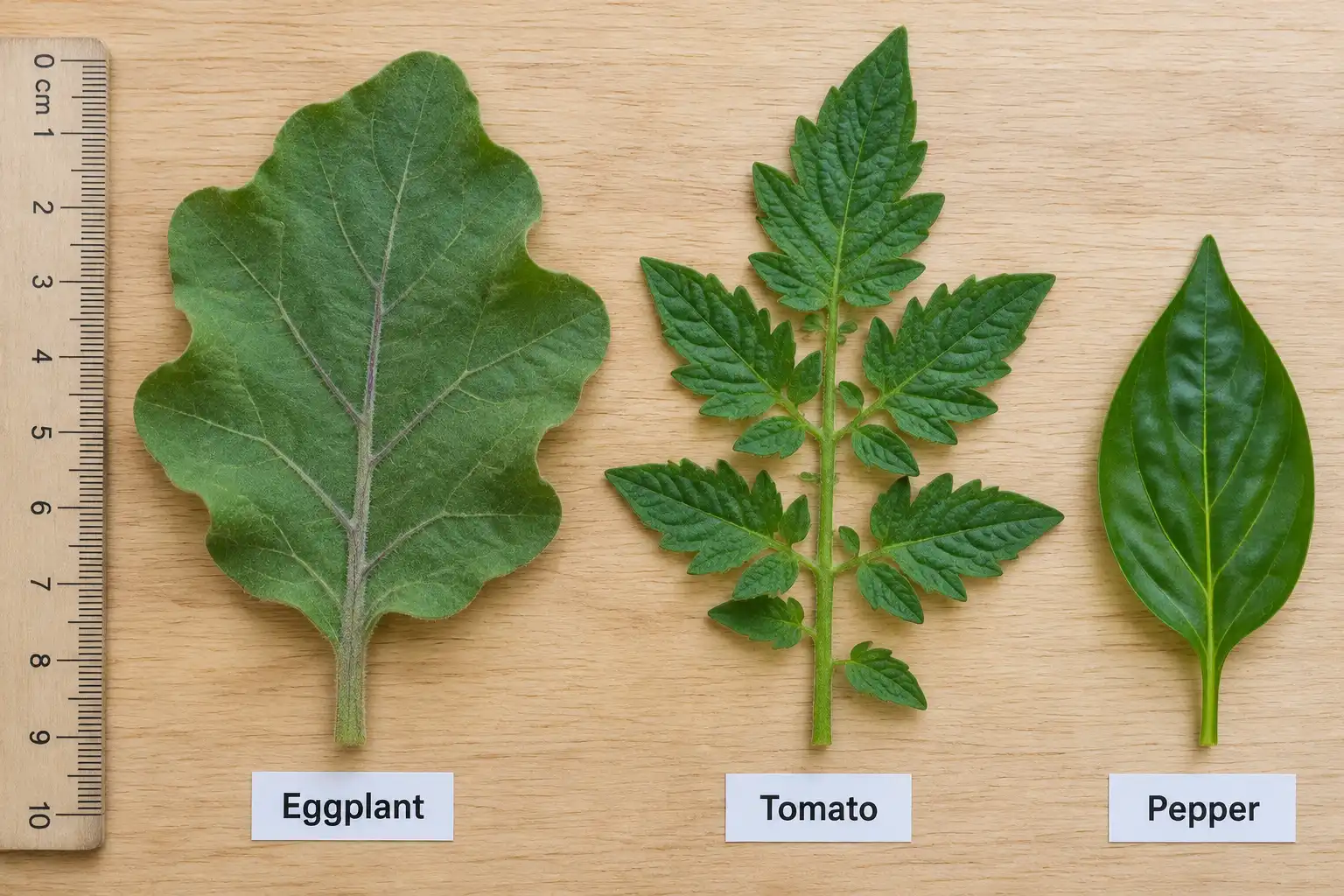
Eggplant leaves are simple and broad with wavy lobes. Tomato leaves are compound with toothed leaflets, and pepper leaves are small, smooth, and glossy. All three crops belong to the nightshade family, Solanaceae, so they share pests and rotation slots. That makes it worth knowing which crops count as nightshades before you plan a rotation.
Every figure below comes from the NC State Extension Gardener Plant Toolbox entries for eggplant, tomato, and pepper.
| Trait | Eggplant | Tomato | Pepper |
|---|---|---|---|
| Leaf type | Simple | Compound, 5 to 9 leaflets | Simple |
| Leaf size | About 8 by 4 inches | 4 to 10 inches long; leaflets about 3 inches | Up to 3 inches long |
| Leaf edge | Smooth or 5 to 9 wavy lobes | Toothed | Smooth |
| Surface | Fuzzy, star-shaped hairs | Velvety, densely hairy, strong scent | Glossy, hairless |
| Stem | Hairy, sometimes prickly, woody with age | Sticky, hairy, aromatic | Smooth |
| Flower | Purple star, 1 to 3 inch class | Yellow star, under 1 inch | White to purple, under 1 inch |
| Plant height | 2 to 4 feet | 1 to 10 feet | 1 foot to 3 feet 8 inches |
In practice, touch and smell settle most doubts. Brush a tomato leaf and it gives off a strong scent. An eggplant leaf feels like felt, while a pepper leaf feels slick.
What Unhealthy Eggplant Leaves Look Like
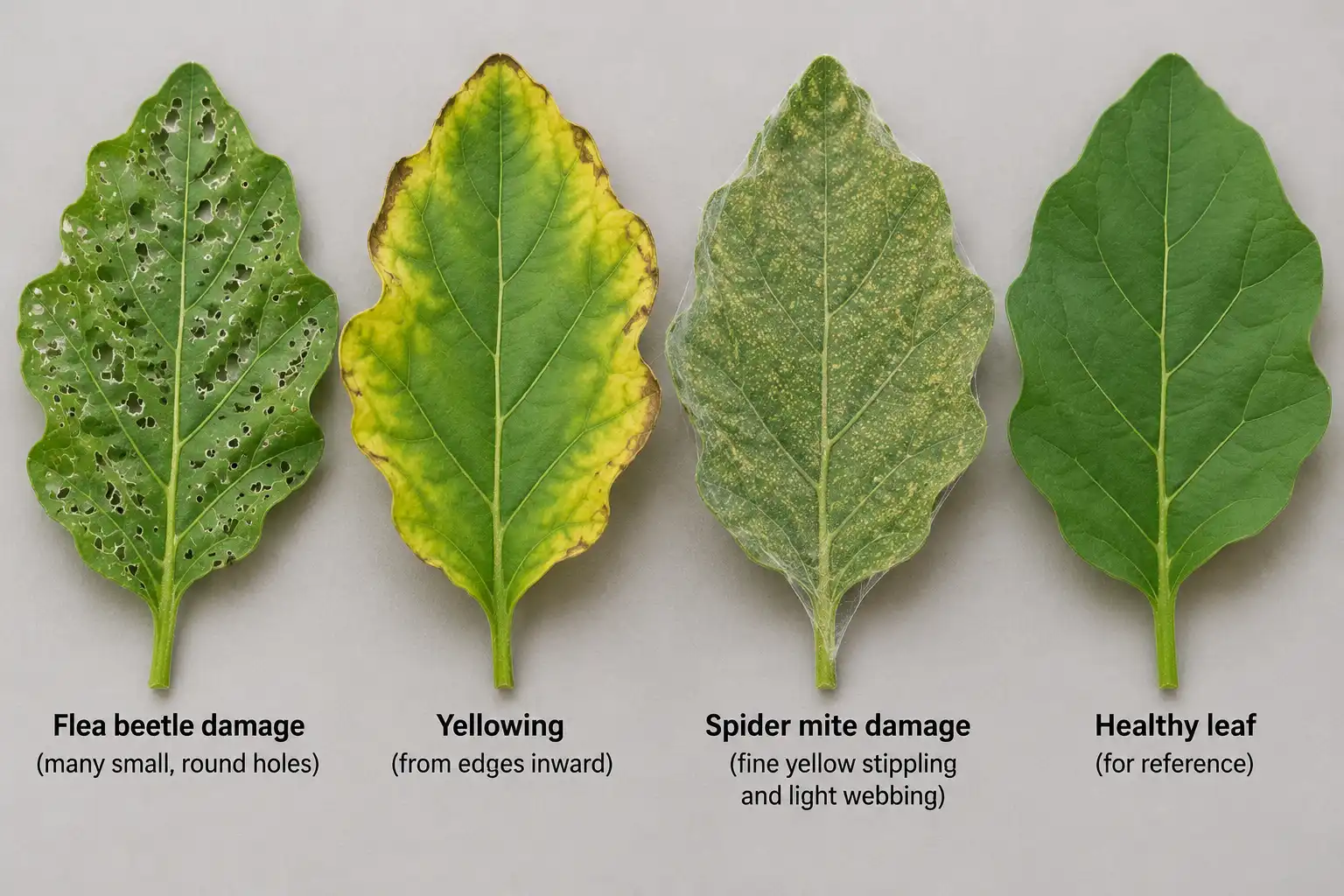
Small round holes, yellowing that starts at the leaf edge, and a stippled or bronzed cast are the three symptoms to check first. Match what you see against this table.
| Leaf symptom | Likely cause | How to confirm |
|---|---|---|
| Many small, round shot holes | Flea beetles | Damage is worst on young plants with few leaves (Clemson) |
| Large chewed areas, only big veins left | Colorado potato beetle or hornworms | Larvae, adults, or large caterpillars feeding on foliage (Clemson) |
| Yellow edges and tips, often on one side, lower leaves first | Verticillium wilt | Tan veins around a green center in a lengthwise stem cut near the soil (UMN) |
| Yellow stippling or a bleached, bronzed cast, fine webbing | Spider mites | Mites on leaf undersides during hot, dry weather (Clemson, UMN) |
| Round gray to brown spots with light centers | Phomopsis blight | More common in fall; also rots fruit (UMN, Clemson) |
| Sudden wilt with little yellowing | Bacterial wilt | Reddish-brown pith inside the stem (Clemson) |
| Soft, water-soaked leaves that turn black | Frost or chilling injury | Shows right after a cold night (UMN) |
Plant size changes how much damage matters. Clemson Extension says flea beetle injury is most serious while plants are small, though larger plants tolerate a fair amount. So scout new transplants closely for the first few weeks.
Verticillium wilt deserves extra attention, since UMN Extension calls it the most common eggplant disease. UNL Extension recommends long rotations with unrelated crops to keep it in check. Rotation is also the first defense against many of the crop diseases growers see most often.
Finally, a bushy, leafy plant that is slow to fruit often points to too much nitrogen, per UMN.
FAQs About Eggplant Plant Identification
Are eggplant leaves poisonous?
Yes, the leaves are toxic, so never eat them or let pets chew them. NC State Extension rates the leaves, flowers, stems, and roots as highly poisonous because of solanine-type alkaloids.
Why are my eggplant leaves purple?
A purple tint is usually normal, since NC State Extension describes eggplant leaves as bright green or purplish-tinged. Before adding fertilizer for a suspected deficiency, confirm it with a soil test.
Do eggplant plants have thorns?
Many do, and NC State Extension notes prickles on the stems and leaves of some plants. UNL Extension suggests gloves at harvest, since the short stem above each fruit often carries sharp spines.
Is an eggplant plant a bush or a vine?
It grows as an upright, multi-stemmed bush 2 to 4 feet tall, per NC State Extension. It never climbs, but UMN Extension still recommends installing a support at planting to carry heavy fruit.
How do you tell an eggplant seedling from a tomato seedling?
Wait for the first true leaves, then check shape and scent. Per NC State Extension, eggplant leaves are single and fuzzy, while tomato leaves split into toothed leaflets and smell strongly.
Can an eggplant plant live more than one year?
Only in frost-free areas, since UNL Extension notes that even cold above freezing can injure eggplant. NC State Extension calls it a short-lived perennial, hardy only in USDA zones 9 through 12.
Key Points to Carry Into the Field
Identify eggplant by touch first: broad, felt-like leaves with wavy lobes, hairy stems, and prickles on many plants. Purple star flowers and glossy fruit under a green cap confirm it.
Then treat the leaves as your early warning. Shot holes on young transplants, yellowing from the edge, or a bronzed cast each point to a specific cause. So check plants weekly and act while they are still small.


