
How to Grow Eggplant: Seed, Spacing, Care, and Harvest Timing
Eggplant is a heat-loving cousin of tomatoes and peppers, and it handles cold far worse than either. Below is how to grow eggplant from seed or transplants, in beds or containers, through to a glossy harvest.
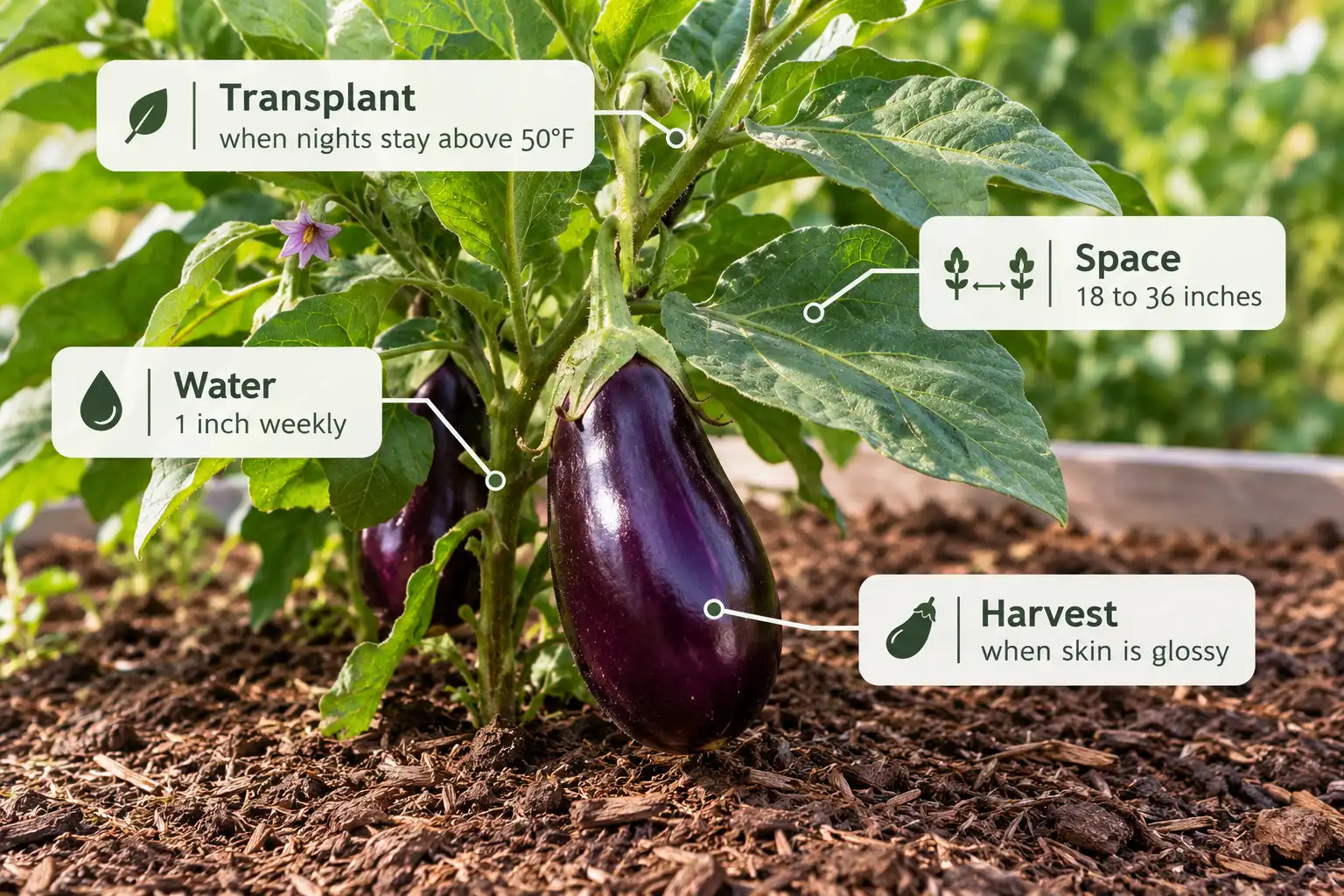
To grow eggplant, start seeds indoors 4 to 8 weeks early, then transplant once night lows stay above 50°F. Space plants 18 to 36 inches apart in full sun, water 1 inch weekly, and pick glossy fruit.
Eggplant Growing Timeline
Most of the season hangs on one date: the day you transplant. Count backward from it to start seed, then forward to feed and harvest.
| Stage | Timing | Source |
|---|---|---|
| Sow seed indoors | 4 to 8 weeks before transplanting | Nebraska and Minnesota Extension |
| Seedlings emerge | 8 to 12 days after sowing | Texas A&M AgriLife |
| Move to individual pots | 15 to 20 days after sowing | Nebraska Extension |
| Harden off | 10 to 14 days before transplanting | Nebraska Extension |
| Transplant outdoors | Night lows steady above 50°F | Minnesota Extension |
| First sidedress | 3 to 4 weeks after transplanting | Clemson Extension |
| Second sidedress | 3 to 4 weeks after the first | Clemson Extension |
| First harvest | 65 to 80 days after transplanting | Clemson Extension |
When to Plant Eggplant
Plant eggplant outdoors once night lows stay above 50°F and frost danger has passed. University of Minnesota Extension warns that plants set out sooner suffer from the chill and may never recover to bear fruit. University of Nebraska-Lincoln Extension adds that eggplant handles cold worse than tomatoes or peppers.
Clemson Cooperative Extension puts the best growing range at 70°F to 85°F. Below that, growth slows to a crawl.
So published windows stretch from midwinter in Florida to late May on the northern Plains:
| Region | Outdoor planting window | Source |
|---|---|---|
| Western Nebraska | About May 20 at the earliest | Nebraska Extension |
| Central Nebraska | About May 10 at the earliest | Nebraska Extension |
| Southeast Nebraska | About May 5 at the earliest | Nebraska Extension |
| South Carolina Piedmont | May 1 to June 30 | Clemson Extension |
| South Carolina Coastal Plain | April 1 to 30, or August for a fall crop | Clemson Extension |
| North Florida | February to March, or August | UF/IFAS Extension |
| Central Florida | January to February, or August to September | UF/IFAS Extension |
| South Florida | August through February | UF/IFAS Extension |
In the Deep South, those dates matter for flavor as well as survival. UF/IFAS Extension notes that fruit grown in hot, dry weather turns bitter, which is why South Florida grows eggplant mainly in the cool season. Up north, the risk runs the other way. There, row covers help plants through a late cold spell, according to Nebraska Extension.
How to Grow Eggplant From Seed
Growing eggplant from seed takes 4 to 8 weeks indoors, and the main references split that range. Nebraska Extension sows 4 to 6 weeks before transplanting, while Minnesota Extension allows about 8. So choose the longer lead when a short season calls for larger transplants.
- Sow shallow. Plant seed 1/4 inch deep, as Minnesota Extension advises, or up to 1/2 inch, per Nebraska Extension. Use a sterile, soilless mix, since damping-off is a common seedling killer.
- Add bottom heat. Hold the mix at 75°F to 85°F on a heat mat until seedlings emerge. Both Minnesota and Nebraska Extension use that range. Check moisture daily, because heat mats dry flats fast.
- Wait patiently. Seedlings take 8 to 12 days to emerge, per Texas A&M AgriLife Extension.
- Light from directly above. Without strong overhead light, stems stretch and lean toward the window.
- Pot up early. Move seedlings to individual pots once the first true leaves open. Nebraska Extension puts that at 15 to 20 days after sowing.
- Grow slightly cooler. After emergence, keep seedlings at 65°F to 75°F by day and 60°F to 70°F at night, per Nebraska Extension.
- Pinch early flowers. Remove any blooms that open indoors. Minnesota Extension advises this until plants reach the garden.
- Harden off. Over 10 to 14 days, move plants from shade into more sun each day. Bring them in whenever nights drop below 55°F, per Minnesota Extension.

Best Eggplant Varieties to Grow
Choose a variety by fruit type and season length first. Clemson sorts eggplant into three groups: Italian types with large, glossy, purple-black fruit; Asian types with thinner skin and a milder flavor; and specialty types in other sizes and colors.
| Variety | Type | Fruit | Best fit | Listed by |
|---|---|---|---|---|
| Black Beauty | Italian heirloom | Large, smooth, purple | Full-size beds or 5-gallon pots | Nebraska, UF/IFAS, Texas A&M |
| Dusky | Italian | Medium, dark purple | Beds or containers | Nebraska, Clemson, UF/IFAS |
| Black Bell | Italian | Round, glossy purple-black | Gardens with disease history | Nebraska |
| Ichiban | Asian | Long, slender, purple | Containers and warm regions | Nebraska, Clemson, UF/IFAS |
| Hansel | Specialty mini | Finger-size purple clusters | Short seasons and containers | Nebraska, Clemson |
| Fairy Tale | Specialty mini | Small, white with violet streaks | Containers | Nebraska |
| White Italian | Specialty | Medium, white | Milder flavor than purple types | Nebraska |
For a short northern season, Hansel is the safer pick, because Nebraska Extension describes it as early maturing. Nebraska also rates Black Bell as extremely disease resistant.
Seed catalogs print days to maturity for every variety. However, those figures come from seed suppliers, not independent extension trials. Use them to compare varieties against each other rather than to set a harvest date.
Prepare the Site and Soil
Give eggplant full sun, shelter from wind, and fertile, well-drained soil. Nebraska Extension notes that plants in partial shade yield less and ripen fruit later.
Rotate first. Minnesota Extension advises a 3 to 4 year gap since tomatoes, potatoes, peppers, eggplant, or tomatillos last grew in the spot. That gap limits Verticillium wilt and other soilborne diseases shared across the nightshade family.
Next, test the soil. The target pH differs slightly by source:
- Clemson: 6.0 to 6.5
- Penn State’s soil testing lab: 6.5
- Minnesota Extension: anywhere from 5.5 to 7.5
All three agree on 6.0 to 6.5, so aim there. Penn State also rates soil test phosphorus of 35 to 70 ppm and potassium of 70 to 140 ppm as optimum for eggplant. Those two lines tell you whether to add P and K at all, so it pays to know how a soil test report reads before buying fertilizer.
Then work in compost or well-rotted manure in spring or fall, as Minnesota Extension suggests. Over several seasons, compost is one of the simplest ways of improving soil fertility ahead of heavy feeders. Also skip any “weed and feed” product near the bed. Minnesota Extension warns that the herbicide in it can kill vegetable plants.
How to Plant Eggplant Transplants
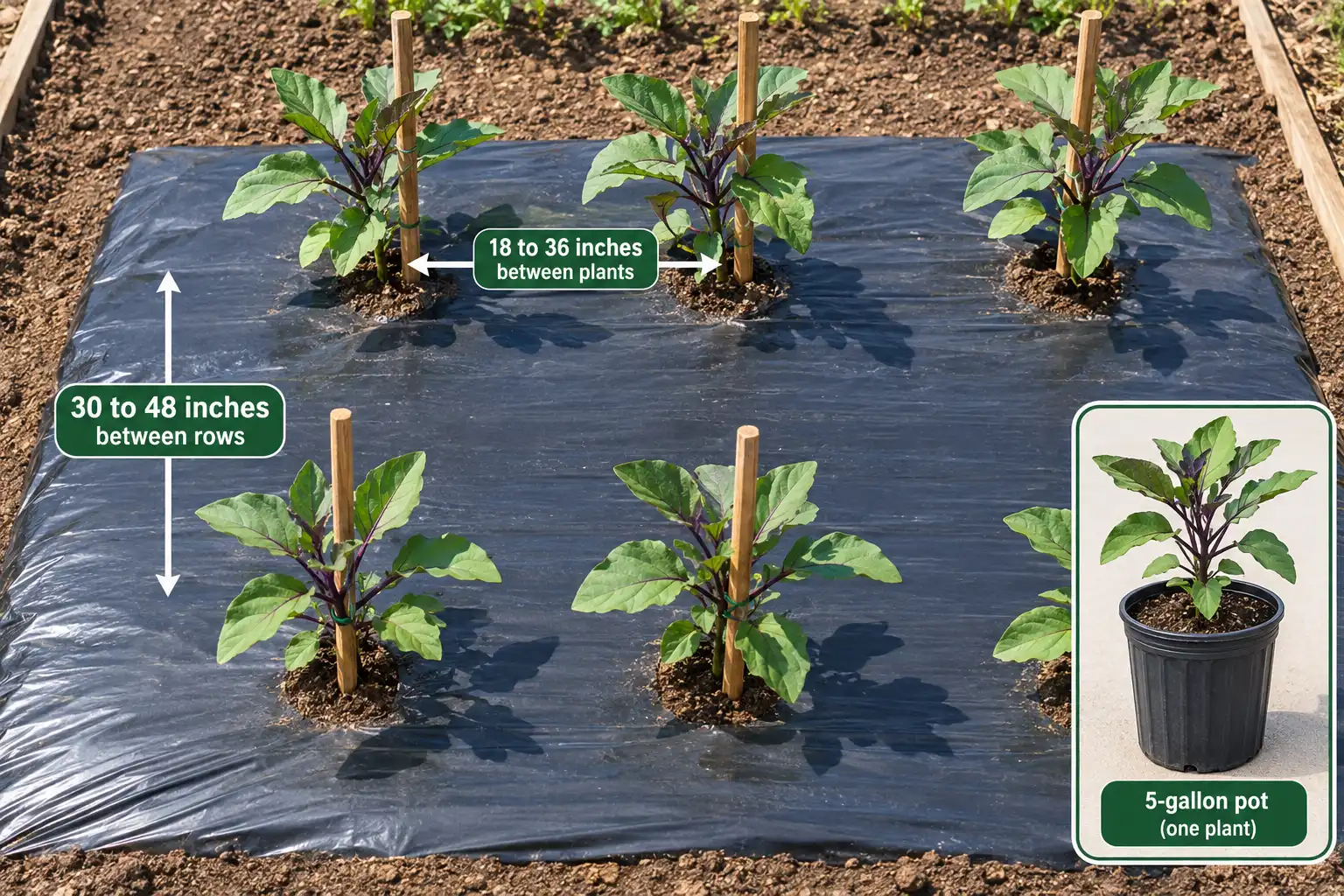
Set transplants 18 to 36 inches apart, depending on the variety. The published spacings differ:
- Minnesota Extension: 18 inches apart, in rows 30 to 36 inches apart
- Clemson: 2 to 2.5 feet apart, in rows 3 to 4 feet apart
- Nebraska Extension: 2 to 3 feet apart, in rows 3 to 4 feet apart
UF/IFAS Extension advises following the seed supplier’s spacing, since varieties vary so much in size. So use the tight end for mini and Asian types and the wide end for full-size Italian types. At 2 feet each way, a 4 by 8 raised bed holds 8 plants.
- Pick sturdy plants. Look for stems as thick as a pencil and no open blooms. Clemson notes that blossoms on transplants slow growth and can lower yields.
- Water first. Soak plants well before moving them.
- Plant late in the day. Minnesota Extension favors late afternoon or a calm, cloudy day.
- Match the depth. Set each plant at the depth it grew in the pot. Bury peat pot rims fully, or they wick water out of the root ball.
- Stake now. Minnesota Extension installs supports at planting, which avoids cutting roots later.
- Mulch in the right order. Lay black plastic before planting to warm cold soil. In contrast, hold straw or other organic mulch until soil reaches 75°F, per Nebraska Extension, because early organic mulch keeps soil cool and slows fruit set.
Growing Eggplant in Containers
Grow one eggplant per 5-gallon container. Texas A&M AgriLife Extension rates 5 gallons as the most suitable size for eggplant, peppers, and tomatoes, since it gives roots enough room and still moves easily.
Compact varieties suit pots best. Nebraska Extension lists Dusky, Ichiban, Hansel, and Fairy Tale as container-adapted. Texas A&M AgriLife adds Black Beauty, Florida Market, and Long Tom.
Set each container up this way:
- Drainage: Drill holes along the side, 1/4 to 1/2 inch above the base, per Texas A&M AgriLife. Waterlogged mix starves roots of oxygen.
- Mix: Fill with a soilless blend of peat moss, perlite, or vermiculite. It drains well and carries no weed seed or soil disease.
- Sun: Give the pot your sunniest spot. Texas A&M AgriLife notes that fruiting crops need the most light of any vegetable.
- Water: Once a day is usually enough. However, a large, leafy plant may need water twice a day in hot weather.
- Flush: Once a week, water until it drains freely from the bottom. That rinses out fertilizer salts that build up in pots.
- Feed: Mix a time-release fertilizer into the media at planting, or water with a soluble fertilizer at the label rate.
- Support: Add a short stake or cage when you plant.
Containers also solve a soil problem. If your garden has a history of Verticillium wilt, fresh mix in a pot sidesteps it. For the same reason, Texas A&M AgriLife advises against reusing last year’s mix unless it has been properly composted.
How to Care for Eggplant Through the Season
Eggplant care comes down to steady moisture, measured nitrogen, and early pest checks. Uneven water and too much nitrogen sit behind many disappointing crops.
How Much Water Eggplant Needs
Give eggplant at least 1 inch of water a week from rain or irrigation. Nebraska Extension sets that as the minimum and favors one heavy soaking over several light ones, because light watering keeps roots shallow. Clemson adds that each watering should wet the soil at least 6 inches deep.
Here is what 1 inch a week means at garden scale:
- One plant on a 2 by 2 foot area: about 2.5 gallons
- A 4 by 8 raised bed: about 20 gallons
- 100 square feet: about 62 gallons
Timing matters too. Clemson identifies fruit set and fruit growth as the critical period for soil moisture. Minnesota Extension links uneven moisture to bitter fruit, low yields, and blossom end rot. Sandy soil needs water more often than clay. Water at the base rather than overhead, since wet leaves invite disease. For a figure matched to your own climate and soil, you can estimate crop water needs directly.
How to Fertilize Eggplant
Apply preplant fertilizer by soil test, then sidedress nitrogen twice. Clemson recommends 5 pounds of calcium nitrate (15.5-0-0) per 1,000 square feet three to four weeks after planting. Then repeat the same rate three to four weeks later. Keep it 4 to 6 inches from stems to avoid burning roots.
Penn State’s soil testing lab gives a similar schedule per acre. It calls for 25-50-50 pounds of N-P2O5-K2O at three to four weeks, then 25 pounds of nitrogen at six to eight weeks. By comparison, Clemson’s rate works out to about 34 pounds of nitrogen per acre per application, so the two programs land close together.
Here is Clemson’s sidedress rate at each scale:
| Area | Calcium nitrate per sidedress | Actual nitrogen |
|---|---|---|
| 1 acre | 218 lb | 34 lb |
| 1,000 sq ft | 5 lb | 0.8 lb |
| 100 sq ft or 30 ft of row | 8 oz | 1.2 oz |
| 4 by 8 bed | 2.6 oz (about 1/3 cup) | 0.4 oz |
Clemson notes that a pint of most fertilizers weighs about a pound, which puts 2.6 ounces near 1/3 cup. Still, go easy. Minnesota Extension warns that excess nitrogen produces bushy, leafy plants that are slow to bear fruit.
Staking, Pinching, and Weeds
Support plants before the fruit load gets heavy. Nebraska Extension notes that rain, wind, and fruit weight can break branches, and fruit resting on soil may spoil. A single stake or short cage suits most varieties. In Florida, though, UF/IFAS reports plants reaching 6 feet, so taller supports help there.
Pinching the top growing tips makes a bushier plant, per UF/IFAS. Beyond that, published guidance on pruning home-garden eggplant for yield is thin, and none of the sources cited here gives a pruning schedule. So leave the leaves alone. Nebraska Extension ties sunscald on fruit to thin leaf cover.
Finally, keep weeds down with shallow hoeing that cuts them just below the surface. Once the soil has warmed, Minnesota Extension recommends 3 to 4 inches of weed-free straw or herbicide-free grass clippings.
Eggplant Pests and Diseases
Flea beetles and Verticillium wilt cause the most trouble in home gardens. Minnesota Extension names Verticillium wilt the most common eggplant disease, and its flea beetle guide notes that eggplant seedlings are a preferred target.
Flea Beetles
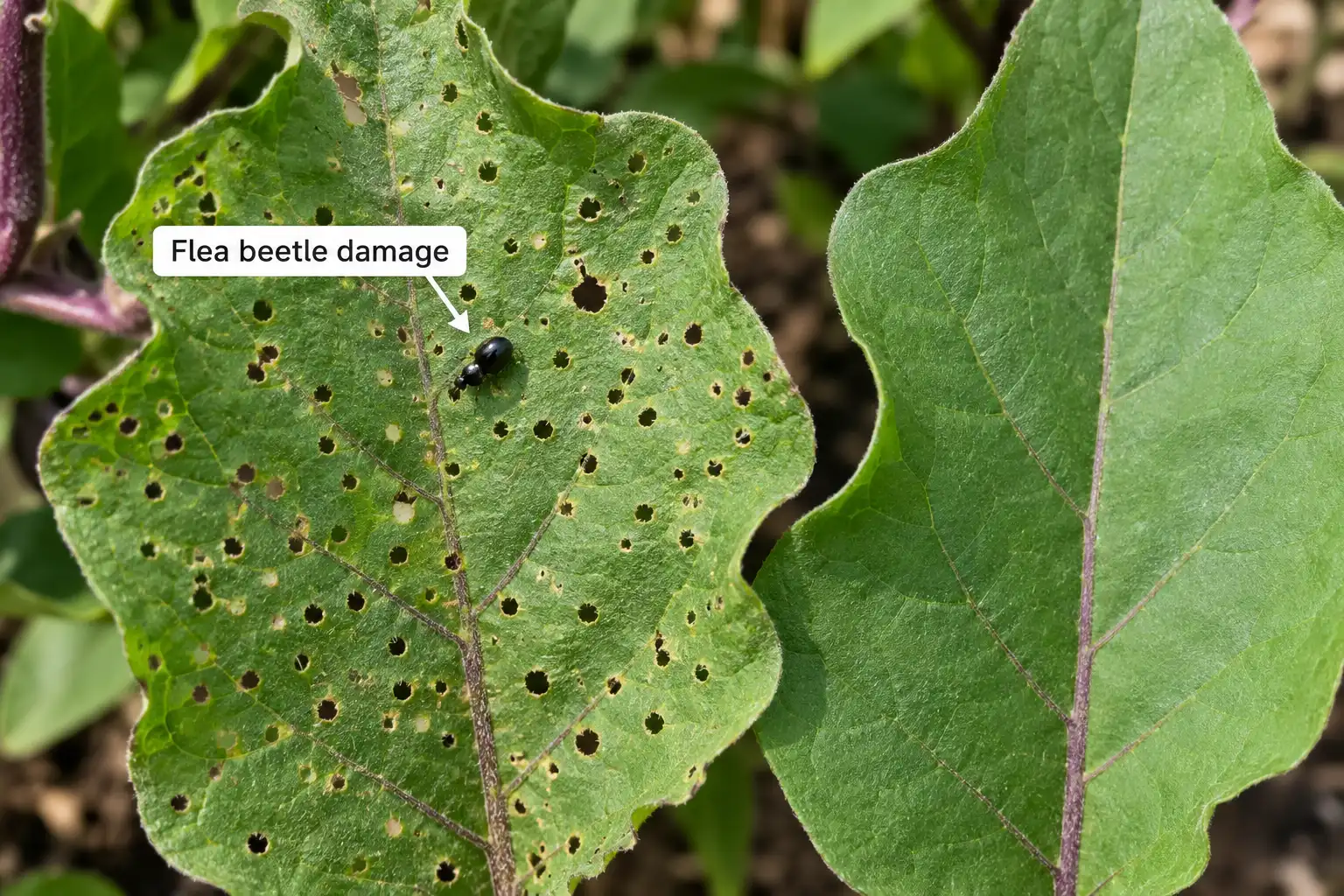
These tiny jumping beetles chew small, round shot holes in leaves, and young plants suffer most. Minnesota Extension sets treatment thresholds at 4 beetles per plant on plants 3 to 6 inches tall, and 8 per plant once they pass 6 inches. Row cover keeps beetles off, but it needs hoops, because the fabric cannot rest directly on eggplant. Then open the cover once plants flower, since UF/IFAS notes that bees help pollinate eggplant.
Colorado Potato Beetle
Adults and larvae gather in large numbers and strip leaves, per Minnesota Extension. So check leaf undersides often and hand-pick beetles, larvae, and egg clusters before numbers build.
Spider Mites
During hot, dry weather, mites feed on leaves and leave them bleached or bronzed, according to Minnesota Extension.
Verticillium Wilt
This soilborne disease yellows leaves, curls them inward, and turns them brown as it spreads. Nebraska Extension recommends long rotations away from susceptible crops and planting in well-drained soil.
Other Diseases
In South Carolina, Clemson also lists Phomopsis blight, Phytophthora blight, Southern blight, bacterial wilt, and root-knot nematodes. Several attack other vegetables too, so learning the signs of diseases that hit many crops speeds up diagnosis. For a firm answer and locally registered controls, send a sample to your county extension office.
Troubleshooting Eggplant Problems
Most eggplant failures trace back to temperature or water. So match the symptom to its likely cause before you treat anything.
| Symptom | Likely cause | What to do |
|---|---|---|
| Flowers drop and no fruit sets | Days above 90°F, nights below 60°F or above 70°F, or drought | Water deeply, mulch, and wait for temperatures to ease |
| Plants sit still for weeks after planting | Set out while nights were still cold | Wait for 50°F nights; use black plastic and row cover |
| Bitter fruit | Uneven moisture, hot and dry weather, or overmature fruit | Water on a schedule and pick sooner |
| Lush leaves, little fruit | Too much nitrogen | Skip the next sidedress |
| White patches on fruit | Sunscald from thin leaf cover | Keep foliage intact; never strip leaves |
| Dark, sunken spot at the blossom end | Blossom end rot from poor moisture | Keep soil evenly moist |
| Leaves yellow, curl inward, then brown | Verticillium wilt | Rotate 3 to 4 years, or switch to containers |
The flowering temperatures, nitrogen effect, sunscald, and blossom end rot links all come from Minnesota Extension. Meanwhile, UF/IFAS ties bitterness to hot, dry weather, and Nebraska Extension describes overmature fruit as spongy and seedy.
When and How to Harvest Eggplant
Harvest eggplant 65 to 80 days after transplanting, or 100 to 120 days from seed, per Clemson. Texas A&M AgriLife gives a similar 90 to 120 days from seed. Once fruit starts coming, pick at least once a week.
Ripe fruit shows three signs:
- Glossy skin. UF/IFAS notes that ripe fruit shines, while overripe fruit turns dull and may yellow.
- Full size for the variety. Italian types run 6 to 9 inches long, per Clemson, while Japanese types are ready at finger or hot dog size.
- Slight give. Clemson’s test is to press the side lightly with a thumbnail. If a dent stays, the fruit is ripe.
However, don’t wait for maximum size. Nebraska Extension notes you can pick any time from one-third grown to full size, and overmature fruit turns spongy with hard, dark seeds.
Cut fruit with pruners or a sharp knife. The stems are tough and often spiny, so wear gloves. Never pull fruit off, because Minnesota Extension warns it damages both fruit and plant. Regular picking also keeps the plant setting new fruit.
Storing Eggplant
Eggplant keeps about a week in the refrigerator. Clemson puts ideal storage at 45°F to 50°F with 90% relative humidity. Colder storage pits the skin over time, per Minnesota Extension. Also, never home-can plain eggplant. Minnesota Extension notes it has caused botulism poisoning.

FAQs About Growing Eggplant
How long does eggplant take to grow from seed?
Expect 100 to 120 days from seed to first harvest, per Clemson Extension. From transplanting, harvest starts in 65 to 80 days, which is why short-season gardeners often buy plants instead.
Do eggplants need full sun?
Yes, eggplant needs full sun for a full crop. University of Nebraska-Lincoln Extension notes that plants in partial shade produce lower yields and take longer to ripen fruit, so give them the sunniest spot available.
Why are my eggplant flowers falling off?
Heat, cold nights, or dry soil usually cause it. University of Minnesota Extension links poor flowering to temperatures above 90°F, nights below 60°F or above 70°F, and drought, so deep, even watering helps most.
How many eggplant plants should I grow?
Two or three plants per person is usually enough, per University of Nebraska-Lincoln Extension. Plant more only if your household eats eggplant several times a week or plans to freeze slices.
Can eggplant survive a light frost?
No, eggplant is very frost sensitive. University of Nebraska-Lincoln Extension notes that even cold spells above freezing can injure it, and it handles chill worse than both tomatoes and peppers.
Should I remove flowers from eggplant transplants?
Yes, pinch off flowers that open before transplanting. University of Minnesota Extension advises removing them until plants are in the garden, and Clemson notes blossoms on transplants slow growth and can lower yields.
Can I plant eggplant in the same spot every year?
No, rotate it. University of Minnesota Extension advises waiting three to four years before planting eggplant, tomatoes, peppers, potatoes, or tomatillos in the same spot, because Verticillium wilt and other soilborne diseases build up.
Key Points to Carry Into the Field
Eggplant rewards patience at the start. Wait for 50°F nights, warm the soil, and keep moisture even from first flower on. Then feed nitrogen in two measured sidedresses rather than one heavy dose.
Pick fruit while it still shines, because fruit left too long turns seedy and bitter. If wilt or flea beetles return every year, your county extension office can confirm the cause and suggest controls registered in your state.


