How to Grow Grapes: Zone Picks, Planting, Pruning and First Harvest
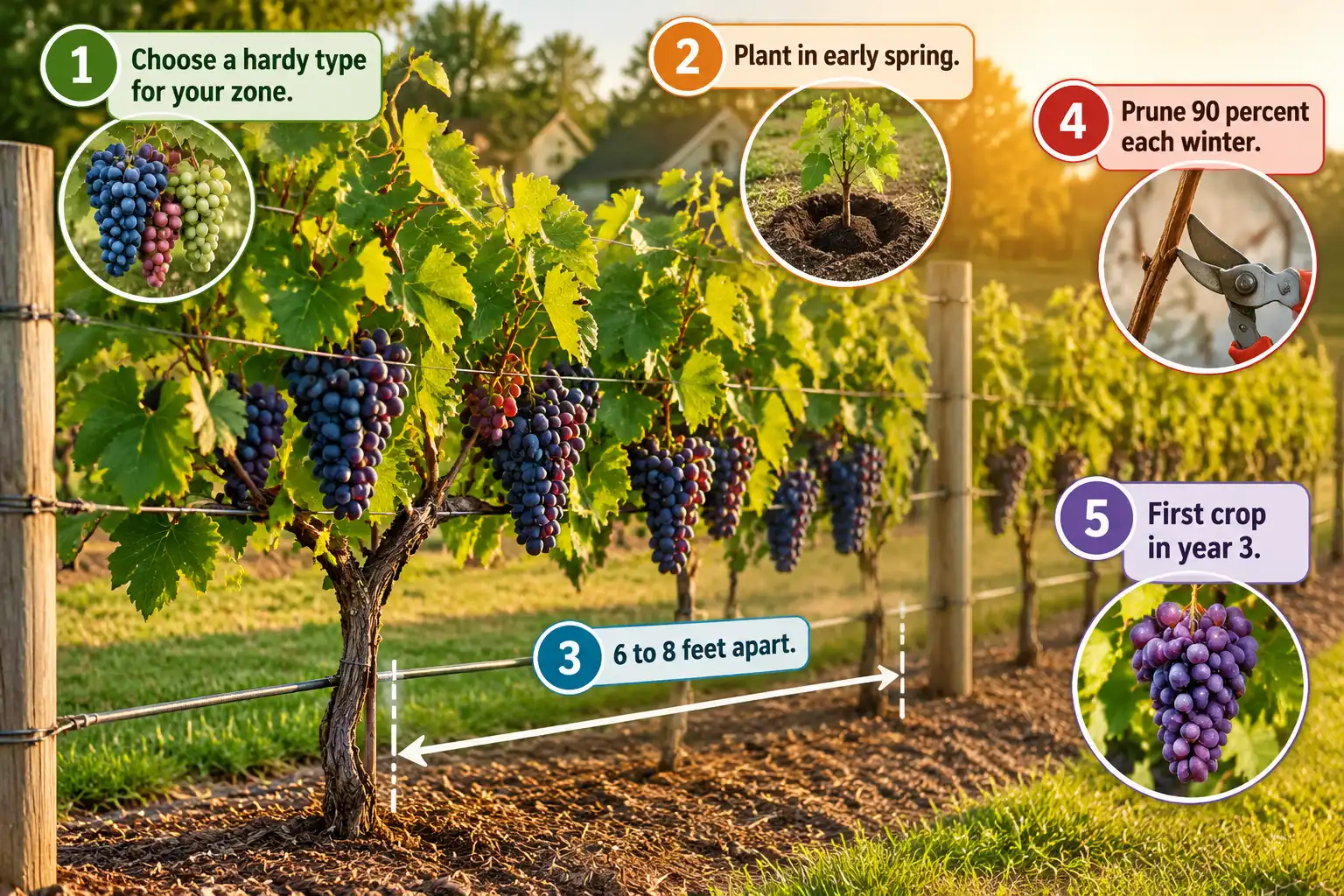
Learning how to grow grapes starts with your winter low. The wrong grape type can freeze out or never ripen. After that, success comes down to a sturdy trellis, hard winter pruning, and three seasons of patience.
To grow grapes, plant a vine rated for your USDA zone in full sun and well-drained soil in early spring. Train it on a trellis, remove about 90 percent of new growth each winter, and expect fruit in year three.
Choose a Grape Type for Your USDA Hardiness Zone
Your coldest winter night decides which grapes survive. So pick the grape type before the cultivar.
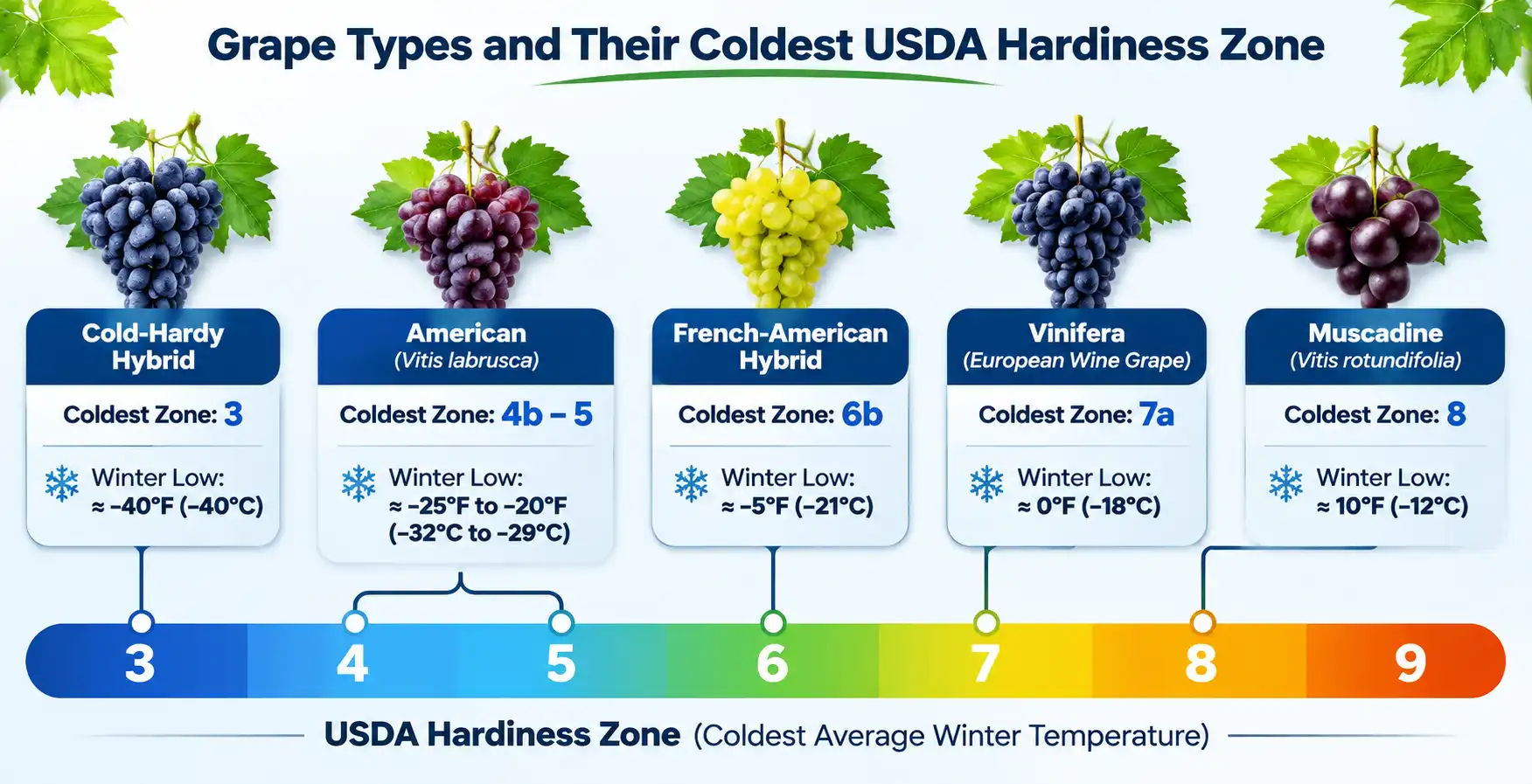
Penn State Extension sets the minimum winter temperature at 0°F for European (vinifera) grapes and -5°F for French-American hybrids. By contrast, University of Minnesota Extension reports that its cold-hardy hybrids have carried a full crop after -30°F or colder.
| Grape type | Example cultivars | Published winter low | Coldest USDA zone | Main use |
|---|---|---|---|---|
| Cold-hardy hybrid | Marquette, Frontenac, La Crescent, Edelweiss | Full crop after -30°F (UMN) | 3 to 4 | Wine, juice, some fresh eating |
| American and American-type | Concord, Niagara, Reliance, Canadice | -20°F to -25°F for Reliance and Canadice (Oregon State) | 4b to 5 | Juice, jelly, fresh eating |
| French-American hybrid | Vidal, Chambourcin | -5°F (Penn State) | 6b | Wine |
| European (vinifera) | Chardonnay, Cabernet Franc | 0°F (Penn State) | 7a | Wine, table grapes |
| Muscadine | Carlos, Noble, Triumph, Nesbitt | Seldom below 10°F; injured below 0°F (NC State) | 8, or 7 for hardier cultivars | Fresh eating, wine, juice |
The zone column translates each published low onto the USDA hardiness zone map, so treat it as a starting point. Next, check season length. Penn State notes that cold-tender cultivars need 160 or more frost-free days to ripen. Seedless grapes also struggle in the North, where UMN rates Somerset Seedless as the hardiest option.
In the warm South, disease matters more than cold. NC State reports that Pierce’s disease limits successful grape growing in the warmer Southern states to muscadines.
Pick a Site and Prepare the Soil
Grapes need full sun, moving air, and soil that drains. Sun ripens the fruit, while moving air dries leaves before fungi can infect them.
University of Minnesota Extension calls for full sun to supply the heat that ripens grapes. Penn State Extension prefers a slight slope facing east to south, with rows running north to south. That slope lets cold air drain away on frosty nights. Oregon State University Extension also warns against frost pockets, because new shoots freeze easily in April and May. So skip the low corner of the yard where cold air settles.
Drainage matters more than fertility. For heavy clay or ground with a hardpan, Oregon State suggests raised beds. Penn State keeps soil pH between 5.5 and 7.0. Muscadines want the upper half of that range, and NC State Extension limes to pH 6.5 before planting.
Test the soil a year ahead, as Penn State advises, so lime has time to react. The lime rate comes from your soil test report, not a guess. Then clear grass and perennial weeds from the planting strip. NC State keeps a 1 to 2 foot circle weed-free around each young vine for the first two years. After planting, UMN works compost around young vines each early spring for two or three years, a slow route to natural soil fertility.
How to Plant Grapes
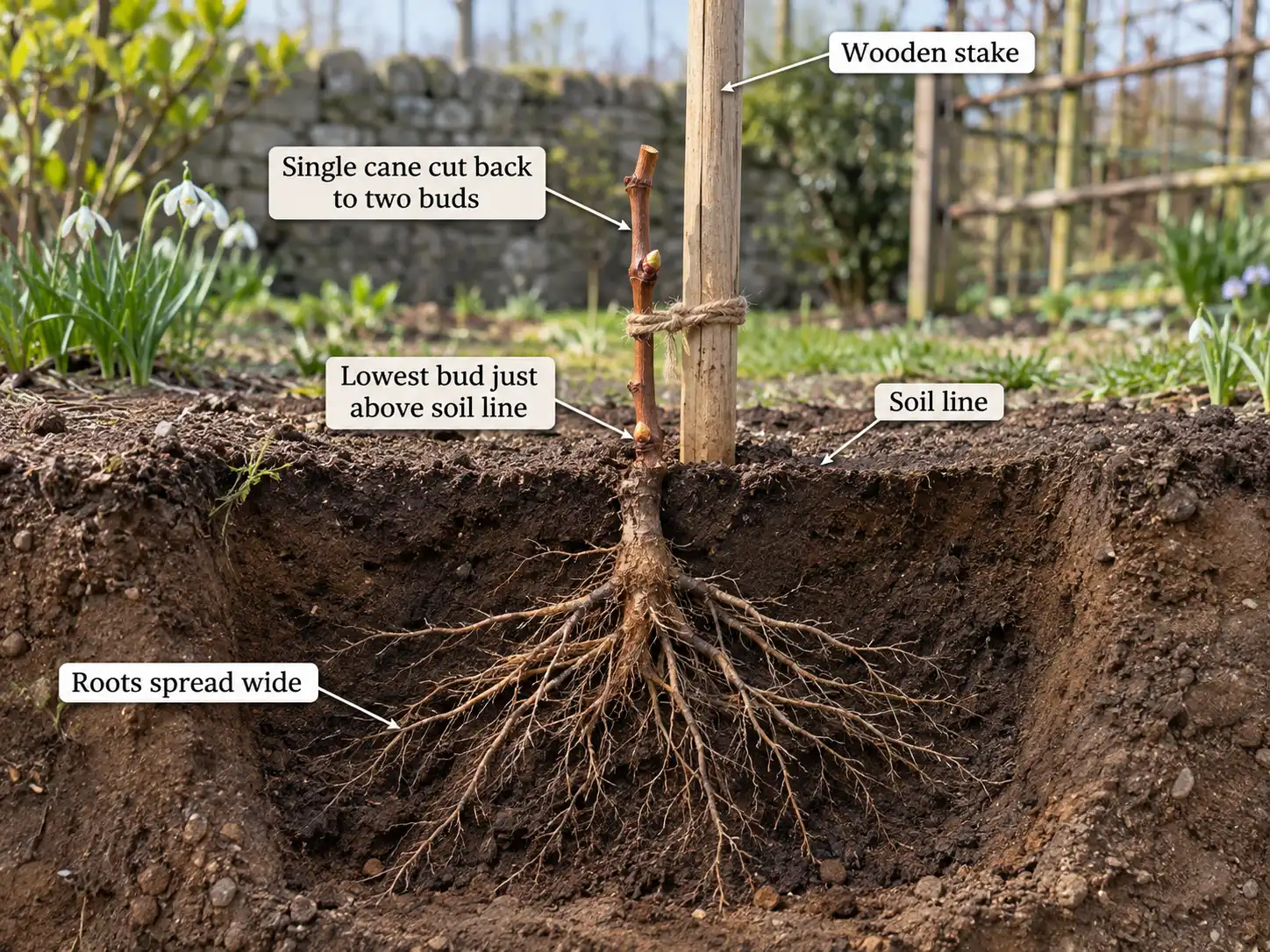
Plant dormant, bare-root vines in early spring, as soon as the soil can be worked. University of Minnesota Extension puts that window at April to May in Minnesota. Potted vines go in later, from May to June, once frost risk has passed.
- Order dormant, bare-root vines for spring delivery. Penn State Extension notes that only European grapes need grafting onto phylloxera-resistant rootstock.
- Soak the roots for 3 to 4 hours, per UMN, and trim broken or overlong roots.
- Dig a hole wide enough to spread the roots without bending them.
- Set the vine at the depth it grew in the nursery, as Oregon State University Extension advises. UMN places the lowest bud on the cane just above the soil surface.
- Firm the soil and water well to remove air pockets.
- Cut the top back to one strong cane with two buds.
- Set a stake beside the vine for the new trunk.
The hard first cut feels wrong, but it lets the roots catch up with the top. Once shoots grow, train the strongest one up the stake. Oregon State removes the other shoots before they reach 12 inches.
Muscadines follow the same steps with two changes. NC State Extension plants them after the last sub-freezing night, at the same depth or slightly deeper. It also builds the trellis before planting.
How Far Apart to Plant Grape Vines
Space bunch grapes 6 to 8 feet apart in the row, and muscadines 10 to 20 feet apart. Vine vigor sets the gap.
Oregon State University Extension uses 6 feet for European types and 6 to 8 feet for American types and hybrids. It leaves 9 to 10 feet between rows for a single-canopy trellis. Muscadines grow far larger. NC State Extension wants at least 10 feet between vines, ideally 20, with rows at least 8 feet apart.
To size a planting, divide 43,560 square feet (one acre) by the area each vine takes:
- 6 by 9 feet: 54 square feet per vine, about 807 vines per acre
- 8 by 10 feet: 80 square feet per vine, about 545 vines per acre
- 20 by 12 feet (muscadines): 240 square feet per vine, about 182 vines per acre
The same math works at backyard scale. A 24-foot fence holds four bunch grapes at 6 feet apart, or two muscadines at the 10-foot minimum.
Build a Trellis and Train Young Vines
Put the trellis up in the first or second season, before the trunk needs it. A trunk left to sprawl rarely straightens.
Penn State Extension describes trellises about 6 feet tall. The right layout depends on how the cultivar grows:
- Downward-growing types. American and many hybrid grapes grow drooping canes. Penn State trains them on a single high wire, such as a single curtain or Hudson River umbrella, so shoots hang down.
- Upright types. European and many French-American hybrids grow straight up. For these, Penn State uses vertical shoot positioning, with the fruiting wire 30 to 36 inches high.
- Muscadines. NC State Extension runs one wire 5 to 6 feet high. A double wire on 4-foot cross arms yields about 30 percent more.
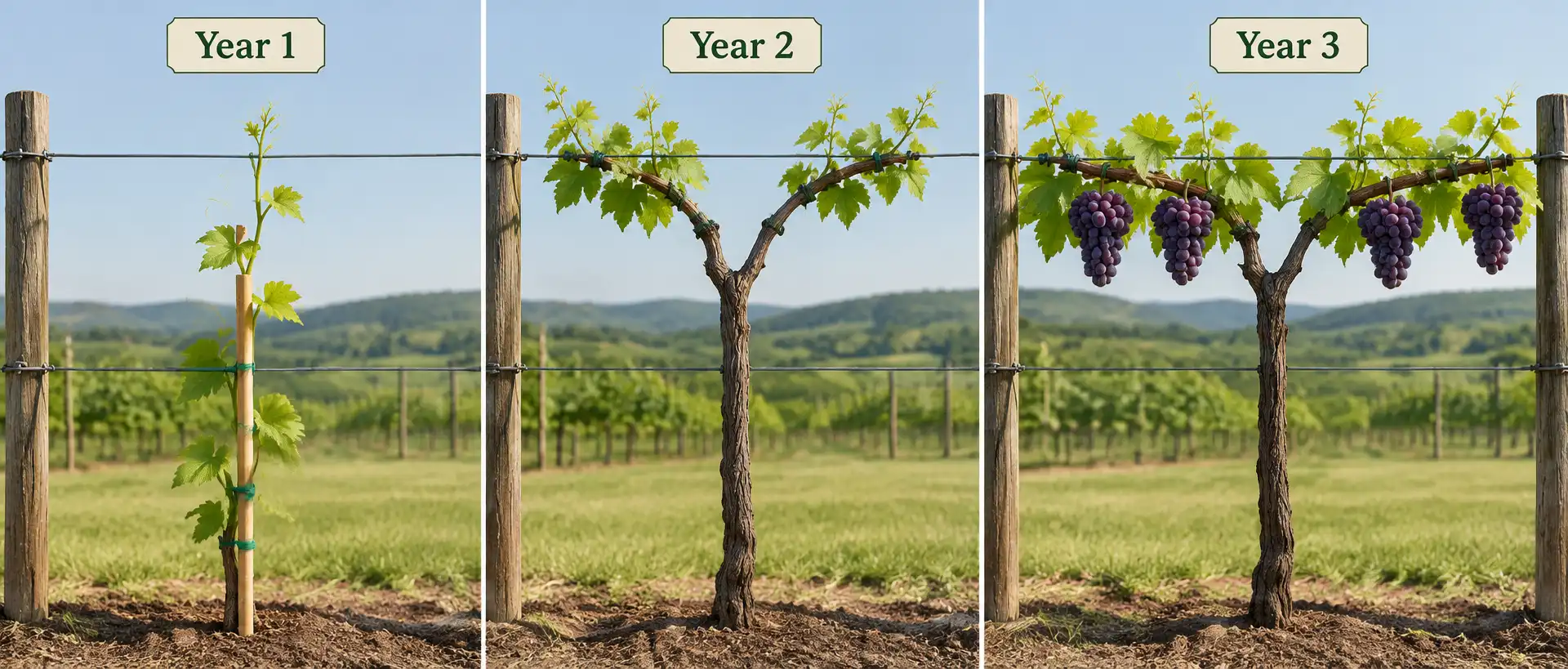
Oregon State University Extension trains young bunch grapes on this schedule:
- Year 1: Grow one straight shoot up the stake. In the first dormant season, cut the trunk 3 to 4 inches above the wire and tie it.
- Year 2: Keep two shoots near the wire, one on each side. Remove every flower cluster. In winter, cut each cane to 7 to 10 buds.
- Year 3: Fruit appears on those canes. Keep about 30 buds per vine, plus a one- or two-bud renewal spur.
Penn State also strips flower clusters in year one. Every cluster a young vine carries draws on roots and trunk it still needs to build.
How to Prune Grapevines
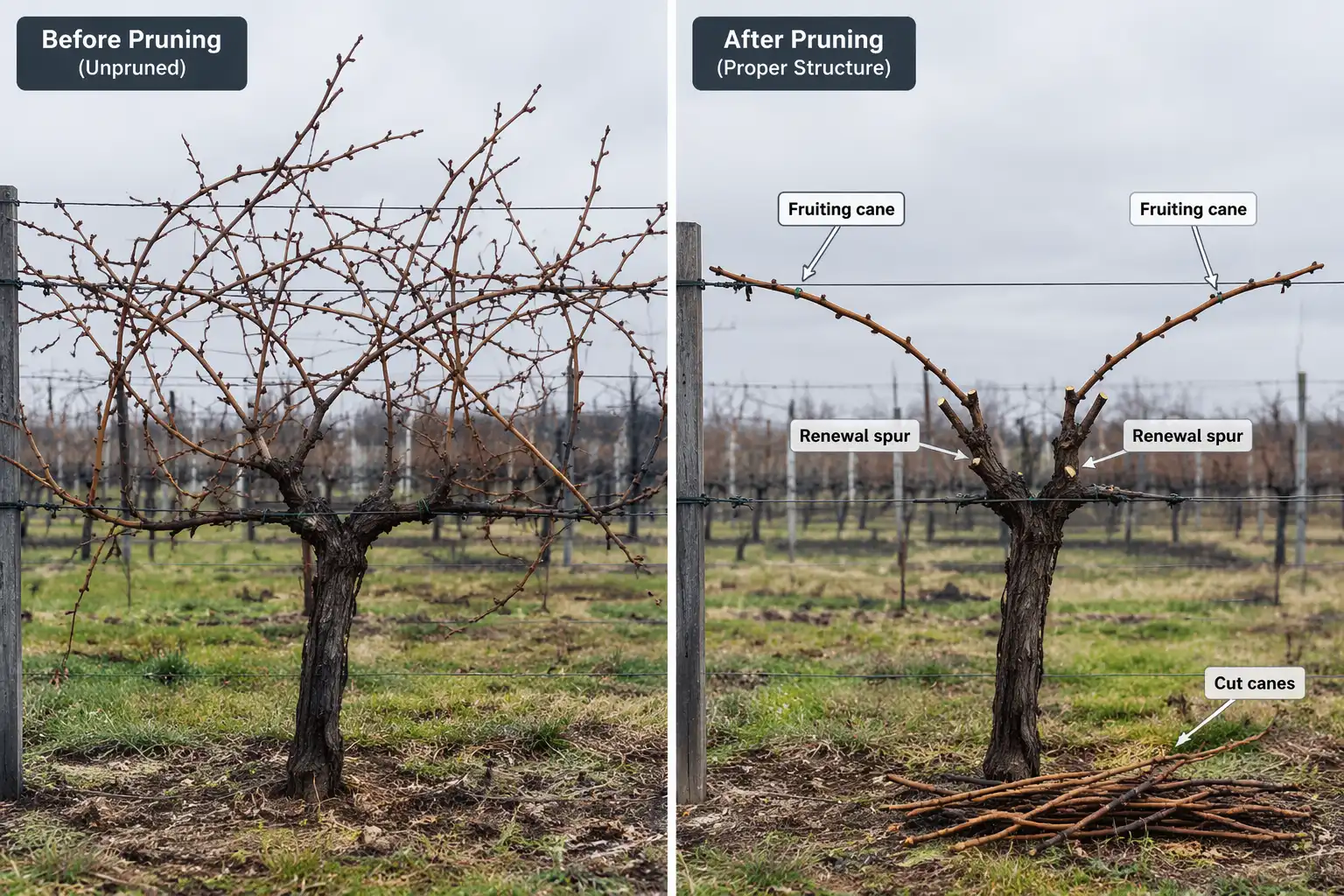
Prune grapes while dormant, from December through March, and remove about 90 percent of last season’s growth. Penn State Extension gives both figures. Grapes fruit only on shoots that grow from one-year-old canes, so older wood and surplus canes just crowd the vine.
That much cutting surprises most first-time growers. Still, the bud count is what matters. University of Minnesota Extension leaves 40 to 60 buds on table, juice, and jelly grapes, but only 20 to 30 on wine grapes. Penn State works by length instead, at 3 to 4 buds per foot of cordon.
Choose the method by grape type. Oregon State University Extension notes that wine grapes and muscadines usually need spur pruning, while American grapes such as Concord need cane pruning.
- Cane pruning. Keep a few long one-year canes tied to the wire. Next to each, leave a renewal spur of one or two buds to grow next year’s cane.
- Spur pruning. Keep permanent arms (cordons) on the wire. Then cut each one-year shoot back to a short spur. NC State Extension cuts muscadine spurs to 2 to 3 buds every dormant season.
Leaving too many buds backfires. The vine sets more clusters than its leaves can ripen, so sugar lags and next year’s canes come in thin. Penn State also keeps the canopy to one or two leaf layers. That way, light reaches the fruit and leaves dry fast after rain.
How Much to Water Grape Vines
Young vines need about 1/2 to 1 inch of water per week for their first two growing seasons, per University of Minnesota Extension. After that, established vines rarely need watering except on sandy or very well-drained soil.
To turn inches into gallons, UMN uses 5 gallons spread over a 3 by 3 foot area for 1 inch. So a young vine needs roughly 2.5 to 5 gallons a week when rain falls short. Water the root zone, keep the leaves dry, and cut back in fall so the vine can harden for winter.
Muscadines are tougher. NC State Extension calls them quite drought tolerant and waters only during dry spells in the first two years.
Mulch depends on climate. UMN advises against mulching grapes because mulch keeps northern soil too cool. In contrast, NC State uses bark mulch around muscadines to hold moisture and smother weeds. Both fit their region: cool soil slows growth in Minnesota, while summer drought stresses vines in the Southeast.
On a larger block, size drip runs by working out crop water needs for your site rather than using a flat weekly figure.
How Much Fertilizer Grapevines Need
Grapevines need small doses of nitrogen. Oregon State University Extension warns that overfeeding causes more problems than underfeeding.
| Vine age | Oregon State (bunch grapes) | Penn State (bunch grapes) | NC State (muscadines) |
|---|---|---|---|
| Planting year | 0.5 to 1 oz actual N | 2 oz of 33-0-0, 2 to 3 weeks after planting | 1/4 lb of 10-10-10, every 6 weeks until early July |
| Year 2 | 1 to 1.5 oz actual N, if needed | 4 to 8 oz of 33-0-0 or 1 to 2 lb of 10-10-10, before bud swell | 1/2 lb of 10-10-10 in March, May, and July |
| Mature vines | About 1 oz actual N on low-fertility soil | Same; skip N on overly vigorous vines | 1 to 2 lb of 10-10-10 in March, plus 1 lb in mid-June |
To convert actual N into product, divide by the first number on the bag. One ounce of N equals about 3 ounces of 33-0-0 or 10 ounces of 10-10-10. So Penn State’s planting dose supplies about 0.66 ounce of N, inside Oregon State’s range. For mature vines, though, Penn State’s range supplies 1.3 to 2.6 ounces of N, well above Oregon State’s figure.
NC State cuts the next year’s rate by 20 percent when new growth averages over 3 to 4 feet. At farm scale, 1 ounce of N per vine on 807 vines is about 50 pounds of N per acre.
Oregon State spreads fertilizer at bud break, 6 to 18 inches from the trunk.
Common Grape Diseases and Pests
Most grape diseases are fungal, and wet weather drives them. Where black rot has been a problem, Penn State Extension strongly suggests resistant cultivars. Symptoms below come from University of Minnesota Extension, controls from Penn State, unless noted.
| Problem | What you see | Favored by | First line of control |
|---|---|---|---|
| Black rot | Leaf spots; berries shrivel into black mummies | Hot, humid weather | Remove mummies and infected prunings before growth starts |
| Downy mildew | Yellow-green greasy spots on top of leaves, white cottony growth beneath | Warm, wet seasons | Improve drainage, rake fallen leaves; worst on vinifera |
| Powdery mildew | White to grayish-white patches on upper leaves | Most grape regions | Sulfur or copper sprays, open canopy |
| Botrytis bunch rot | Gray mold on ripening clusters | Damp, humid weather | Pull leaves around the fruit zone |
| Pierce’s disease | Scorched leaf margins; bunch grapes decline (NC State) | Warm Southern climates (NC State) | Plant muscadines (NC State) |
| Japanese beetle | Chewed leaves, worst on smooth, thin leaves | Summer | Vacuum adults off the vines |
| Birds | Pecked or missing berries | Ripening | Netting; scare devices do little (Oregon State) |
NC State reports that Pierce’s disease has hit up to 50 percent of vinifera vines within several years of planting in North Carolina’s eastern piedmont. Muscadines are less seriously affected.
Black rot and the mildews respond to the same habits as other fungal crop diseases: clean debris, open canopies, and resistant cultivars. If you spray, the label sets the rate and the days-to-harvest interval.
How Long Do Grapes Take to Grow?
Grapes take about three years from planting to the first real crop, and five to six years to reach full production. Oregon State University Extension gives both figures. It also puts a mature, well-managed vine at about 15 to 35 pounds of fruit.
| Year | What the vine builds | Your job | Fruit |
|---|---|---|---|
| 1 | Roots and one straight shoot | Train to a stake; remove flower clusters (Penn State) | None (Oregon State) |
| 2 | Trunk reaches the wire | Keep two canes; strip clusters (Oregon State) | Removed |
| 3 | Fruit on one-year canes | About 30 buds; one cluster per shoot (Oregon State) | First crop |
| 4 | Arms fill the trellis | 20 to 60 buds, low end for young vines (Oregon State) | Rising crop |
| 5 to 6 | Mature canopy | Full bud count each winter | Full crop of 15 to 35 lb (Oregon State) |
Sources differ on how soon a vine can bear. University of Minnesota Extension says fruit is possible one year after planting. Oregon State, however, strips clusters through year two so the trunk develops first. Both hold up: early fruit is possible, but it costs the vine growth it needs.
Muscadines run on a similar clock. NC State Extension tells growers to expect a 3 to 4 year development period before vines bear heavily. Once established, though, a grapevine lasts. Oregon State gives well-kept vines a life of 50 to 100 years.
When and How to Harvest Grapes
Harvest grapes when they taste ripe, not when they change color. Color often arrives before sugar, so University of Minnesota Extension advises tasting a few berries first.
Oregon State University Extension checks three signs:
- The cluster stem turns from green to brown.
- Seeds darken in seeded types.
- Berries at the tip of the cluster taste sweet. They ripen last, so test those.
Picked grapes stop ripening, per Oregon State, so nothing improves on the counter. For wine, Penn State Extension picks at about 18 to 22 percent Brix, measured with a handheld refractometer. Table grapes are ready when they taste good.
Cut whole clusters with shears instead of pulling them. Then cool them fast. UMN keeps clusters in the refrigerator, loosely covered, for one to two weeks.
Timing depends on cultivar. In Minnesota, UMN lists Edelweiss ripening in late August to early September, and Frontenac and La Crescent in late September to early October.
Muscadines ripen differently. According to NC State Extension, the berries grow singly or in small groups, not tight clusters. Ripe fruit is fully colored and soft, and harvest runs from early August into September in North Carolina.
Growing Grapes in Pots
Grapes grow in pots as long as the container holds at least 15 to 20 gallons. Michigan State University Extension sets that minimum, with a pot 16 to 18 inches deep and 18 to 24 inches wide, plus drainage holes.
Set up the pot this way, following MSU:
- Container. Skip dark colors, which absorb and hold heat. MSU rates wood as the best material.
- Mix. Use a light potting mix, never garden soil.
- Support. Start with a 4-foot stake, then add a small trellis as the vine grows.
- Cultivar. MSU says almost any grape grows in a container. Pixie, a natural dwarf, stays 18 to 24 inches tall and wide and needs little pruning.
- Pruning. Prune in late winter to early spring, cutting back to two buds while the vine is dormant.
Water often. UMN notes potted vines need regular watering and daily checks until established.
Winter is the weak point. None of the extension sources reviewed here gives a cold rating for potted grape roots. Still, roots in a pot lack the buffer of surrounding soil. So choose a cultivar rated at least one zone colder than yours, or move the dormant pot into an unheated garage.
Growing Grapes From Seed
You can grow grapes from seed, but the vine will not match its parent. Oregon State University Extension tells growers to propagate from cuttings, because seedlings lack the parent’s characteristics. Oklahoma State University Extension adds that seed will not reliably reproduce a variety.
So seeds from a favorite Concord grow into a new, unknown grape, and seedless grapes offer no usable seed. For a known variety, root a hardwood cutting instead. Oregon State takes cuttings from healthy one-year-old canes in February, just before pruning.
How to Plant Grape Seeds
- Collect seeds from fully ripe, seeded grapes and rinse off all pulp.
- Mix the seeds with moist, not wet, vermiculite in a labeled, sealable bag. Oklahoma State prefers vermiculite because it is sterile and holds water.
- Stratify at 37°F for 90 to 140 days, per Oklahoma State. A refrigerator works for small batches.
- Check the bag every few weeks for drying or mold.
- Sow the chilled seeds in seed-starting mix, barely covered, in a warm, bright spot.
- Grow seedlings in pots for the first season. Then plant them out the next spring, like a nursery vine.
Published data on seedling timelines is thin, and none of these services gives a seed-to-fruit figure. A seedling must build the same trunk and arms as a nursery vine, so expect fruit after year three. Expect quality to vary from vine to vine, too.
FAQs About Grow Grapes
Do grapes need a trellis?
Yes, because grapevines cannot hold up their own weight. Penn State Extension describes trellises about 6 feet tall, and NC State Extension runs muscadine wire at 5 to 6 feet.
Can you grow grapes from store-bought grapes?
You can sprout seeds from seeded store grapes, but the vine will differ from the parent fruit. Seedless grapes carry no usable seed, and Oregon State Extension recommends cuttings for any variety you want to copy.
Why is my grapevine growing leaves but no grapes?
Check vine age, sunlight, and pruning first. Grapes fruit only on shoots from one-year-old canes, per Penn State Extension, so cutting off every young cane in winter removes the coming crop.
Do you need two grapevines to get fruit?
Usually not, because most cultivars sold today set fruit on their own. The exception is female-only muscadines such as Scuppernong, Fry, Higgins, and Jumbo, which need a self-fertile vine nearby, per NC State Extension.
How many grapes does one vine produce?
A mature, well-managed vine yields about 15 to 35 pounds of grapes, per Oregon State Extension. Expect far less in year three, when Oregon State limits young vines to about 30 buds and one cluster per shoot.
Can grapes grow in partial shade?
Grapes grow in partial shade but fruit poorly there. University of Minnesota Extension calls for full sun, and NC State Extension reports muscadine fruit set drops with several hours of daily shade.
Where to Start
Match the grape type to your coldest winter night first, then choose two or three cultivars proven near you. Test the soil this fall and lime if needed. Build the trellis before the vines arrive, and plant dormant vines in early spring. After that, plan on three seasons of training before the first crop, and count buds every winter. Your county extension office knows local cultivar trials and disease pressure, so call it before you order.