Where Do Grapes Grow? US Regions, Winter Lows, and Grape Types
On woody vines, in temperate climates on every continent except Antarctica. For a US grower, the useful question is which grape grows where. Winter lows, season length, and one bacterial disease settle that, region by region.
Grapes grow on woody vines in temperate climates, mostly between 30° and 50° latitude. California grows about 89% of the US crop, per USDA NASS. Cold-hardy hybrids still reach zone 3, and muscadines thrive across the humid Southeast.
Do Grapes Grow on Trees?
No. Grapes grow on vines, and University of Minnesota Extension classes them as woody perennial vines. The trunk thickens with age and can look like a small tree. Still, it cannot hold up its own canopy. So every planting needs a trellis, arbor, or fence.
All grapes belong to the genus Vitis. Three groups matter for US growers:
- European grapes (Vitis vinifera), such as Chardonnay and Cabernet Sauvignon
- American grapes (mostly Vitis labrusca), such as Concord and Niagara
- Muscadines (Vitis rotundifolia), native to the Southeast
Hybrids add a fourth option. Purdue Extension notes that breeders crossed vinifera with disease-resistant wild American species to create them. That range of types is why some grape fits nearly every part of the lower 48.
Where Grapes Grow Around the World
Most of the world’s vineyards sit between about 30° and 50° latitude, in both hemispheres. That band takes in the Mediterranean, California, central Chile, Mendoza in Argentina, South Africa’s Western Cape, and southern Australia. Summers there run long and warm enough to ripen fruit. Winters, in turn, stay mild enough for most vines to survive.
The lower 48 states run from about 25° N at the tip of Florida to 49° N at the Canadian border. As a result, nearly the whole country sits inside the grape band. Latitude rarely rules out a US site. Instead, the local winter low and disease pressure decide which grape fits.
Where Grapes Grow in the United States
California grows almost all of them. USDA NASS put 2025 US grape production at 5.23 million tons, and California harvested 4.67 million tons of that. Washington, New York, and Oregon round out the states NASS tracks.
| State | Bearing acres (2025) | Production, tons (2025) | Share of US tons |
|---|---|---|---|
| California | 751,000 | 4,670,000 | 89.3% |
| Washington | 67,000 | 258,300 | 4.9% |
| New York | 33,000 | 191,600 | 3.7% |
| Oregon | 32,000 | 107,800 | 2.1% |
| United States | 883,000 | 5,227,700 | 100% |
We calculated the shares from the NASS state totals. Note what the table leaves out, though. NASS estimates only these four states, and New York and Oregon joined the series in 2024. Grapes still grow commercially across the East, the Midwest, Texas, and the South. They simply fall outside the annual count.
The West also faces different limits than the East. Dry summers keep fungal disease pressure low, but many western vineyards depend on irrigation. That makes estimating crop water needs part of planning a western planting.
What Decides Where a Grape Will Grow
Three factors decide it: the coldest winter night, the frost-free season, and Pierce’s disease pressure. Soil matters less. NC State Extension notes that grapes are less fussy about soil than most small fruits. Drainage is the exception.
Winter Low Temperature
The coldest night of the year rules out more grapes than anything else. Purdue Extension says the expected minimum temperature often dictates variety choice. It sorts grapes into six hardiness classes by critical bud temperature. They run from 0°F for the most tender to -25°F for the hardiest.
Timing matters too. Per Purdue, a cold snap before vines acclimate, or a fast drop, causes far more injury. Overcropping, drought, and disease also lower hardiness. So treat any published rating as a best case.
Frost-Free Season and Heat
Grapes need enough warm days to ripen before fall frost. Purdue Extension sets the floor at 150 frost-free days for early-ripening varieties. Late ripeners need about 180 days or more.
Heat counts as well as days. Purdue reports about 3,800 growing degree days (base 50°F) in southern Indiana but only about 2,500 in the north. That gap, inside one state, is why it recommends late-ripening Chambourcin for southern Indiana only.
Pierce’s Disease Pressure
Pierce’s disease comes from a bacterium, Xylella fastidiosa, carried by xylem-feeding leafhoppers, per UF/IFAS Extension. Unlike the fungal crop diseases most growers know, it lives inside the vine’s water-conducting tissue. UF/IFAS credits it with wiping out Florida’s bunch grape plantings in the 1920s.
Cold winters keep it in check. NC State Extension maps risk by the number of winter days at or below 10°F. In North Carolina, the high-risk line runs through the central Piedmont, and risk climbs to the south and east. So in warm-winter country, the variety you plant is your main defense.
Grape Types and How Cold They Can Go
Match the grape type to your winter low before anything else. This table pairs each type with its approximate winter limit, and we translated those temperatures into USDA hardiness zones.
| Grape type | Example cultivars | Approximate winter limit | Best-fit USDA zones |
|---|---|---|---|
| Muscadine | Carlos, Noble, Magnolia | Injured below 0°F; best where lows seldom drop under 10°F | 7b and warmer |
| European (vinifera) | Chardonnay, Riesling, Cabernet Sauvignon | 0 to -10°F | 7 and warmer; 6 at the edge |
| French-American hybrid | Chambourcin, Vidal, Traminette, Seyval | -10 to -20°F | 5 to 7, by variety |
| American | Concord, Niagara | -15 to -20°F | 5 and warmer |
| Cold-climate hybrid | Marquette, Frontenac, La Crescent | -25°F or colder | 3 to 6 |
Limits come from Purdue Extension’s hardiness classes, except the muscadine row, which comes from NC State Extension.
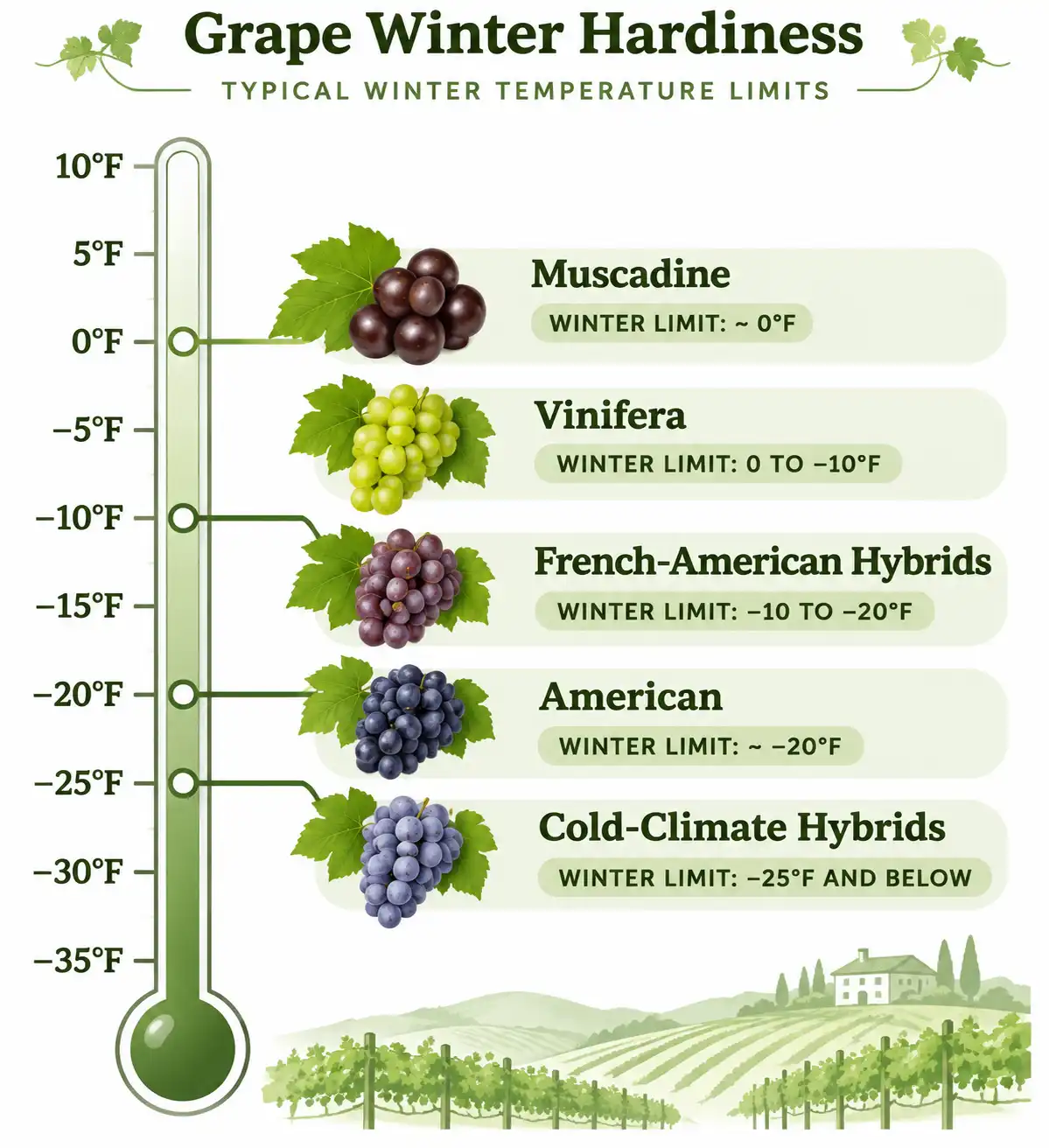
Sources disagree on vinifera, so read that row as a range. Purdue Extension rates vinifera varieties at -5 to -10°F. NC State Extension, citing Arkansas guidance, keeps vinifera where winters stay above 0°F. Treat 0°F as the safe line and -10°F as the edge.
The cold-climate hybrids, meanwhile, run past the table. Purdue reports Frontenac bore a full crop after -33°F. University of Minnesota Extension says Marquette, Frontenac, and La Crescent grow very well in zone 4 and do well in zone 3.
One caution applies to every row but the first. Where Pierce’s disease pressure is high, only muscadines and resistant bunch varieties hold up, whatever the zone says.
Which Grapes Grow Best in Each US Region
Each region has a default grape type, set by its winter low and its Pierce’s disease risk.
West Coast and Pacific Northwest
Vinifera leads here. Most of California stays well above vinifera’s winter limit, and dry summers hold fungal disease down. Together, California, Washington, and Oregon produced about 96% of the 2025 tonnage USDA NASS tracked. California’s crop also covers all three uses: wine, table, and raisin grapes.
Great Lakes and the Northeast
American grapes and hybrids lead here, with vinifera on the warmest sites. Large lakes help. NC State Extension explains that cold air crossing unfrozen water warms before it reaches the downwind shore. That buffer is why vineyards cluster along Lake Erie and New York’s Finger Lakes. New York produced 191,600 tons in 2025, per USDA NASS, third behind California and Washington.
Midwest and Upper Midwest
The Midwest splits by winter low. Purdue Extension reports Indiana minimums from 0 to -5°F in the southwest corner to -15 to -20°F in the north. So Concord suits northern Indiana, while Chambourcin stays in the southern half.
Farther north, cold-climate hybrids take over. University of Minnesota Extension says vinifera cannot survive Upper Midwest winters without help, such as burying the vines. Its own releases, including Marquette, Frontenac, and La Crescent, fill that gap in zones 3 and 4.
Southeast and Gulf Coast
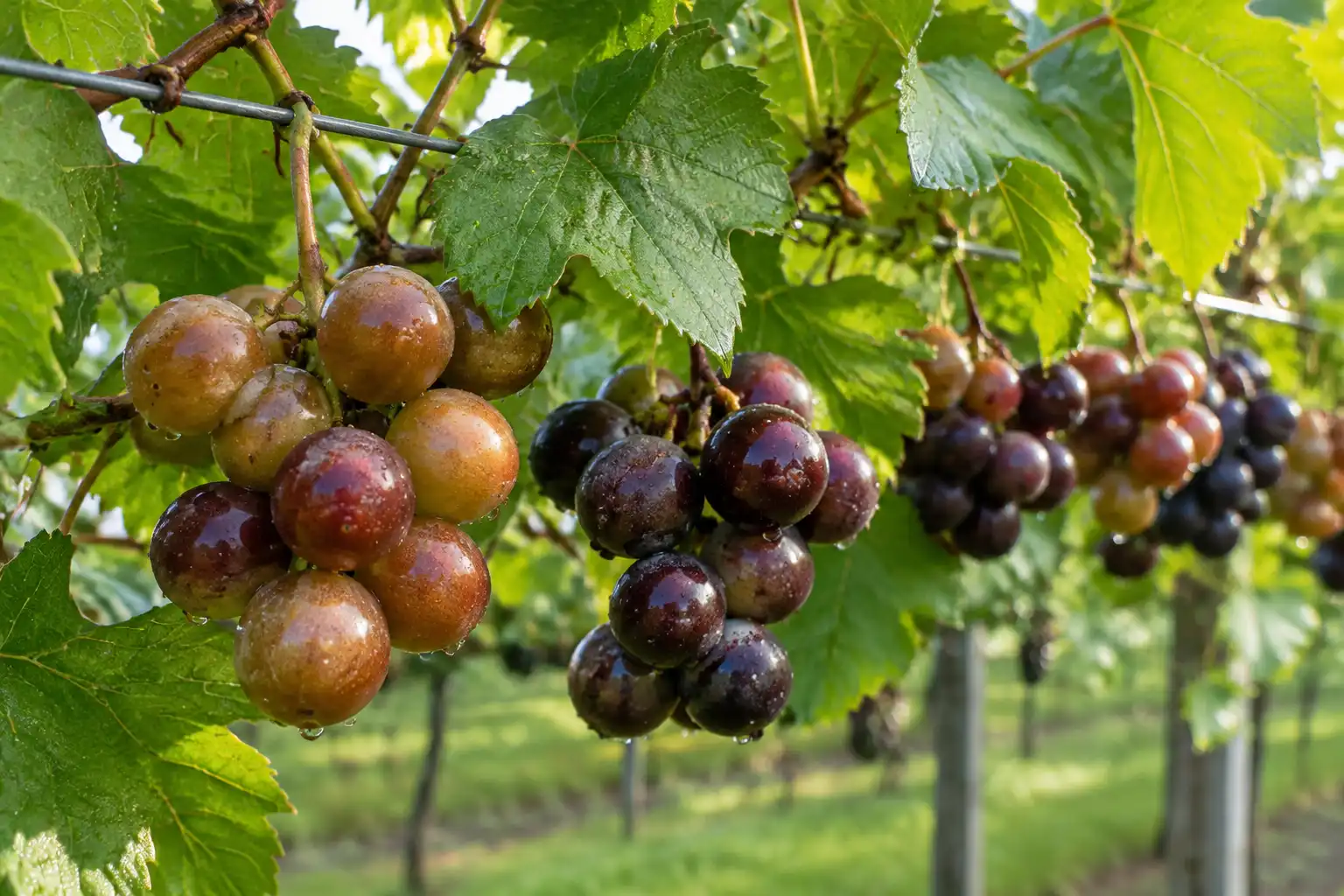
Muscadines rule the humid Southeast. UF/IFAS Extension traces their native range from Delaware to central Florida and west to east Texas. It also runs up the Mississippi River to Missouri. NC State Extension finds them best suited where winter lows seldom fall below 10°F. Hardier cultivars such as Carlos, Magnolia, and Sterling reach Virginia and the Blue Ridge foothills.
Bunch grapes work here, but the list is short. UF/IFAS recommends only seven Pierce’s disease-resistant bunch varieties for Florida. Blanc Du Bois rates best for wine, Conquistador for wine and fresh eating, and Lake Emerald for juice and jelly.
In the North Carolina mountains, the pattern flips. Winters there run too cold for muscadines and for Pierce’s disease. So NC State Extension recommends bunch grapes instead.
One option remains unproven. UF/IFAS harvested its first Pierce’s disease-resistant vinifera at Citra, Florida, in 2025. That is early trial data from one site, not yet a planting recommendation.
Texas and the Southern Plains
Texas splits by Pierce’s disease risk. Texas A&M AgriLife rates East Texas, South Texas, and the Gulf Coast as high risk. The Hill Country and North Central Texas sit in a transition zone, while the High Plains carry low risk. Where pressure is high, AgriLife advises against susceptible varieties. Instead, it points to Blanc du Bois for white wine and Black Spanish, also sold as Lenoir, for red.
How to Check Whether Grapes Will Grow at Your Site
Run four checks before you buy vines. Grapes hold the same ground for years, so treat this like any long-term decision about which crops fit your farm.
- Find your coldest typical winter night. Look up your USDA hardiness zone, then pick a grape type from the table above that clears it.
- Count your frost-free days. Under 150, plant only early-ripening varieties, per Purdue Extension, or the fruit may not ripen before frost.
- Check Pierce’s disease risk. Winters that rarely reach 10°F mean high risk on NC State Extension’s maps. There, plant muscadines or resistant varieties.
- Walk the site. Choose full sun, which University of Minnesota Extension says supplies the heat to ripen fruit. Skip low spots, where cold air settles and rain collects.
Drainage deserves a second look. NC State Extension warns that muscadines can fail where water stands even briefly after heavy rain. Test the soil before planting, too. NC State limes muscadine ground to pH 6.5 at the soil-test rate, and your soil test report gives that lime rate.
How Much Room Grapes Need
Spacing depends on the grape type. University of Minnesota Extension gives each bunch grape vine about 6 feet. NC State Extension spaces muscadines at least 10 feet apart, and ideally 20.
Here is how that works out, from a backyard fence to a full acre:
| Space available | Bunch grapes (6 ft per vine) | Muscadines (20 ft per vine) |
|---|---|---|
| 24-foot fence | 4 vines | 1 vine (2 at the 10-foot minimum) |
| 100-foot row | About 16 vines | 5 vines |
| 1 acre, rows 10 feet apart | About 726 vines | About 218 vines |
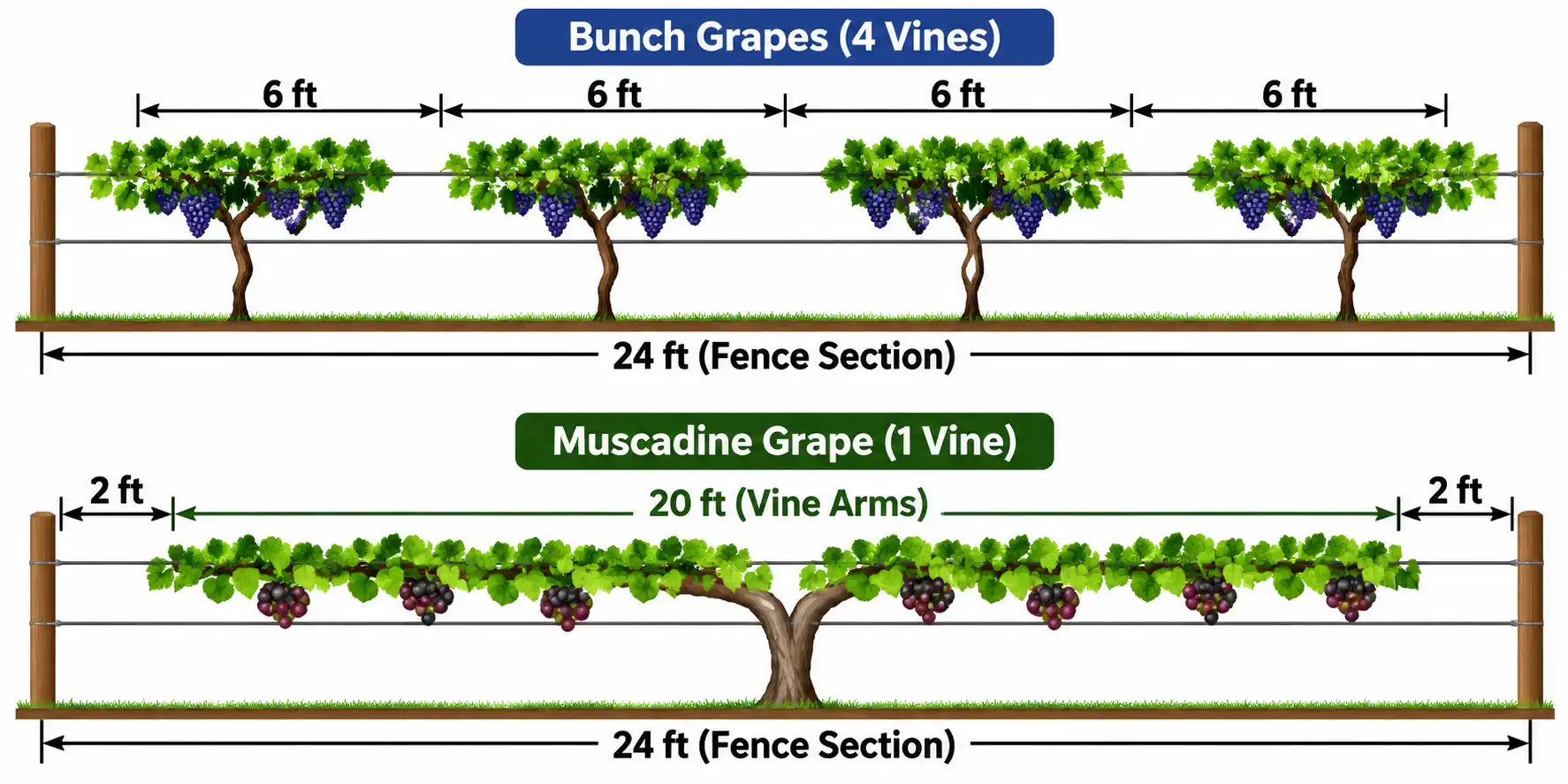
We ran the acre figures as 43,560 square feet divided by in-row spacing times row width. Change the row width to match your equipment, and the same math applies.
Pollination changes the muscadine count. NC State Extension notes that female cultivars such as Fry and Scuppernong need a self-fertile vine nearby. So a one-vine fence needs a self-fertile cultivar, such as Carlos or Noble.
Signs a Grape Is Planted in the Wrong Place
Most grape failures trace back to a type that does not fit the site. These symptoms point to the cause.
| Symptom | Likely cause | What to do |
|---|---|---|
| Buds fail to push in spring; canes die back | Winter low below the variety’s limit | Retrain from shoots low on the trunk, then plant a hardier type |
| Fruit still sour or green at first fall frost | Season too short for the variety | Switch to an early ripener; Purdue sets 150 frost-free days as the floor |
| Leaf edges scorch in summer, then blades drop and leave bare stems | Pierce’s disease | Remove infected vines; replant with muscadine or a resistant variety |
| Fruit and leaves rot every humid summer | Bunch grape in a humid climate | Move to muscadines or disease-resistant hybrids |
| Healthy muscadine, few or no grapes | Female cultivar with no pollinator | Plant a self-fertile cultivar nearby |
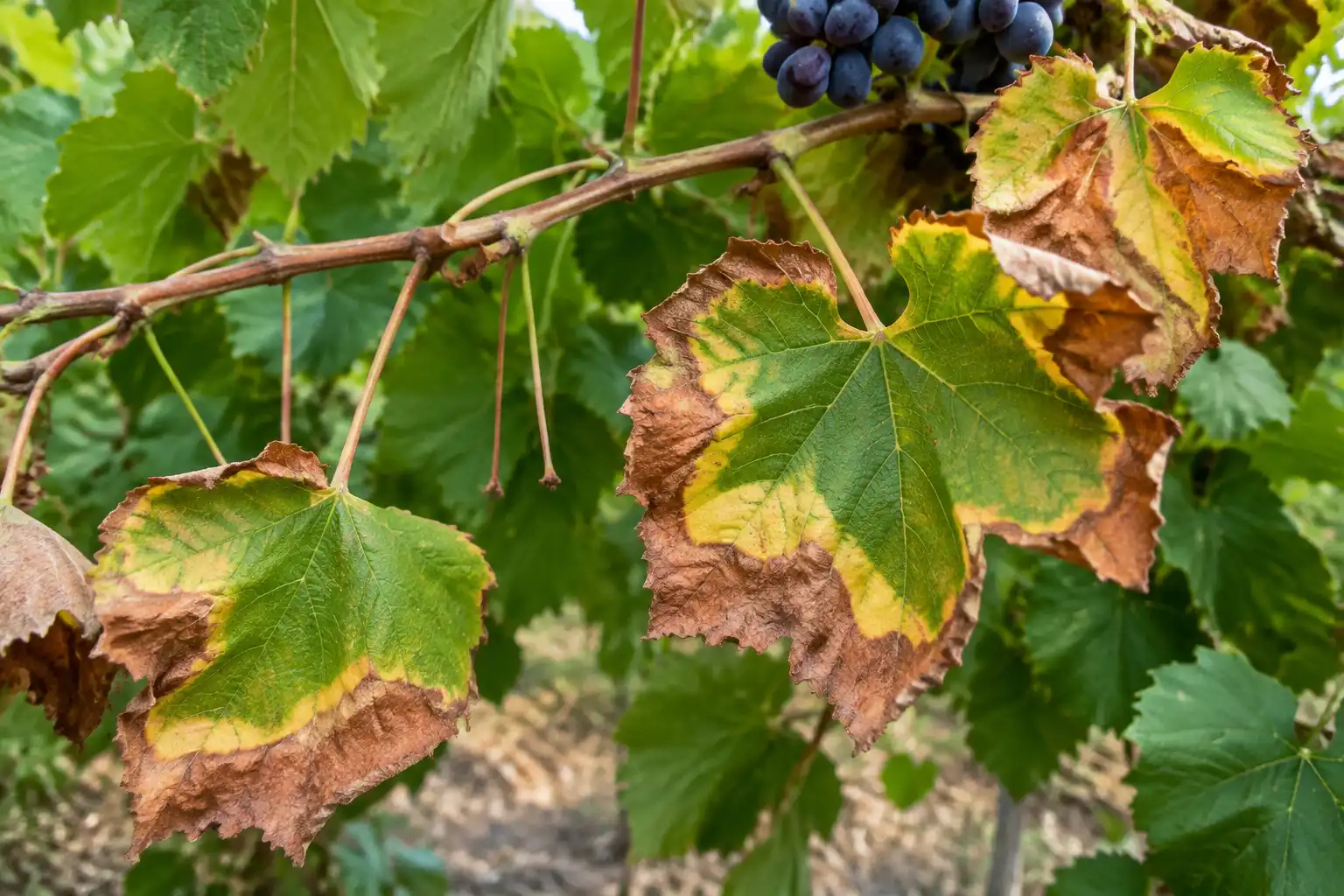
Texas A&M AgriLife lists irregular leaf scorch and leaf stems left on the cane, called matchsticks, as Pierce’s disease signs. UF/IFAS Extension names fungal disease in hot, humid summers as the main reason bunch grapes struggle in Florida. For cold injury, University of Minnesota Extension notes that damaged vines often regrow from canes low on the trunk.
FAQs About Grapes Grow
Can grapes grow in zone 3?
Yes, if you plant cold-climate hybrids. University of Minnesota Extension says Marquette, Frontenac, and La Crescent do well in zone 3, where vinifera will not survive without burying the vines.
Can you grow grapes in Florida?
Yes, if you choose muscadines or Pierce’s disease-resistant bunch grapes. UF/IFAS Extension says muscadines perform well statewide and rates Blanc Du Bois and Conquistador as the top resistant bunch varieties.
Do grapes grow wild in the United States?
Yes, muscadines grow wild from Delaware to central Florida and west to east Texas, per UF/IFAS Extension. Texas A&M AgriLife adds that native Texas species such as Vitis berlandieri tolerate Pierce’s disease.
How long does a grapevine take to produce fruit?
A light crop can come early, but a full crop takes about three seasons. University of Minnesota Extension says fruit is possible one year after planting, while NC State Extension’s muscadine plan fills the trellis over two seasons first.
Will grapes grow in partial shade?
Not well, because grapes need sun and heat to ripen. NC State Extension reports that fruit set and production drop when vines sit in shade for more than several hours a day.
Can vinifera grapes grow in the Midwest?
Only on the warmest, best-drained Midwest sites. Purdue Extension says vinifera generally lacks the cold hardiness Indiana requires, which is why French hybrids carry most of the state’s wine production.
What to Check Before You Plant
Start with your coldest winter night, because it rules out the most grape types. Then confirm at least 150 frost-free days for early varieties. If your winters rarely reach 10°F, plant muscadines or a Pierce’s disease-resistant variety. After that, give the vines your sunniest, best-drained ground and space them for their type. Your county extension office can confirm local disease pressure and the cultivars that do best nearby.