What Does a Wheat Plant Look Like? From Seedling to Harvest
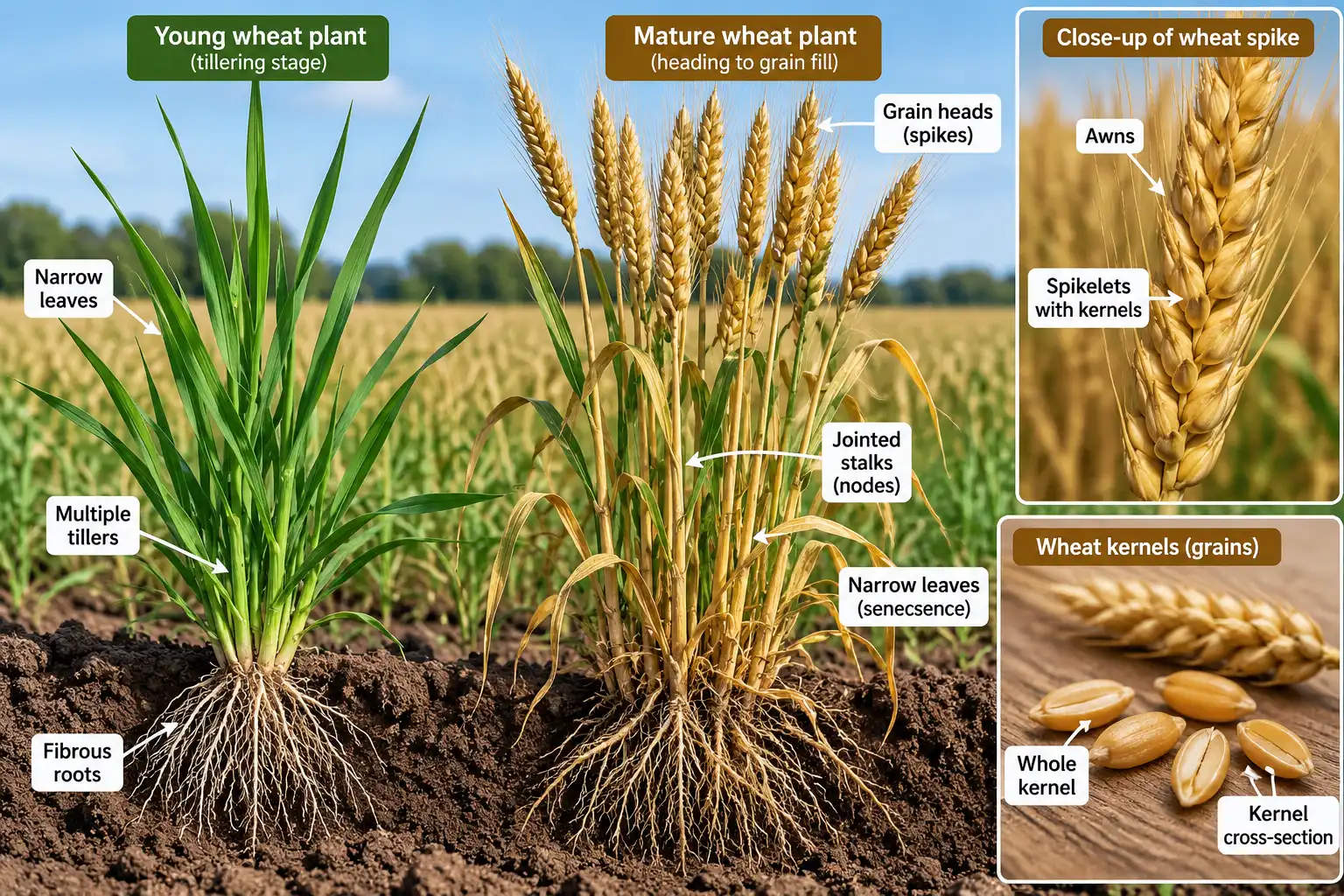
Young wheat resembles ordinary grass, but its leaf collar, clustered stems, and developing grain head reveal its identity. Understanding these features helps you recognize wheat from its first green shoot through harvest.
A wheat plant looks like an upright, tufted grass, commonly about 2 to 4 feet tall at maturity. It has narrow leaves, jointed stems, and compact grain heads. Young wheat is green, while ripe wheat turns golden.
What Are the Main Parts of a Wheat Plant?
A wheat plant consists of slender stems, long leaves, fibrous roots, and a grain-producing head.
Wheat (Triticum aestivum) belongs to the grass family, Poaceae. Unlike corn, which forms large ears along its stalk, wheat develops a compact grain head at the top of each fertile stem.
These features help identify the plant:
| Plant part | What it looks like |
|---|---|
| Stem (culm) | Thin, upright, and usually hollow between solid joints called nodes |
| Leaves | Long, narrow, flat green blades with parallel veins and pointed tips |
| Leaf sheath | Lower portion of the leaf that wraps around the stem |
| Auricles | Small, hairy, ear-shaped projections near the leaf base |
| Tillers | Additional shoots emerging from the plant’s base |
| Flag leaf | Last leaf produced, directly below the grain head |
| Head (spike) | Compact cluster of grain-bearing spikelets at the stem tip |
| Roots | Numerous branching, fibrous roots without one large taproot |
According to UC Statewide IPM’s wheat identification guide, mature wheat generally reaches 2 to 4 feet tall.
However, the height varies with genetics, growing conditions, and management. Modern semidwarf varieties are generally shorter than many older wheat types.
A single wheat seed can also produce several stems through tillering. Consequently, one mature plant may carry multiple grain heads.
What Does a Wheat Plant Look Like When It First Sprouts?
Newly emerged wheat looks like a thin, bright green blade of grass pushing through the soil.
The first true leaf emerges through a protective sheath called the coleoptile. Unlike beans or sunflowers, wheat does not emerge with two broad seed leaves.
During early growth, the seedling usually has:
- One narrow, pointed green shoot.
- A straight or slightly curved leaf blade.
- Fine roots developing beneath the soil.
- No visible grain head or thick stem.
The University of Georgia Extension’s small grains handbook reports that wheat germination normally takes 4 to 6 days under favorable temperatures of 68°F to 77°F. Aboveground emergence can take longer.
As additional leaves appear, the plant develops a grassy clump.
After approximately three or more leaves develop, new shoots can begin emerging near the original stem. These shoots are called tillers.
Identification tip: Very young wheat seedlings are difficult to distinguish from barley, rye, and other grasses. Wait until several leaves expand before checking the leaf collar.
How Does a Wheat Plant Change as It Grows?
Wheat changes from a small green shoot into a taller plant carrying a compact grain head. As the kernels mature, the green stalks and leaves gradually become straw-colored.
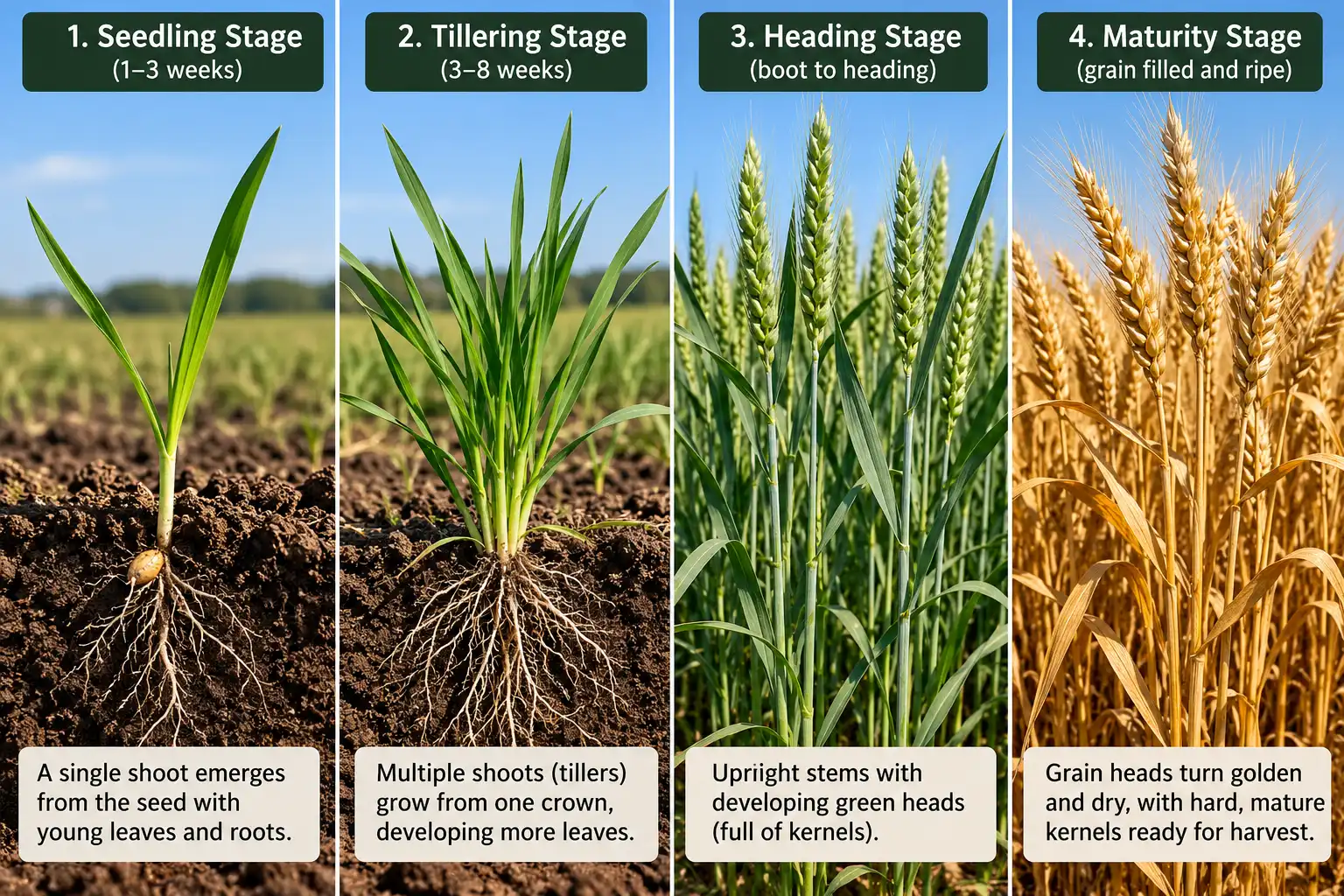
The University of Minnesota Extension’s spring wheat development guide describes wheat development using the Zadoks growth-stage system.
| Growth stage | Zadoks code | Visible appearance |
|---|---|---|
| Seedling | 10 to 19 | Small green shoots with developing leaves |
| Tillering | 20 to 29 | Several leafy shoots form a dense clump |
| Stem elongation | 30 to 39 | Stems grow taller, nodes become detectable, and the flag leaf appears |
| Boot stage | 40 to 49 | The upper leaf sheath swells around a developing head |
| Heading | 50 to 59 | A compact green grain head emerges |
| Flowering | 60 to 69 | Tiny pollen-bearing anthers become visible |
| Grain filling | 70 to 89 | Kernels enlarge as heads gradually lose their green color |
| Ripening | 90 to 92 | Stalks turn straw-colored and kernels become hard |
The Zadoks system identifies physical stages rather than counting days after planting.
This matters because wheat development varies with temperature, variety, planting season, and available moisture.
A wheat plant may remain short for months during winter but grow rapidly after temperatures increase.
What Do Wheat Leaves and Stems Look Like?
Wheat leaves are long, narrow, and usually medium green to blue-green. They have parallel veins and grow alternately along slender stems.
Each leaf has two main parts: the flat blade and the sheath surrounding the stem.
At the junction of these parts, wheat develops two small structures:
Auricles: Short, usually hairy projections that partially clasp the stem.
Ligule: A thin membrane on the inner side of the leaf collar.
The auricles are particularly helpful for distinguishing wheat from similar cereal grasses.
Wheat stems also develop noticeable joints as they elongate. Most have hollow spaces between the joints, although certain varieties have more solid stem tissue.
The uppermost leaf is called the flag leaf. It sits immediately beneath the grain head and contributes to grain development.
Before heading, the flag leaf is another useful visual sign that the plant is approaching its reproductive stage.
What Does a Wheat Head Look Like?
A wheat head is a compact, elongated cluster of grain-bearing structures called spikelets. It develops at the top of a mature stem.
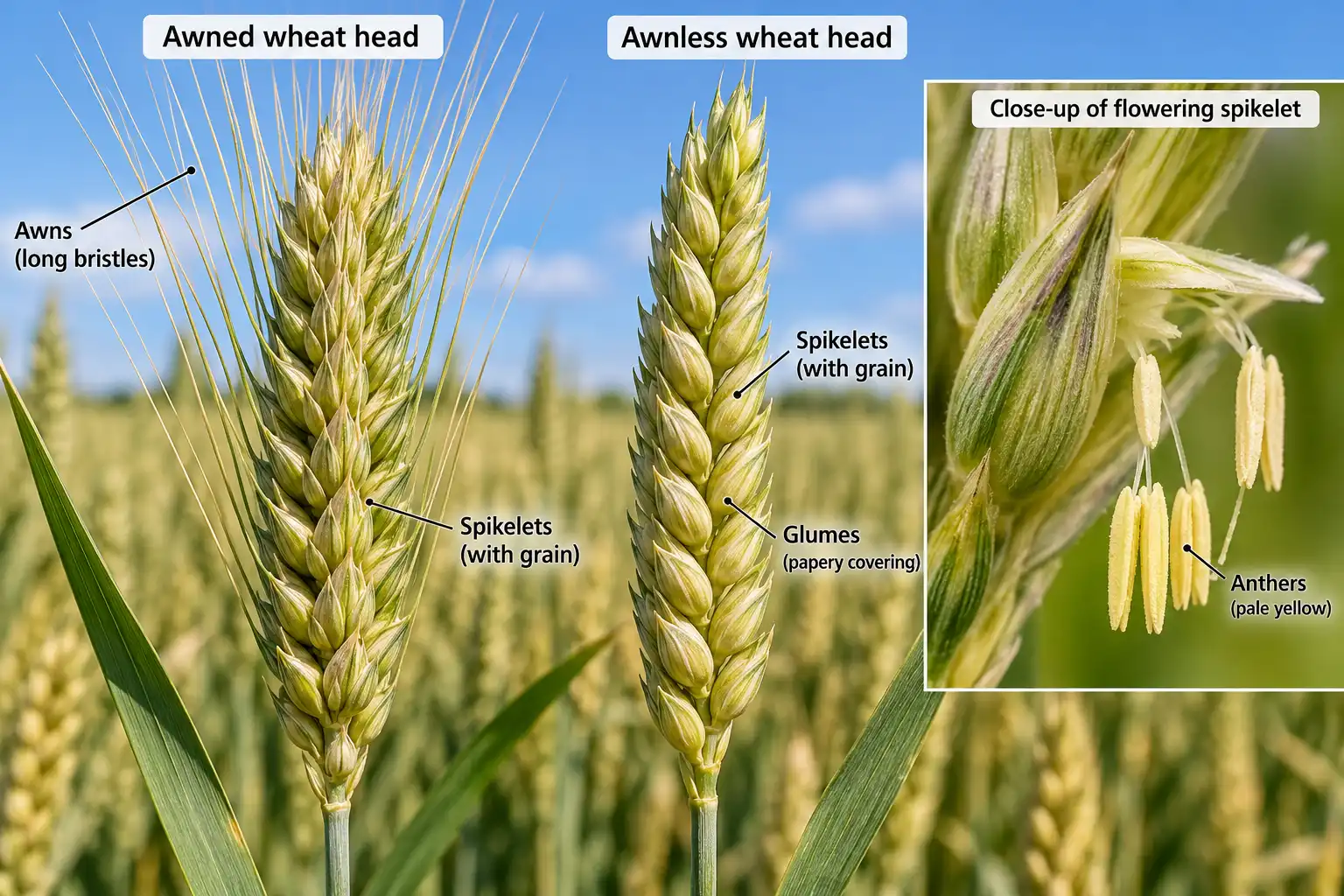
Each wheat head contains numerous spikelets arranged along a central stalk. The spikelets contain small flowers called florets, which can develop into grain kernels.
A wheat head generally has these features:
Compact shape: Spikelets sit closely together rather than spreading on long branches.
Papery coverings: Small structures called glumes protect the spikelets.
Awns: Some wheat varieties produce long, slender bristles extending from their heads. Others are nearly awnless.
Developing kernels: Individual grains form inside the florets after pollination.
During flowering, tiny yellow or pale anthers may briefly appear on the outside of the head. Wheat does not produce large, colorful flowers.
As the kernels develop, they progress from watery or milky interiors to doughlike and finally hard grain.
A wheat head usually changes from green to yellow or golden brown as the crop matures.
How Can You Tell Wheat From Barley, Rye, and Oats?
The most reliable early identification clue is the leaf collar, particularly the size and hairiness of its auricles.
Wheat, barley, rye, oats, and triticale can look very similar before their seed heads form.
The USDA Natural Resources Conservation Service’s cereal plant identification guide describes distinguishing leaf characteristics that help separate these crops.
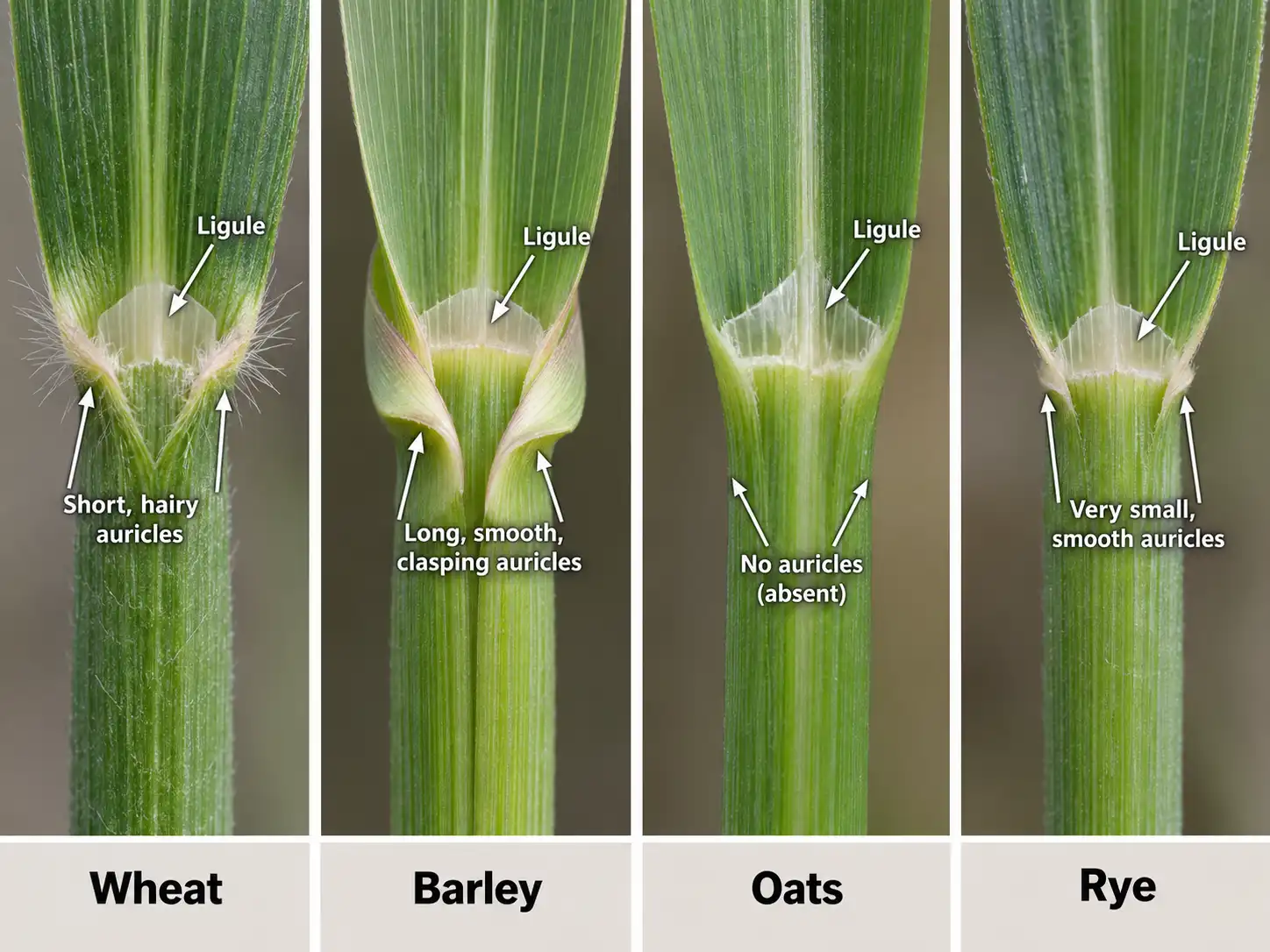
| Crop | Leaf collar characteristics | Mature seed head |
|---|---|---|
| Wheat | Short, hairy auricles | Dense spike, sometimes with long awns |
| Barley | Long, smooth auricles clasping the stem | Compact spike, often with prominent awns |
| Rye | Very small, usually smooth auricles | Generally narrow, elongated spike |
| Oats | Auricles absent | Loose, branching cluster called a panicle |
| Triticale | Often has pointed auricles and closely resembles wheat | Wheat-like spike, sometimes difficult to distinguish |
The Quickest Way to Identify Young Wheat
Inspect a fully expanded leaf where its blade meets the sheath.
Look for two small, hairy projections curling partly around the stem. Their presence strongly supports wheat identification.
However, young triticale can resemble wheat closely. If identification remains uncertain, examine mature heads or confirm the seed source and planting records.
Do not rely on bristles alone. Some wheat varieties have awns, while others do not.
Does Winter Wheat Look Different From Spring Wheat?
Winter wheat and spring wheat have similar structures, but their growth patterns differ with the planting season.
Winter Wheat in the Great Plains and Southeast
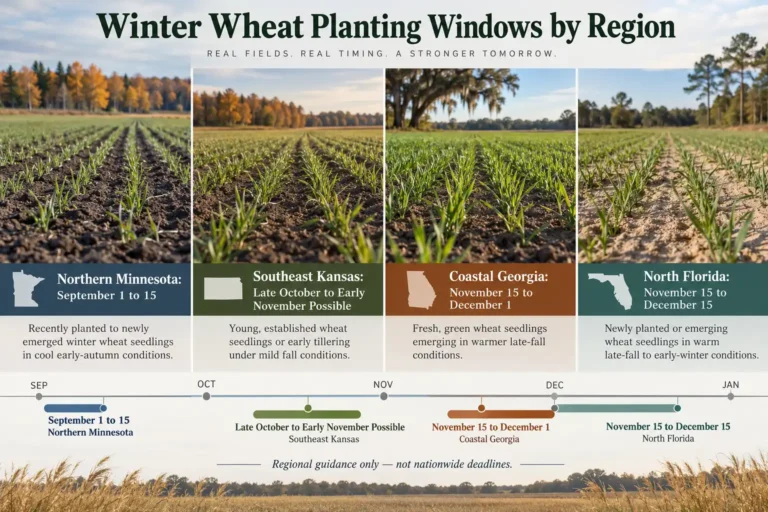
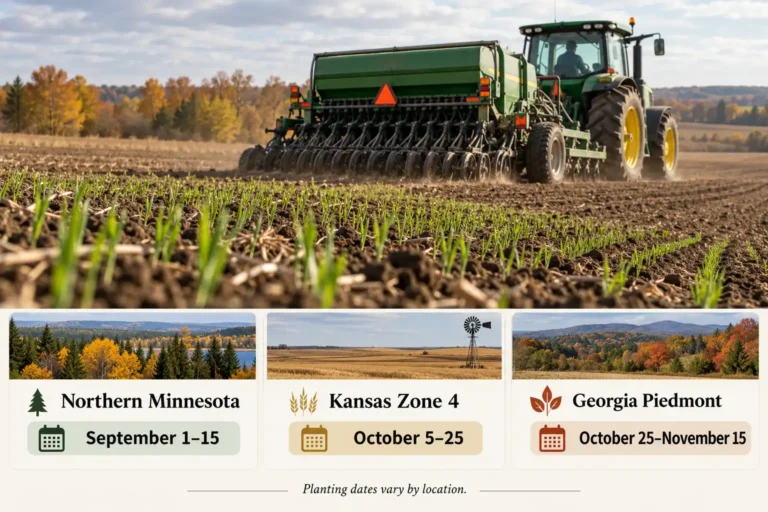
Winter wheat is commonly planted in fall across regions such as Kansas, Oklahoma, and parts of the southeastern United States.
It develops green leaves and tillers before winter.
During colder weather, plants often remain low to the ground instead of developing tall stems.
South Dakota State University Extension describes winter wheat as typically prostrate around Feekes stage 3, becoming more upright as development advances.
After spring growth resumes, the stems elongate and eventually produce heads.
Spring Wheat in the Northern Plains
Spring wheat is commonly grown in areas such as North Dakota and Minnesota.
It emerges after spring planting, develops green leaves and tillers, and produces grain heads during the warmer growing season.
The University of Minnesota Extension reports that spring wheat in Minnesota generally heads in late spring or early summer and matures during summer.
Therefore, the same crop may appear as low green grass, tall green stalks, or a golden field depending on the season.
What Does a Wheat Field Look Like Before Harvest?
A mature wheat field usually appears as a dense stand of golden or straw-yellow plants carrying grain heads above the leaves.
Earlier in the season, the field looks more like a continuous carpet of green grass.
As wheat approaches maturity, several changes become visible:
The leaves begin losing their green color. Stems turn yellow, and the grain heads become golden or tan.
Individual kernels also harden as they dry.
However, a golden field alone does not confirm that wheat is ready for harvest.
Kernel firmness and moisture matter. A crop can appear dry while the grain still contains too much moisture for safe storage.
The University of Minnesota Extension recommends combining spring wheat around 13% to 14% kernel moisture when avoiding additional drying costs.
What If a Wheat Plant Looks Yellow, Stunted, or Unusual?
Wheat normally becomes yellow as it matures, but early yellowing and abnormal growth can indicate stress.
Before assuming the plant is another cereal species, examine its growth stage and surrounding plants.
Uneven yellow patches may be associated with moisture problems, nutrient shortages, root injury, or disease.
Orange or brown pustules on leaves can indicate rust infection. Bleached heads developing while neighboring plants remain green may also require investigation.
Compare affected and healthy plants, inspect their roots, and note whether symptoms occur across the field or in isolated patches.
The site’s guide to common crop disease symptoms can help organize an initial inspection. If poor growth suggests nutrient problems, reading a soil test report provides a more dependable starting point than judging leaf color alone.
Do not identify a disease or nutrient deficiency from one symptom without checking other possible causes.
FAQs about Plant Identification
Does a wheat plant look like ordinary grass?
Yes. Young wheat resembles common grass because it has narrow green blades, parallel veins, and slender stems. Its short hairy auricles and eventual compact grain heads provide more dependable identification features than leaf color alone.
Can a wheat plant grow without long bristles?
Yes. Some wheat varieties produce prominent bristles called awns, while others have short awns or none. Both types produce wheat kernels, so the absence of long bristles does not mean the plant is another grain.
Does one wheat seed produce more than one stalk?
Yes. One wheat kernel initially produces a main shoot, which can develop additional shoots called tillers. When several shoots survive and become fertile, a single wheat plant can produce multiple grain heads instead of just one.
What color is wheat before it is harvested?
Mature wheat is commonly golden yellow, pale brown, or straw-colored, with dry stalks and firm grain heads. However, plants remain green during earlier growth stages, and differences in maturity or weather can cause uneven coloring.
Is wheatgrass the same plant as wheat?
Wheatgrass grown for juicing is generally young wheat harvested for its green leaves before grain heads form. If allowed to continue growing under suitable conditions, the same wheat plant can eventually produce mature grain-bearing stems.
Can you identify wheat before its seed head appears?
Often, yes. Examine developed leaves for short, hairy auricles at the junction between the blade and sheath. However, very young wheat resembles several other cereal grasses, so identification may require additional growth or planting records.
Key Signs to Remember When Identifying Wheat
The strongest signs of a wheat plant are narrow leaves, short hairy auricles, multiple shoots from the base, and compact grain heads.
If no head is visible, inspect the leaf collar. If the crop is mature, compare the grain head with barley, rye, and oats.
Always judge the plant by its growth stage rather than color alone.