21-0-0 Fertilizer: Uses, Lawn Rates, and 5 Ammonium Sulfate Picks
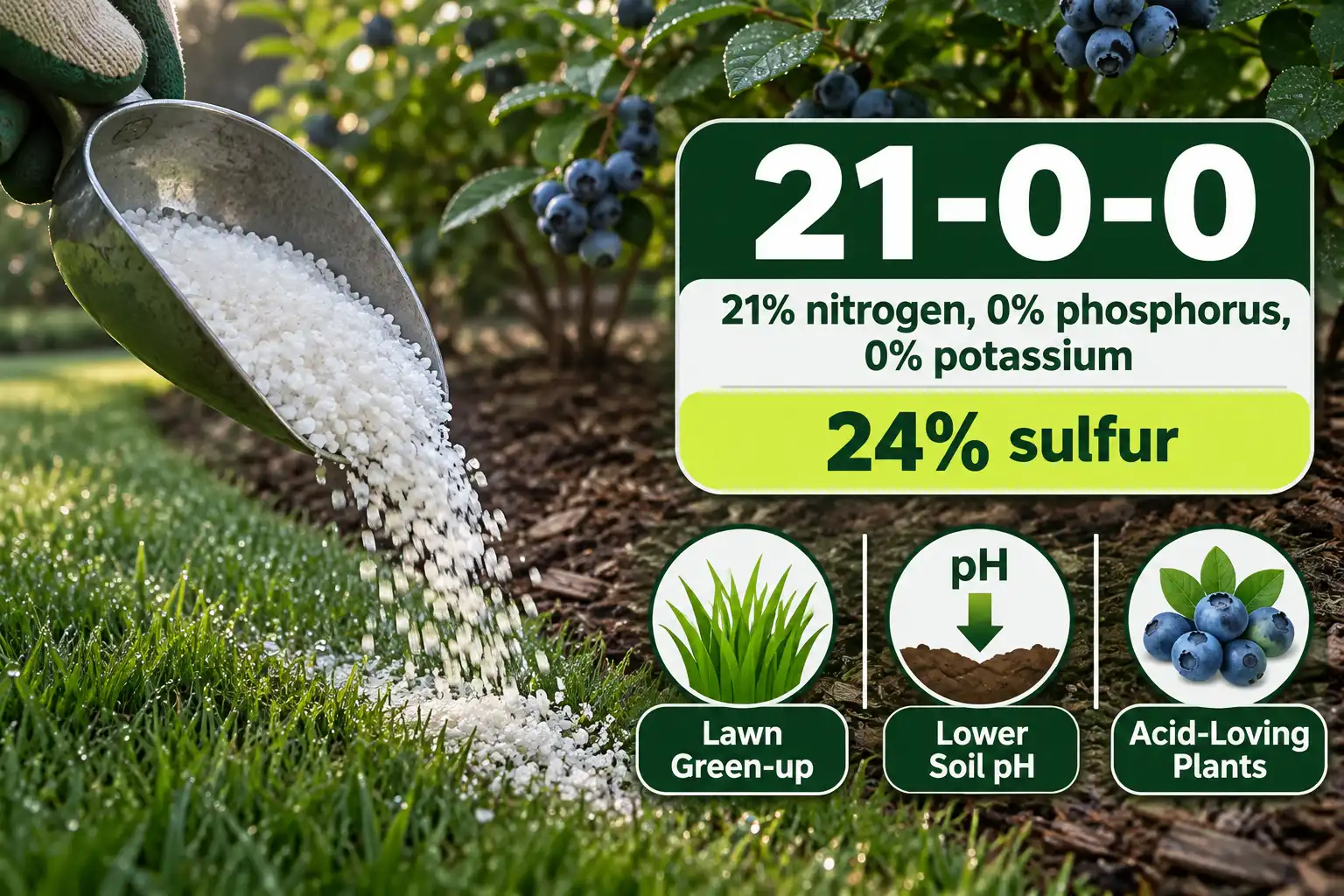
21-0-0 fertilizer is ammonium sulfate, a fast-acting salt that supplies nitrogen and sulfur and slowly lowers soil pH. It suits lawns on alkaline ground, blueberries, and sulfur-hungry crops. The rate matters, though, because it burns grass when overapplied.
21-0-0 fertilizer is ammonium sulfate: 21% nitrogen, 0% phosphorus, 0% potassium, plus 24% sulfur. It greens up lawns, feeds blueberries and azaleas, and fixes sulfur deficiency. On grass, Purdue’s nitrogen limit equals 4.8 pounds per 1,000 square feet.
What Is 21-0-0 Fertilizer?
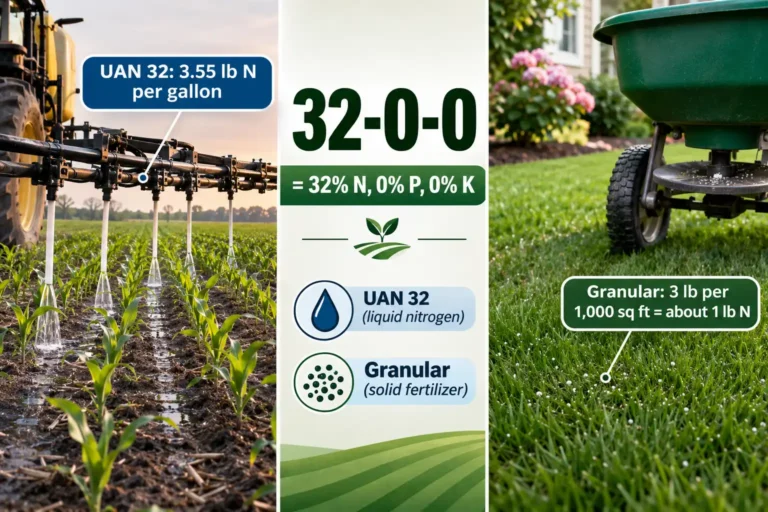
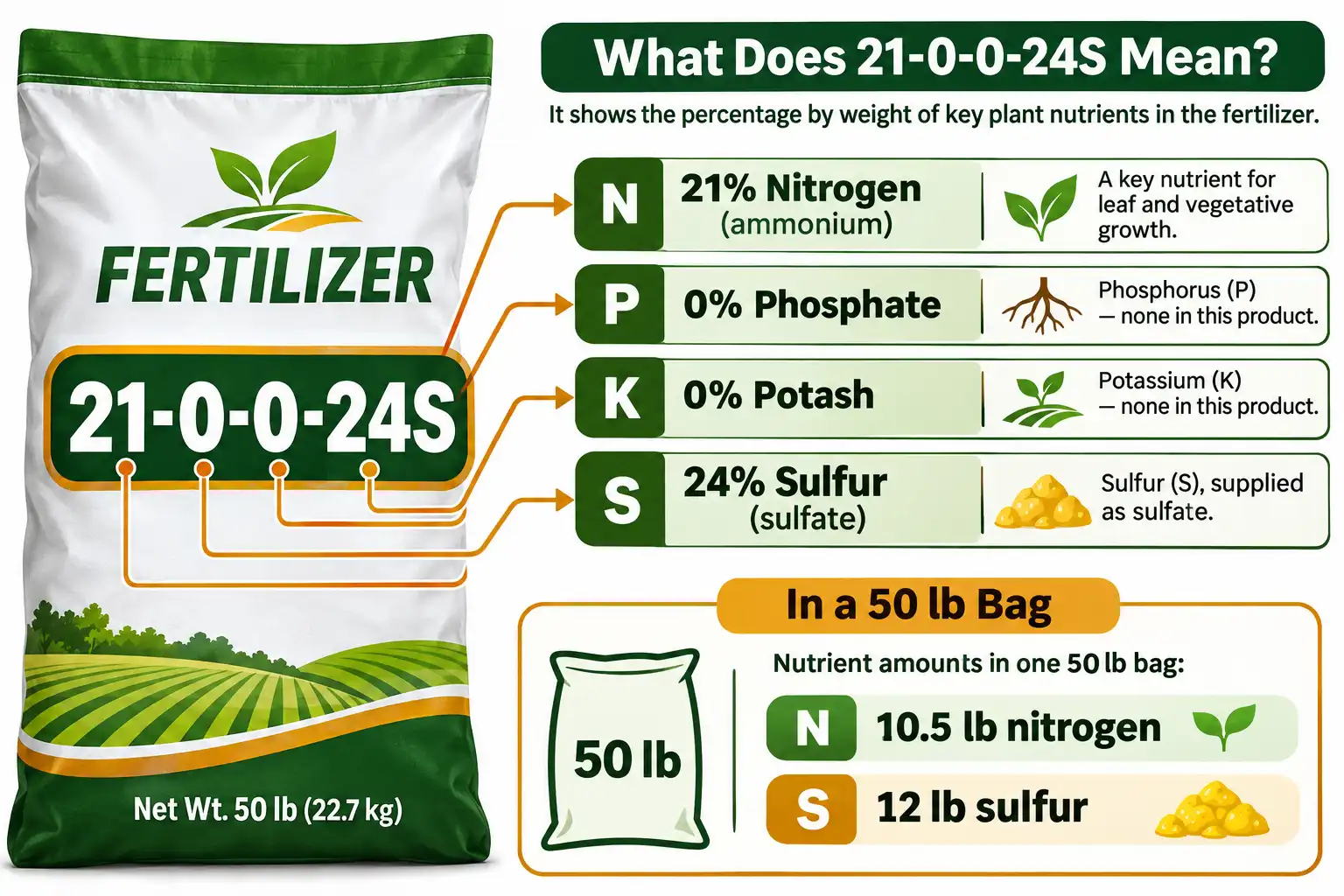
21-0-0 fertilizer is ammonium sulfate, (NH4)2SO4, named by its N-P-K analysis. The three figures mean 21% nitrogen, 0% phosphate, and 0% potash by weight. Many bags add “24S” to show the 24% sulfur, and that sulfur is often the real reason to buy it.
In practice, a 50-pound bag holds 10.5 pounds of nitrogen and 12 pounds of sulfur. The rest of the weight is the hydrogen and oxygen that bind the salt together.
How the Nitrogen Behaves
All of the nitrogen arrives as ammonium. That gives the product three traits:
- It acts fast. Iowa State University Extension lists ammonium sulfate among water-soluble, quickly available nitrogen sources, so grass responds fast.
- It acidifies. Soil bacteria convert ammonium to nitrate. Nebraska Extension notes that ammonium nitrogen leaves soil more acidic, while nitrate nitrogen does not.
- It loses less to the air than urea. Urea has to convert to ammonium first. Oregon State University Extension points out that this step raises soil pH, which drives ammonia loss.
Is 21-0-0 Always Ammonium Sulfate?
Nearly always. Pure ammonium sulfate tops out at about 21% nitrogen, so any bag above that number contains something else. For example, lawn products sold as “ammonium sulfate” with a 33-0-0 or 34-0-0 analysis blend in another nitrogen source, such as urea. Read the “derived from” line on the label. Straight 21-0-0 lists ammonium sulfate alone.
What Is 21-0-0 Fertilizer Used For?
21-0-0 fertilizer is used wherever plants need fast nitrogen, sulfur, or a gentle push toward acidic soil. Most bags end up in one of four jobs:
| Use | Why ammonium sulfate fits | Starting rate |
|---|---|---|
| Lawn green-up | Quick-release nitrogen; the acidity helps on high-pH soil | 2.4 to 4.8 lb per 1,000 sq ft |
| Blueberries, azaleas, rhododendrons | Ammonium form; keeps the root zone acidic | 75 to 300 lb per acre, by bush age |
| Corn, soybeans, and alfalfa short on sulfur | Sulfate sulfur is plant-available right away | 63 to 125 lb per acre |
| Herbicide spray tanks | Ties up hard-water minerals that weaken glyphosate | 8.5 to 17 lb per 100 gal, spray grade |
The lawn range follows Purdue’s cap of 1 pound of nitrogen per 1,000 square feet per feeding. The blueberry and crop rates come from Michigan State and Iowa State, covered below. Nebraska Extension supplies the spray-tank rate.
It is not a complete fertilizer, though. With no phosphorus or potassium, it fixes one or two shortages, not all three. So if your soil test also calls for P and K, a balanced 10-10-10 blend or separate P and K products fit better.
Ammonium Sulfate vs Urea: Which Nitrogen Source Fits?
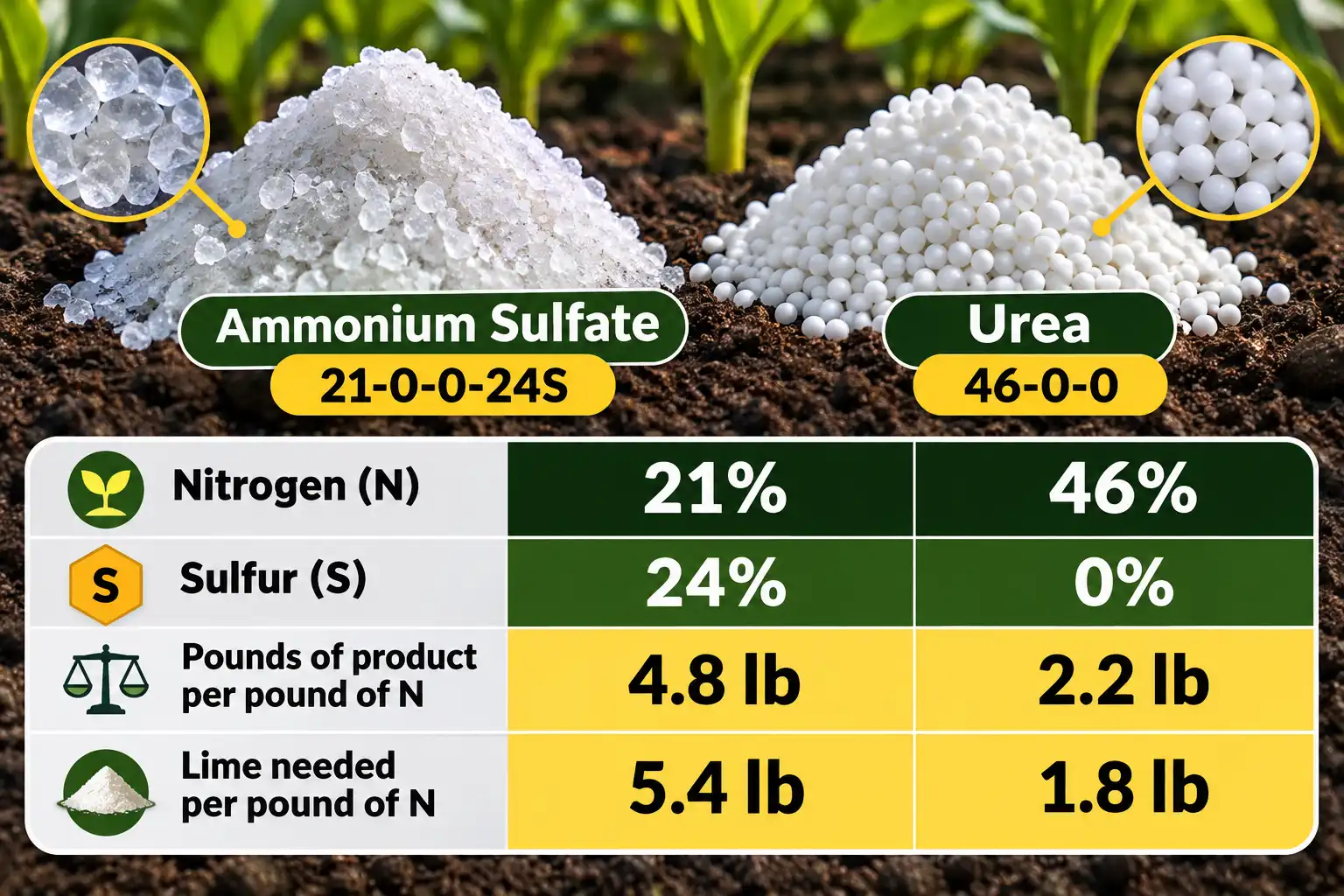
Ammonium sulfate carries less than half the nitrogen of urea, but it adds sulfur and loses less nitrogen to the air. It also acidifies soil about three times harder per pound of nitrogen.
| Trait | Ammonium sulfate (21-0-0-24S) | Urea (46-0-0) |
|---|---|---|
| Nitrogen | 21% | 46% |
| Sulfur | 24% | None |
| Product needed for 1 lb of N | 4.8 lb | 2.2 lb |
| Lime to neutralize acidity, per lb of N | 5.4 lb | 1.8 lb |
| Nitrogen form | All ammonium, usable at once | Must convert to ammonium first |
| Ammonia loss from the surface | Lower than urea | Higher, unless watered in or worked into the soil |
| Best fit | High-pH or sulfur-short soil, acid-loving plants | Lowest cost per pound of N |
Nebraska Extension’s lime table puts ammonium sulfate at 5.4 pounds of calcium carbonate per pound of nitrogen. Urea, ammonium nitrate (34-0-0), and anhydrous ammonia all sit at 1.8. That extra acidity helps on alkaline ground but hurts on soil that is already acidic.
Oregon State University Extension researchers at Hermiston credit ammonium sulfate with cutting ammonia loss by more than 60%. All of its nitrogen is already ammonium, so none has to convert first. High soil pH still raises losses from any ammonium source, so water it in on calcareous ground.
Cost runs the other way. Michigan State University Extension notes that nitrogen from ammonium sulfate costs more per pound than nitrogen from urea. In short, choose 21-0-0 when the sulfur or the acidity pays its way, not for nitrogen alone.
How Much Ammonium Sulfate to Apply
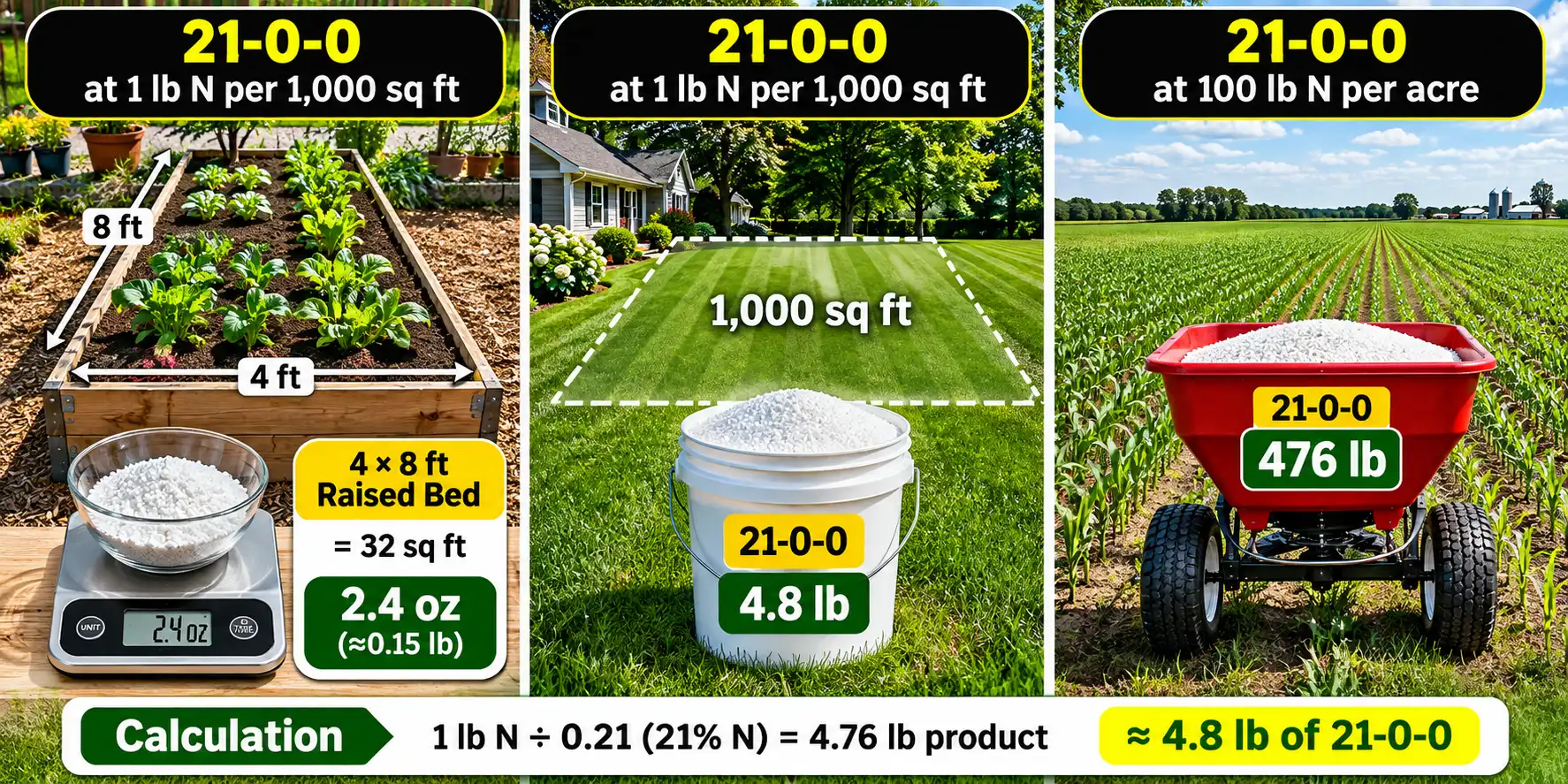
Divide your nitrogen target by 0.21. Each pound of actual nitrogen takes 4.76 pounds of 21-0-0, so a 1-pound target means about 4.8 pounds of product.
Purdue University turf specialists set the lawn ceiling at 1 pound of nitrogen per 1,000 square feet per application. They also advise no more than one feeding a month at that rate. Purdue also warns against heavy summer feeding of cool-season grass, so a half rate of 0.5 pound fits better then.
| Area | Nitrogen goal | 21-0-0 per feeding | Sulfur supplied |
|---|---|---|---|
| 4 by 8 ft raised bed (32 sq ft) | 1 lb per 1,000 sq ft | 2.4 oz | 0.6 oz |
| 10 by 10 ft garden bed (100 sq ft) | 1 lb per 1,000 sq ft | 7.6 oz | 1.8 oz |
| 1,000 sq ft lawn, summer half rate | 0.5 lb | 2.4 lb | 0.6 lb |
| 1,000 sq ft lawn, full rate | 1 lb | 4.8 lb | 1.1 lb |
| 5,000 sq ft lawn, full rate | 5 lb | 23.8 lb | 5.7 lb |
| 1 acre field, 100 lb N goal | 100 lb | 476 lb | 114 lb |
Weigh small doses on a kitchen scale. Granule size changes how much fits in a cup, so volume measures drift from bag to bag.
For a full season, add up the feedings. Purdue puts well-kept cool-season lawns at 3.5 to 4 pounds of nitrogen a year. At 4 pounds, that comes to about 19 pounds of 21-0-0 per 1,000 square feet, split across at least four applications.
Ammonium Sulfate for Grass: When and How to Apply
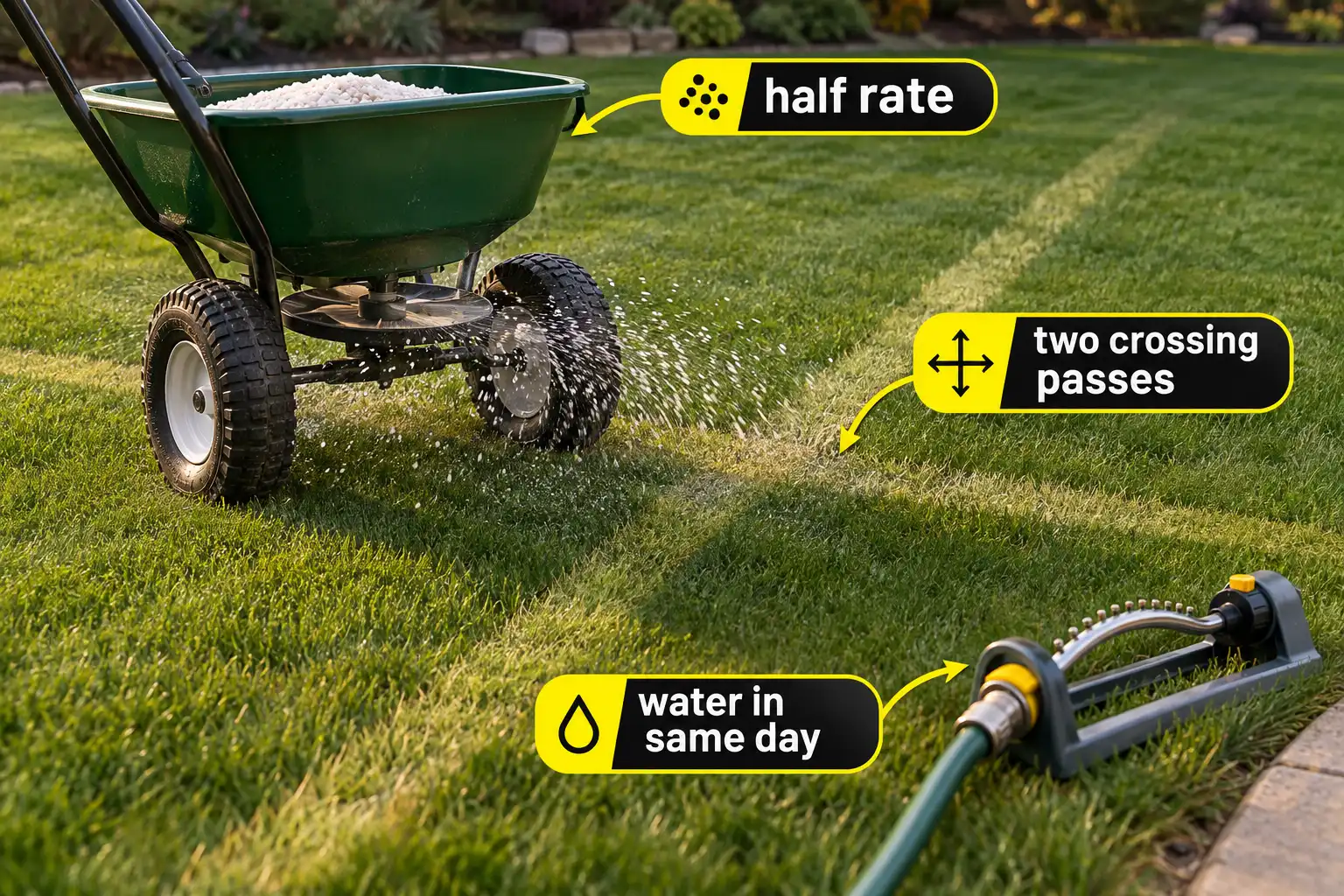
Spread ammonium sulfate on dry grass while it is actively growing, then water it in the same day. The calendar depends on your grass type.
Timing by Grass Type
For Kentucky bluegrass, tall fescue, and other cool-season lawns, Purdue recommends feedings in September and November. Add one more in late spring, after the first flush of growth. Warm-season grasses such as bermudagrass and zoysiagrass get fed in summer instead, when they grow hardest. In either case, skip dormant turf, because it cannot use the nitrogen.
Step by Step
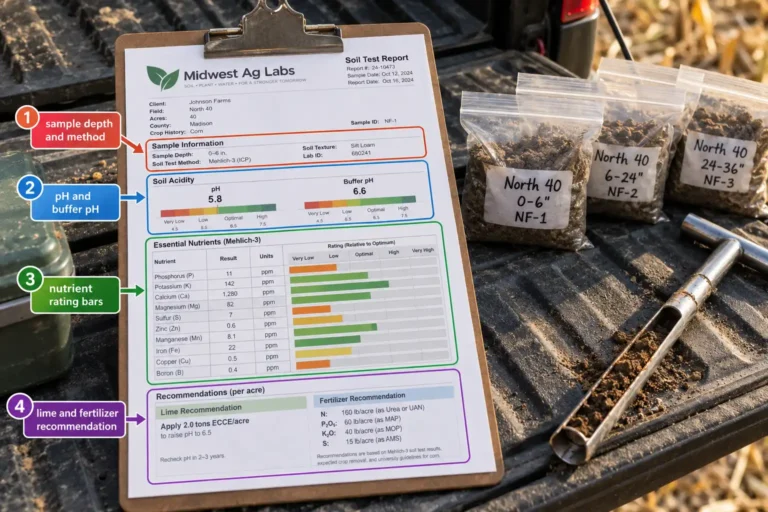
- Test first. Ammonium sulfate pays off most on neutral to alkaline soil, so confirm pH before the first bag.
- Mow, then let the blades dry. Dry granules bounce down to the soil, while wet leaves hold them and scorch.
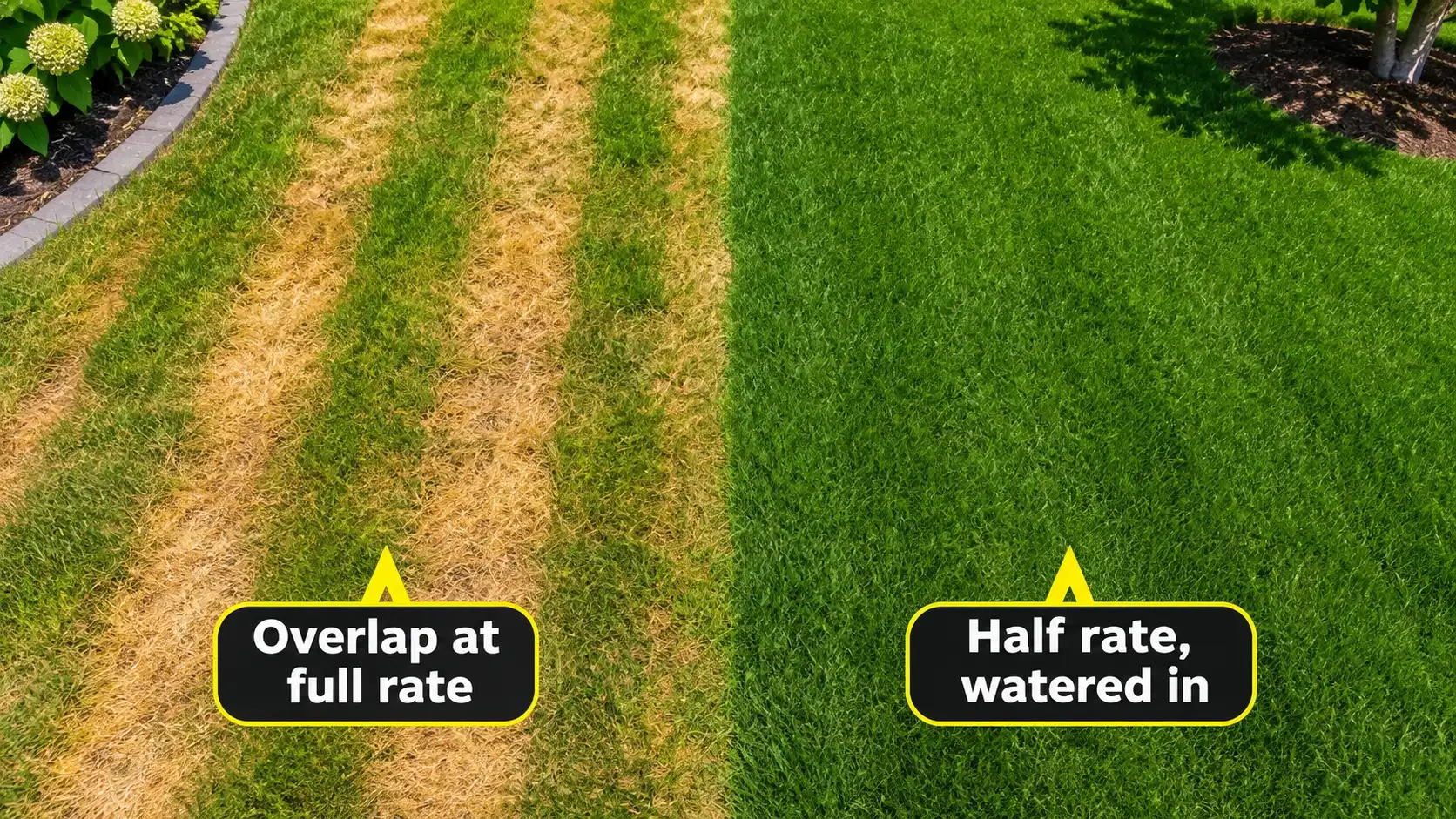
- Set the spreader to half rate. Then cover the lawn twice, the second pass at a right angle to the first, to avoid stripes.
- Water in right away. Labels from both Greenway Biotech and Lawn Synergy call for watering in after application.
- Sweep hard surfaces. Brush stray granules off drives and decks back onto the grass.
- Wait at least four weeks. Purdue limits full-rate feedings to once a month.
Read the pH line on your soil test report before you buy. For lawns over an acre, a tow-behind spreader covers the ground faster than a push model.
Using 21-0-0 to Lower Soil pH and Feed Blueberries
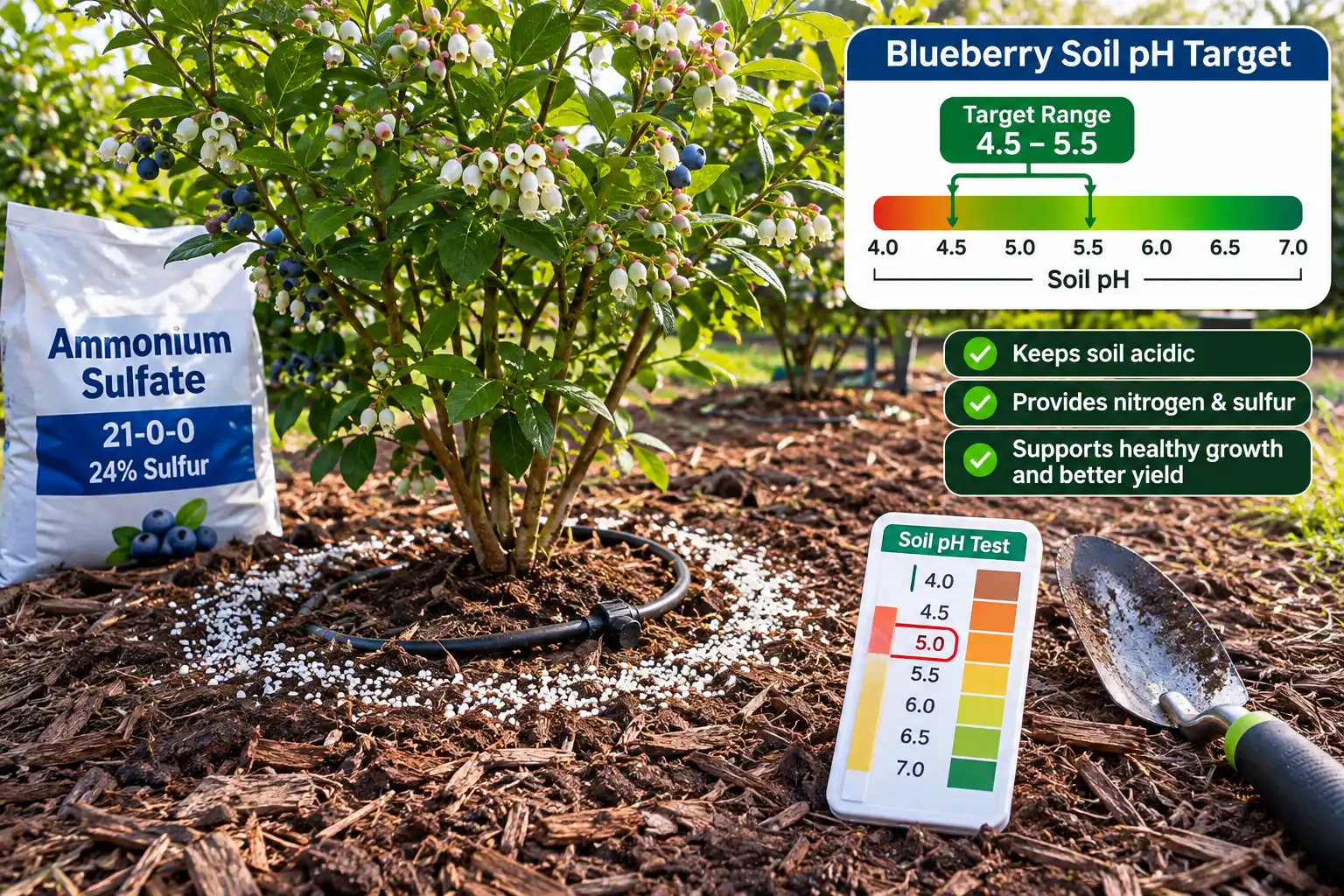
Ammonium sulfate lowers soil pH slowly, as a side effect of feeding. So it suits holding blueberry and azalea soil acidic, not dropping pH by a full unit.
The acidity comes from the nitrogen, not the sulfur. Soil bacteria turn ammonium into nitrate and release acid as they work. Nebraska Extension sets that acidity equal to 5.4 pounds of lime per pound of nitrogen.
Run it on a lawn. Feed 4 pounds of nitrogen per 1,000 square feet in a season, all from 21-0-0. That creates acidity equal to about 21.6 pounds of lime. Sandy soil shows that change sooner than clay, which buffers pH harder. For a large drop, elemental sulfur is the usual tool instead.
Blueberry Rates by Bush Age
Michigan State University Extension calls ammonium sulfate the best choice when you want to reduce pH slightly. MSU small fruit educators put the blueberry target at pH 4.5 to 5.5. Once soil falls below pH 5.0, MSU suggests urea instead, because it moves pH less.
| Bush age | Nitrogen (lb/acre) | Ammonium sulfate (lb/acre) | Per bush, 4 by 10 ft spacing |
|---|---|---|---|
| 2 years | 15 | 75 | 1.1 oz |
| 4 years | 30 | 150 | 2.2 oz |
| 6 years | 45 | 215 | 3.2 oz |
| 8 years | 65 | 300 | 4.4 oz |
The per-bush column is our conversion at 1,089 bushes per acre. Treat each figure as a yearly total, and split it rather than applying it all at once.
Ammonium Sulfate as a Sulfur Source for Field Crops
On crop ground, ammonium sulfate works mainly as a sulfur product that also carries nitrogen. Iowa State University Extension reports that sulfur deficiency has become common in Iowa. One reason is that rain carries less sulfur since air pollution rules tightened.
Iowa State’s rates when a field needs sulfur:
| Crop and soil | Sulfur rate | 21-0-0 needed | Nitrogen that comes with it |
|---|---|---|---|
| Corn or soybean, fine-textured soil | 15 lb S/acre | 63 lb/acre | 13 lb N |
| Corn or soybean, coarse-textured soil | 25 lb S/acre | 104 lb/acre | 22 lb N |
| Alfalfa topdress | 20 to 30 lb S/acre | 83 to 125 lb/acre | 17 to 26 lb N |
ISU suggests applying sulfur to corn every other year. Because the sulfur is already sulfate, you can apply it anytime from spring through early crop stages, broadcast or banded. Count the nitrogen it brings, too, and subtract it when you set corn fertilizer rates per acre.
Spray-Grade AMS in Herbicide Tanks
Spray tanks call for a different grade. Michigan State University Extension recommends dry AMS labeled “spray grade” at 17 pounds per 100 gallons, added before the glyphosate. Nebraska Extension gives a range of 8.5 to 17 pounds. At the 17-pound rate, Nebraska figures each acre gets only 0.85 to 3.4 pounds of AMS. That supplies less than 1 pound of nitrogen.
Common 21-0-0 Problems and How to Avoid Them
Most trouble with ammonium sulfate traces back to rate, timing, or soil that does not need it.
| Problem | Likely cause | Fix |
|---|---|---|
| Brown streaks after feeding | Overlapping passes, or more than 1 lb N per 1,000 sq ft | Water heavily now, skip the next feeding, then use half-rate crossing passes |
| Surge of growth and heavy mowing | Full rate during peak spring growth | Drop to 0.5 lb N per 1,000 sq ft |
| Weak response on alkaline soil | Ammonia lost from granules left on the surface | Water in the same day |
| Lawn thins and yellows after years of use | Soil pH drifted too low | Test pH, then lime or switch to a less acidifying source |
| Granules jam the spreader | Prill too large for the hopper gate | Choose a smaller, uniform prill, or dissolve and spray |
| Cloudy or brown spray solution | Impurities in fertilizer-grade product | Use a fully soluble or spray-grade product |
When to Skip 21-0-0
- Soil that already tests acidic. Each feeding pushes pH lower still.
- Certified organic ground. USDA’s Agricultural Marketing Service notes that synthetic ammonium fertilizers, ammonium sulfate among them, have not been allowed in organic production.
- Soil short on phosphorus and potassium too. A single-nutrient salt leaves those gaps open.
Between lab tests, a soil pH meter shows whether repeat feedings are pulling pH down.
How to Choose a 21-0-0 Fertilizer
Straight ammonium sulfate is the same chemistry in every bag, so choose on how you will apply it and what it will feed. Four specifications separate one product from another:
- Granule size. Broadcast spreaders need uniform prills, and oversize granules jam small spreaders.
- Solubility and purity. Sprayers, hose-end feeders, and watering cans need a product that dissolves clean.
- Heavy-metal testing. For vegetables and fruit, batch testing and state registration add assurance.
- Bag size against your area. Work it out before you buy.
The bag math is simple: multiply the bag weight by 0.21, divide by your nitrogen rate, then multiply by 1,000. For example, a 50-pound bag at 1 pound of nitrogen covers about 10,500 square feet, or 21,000 at half rate. A 25-pound bag covers about 5,250 square feet at the full rate.
| Your job | Spec that matters most | Best match below |
|---|---|---|
| Vegetables, fruit, fertigation | Heavy-metal testing, full solubility | Greenway Biotech |
| Lawn, dry or sprayed | Coverage stated in nitrogen | Lawn Synergy |
| Lawn, spreader only | Uniform prill size | Supply Solutions |
| Large area, dry spreading | 50 lb bag | CountryMax |
| Azaleas, blueberries, containers | Small bag, hand spreading | Easy Peasy Plants |
For herbicide tanks, buy AMS sold as spray grade. The bags below are sold as fertilizer.
Best 21-0-0 Fertilizers for Lawns and Gardens
These picks rest on manufacturer specifications and patterns across verified buyer reviews.
1. Greenway Biotech Ammonium Sulfate 21-0-0: Best Overall
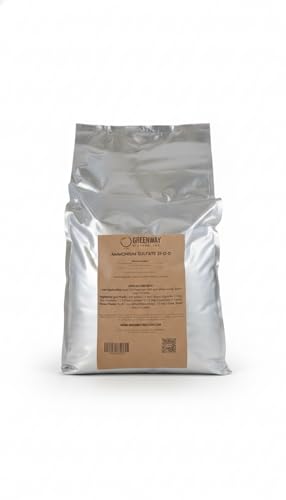
- MANAGE PH LEVEL: Due to 24% of Sulfur, this ammonium sulfate lawn fertilizer is Very suitable for Acid Loving Plants and…
- WATER SOLUBLE: This ammonium sulfate 21-0-0 fertilizer contains 21% water soluble nitrogen and 24% sulfur. It is 100% wa…
- ESSENTIALS FOR PLANTS: This is the only and much-needed ammonium sulfate lawn fertilizer for plants and crops, with our …
Greenway Biotech’s bag carries the most documentation in this group. Every batch is third-party tested for heavy metals, and the product is registered with the California Department of Food and Agriculture. That makes it the strongest pick for vegetable beds and fruit trees. It dissolves fully, so it also works in a watering can. Its lawn rate of 3 to 5 pounds per 1,000 square feet supplies 0.63 to 1.05 pounds of nitrogen. That tops out right at Purdue’s ceiling.
Owner evidence: Owner reports consistently note darker lawns and healthier blueberries, and most say it dissolves easily.
Pros
- Batch-tested for heavy metals
- 100% water soluble
- Clear lawn rate on label
- Four bag sizes
Cons
- Directions advise against use above 65°F
- Listing calls it organic; it is synthetic
Specs
- Analysis: 21-0-0, 24% sulfur
- Form: water-soluble granules
- Sizes: 2, 5, 10, and 25 lb
- Made in California since 1989
2. Lawn Synergy 21-0-0 Ammonium Sulfate: Best for Lawns
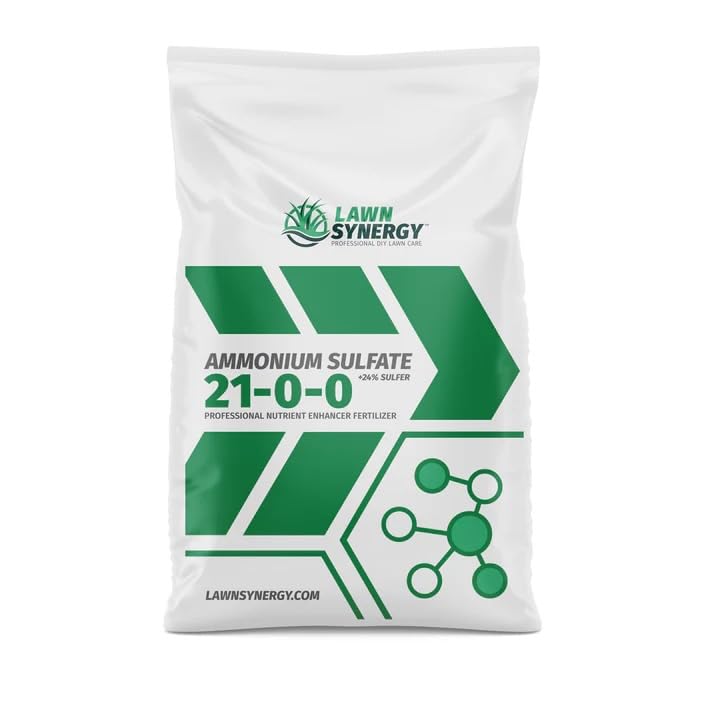
- Lush, Dark Green Lawn: With its fast-release nitrogen, this fertilizer works quickly to create a lush, dark green lawn. …
- Quick-Acting Formula: The 21-0-0 formulation means your lawn gets a concentrated dose of nitrogen, promoting rapid growt…
- Enhanced Soil Health: The addition of 24% sulfur helps improve the soil's ability to absorb nutrients, fostering healthi…
Lawn Synergy builds this 18-pound bag around lawn math. The label states coverage of up to 7,500 square feet at 0.5 pound of nitrogen per 1,000, a sensible half rate for summer. AdvanSix manufactures the Sulf-N ammonium sulfate inside. You can spread it dry or dissolve it for a sprayer, and the listing prefers the liquid method. Community answers say it gives Kentucky bluegrass deep color, especially on alkaline soil.
Owner evidence: Owner reports consistently describe thick, dark green turf after one application, and several stress watering in right away.
Pros
- Coverage stated in nitrogen
- Spreads dry or sprays
- Made by AdvanSix
- Deep bluegrass color
Cons
- Granules too big for one owner’s spreader
- Covers about 3,800 sq ft at full rate
Specs
- Analysis: 21-0-0 ammonium sulfate
- Form: granules
- Weight: 18 lb
- Manufacturer: AdvanSix
3. Supply Solutions 21-0-0-24S: Best for Spreaders
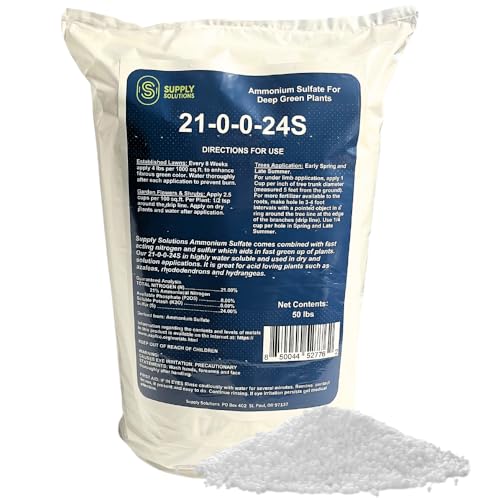
- Produce Deep Green Growth with Colorful Blooms: Our blueberry fertilizer act as nutrient-rich formula, infusing vitality…
- Customized for Acid-Loving Plants: Whether it's azalea, camellia or rhododendron, our ammonium sulfate ammonium sulfate …
- pH Regulation in Soil: This sulfur for plants compound helps regulate soil pH, releasing ammonium ions that contribute t…
Supply Solutions packs Diamond K ammonium sulfate in 10, 25, and 50-pound bags, so it scales from shrub beds to large lawns. The listing aims it at azaleas, camellias, rhododendrons, and blueberries, yet owner reports center on grass. Their main point is handling: the prill size runs uniform and does not clog spreaders. The weak spot is the listing itself, which gives no coverage rate and points you to the label.
Owner evidence: Owner reports consistently mention grass greening up noticeably and getting thicker. One owner pairs it with sulfur pellets on alkaline soil.
Pros
- Spreader-friendly prill size
- Full 24% sulfur stated
- Three bag sizes
- Strong greening reports
Cons
- No coverage rate in listing
- Fast growth means more mowing
Specs
- Analysis: 21-0-0-24S
- Form: granules
- Sizes: 10, 25, and 50 lb
- Manufacturer: Diamond K
4. CountryMax Ammonium Sulfate 21-0-0: Best Bulk Bag

- [HIGH NITROGEN LAWN FERTILIZER]: 21-0-0 ammonium sulfate fertilizer delivers a strong nitrogen source for lawns, grass, …
- [SULFUR FOR SOIL BALANCE]: Contains sulfur to support soil conditions and nutrient uptake, making it a practical choice …
- [MULTI PURPOSE PLANT FOOD]: Ideal for lawns, vegetable gardens, flowers, shrubs, trees, and landscape use as part of a r…
CountryMax sells a plain 50-pound bag of granular ammonium sulfate for big lawns, vegetable gardens, and landscape beds. At 1 pound of nitrogen per 1,000 square feet, one bag covers about 10,500 square feet. It runs through broadcast and drop spreaders or spreads by hand. Keep it for dry use, though. One owner found contaminants and a brown solution when dissolving it for a sprayer.
Owner evidence: Owner reports are mixed. Several describe greener lawns and plants, while a few saw little change and one received a ripped bag.
Pros
- Covers about 10,500 sq ft
- Broadcast, drop, or hand spreading
- Plain ammonium sulfate formula
- Multi-purpose lawn and garden label
Cons
- Purity complaint when dissolved
- Mixed results, one torn bag
Specs
- Analysis: 21-0-0 ammonium sulfate
- Form: granules
- Weight: 50 lb
- Other sizes: 10 and 25 lb
5. Easy Peasy Plants Ammonium Sulfate 21-0-0 24S: Best for Acid-Loving Shrubs

- 21-0-0-24S ratio means our fertilizer delivers 21% nitrogen and 24% sulfur to produce deep green growth with colorful bl…
- ACIDIC LOVING PLANTS LOVE OUR AMMONIUM SULFATE – Our ammonium sulfate acts quickly to acidify soil in potted plants, flo…
- SIMPLE INSTRUCTIONS- Easy to Spread granules with Easy Peasy instructions means even the most novice gardener with a few…
Easy Peasy Plants sizes this product for azaleas, blueberries, gardenias, and Japanese pieris rather than whole lawns. The 10-pound bag suits a few shrub beds and containers, and a 20-pound size covers more. The instructions are written for beginners, and the granules spread evenly by hand. The family company behind it cites five generations of farming. Owners rate it well for bringing soil pH down.
Owner evidence: Owner reports consistently mention quick greening, fast growth, and lower soil pH. One owner singles out azaleas and rhododendrons.
Pros
- Sized for shrub beds
- Beginner-friendly instructions
- Strong pH-lowering feedback
- Even hand spreading
Cons
- White residue stained one owner’s deck
- Little hydrangea color change, per some owners
Specs
- Analysis: 21-0-0, 24% sulfur
- Form: granules
- Sizes: 10 and 20 lb
- Targets: acid-loving shrubs and pots
FAQs About Ammonium Sulfate 21-0-0
Will ammonium sulfate burn my lawn?
Yes, if you exceed 1 pound of nitrogen per 1,000 square feet, about 4.8 pounds of product. Stay under Purdue’s limit, spread on dry grass, and water it in the same day.
Can you dissolve 21-0-0 in water and spray it?
Yes, ammonium sulfate dissolves fully, so a sprayer, hose-end feeder, or watering can all work. Choose a product sold as water soluble, because impurities in some fertilizer-grade bags can clog nozzles.
Is ammonium sulfate organic?
No, ammonium sulfate is a synthetic salt, whatever a product listing says. USDA’s National Organic Program has not allowed synthetic ammonium fertilizers on certified organic farms, so organic growers need another nitrogen source.
Can you use 21-0-0 on a vegetable garden?
Yes, as a side-dress for heavy nitrogen feeders such as sweet corn on neutral or alkaline soil. On a 100-square-foot bed, every 0.1 pound of nitrogen takes about 7.6 ounces of 21-0-0.
How long does ammonium sulfate last on a lawn?
Green-up shows within days, and the response fades in about four to six weeks. Labels such as Greenway Biotech’s set a 4 to 6 week repeat interval, so plan feedings on that cycle.
Can you apply ammonium sulfate in fall?
Yes, fall is the main feeding season for cool-season lawns. Purdue recommends September and November feedings for cool-season turf, but skip warm-season grass such as bermudagrass as it heads into dormancy.
Is 21-0-0 safe around pets?
Keep pets off until it is watered in and the grass is dry, since labels direct you to keep it away from pets. Store opened bags sealed and out of reach of children and animals.
Putting This Into Practice
Start with a soil test. If pH runs above neutral or sulfur comes back low, 21-0-0 earns its place. Convert every rate from nitrogen by dividing by 0.21. Keep lawns at or under 4.8 pounds per 1,000 square feet per feeding, and water in the same day. If you use it season after season, recheck pH every couple of years.