
Best Tow Behind Broadcast Spreader in 2026: Top 7 Picks

A lawn, pasture or food plot that outgrows a push spreader needs a machine you can ride. A tow behind broadcast spreader hitches to a lawn tractor, zero-turn or ATV. Which one fits depends on hopper size, gearbox, tow vehicle and the material you spread.
The Agri-Fab 45-0463 is the best tow behind broadcast spreader most lawns should start with: a 130 lb hopper, enclosed gearbox and 13 x 4 inch pneumatic tires. Past an acre, step up to the 175 lb Brinly BS36BH-A.
Quick Comparison: Tow Behind Broadcast Spreader
This tow behind spreader comparison lines up all seven model numbers on the specs that decide most jobs: hopper, rated coverage, spread width, tires, gears and control. Shortlist here, then read the reviews below.
| Model | Hopper | Rated coverage per fill | Spread width | Tires | Gears | Control |
|---|---|---|---|---|---|---|
| Agri-Fab 45-0463 | 130 lb | 25,000 sq ft (1/2 acre) | 10 to 12 ft | 13 x 4 in pneumatic | Enclosed gearbox | Steel rod |
| Brinly BS36BH-A | 175 lb (3.5 cu ft) | 1 acre and up | Up to 12 ft | Pneumatic | Glass-filled nylon, 6:1, enclosed | Locking rate dial, AutoFlow |
| Chapin 8622B | 2.2 cu ft (about 150 lb) | 33,000 sq ft | Not listed | 14 in wide-tread pneumatic | Enclosed gearbox, lubricated bearings | Auto-stop, 11 gate settings |
| VEVOR TC2029A | 130 lb | Not listed | Up to 9.8 ft | 13 in pneumatic | Aluminum | 30-setting dial |
| Agri-Fab 45-0547 | 185 lb | 40,000 sq ft (1 acre) | Up to 12 ft | 13 x 5 in turf tread | Heat-treated steel | Direct rod |
| Craftsman CMXGZBF7124571 | 110 lb | 17,500 sq ft (1/3 acre) | Up to 10 ft | 10 x 4 in pneumatic | Enclosed gearbox | Steel rod |
| Agri-Fab 45-0530-131 | 85 lb | 14,000 sq ft (1/4 acre) | Up to 10 ft | 10 in pneumatic | Enclosed gearbox | Cable |
What a Tow Behind Broadcast Spreader Does
A tow behind broadcast spreader is a hopper on two wheels that hitches to a lawn tractor, zero-turn mower, ATV or UTV. Granules fall through a gate onto a spinning impeller, also called a spinner plate, which flings them out in a wide fan. Sellers also call it a pull behind spreader, a pull behind broadcast spreader or a tow broadcast spreader. The hardware is the same.
Most units are ground-driven. One wheel turns a gear set inside an enclosed gearbox, and those gears spin the impeller. So your ground speed sets the throw. Agri-Fab’s operator manuals put it simply: drive faster and the broadcast gets wider.
That is why published widths come with a speed attached. Brinly lists up to 12 ft for its 175 lb unit, and Agri-Fab lists 10 to 12 ft for its 130 lb model. Both figures assume about 3 mph.
A 12-volt electric spreader works another way. A motor on the vehicle battery spins the impeller, so throw width stays steady at any speed. However, the rate per square foot still drops as you speed up, because the gate meters the same flow while you cover more ground.
Tow Behind vs Push vs Drop Spreader
Penn State Extension sorts turf spreaders into two families. A rotary spreader, also called a broadcast, centrifugal or spinner spreader, throws a wide broadcast pattern that thins at the edges. A drop spreader lets granules fall straight down between the wheels, so its edge is sharp and passes must butt together exactly.
| Type | Typical hopper | Swath | Best use | Weak spot |
|---|---|---|---|---|
| Push broadcast | 50 to 130 lb (Agri-Fab push range) | Set by walking pace | Small lawns and tight spaces | You supply the power and the steady pace |
| Tow-behind broadcast | 85 to 185 lb | Up to 10 to 12 ft published | Open lawns, pasture, food plots | Width and rate shift with ground speed |
| Tow-behind drop | 175 lb (Agri-Fab 45-0288) | 42 in | Edges, beds, fine or light granules | Slow on big ground; misses show as stripes |
| 12V electric for ATV or zero-turn | 125 lb (Agri-Fab 45-0627) | 10 to 12 ft | Zero-turns and ATVs; throw holds at any speed | Needs wiring; rate still changes with speed |
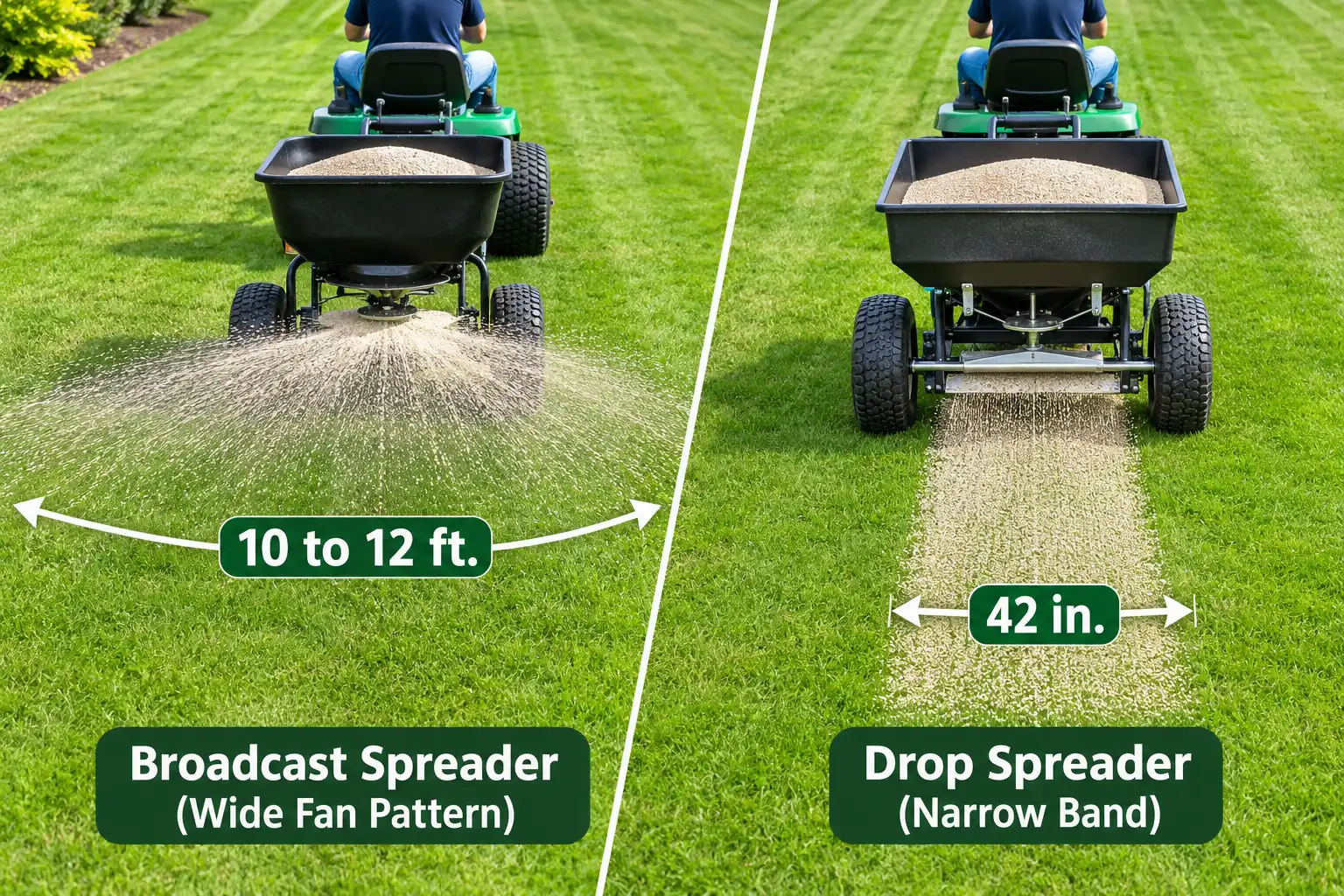
A push spreader still makes sense on small lots. Past that, a pull behind spreader trades walking for driving. Meanwhile, a 12V electric spreader suits machines that lack a usable hitch.
One rule covers most choices: broadcast for open ground, drop for edges and beds. Penn State Extension also prefers drop spreaders for small, confined areas and for very fine or lightweight granules.
How Big a Property Justifies a Tow Behind Spreader
The makers’ own per-fill ratings form a simple size ladder. Agri-Fab rates its 85 lb hopper at about 1/4 acre (14,000 sq ft), its 130 lb hopper at about 1/2 acre (25,000 sq ft) and its 185 lb hopper at about 1 acre (40,000 sq ft). Brinly aims its 175 lb BS36BH at properties of 1 acre and larger.
So the decision rule is short. Under 1/4 acre, a push spreader is enough. From 1/4 acre to 1 acre, a 130 lb tow unit saves the most walking. Past an acre, a 175 to 185 lb tow behind spreader for large yards cuts refill stops.
There is a catch, though. Those square feet per fill ratings assume a light fertilizer rate. By our arithmetic, Agri-Fab’s three ratings work out to just 4.6 to 6.1 lb of product per 1,000 sq ft. Lime goes on about ten times heavier, so hopper capacity shrinks fast, as the next section shows.
How Far One Hopper Goes: Tow Spreader Coverage by Material
A “25,000 sq ft per fill” rating fits one light fertilizer rate and little else. A 10-10-10 blend covers about half that, new-lawn seed covers less, and lime covers about a tenth.
The math takes one line: coverage (sq ft) = hopper lb ÷ product lb per 1,000 sq ft × 1,000. For granular fertilizer, Virginia Cooperative Extension finds the product rate as lb N wanted ÷ N percent × 100. So 1 lb N from a 24-0-6 takes 4.2 lb of product. For per-acre seed rates, divide by 43.56 to get pounds per 1,000 square feet.
Every figure below is our arithmetic from the cited rate.
| Material and rate (source) | 85 lb hopper | 130 lb hopper | 185 lb hopper |
|---|---|---|---|
| 24-0-6 at 1 lb N per 1,000 sq ft = 4.2 lb product (K-State N rate) | 20,400 sq ft | 31,200 sq ft | 44,400 sq ft |
| 10-10-10 at 1 lb N per 1,000 sq ft = 10 lb product | 8,500 sq ft | 13,000 sq ft | 18,500 sq ft |
| Tall fescue, new lawn, 6 to 8 lb per 1,000 sq ft (K-State) | 10,600 to 14,200 sq ft | 16,300 to 21,700 sq ft | 23,100 to 30,800 sq ft |
| Tall fescue, overseeding, 3 to 5 lb per 1,000 sq ft (K-State) | 17,000 to 28,300 sq ft | 26,000 to 43,300 sq ft | 37,000 to 61,700 sq ft |
| Pelletized lime, 50 lb per 1,000 sq ft, the single-application limit (UMD Extension) | 1,700 sq ft | 2,600 sq ft | 3,700 sq ft |
| Cereal rye food plot, 120 to 150 lb per acre broadcast (Mississippi State) | 0.6 to 0.7 acre | 0.9 to 1.1 acres | 1.2 to 1.5 acres |
| Crimson clover, coated seed, about 56 lb per acre for 25 lb PLS (Mississippi State rate, example lot) | 1.5 acres | 2.3 acres | 3.3 acres |
With a 10-10-10 blend, expect about twice the refills of a high-nitrogen lawn product, since only a tenth of each bag is nitrogen. That gap shows up in your coverage per fill right away.
Extension services also disagree on the nitrogen rate. K-State Research and Extension recommends 1 to 1.5 lb N per 1,000 sq ft in September for cool-season lawns. Virginia Cooperative Extension, working under state nutrient rules, allows up to 0.7 lb of water-soluble N every 3 to 4 weeks in fall. So a 130 lb load of 24-0-6 covers about 44,600 sq ft at Virginia’s rate but only 20,800 sq ft at K-State’s top rate. Use your own state’s figure, not a midpoint.
Food plots run on per-acre rates. Mississippi State University Extension lists cereal rye and oats at 120 to 150 lb per acre broadcast, versus 90 to 100 lb drilled. That premium matters when a tow behind seed spreader handles broadcasting oats or rye, since one 130 lb fill may not finish an acre. Clover rates, however, are pure live seed (PLS), not coated bag weight. For crimson clover at 25 lb PLS, a coated lot at 50 percent purity and 90 percent germination needs 25 ÷ 0.45, or about 56 lb per acre. Run the same check before planting soybean food plots.
Here the published data runs thin. Brinly (3.5 cu ft) and Chapin (2.2 cu ft) state hopper volume, while most other listings give pounds only. By our arithmetic, those two ratings assume material of about 50 to 68 lb per cubic foot. Light grass seed fills by volume first, so treat the seed rows as upper limits. Weigh one full hopper of your seed and rerun the formula.
Lime, Rock Salt and Sand: Check the Rating First
Only some tow spreaders are rated for lime, salt or sand, so check the maker’s listing before you load one. Pelletized lime is heavy, sand is abrasive, and rock salt or ice melt corrodes metal.
| Model | Seed and fertilizer | Pelletized lime | Rock salt or ice melt | Sand |
|---|---|---|---|---|
| Agri-Fab 45-0463 | Yes | Not listed | Yes | Not listed |
| Agri-Fab 45-0547 | Yes | Not listed | Yes | Yes |
| Brinly BS36BH-A | Yes | Yes | Yes | Yes |
| Chapin 8622B | Yes | No | No | No |
| Craftsman CMXGZBF7124571 | Yes | Not listed | Yes | Not listed |
| VEVOR TC2029A | Yes | Not listed | Yes | Not listed |
| Agri-Fab 45-0530-131 | Yes | Not listed | Ice melt | Not listed |
“Not listed” means the maker neither approves nor rules out the material, so treat it as a no until the manual says otherwise. The 45-0530-131 row follows listings for the 45-0530 it replaces.
If you plan to spread lime with a tow behind spreader, two more rules apply. University of Maryland Extension says to split any recommendation above 50 lb of limestone per 1,000 sq ft into two applications about six months apart. It also calls burnt and hydrated lime too caustic for lawns. So buy pelletized lime, which UMD notes is easier to apply than powdered lime. Agri-Fab’s manuals also advise against powdered lawn chemicals in their spreaders. Take the actual rate from your soil test report, not from the bag.
What to Look for in a Tow Behind Broadcast Spreader
Four specs decide most outcomes: the gearbox, the tires, whether you can reach the flow control from the seat, and whether the hitch fits your machine. Hopper size, spread pattern and warranty come next. Use this tow behind spreader buying guide to match features and specs to your own ground.
Hopper Size and Build
Size the hopper to your heaviest common job, not to lot size alone. A 130 lb tow spreader that covers half an acre of fertilizer covers only 2,600 sq ft of lime, per the coverage table. So if you lime every year, a 175 lb tow behind spreader cuts refill stops.
Most hoppers are poly. Agri-Fab and Brinly both use a rustproof poly hopper, which matters on a pull behind lawn fertilizer spreader because fertilizer salts and ice melt eat bare steel. Chapin lists a powder-coated steel frame on the 8622B. Any chip in that coating is where rust starts.
Also compare hopper capacity in pounds with volume in cubic feet. Brinly’s 175 lb hopper holds 3.5 cu ft, while Chapin’s 150 lb hopper holds 2.2 cu ft. For light seed, the bigger volume carries more.
Gearbox and Gears
Choose an enclosed gearbox. On any fertilizer pull behind spreader, the gears sit right under the dust and spray, and a sealed box keeps that grit and water out.
Gear material varies across the seven models. The Agri-Fab 45-0463 pairs its enclosed box with heat-treated bevel gears, and the 45-0547 lists a heat-treated steel gear. Brinly runs glass-filled nylon gears at a 6:1 gear ratio and lists greasable fittings, so plan to hit each grease fitting with a grease gun. VEVOR lists aluminum gears, while Chapin lists an enclosed gearbox with lubricated bearings.
Two habits wear gears fastest. First is speed: Agri-Fab’s manual warns that driving above 6 mph can cause excessive gear wear. Second is material. Chapin rules lime out of its 150 lb tow spreaders, and loading any product a unit is not rated for shortens gear life.
Tires, Frame and Stability
Pick pneumatic turf tires with a turf tread. Air-filled tires roll over bumps, keep the impeller steadier and press less on soft turf. Bigger tires and a wider stance also resist tipping.
Tire size tracks hopper size. A small lawn mower fertilizer spreader in the 85 to 110 lb class runs about 10 in tires. The 130 to 185 lb units run about 13 in, and the Chapin 8622B runs 14 in. Agri-Fab also widened the 45-0547 frame for stability on uneven ground.
Check tire pressure each season. Brinly’s manual sets 20 psi, but other makers differ, so follow your own manual. Owner reports describe tipping on rough terrain, so slow down there.
Flow Control, Auto-Stop and Reaching the Lever
Flow control from the seat matters more than any comfort feature. You open the gate after you start rolling and shut it before you stop, often dozens of times per job.
Direct rod control uses a rigid rod, which Agri-Fab says opens and closes the gate securely. The Agri-Fab 45-0463 and 45-0547 use it. Cable control, found on the 45-0530-131, routes the pull through a flexible cable instead. Either way, owner reports note the lever sits out of reach on some tractors. Brinly’s BS361BH-A version adds an extended handle.
Auto-stop comes in two designs. Chapin’s dual impeller stops spreading when the wheels stop, yet you still close the rate gate by hand to move without spreading. Brinly’s AutoFlow holds material on the fan at a stop and spins it off when you roll again. Neither replaces closing the gate for transport. Owner reports also call the 8622B auto-stop inconsistent at times.
Spread Width and Pattern Control
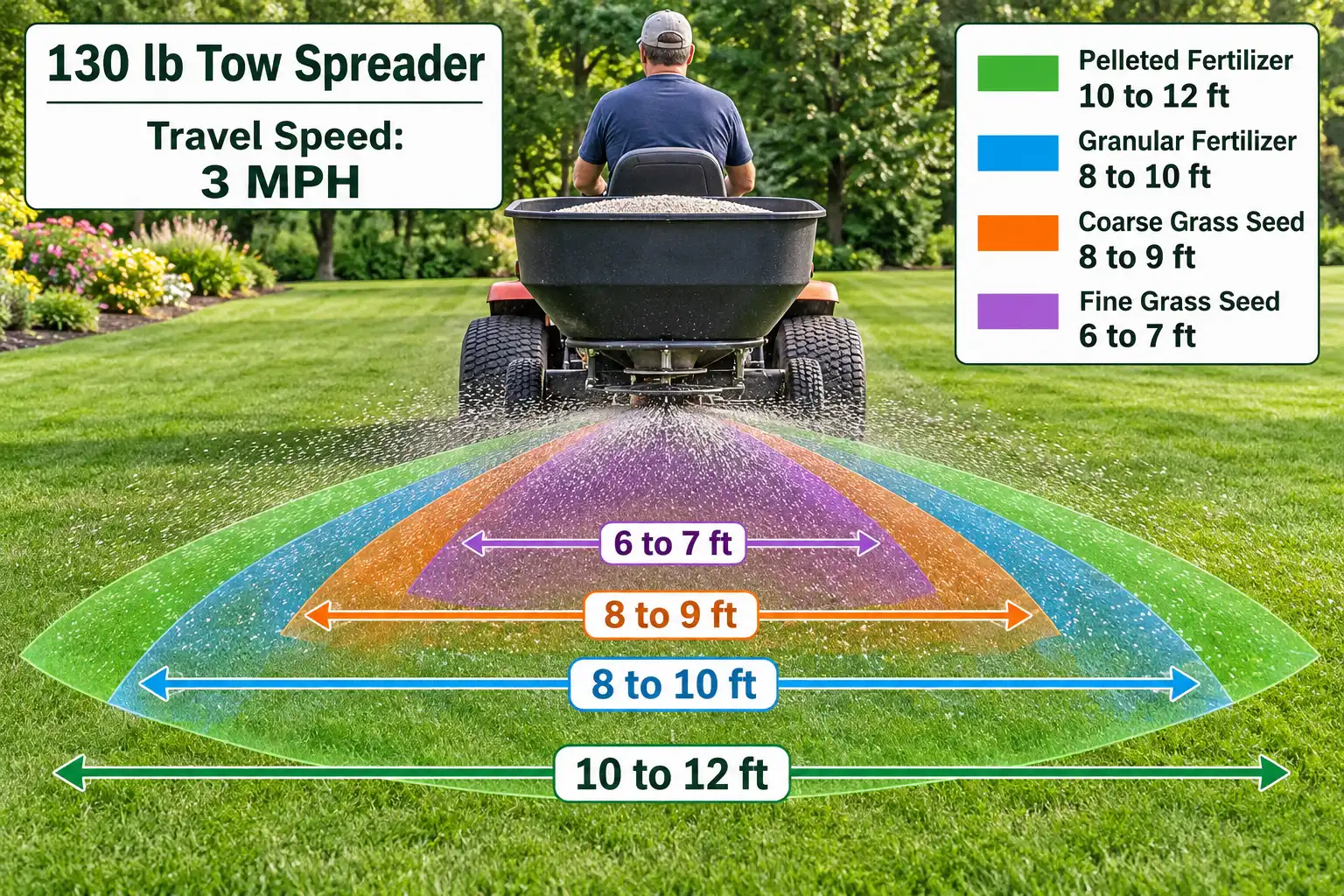
Published widths are the full throw, but you should space passes at the narrower effective swath. A rotary pattern tapers at the edges, so the outer granules land thin and need overlap from the next pass.
Spread width also follows ground speed and material. At 3 mph, the Agri-Fab 45-0463 chart lists 8 to 10 ft for granular fertilizer, 10 to 12 ft for pelleted fertilizer and only 6 to 7 ft for fine grass seed.
Pattern control helps near edges. Brinly’s directional spread pattern control centers the throw for seed versus fertilizer. Agri-Fab, meanwhile, sells an optional deflector kit to block one side near drives, beds and water. That matters, because Virginia Cooperative Extension advises keeping fertilizer off hard and paved surfaces.
Hitch Fit: Lawn Tractor, Zero-Turn or ATV and UTV
Lawn tractors are the easy case. Almost every lawn tractor spreader uses a universal hitch pin that drops through the tractor’s drawbar plate. A riding mower with a rear hitch plate takes the same pin, so most units sold as a spreader for riding mower use need no adapter.
Zero-turns vary, so check the mower before you buy any zero turn spreader. Brinly says its units fit many zero-turns that accept a hitch pin. Chapin, by contrast, does not recommend the 8622B behind a zero-turn. If your mower has no hitch, the Agri-Fab 45-0627 is a front-mount 12V zero turn mower spreader that skips the hitch question.
ATVs and UTV models need a unit rated for them. Chapin lists the 8622B for ATV, UTV or lawn tractor, and Agri-Fab builds the 45-0329 as its ATV broadcast spreader. An older Brinly manual warns against towing behind ATVs, so read the current manual before you hitch one up.
Towing speed limits also differ by maker:
- Brinly: spread at 3 mph, tow at 5 mph
- Chapin 8622B: 3.5 mph maximum
- Agri-Fab: 6 mph maximum with the drive engaged; pull the drive pin to free-wheel at up to 20 mph for transport
Warranty, Parts and Where It Is Built
Treat warranty length as one signal of build confidence, not proof of it.
- Agri-Fab: 3-year limited, wear parts excluded, built in Sullivan, Illinois
- Craftsman tow spreader: built by Agri-Fab, 3-year
- Brinly: 2-year, made in the USA
- Chapin: limited lifetime per Chapin (current listings say 1 to 2 years), made in USA in Batavia, New York
- VEVOR: warranty not stated in the listing
Parts support matters as much as the term. Agri-Fab sells replacement parts down to complete gearboxes, and Brinly sells parts online, which keeps an older unit running.
The 7 Best Tow Behind Broadcast Spreaders: Reviews
We don’t field-test equipment. Each review below draws on manufacturer specifications and patterns across verified owner reviews.
1. Agri-Fab 45-0463 130 lb Tow Spreader: Best Overall

- LARGE HOPPER CAPACITY: 130 lb hopper covers up to 1/2 acre or 25,000 sq ft with fewer refills, making this pull-behind s…
- UNIVERSAL TRACTOR COMPATIBILITY: Universal hitch design connects easily to most riding lawn mowers and lawn tractors, in…
- CONSISTENT WIDE SPREADING: Wide 10 ft to 12 ft spread width helps provide more even fertilizer and seed distribution wit…
Agri-Fab builds this 130 lb tow spreader in Sullivan, Illinois, and the same company makes Craftsman’s tow units. It suits lawn tractor owners spreading fertilizer, grass seed and ice melt on mostly level ground. Owner reports consistently praise the build quality and easy hose cleanup. Assembly instructions, however, draw the most complaints, so check every hardware packet on arrival.
Why it’s a good buy
- Half-acre rated fill
- Steel rod seat control
- Enclosed, removable gearbox
- Handles salt and ice melt
Why it’s not recommended
- Confusing assembly instructions
- Top-heavy on steep slopes
Specifications
- Frame: 1 in steel tubing
- Tires: 13 x 4 in pneumatic
- Spread width: 10 to 12 ft
- Warranty: 3-year limited
2. Brinly BS36BH-A 175 lb Tow Behind Broadcast Spreader

- High-capacity hopper: Extra large, rust- and dent-proof poly hopper holds 175 lb. (3. 5 cu. Ft.) of seed, fertilizer, Ic…
- Lasting durability: All parts that come in contact with corrosive fertilizers are designed to last: heavy polyethylene h…
- Patented autoflow with spread pattern control: Brinly spreaders are designed for professional-level results. Different m…
Verdict: Best for 1+ acre and lime jobs
Brinly-Hardy, an Indiana company founded in 1839, makes this 175 lb tow behind spreader. It is the only model here rated for pelletized lime and sand. Its patented AutoFlow stops the spread when you stop, and directional pattern control evens out a lopsided throw. Owner reports like the 30-minute assembly, but some describe gearbox and axle failures. Keep it near 3 mph and grease it on schedule.
Why it’s a good buy
- 175 lb, 1+ acre fill
- AutoFlow stops at standstill
- Spreads lime and sand
- Locking rate-gate dial
Why it’s not recommended
- Gate lever may drift
- Nylon gearbox failures reported
Specifications
- Gears: glass-filled nylon, 6:1
- Hopper: rustproof polyethylene, 3.5 cu ft
- Hardware: stainless shaft and agitator
- Spread width: up to 12 ft
3. Chapin 8622B TurfPro Tow-Behind Broadcast Spreader

- Reduce waste when stopping: Auto-stop technology stops material flow when you stop moving, helping prevent seed and fert…
- Spread with greater control: Dual impellers help distribute material evenly, while 11 gate settings let you match materi…
- Cover larger properties: The 2.2 cu ft poly hopper makes larger lawn and acreage tasks more manageable. Connects to a st…
Verdict: Best auto-stop pick for ATVs and UTVs
Chapin, based in Batavia, New York, makes the 8622B in the USA. Its dual impeller auto-stop halts flow the moment you stop, and two hitch pins come in the box for an ATV, UTV or lawn tractor. Owner reports praise the auto-stop and the 14 in tires on rough ground. However, Chapin rules out zero-turns, rock salt, sand and lime, and it caps speed at 3.5 mph.
Why it’s a good buy
- Auto-stop dual impeller
- 11 gate settings
- Two hitch pins included
- Made in the USA
Why it’s not recommended
- No salt, sand or lime
- Spread can run uneven
Specifications
- Hopper: 2.2 cu ft poly
- Frame: powder-coated steel
- Gearbox: enclosed, lubricated bearings
- Tires: 14 in wide-tread pneumatic
4. VEVOR TC2029A 130 lb Tow Behind Broadcast Spreader

- Precise Spreading, Beautiful Lawn: With a 10-ft wide spread and 30 adjustable settings, this tow behind spreader allows …
- Durable Construction: Featuring a powder-coated steel frame and aluminum gears for UV corrosion and impact resistance, p…
- Easy Installation: No tools required—assembly is simple enough for women or seniors. The fertilizer spreader with 130lb …
Verdict: Best for compost, topsoil and fine materials
VEVOR’s 130 lb spreader goes together without tools and ships with a clog-free grate and a clear cover. You can tow it or push it. Owner reports rate its spread highly for topsoil, compost and peat moss, which helps if you are building soil fertility with organic matter. The weak point is the gate. Some owners say it sticks open and dumps fertilizer, so test the latch before the first pass.
Why it’s a good buy
- Tool-free assembly
- Grate and cover included
- 30 rate settings
- Tow or push use
Why it’s not recommended
- Gate latch can stick
- Warranty not stated
Specifications
- Frame: powder-coated Q195 steel
- Gears: aluminum
- Tires: 13 in pneumatic
- Spread width: up to 9.8 ft
5. Agri-Fab 45-0547 185 lb Tow Behind Broadcast Spreader

- LARGE CAPACITY PERFORMANCE: 185 lb hopper provides ample capacity for seed, fertilizer, salt, sand, grit, and ice melt t…
- WIDE COVERAGE APPLICATION: Covers up to 1 acre or 40,000 sq ft with a spread width up to 12 ft, helping complete larger …
- CONVENIENT TOW-BEHIND CONTROL: Easy-to-use on and off flow control can be reached directly from the seat of your riding …
Verdict: Biggest hopper here, light duty only
The 45-0547 carries the biggest hopper on this list, rated for about 1 acre (40,000 sq ft) per fill. Agri-Fab adds heat-treated steel gears, a wider frame, 13 x 5 in turf tires and a hopper cover in the box. It also handles salt, sand and grit. Owner reports, though, often describe axle, wheel and gearbox failures, sometimes within the first few uses. Buy it for light materials on flat ground.
Why it’s a good buy
- 1-acre rated fill
- Hopper cover included
- Direct rod seat control
- Handles salt and sand
Why it’s not recommended
- Frequent durability complaints
- Weak agitator with clumps
Specifications
- Gears: heat-treated steel
- Hopper: rustproof polypropylene
- Tires: 13 x 5 in turf tread
- Warranty: 3-year limited
6. Craftsman CMXGZBF7124571 110 lb Tow Spreader
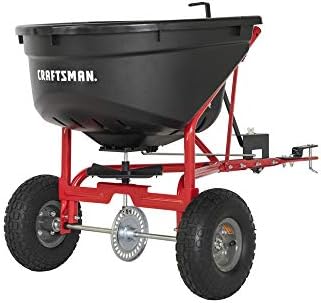
- LARGE CAPACITY COVERAGE: 110 lb hopper covers up to 1/3 acre or 17,500 sq ft with fewer refills, making this pull-behind…
- CONSISTENT SPREADING PERFORMANCE: Wide spread pattern up to 10 ft helps distribute fertilizer, grass seed, and lawn trea…
- UNIVERSAL TRACTOR COMPATIBILITY: Universal hitch design connects easily to most riding lawn mowers and lawn tractors for…
Verdict: Mid-size pick for occasional use
Agri-Fab builds this Craftsman spreader in Sullivan, Illinois, so it shares Agri-Fab’s 1 in steel tubing and enclosed gearbox. The 110 lb hopper covers about 1/3 acre (17,500 sq ft), which fills the gap between 85 and 130 lb units. Even so, owner reports often describe drive gears and wheels locking up after a few uses. Keep it for light, occasional jobs on flat lawns.
Why it’s a good buy
- Third-acre rated fill
- Steel rod seat control
- Spreads salt and ice melt
- Built by Agri-Fab
Why it’s not recommended
- Drive and wheel lockups
- Hardware sometimes missing
Specifications
- Frame: 1 in steel tubing
- Tires: 10 x 4 in pneumatic
- Hopper: rustproof polypropylene
- Warranty: 3-year limited
7. Agri-Fab 45-0530-131 85 lb Tow Behind Broadcast Spreader

- IDEAL FOR SMALL TO MEDIUM LAWNS: 85 lb hopper capacity covers up to 14,000 sq ft or approximately 1/4 acre to help simpl…
- CONSISTENT SPREADING PERFORMANCE: Delivers a spread width up to 10 ft, depending on material and application speed, for …
- CONVENIENT TRACTOR SEAT CONTROL: Cable flow control system allows easy opening and closing of material flow without need…
Verdict: Smallest hopper; check the gate first
This is Agri-Fab’s entry tow model, rated for about 1/4 acre (14,000 sq ft) per fill. At 18.4 lb, it lifts onto a garage shelf with ease. It replaces the 45-0530 and uses cable flow control with 10 in tires. Owner reports, however, center on a stiff plastic gate that won’t open or close cleanly. Work the gate by hand before the first fill, and return the unit if it binds.
Why it’s a good buy
- Light, compact frame
- Quarter-acre rated fill
- Enclosed gearbox
- 3-year limited warranty
Why it’s not recommended
- Gate binds or sticks
- Diagram-only instructions
Specifications
- Hopper: rustproof polypropylene
- Tires: 10 in pneumatic
- Spread width: up to 10 ft
- Frame: alloy steel
How to Set Up and Calibrate a Tow Behind Broadcast Spreader
Calibration turns a bag setting into a rate you can trust. Extension guides, including Penn State Extension’s, are written around push spreaders, yet the method transfers directly. The one change is that your tractor’s gear and throttle, not your stride, now set the speed. Here is how to calibrate a tow behind spreader in seven steps.
- Level the spreader. Set tire pressure and hitch height so the hopper rides level; Brinly’s manual sets 20 psi. A tilted unit throws more to one side.
- Treat the bag setting as a starting point. Penn State Extension says label settings are only a start, because ground speed differs between operators and spreaders. So the number on the bag only gets you close.
- Measure the effective swath. Lay shallow pans in a row across your path, 1 ft apart, and drive over them three times in one direction. Per Penn State Extension, the effective swath width is the distance between the two pans that caught half of what the center pan caught.
- Fix your speed. Agri-Fab’s charts assume 3 mph, which is 100 ft in 23 seconds. Time a 100 ft run in the gear and throttle you will actually use, then note that setting.
- Run a test strip. Load a weighed amount, spread it over a measured 50 or 100 ft test strip as Penn State Extension describes, then weigh what left the hopper. For example, a 10 ft swath × 100 ft equals 1,000 sq ft, so a 24-0-6 target at 1 lb N is 4.2 lb. If 5 lb left the hopper, close the gate a notch and rerun.
- Spread at half rate, twice. Set the gate for half rate and make two passes at right angles. Penn State Extension recommends this crisscross pattern because each pass hides the other’s skips and overlaps. It works the same way for seed and pelletized lime.
- Move before you open. Get rolling before you open the gate, and close it before you stop or turn, per Agri-Fab’s manual. Otherwise piles form wherever the impeller slows.
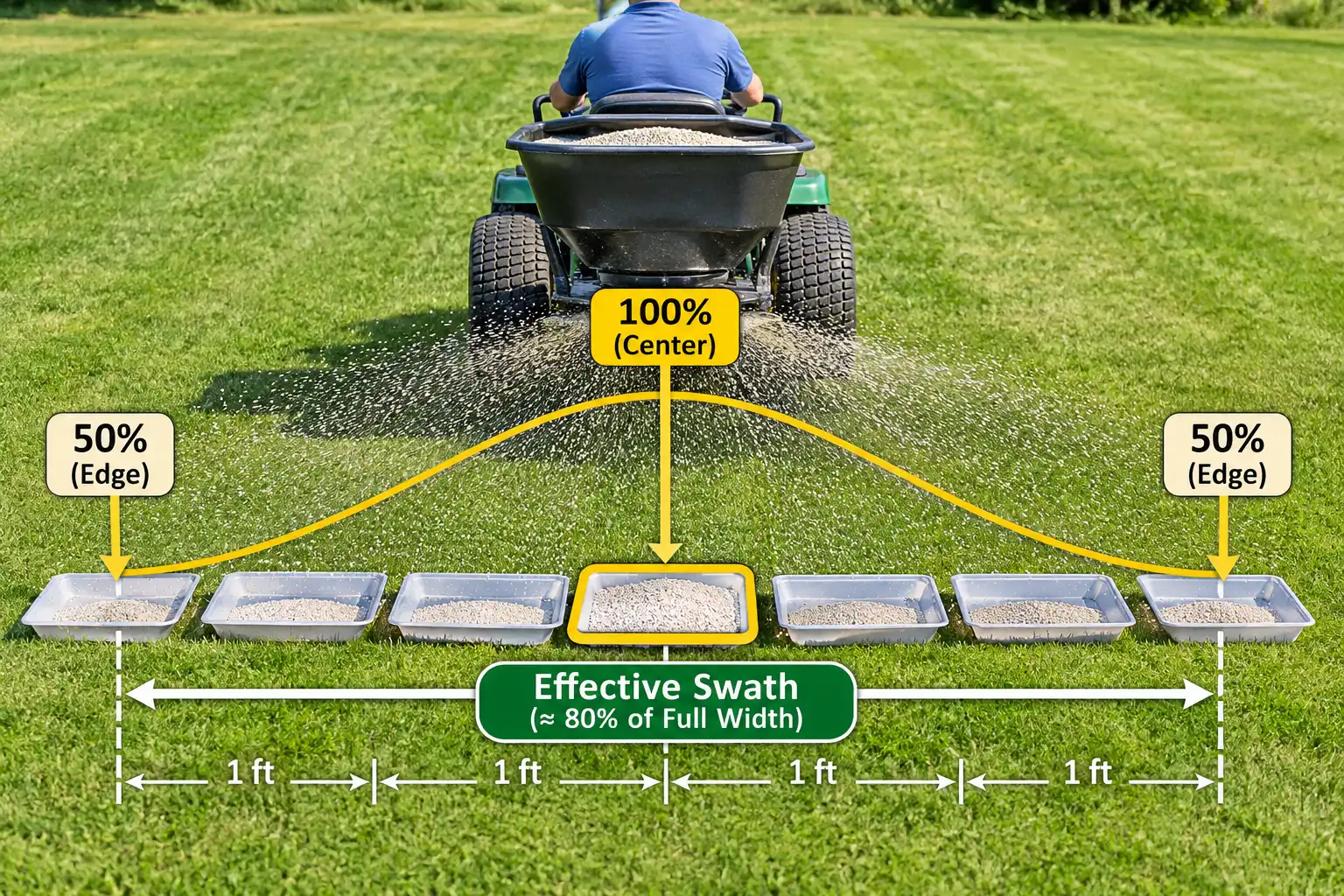
Now the time math, which is our arithmetic. At 3 mph you travel 264 ft per minute. With a 10 ft effective swath, that covers 2,640 sq ft per minute, or about 16.5 minutes of driving per acre before turns and refills. Two half-rate passes double that to about 33 minutes. Even so, steady ground speed matters more than fast speed, since every change shifts both width and rate.
Tow Spreader Problems and How to Fix Them
Most cases of tow behind spreader uneven spread trace back to six causes. Find your symptom, then work through the cause and the fix. The same list applies to any tow behind fertilizer spreader or seed rig.
Striping. Green and pale bands mean your passes sit wider than the effective swath. Narrow your spacing to the measured swath, then spread half rate in a crisscross, as Penn State Extension recommends.
One side heavier. The pattern is off center, or the unit is not riding level. Level the hitch first. Then, on a Brinly, adjust the directional pattern control until pans on both sides catch the same amount.
Clogging or bridging. Damp or clumped product hangs up over the gate and starves the impeller. Break up lumps as you fill, and use an agitator or hopper grate if your model takes one. Brinly fits a stainless agitator, and Agri-Fab sells a grate kit. For lime, stick with pelletized lime, which University of Maryland Extension notes is easier to apply than powder.
Piles at stops and turns. The gate stayed open while the impeller slowed down. Close it before you stop or turn, or choose an auto-stop unit.
Worn or stripped gears. Running above 6 mph speeds up gear wear, per Agri-Fab, and lime in a unit not rated for it adds strain. So slow down and match the material to the rating.
Tipping. Speed on rough ground or an overfilled hopper makes the unit top-heavy. Chapin warns against overfilling, so stop short of the rim and slow down on side slopes.
Cleaning and Storing a Tow Behind Spreader
Clean the spreader after every use, not once a season. Fertilizer and salt pull in moisture, and that moisture drives corrosion on every metal part they touch. Here is how to clean a fertilizer spreader the way the makers describe:
- Empty the hopper. Agri-Fab’s manuals say to store leftover material in its original bag, not in the spreader.
- Rinse it. Hose off the hopper, gate, impeller and frame, since Agri-Fab says to wash and dry the unit after each use. This step matters most after salt or fertilizer.
- Dry it fully. Leave the gate open so trapped water drains out.
- Lubricate. Agri-Fab calls for a light coat of oil on exposed metal, and Brinly units take grease at each grease fitting.
- Store it covered. Keep it somewhere dry, with the hopper cover on if your model has one. On an Agri-Fab, pull the drive pin first so the unit free-wheels as you roll it into storage.
One winter note: if you spread rock salt or ice melt, rinse after each storm rather than once in spring. Salt left in the gate over winter can seize it shut. Also, touch up chipped frame paint before rust spreads under it.
FAQs on Tow Behind Broadcast Spreader
Can you use a tow behind broadcast spreader with a zero-turn mower?
Yes, if your zero-turn has a rear hitch plate that takes a pin and the spreader’s maker allows it. Brinly fits many zero-turns, but Chapin rules out zero-turns for its 8622B, so check the manual first.
How fast should you drive with a tow behind spreader?
Aim for a steady 3 mph, or 100 ft in 23 seconds, the speed Agri-Fab and Brinly charts assume. Faster driving widens the throw and thins the rate, and Agri-Fab caps speed at 6 mph to protect the gears.
Can you spread lime with a tow behind spreader?
Yes, but use pelletized lime only, and only in a unit rated for it, such as the Brinly BS36BH-A. University of Maryland Extension advises splitting any rate above 50 lb per 1,000 sq ft into two applications six months apart.
Can a tow behind spreader spread salt or ice melt?
Many can, including the Agri-Fab 45-0463, 45-0547 and Brinly BS36BH-A, but the Chapin 8622B is not rated for rock salt. Rinse the hopper, gate and frame after every use, because salt corrodes exposed metal fast.
How many acres does one fill of a tow spreader cover?
Makers rate one fill at about 1/4 acre for 85 lb hoppers, 1/2 acre for 130 lb and 1 acre for 175 to 185 lb. Those ratings assume light fertilizer rates, so lime or 10-10-10 covers far less.
Can you use a tow behind spreader for grass seed?
Yes, and it’s a good way to seed or overseed big lawns. Expect a narrower throw, since Agri-Fab’s chart lists 6 to 7 ft for fine seed, and spread half the rate in two crisscross passes for even coverage.
How do you keep fertilizer off driveways and sidewalks?
Fit a deflector kit, set pattern control, or switch to a drop spreader for the edge pass along paved sides. Then sweep stray granules back onto the lawn, since Virginia Cooperative Extension advises keeping fertilizer off hard surfaces.
How do you clean a tow behind spreader?
After every use, empty the hopper back into the original bag, then hose off the hopper, gate, impeller and frame and let it dry with the gate open. Oil exposed metal, grease any fittings and store it covered and dry.
What to Check Before You Buy
Size the hopper to your heaviest common job with the coverage table, not to lot size. Confirm in the manual that your tow vehicle is allowed, since zero-turn and ATV rules differ by brand. Check that the material rating covers lime, salt or sand if you need them. Then calibrate on one test strip before the first real pass, because a tow behind broadcast spreader only delivers the rate you have measured.
