When to Plant Soybeans for Deer: Dates, Soil Temp, and Seed Rates
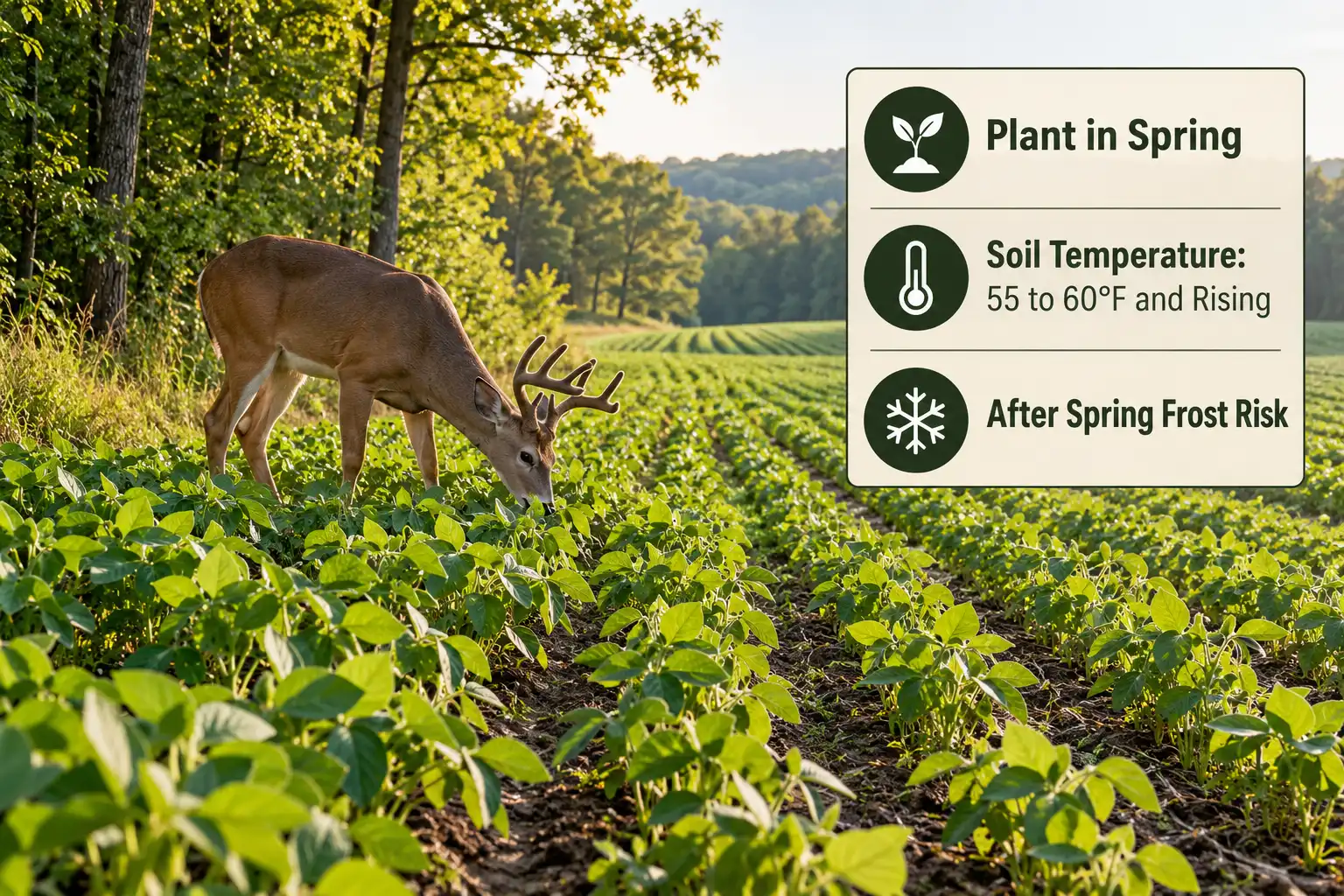
Knowing when to plant soybeans for deer helps you establish healthy summer forage and produce standing beans for fall and winter. Planting dates vary by region, but soil warmth, frost risk, soybean maturity, and deer browsing pressure determine whether a food plot succeeds.
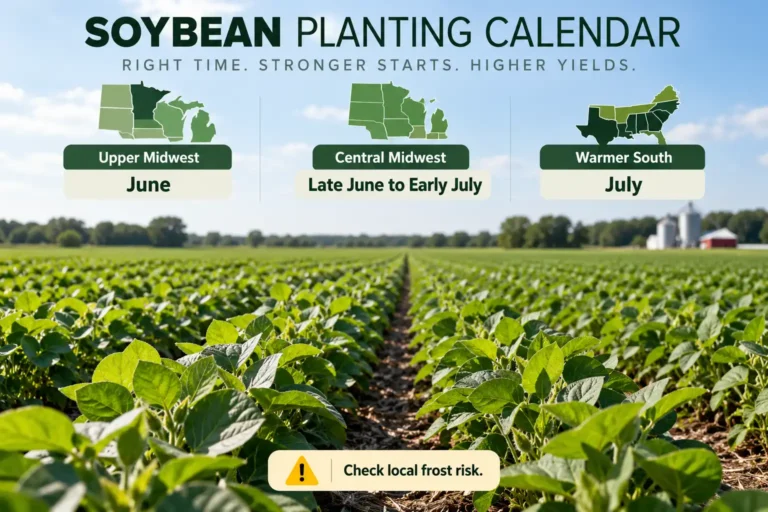
Plant soybeans for deer in spring, after the main frost risk has passed and soil temperatures reach 55 to 60°F and continue rising. Most U.S. planting windows fall between late April and June, depending on location.
When to Plant Soybeans for Deer by Region
The best planting window depends on your local spring weather, not just the calendar. Soybeans need warm soil, adequate moisture, and enough growing time to develop leaves and mature pods.
Regional extension recommendations provide useful starting dates.
| U.S. region | Typical planting window | Important consideration |
|---|---|---|
| Southeast, including Mississippi | April 15 to June 15 | Plant after cold weather and avoid saturated soil |
| Missouri and nearby central states | Mid-May to late June | Earlier planting generally supports greater forage growth |
| Northeast, including New York | Early to late May | Colder locations may need to wait longer |
| Upper Midwest, including Minnesota | May, sometimes early June | Match maturity group to the shorter frost-free season |
These are regional examples, not guaranteed dates for every county.
Mississippi State University Extension recommends April 15 through June 15 for both commercial and wildlife soybean food plots in the Southeast.
University of Missouri Extension identifies mid-May through late June as a suitable forage soybean window, with stronger growth potential from earlier planting.
In New York, Cornell University identifies approximately May 5 through May 25 as a favorable period in warmer growing regions. Cooler areas have a shorter planting window.
For northern areas, spring frost dates and early-fall maturity become especially important. USDA hardiness zones alone cannot determine a safe soybean planting date.
What Soil Temperature Is Best for Planting Deer Soybeans?
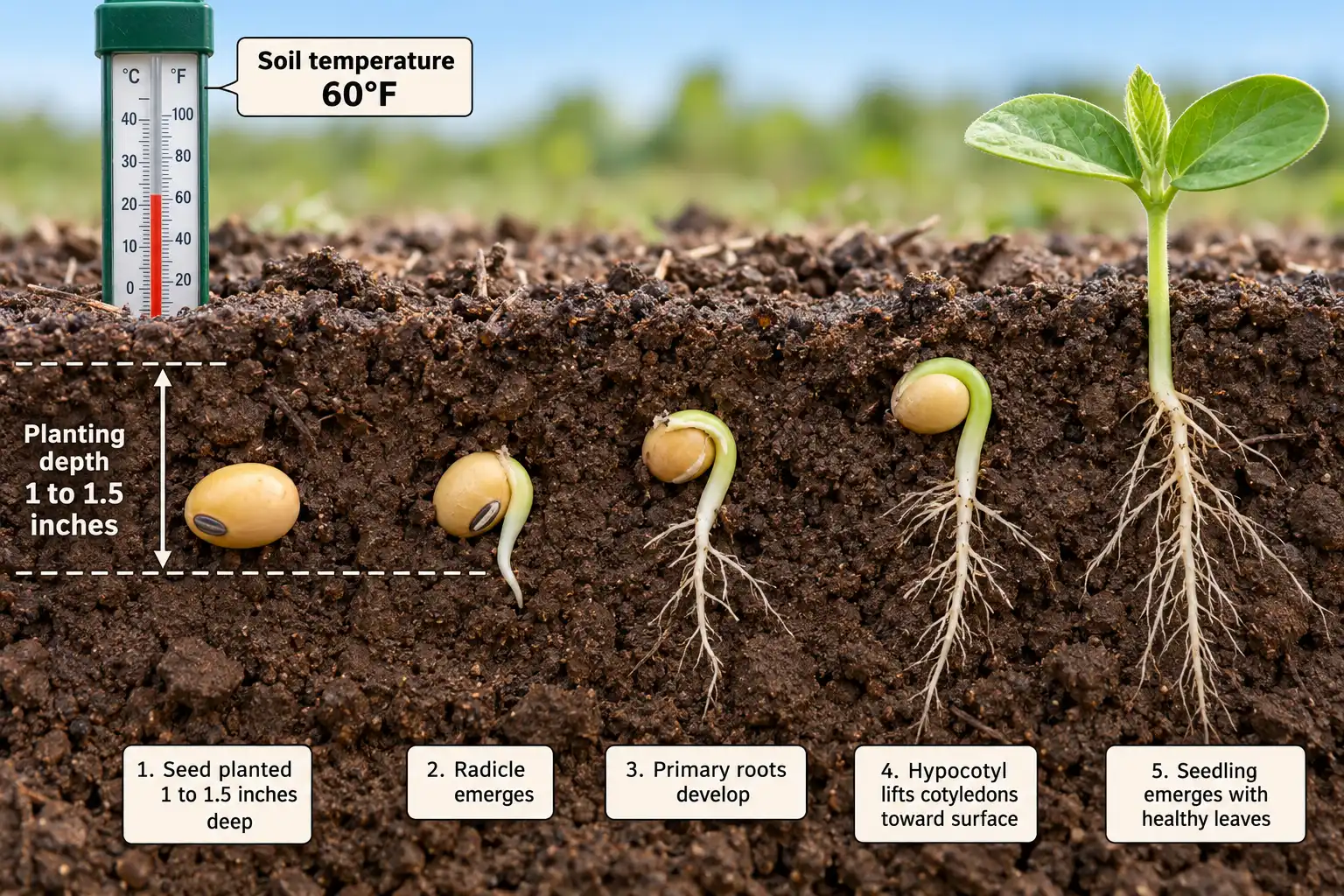
Wait until soil temperatures reach at least 55°F and are rising, preferably approaching 60°F or warmer.
Soybeans can germinate in cooler conditions, but cold, wet soil slows emergence and increases seedling disease risk.
The University of Minnesota Extension identifies 60 to 70°F as favorable soil temperatures for soybean establishment.
For a deer food plot, follow three weather checks:
- Measure soil temperature near the intended planting depth over several mornings.
- Check that the main spring frost danger has passed, particularly where replanting would be difficult.
- Choose a period with adequate soil moisture and no prolonged heavy rain in the forecast.
Do not plant simply because the afternoon air temperature reaches 75°F. Soil can remain considerably colder.
Also, avoid working saturated ground. Compacted soil and surface crusting can prevent soybean seedlings from emerging.
Should You Plant Soybeans for Summer Forage or Winter Beans?
Plant in spring for either purpose, but choose the soybean variety according to the food you want deer to have later.
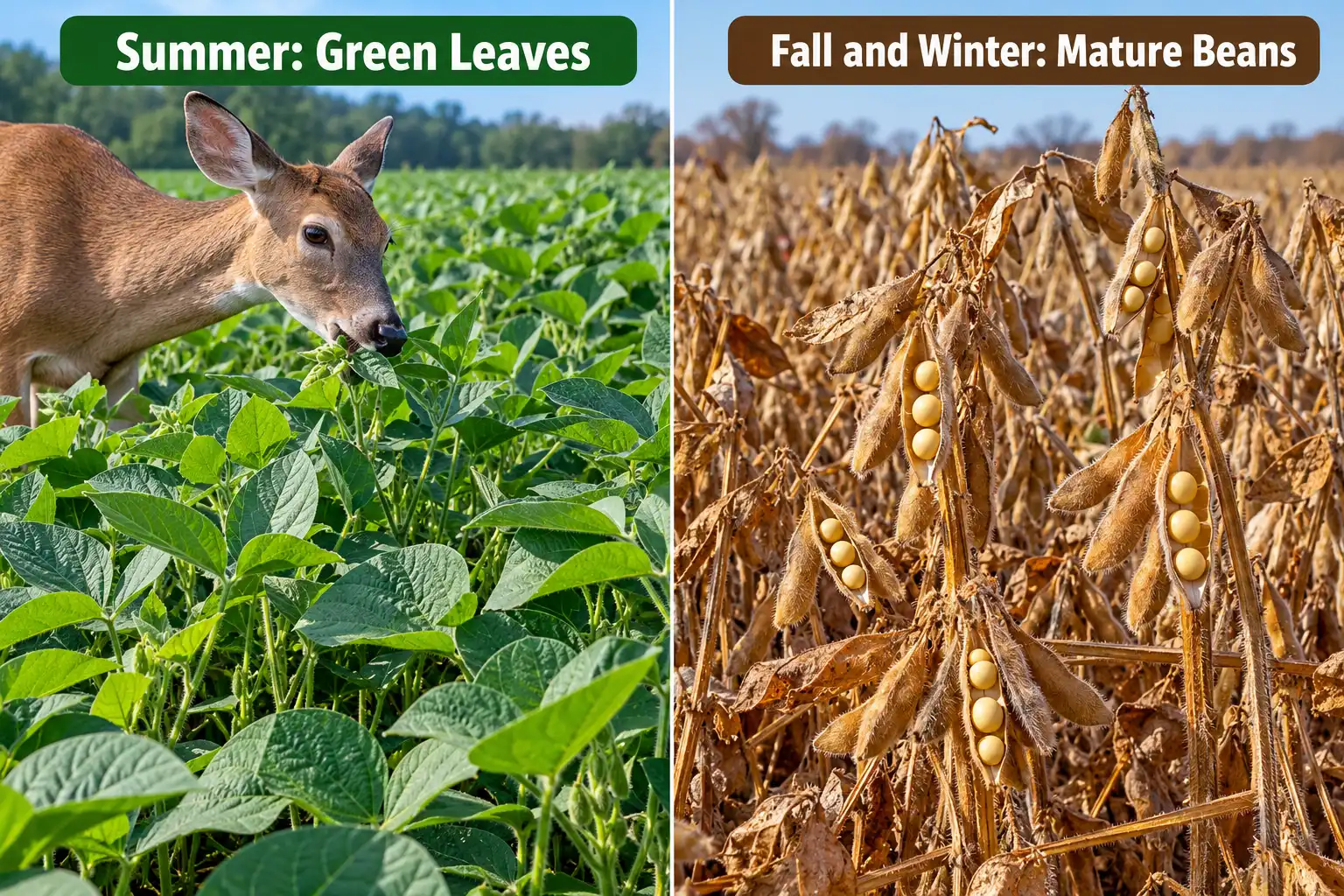
Soybeans provide two different seasonal food sources.
| Growing stage | Food available to deer | Main consideration |
|---|---|---|
| Spring emergence | Tender young plants | Heavy browsing can destroy seedlings |
| Summer vegetative growth | Green leaves and tender stems | Strong leaf growth supports summer feeding |
| Late summer to fall | Leaves, developing pods, and beans | Variety maturity affects the available food |
| Late fall and winter | Mature beans in standing pods | Pods must develop before damaging frost |
Forage soybeans for summer feeding
Forage varieties are generally selected for vigorous vegetative growth and leaf production.
For example, Mississippi State University Extension lists Big Fellow among wildlife soybean varieties.
Later-maturing varieties may remain leafy for longer periods. However, delaying maturity can reduce the chance of producing mature beans in northern growing regions.
Grain soybeans for fall and winter
Commercial grain varieties are bred primarily for seed production.
These can provide green summer forage while also producing pods that remain available after the leaves fall.
University of Maryland Extension explains that soybean maturity groups influence leaf retention, reproductive development, and grain maturity.
Its research also found no statistically significant overall deer preference among the soybean varieties compared. Location and surrounding cover were stronger predictors of deer use.
Practical choice: Select a regionally adapted grain-producing variety if standing winter beans are your priority. Consider a forage variety if sustained summer leaf growth matters more.
How to Plant a Soybean Food Plot for Deer
Start with a sunny, well-drained plot, then plant into moist soil at the correct depth.
A strong planting date cannot compensate for poor seed establishment.
1. Test and prepare the soil
Soybeans generally perform well in soil with a pH near 6.0 to 7.0.
Test the soil before planting and correct deficiencies according to the crop recommendation.
Use the soil test interpretation guide to understand pH, phosphorus, potassium, and lime requirements.
Remove competing weeds and grass before planting. A no-till drill can establish soybeans without extensive soil disturbance.
2. Select the seed and inoculant
Choose soybean seed adapted to your growing region.
Where soybeans have not been grown recently, use the appropriate soybean-specific rhizobial inoculant.
Effective inoculation helps roots form nitrogen-fixing nodules, reducing the need for additional nitrogen fertilizer.
3. Plant at the correct depth
Place soybean seeds approximately 1 to 1.5 inches deep in moist soil.
Narrow drilled rows can help plants establish a canopy and compete with weeds.
Broadcasting is possible on a prepared seedbed, but seeds still require suitable coverage and firm seed-to-soil contact.
4. Protect establishment
Inspect the food plot regularly during its first several weeks.
Look for missing seedlings, deer browsing, weeds, crusted soil, and excessive moisture.
If irrigation is available, use crop water requirement calculations to assess water needs rather than applying a fixed amount regardless of soil conditions.
How Much Soybean Seed Do You Need for a Deer Food Plot?
Seed requirements depend on the soybean type, planting method, and area.
Mississippi State University Extension publishes different seeding rates for commercial soybeans and wildlife soybean varieties.
| Soybean type and method | Seed per acre | Seed per ½ acre |
|---|---|---|
| Conventional soybean, drilled | 50 lb | 25 lb |
| Conventional soybean, broadcast | 100 lb | 50 lb |
| Wildlife soybean, drilled | 20 lb | 10 lb |
| Wildlife soybean, broadcast | 40 lb | 20 lb |
These are Mississippi State’s pure-stand recommendations for Southeast food plots, not universal rates for every seed variety. Seed size, germination, and seed-tag instructions can require adjustments.
Missouri’s 2026 forage soybean guidance, for example, recommends approximately 50 to 60 lb/acre for its studied production system.
Calculate seed for a smaller plot
Use this formula:
For a 100-by-100-foot plot:
- Area: 10,000 square feet, approximately 0.23 acre.
- At 50 lb/acre: approximately 11.5 lb of seed.
- At 20 lb/acre: approximately 4.6 lb of seed.
Use the rate appropriate to your selected seed rather than automatically increasing seed amounts to compensate for deer browsing.
How Do You Prevent Deer From Eating Soybeans Too Early?
Protect soybean seedlings during their first few weeks, especially where deer numbers are high.
Deer may begin browsing shortly after plants emerge.
University of Maryland Extension warns that a soybean seedling can die when deer remove the growing point below its cotyledons.
This makes the establishment stage particularly vulnerable.
Plot size matters
Small soybean food plots near wooded cover may receive more browsing than they can tolerate.
Even a one-acre plot can fail under intense deer pressure. A larger planting generally distributes browsing across more plants, but acreage alone does not guarantee survival.
Consider temporary electric fencing or other effective deterrents during establishment. Maryland Extension identifies temporary fencing as one method for protecting vulnerable soybean seedlings.
Where browsing pressure remains excessive, choosing crops suited to the field may be more productive than repeatedly replanting soybeans.
Keep competing weeds under control so surviving soybean plants receive adequate sunlight, water, and nutrients. If using herbicides, follow the product label and confirm compatibility with the soybean variety.
Can You Plant Soybeans Late and Still Get Winter Food?
Late planting can produce green forage, but it becomes less reliable for mature winter beans.
Soybean plants respond to temperature and day length. Planting later shortens the time available for vegetative growth and seed development.
This is particularly important in northern states.
University of Minnesota Extension recommends adjusting soybean maturity selection when planting is delayed beyond approximately June 10 in Minnesota. For grain production, an earlier-maturing variety helps reduce frost-related risk.
In Missouri research published in 2026, delaying forage soybean planting until early July reduced measured forage yield at the beginning-pod stage by 51% compared with the earlier planting. That result concerns forage production, not measured deer use.
What about fall planting?
Soybeans are not a dependable fall-planted crop for winter beans in areas with autumn frost.
If you want standing pods during deer season, establish the crop in spring and let it mature.
For fall green forage, consider cool-season crops such as oats, winter wheat, or suitable brassicas.
Mississippi State University Extension lists August 15 through October 15 as a Southeast planting window for oats and wheat in deer food plots. Other regions require different dates.
Common Soybean Food Plot Problems
A soybean food plot may fail even when the planting date is appropriate. Identify the cause before purchasing more seed.
| Problem | Possible cause | What to do |
|---|---|---|
| Seeds do not emerge | Cold, saturated, or crusted soil | Check seed condition and soil moisture before replanting |
| Seedlings disappear | Heavy deer browsing | Protect emerging plants with appropriate temporary fencing |
| Weeds overtake soybeans | Poor weed control before planting | Prepare a cleaner seedbed and manage weeds early |
| Weak, yellow plants | Waterlogging, nutrient deficiency, or poor nodulation | Check drainage, soil test results, and root nodules |
| Few mature pods by fall | Late planting or poorly adapted maturity group | Choose an earlier planting date or suitable variety next season |
Soybeans are particularly sensitive to poor drainage and early grazing. Replanting without addressing either problem often produces the same result.
FAQs About Plant Soybeans for Deer
How long does it take soybean seeds to sprout?
Soybean seedlings commonly emerge about 10 days after planting, although the University of Minnesota Extension reports a range of 5 to 15 days. Warm soil and adequate moisture support faster, more uniform emergence.
Can you broadcast soybeans without tilling?
Yes, but seeds need adequate contact with soil and suitable coverage to germinate consistently. A no-till drill is preferable in established vegetation, while broadcast seeding works better on a prepared, relatively bare seedbed.
Can you grow soybeans for deer on half an acre?
Yes, a half-acre soybean plot can establish successfully where browsing pressure is manageable. However, concentrated deer feeding may destroy young plants, so temporary protection or a less browsing-sensitive forage may be necessary.
Do food plot soybeans come back every year?
No, soybeans are warm-season annual plants and must be replanted each growing season. Although mature pods can remain standing into winter, the soybean plants themselves do not survive and resume growth the following spring.
Do soybeans need nitrogen fertilizer?
Usually not when plants develop healthy nitrogen-fixing root nodules. Soil testing should guide phosphorus, potassium, and lime applications, while suitable soybean inoculant supports nodulation in soils without a recent soybean-growing history.
Will deer eat soybeans after the leaves turn brown?
Yes, deer can consume mature soybean beans after the foliage turns yellow and drops. For reliable late-season food, the plants must develop mature pods before damaging frost and retain sufficient beans despite earlier browsing.
Key Points for Your Deer Food Plot
For most deer food plots, spring planting into warming soil near 60°F offers a dependable starting point.
Choose the date using local frost conditions, not a nationwide calendar. Match the soybean maturity group to your intended feeding season, plant at the correct depth, and protect seedlings where deer browsing is intense.
If winter food is your priority, favor established, mature soybean pods over late-planted green growth.