How Late Can You Plant Soybeans? Regional Dates and Yield Risk
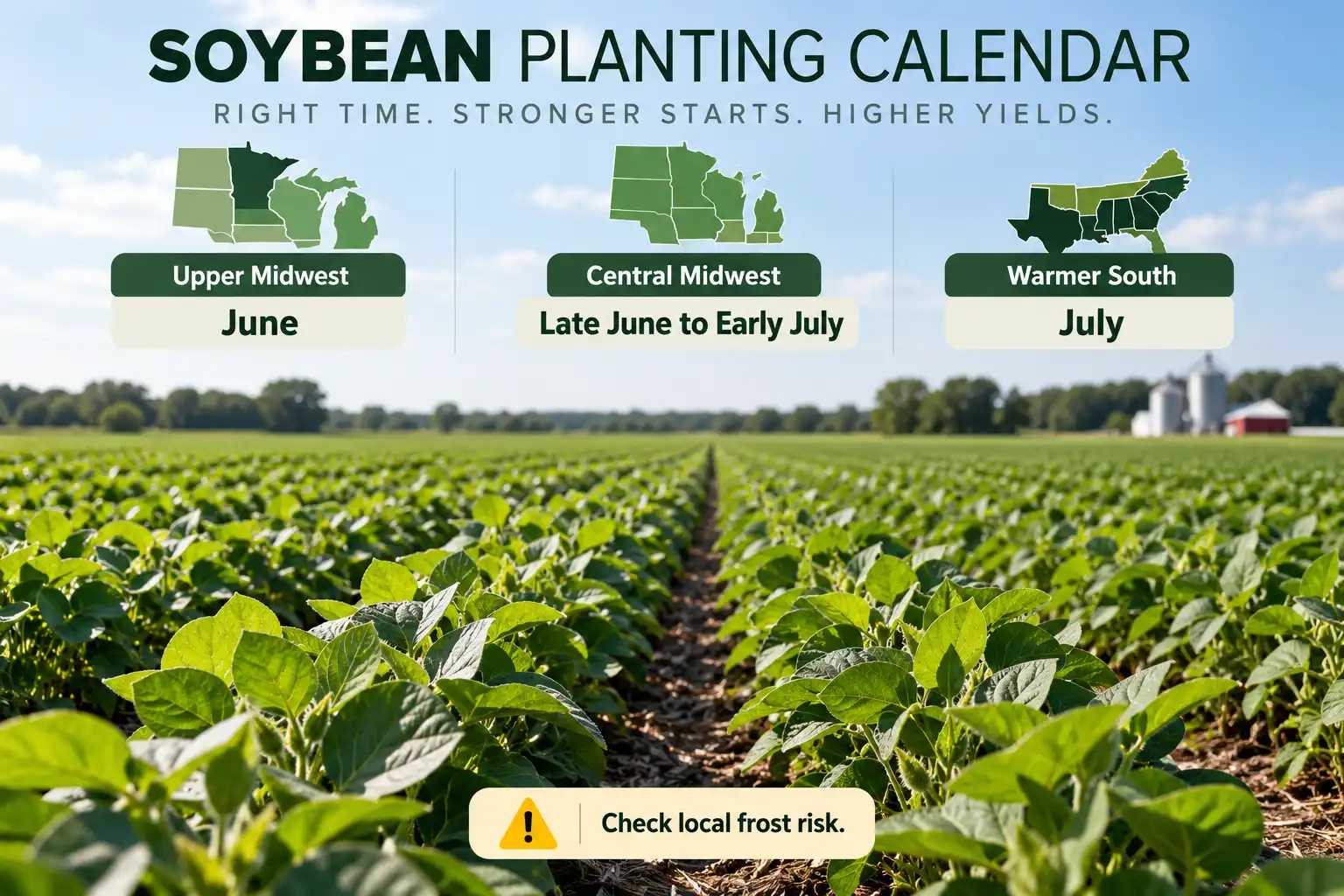
June planting remains possible across much of the Midwest. Some southern regions support July planting. Your location, soybean maturity group, soil moisture, and fall frost risk determine whether another planting is worthwhile.
Most Midwest growers can still plant soybeans in June, although yields generally decline. Early July planting is possible in selected areas, while parts of the South support later July planting. Fall frost risk and variety maturity determine the practical limit.
How Late Can You Plant Soybeans in Different States?
The latest practical soybean planting date varies substantially across U.S. growing regions.
Northern states have shorter frost-free seasons. Southern locations generally provide more growing time, although drought and heat can still limit yield.
The following table summarizes late-season planting opportunities based on regional university extension guidance.
| Region | Late planting window | Main consideration |
|---|---|---|
| Minnesota and northern Upper Midwest | June, with increasing risk in late June | Short growing season and early frost |
| Iowa | Through June; early July is high-risk | Sharp yield decline after mid-June |
| Ohio | Late June to about July 10 in suitable situations | Choose a maturity group suited to the planting date |
| Missouri | Late June and some July planting | Reduced yield potential and variable summer rainfall |
| North Carolina | June through late July | Longer growing season and double-crop opportunities |
These are agronomic decision windows, not guaranteed final planting dates.
University of Minnesota Extension documents significant yield reductions through June.
Iowa State University Extension provides regional yield comparisons, while Ohio State University Extension identifies suitable maturity groups through early July.
University of Missouri Extension reports variable July results. NC State Extension documents soybean planting through the end of July.
How Much Soybean Yield Is Lost When Planting Late?
Soybean yield potential usually declines as planting moves from May into June and July.
The main reason is reduced vegetative growth before flowering.
Soybeans respond strongly to day length. Late-planted soybeans often develop fewer nodes and branches, leaving fewer sites for pods.
Soybean yield potential by planting date
Iowa State University Extension published the following historical relative-yield results.
| Planting date | Northern Iowa | Southern Iowa |
|---|---|---|
| Early June | 81% | 89% |
| Mid-June | 61% | 82% |
| Early July | 33% | 47% |
Percentages compare yields with the highest-yielding planting period in each region. They are historical research results, not predictions for every field.
July yields also vary dramatically between seasons.
University of Missouri Extension reported that soybeans planted around July 20 yielded in the upper 20s bushels per acre during one research year. A July 19 planting produced only 8 bushels per acre in another year affected by frost.
The practical lesson is that planting date changes yield potential, but late-season weather determines how much of that potential remains.
Which Soybean Maturity Group Should You Plant Late?
Choose a locally adapted maturity group that can reach physiological maturity before a damaging fall freeze.
Soybeans use relative maturity (RM) ratings to describe adaptation and development. Lower numbers generally represent earlier-maturing varieties.
However, switching to the earliest available variety is not always beneficial. Very early varieties can flower before producing enough nodes.
Regional maturity recommendations differ
University of Minnesota Extension recommends considering a variety about 0.5 RM unit earlier after June 10. A reduction of approximately 1.0 unit may be appropriate for late-June planting.
For example, a normally planted RM 1.7 soybean might be replaced with an RM 1.2 variety during delayed planting.
By comparison, Iowa State’s soybean replant guidance advises retaining well-adapted varieties unless planting extends into late June.
Missouri Extension generally favors retaining the normal maturity group for delayed planting, with shorter-season choices potentially needed in mid-to-late July.
These recommendations reflect differences in regional frost risk.
For a specific example, Ohio State recommends RM 3.0 to 3.3 for northern Ohio soybeans planted July 1 to 10, compared with RM 3.4 to 3.7 in southern Ohio.
Use physiological maturity rather than a fixed number of days
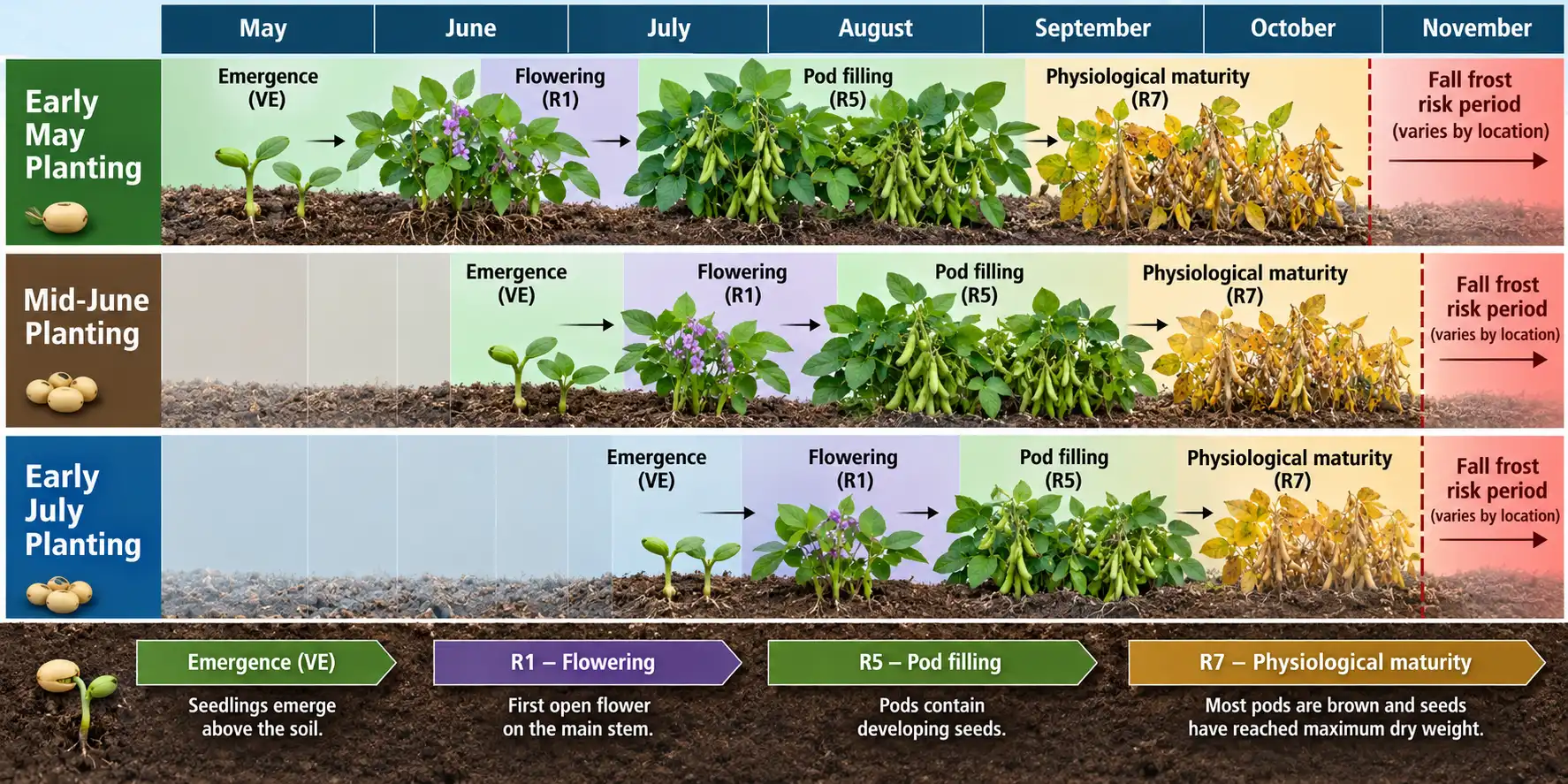
Soybeans reach the R7 stage when one normal pod on the main stem develops its mature color. R8 occurs when about 95% of pods reach mature color.
Aim for R7 before the expected damaging freeze, with additional time for the crop to finish maturing and dry before harvest.
Do not assume a late-planted soybean needs the same number of calendar days as one planted in May.
How Should You Adjust Seeding Rates and Row Spacing?
Late-planted soybeans often benefit from faster canopy closure, but higher seeding rates are not automatically profitable.
Select a population suited to your region
Ohio State Extension recommends final populations of approximately 130,000 to 150,000 plants per acre for June plantings.
NC State Extension research found that 165,000 to 175,000 planted seeds per acre often maximized yield after mid-June in its production environments.
However, Minnesota Extension trials found that increasing seeding rates did not provide an exceptional benefit specifically because planting was delayed.
These are different regional findings. Also, planted seeds per acre and established plants per acre are not interchangeable.
Calculate your seed requirement
Suppose your target is 150,000 established plants per acre, with 85% of planted seeds expected to establish.
Seeds needed = Target plants ÷ Expected establishment rate
150,000 ÷ 0.85 = approximately 176,500 seeds per acre.
At 15-inch row spacing, that equals approximately:
- 5.1 seeds per foot of row.
- 510 seeds per 100-foot row.
- 1,520 seeds across three 100-foot rows in a 4-foot-wide bed.
- 1.76 million seeds for a 10-acre field.
These figures are planning examples, not universal seeding recommendations.
Choose rows that close the canopy sooner
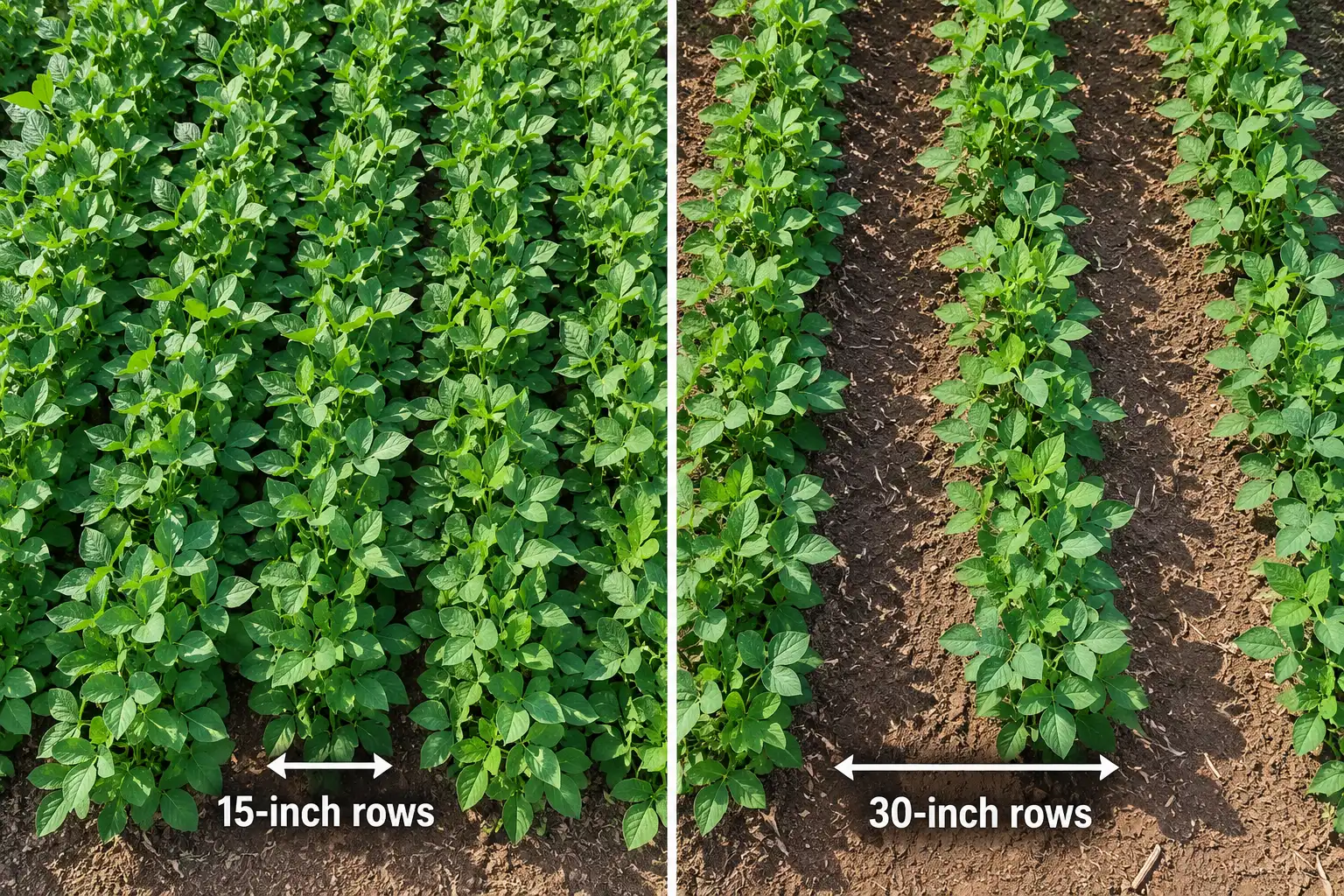
Rows spaced 7.5 to 15 inches apart can capture sunlight sooner than 30-inch rows.
That advantage becomes more useful when soybean vegetative growth is shortened.
However, do not delay planting several additional days merely to obtain different equipment. Field readiness and planting speed still matter.
How Do You Establish a Healthy Late-Planted Soybean Stand?
Plant into suitable soil conditions rather than forcing the planter through saturated ground.
Warm soil usually supports fast summer emergence. However, excessive moisture, soil compaction, and poor seed placement can reduce stands.
Plant at the right depth
Planting depth depends on soil texture, available moisture, and regional recommendations.
University of Minnesota Extension describes approximately 1.5 inches as a suitable depth under favorable conditions.
NC State Extension generally recommends 0.75 to 1.25 inches, with deeper placement justified in certain conditions.
Keep the seed in firm contact with moist soil. Avoid leaving seed in a dry surface layer or an open seed furrow.
Manage moisture and soil fertility
Water stress during flowering and pod filling can severely restrict grain development.
Check moisture throughout the root zone. Where irrigation is available, use crop stage and soil conditions to calculate crop water requirements.
Also, avoid extra fertilizer simply because planting occurred late.
According to NC State’s soybean nutrient management guide, properly nodulated soybeans usually fix sufficient nitrogen.
Base phosphorus, potassium, and lime decisions on a current soil test. You can use a soil test report to identify actual nutrient limitations.
Inoculation deserves attention on fields without a recent soybean history or where severe flooding has disrupted nodulation.
Can You Plant Soybeans After Wheat Harvest?
Yes. Double-crop soybeans are commonly planted after wheat harvest in regions with sufficient remaining growing time.
This system provides two harvested crops from the same ground during one growing season.
However, soybean planting should follow wheat harvest as soon as practical.
Waiting several weeks reduces the time available for canopy development and pod production.
For late double-crop planting:
- Have soybean seed and planting equipment ready before wheat harvest.
- Preserve soil moisture by minimizing unnecessary tillage.
- Choose a maturity group that can mature before damaging frost.
- Consider narrow rows for faster canopy closure.
- Check previous herbicide labels for crop rotation restrictions.
Ohio State Extension recommends 7.5-inch or 15-inch rows for double-crop soybeans. Its guidance includes suitable maturity groups for plantings through July 10.
In North Carolina, late-June and July soybean planting is a recognized part of regional production systems.
A successful double crop still depends on rainfall, harvest timing, and adequate remaining growing days.
Does Crop Insurance Set the Last Day to Plant Soybeans?
Crop insurance final planting dates are financial coverage deadlines, not biological limits on seed growth.
The USDA Risk Management Agency (RMA) establishes different dates according to the insured crop, location, and applicable insurance provisions.
Many soybean policies include a late planting period after the final planting date.
Under standard provisions, the production guarantee generally decreases by 1% for each day planted during that period.
For example, planting June 25 after a June 15 final planting date would mean a 10% reduction in the production guarantee.
That does not mean actual harvested yield automatically declines by 10%.
Coverage after the late planting period has additional eligibility conditions. Prevented planting payments also depend on meeting policy requirements.
Check your county and crop year in the USDA RMA Dates Map Viewer, then discuss your options with your crop insurance agent before planting or changing crops.
When Is It Too Late for Soybeans to Be Worth Planting?
Planting becomes difficult to justify when expected harvestable yield cannot cover the remaining production costs or frost risk becomes unacceptable.
A simple break-even calculation helps.
Break-even yield = Remaining production costs per acre ÷ Expected soybean price per bushel
Consider a hypothetical field with $200 per acre in remaining costs and an expected selling price of $10 per bushel.
$200 ÷ $10 = 20 bushels per acre.
The crop must produce more than 20 bushels per acre to cover those costs.
This illustration excludes any additional fixed costs, insurance effects, or financing adjustments not included in the $200 estimate. The price is hypothetical, not a current market quote.
Also consider the probability of harvesting the predicted yield.
A field with attractive yield potential but substantial frost exposure may still represent a poor financial decision.
If soybeans are replacing unplanted corn, compare the decision with the remaining opportunities for late corn planting.
Common Problems With Late-Planted Soybeans
Late planting leaves less time to recover from establishment problems.
| Problem | Likely cause | Recommended response |
|---|---|---|
| Slow or uneven emergence | Dry seed zone, crusting, or compacted furrow | Check planting depth, moisture, and seed placement |
| Small plants at flowering | Shortened vegetative period | Maintain weed control and protect available moisture |
| Heavy weed competition | Delayed canopy closure | Scout early and follow approved herbicide labels |
| Poor stand establishment | Seedling disease or unfavorable soil conditions | Inspect seedlings and consider an appropriate labeled seed treatment |
| Immature pods near frost | Excessive maturity length or very late planting | Reassess maturity selection and frost risk before seeding |
Pay particular attention to herbicide restrictions.
Soybean growth stages can advance quickly after delayed planting. Postemergence herbicide labels may restrict applications by growth stage, calendar date, or other conditions.
Never assume that a late planting date extends a pesticide application deadline.
FAQs About Late Can You Plant Soybeans
Is June 15 too late to plant soybeans?
No. June 15 is still a workable soybean planting date in many U.S. production regions. However, expected yield is generally lower than for earlier planting, especially in northern locations with shorter growing seasons.
Can soybeans be planted in July?
Yes. July soybean planting is possible in some regions, particularly southern states and double-crop systems. However, yield potential declines and frost risk increases. Choose a locally adapted maturity group before committing seed and fieldwork costs.
Can you plant soybeans in August?
August is usually too late for dependable grain soybean production across most of the Midwest. Some warmer regions or specialized systems differ, but grain maturity and profitability require local verification. Soybeans may instead serve a cover-crop purpose.
Should you replant a thin soybean stand in June?
Not automatically. Established soybeans can compensate for low populations through branching. Iowa State Extension suggests evaluating replanting when uniform late-May to June stands fall below approximately 50,000 to 60,000 plants per acre.
Do late-planted soybeans need more fertilizer?
Not simply because planting is late. Soybeans with effective nodulation usually supply much of their nitrogen through biological fixation. Correct phosphorus, potassium, or pH limitations according to soil-test recommendations rather than applying additional nutrients without evidence.
Will late-planted soybeans mature before the first frost?
They may, but planting date alone cannot establish that outcome. Location, maturity group, temperature, and day length affect development. Compare expected physiological maturity with local historical freeze risk before planting in late June or July.
Key Points for Your Soybean Planting Decision
June planting remains possible across much of the Midwest, while July planting is more region-dependent.
Before planting late, confirm the maturity group, expected frost exposure, soil conditions, and break-even yield. Keep soybean seed in a suitable moisture zone and avoid unnecessary planting delays.
The latest possible planting date is not necessarily the latest profitable planting date.