10-10-10 Fertilizer: N-P-K, Rates, Organic Options, Top Picks
The three numbers on a bag of 10-10-10 fertilizer decide where it helps and where it wastes money. Read the label right, and one bag can feed a vegetable bed for a season. Spread it on an established lawn, and you pay for phosphate the grass rarely needs.
10-10-10 fertilizer is a balanced blend: 10% nitrogen, 10% phosphate, and 10% potash by weight. Penn State Extension suggests 1.75 pounds per 100 square feet for untested vegetable gardens. Most established lawns need nitrogen without the phosphorus.
What Is 10-10-10 Fertilizer?
10-10-10 fertilizer is a complete, balanced fertilizer with equal parts of the three primary plant nutrients. Many gardeners call it triple 10. Its ratio is 1-1-1, so every pound of nitrogen arrives with the same weight of phosphate and potash.
The three numbers are the N-P-K grade. They always run in the same order: nitrogen first, then phosphate, then potash. Each one is a percent of the bag’s weight.
Other balanced grades share the ratio but not the strength. UF/IFAS Extension rates 1 pound of 10-10-10 as equal to 1⅔ pounds of 6-6-6, 1¼ pounds of 8-8-8, or ¾ pound of 13-13-13. So a stronger grade means fewer pounds to spread, not a different diet.
What Does 10-10-10 Mean on the Bag?
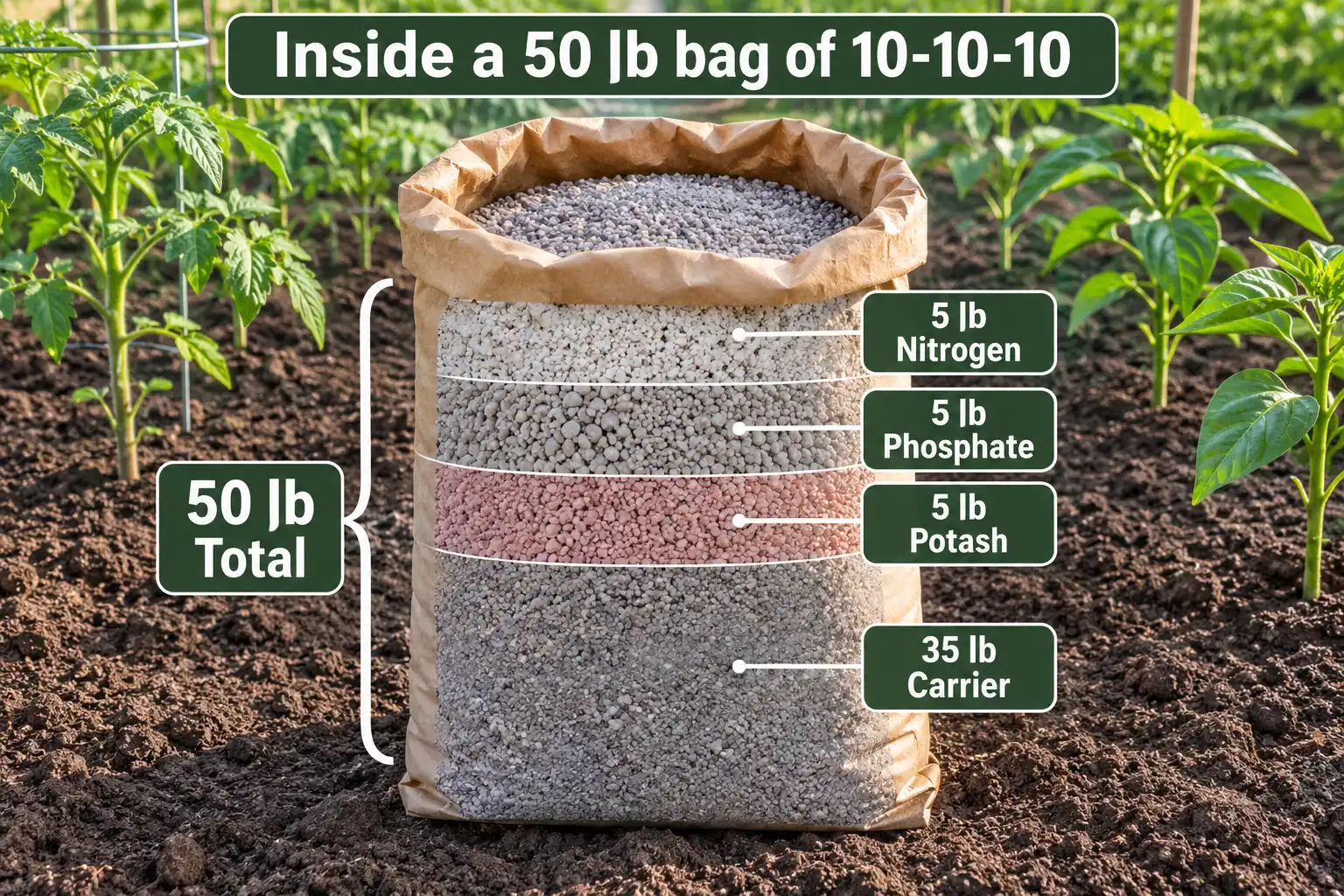
10-10-10 means every 100 pounds of product holds 10 pounds each of nitrogen (N), phosphate (P2O5), and potash (K2O). Phosphate and potash are oxide forms, though, not the pure elements.
Penn State Extension gives the conversions. Multiply P2O5 by 0.44 to get actual phosphorus, and multiply K2O by 0.83 to get actual potassium.
| Bag size | Nitrogen (N) | Phosphate (P2O5) | Actual phosphorus (P) | Potash (K2O) | Actual potassium (K) |
|---|---|---|---|---|---|
| 5 lb | 0.5 lb | 0.5 lb | 0.22 lb | 0.5 lb | 0.42 lb |
| 40 lb | 4 lb | 4 lb | 1.76 lb | 4 lb | 3.32 lb |
| 50 lb | 5 lb | 5 lb | 2.2 lb | 5 lb | 4.15 lb |
The other 35 pounds in a 50 pound bag is the rest of the nutrient compounds plus carrier material.
In practice, you rarely need the elemental figures. Penn State notes that soil test recommendations are almost always written in pounds of P2O5 and K2O. Those are the same units printed on the bag, so you can match them directly.
What Is 10-10-10 Fertilizer Good For?
10-10-10 is good for feeding vegetable and flower beds before planting, especially without a soil test. It covers all three primary nutrients in one pass.
UF/IFAS Extension uses it as the preplant feed for corn, greens, peppers, eggplant, onions, potatoes, and tomatoes. It also works as a mid-season sidedress for tomatoes, peppers, onions, and squash. For potatoes, UF/IFAS adds 1 pound per 25 feet of row three weeks after planting. Match that timing when fertilizing potatoes in your own rows.
Still, a balanced grade is the wrong tool in several common cases.
| Situation | Better choice | Why |
|---|---|---|
| Soil test shows high phosphorus | Nitrogen-only or N-K grade such as 10-0-10 | Extra phosphate adds nothing and builds up |
| Beans and peas | Half the usual 10-10-10 rate | UF/IFAS says excess nitrogen limits production |
| Leafy greens mid-season | Nitrogen-only sidedress | UF/IFAS recommends nitrogen sidedressings for them |
| Established lawn | Lawn grade near 24-0-12 | Grass mostly needs nitrogen and potash |
| New lawn on low-phosphorus soil | 10-10-10 or a starter grade | Phosphorus speeds root establishment |
That first row is common. University of Minnesota Extension reviewed soil tests from 1988 to 2021. Lawns and gardens had a median of 68 ppm phosphorus (Bray), against 26 ppm for farm fields. Vegetables need only 20 ppm. Above 25 ppm Bray or 18 ppm Olsen, UMN advises skipping phosphorus for a few years.
Is 10-10-10 Fertilizer Good for Lawns?
10-10-10 is a poor fit for most established lawns. Grass uses far more nitrogen than phosphorus. Yet every pound of nitrogen from 10-10-10 brings a full pound of phosphate along.
That phosphate usually goes unneeded. University of Minnesota Extension reports that most Minnesota lawns already test very high in phosphorus. So state law there restricts phosphorus on established turf. The exceptions are a soil or tissue test that shows a need, or a new lawn being seeded or sodded.
Iowa State University Extension notes that Wisconsin restricts lawn phosphorus too. Iowa has no such rule, but Iowa State still advises phosphorus only when a soil test calls for it. Other states and cities set their own limits, so check yours before you buy.
The grade lawns need looks different. University of Minnesota turfgrass researchers call a grade close to 24-0-12 appropriate for most lawns. Iowa State describes turf-grade fertilizer as roughly a 3-1-2 or 2-1-1 ratio. It also wants at least 35% of the nitrogen in water-insoluble (slow release) form.
So is 10-10-10 good for grass? Only when a soil test shows low phosphorus and potassium, or when you are starting new turf.
How Much 10-10-10 per 1,000 Square Feet of Lawn?
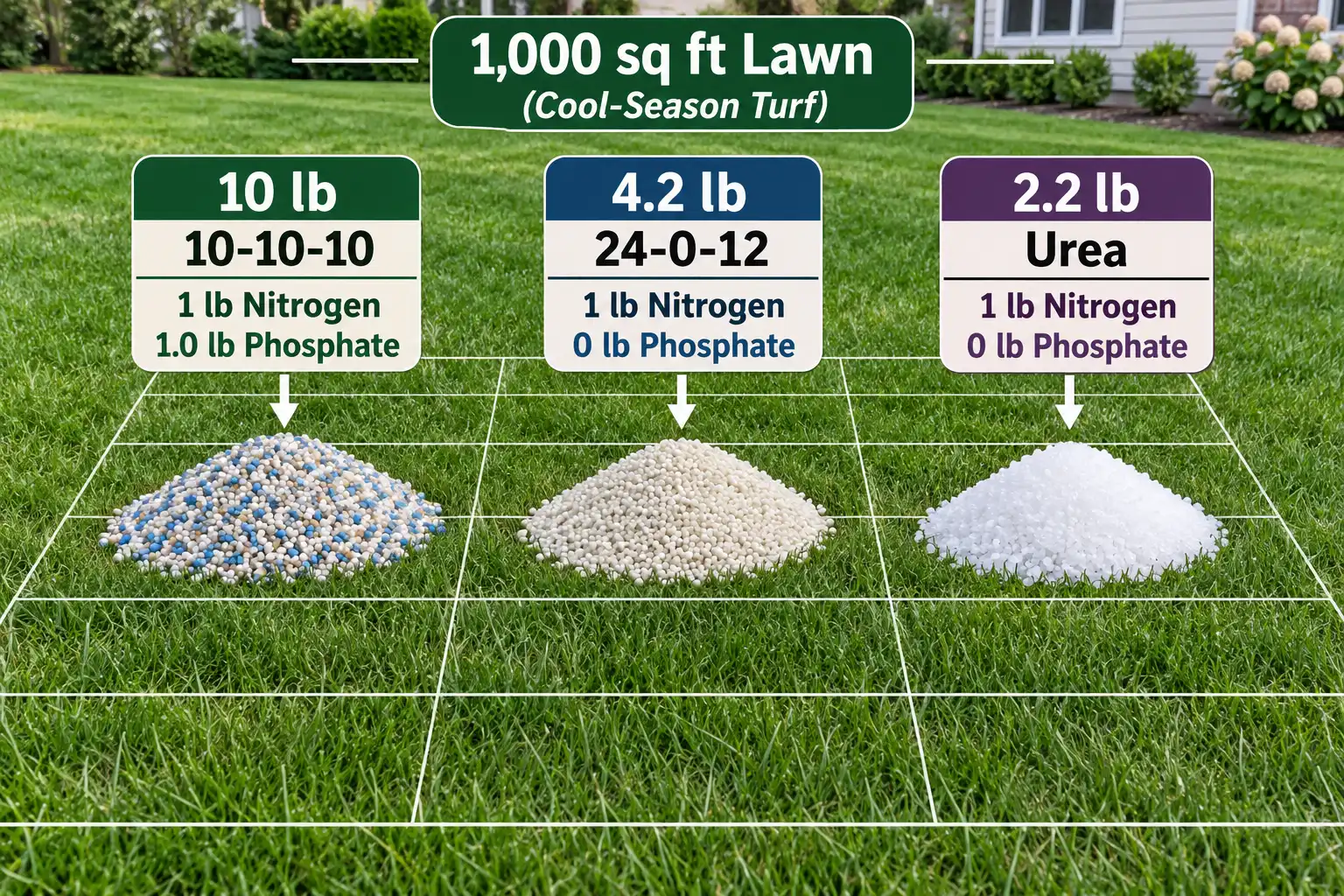
Ten pounds of 10-10-10 per 1,000 square feet supplies 1 pound of nitrogen. For soluble nitrogen, Iowa State suggests 0.5 to 0.75 pound of N in spring, or 5 to 7.5 pounds of product. Late summer and mid-fall rates rise to 0.75 to 1 pound of N, or 7.5 to 10 pounds.
Spread it on dry blades, then water thoroughly. Iowa State also advises skipping June through August on cool-season lawns in the Corn Belt. Warm-season grasses follow their own calendar.
The phosphate cost shows up fast. Here is what 1 pound of nitrogen per 1,000 square feet takes across common grades:
| Grade | Product per 1,000 sq ft | Phosphate (P2O5) applied | Potash (K2O) applied |
|---|---|---|---|
| 10-10-10 | 10 lb | 1.0 lb | 1.0 lb |
| 13-13-13 | 7.7 lb | 1.0 lb | 1.0 lb |
| 15-0-15 | 6.7 lb | 0 lb | 1.0 lb |
| 24-0-12 | 4.2 lb | 0 lb | 0.5 lb |
| 46-0-0 (urea) | 2.2 lb | 0 lb | 0 lb |
On a 5,000 square foot lawn, one full-rate feeding of 10-10-10 takes a whole 50 pound bag. It also lays down 5 pounds of phosphate the grass may not use.
Is 10-10-10 Good for Grass Seed or a New Lawn?
Yes, it can be, when a soil test shows low phosphorus. University of Minnesota Extension notes that turf establishes faster with adequate phosphorus in the root zone. Minnesota law allows phosphorus while a newly seeded or sodded lawn is still establishing.
UMN advises working phosphate fertilizer 4 to 6 inches deep before seeding or laying sod. Use your soil test for the rate. Once the turf fills in, switch to a lawn grade with little or no phosphorus.
Using 10-10-10 Fertilizer: How Much to Apply
Most vegetable gardens take 1.5 to 2 pounds of 10-10-10 per 100 square feet before planting. Heavy feeders such as tomatoes take more, and peas take less.
The two main published rates use different methods, so we give both. Penn State Extension sets one figure for the season: 1.75 pounds per 100 square feet without a soil test. UF/IFAS Extension sets the rate by crop instead. It runs from ½ to 1 pound for southern peas to 3 pounds for tomatoes. Most other crops get 1½ to 2 pounds. Then UF/IFAS adds sidedressings during the season.
To scale any rate, divide the nitrogen you want by 0.10. For example, a soil test calling for 0.2 pound of N per 100 square feet means 2 pounds of 10-10-10.
How Much 10-10-10 for Your Garden Size
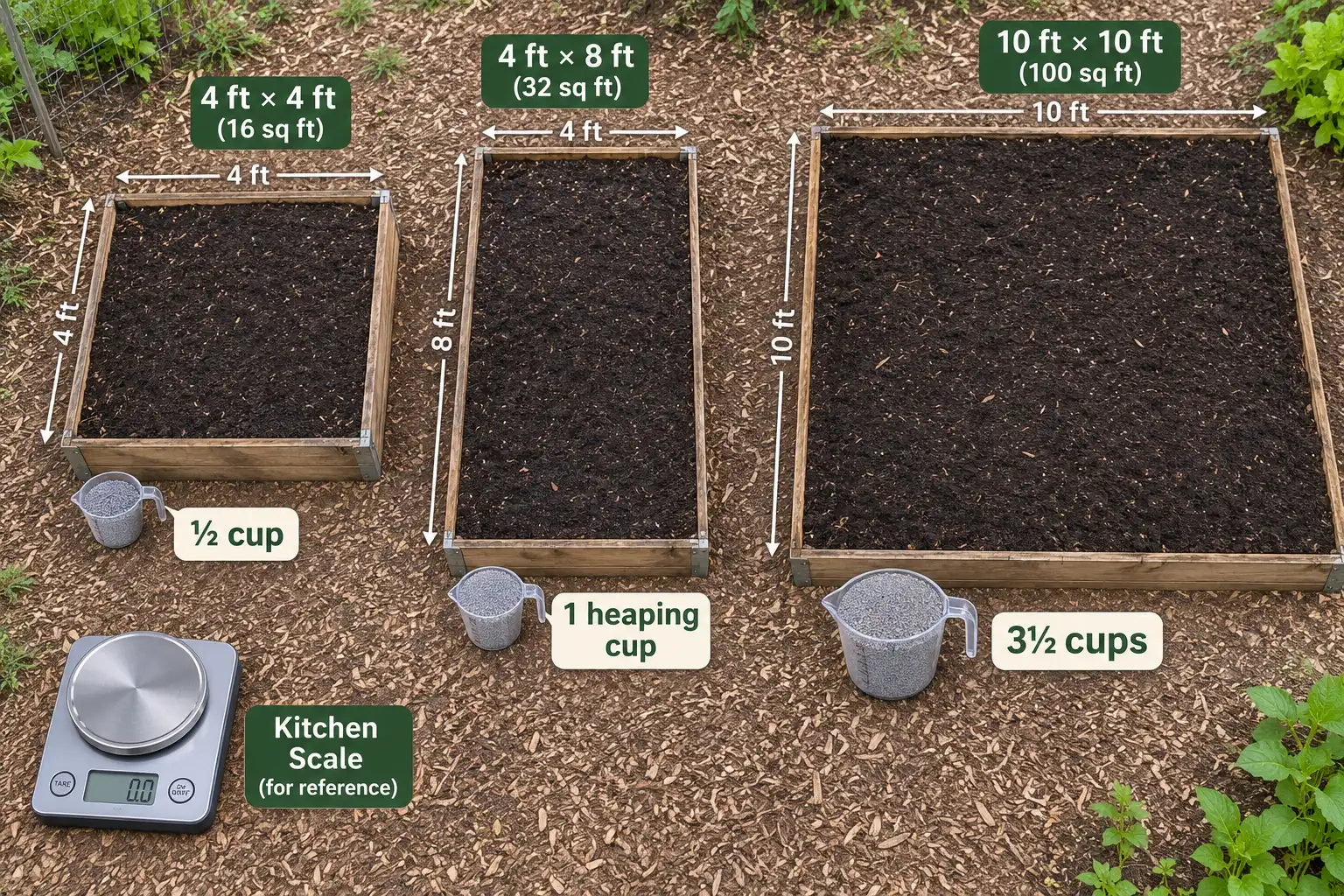
UF/IFAS Extension’s garden chart counts about 2 cups of granular fertilizer per pound. Granule size shifts that figure, so weigh one cup of your own product once.
| Area | At 1.75 lb per 100 sq ft (Penn State) | At 3 lb per 100 sq ft (UF/IFAS tomatoes) |
|---|---|---|
| 4 by 4 ft bed (16 sq ft) | 4.5 oz, about ½ cup | 7.7 oz, about 1 cup |
| 4 by 8 ft bed (32 sq ft) | 9 oz, about 1 heaping cup | 15 oz, about 2 cups |
| 10 by 10 ft plot (100 sq ft) | 1.75 lb, about 3½ cups | 3 lb, about 6 cups |
| 1,000 sq ft | 17.5 lb | 30 lb |
| 1 acre | about 760 lb | about 1,300 lb |
The acre row is a scale check, not a field recommendation. Field crops run on soil-test rates in pounds per acre, as corn fertilizer rates per acre show.
How to Apply 10-10-10 in a Garden
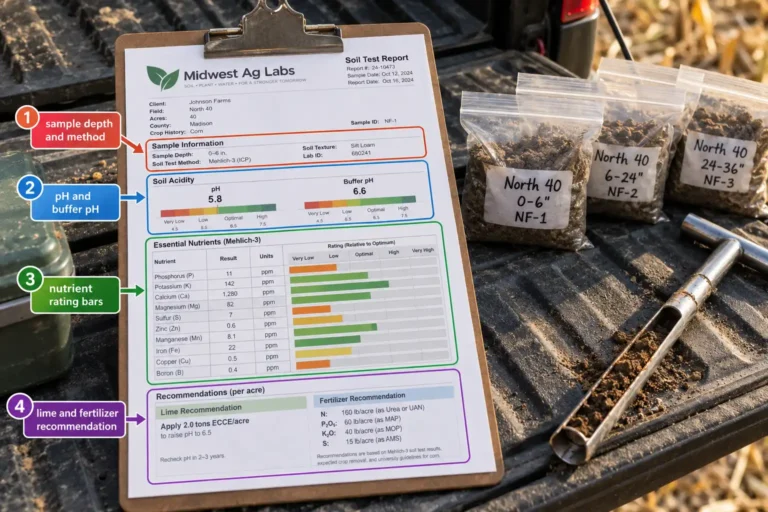
Start with a soil test if you can. It tells you whether the bed needs phosphate at all. Once results arrive, interpret your soil test report before choosing a grade. Then follow these steps:
- Measure the bed. Multiply length by width. Every rate depends on square feet, so guessing here throws off the dose.
- Weigh the dose. Use a kitchen or postal scale. Cup estimates drift with granule size.
- Broadcast half, band half. UF/IFAS Extension mixes half the preplant rate into the soil. It bands the rest 2 to 3 inches beside and below the seed row. The band puts nutrients where young roots reach first.
- Keep it off seed and leaves. UF/IFAS warns against direct contact between seed and the fertilizer band. Brush or rinse any granules off foliage.
- Water it in. Moisture carries the dissolved nutrients into the root zone.
- Sidedress later. UF/IFAS plans 2 or 3 light sidedressings per season. Place each one just beyond the outer leaves.
When to Sidedress With 10-10-10
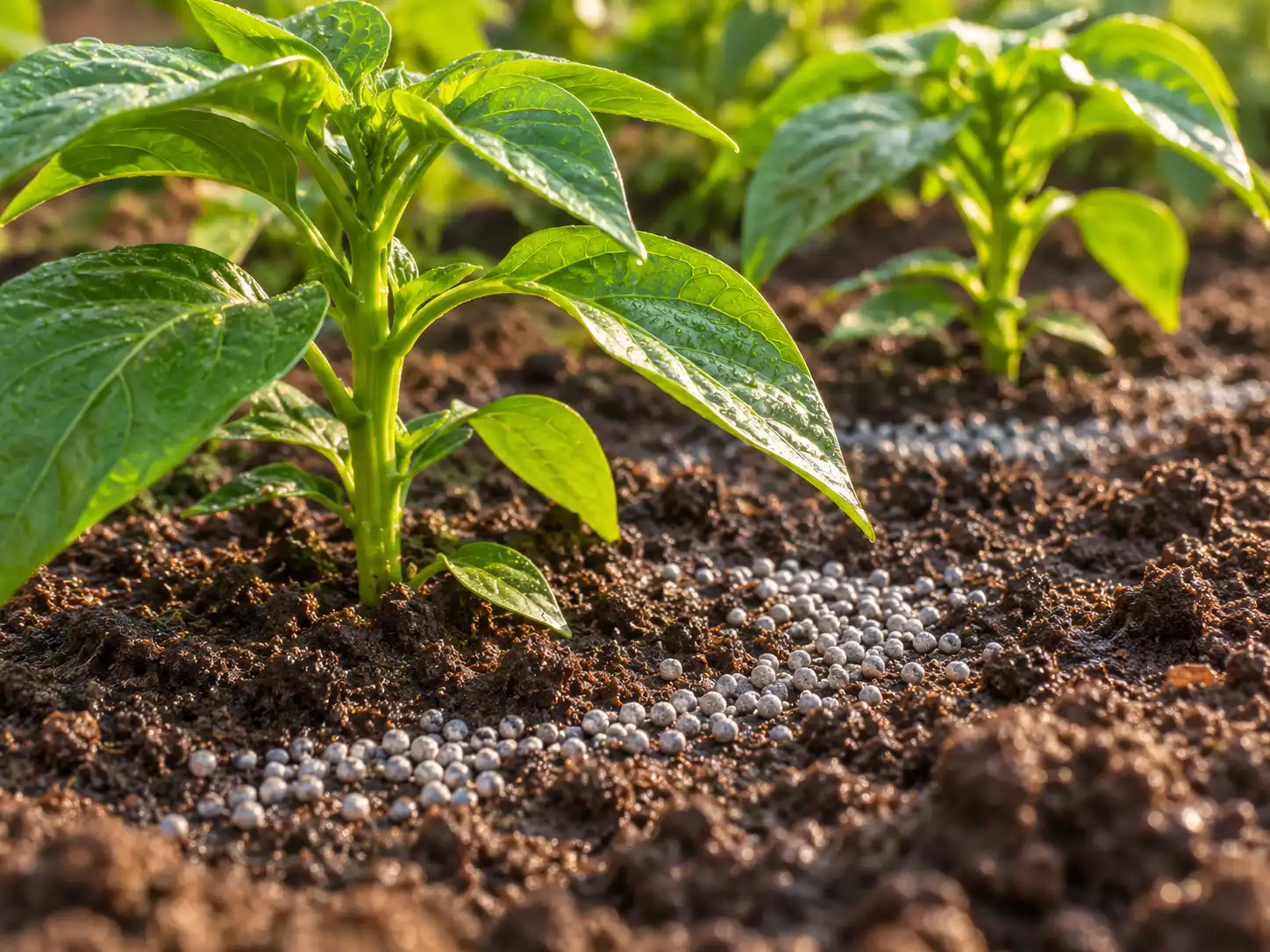
Sidedress fruiting crops once they start setting fruit, and long-season crops every 3 to 4 weeks. UF/IFAS Extension gives these rates per 25 feet of row:
| Crop | Preplant per 100 sq ft | 10-10-10 sidedress per 25 ft of row | When |
|---|---|---|---|
| Tomatoes | 3 lb | 2 lb | Fruit reach 1½ inches across |
| Peppers and eggplant | 1½ to 2 lb | 1 to 1½ lb | Every 3 to 4 weeks |
| Onions | 1½ to 2 lb | 1 lb | Every 3 to 4 weeks |
| Potatoes | 1½ to 2 lb | 1 lb | 3 weeks after planting |
| Squash and cucumbers | 1 to 1½ lb | ½ lb | Every 10 to 14 days, or when leaves pale |
At 2½ foot spacing, the tomato rate works out to about 3 ounces per plant, a heaping ⅓ cup. Eggplant and peppers keep setting fruit for months, so they get repeat feedings instead of one large preplant dose. The same logic shapes the feeding plan for growing eggplant from transplant to frost.
10-10-10 Organic Fertilizer: Does It Exist?
A true organic 10-10-10 fertilizer is rare. Natural materials are low in nutrients and lopsided. So balanced organic blends usually land near 3-4-4 or 5-3-3, per University of Wisconsin Extension.
That’s because each single organic source leans hard on one nutrient. UW Extension lists blood meal at 12-0-0, feather meal at 7 to 12-0-0, and bone meal at 1-15-0. So when you blend them to balance the ratio, each one dilutes the others.
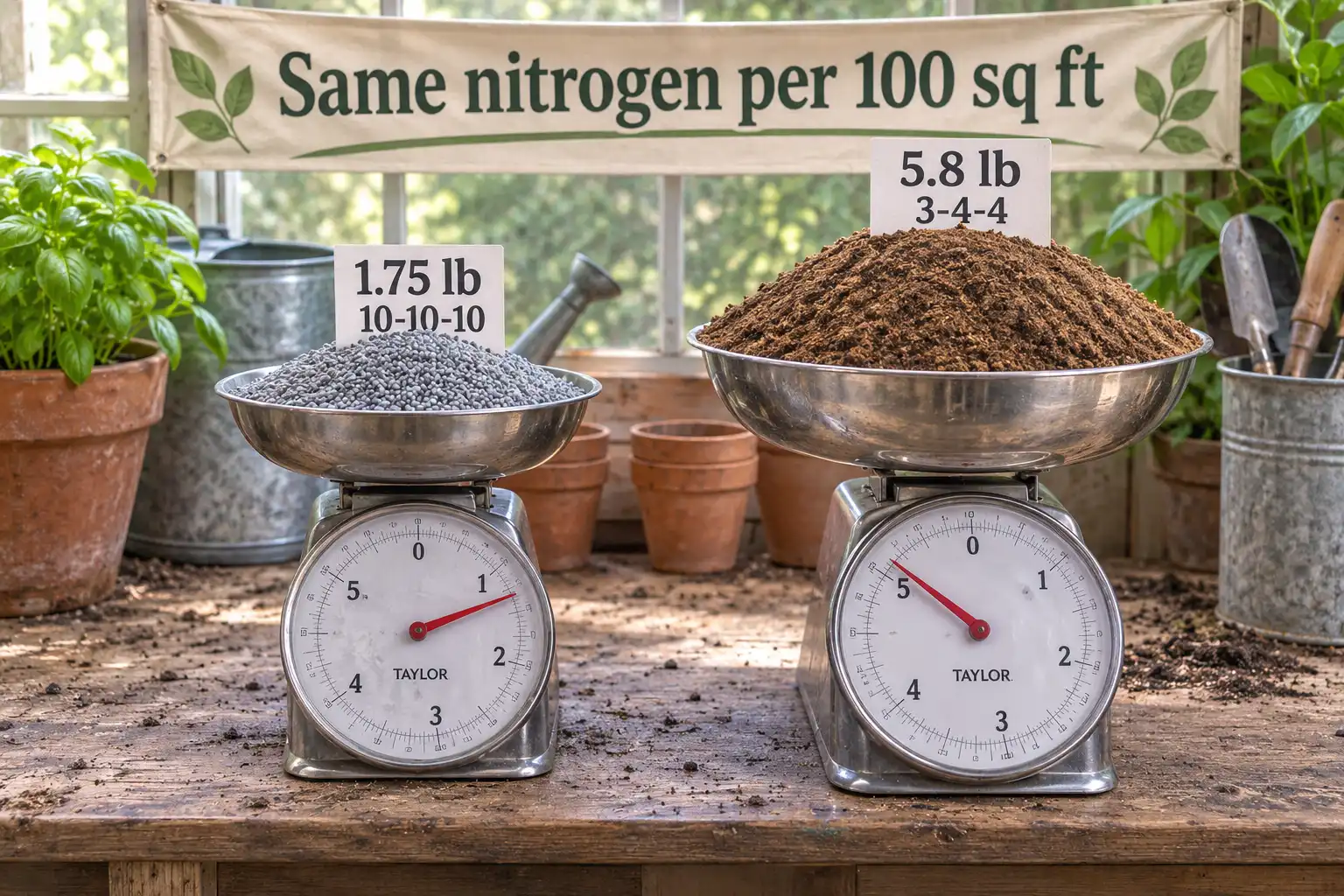
That changes how much you spread. Iowa State University Extension says to apply the same pounds of nitrogen whatever the fertilizer type. So an organic blend means more product for the same feeding:
| Product | Pounds for 1 lb of N | Pounds per 100 sq ft at Penn State’s garden rate |
|---|---|---|
| 10-10-10 | 10 | 1.75 |
| 5-3-3 organic blend | 20 | 3.5 |
| 3-4-4 organic blend | 33 | 5.8 |
| Blood meal (12-0-0) | 8.3 | 1.5, with no P or K |
Is an Organic 10-10-10 Label Real?
Only if the ingredient list backs it up, so check the “derived from” list first. If it names urea, ammonium sulfate, or potassium chloride, the nutrients are synthetic. Iowa State also notes that some natural-base products are fortified with inorganic nutrients to raise their analysis. For certified organic production, look for the OMRI Listed seal.
Also, organic does not mean phosphorus-free. UMN Extension notes that compost, especially manure-based compost, adds phosphorus. For nitrogen without extra phosphate, it points to feather meal or blood meal. For a slower, soil-building route, cover crops and compost can improve soil fertility naturally over several seasons.
Common 10-10-10 Mistakes and How to Fix Them
Most 10-10-10 problems come from three errors: too much, the wrong spot, or the same ground year after year.
- Big leafy plants, few beans or peas. That pattern points to excess nitrogen. UF/IFAS Extension halves the rate for beans and peas for this reason. So skip extra sidedressings on legumes.
- Scorched seedlings or brown leaf edges. Fertilizer touched the seed or foliage, or the dose ran high. Keep the band 2 to 3 inches from the seed row, as UF/IFAS advises. Then water deeply to move excess salts below the roots.
- Burned stripes across a lawn. Soluble nitrogen landed on wet blades or overlapped between spreader passes. Iowa State Extension advises spreading only on dry grass and watering thoroughly afterward.
- A soil test showing very high phosphorus. Past fertilizing is a common cause. UMN Extension notes that soils can test high from buildup of earlier applications. Switch to a nitrogen-only or N-K grade until phosphorus drops below 25 ppm (Bray).
- Pale plants by midsummer despite a preplant feed. Nitrogen moves with water, so it runs out first, especially in sandy soil. Sidedress on the schedule in the chart above.
One habit prevents most of these. Retest the soil every few years, then let the report pick the grade instead of the bag on the shelf.
How to Choose the Best 10-10-10 Fertilizer
Every 10-10-10 bag carries the same N-P-K grade, so the analysis alone won’t separate one product from another. Four other details decide which bag fits your job.
- Form. Granular product suits preplant broadcasting and banding. Water-soluble and liquid concentrates feed faster through a watering can or hose-end sprayer, but they need repeat applications.
- Bag size against your area. At Penn State’s rate of 1.75 pounds per 100 square feet, a 10 pound bag covers about 570 square feet. A 40 pound bag covers about 2,290, and a 50 pound bag about 2,860.
- Nitrogen source. The guaranteed analysis splits nitrogen into forms such as ammoniacal, urea, nitrate, or water-insoluble. Iowa State Extension notes that water-insoluble nitrogen releases slowly, with less burn risk on turf than soluble forms.
- Extras and claims. Added sulfur, calcium, or micronutrients only help if your soil test flags a shortage. An “organic” claim needs the ingredient check covered above.
One buying mistake stands out: the big bag meant for the lawn. For established grass, a lawn grade with little or no phosphorus does the same job with fewer pounds.
The five products below cover granular and liquid forms. Specifications come from each maker’s product details, and buyer feedback appears as owner reports. Check the makers’ rates against the extension rates above.
1. Southern Ag All Purpose Granular Fertilizer 10-10-10

- Size: 5 LB
- Uniform, homogenous granular formulation .
- CONTAINS: 10% Nitrogen, 10% Phosphorus (P205), 10% Potassium (K20) plus minor elements .
Best for: Mixed gardens with fruit trees and shrubs
Southern Ag packs uniform granules with magnesium, boron, iron, manganese, and zinc added. Its directions are the most detailed of the five. They give separate rates for vegetable rows, flower beds, roses, shade trees, fruit trees, and citrus. The product dissolves quickly, so plan on repeat feedings. Owner reports consistently praise ease of use, while opinions on value split.
Pros
- Rates for many plants
- Five minor elements added
- Uniform, even granules
- Easy-to-handle bag
Cons
- Not slow release
- Can stain paving if left unswept
Specs
- Size: 5 lb bag
- Form: granular
- Minor elements: magnesium, boron, iron, manganese, zinc
- Vegetable rate: 1 cup per 25 ft of row, monthly
2. CountryMax 10-10-10 All Purpose Fertilizer
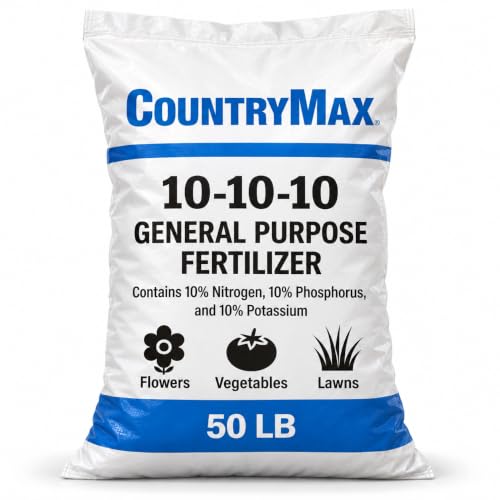
- Balanced Nutrition: Contains an even 10% Nitrogen, 10% Phosphorus, and 10% Potassium in each granule to deliver consiste…
- Promotes Soil Health: Improves the fertility and biological health of your soil over time by encouraging beneficial micr…
- Safe & Effective: Formulated to be safe for use on fruits, vegetables, herbs, grass, and ornamental plants when applied …
Best for: Large vegetable gardens and bulk preplant feeding
CountryMax is the bulk option, sold in 10, 25, and 50 pound bags of large pellets. Its garden rate is 2 pounds per 100 square feet, worked in before planting. That sits at the top of the extension range above. At that rate, a 50 pound bag covers about 2,500 square feet. Owner reports consistently describe it as an easy-to-spread general feed.
Pros
- Bulk bag sizes
- Large, easy-handling pellets
- Clear preplant garden rate
- Spring through fall use
Cons
- No lawn rate in product details
- No minor elements listed
Specs
- Sizes: 10, 25, and 50 lb
- Form: pellets
- Garden rate: 2 lb per 100 sq ft before planting
- Packaging: plastic bag
3. GardenWise 10-10-10 All-Purpose Granular Fertilizer
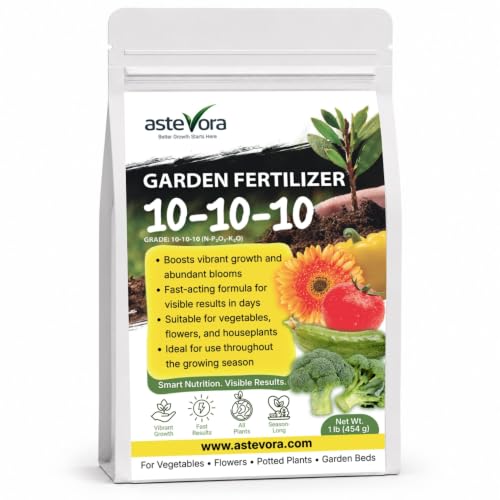
- 🌿 Balanced 10-10-10 Granular Fertilizer for Outdoor & Indoor Plants: All-purpose plant food with 10% Nitrogen, 10% Phosp…
- ⏳ Slow-Release Formula for Continuous Outdoor Feeding: Provides up to 8 weeks of sustained nutrition with fewer applicat…
- 🌼 Promotes Strong Roots, Lush Growth, and Vibrant Outdoor Blooms: Phosphorus supports root health, Nitrogen fuels lush g…
Best for: Small beds, containers, and shrubs
GardenWise sells by volume, from ½ quart up to 20 quarts, which suits a few beds or pots. The maker claims quick-release nitrogen plus up to 8 weeks of slow feeding. It does not state the slow-release share, though. Its lawn rate supplies a pound of phosphate with each pound of nitrogen. Owner reports praise results, though some mention plant damage.
Pros
- Many small sizes
- Claims extended feeding
- Fine, even granules
- Rates for trees, shrubs
Cons
- Small quantity for the cost, per owner reports
- Mixed reports of plant damage
Specs
- Sizes: ½ to 20 quarts
- Form: fine granules
- Vegetable rate: 1 to 1.5 lb per 100 sq ft every 6 to 8 weeks
- Lawn rate: 10 lb per 1,000 sq ft, twice a season
4. TPS Nutrients 10-10-10 Fertilizer for Vegetables
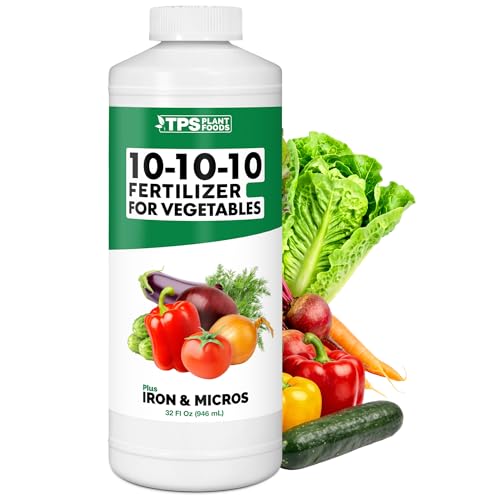
- Supports Roots, Foliage & Yield – Helps encourage strong roots, healthy leaves, and productive harvests.
- All-Purpose Feeding for Garden Crops – Provides balanced nutrients for a wide range of vegetables.
- Ideal for Garden Beds & Raised Planters – Suitable for backyard gardens, rows, and container vegetables.
Best for: Raised beds and container vegetables
TPS Nutrients makes a liquid concentrate aimed at vegetables, with iron and micronutrients added. One ounce covers about 50 square feet, so a 4 by 8 foot bed takes about ⅔ ounce per feeding. Feed every 1 to 2 weeks in spring and summer. Owner reports single out results on zucchini, tomatoes, onions, and peppers, plus ease of use.
Pros
- Vegetable-focused formula
- Iron and micronutrients added
- Can, hose-end, or foliar
- Made in USA
Cons
- Needs feeding every 1 to 2 weeks
- Micronutrient amounts not stated
Specs
- Sizes: 8 oz, 32 oz, and 128 oz
- Form: liquid concentrate
- Mix: 1 to 2 oz per gallon of water
- Coverage: 1 oz per about 50 sq ft
5. ASTEVORA 10-10-10 Liquid Fertilizer
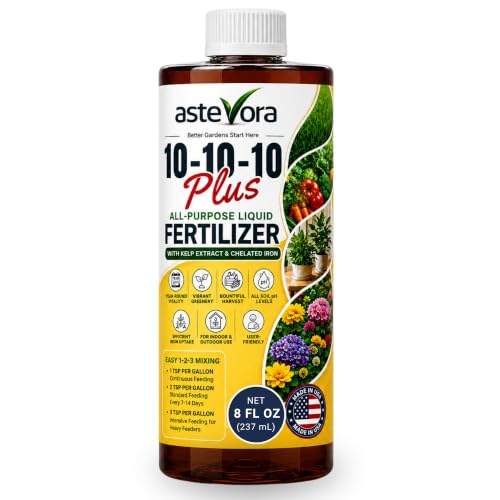
- COMPREHENSIVE PLANT NUTRITION: The 10-10-10 in our liquid plant fertilizer signifies a balanced blend of Nitrogen (N), P…
- ULTIMATE VERSATILITY AND ALL-PURPOSE FORMULA FOR EVERY GARDEN: Our 10-10-10 liquid fertilizer is meticulously balanced t…
- BOOSTED WITH SEAWEED EXTRACT: Our fertilizer is enriched with premium seaweed extract. This natural powerhouse is brimmi…
Best for: Houseplants and mixed indoor and outdoor feeding
ASTEVORA comes from the same maker as GardenWise. It adds seaweed extract and lists 6% chelated iron plus sulfur, magnesium, calcium, boron, manganese, copper, and zinc. Despite the seaweed, it is not certified organic. Owner reports praise growth on peppers, tomatoes, and houseplants, but some find the 8 ounce bottle small for the money.
Pros
- Seaweed extract added
- Chelated iron listed
- Wide trace element list
- Simple watering-can use
Cons
- 8 oz bottle feels small, per owners
- Not for foliar spray on sensitive plants
Specs
- Sizes: 8, 16, 32, and 128 oz
- Form: liquid concentrate
- Mix: 0.5 to 1 oz per gallon of water
- Interval: every 1 to 2 weeks
FAQs About 10-10-10 Fertilizers
Can you use 10-10-10 on tomatoes?
Yes, 10-10-10 feeds tomatoes at planting and again once fruit reach 1½ inches. UF/IFAS Extension uses 3 pounds per 100 square feet, then 2 pounds per 25 feet of row.
Will 10-10-10 burn my lawn?
It can, since soluble nitrogen scorches grass when overapplied or spread on wet blades. Iowa State Extension advises dry blades, thorough watering, and 0.5 to 0.75 pound of N per 1,000 sq ft in spring.
Is 13-13-13 better than 10-10-10?
Neither grade is better for plants, because both share the same 1-1-1 ratio. 13-13-13 is just stronger, so ¾ pound of it equals 1 pound of 10-10-10, per UF/IFAS Extension.
How many cups of 10-10-10 per 100 square feet?
About 3½ cups at Penn State Extension’s rate of 1.75 pounds per 100 square feet. That uses UF/IFAS Extension’s figure of roughly 2 cups per pound, so weigh one cup to confirm.
How often should you apply 10-10-10 to a garden?
Apply it once before planting, then sidedress 2 or 3 times during the season, per UF/IFAS Extension. Squash and cucumbers may take a light dose every 10 to 14 days, while beans and peas need much less.
Key Points to Carry Into the Field
Use 10-10-10 where a bed needs all three nutrients, mainly vegetable gardens without a recent soil test. Start near Penn State’s 1.75 pounds per 100 square feet, then sidedress fruiting crops on the UF/IFAS schedule.
Skip it on established lawns and on soil that already tests high in phosphorus. Once a soil test comes back, let the report choose the grade.