46-0-0 Fertilizer: Urea Rates, Uses and Best Bags
A bag stamped 46-0-0 fertilizer holds more nitrogen than any other common dry product, and nothing else. That concentration means less weight to haul per pound of N. It also means rate math, timing, and watering in matter more than with a blended bag.
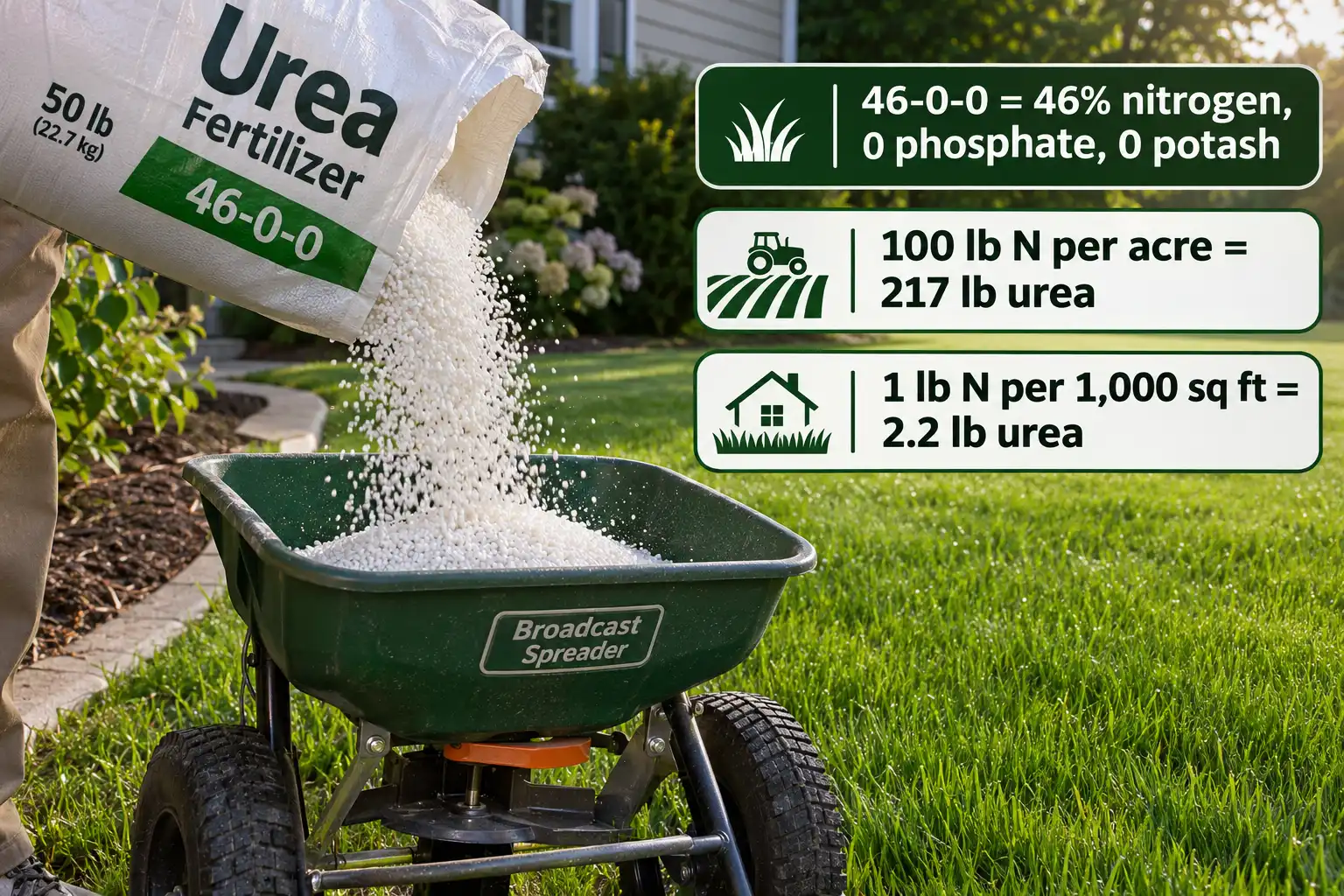
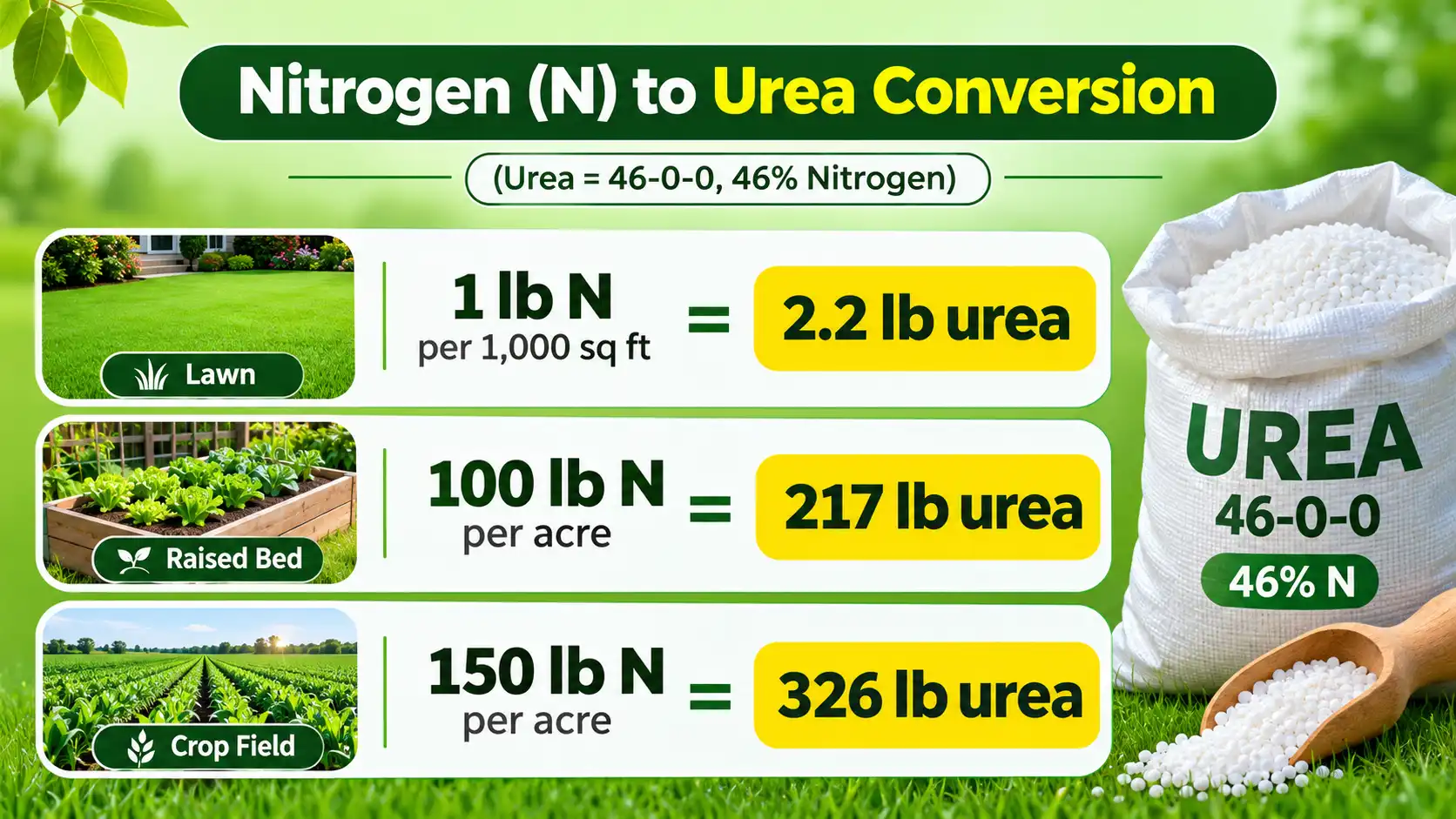
46-0-0 is urea, a dry fertilizer that is 46% nitrogen with no phosphorus or potassium. Every 100 pounds holds 46 pounds of N, so divide your nitrogen target by 0.46 to get pounds of product.
Top 46-0-0 Urea Fertilizers: Quick Comparison
| Product | Bag sizes | Form | Lawn area per largest bag at 1 lb N |
|---|---|---|---|
| CountryMax Urea 46-0-0 | 50 lb | Granular | 23,000 sq ft |
| Duda Energy Urea 46.0% | 25 lb (five 5 lb bags) | Prilled | 11,500 sq ft |
| Supply Solutions Urea 46-0-0 | 5, 10, 20, 40 lb | Granular | 18,400 sq ft |
| Easy Peasy Urea 46-0-0 | 10, 20, 50 lb | Granular | 23,000 sq ft |
What Is 46-0-0 Fertilizer?
It is urea, CO(NH2)2, sold as a dry fertilizer with a guaranteed 46% nitrogen. The three numbers follow the N-P-K order on every fertilizer label: 46% nitrogen, 0% phosphate, and 0% potash. So a 50 lb bag carries 23 pounds of actual nitrogen and no other nutrient.
University of Minnesota Extension notes that urea has passed anhydrous ammonia as the main nitrogen source in Minnesota. Its high analysis also cuts handling, storage, and hauling costs compared with other dry N forms. Once urea dissolves on moist soil, the urease enzyme converts it to ammonia and then to ammonium. Plants take up that ammonium, or soil bacteria turn it into nitrate.
Prilled vs Granular Urea
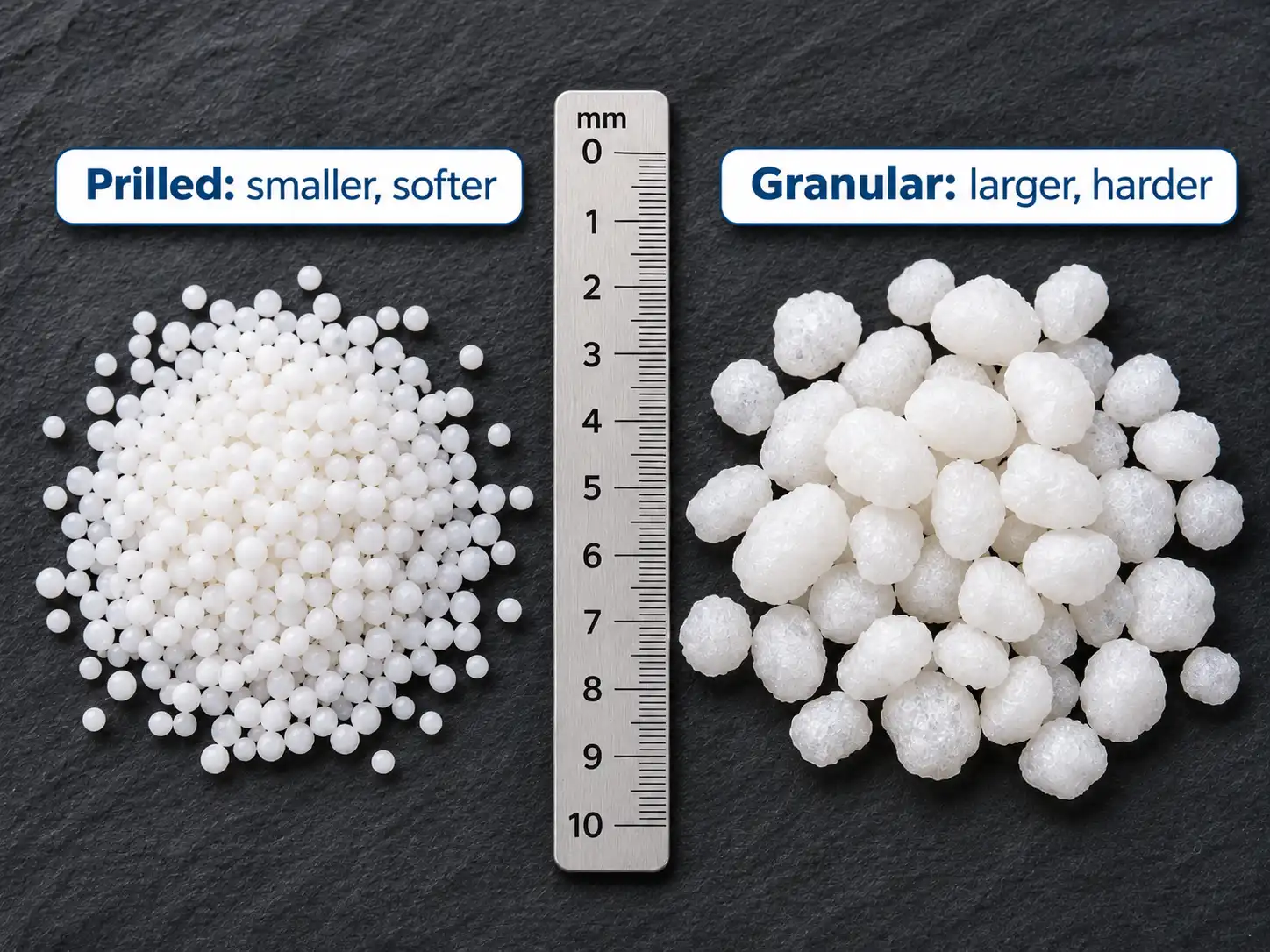
You will find both forms on the shelf. According to UMN Extension, prills are the older form, made by dropping liquid urea from a tower. They are smaller and softer. Granules, by contrast, are larger, harder, and more moisture resistant, so they suit fertilizer blends better.
Both deliver the same nitrogen per pound. For a hand or push spreader, either form works. On a farm, though, granules handle better, and UMN advises against small, fast augers that break particles.
What Is 46-0-0 Fertilizer Used For?
Growers use 46-0-0 wherever a crop needs nitrogen and the soil already holds enough phosphorus and potassium. The common jobs look like this:
| Use | When it goes on | Watch for |
|---|---|---|
| Cool-season lawns | Fall, with a second feeding 3 to 4 weeks later (Purdue) | Burn from overlaps |
| Corn | Before planting or as a sidedress | Never in the seed furrow (UMN) |
| Winter wheat | Topdress before jointing (K-State) | Needs rain to reach roots |
| Vegetable gardens | Before planting, then sidedress by crop stage (Mississippi State) | Tiny doses, weigh them |
| Grass pasture | Spring and summer growth | In summer, apply only when rain is likely (UMN) |
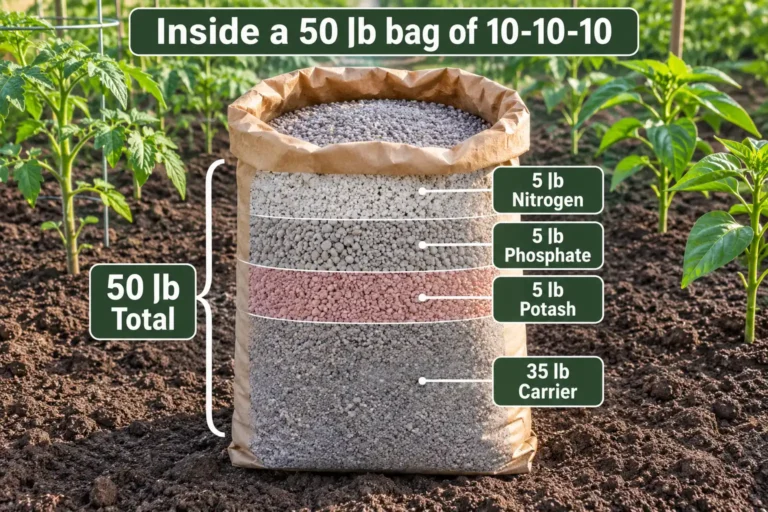
Skip urea when your soil test calls for phosphorus or potassium too. In that case, a balanced 10-10-10 blend covers all three nutrients in one pass. Also leave out crops that need little extra nitrogen. Mississippi State University Extension lists peanuts, southern peas, radishes, and sweet potatoes as needing no sidedress.
How Much 46-0-0 Fertilizer Per Acre?
Divide the pounds of nitrogen you need by 0.46. University of Minnesota Extension works the standard example: 100 pounds of N per acre takes 217 pounds of urea.
Pounds of urea = pounds of N needed ÷ 0.46
Purdue’s turf program sets lawn rates the same way, in pounds of N per 1,000 square feet. An acre holds 43,560 square feet, so 1 pound per 1,000 square feet equals about 44 pounds per acre. Here is that conversion at every scale:
| Nitrogen target | Urea per acre | Urea per 1,000 sq ft | Urea per 100 sq ft |
|---|---|---|---|
| 0.5 lb N per 1,000 sq ft (22 lb N/acre) | 47 lb | 1.1 lb | 1.7 oz |
| 1.0 lb N per 1,000 sq ft (44 lb N/acre) | 95 lb | 2.2 lb | 3.5 oz |
| 60 lb N per acre | 130 lb | 3.0 lb | 4.8 oz |
| 100 lb N per acre | 217 lb | 5.0 lb | 8.0 oz |
| 150 lb N per acre | 326 lb | 7.5 lb | 12.0 oz |
The bottom three rows are field rates. Growers often split them into two passes, and none of them belong on a lawn in one feeding.
46-0-0 Rates for Corn and Wheat
Your nitrogen target comes from the crop, the yield goal, and the soil test. The bag only tells you how to reach it.
Corn
Corn rates shift with the previous crop and the price of nitrogen. Iowa State University’s Corn Nitrogen Rate Calculator sets those rates for several Corn Belt states. Once you have the N figure from your state’s corn fertilizer rates per acre, divide it by 0.46. A 150 pound target, for example, means 326 pounds of urea.
Timing matters too. In UMN Extension’s 24-year Lamberton study, spring urea averaged 5 to 6 bushels per acre more than fall plowed-down urea. Splitting the rate also works well, and sidedress timing for corn decides when the second half goes on.
Winter Wheat
K-State Research and Extension recommends 2.4 pounds of N per bushel of yield goal. Credits for profile N, previous crop, tillage, and organic matter then come off. So a 50 bushel goal starts at 120 pounds of N, or 261 pounds of urea. Every 10 pounds of N you credit trims about 22 pounds of urea.
K-State trials show dry urea and UAN equally effective for topdressing. The catch is moisture: rain needs to carry the N into the root zone well before jointing (Feekes 6). That window fits inside the wider schedule for growing winter wheat.
46-0-0 Rates for Lawns and Gardens
Lawns
Purdue’s turf program recommends a fast-release source like urea at 0.75 to 1.0 pound of N per 1,000 square feet. That works out to 1.6 to 2.2 pounds of 46-0-0 per feeding. In fall, Purdue adds a second feeding 3 to 4 weeks later, near the final mowing.
Heat raises the burn risk, though. For sod and turf, UMN Extension advises spreading urea below 60°F. In warmer air, urea resting on leaves can release ammonia. For bermudagrass or zoysia, follow your state extension’s warm-season calendar instead.
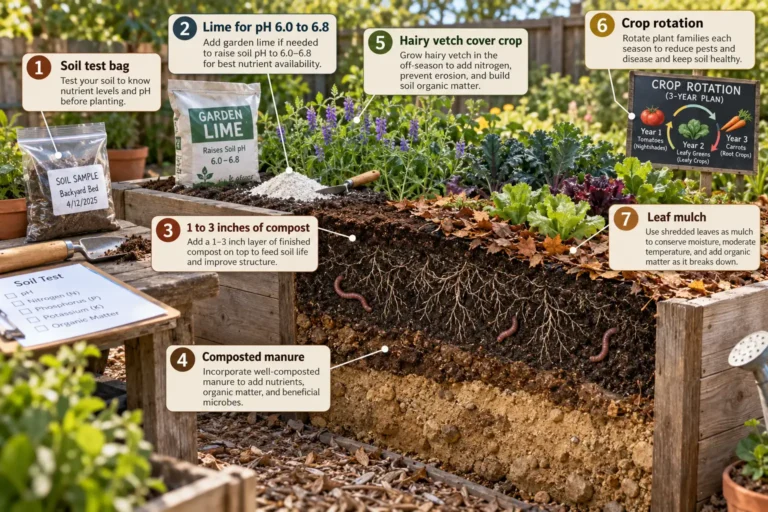
Vegetable Gardens and Raised Beds
Mississippi State University Extension’s nitrogen-only garden rate is 3 pounds of 34-0-0 per 1,000 square feet before planting. In urea terms, that equals 2.2 pounds per 1,000 square feet, or 3.5 ounces per 100. On a 4 by 8 raised bed, it comes to about 1.1 ounces.
For sidedressing, the same guide uses 1 pint, about 1 pound, of 34-0-0 per 100 feet of row. Swap in urea and you need about 12 ounces per 100 feet, or 1.2 ounces per 10 feet. Timing then follows the crop. Sweet corn gets fed at 8 inches and again at knee-high. Tomatoes get theirs when the first fruit reaches about 1 inch across. At these weights, a kitchen scale beats a measuring cup.
How Far Does a 50 lb Bag of Urea Go?
A 50 lb bag of urea holds 23 pounds of nitrogen. That covers about 23,000 square feet of lawn at 1 pound of N per 1,000 square feet.
| Bag size | Actual N | Lawn area at 1 lb N per 1,000 sq ft | Field area at 100 lb N per acre |
|---|---|---|---|
| 5 lb | 2.3 lb | 2,300 sq ft | about 1,000 sq ft |
| 10 lb | 4.6 lb | 4,600 sq ft | about 2,000 sq ft |
| 25 lb | 11.5 lb | 11,500 sq ft | about 5,000 sq ft |
| 40 lb | 18.4 lb | 18,400 sq ft | about 8,000 sq ft |
| 50 lb | 23 lb | 23,000 sq ft | about 10,000 sq ft (0.23 acre) |
So a 5,000 square foot lawn uses about 11 pounds per feeding. One 50 lb bag covers four feedings with some left over. Field work, by contrast, goes through bags fast: a single acre at 100 pounds of N takes more than four.
How to Use 46-0-0 Fertilizer
Apply urea at a weighed rate, with a calibrated spreader, right before rain or irrigation. Each step below prevents a specific failure.
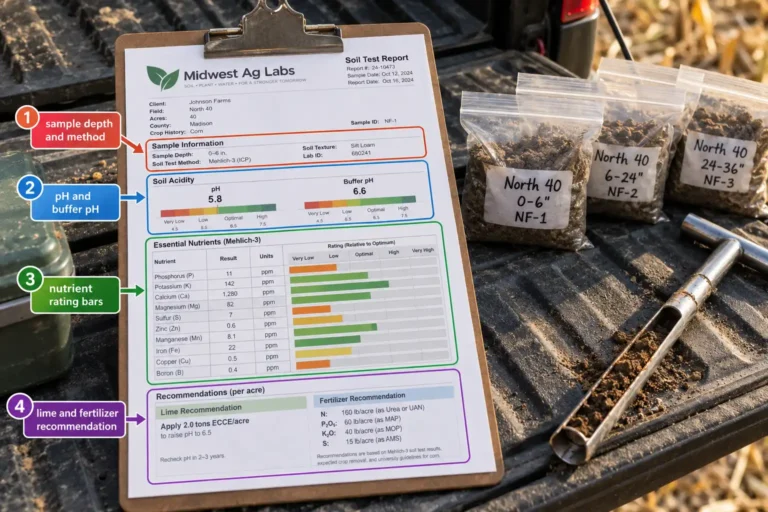
- Start with a soil test. It shows whether nitrogen alone will do or phosphorus and potassium run short too.
- Convert the N target to product. Divide pounds of N by 0.46, then multiply by your area in thousands of square feet.
- Weigh the dose. A cup of fertilizer varies with particle size, while weight stays exact.
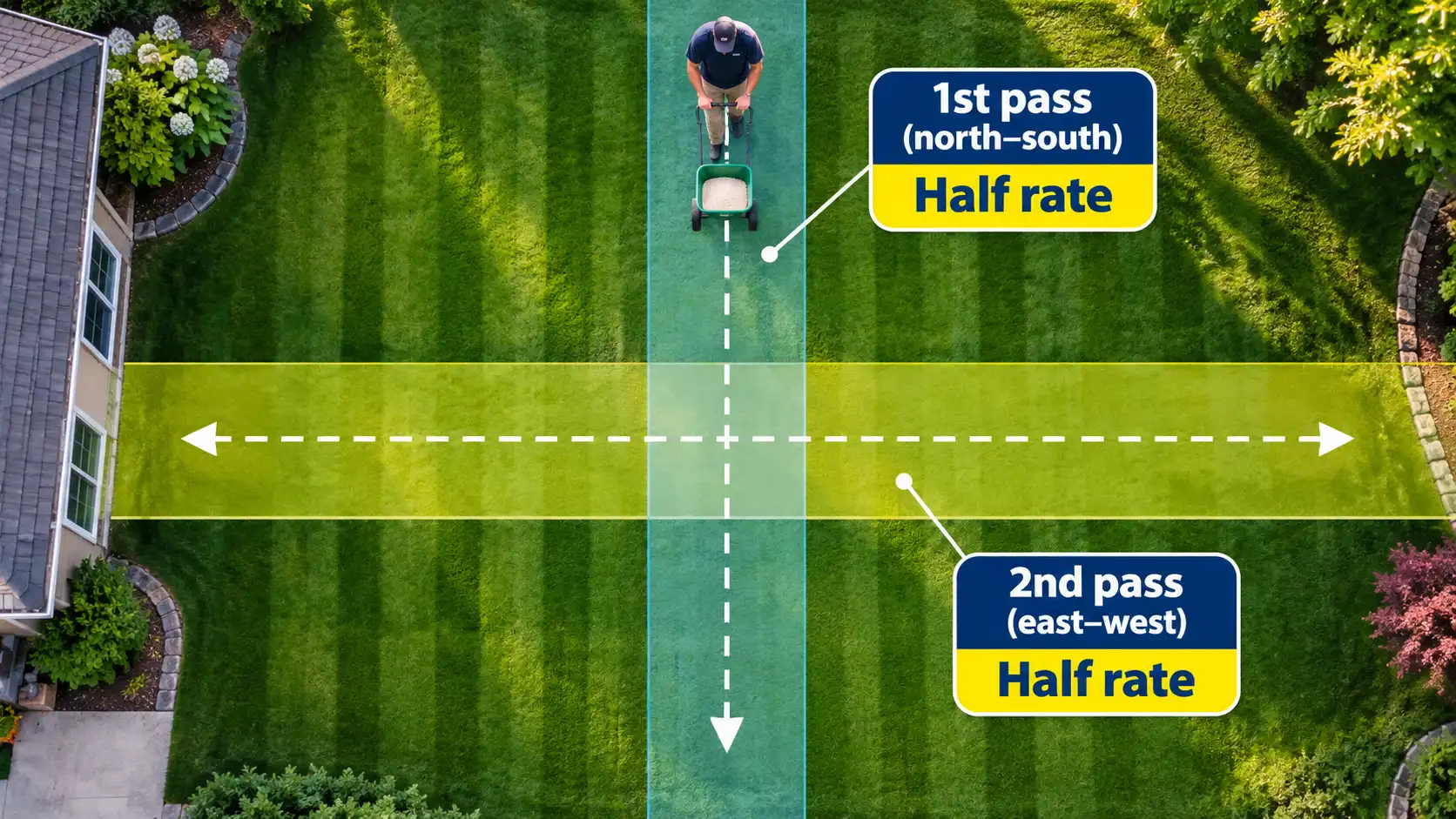
- Spread half the rate in two directions. Go north to south, then east to west, so gaps and doubled strips disappear.
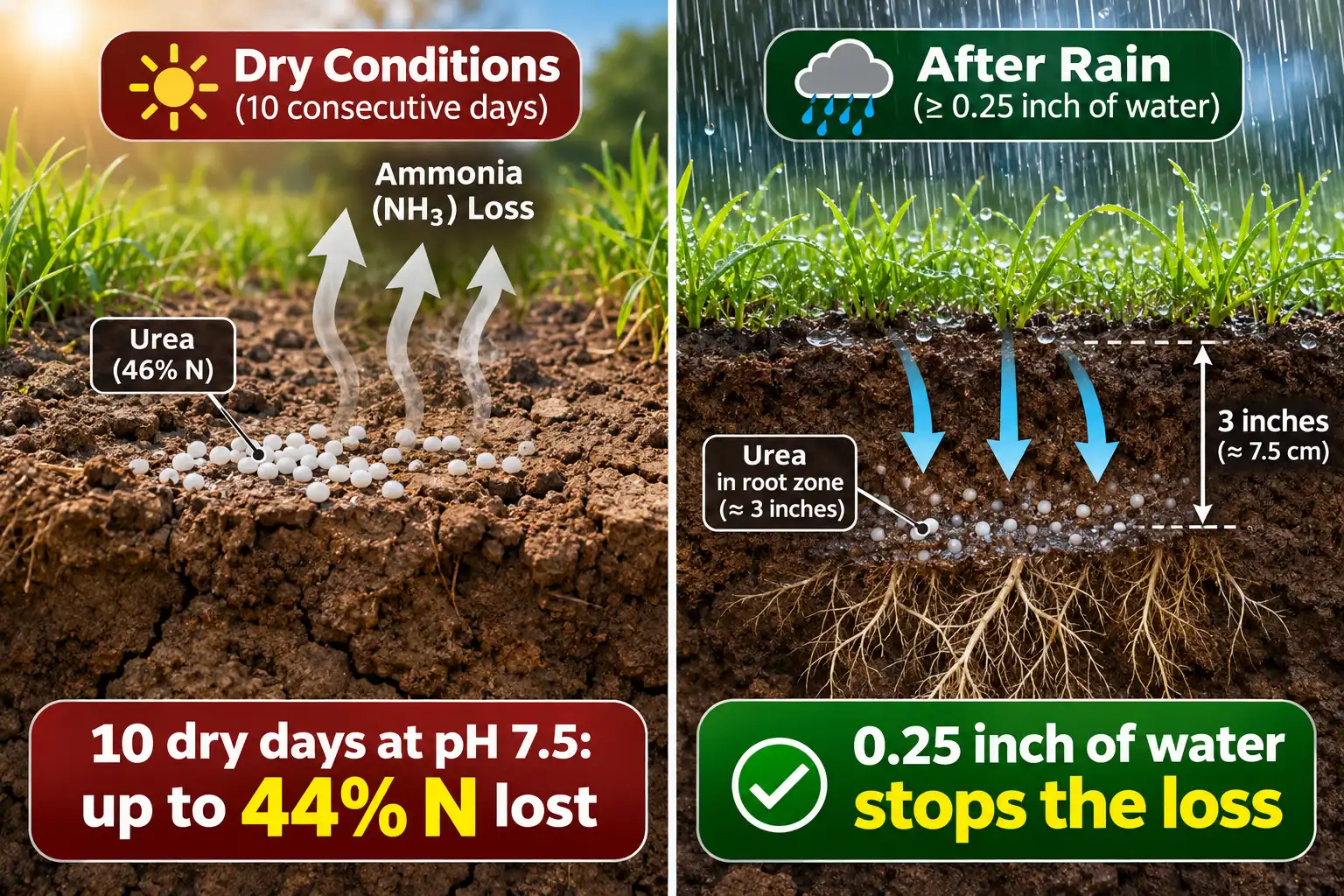
- Water in within two days. UMN Extension says 0.25 to 0.5 inch of water moves urea about 3 inches down, out of reach of ammonia loss.
- Sweep pavement and spills. Prills on a driveway wash toward storm drains, and a spilled pile kills the grass under it.
- Wait before the next feeding. Purdue spaces fall lawn feedings 3 to 4 weeks apart.
Your soil test also reports pH, which matters because urea slowly acidifies soil. Reading your soil test report shows where to find both figures. On acreage, a tow-behind broadcast spreader makes the two-direction pass practical.
Why Surface Urea Loses Nitrogen
Urea left dry on the surface turns into ammonia gas, and warm or high-pH soil speeds that loss. University of Minnesota Extension measured it on silt loam with 100 pounds of N per acre on the surface:
| Days on the surface | 60°F | 90°F | Soil pH 6.0 | Soil pH 7.5 |
|---|---|---|---|---|
| 2 | 0% | 2% | 0% | 5% |
| 4 | 2% | 5% | 5% | 20% |
| 6 | 6% | 10% | 7% | 30% |
| 10 | 10% | 20% | 13% | 44% |
The temperature and pH columns come from two separate UMN tables. In bag terms, ten dry days at pH 7.5 waste about 95 pounds of a 217 pound application.
Water stops it. UMN Extension says as little as 0.25 inch of rain moves urea deep enough to prevent ammonia loss. If no rain is due and you cannot irrigate or till, a urease inhibitor such as NBPT buys time. UMN puts that protection at about 10 days.
Heavy crop residue raises the risk, because residue carries its own urease. Cold soil slows losses but does not stop them. Also, UMN warns that urea spread on frozen ground sits on the surface until spring runoff.
Seed Safety, Lawn Burn, and Spraying Urea
Keep urea away from seed, off warm grass, and out of repeated leaf sprays unless it is low-biuret.
Seed Placement
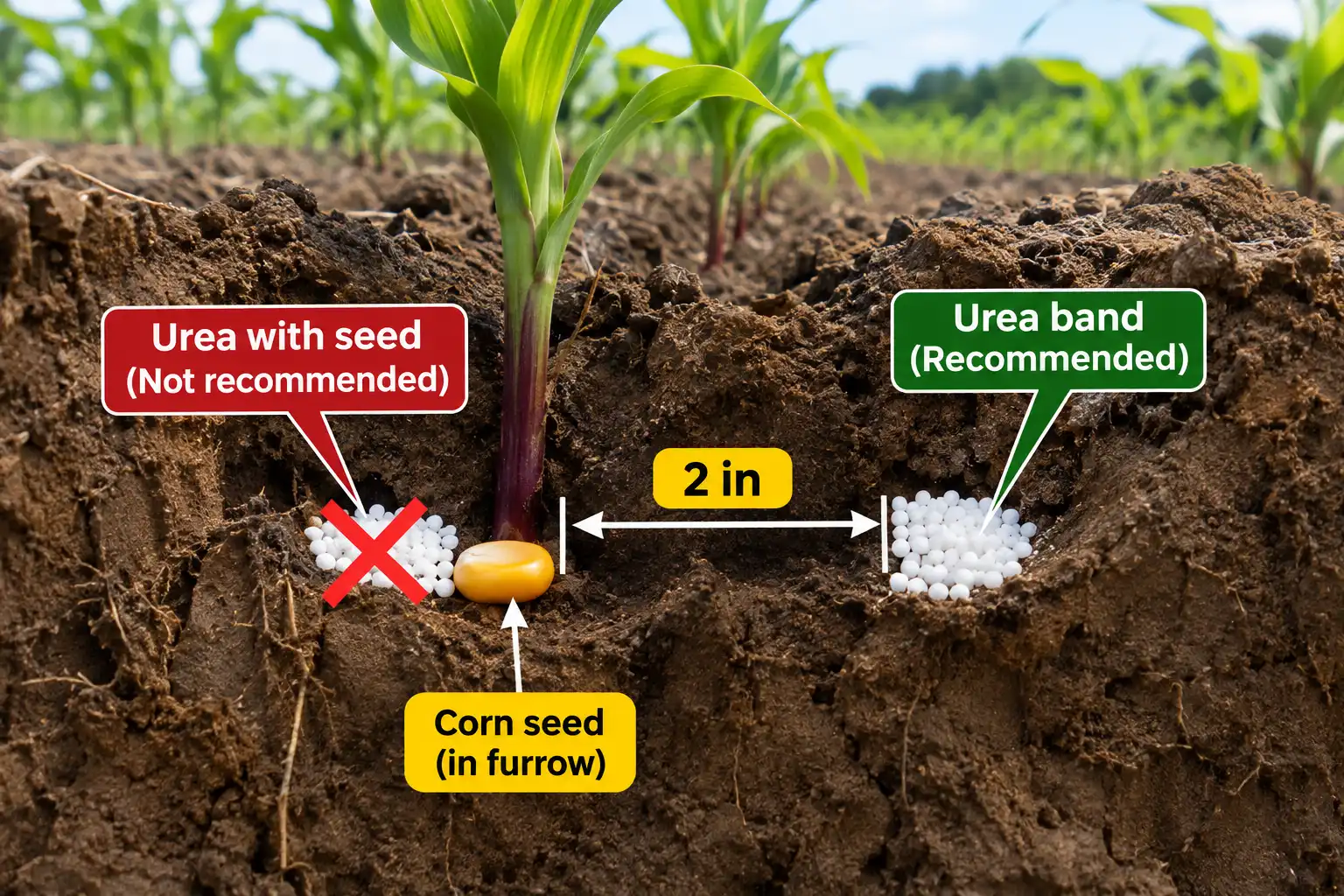
University of Minnesota Extension says never to place urea with corn seed, under any circumstances. Instead, keep banded urea at least 2 inches of soil away from the seed. Small grains tolerate a little. With the drill, UMN allows 10 pounds of N as urea in dry soil and 20 with good moisture. UMN also cites North Dakota research on dry soil. There, more than 20 pounds of N on 6-inch drill rows cut wheat stands by over half.
Lawn Burn
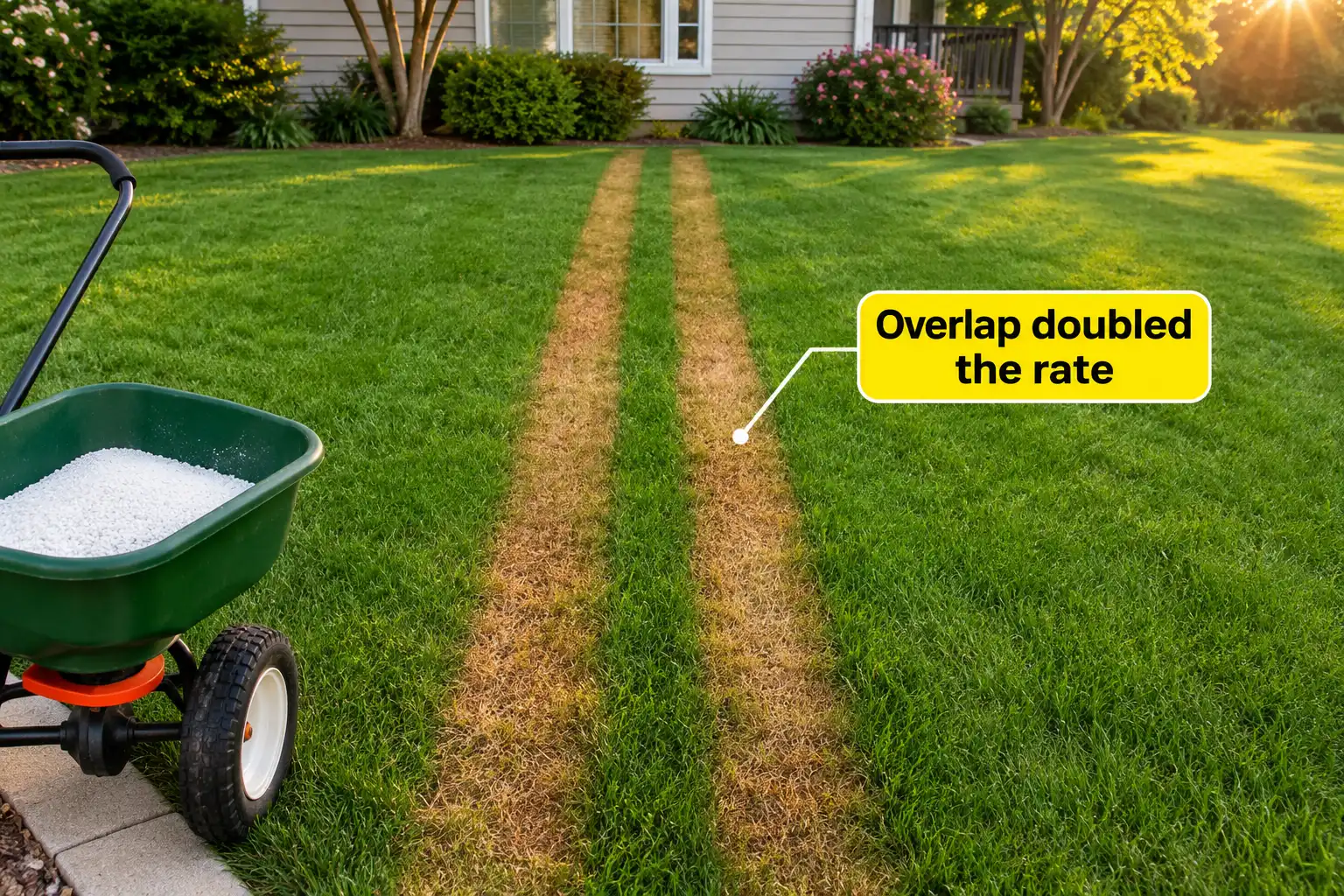
Urea burns grass when too much lands in one spot. Overlapping passes, spills, and rates above Purdue’s 1 pound of N per 1,000 square feet cause most of it. So weigh, crisscross at half rate, and water in.
Mixing Urea With Water
Urea dissolves completely, so you can apply it to soil from a watering can or sprayer. Leaf sprays are different. UMN Extension says foliar urea should contain no more than 0.25% biuret, a manufacturing byproduct. Typical U.S. urea runs about 0.3%. None of the four bags reviewed below lists a biuret figure, so use them on soil, not as repeated leaf feeds.
Urea vs Other Nitrogen Fertilizers
Urea carries the most nitrogen per pound of any common dry source. Its main weakness is loss from the surface.
| Source | Analysis | Product for 100 lb N | Aglime per lb N (Iowa State) | Main drawback |
|---|---|---|---|---|
| Urea | 46-0-0 | 217 lb | 4 lb | Ammonia loss if left on the surface |
| Anhydrous ammonia | 82-0-0 | 122 lb | 4 lb | Escapes if placed too shallow |
| Ammonium nitrate | 34-0-0 | 294 lb | 4 lb | Nitrate half can leach |
| UAN solution | 28 to 32% N | 313 to 357 lb | 4 lb | Urea half can volatilize |
| Ammonium sulfate | 21-0-0-24S | 476 lb | 7 lb | Strongest acidifier |
Per UMN Extension, UAN is 50% urea, 25% ammonium, and 25% nitrate. As a result, it loses less to the air than straight urea. Iowa State’s liming figures also add up over time. For example, 100 pounds of N from urea calls for about 400 pounds of aglime, while ammonium sulfate needs 700.
How to Store an Open Bag of Urea
Seal it, keep it dry, and store it away from ammonium nitrate. UMN Extension says urea is not combustible or explosive and stores without quality loss. However, it pulls in moisture above 75.2% relative humidity, so open bags cake in humid sheds.
Mixed with ammonium nitrate, that threshold falls to 18.1%, and the pair absorbs water in almost any air. So roll the bag top down and clamp it, or pour it into a lidded bucket. Then set it on a shelf, not bare concrete. Caked urea still carries its full 46% N, so break up the lumps and use it.
Troubleshooting 46-0-0 Problems
Most urea failures trace back to rate, water, or placement.
- Straight yellow or brown stripes a few days after spreading. Overlapping passes doubled the rate. Water heavily to dilute it, then switch to two half-rate passes.
- No green-up after a week. The urea probably sat on dry ground and gassed off. Check whether 0.25 inch of water reached it, and look for a sulfur shortage on your soil test.
- Fast green-up, then fading within a month. Urea releases quickly, so color tracks the supply. That is why Purdue repeats fall feedings every 3 to 4 weeks.
- Seedlings dying in the row. Urea sat too close to the seed. Next time, keep bands at least 2 inches away.
What to Check Before You Buy Urea
Every bag of 46-0-0 delivers the same nitrogen per pound. So the choice comes down to four specifications, not brand claims.
- Bag size against your area. Match the bag to two or three feedings so it does not sit open for a year.
- Form. Granules handle augers and blending better, while prills work fine in a push spreader.
- Packaging. Urea cakes above 75% relative humidity, so smaller sealed bags help in humid climates.
- Spray plans. For leaf sprays, buy urea sold as low-biuret. None of the four below publishes a biuret figure.
What usually goes wrong is the rate, not the product. A bag with no clear weight per 1,000 square feet gets scooped by the cup, and the lawn burns.
Top Four 46-0-0 Fertilizer Bags
1. CountryMax Urea Fertilizer 46-0-0, 50 lb
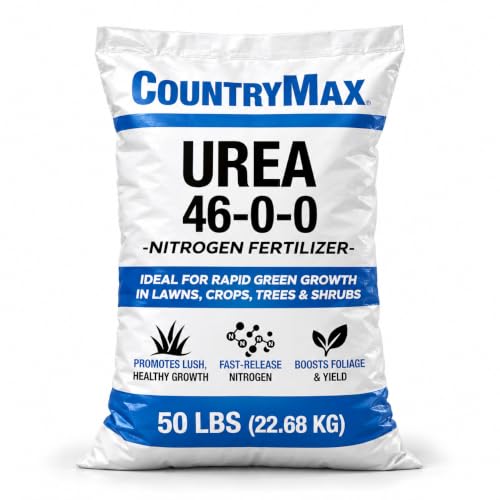
- [HIGH NITROGEN 46-0-0 FORMULA]: Professional-grade urea fertilizer delivers 46% nitrogen to help promote rapid plant gro…
- [FAST GREEN-UP FOR LAWNS & GARDENS]: Quickly corrects nitrogen deficiencies and stimulates vigorous top growth, making i…
- [VERSATILE PLANT FOOD]: Works as a plant fertilizer for lawns, gardens, fruit trees, shrubs, crops, and ornamental plant…
Best for: Large lawns and small acreage
This is the straight 50 lb urea bag. The maker describes uniform granules sized for broadcast and drop spreaders, with no phosphorus or potassium. At 23 pounds of N, one bag covers about 23,000 square feet at a full lawn feeding. Owner reports consistently note darker grass within about 3 days of watering in.
Pros
- Most N per bag
- Uniform granule size
- Broadcast and drop ready
- Spreads without clumping
Cons
- Maker rules out liquid spraying
- Too much for small yards
Specifications
- Analysis: 46-0-0
- Form: granular
- Weight: 50 lb
- Spreaders: broadcast or drop
2. Duda Energy Urea 46.0% Commercial Grade, 25 lb

- 98.5+% Pure, Dry
- High Quality Commercial Grade
- Urea – (NH2)2CO, 46.0% Minimum Nitrogent Content
Best for: Humid storage and smaller lawns
Duda Energy lists 98.5% or higher purity and a 46.0% nitrogen minimum, in prilled form. The packaging stands out: five 5 lb bags inside a reusable pail. You open one bag at a time, which limits caking in humid storage. Owner reports consistently note greener grass within a week, and some buyers use it to condition straw bale gardens.
Pros
- Published 98.5% purity
- Five separate 5 lb bags
- Reusable storage pail
- Easy small-batch measuring
Cons
- Prills are softer than granules
- Lowest total weight here
Specifications
- Analysis: 46-0-0 (46.0% N minimum)
- Purity: 98.5% or higher
- Form: prilled
- Weight: 25 lb (five 5 lb bags)
3. Supply Solutions Urea 46-0-0, 40 lb

- Pure Nitrogen Fertilizer: With a potent 46% urea nitrogen content, our fertilizer serves as a vital component for plant …
- Bountiful Harvests: Elevate your garden’s productivity with our urea fertilizer for grass. Not only for larger, but more…
- Plant Growth: Witness your plants thrive as our urea grass fretilizer accelerates growth. By providing a balanced ingred…
Best for: Buying close to your exact area
Supply Solutions sells granular 46-0-0 in 5, 10, 20, and 40 lb bags. The label adds sound cautions: apply to moist soil or before rain, and wait 1 to 2 weeks between applications. Check its printed rates, though. Its 1/5 lb turf rate per 1,000 square feet delivers under 0.1 pound of N, against Purdue’s 0.75 to 1.0. Owner reports consistently note deep green lawns within about 10 days.
Pros
- Four bag sizes
- Granular for spreaders
- Clear safety directions
- Moist-soil timing advice
Cons
- Turf rate far below extension guidance
- Garden rates in cups, not weight
Specifications
- Analysis: 46-0-0
- Form: granular
- Sizes: 5, 10, 20, 40 lb
- Spreaders: broadcast or drop
4. Easy Peasy Urea 46-0-0

- High-Concentration 46-0-0 Urea Fertilizer – Provides a reliable source of nitrogen to support healthy plant growth, leaf…
- Fast-Acting Nitrogen for Active Growth – Delivers plant-available nitrogen efficiently, helping plants access nutrients …
- Promotes Lush, Green Growth – Nitrogen supports chlorophyll production, encouraging uniform color, strong growth, and ov…
Best for: Vegetable gardens and soil drenches
Easy Peasy comes in 10, 20, and 50 lb bags. The maker says it works in standard spreaders or dissolved for spraying. The 10 lb bag suits a garden, where a full season may use only a few pounds. Owner feedback runs 86% positive on effectiveness and 82% positive on greening, which buyers place at 2 to 4 weeks. Some owners report plant damage after overapplying.
Pros
- Garden-sized 10 lb bag
- Spreader or dissolved use
- Nitrogen only, no fillers
- Simple spread-and-water steps
Cons
- No biuret figure for leaf sprays
- Slower greening in owner reports
Specifications
- Analysis: 46-0-0
- Form: granular
- Sizes: 10, 20, 50 lb
- Application: spreader or dissolved spray
FAQs About 46-0-0 Urea Fertilizer
Will 46-0-0 burn my lawn?
It can above about 1 pound of nitrogen per 1,000 square feet, or 2.2 pounds of product. Spread half the rate in two directions, then water in 0.25 inch to cut the risk.
How long does 46-0-0 take to work?
Expect green-up 3 days to 4 weeks after watering in, based on owner reports for the bags above. Dry weather delays it, because urea must dissolve before roots can use it.
Can I apply 46-0-0 before rain?
Yes, because University of Minnesota Extension says 0.25 inch of rain moves urea into the soil. Skip it before a downpour on frozen or sloped ground, where runoff carries it away.
Can you mix 46-0-0 with water?
Yes, urea dissolves completely, so you can apply it to soil with a watering can or sprayer. For repeated leaf sprays, buy urea with 0.25% biuret or less, as UMN Extension advises.
Is 46-0-0 good for vegetables?
It works for leafy crops and sweet corn when the soil already has enough phosphorus and potassium. Weigh small doses, about 1.2 ounces per 10 feet of row as a sidedress, and skip legumes like southern peas.
Does urea lower soil pH?
Yes, slowly, as its ammonium converts to nitrate and releases acid. Iowa State University Extension pairs each pound of urea N with about 4 pounds of aglime to offset it.
How often can you apply 46-0-0 to a lawn?
Purdue’s turf program spaces fall feedings 3 to 4 weeks apart. Each one carries 0.75 to 1.0 pound of N per 1,000 square feet, and shorter gaps raise burn risk.
Key Points for Your Field
Treat 46-0-0 as pure nitrogen and do the math first: pounds of N divided by 0.46. Then weigh it, spread two half-rate passes, and get 0.25 inch of water on it within two days. On fields, follow your state’s N rate and keep urea out of the seed row. On lawns, stay at or under 1 pound of N per 1,000 square feet per feeding.