18-46-0 Fertilizer (DAP): Uses, Rates, Cost, and Top Picks
18-46-0 fertilizer is diammonium phosphate (DAP), a granular product that delivers phosphorus with a side of nitrogen. It fixes low-phosphorus soil fast. Used carelessly, though, it injures seed and wastes money on ground that already tests high.
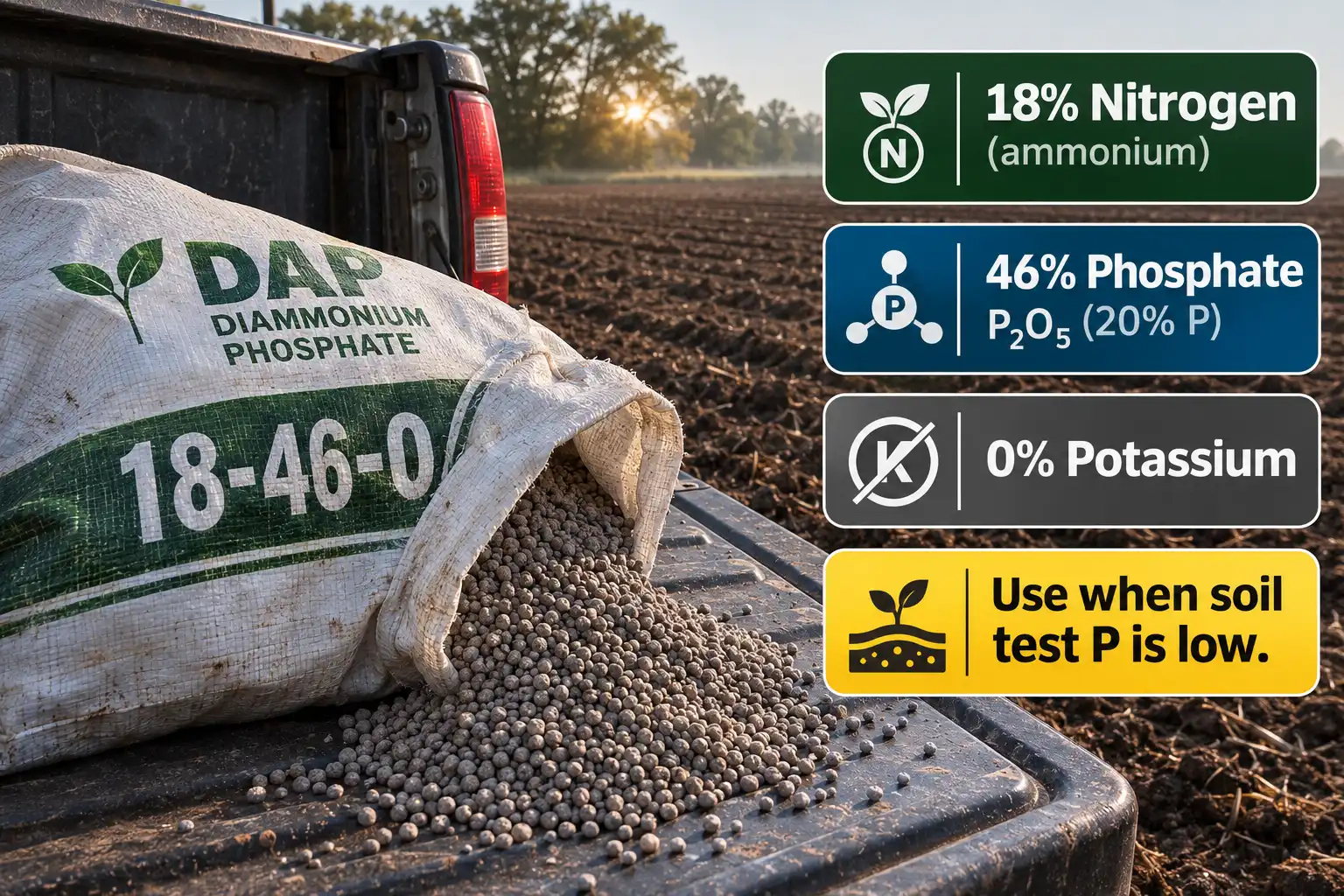
18-46-0 fertilizer is DAP: 18% nitrogen and 46% phosphate (P2O5) by weight, with no potassium. Use it when a soil test shows low phosphorus. Broadcast it before planting or band it beside the seed, keeping seed-row rates low.
What Is 18-46-0 Fertilizer?
18-46-0 is diammonium phosphate, a two-nutrient fertilizer sold as DAP. Every 100 pounds holds 18 pounds of nitrogen, 46 pounds of phosphate (P2O5), and no potassium. Among common dry products, only MAP packs more phosphate, at 50 to 52 percent, per University of Minnesota Extension.
The DAP Formula and How It Is Made
The DAP formula is (NH4)2HPO4. In plain terms, that is two ammonium ions paired with one phosphate. Mosaic Crop Nutrition, a major US phosphate producer, makes it by reacting phosphoric acid with ammonia. The hot slurry is then cooled, granulated, and screened.
Mosaic also notes that 18-46-0 is the standard grade. Products with less nutrient content may not carry the DAP name.
What 18, 46, and 0 Mean
The middle number trips people up. Fertilizer labels report phosphorus as P2O5, not elemental P. So 46 percent P2O5 equals only 20 percent actual phosphorus, per Mosaic’s DAP specifications. Some soil test reports use elemental P, so check the units before you compare.
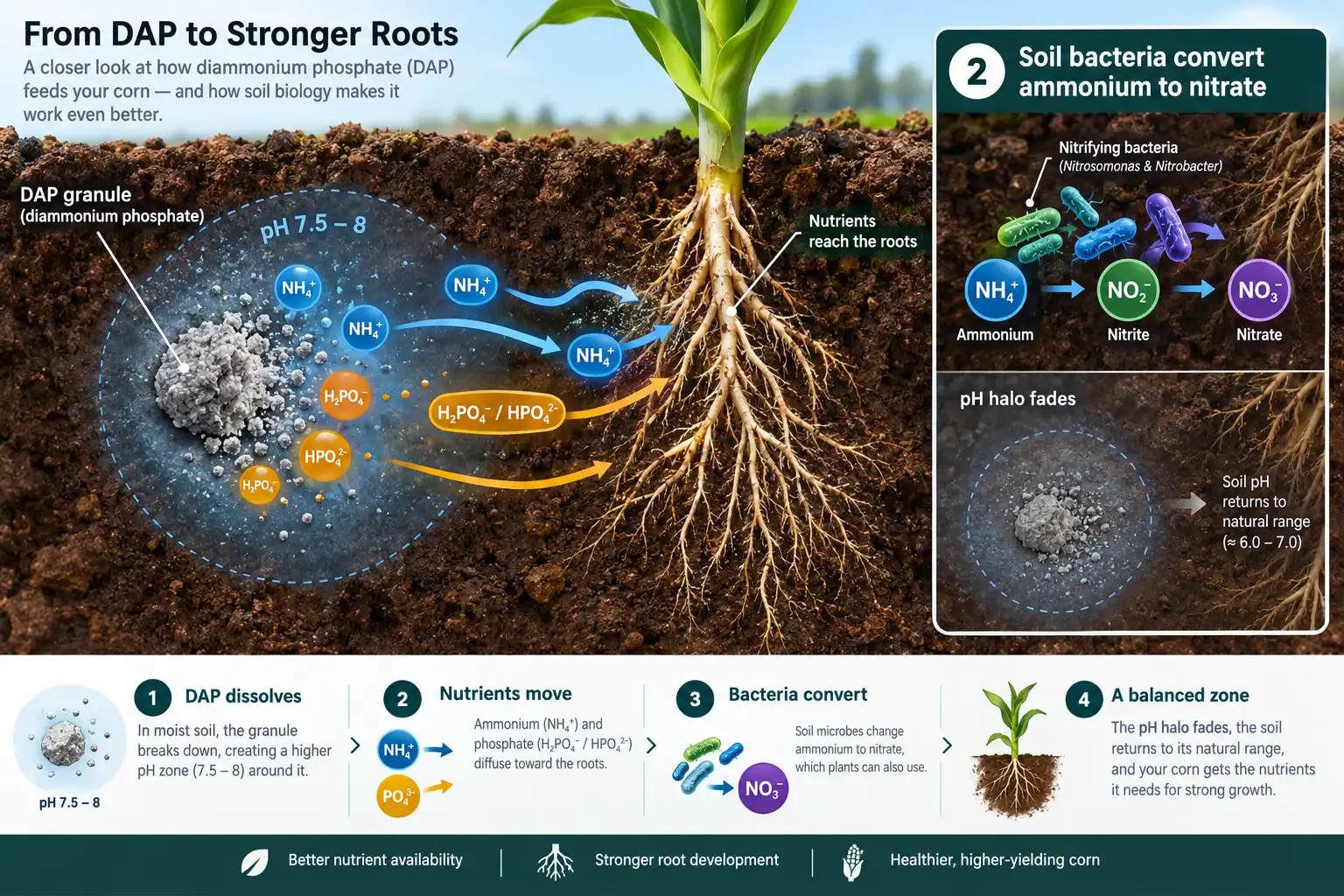
All 18 percent of the nitrogen is ammonium. That has two effects. First, a dissolving granule turns the soil around it alkaline, with a solution pH of 7.5 to 8, per Mosaic. Later, soil bacteria convert the ammonium to nitrate, which pulls the pH back down.
What Is 18-46-0 Fertilizer Used For?
18-46-0 corrects low soil phosphorus and gives young crops an early phosphorus supply. The nitrogen helps, but it is a side benefit, not the reason to buy DAP.
Common uses include:
- Preplant and fall broadcasts for corn, soybeans, and small grains on fields that test low in phosphorus
- In-furrow starter for winter wheat. K-State Research and Extension trials found seed-placed phosphorus consistently raised wheat yields on low-testing soils. DAP performed about the same as MESZ, a phosphate with added sulfur and zinc.
- Garden beds before planting, mixed into the root zone where a soil test calls for phosphorus
- New lawns at seeding or sodding, where state law allows phosphorus on turf
When DAP Is the Wrong Choice
Skip it when the soil already tests adequate. SDSU Extension’s garden guide calls for no phosphorus at all once an Olsen soil test reaches 16 ppm. Extra phosphate on that ground buys nothing and adds runoff risk.
DAP also fails as an all-purpose plant food. It carries no potassium, and phosphorus barely moves from where you place it. So for routine feeding of established plants, a balanced product fits better.
Finally, DAP is off the table for certified organic ground. USDA’s National Organic Program bars synthetic substances unless they appear on its National List. DAP is a synthetic, made from ammonia and phosphoric acid.
DAP vs MAP vs Triple Superphosphate vs 10-10-10
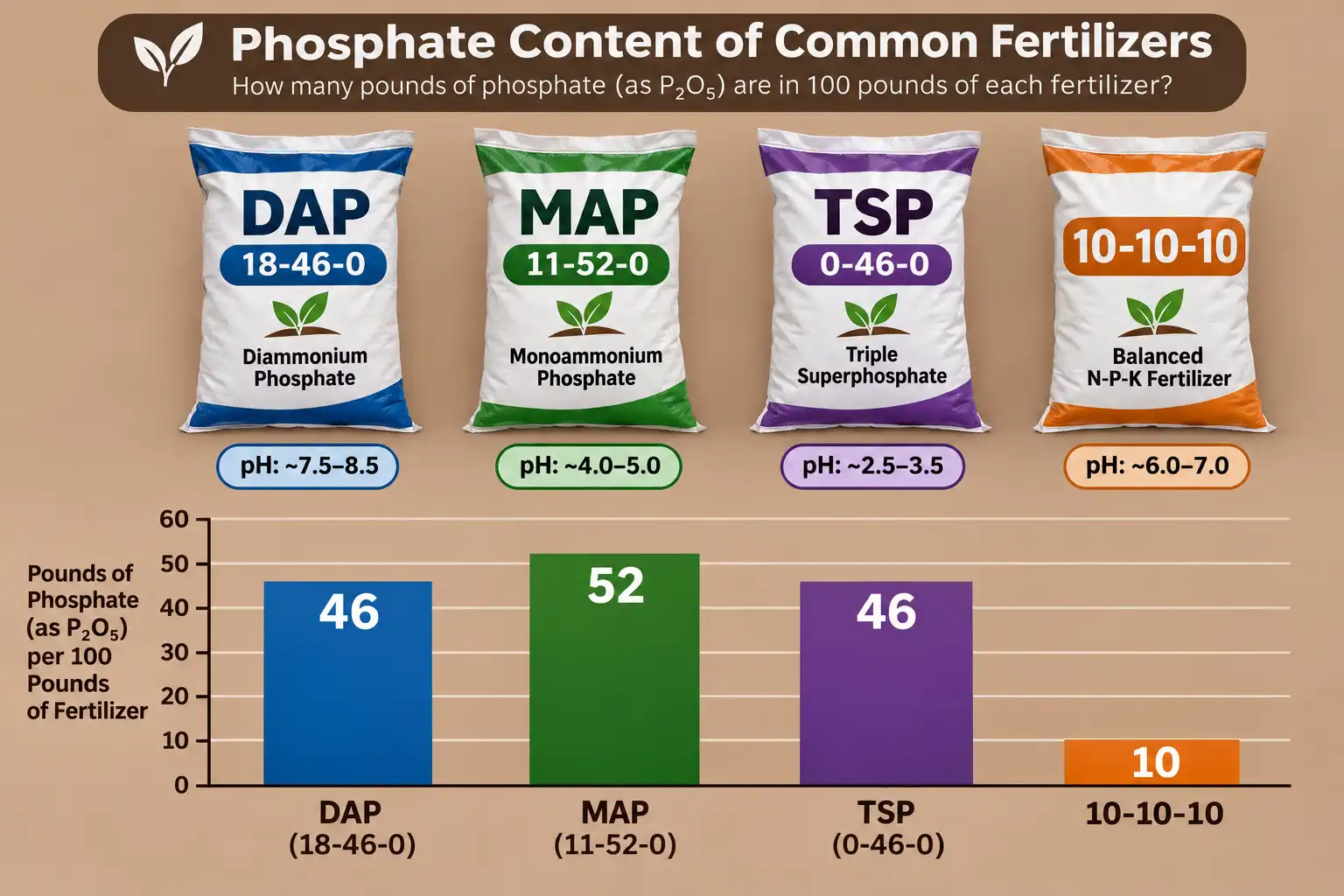
DAP and MAP produce similar yields, so seed safety and price per pound of phosphate usually decide between them. Here is how the common choices compare per 100 pounds of product.
| Fertilizer | Analysis | N per 100 lb | P2O5 per 100 lb | K2O per 100 lb | Solution pH | Fits best |
|---|---|---|---|---|---|---|
| DAP | 18-46-0 | 18 lb | 46 lb | 0 lb | 7.5 to 8 | Low-P soils that can use some N |
| MAP | 11-52-0 | 11 lb | 52 lb | 0 lb | 4 to 4.5 | Seed-row starter, high-pH soils |
| Triple superphosphate (TSP) | 0-46-0 | 0 lb | 46 lb | 0 lb | 1 to 3 | Fall phosphorus without N |
| 10-10-10 | 10-10-10 | 10 lb | 10 lb | 10 lb | Varies by blend | Light all-around feeding |
The DAP pH comes from Mosaic. The MAP and TSP figures come from University of Minnesota Extension.
Which One Should You Buy?
University of Minnesota Extension reports that most research shows little crop difference between MAP and DAP. Its nutrient management specialist, Dan Kaiser, sees no reason for growers on soils above pH 7.5 to hunt for MAP. If DAP is what the local retailer stocks, DAP works.
The real differences are placement and timing. Mosaic notes that ammonia damage to seedlings is more likely above pH 7. That is exactly the condition around a dissolving DAP granule. MAP’s acidic reaction avoids that zone, so it is the safer pick for the seed row.
TSP carries no nitrogen. So the University of Minnesota suggests it for fall use, when nitrogen would be lost before a crop needs it.
A balanced 10-10-10 blend holds less than a quarter of DAP’s phosphate. Correcting a true deficiency with it takes nearly five times the product, plus nitrogen and potassium you may not need.
How Much 18-46-0 Fertilizer to Apply
Apply DAP to hit the phosphate rate on your soil test, then count the nitrogen it brings along. The calculation takes two lines:
Pounds of DAP = pounds of P2O5 recommended ÷ 0.46
Nitrogen supplied = pounds of DAP × 0.18
Field Rates Per Acre
Say your soil test calls for 40 pounds of P2O5 per acre. Divide 40 by 0.46, and you need 87 pounds of DAP. That DAP also delivers about 16 pounds of nitrogen, so subtract it from the crop’s total N plan. For corn, fold that credit into your corn fertilizer rates per acre.
A very low testing field that needs 100 pounds of P2O5 takes 217 pounds of DAP. In that case the DAP supplies 39 pounds of N, which is enough to matter.
The P2O5 figure itself should come from a lab calibrated for your state. If the report’s units or categories are unclear, start by reading your soil test report line by line.
Garden and Raised Bed Rates
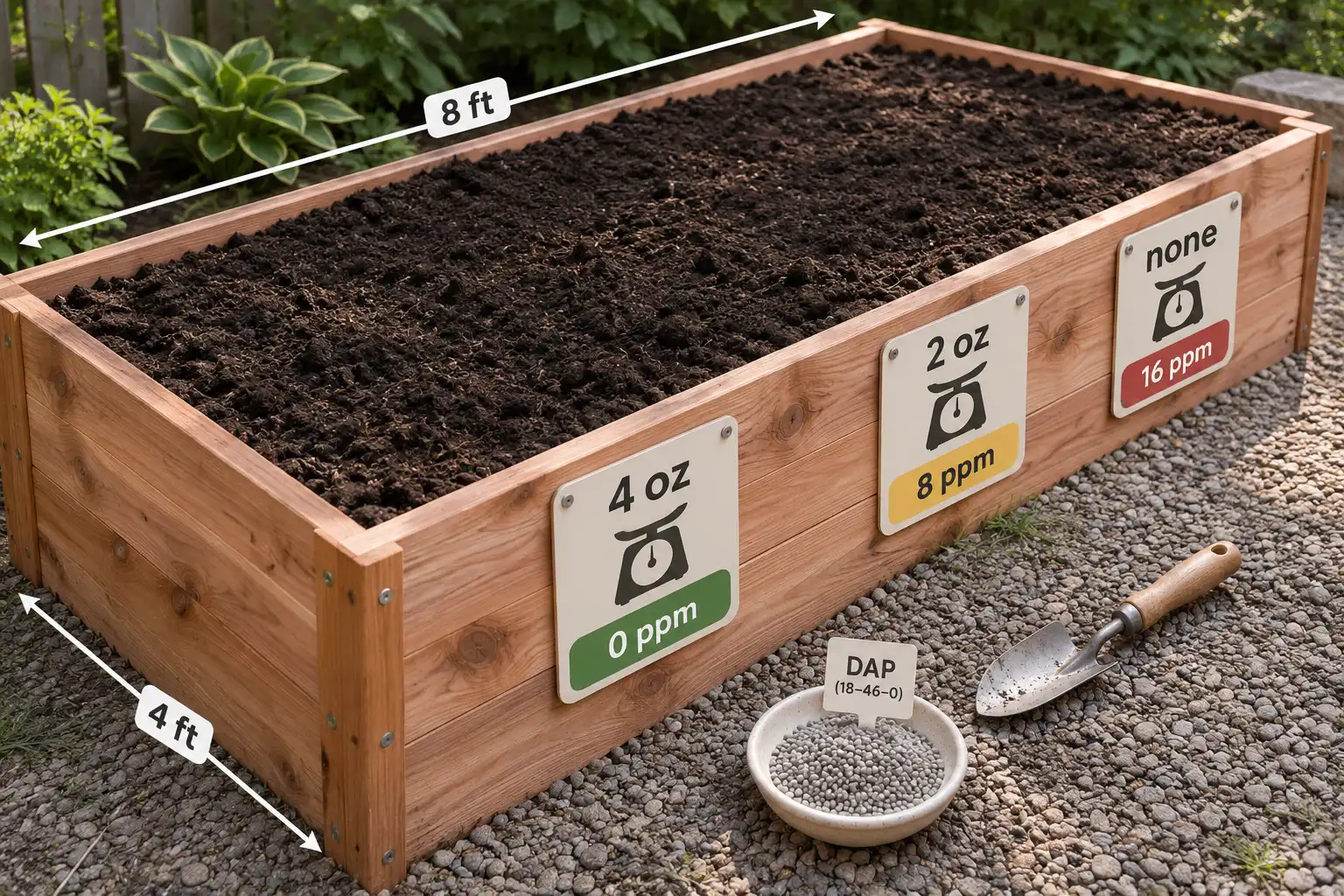
SDSU Extension publishes garden DAP rates tied to the Olsen phosphorus test. We converted its per-1,000-square-foot figures to smaller areas.
| Olsen soil test P (ppm) | DAP per 1,000 sq ft | DAP per 100 sq ft | DAP per 4 by 8 bed |
|---|---|---|---|
| 0 | 7.8 lb | 12.5 oz | 4.0 oz |
| 4 | 5.8 lb | 9.3 oz | 3.0 oz |
| 8 | 3.8 lb | 6.1 oz | 2.0 oz |
| 12 | 1.8 lb | 2.9 oz | 0.9 oz |
| 16 or higher | None | None | None |
Weigh the dose on a kitchen scale instead of guessing by volume. Then mix it into the soil before planting. University of Minnesota Extension recommends working phosphate 4 to 6 inches into garden soil.
One caution: labs that use the Bray or Mehlich-3 test report different values for the same soil. So if your report uses another method, follow the rate printed on it.
How to Apply DAP Without Burning Seed
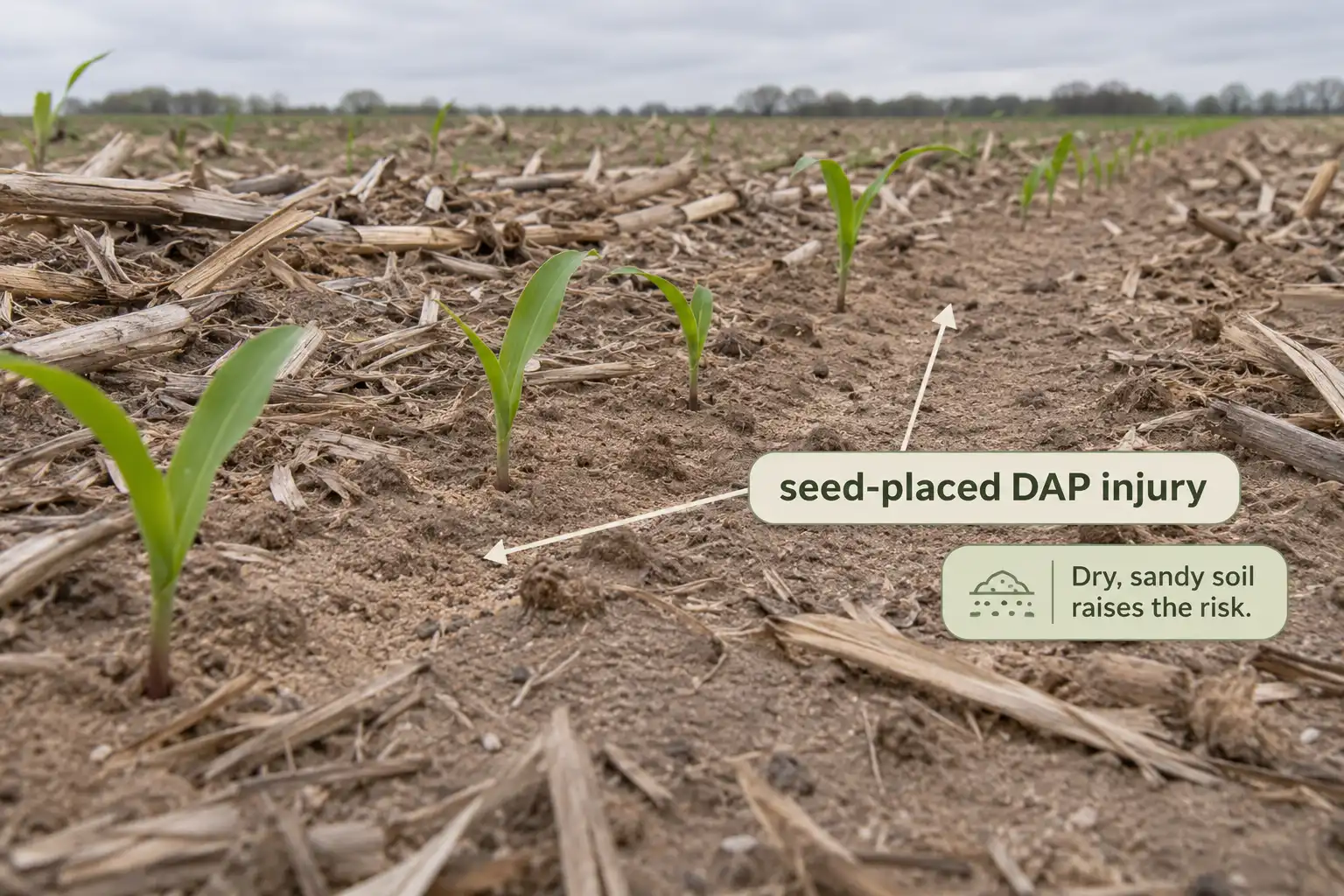
Keep heavy rates of DAP away from seed, and work surface applications into the soil. Both problems trace back to ammonia released by the dissolving granule.
Seed-Placed Limits
K-State Research and Extension caps fertilizer in direct seed contact by pounds of N plus K2O per acre. Because DAP is 18 percent N, those caps convert into product limits.
| Row spacing | Max N + K2O, medium to fine soil | Max DAP, medium to fine soil | Max N + K2O, sandy or dry soil | Max DAP, sandy or dry soil |
|---|---|---|---|---|
| 30-inch rows (corn) | 8 lb | 44 lb | 6 lb | 33 lb |
| 15-inch rows | 16 lb | 89 lb | 11 lb | 61 lb |
| 6 to 8-inch rows (wheat) | 30 lb | 167 lb | 21 lb | 117 lb |
Treat these as ceilings, not targets. Mosaic warns that ammonia near a dissolving DAP granule can harm seedlings, and dry or sandy soil makes it worse. Also note that K-State’s table covers corn and wheat only. For other crops, keep DAP out of the seed furrow.
Banding to the side of and below the seed avoids most of this risk. Per K-State, you can apply most of corn’s needs at planting if enough soil separates fertilizer and seed.

Broadcast Applications
Broadcast DAP before planting, then incorporate it with tillage where you can. Mosaic notes that dissolving DAP can form volatile ammonia, especially above pH 7. So on calcareous soils, DAP left on the surface can lose part of its nitrogen to the air.
On larger areas, an even rate matters as much as the rate itself. A calibrated tow-behind broadcast spreader keeps granules from striping the field.
Lawns
Most established lawns do not need DAP. Minnesota, for example, bans phosphorus on established turf unless a soil or tissue test shows a need. New lawns at seeding or sodding are exempt too, per University of Minnesota Extension. Rules differ by state, so check yours before spreading.
Cost of DAP Fertilizer in 2026
Bulk DAP ran roughly $850 to $985 per ton at farm retail in late summer and fall 2026. The price depended on region. Two reports frame that range, and we give both rather than averaging them.
The USDA AMS North Carolina Production Cost Report tracks prices weekly. For the week ending October 2, 2026, it put DAP at $885 to $1,086 per ton, averaging $985.50. Meanwhile, University of Illinois farmdoc daily put Corn Belt DAP near $850 per ton in August 2026. That was up more than 20 percent from earlier in the year.
The two figures cover different regions and weeks. So check the state report closest to you before you book fertilizer.
Why DAP Prices Climbed
Sulfur drove much of the increase. Mosaic says one ton of DAP takes about 0.4 tons of sulfur, along with phosphate rock and ammonia. In turn, farmdoc daily tied the 2026 rise to sulfur prices topping $1,000 per ton and higher ammonia costs.
Cost Per Pound of Phosphate
Compare phosphorus products on cost per pound of P2O5, not cost per ton. One ton of DAP holds 920 pounds of P2O5 and 360 pounds of N.
At the North Carolina average of $985.50, DAP costs $1.07 per pound of P2O5. Now credit the nitrogen at that same report’s urea price of $767.50 per ton, which works out to $0.83 per pound of N. The net phosphate cost then drops to about $0.74 per pound. At that price, the 87-pound-per-acre example above costs about $43 per acre.
For bagged garden DAP, use the same logic. Divide the package price by its weight in pounds times 0.46. For example, a 4 lb pouch holds 1.84 pounds of P2O5.
How to Choose an 18-46-0 Product
Pick a DAP product by its confirmed analysis and package size, not by bloom or yield promises. Four checks catch most buying mistakes.
Confirm the grade on the label. True DAP reads 18-46-0. Mosaic notes that lower-analysis products may not carry the DAP name. So a listing that says only “DAP” deserves a look at the guaranteed analysis.
Match the package to your area. At SDSU Extension’s 3.8 pounds per 1,000 square feet (an 8 ppm soil test), a 4 lb pouch covers about 1,050 square feet. A 40 lb box covers nearly a quarter acre.
Plan for storage. DAP pulls moisture from humid air. K-State found that DAP mixed with seed takes up moisture and cakes above 70 percent relative humidity. A resealable bag helps if leftovers will sit until next season.
Read “organic” claims closely. DAP cannot be used on certified organic ground under USDA National Organic Program rules. So an 18-46-0 product sold as organic deserves a hard look at its ingredient list. If you need an organic route, focus on building soil fertility naturally with permitted inputs instead.
Top 18-46-0 Fertilizer Picks
The three products below are straight DAP in sizes that fit gardens, lawns, and small plots. Specifications come from manufacturer listings, and owner feedback is summarized where it exists.
1. Cz Garden 18-46-0 DAP Fertilizer (4 lb)
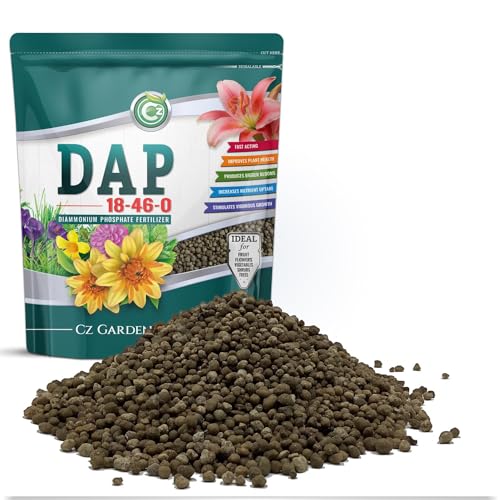
- PREMIUM QUALITY INGREDIENTS – Cz Garden 18-46-0 is a high purity, premium DAP fertilizer for all indoor/outdoor flowers,…
- POWERFUL FERTILIZER promotes vigorous growth and bigger blooms in your home garden
- RESEALABLE, EASY POUR PACKAGING: Cz Garden 18-46-0 DAP fertilizer comes sealed in a heavy duty resealable 4LB pouch. Pou…
Best overall for home gardens
Cz Garden Supply sells a straight 18-46-0 in a heavy-duty, resealable 4 lb pouch made in the USA. The listing positions it for flowers, lawns, and vegetables, indoors or out. At an 8 ppm soil test, one pouch treats about 1,050 square feet, or roughly 32 raised beds measuring 4 by 8. The weak spot is guidance. The listing gives no application rate, so plan on dosing from a soil test.
Owner reports: Owners rate its effectiveness and quality highly. Several report faster tomato growth and darker green plants, and one credits it with blooms on citrus trees and Arabian jasmine.
Pros
- Clearly labeled 18-46-0
- Resealable heavy-duty pouch
- Made in the USA
- Sized for home gardens
Cons
- No application rate listed
- Too phosphorus-heavy for routine feeding
Specifications
- Analysis: 18-46-0 (DAP)
- Form: Granules
- Size: 4 lb (64 oz)
- Brand: Cz Garden Supply
2. Bare Ground Solutions DAP 18-46-0 (40 lb)
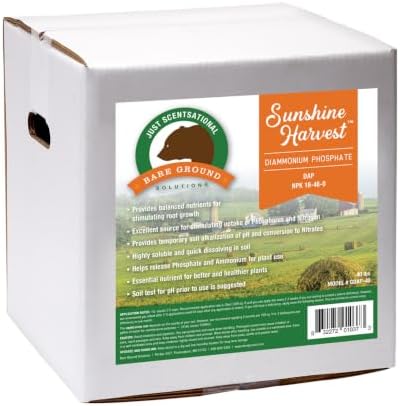
- Diammonium Phosphate NPK 18-46-0 that helps release phosphate and ammonium for plant use
- Provides temporary soil alkalization of pH to aid conversion of nitrates
- Excellent way to stimulate the uptake of phosphorous and nitrogen
Best for lawns and larger plots
This 40 lb box from Bare Ground Solutions (Just Scentsational) is the bulk option. It prints a clear rate: 275 lb per acre, or 10.1 oz per 100 square feet. At that rate, one box covers about 6,300 square feet. The dose supplies roughly 126 lb of P2O5 per acre, a build-up dose suited only to low-testing soil. To its credit, the listing tells buyers to test soil first. On established turf, check your state’s lawn phosphorus rules before spreading.
Owner reports: Owner feedback is too thin to show a consistent pattern yet.
Pros
- Printed per-acre rate
- Bulk 40 lb box
- Soil-test-first guidance
- Quick-dissolving granules
Cons
- Listed rate runs heavy
- Opened box needs dry storage
Specifications
- Analysis: 18-46-0 (DAP)
- Form: Granules
- Size: 40 lb box
- Target use: Lawn
3. Go Garden DAP Fertilizer (400 g)

- Improves Size of Flowers, Fruits and Vegetables. Good quality It controls the leaf yellowing, and improving green leaves
- A plant food with a similar description to DAP but organic Fertilizer
- A plant food similar to DAP is one that provides a source of both nitrogen and phosphorus to plants.
Best for containers and small trials
Go Garden’s 400 g (14.1 oz) pack fits a few pots or a handful of beds. The listing describes fully water-soluble granules for soil drenching, which suits container growers who water nutrients in. Solubility is not the worry, since Mosaic lists DAP at 588 grams per liter of water. Instead, the gap is label data. The listing names DAP but prints neither the 18-46-0 grade nor a clear rate, so confirm both on the package. At 2 oz per 4 by 8 bed, the pack treats about seven beds.
Owner reports: Owner feedback is limited, so no consistent pattern has emerged.
Pros
- Small, low-waste size
- Water-soluble granules
- Works as soil drench
- Indoor and outdoor use
Cons
- Grade not stated in listing
- Vague application directions
Specifications
- Analysis: DAP (nitrogen and phosphorus)
- Form: Granules
- Size: 400 g (14.1 oz)
- Brand: Go Garden
Common 18-46-0 Mistakes and How to Spot Them
Most DAP problems show up as a thin stand, no visible response, or a caked bag. Here is what each one usually means.
Gaps and weak seedlings after planting. Seed-placed DAP above K-State’s limits releases enough ammonia to injure germinating seed, especially in dry or sandy soil. Next season, band it to the side or cut the in-furrow rate.
No visible response. Most likely, the soil already had enough phosphorus. SDSU Extension’s garden rates drop to zero at 16 ppm Olsen. Test before the next application rather than adding more.
Hard, caked granules. Humid air got into the bag. Break up the clumps, then store the rest sealed in a dry spot.
Fall nitrogen gone by spring. DAP’s ammonium can convert to nitrate and move before a spring crop uses it. For that reason, University of Minnesota Extension points fall phosphorus users to TSP when the nitrogen would be lost.
Doubled-up nitrogen. DAP’s nitrogen is easy to overlook. If you also sidedress with straight urea, subtract DAP’s contribution from the urea rate first.
FAQs About 18-46-0 Fertilizer
What is 18-46-0 fertilizer used for?
18-46-0 raises low soil phosphorus before planting and supplies starter phosphorus near young crops. It works for field crops, gardens, and new lawns, but only where a soil test shows a real need.
Is 18-46-0 fertilizer organic?
No, DAP is a synthetic made from ammonia and phosphoric acid, and the USDA National Organic Program does not allow it. Organic growers need a permitted phosphorus source, such as compost or untreated rock phosphate.
Will 18-46-0 burn my plants?
It can if too much sits right next to seeds, roots, or stems. Ammonia from dissolving DAP injures young tissue, so mix it into the soil at your soil-test rate.
Is DAP better than MAP?
Neither wins on yield, since University of Minnesota Extension reports little crop difference between them. Pick MAP for seed-row placement, and DAP when you want extra nitrogen or cheaper phosphate.
Can you dissolve 18-46-0 in water?
Yes, Mosaic lists DAP’s solubility at 588 grams per liter at 68°F, so granules dissolve readily for a soil drench. Liquid application does not change the dose, so still follow your soil test.
Can I use DAP on my lawn?
Only on a new lawn or on turf whose soil test shows low phosphorus. Some states, including Minnesota, restrict phosphorus on established lawns, so check your state rules before spreading.
Does DAP fertilizer go bad?
The nutrients do not break down in storage, but the granules absorb moisture and cake. K-State notes caking above 70 percent relative humidity, so keep opened bags sealed and stored somewhere dry.
Key Points for Your Field
Treat 18-46-0 as a phosphorus fix, not a general plant food. Test first, then divide the P2O5 recommendation by 0.46 to get pounds of DAP.
Next, count the nitrogen it adds and keep seed-contact rates under K-State’s limits. And if your soil already tests optimum or higher, skip DAP this season and keep the money.