
Best pH Meter for Soil Testing in 2026: What Extension Trials Found
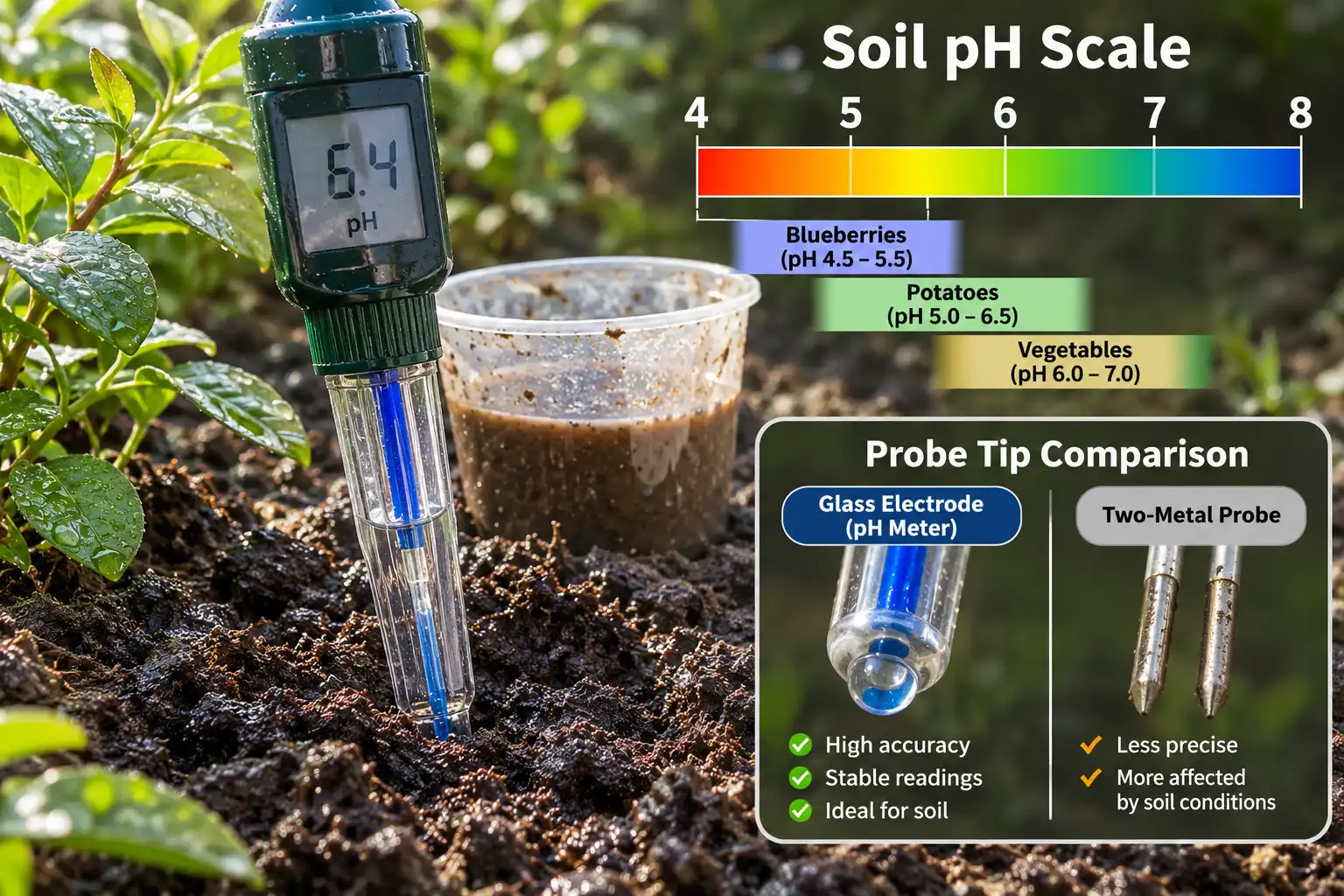
A soil pH reading is worth taking only if it steers a decision: lime, sulfur, or blueberries. Probe type matters more than brand. The best pH meter for soil testing reads through a glass electrode. Data from an extension trial shows why cheaper probes fall short.
The best pH meter for soil testing is a calibrated glass electrode tester such as the Hanna HI981030, rated ±0.05 pH. Avoid cheap two-metal probe meters. In a Journal of Extension trial, a battery-free probe read 6.0 on every soil.
Top 10 Picks for the Best pH Meter for Soil Testing
- Apera Instruments GroStar GS2 Soil pH Pen (Gen II)
- Bluelab Soil pH Pen
- Tadeto TE027 Soil pH Tester
- YINMIK YK-S01E Digital Soil pH Tester
- Luster Leaf Rapitest 1601 Soil Test Kit
- Kelway HB-2 Soil pH and Moisture Meter
- VIVOSUN 4-in-1 Digital pH Meter (PH-002)
- Gain Express ZD-06 Soil pH Meter
- YAMRON 4-in-1 Digital Soil Moisture Meter
- SONKIR MS02 3-in-1 Soil Meter
How a Soil pH Meter Works: Glass Electrode vs Two-Metal Probe
Every soil pH meter reads acidity in one of three ways. The method sets how far you can trust the reading, so start here.
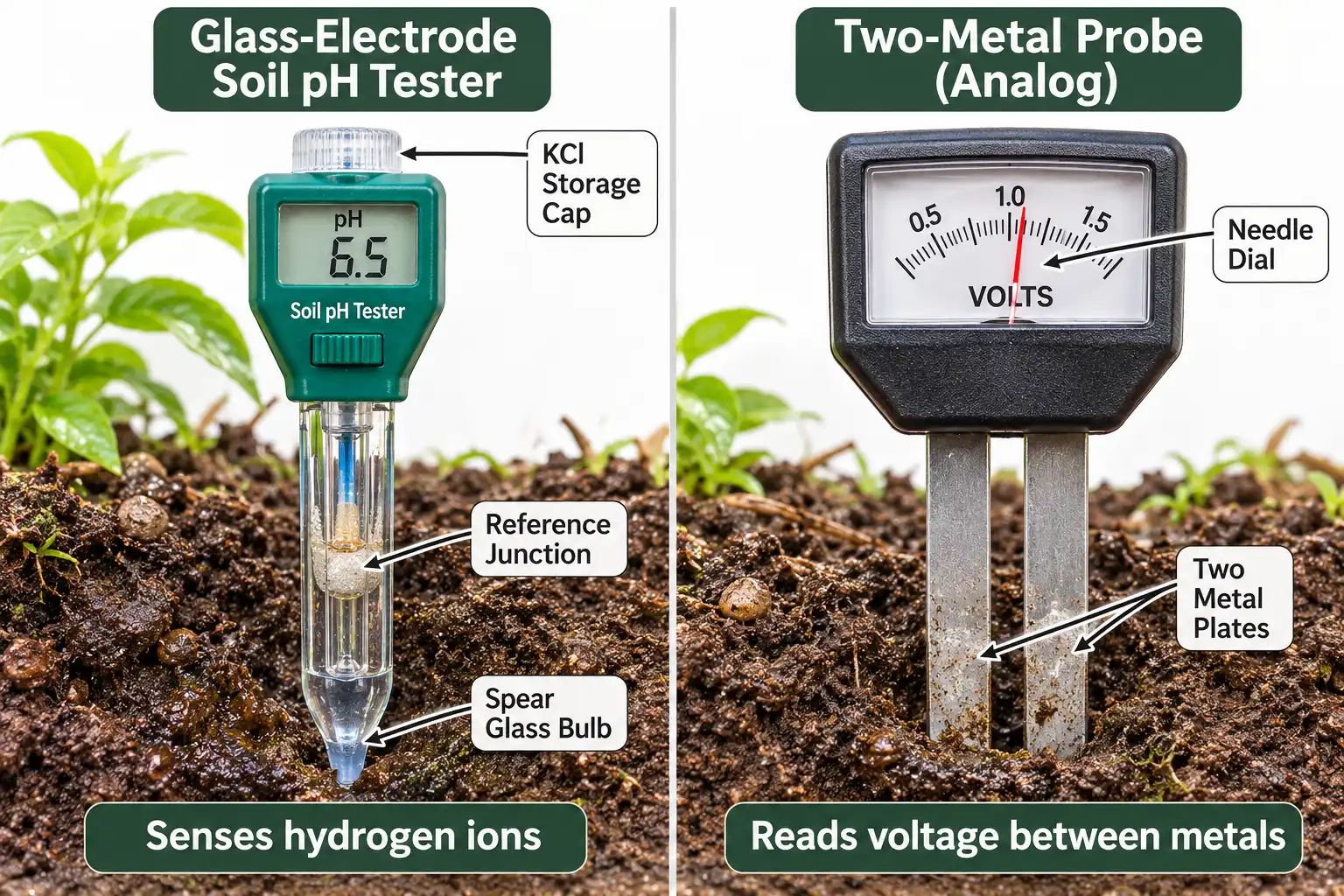
Glass-Electrode Meters: Pens, Spears and Conical Tips
A glass electrode pH meter senses hydrogen ion activity in soil moisture through a thin glass bulb. Next to the bulb, a reference junction completes the circuit. Spear and conical tips push straight into moist soil. The Hanna HI981030, Apera GS2 and Bluelab Soil pH Pen work this way. By contrast, general pens such as the Apera PH20 have no spear tip. They read a soil and water slurry instead. Either way, you calibrate with pH 4.01 and 7.01 buffers and store the tip wet in KCl solution.
Two-Metal Analog Probes: Battery-Free, Narrower Range
A two-metal probe reads the small voltage between two different metals in moist soil. So it needs no battery, no buffers and no calibration. The Kelway HB-2 and the self-powered Gain Express ZD-06 work this way. Kelway distributors cite manufacturer testing at ±0.2 pH in acidic soils, across a 3.5 to 8.0 range. That puts alkaline ground at the edge of the scale.
That is also the real issue in any analog vs digital soil pH meter choice. A digital screen says nothing about the sensor. So if the spec sheet lists only metal probes, treat the pH reading like a two-metal one.
Chemical Kits and Test Strips
A chemical kit such as the Luster Leaf Rapitest 1601 skips electronics entirely. You mix soil with water, add a dye capsule and match the color to a chart. The 1601 holds 40 tests, 10 each for pH, nitrogen, phosphorus and potash. However, a color chart gives steps, not decimals. Oregon State Extension notes that many cropping situations need 0.5-unit steps, so a whole-unit chart falls short.
Do Soil pH Meters Actually Work? What Extension Trials Found
Do soil pH meters work? Calibrated electronic meters do, but a cheap battery-free probe did not. Gene Stevens, David Dunn and Bobby Phipps ran the test at the University of Missouri Delta Center in Portageville. They published it in the Journal of Extension in 2001. Their calibrated hand-held meter landed within 0.3 pH of the lab’s bench meter. Meanwhile, the probe read 6.0 on every soil.
First, the team read limed and unlimed cotton plots. Next, they tested three soils from the NAPT program (North American Proficiency Testing) that 82 labs had already analyzed. Here is how each method compared, using the trial’s published figures.
| Test method | Unlimed plot | Limed plot | NAPT soil 00-103 | NAPT soil 00-107 | NAPT soil 00-113 |
|---|---|---|---|---|---|
| 82 NAPT labs | Not run | Not run | 7.9 | 6.3 | 5.6 |
| Lab bench meter | 5.6 | 6.8 | 7.8 | 6.5 | 6.0 |
| Hand-held meter, calibrated | 5.5 | 6.5 | 7.7 | 6.3 | 5.5 |
| Color kit | 5.8 | 7.0 | 8.0 | 6.5 | 5.5 |
| Battery-free probe | 6.0 | 6.0 | 6.0 | 6.0 | 6.0 |
Oregon State University Extension summarizes this four-method comparison the same way. The hand-held meter came closest to the 82-lab average. The probe, by contrast, could not separate samples that differed by more than 2.0 pH units.
Calibration habits matter as much as hardware, though. In the same trial, 17 untrained people each tested one sample with a hand-held meter, unsupervised. Some calibrated with pH 4 and 7 standards, and others skipped it. Their median of 6.3 sat close to the labs’ 6.34. Yet their readings scattered more than twice as widely as the labs’ did.
So, are cheap soil pH meters accurate? The failed probe was a low-cost Luster Leaf mini probe, not the company’s chemical kit. Still, the evidence is old and narrow. We found no extension trial that tests the Kelway HB-2 or the Gain Express ZD-06 by name. Until one exists, treat any two-metal reading as a rough screen.
On this evidence, the most accurate soil pH meter for field work is a calibrated electrode tester. It also needs an owner who actually calibrates it.
How Much Accuracy You Need: Crop pH Targets
Aim for a meter that reads within about 0.2 pH. Crop targets are narrow, and Oregon State Extension warns that 0.1 to 0.2 unit differences can matter when lime is expensive. The ideal soil pH also shifts by crop. Rutgers NJAES sets the vegetable targets below in its commercial recommendations. University of Minnesota Extension sets the field crop targets.
| Crop | Target pH | Source |
|---|---|---|
| Highbush blueberries | 4.5 to 4.8 | Rutgers NJAES |
| Potatoes, scab-susceptible varieties | 5.2 (lower limit 5.0) | Rutgers NJAES |
| Potatoes, scab-resistant varieties | 6.2 (lower limit 5.5) | Rutgers NJAES |
| Carrots | 6.0 (lower limit 5.5) | Rutgers NJAES |
| Most vegetables | 6.0 to 6.8 | Rutgers NJAES |
| Peppers, cabbage | 6.5 | Rutgers NJAES |
| Corn, soybeans | Lime to 6.0 | University of Minnesota Extension |
| Alfalfa | Lime to 6.5 | University of Minnesota Extension |
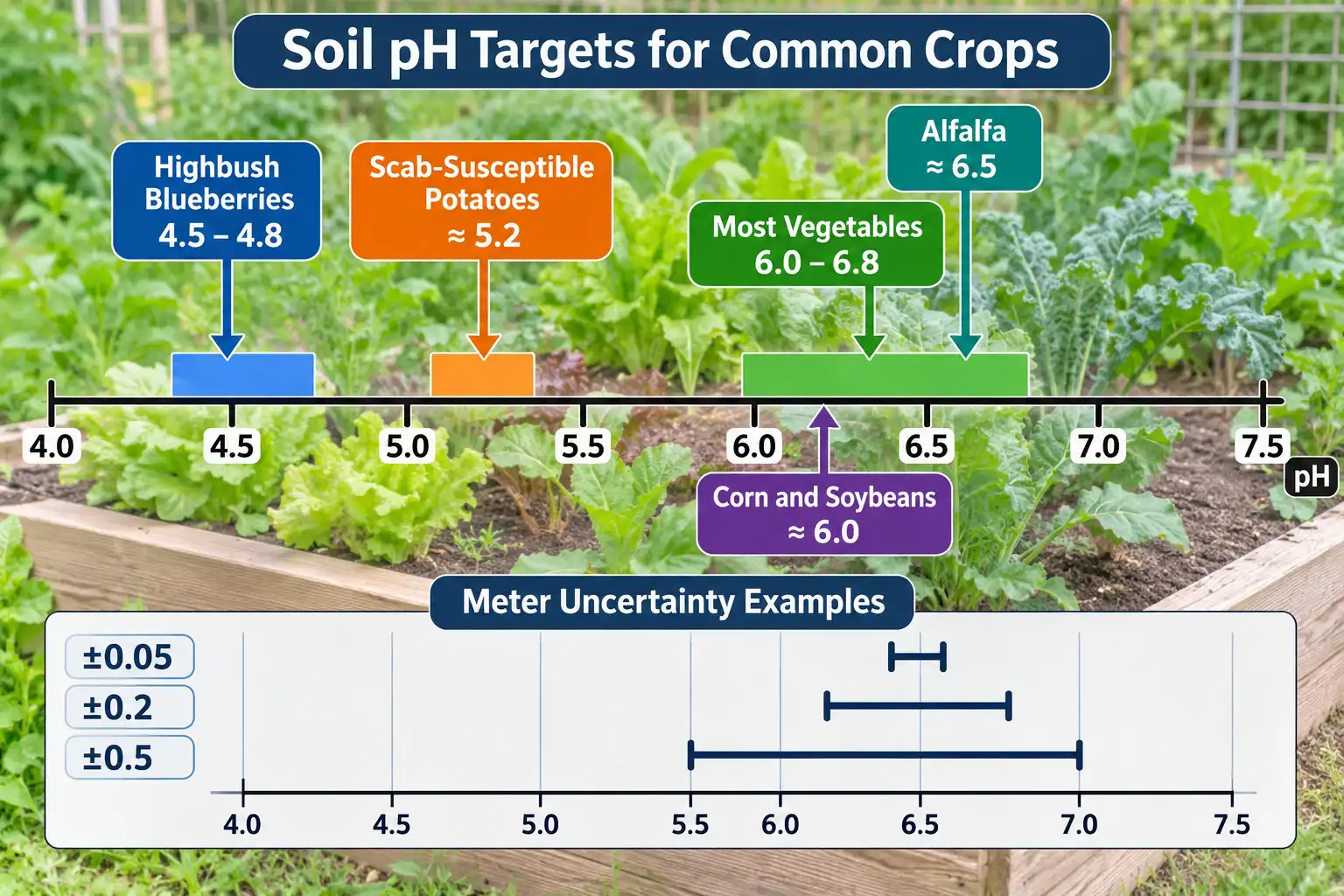
Most soil pH for vegetables advice lands at 6.0 to 6.8. Blueberries leave far less room. Their window is only 0.3 units wide, so a ±0.2 meter is about the loosest tool that still fits.
Potatoes show the risk best. Scab-susceptible varieties need pH near 5.2 to hold down common scab. A ±0.5 meter reading 5.7 could mean 5.2 or 6.2. That is the gap between a scab-safe bed and one suited to most vegetables. If potatoes are on the plan, set the pH target alongside your plan for fertilizing potatoes.
Field crops are more forgiving. University of Minnesota Extension reports that corn and soybeans gain from lime only below pH 6.0, while alfalfa responds below 6.5. On a corn field testing 6.2, skip the lime and put the effort into your corn fertilizer rates instead.
What a pH Meter Cannot Tell You: Water pH vs Buffer pH
A meter gives you water pH, the active acidity in soil moisture. It cannot give you a lime requirement. University of Minnesota Extension explains the lab sequence. First, labs mix equal weights of soil and water and read the water pH. Then, when water pH drops below a set point, most labs run a buffer pH. At the University of Minnesota lab, that cutoff is 6.0.
The buffer pH captures reserve acidity held on soil particles, so it sets the limestone rate. Minnesota’s lab uses the Sikora buffer. Oregon State Extension describes the older SMP buffer, with a quarter-strength version for sandy soils. Also, don’t be thrown when the buffer number reads higher than water pH. Minnesota notes that this is normal.
That is why two soils at pH 5.5 can need very different amounts of agricultural limestone. Clay and organic matter hold far more reserve acidity than sand. Oregon State Extension lists buffering capacity among the factors that set any lime rate.
So in the soil test vs pH meter question, the meter screens and the lab prescribes. Our soil test report walkthrough shows where buffer pH appears and how to use it.
Soil pH Meter vs Lab Test vs Test Kit: Which Fits Your Ground
Match the tool to the ground you manage. A soil pH tester earns its keep where you need many quick checks. A lab soil test, on the other hand, is what sets lime rates.
| Your ground | Start with | Why it fits | Confirm with a lab |
|---|---|---|---|
| Raised bed or containers | Soil pH test kit or a glass pen read in slurry | Few readings, and a kit costs little per test | Before the first planting and after any off-target reading |
| Home garden or small orchard | Glass electrode tester | Spot-checks beds between lab tests | Before buying lime or sulfur |
| Market garden | Glass electrode tester, slurry method | Many beds with different crop targets | Each block before liming |
| Row crops | Lab soil test by field or zone | Lime rates need buffer pH | Every field on your sampling cycle |
Whatever the scale, Oregon State Extension treats field readings as estimates. If a meter or kit puts pH outside a crop’s range, send a sample to a lab before acting. The same source suggests testing if you have not checked pH in three years. On row crops, a meter adds little. Lime decisions there rest on buffer pH from cores pulled across each field.
The 10 Best pH Meters for Soil Testing: Reviews
1. Apera Instruments GroStar GS2 Soil pH Pen (Gen II)

- Lab-grade soil pH meter designed specifically to meet growers’ needs and habits
- Measures pH and temperature directly in soil, coco coir, rockwool, and many other media types as well as nutrition solut…
- The replaceable Swiss spear pH sensor makes high-accuracy direct soil pH measurement easier than ever.
Best overall for direct soil readings
Apera Instruments, a Columbus, Ohio sensor maker since 1991, built the GS2 for growers. Its replaceable Swiss spear glass probe reads soil directly. TruRead mode averages several spots, and a health indicator warns before the probe fails. It suits market gardens and serious bed growers. Owner reports consistently praise the build and quick setup.
Why it’s a good buy
- Replaceable glass spear probe
- Averages readings across beds
- Warns when probe weakens
- Calibrates in under a minute
Why it’s not recommended
- Replacement probes cost extra
- Some report erratic readings
Specifications
- Accuracy: ±0.1 pH with ATC
- Probe: Swiss LabSen spear, replaceable
- Housing: IP67 waterproof and dustproof
- Warranty: 2 years pen, 1 year probe
2. Bluelab Soil pH Pen
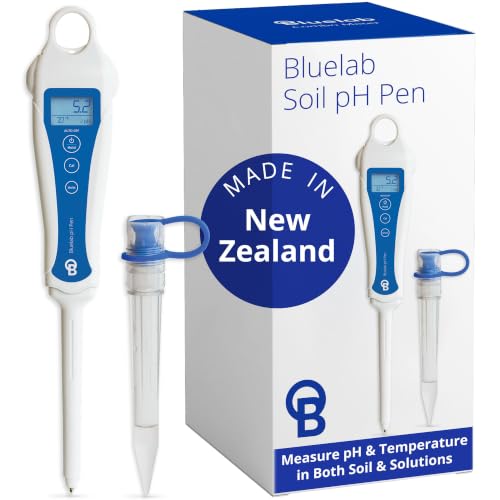
- pH management for various media – Our pH meter can be used for soil, coco, coir, potting mixes, hydroponics or water fis…
- Easy calibration – Set up our pH soil tester for garden with a two-point calibration process. Calibrate the handheld met…
- Thrives in the toughest environments – Our soil pH tester comes with waterproof casing. It can withstand the knocks, dro…
Best rugged sealed pen
Bluelab, based in Tauranga, New Zealand, has focused on grower meters since 2004 and makes this pen there. A glass bulb reads soil and potting mix directly. The cap doubles as a dibber, so you punch a pilot hole and spare the tip. A 30-day indicator tells you when to recalibrate. It fits greenhouses and beds. Owner reports trust its readings but note drift between calibrations.
Why it’s a good buy
- Fully waterproof, even floats
- Dibber cap protects tip
- 30-day calibration reminder
- Made in New Zealand
Why it’s not recommended
- Probe is not replaceable
- Storage cap spills easily
Specifications
- Accuracy: ±0.1 pH with ATC
- Range: 0 to 14 pH
- Power: one AAA battery
- Warranty: 12 months
3. Tadeto TE027 Soil pH Tester

- Versatile & Accurate pH Measurement: This pH meter quickly and reliably reads pH values for a wide range of liquids, inc…
- 3‑Point Calibration Method & Manual Value Adjustment: This pH test kit uses a scientific 3‑point calibration method (aci…
- Clear Display & Smart Alerts: Equipped with a large LCD backlit screen for clear readings even in low‑light conditions, …
Best mid-price digital tester
The Tadeto TE027 is a digital pH tester with a zinc-alloy cap that shields the electrode in firmer soil. It stores wet in KCl solution and takes a three-point calibration at pH 4.01, 7.0 and 10.01. For steadier readings, calibrate with all three buffers before each session. Owner reports call it dependable for the money but find the manual confusing.
Why it’s a good buy
- Calibrates at three points
- Tough zinc-alloy probe cap
- Alerts at extreme pH
- Hold button freezes readings
Why it’s not recommended
- Confusing calibration instructions
Specifications
- Range: 0 to 14 pH
- Calibration: manual, three points
- Storage: KCl in the cap
- Power: two AA batteries
4. YINMIK YK-S01E Digital Soil pH Tester

- 【Great Gadget for Soil pH Testing】Tired of making slurries or mixing up soil solution? Can’t get any change from dial po…
- 【Effective in Most Growing Media】YINMIK Digital pH soil tester is equipped with a tapered stainless-steel dibber which c…
- 【Digital Plant pH Tester for Soil and Water】 With stainless steel dibbor, YINMIK pH tester can easy measure pH of your g…
Best for logging readings by phone
The YK-S01E pairs a spear pH electrode with a tapered stainless steel dibber that guards the tip in soil. Pull the dibber off and it reads nutrient solution or well water. Its Bluetooth app logs readings automatically. Plan to recalibrate every 5 to 7 uses. Owner reports split on accuracy, and some see readings stick after weeks.
Why it’s a good buy
- Phone app logs readings
- Steel dibber guards electrode
- Tests soil and water
- Replaceable probe for longevity
Why it’s not recommended
- Calibration can confuse beginners
Specifications
- Range: 0 to 14 pH
- Calibration: three points, set in app
- Probe: 5.5-inch spear with dibber
- Power: three LR44 button cells
5. Luster Leaf Rapitest 1601 Soil Test Kit

- Quick, at home results for Soil pH, Nitrogen, Phosphrous and Potash
- Innovative and inexpensive soil test kit features an easy-to-use capsule system and patented color comparators
- Contains all components needed for 40 tests. 10 for each of pH, N, P and K
Best for pH plus N, P and K
Woodstock, Illinois-based Luster Leaf makes the 1601 in the USA. You shake soil with water, add a capsule and match the color in a comparator. It checks pH, nitrogen, phosphorus and potash. Color steps can’t show tenths, so confirm any lime decision with a lab. Its nutrient reads guide building soil fertility naturally. Owner reports praise its ease and value.
Why it’s a good buy
- No batteries or calibration
- 450-plant pH guide
- Easy color comparator
- Low cost per test
Why it’s not recommended
- No decimal pH readings
- Kit runs out after 40
Specifications
- Tests: 40 total, 10 each
- Method: capsule and color comparator
- Sample depth: 4 to 6 inches
- Power: none needed
6. Kelway HB-2 Soil pH and Moisture Meter

- Measures pH values from 3.5 to 8,
- Measures soil moisture from 0 to 100 percent
- Requires No chemical, distilled water, or outside electric power source
Best analog meter for acidic soil
Kel Instruments of New Jersey first filed the Kelway trademark in 1978. The HB-2 is a two-metal analog meter. Wipe the plates with conditioning film, push in to the black marks, and read pH and moisture within two minutes. It suits lawns, roses and blueberries on acidic ground. Owner reports consistently praise its sturdy build and repeatable dial.
Why it’s a good buy
- No batteries or chemicals
- Sturdy, long-lived build
- Reads moisture too
- Fast checks across yards
Why it’s not recommended
- Tops out at pH 8.0
- Refill film sold separately
Specifications
- pH range: 3.5 to 8.0
- Accuracy: ±0.2 pH in acidic soils
- Moisture: 0 to 100%, ±10%
- Case: belt-loop carrying case
7. VIVOSUN 4-in-1 Digital pH Meter (PH-002)

- 4-in-1 Mode: With Vivosun 4-in-1 PH tester, you can accurately measure PH, TDS, EC and Temp value; Know water quality cl…
- High Accuracy: With high sensitive probe, you can quickly read the results; ±0.1 accuracy, a wide measurement range 0-14…
- Automatic Temperature Compensation: With ATC function, Vivosun 4-in-1 pH meter solve the inaccurate measuring problem ca…
Budget pick for the slurry method
VIVOSUN is an Ontario, California brand known for indoor growing gear. This pen reads pH, EC, TDS and temperature in liquids, not soil. So you use it on a 1:1 soil and distilled water slurry, the most accurate home method anyway. Dip only the probe, never the upper body. Owner reports like the simple buttons but flag calibration trouble and early failures.
Why it’s a good buy
- Reads pH, EC, TDS
- Automatic temperature compensation
- Simple push-button operation
- Lock button freezes readings
Why it’s not recommended
- Liquids only, no soil
- Owners report calibration failures
Specifications
- Accuracy: ±0.1 pH
- Calibration: pH 4.0 and 7.0 packets included
- Power: three LR44 batteries
- Warranty: 1 year
8. Gain Express ZD-06 Soil pH Meter

- Accurate pH and Moisture Measurement: Achieve optimum results with this pH and moisture meter; It provides accurate and …
- Versatile and Practical: Suitable for commercial use in vineyards; orchards; field production and lawn maintenance; as w…
- Deep Penetration and Durability: The longer and slender 295mm electrode allows for deep penetration into the soil; provi…
Best long probe for quick field checks
Hong Kong-based Gain Express makes the ZD-06, a self-powered analog meter with an 11.6-inch metal electrode. That length reaches below the surface layer in beds, orchards and vineyard rows. The dial shows pH and moisture together for fast screening. Still, confirm odd readings with a lab. Owner reports consistently praise its reach and durability.
Why it’s a good buy
- 11.6-inch deep-reaching probe
- No batteries needed
- Suits vineyards and orchards
- Durable metal electrode
Why it’s not recommended
- Coarse 3 to 8 scale
Specifications
- Probe: 295 mm metal electrode
- pH scale: 3 to 8
- Power: self-powered
- Operating range: 41 to 122°F
9. YAMRON 4-in-1 Digital Soil Moisture Meter
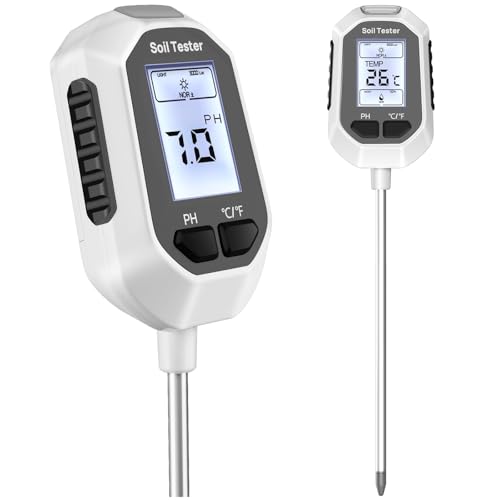
- 【4 in 1 function】This is a 4-in-1 multifunctional soil tester.Our soil tester fastly to measure soil moisture, pH, tempe…
- 【Large Screen & Backlight LCD Display】The Soil Tester uses a large LCD screen and white backlight to conveniently displa…
- 【Quick Accurate measurement】The latest probe detection technology in 2026 can quickly and accurately measure the pH, moi…
Moisture-first multi-meter
The YAMRON CTY-SM-US01 reads moisture, pH, soil temperature and light on a backlit screen that tilts up to 45 degrees. Its 8-inch probe needs no calibration, and pH shows in 12 coarse levels from 3.5 to 9.0. So treat it as a watering guide and pair it with your crop water needs plan. Owner reports love the easy screen but describe probe tips breaking within weeks.
Why it’s a good buy
- Four readings, one tool
- Tilting backlit display
- Auto shutoff saves batteries
- Clear screen for beginners
Why it’s not recommended
- Probe tips break easily
- pH readings too coarse
Specifications
- pH: 12 levels, 3.5 to 9.0
- Probe: 8 inches
- Temperature: 16 to 122°F
- Power: four AAA, not included
10. SONKIR MS02 3-in-1 Soil Meter
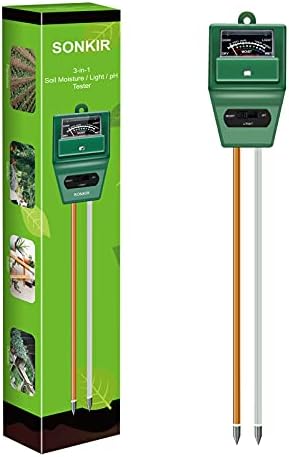
- Kindly NOTE: This soil tester can not be applied to test pH value of any other liquid. If the soil is too dry the indica…
- 3 METERS IN ONE: Soil moisture level, Soil pH value and Sunlight level could be tested easily according to your need by …
- NO BATTERY NEEDED: Simply insert the meter into soil, wait few minutes, accurate test results will be displayed on the r…
Moisture check only
The SONKIR MS02 is a battery-free meter with copper and aluminum probes, the classic two-metal design. A switch flips between moisture, light and pH. Moisture is the reason to buy it. SONKIR itself notes the pH needle may not move in near-neutral soil, so don’t use it to plan lime. Owner reports consistently flag a stuck pH needle and fragile probes in hard soil.
Why it’s a good buy
- No batteries required
- Lightweight and simple
- Decent moisture readings
- Inexpensive watering aid
Why it’s not recommended
- pH needle often sticks
- Probes snap in hard soil
Specifications
- pH scale: 3.5 to 8.0
- Moisture: 1 to 10 scale
- Probe: 7.9 inches, copper and aluminum
- Power: none needed
How to Choose a Soil pH Meter: 6 Specs That Matter
Rank the specs in this order: probe type, accuracy, calibration, temperature compensation, probe care and pH range. That order is how to choose a soil pH meter without paying for extras that never improve the reading. Most soil pH tester features fall under one of these six.
Probe Type and Tip Shape
Start with the probe, because it caps accuracy. Conical or spear glass electrode tips push into moist soil for direct readings. Flat glass tips, by contrast, are built for surface readings rather than for pushing into soil. Two-metal probes skip calibration but read coarsely. Recall the Missouri trial, where the battery-free probe read 6.0 on every soil.
Accuracy vs Resolution
Accuracy is how close a reading sits to true pH. Resolution is just how many decimals the screen shows. Hanna lists the HI981030 at ±0.05 accuracy with 0.01 resolution. Apera and Bluelab list the GS2 and Soil pH Pen at ±0.1 with 0.1 resolution. So a 0.01 display on a ±0.2 meter is false precision. Given Oregon State Extension’s warning about 0.1 to 0.2 unit differences, shop the accuracy line first. That line, not the display, marks the most accurate soil pH meter.
Calibration Points and Buffers
Two-point calibration with pH 4.01 and 7.01 buffers covers most acidic and neutral soils. Pick buffers that bracket your soil’s likely range. For alkaline ground, add a pH 10 point if the meter accepts one. The GS2, for example, takes up to three points. Calibration habits count too. In the Journal of Extension trial, untrained users scattered more than twice as widely as labs.
Automatic Temperature Compensation
Glass electrode output shifts with temperature. So cold spring soil and warm buffers can disagree. ATC uses a built-in temperature sensor to correct for that shift. Apera lists automatic compensation from 32 to 122°F on the GS2. That matters most for early spring readings in cold ground.
Replaceable Probe, Storage and Waterproofing
Glass probes wear out with normal use. A replaceable probe, as on the Apera GS2, keeps the meter body in service. A sealed pen like the Bluelab Soil pH Pen is different. Bluelab’s troubleshooting guide says to replace the whole pen once the glass ages. Storage decides how fast either one wears. Oregon State Extension warns that a meter left in a truck with a dried electrode will not perform. Also look for an IP67 rating, which the GS2 carries. It means the housing is dust-tight and survives brief immersion.
pH Range and Soil Type
Check the top of the scale if your ground runs alkaline. Kelway’s HB-2 stops at 8.0, and its distributors rate the ±0.2 accuracy for acidic soil only. One distributor adds that these meters won’t read extremely sandy soil, because conductivity cannot be maintained. By contrast, Hanna rates the HI981030 from 0 to 12 pH, which covers calcareous western soils with room to spare.
How to Use a Soil pH Meter for Accurate Readings
Here is how to use a soil pH meter so the reading holds up. Calibrate, sample at a set depth, build one sample, then read it. Each step removes one source of error. The same steps also cover how to test soil pH with a kit, minus the calibration.
- Calibrate with fresh buffers. Use pH 4.01 and 7.01 buffers before any reading you plan to act on. Oregon State Extension calls for fresh buffer at every calibration, since stale buffer shifts the whole scale.
- Pull cores at a set depth. Walk a zigzag across the area and sample to the depth in the table below. Keep the depth constant, because pH often changes from one soil layer to the next.
- Build one composite sample. Mix the cores in a clean bucket, then drop roots, stones and mulch. A composite sample averages out odd spots. Purdue Extension also advises clearing surface debris before you probe.
- Read a slurry for accuracy. Mix equal weights of soil and distilled water, such as 50 grams of each on a kitchen scale. Stir, let it settle, then read the liquid. This soil slurry test mirrors the lab method University of Minnesota Extension describes.
- Read directly for spot checks. Scrape off the top 2 inches, as Apera’s manual directs, and moisten dry soil with distilled water. Then make a pilot hole, insert the tip and wait for the stability indicator. Apera warns that dry soil can damage the probe, and Bluelab notes that tap water skews the reading.
- Rinse and cap the probe. Rinse the tip with clean or distilled water. Then return it to its cap with KCl storage solution, as both Apera and Bluelab direct.
- Log the result. Record the reading, the date and the spot. Retest in the same season next year so the readings compare.
Sampling depth depends on what grows there. Purdue Extension and K-State Research and Extension don’t fully agree on turf, so match the depth your lab’s recommendations assume.
| Area | Sampling depth | Source |
|---|---|---|
| Lawns and turf | 3 inches | Purdue Extension |
| Lawns and turf | Upper 4 to 6 inches | K-State Research and Extension, 2026 turf guidance |
| Vegetable gardens and flower beds | 6 to 8 inches | Purdue Extension |
| Gardens | 6 inches | K-State Research and Extension |
| Tree and shrub root zones | 8 to 12 inches or deeper | Purdue Extension |
| Field crops | Top 6 inches, 20 to 30 cores per uniform area | K-State Research and Extension |
| Long-term no-till fields | Split cores at 0 to 3 and 3 to 6 inches | K-State Research and Extension |
Timing matters as much as depth. Oregon State Extension reports that spring pH commonly runs 0.3 to 0.5 units higher than during the growing season. So test in the same season each year, or an apparent drop may only reflect the calendar.
Calibrating and Caring for a Soil pH Meter
Calibrate at least monthly and before any reading you will act on. And never let a glass probe dry out. Bluelab’s guidance for its Soil pH Pen makes a sound baseline: calibrate after every clean and at least once a month. If the probe dries out, hydrate it for 24 hours in KCl solution, then calibrate again.
When you calibrate a pH meter, start with pH 7, as Apera’s GS2 manual directs, then move to pH 4. Use fresh pH buffer solution each time, as Oregon State Extension advises. Single-use sachets make that easy. Hanna’s HI981030 kit, for example, ships with pH 4.01 and 7.01 sachets.
To clean pH probe tips, match the cleaner to the residue. Hanna supplies separate cleaning solutions for soil deposits and humus deposits. After cleaning, rinse and recalibrate. Between uses, keep the tip capped in KCl storage solution, which Bluelab and Apera both include with their soil pens.
Two-metal meters need different care. Kelway distributors recommend rubbing the plates with conditioning film before each use, and each sheet lasts up to 20 uses. Also keep your fingers off the plates.
Troubleshooting Drifting or Slow Readings
Most drift traces back to one of five causes. Work down this list before you blame the meter.
| Symptom | Likely cause | Fix |
|---|---|---|
| Slow response, drifting reading | Dried glass bulb | Soak 24 hours in KCl storage solution, then calibrate |
| Wrong readings after a good calibration | Clogged junction (Bluelab calls it the wick) | Clean with a soil or humus cleaning solution, then soak in KCl |
| Calibration will not take | Old or contaminated buffer | Open fresh sachets and never reuse buffer |
| Reading won’t settle in the field | Dry soil | Moisten the spot with distilled water and retest |
| Two-metal dial reads the same everywhere | Fouled plates | Rub the plates with conditioning film |
If a glass probe still fails after cleaning and a 24-hour soak, the glass has likely aged. In that case, replace the probe, or the whole pen if it is sealed.
What to Do With Your Soil pH Reading
If the reading is off target, get a lab test with buffer pH before you buy lime. To raise soil pH, apply agricultural limestone at the lab’s rate. To lower soil pH, apply elemental sulfur at a rate from your lab or extension office. Then retest in 3 to 6 months, as Oregon State Extension advises.
Don’t reach for fertilizer to fix a pH problem. Oregon State Extension is blunt here: if pH is out of range for a plant, adding fertilizer won’t help. So hold the balanced 10-10-10 blend until pH sits in range.
Labs usually report lime in tons per acre. Converting gives the lime rate per 1,000 square feet: 1 ton per acre equals about 46 pounds (2,000 ÷ 43.56). On a 4 by 8 raised bed, multiply by 0.032 for about 1.5 pounds.
| Lab rate | Per 1,000 sq ft | 4 by 8 bed (32 sq ft) | 10 by 20 garden (200 sq ft) |
|---|---|---|---|
| 0.5 ton per acre | 23 lb | 0.7 lb | 4.6 lb |
| 1 ton per acre | 46 lb | 1.5 lb | 9.2 lb |
| 2 tons per acre | 92 lb | 2.9 lb | 18.4 lb |
Weigh the lime, then mix it into the root zone. Oregon State Extension notes that untilled lime raises pH only in the top inch or two.
FAQs on pH meters
Which pH meter is most accurate for soil?
A calibrated glass electrode tester is the most accurate field option. The Apera GroStar GS2 and Bluelab Soil pH Pen both list ±0.1 pH, while Hanna rates its HI981030 soil tester at ±0.05.
Do soil pH meters actually work?
Calibrated electronic meters do, but cheap battery-free probes are unreliable. In a Journal of Extension trial, a calibrated hand-held meter landed within 0.3 pH of the lab, while a battery-free probe read 6.0 on every soil.
How often should I calibrate my soil pH meter?
Calibrate at least once a month and before any reading you’ll act on, such as a liming decision. Bluelab also advises recalibrating after every probe cleaning, and Oregon State Extension calls for fresh buffer each time.
Can I use pH test strips instead of a pH meter?
Yes, for a rough screen: dip strips in a soil and distilled water mix, and expect accuracy similar to color kits, per Oregon State Extension. Confirm any off-target reading with a lab before liming.
Do soil pH meters come with calibration solution?
Most digital ones do, but only a starter supply. Bluelab ships one sachet each of pH 4 and 7, Apera includes 50 mL bottles, and two-metal meters like the Kelway HB-2 need no buffer at all.
Can I use the same pH meter for soil and water?
Often, yes: electrode pens like the Bluelab Soil pH Pen and YINMIK YK-S01E read both. Two-metal and 3-in-1 meters such as the Kelway HB-2 and SONKIR MS02 read soil only, never liquids.
How do I clean and store a pH meter probe?
Rinse the tip with distilled water after every use, and clear buildup with a soil or humus cleaning solution. Then store it capped in KCl storage solution, because a dried-out glass probe reads slowly or fails.
Why does my soil pH meter read differently from my lab test?
Labs dry the soil and read a measured 1:1 soil and water mix, while field meters read moist soil in place, often in another season. Spring pH can run 0.3 to 0.5 units higher, per Oregon State Extension.
Key Points Before You Buy a Soil pH Meter
Probe type decides accuracy more than brand does. In extension trials, a calibrated electrode meter tracked lab results. A battery-free probe read the same number on every soil. So the best pH meter for soil testing is a calibrated glass electrode tester, kept wet and checked monthly. Even so, no meter gives a lime rate. Pair any off-target reading with a lab soil test that reports buffer pH. A budget 3-in-1 soil pH tester still earns a place as a moisture check. Finally, test in the same season each year, and at least every three years.