3-18-18 Liquid Fertilizer: Rates for Lawns, Corn and Gardens

3-18-18 fertilizer is a low-nitrogen liquid made for one job: placing phosphorus and potassium near young roots. It earns its place at seeding or planting, on soil that tests low. On soil that already tests high, it adds cost and little else.
3-18-18 fertilizer contains 3% nitrogen, 18% phosphate and 18% potash. Use it as a starter for new grass, row crops or transplants on soil low in phosphorus or potassium. Keep your regular fertilizer program alongside it.
What Does 3-18-18 Fertilizer Mean?
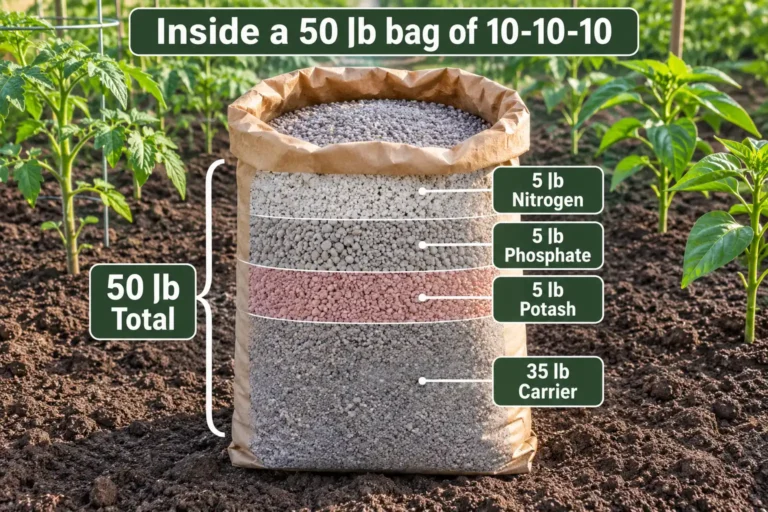
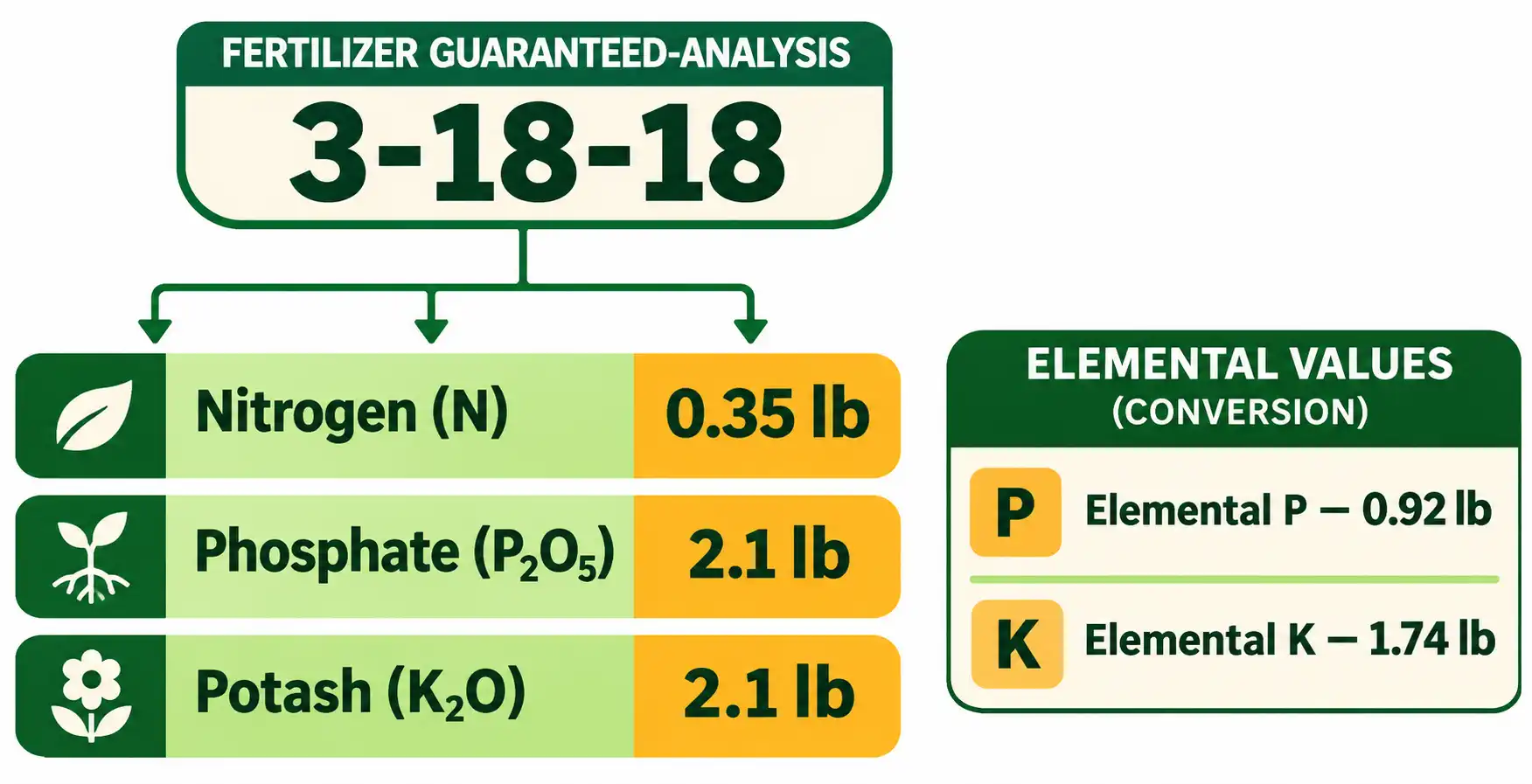
The three figures are percentages by weight: 3% nitrogen (N), 18% phosphate (P2O5) and 18% potash (K2O). So 100 pounds of product holds 3 pounds of N, 18 pounds of P2O5 and 18 pounds of K2O.
Labels list phosphorus and potassium as oxides, not as elements. To convert, multiply P2O5 by 0.44 and K2O by 0.83. That means the same 100 pounds holds about 7.9 pounds of elemental phosphorus and 14.9 pounds of potassium.
Liquids add one more step, because you buy them by the gallon. The Monty’s 3-18-18 label lists 11.66 pounds per gallon, and the Monterey 3-18-18 label lists 11.7. Using that weight, here is what you actually apply:
| Amount of 3-18-18 | Product weight | Nitrogen (N) | Phosphate (P2O5) | Potash (K2O) |
|---|---|---|---|---|
| 1 gallon | 11.7 lb | 0.35 lb | 2.1 lb | 2.1 lb |
| 1 quart | 2.9 lb | 0.09 lb | 0.52 lb | 0.52 lb |
| 1 fluid ounce | 1.5 oz | 0.04 oz | 0.26 oz | 0.26 oz |
Every rate in this guide uses that 11.7-pound weight. Still, check your own label, since products vary slightly.
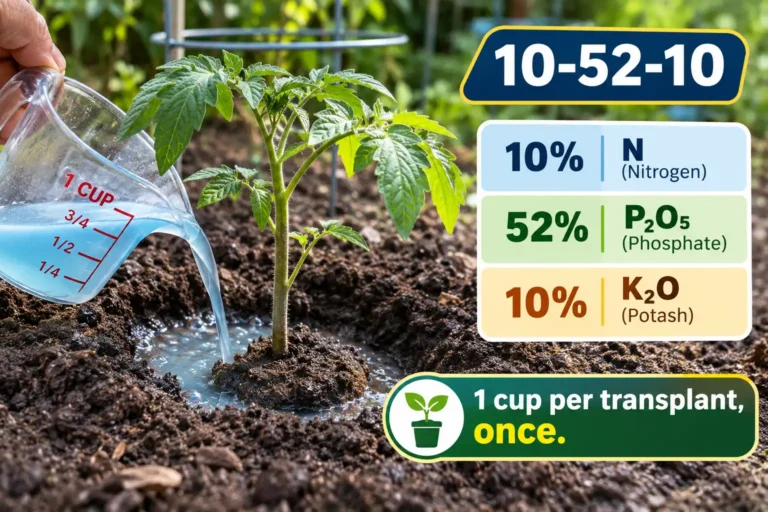
Also know: 10-52-10 Fertilizer Uses, and Tips
What Is 3-18-18 Fertilizer Used For?
3-18-18 is a starter and a supplement. It puts phosphorus and potassium where new roots are forming, but with too little nitrogen to push top growth. In fact, the Monty’s label says its 3-18-18 supplements a regular program and will not supply everything a crop needs.
| Situation | Fit | Reason |
|---|---|---|
| New lawn from seed or sod, soil low in P or K | Good, as a follow-up | Label rates supply a fraction of a full starter dose |
| Corn pop-up in the seed furrow | Good, at 2 to 3.3 gal per acre | Salt limits on N plus K2O cap the rate |
| Vegetable transplants on low-P soil | Reasonable | Little gain shows on high-fertility soil |
| Foliar spray on well-fertilized soybeans | Poor | Iowa State trials found no yield gain at most fields |
| Established lawn testing medium to high in P | Skip it | Extra P adds runoff risk, and some states restrict it |
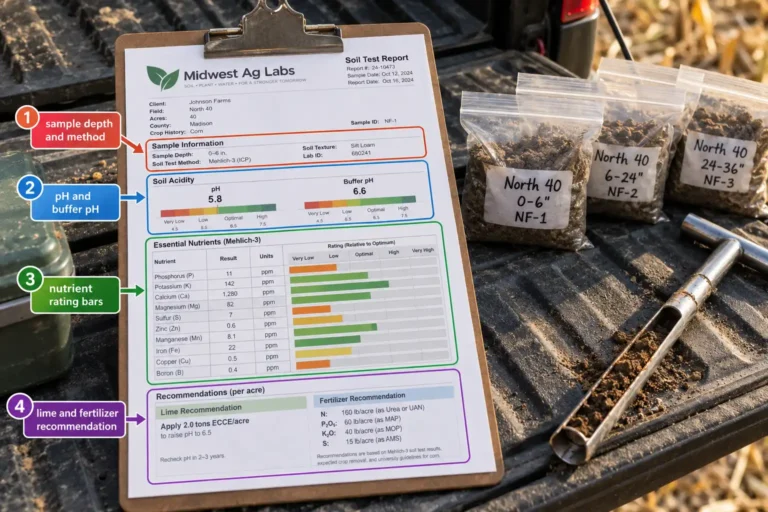
Check Your Soil Test Before You Buy
Buy 3-18-18 only when a soil test shows phosphorus or potassium below the optimum range. Phosphorus beyond what the soil needs can reach lakes and streams with runoff. As a result, several states limit it on lawns.
Minnesota is a clear example. The Minnesota Department of Agriculture bars phosphorus lawn fertilizer, with a few exceptions. A soil or tissue test must show a need, or the lawn must be new from seed or sod. Golf courses with trained staff and sod farms are also exempt. The department adds that excess phosphorus in lakes and rivers feeds algae growth.
Lawn 3-18-18 labels carry similar warnings. For example, the Simple Lawn Solutions label limits maintenance use in Maryland, Michigan, New Jersey, New York and Virginia. Minnesota’s rule covers lawns and turf, though, not gardens or farm fields.
Also, read both nutrient lines. When reading a soil test report, check phosphorus and potassium separately. If only potassium tests low, a potash-only product fits better, because 3-18-18 adds phosphorus you do not need.
3-18-18 on Lawns: How Much Phosphorus a Jug Delivers
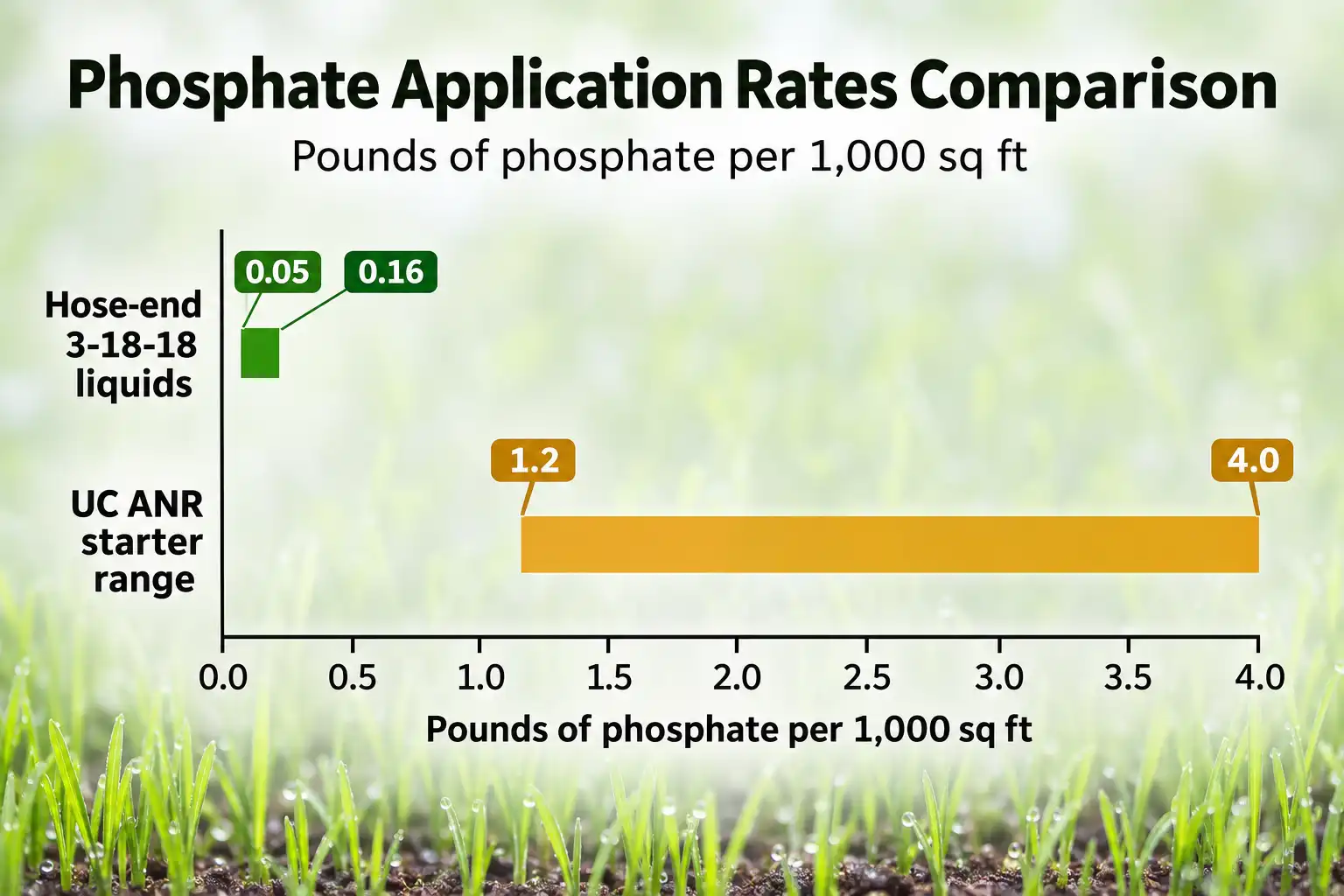
At label rates, the three liquids compared below deliver about 0.05 to 0.16 pound of phosphate per 1,000 square feet. That is a light dose.
For comparison, UC ANR advises at least 1 pound of phosphorus per 1,000 square feet at planting. It caps nitrogen at 1 pound and says to mix the starter 2 to 4 inches into the soil. Its own starter table works out to 1.2 to 4 pounds of P2O5 per 1,000 square feet.
So the strongest of those liquids supplies about one-seventh of the low end. Reaching 1.2 pounds would take roughly 73 fluid ounces per 1,000 square feet, more than seven times the label rate. Do not do that. Instead, follow this rule:
- Soil tests low in P: apply the lab’s phosphorus rate at seeding with a granular starter worked into the seedbed. Then use 3-18-18 as a light follow-up once the grass is growing.
- Soil tests adequate: skip it. Extra phosphorus is unlikely to help the grass.
Scale changes the tool, too. A 5,000-square-foot lawn takes about 50 fluid ounces at a 10-ounce rate. By contrast, a 4 by 8 foot bare patch needs only about 2 teaspoons. Mix that in a small pump sprayer, not a hose-end bottle.
How to Apply 3-18-18 Liquid Fertilizer to a New Lawn
- Confirm the need. Check that the soil test shows low phosphorus or potassium and that your state allows the application. Otherwise you add runoff risk and no benefit.
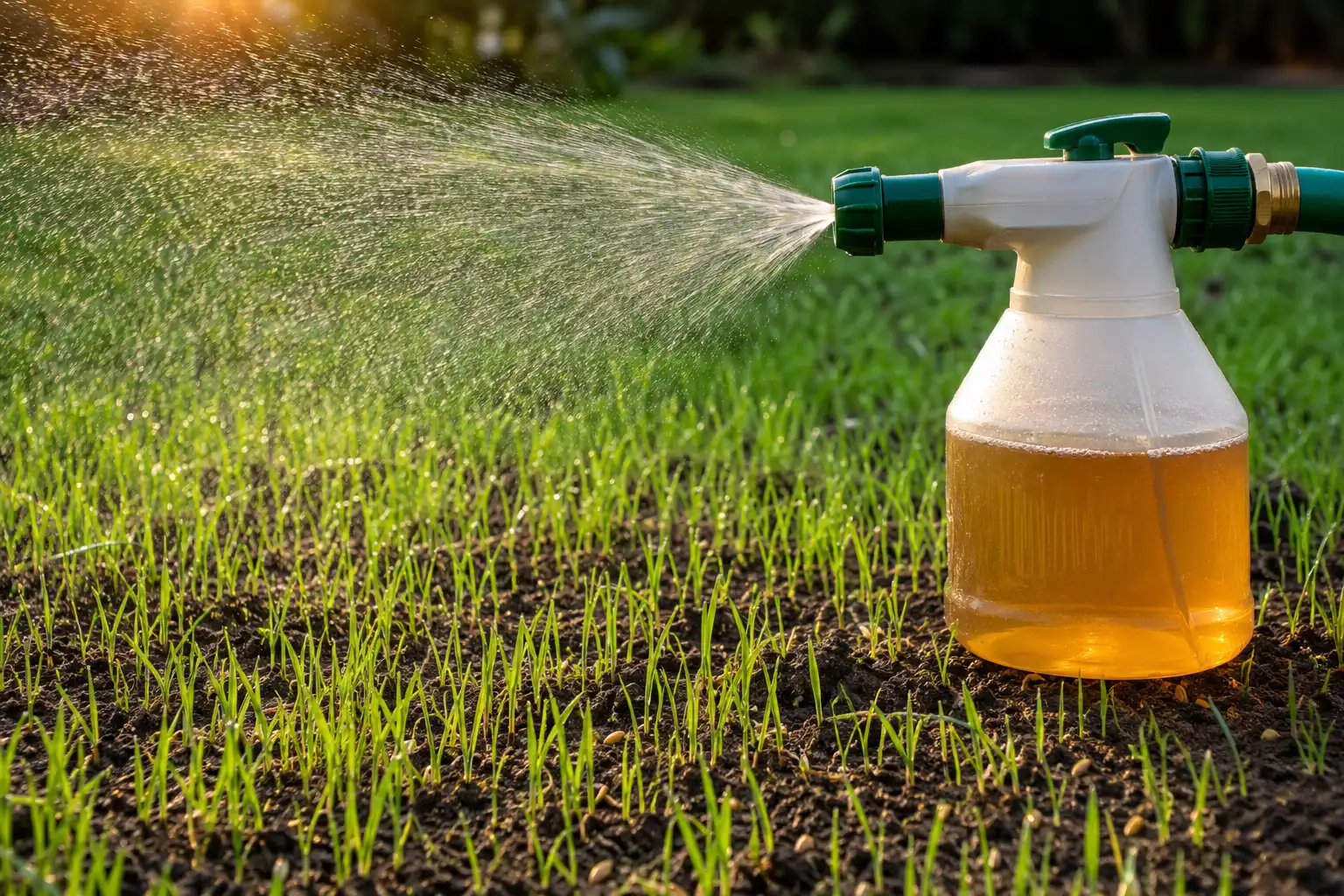
- Wait for active growth. Lawn 3-18-18 labels call for actively growing turf. On seed, spray once seedlings are up. On sod, spray once it starts growing.
- Strain the concentrate. Some owners report clogged spray jets and screens when they skip this step. So pour it through a fine mesh strainer before you fill the sprayer.
- Check your coverage. Hose-end output shifts with water pressure and walking speed. Mark off 1,000 square feet and confirm you use the label amount there.
- Spray in overlapping passes. Walk at a steady pace and overlap each pass slightly, so no strips go untreated.
- Keep your regular program. At 3% nitrogen, 3-18-18 cannot feed a lawn alone. That is why lawn labels pair it with your normal fertilizer.
On a larger new lawn, a battery backpack sprayer lets you mix a measured amount per tank. That beats trusting a hose-end siphon ratio.
3-18-18 as an In-Furrow Starter for Corn
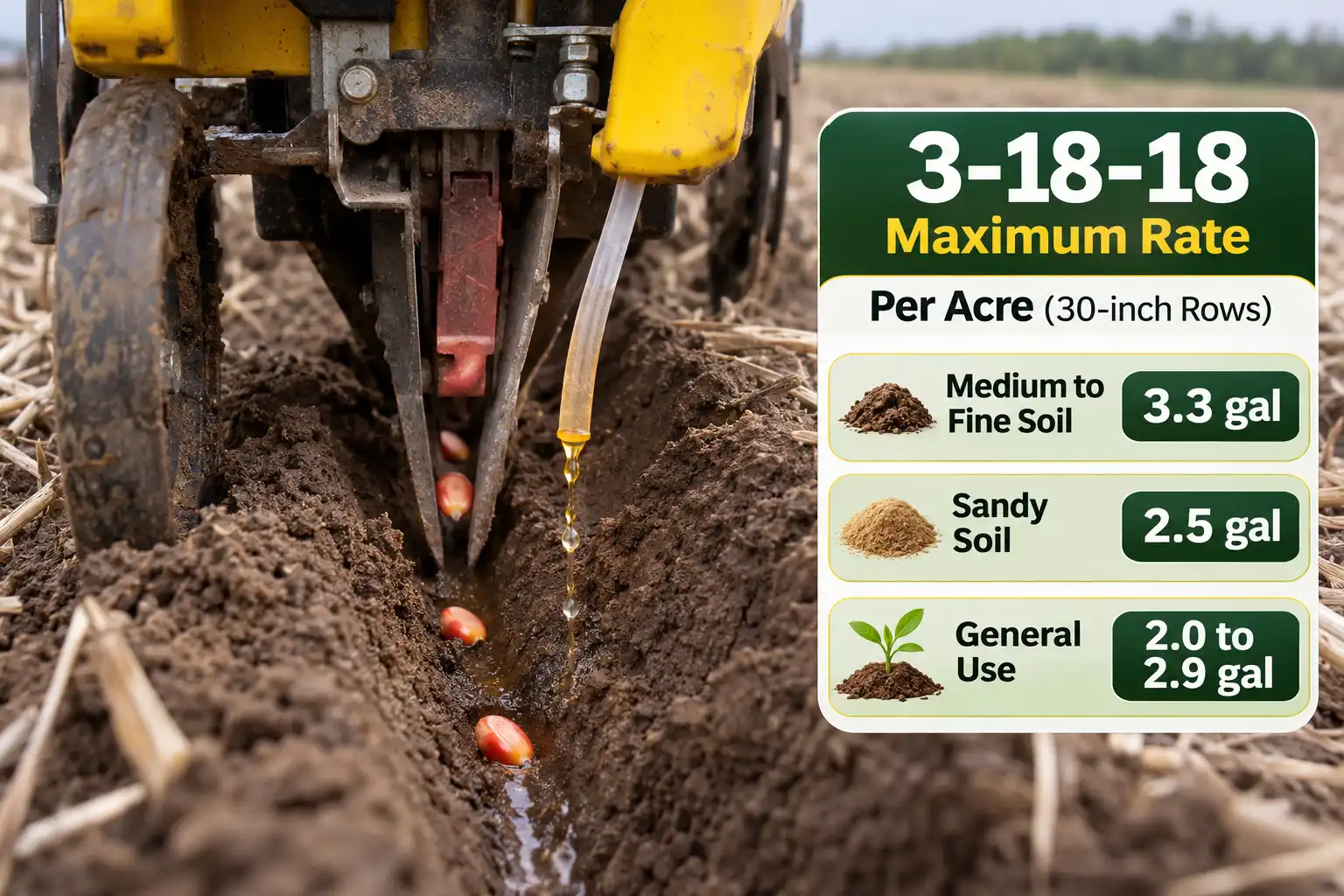
In the seed furrow, plan on about 2 to 3.3 gallons of 3-18-18 per acre on 30-inch rows. Its potash counts toward salt limits, and that caps the rate.
Those limits apply to nitrogen plus potash (N + K2O) in seed contact. K-State Research and Extension puts the seed injury risk point at 8 pounds per acre on medium to fine soils. On sandy soils, it drops to 6, both on 30-inch rows. University of Nebraska-Lincoln Extension sets a lower general range, usually under 5 to 7 pounds. It notes the safe amount depends on the product and soil. So use the stricter number on sandy or dry ground.
Each gallon of 3-18-18 carries about 2.45 pounds of N + K2O. Divide each ceiling by that figure:
| Published ceiling (N + K2O per acre) | Source | Max 3-18-18 per acre | P2O5 delivered per acre |
|---|---|---|---|
| 8 lb, medium to fine soil | K-State | 3.3 gal | 6.9 lb |
| 6 lb, sandy soil | K-State | 2.5 gal | 5.1 lb |
| 5 to 7 lb, general | Nebraska | 2.0 to 2.9 gal | 4.3 to 6.0 lb |
Why 3-18-18 Is a Weak In-Furrow Phosphorus Source
Under that same 8-pound ceiling, 10-34-0 could supply about 27 pounds of P2O5 per acre, because only its nitrogen counts. By contrast, 3-18-18 tops out near 7. So choose 3-18-18 in furrow when you want potassium beside the seed with little nitrogen. For phosphorus alone, a higher-phosphate starter does more per pound of salt.
Check the nitrogen source, too. K-State’s seed-contact limits apply to products without urea or UAN. Yet the Monty’s label lists 2 of its 3 percent nitrogen as urea. With a product like that, move it out of seed contact. K-State points to a 2×2 band or a surface dribble as safer placements.
A pop-up of 4 to 7 pounds of P2O5 is a starter, not a phosphorus program. In other words, it rides on top of the per-acre fertilizer rates for corn your soil test calls for.
Translate the Rate to Your Rows
On 30-inch rows, one acre holds 17,424 feet of row. So 3 gallons per acre works out to about 2.2 fluid ounces of product per 100 feet of row. Likewise, 2 gallons works out to about 1.5 ounces.
Use those figures when you calibrate a liquid starter before planting corn. They also help if you meter a starter by hand on a market garden row.
Does Foliar 3-18-18 Pay on Soybeans?
Usually not on well-fertilized ground. Iowa State University tested it directly in 2005 and 2006 trials at five fields. Researchers sprayed 3 gallons per acre of 3-18-18 at V5, at R2 to R3, or at both stages. The spray did not affect yield at four fields and raised it slightly at one.
On the plus side, 3-18-18 caused no leaf burn, while a UAN spray in the same trials caused moderate burning. Still, 3 gallons per acre supplies only about 6.3 pounds of P2O5.
Iowa State agronomist Antonio Mallarino describes foliar feeding as a complement to preplant fertilizer or a rescue treatment. A response is more likely when preplant rates fell short or deficiency symptoms show. It is also more likely when soil or weather, other than drought, limits uptake. Without one of those, put the money into preplant phosphorus and potassium instead.
3-18-18 for Vegetable Transplants and Gardens
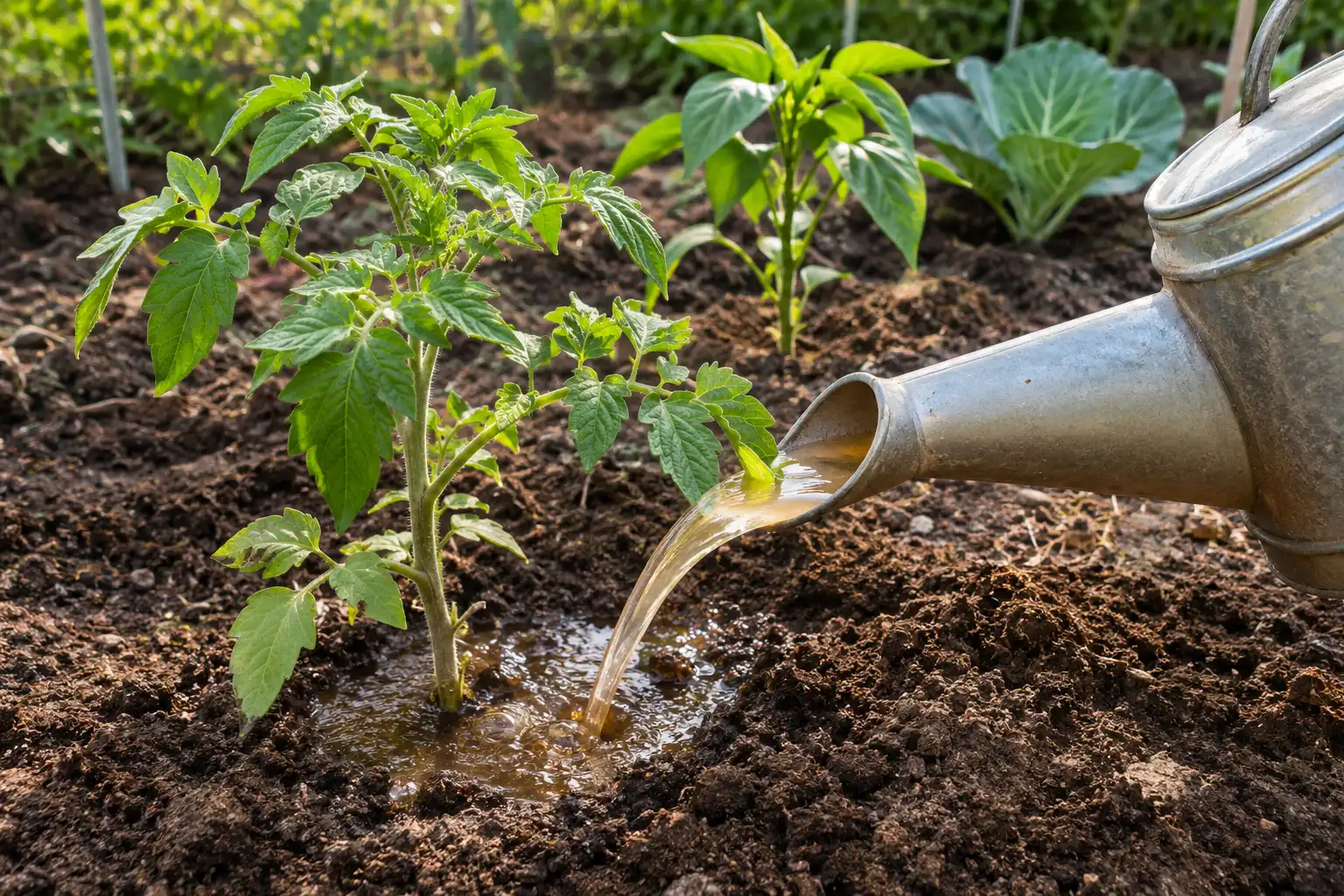
In a garden, 3-18-18 can serve as a starter solution for transplants such as tomatoes, peppers and cabbage. However, it pays mainly where soil tests low in phosphorus.
The evidence on rich soil is weak. In a 2025 University of Minnesota trial, high-phosphorus and molasses transplant solutions gave no cabbage yield benefit on high-fertility soil. In fact, a large molasses dose hurt the crop.
Published dilution rates specific to 3-18-18 transplant drenches are thin. So mix at your product’s label rate, then pour enough around each transplant to wet the root ball. Fervita, for example, prints its mixing rates on the back of the jug.
3-18-18 vs Other Starter Fertilizers
3-18-18 carries the least nitrogen per pound of phosphate of the starters below. However, it carries the most nitrogen plus potash of the liquid starters here. That trade-off decides which one fits.
| Analysis | Form | N per lb of P2O5 | N + K2O per lb of P2O5 | Best fit |
|---|---|---|---|---|
| 3-18-18 | Liquid | 0.17 | 1.17 | P and K together, little N |
| 9-18-9 | Liquid | 0.50 | 1.00 | P and K with moderate N |
| 10-34-0 | Liquid | 0.29 | 0.29 | Most P per pound of salt in furrow |
| 18-24-6 | Granular | 0.75 | 1.00 | New lawns needing N and P at seeding |
| 10-10-10 | Granular | 1.00 | 2.00 | General feeding, not starter work |
Choose 3-18-18 when potassium also tests low and you want no nitrogen push. Choose 10-34-0 when in-furrow phosphorus is the goal. Meanwhile, a balanced 10-10-10 blend suits general feeding rather than starter work.
How to Choose a 3-18-18 Liquid
First, match the product to the job. Lawn products ship hose-end ready with a rate per 1,000 square feet. Garden and farm concentrates list rates per acre or per gallon of water. Then check five label details:
- Coverage rate: divide the jug by its labeled area. That rate, not jug size, sets how much phosphate lands.
- Weight per gallon: without it, you cannot convert gallons to pounds of nutrient.
- Nitrogen source: urea nitrogen matters if the product goes in furrow.
- State restrictions: lawn labels list states where maintenance use is limited.
- Micronutrients: count iron, manganese or zinc as a plus only if a test shows a shortage.
Best 3-18-18 Liquid Fertilizers Compared
Simple Lawn Solutions fits new lawns best. GrowIQ suits mixed lawn and garden use, while Fervita fits irrigated vegetables and fruit.
| Product | Size | Labeled coverage | Rate per 1,000 sq ft | Est. P2O5 per 1,000 sq ft | Best fit |
|---|---|---|---|---|---|
| Simple Lawn Solutions 3-18-18 Lawn Food | 2.5 gal | 32,000 sq ft (hose-end) | 10 fl oz | 0.16 lb | New lawns |
| GrowIQ 3-18-18 | 1 gal | 1/2 acre | 5.9 fl oz | 0.10 lb | Lawn and garden |
| Fervita 3-18-18 | 2.5 gal | 1 to 2 gal per acre | 2.9 to 5.9 fl oz | 0.05 to 0.10 lb | Vegetables and fruit |
Phosphate estimates assume 11.7 pounds per gallon, the weight on other 3-18-18 labels. Your product’s label weight may differ slightly.
Simple Lawn Solutions 3-18-18 Lawn Food
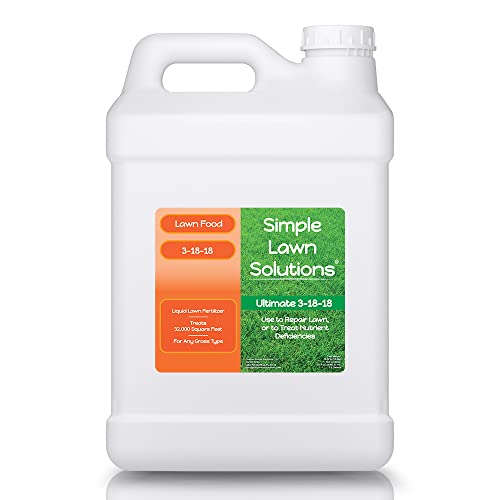
- Great Starter Fertilizer: High phosphorus and potassium lawn food provides essential phosphorus and is highly recommende…
- 3-18-18 Lawn Fertilizer Food covers 32,000 square feet when using a hose-end sprayer: Refill 3-18-18 hose-end sprayer or…
- Can be used on all warm season and cool season grass types: Including Bermuda, St. Augustine, Zoysia, Fine Fescue, Tall …
Best for: New lawns from seed or sod
This is the most lawn-focused 3-18-18 here. The maker labels it as a starter for new seed or sod. Its grass list runs from Bermuda and St. Augustine to tall fescue and Kentucky bluegrass. The 2.5-gallon jug is a refill size, so you supply the hose-end or backpack sprayer. At its labeled coverage, it applies 10 fluid ounces per 1,000 square feet, the highest rate of the three. That also makes it the strongest phosphate dose per pass. The label limits it to actively growing turf and pairs it with your regular fertilizer program. UAS of America, a family-owned company, makes it in the USA.
Pros
- Labeled for lawn establishment
- Warm and cool season grasses
- Highest phosphate per pass
- Easy hose-end mixing
Cons
- Can clog jets unless strained
- Some owners report short coverage
Specifications
- Analysis: 3-18-18 liquid
- Size: 2.5 gallons (320 fl oz)
- Coverage: 32,000 sq ft by hose-end sprayer
- Application: hose-end, hose or backpack sprayer
What owners report: Owner reports consistently note easy mixing and greener, fuller grass within one to two weeks, mostly on new lawns. Value and labeled coverage draw mixed reports.
GrowIQ 3-18-18 Liquid Lawn and Garden Fertilizer
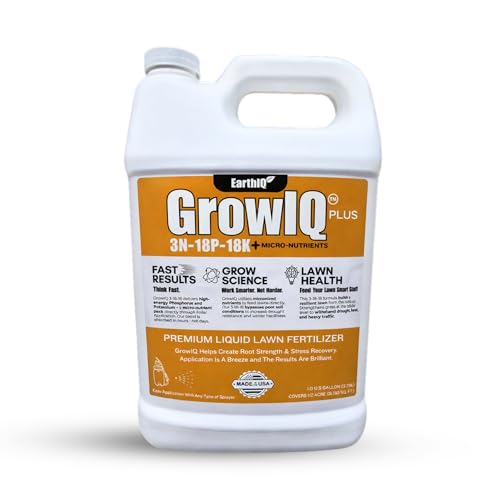
- PROMOTES STRONG ROOTS & HEALTHY GROWTH – Advanced 3-18-18 formula with micronutrients (iron, manganese, zinc) supports d…
- MORE COVERAGE than leading competitors 1 Gallon treats 1/2 acre. 1 Quart treats 1/8 acre.
- IDEAL FOR LAWNS, GARDENS & LANDSCAPING – Perfect for grass, flowers, vegetables, and shrubs. Helps establish new lawns a…
Best for: Lawn and garden use with micronutrients
GrowIQ, sold under the EarthIQ brand, adds iron, manganese and zinc to the 3-18-18 base. The listing covers grass, flowers, vegetables and shrubs, plus new lawn establishment. It mixes with water and runs through pump, backpack or hose-end sprayers, as a foliar spray or soil drench. One gallon covers half an acre on the label, about 5.9 fluid ounces per 1,000 square feet. The listing suggests repeat applications every 4 to 6 weeks through the growing season. On a lawn that already tests adequate in phosphorus, skip that schedule. Also, the product description does not list micronutrient percentages, so read the label before you count on them.
Pros
- Adds iron, manganese and zinc
- Lawn and garden labeling
- Works in most sprayers
- Quart size also sold
Cons
- Little owner feedback so far
- Micronutrient levels not stated
Specifications
- Analysis: 3-18-18 plus micronutrients
- Size: 1 gallon (128 fl oz)
- Coverage: about 1/2 acre per gallon
- Weight: 12 lb
What owners report: Reviews are too few to show a pattern yet. One top review says garden plants respond well to it.
Fervita 3-18-18 Liquid Fertilizer
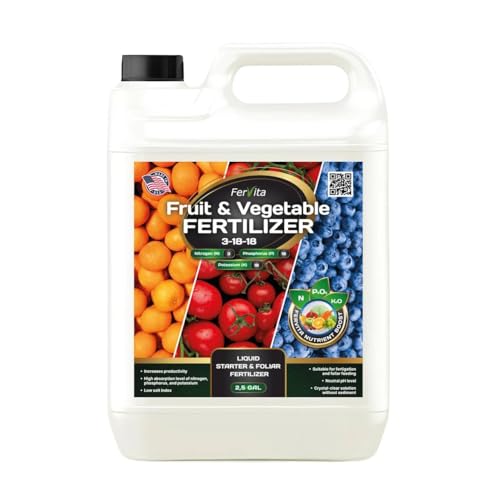
- All Purpose Fertilizer 3-18-18 is a liquid plant fertilizer designed and meticulously balanced to support your plants, f…
- Versatile Ways To Use. Vegetable Gardens: Support robust root and foliage growth with targeted applications of this nutr…
- Jumpstart Growth: with its starter fertilizer for vegetables and fruits formula ensures plants get the feed they need to…
Best for: Vegetables, fruit and fertigation
Fervita aims its 3-18-18 at gardens and fruit trees, and the listing does not mention lawns. It covers flowers, fruits, vegetables and indoor or outdoor plants, applied through irrigation or as a foliar spray. The label states coverage per acre, at 1 to 2 gallons, so one 2.5-gallon jug covers roughly 1.25 to 2.5 acres. That works out to about 2.9 to 5.9 fluid ounces per 1,000 square feet, the lowest rate of the three. As a result, it suits drip or fertigation work where you meter product into water. The back panel carries the mixing rates. The safety directions call for protective clothing and no skin or eye contact.
Pros
- Fits irrigation and fertigation
- Covers 1.25 to 2.5 acres
- Labeled for fruit and vegetables
- Also sold in 5 gallons
Cons
- Mixing directions confused one owner
- No lawn rate in the listing
Specifications
- Analysis: 3-18-18 liquid concentrate
- Size: 2.5 gallons (also 5 gal and 32 oz)
- Coverage: 1 to 2 gallons per acre
- Weight: 27.5 lb
What owners report: Most top reviews describe healthier plants that grow well. One owner found the mixing instructions unclear.
Common 3-18-18 Mistakes and How to Fix Them
- Expecting fast green-up: color comes mostly from nitrogen, and 3-18-18 has little. Even the Simple Lawn Solutions description says potassium generally shows no visible response.
- Clogged hose-end jets: strain the concentrate first, then rinse the sprayer after each use.
- Thin corn stands after an in-furrow pass: check whether the rate passed the N + K2O ceiling for your soil. Then drop to the low end of the range, or move the starter to a 2×2 band.
- Spraying dormant grass: lawn labels call for actively growing turf, so wait for growth to resume.
- Repeating it on high-phosphorus soil: extra phosphorus adds runoff risk and may break state lawn rules. Retest before another season of use.
- Using it to fix a large deficiency: a few pounds per acre cannot rebuild a low soil test. Apply the lab’s full rate first.
FAQs About 3-18-18 Fertilizer
Is 3-18-18 a good starter fertilizer for grass seed?
Yes, if your soil tests low in phosphorus or potassium and you pair it with a full starter. At hose-end rates, it supplies only a small fraction of the phosphorus new grass needs.
Will 3-18-18 burn my lawn?
Burn is unlikely at label rates, since Iowa State soybean trials saw no leaf burn from 3 gallons per acre. Still, follow the label rate and spray only actively growing grass, as lawn labels direct.
When should I apply 3-18-18 to my lawn?
Apply it while establishing new grass, once seedlings or sod are actively growing. On an established lawn, use it only when a soil test shows a shortage and state law allows it.
How much 3-18-18 per acre for corn?
In furrow on 30-inch rows, plan on about 2 to 3.3 gallons per acre. That range keeps nitrogen plus potash within the 5 to 8 pound ceilings from Nebraska and K-State Extension.
Is 3-18-18 the same as 10-34-0?
No, 10-34-0 has almost twice the phosphate and no potash. It puts more phosphorus in the seed furrow before hitting salt limits, while 3-18-18 adds potassium and carries less nitrogen.
Can I use 3-18-18 on vegetables?
Yes, as a diluted starter solution at transplanting on soil low in phosphorus. A 2025 University of Minnesota trial found no cabbage yield benefit from starter solutions on high-fertility soil.
Does 3-18-18 make grass greener?
Not by much, because grass color comes mostly from nitrogen, and 3-18-18 carries only 3%. Even the Simple Lawn Solutions description notes that phosphorus effects are subtle and potassium rarely shows a visible response.
Where to Start
Start with the soil test. If phosphorus and potassium come back low, apply the lab’s full rate at seeding or planting. Then use 3-18-18 as a light, low-nitrogen follow-up on new grass. For corn, run it as a pop-up at 2 to 3.3 gallons per acre on 30-inch rows. If the test comes back adequate, skip it and spend the money on what the soil actually lacks.