When to Plant Oats for Deer: Dates by Region and Frost Date
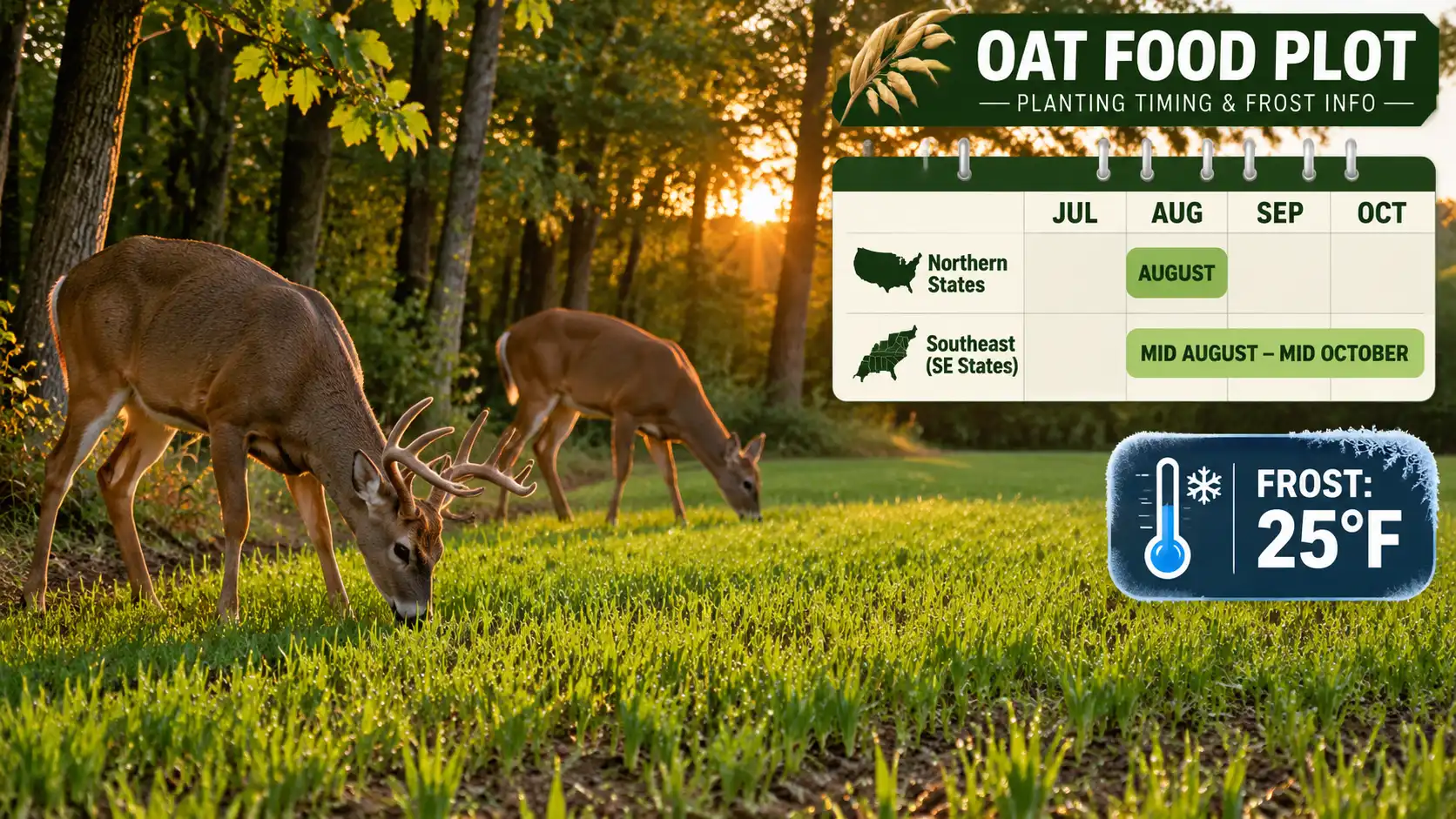
Knowing when to plant oats for deer comes down to two dates: your region’s planting window and your average first frost. Plant too early, and heat or armyworms thin the stand. Plant too late, and a hard freeze ends the plot early.
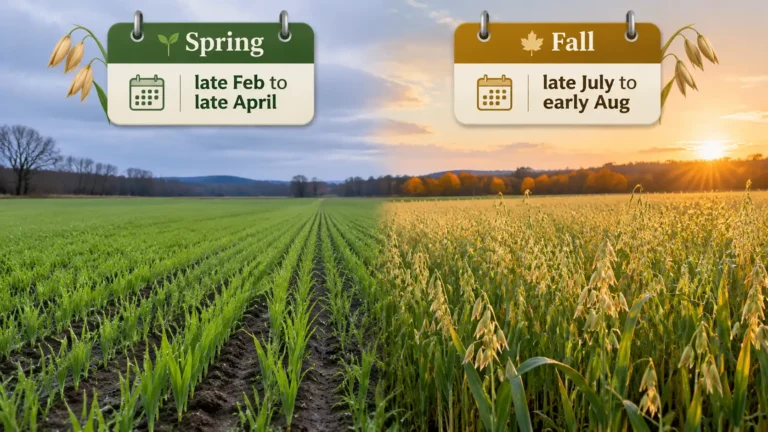
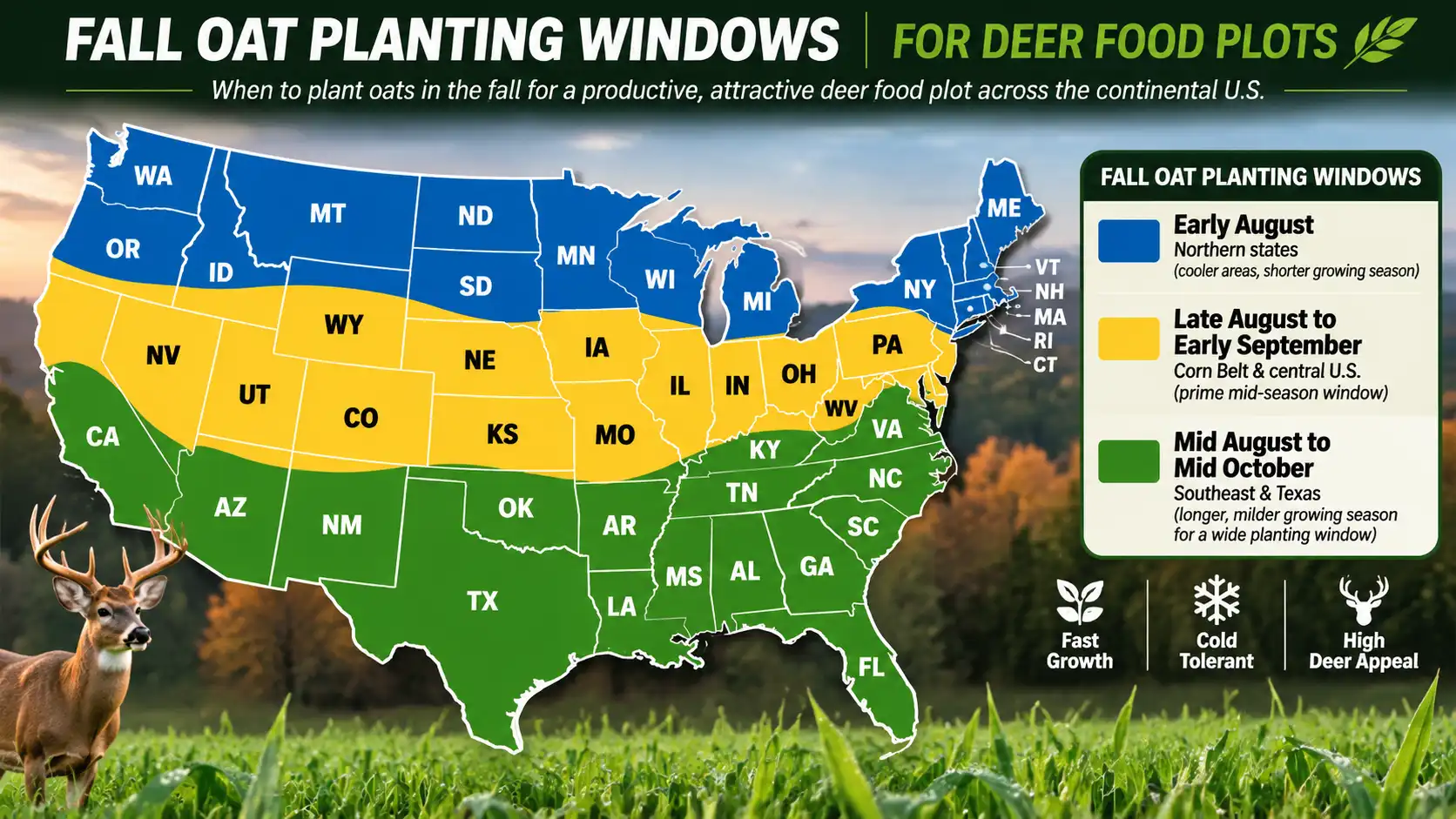
Plant oats in early to mid August in the North, by early September in the central Corn Belt, and from mid August to mid October in the Southeast. Northern plots need six to ten weeks before first frost.
When to Plant Oats for Deer by Region
The last safe planting date shifts by about two months between northern Wisconsin and Georgia. Northern plots race the first hard freeze. Southern plots, by contrast, wait out late summer heat and pests.
The table gathers published windows from five sources. Note that the Wisconsin and Iowa dates come from forage and cover crop guidance, not deer plot guides. Still, the oats need the same growing days whether a cow or a deer eats them.
| Region | Planting window | Source |
|---|---|---|
| Northern Wisconsin | By August 10 to 15 | UW Extension |
| Southern Wisconsin | By September 1 | UW Extension |
| Iowa | Mid August to mid September | USDA NRCS |
| Mississippi and the Southeast | August 15 to October 15 | Mississippi State |
| Georgia | September 1 to October 15 | UGA Extension |
| Texas | September through October | Texas A&M AgriLife |
In the South, two services publish different start dates. Mississippi State University Extension opens the window on August 15, while UGA Extension starts it on September 1. Both close it on October 15.
That gap reflects heat risk more than any real disagreement about the crop. So if late August stays hot and dry where you hunt, the September start is the safer choice. For states not listed, use the frost count-back in the next section.
Count Back From Your First Frost
Where no state window exists, count backward from your average first frost date. Michigan State University Extension advises planting oats six to ten weeks before frost for full growth. That rule suits northern deer plots, because UW Extension research found fall oats make all their forage before winter.
Oats do not quit at the first light frost, though. USDA NRCS lists their cold tolerance at 25°F. As a result, a plot keeps growing through a few frosty mornings until a hard freeze arrives.
Run the math for your own plot:
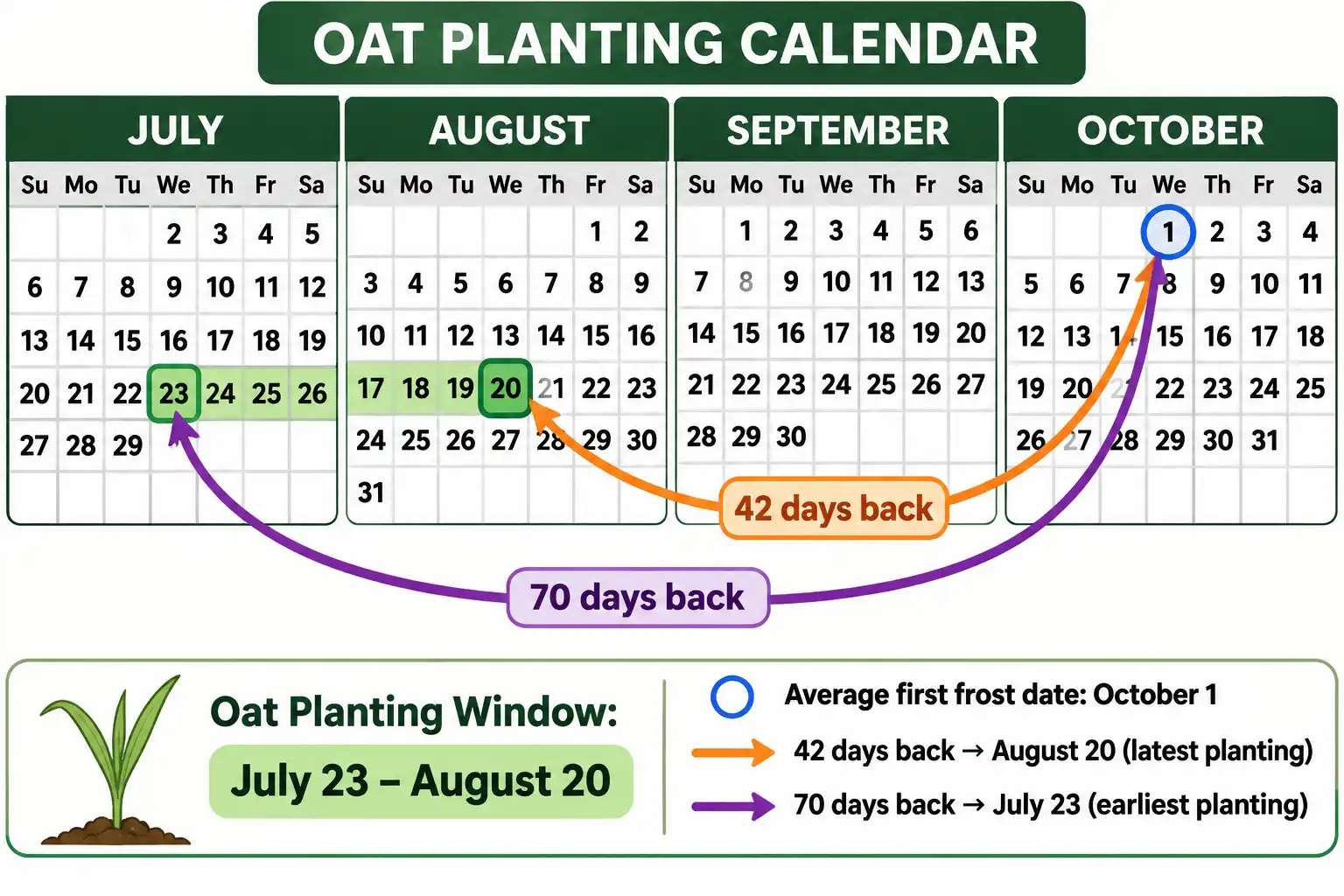
- Get your average first frost date from your county extension office.
- Subtract 70 days. That is your earliest planting date.
- Subtract 42 days. That is your latest planting date.
For example, a first frost of October 1 gives a window of July 23 to August 20. A first frost of October 20 gives a window of August 11 to September 8.
That second result lands close to the UW Extension deadline of September 1 for southern Wisconsin. So the rule works well as a cross-check against published dates.
In the Southeast, however, the frost date matters less. Oats there often carry through mild winters. So the October 15 cutoff from Mississippi State and UGA is the date to watch.
Why Planting Too Early Backfires
Early planting looks like a head start. In practice, it often costs you the plot.
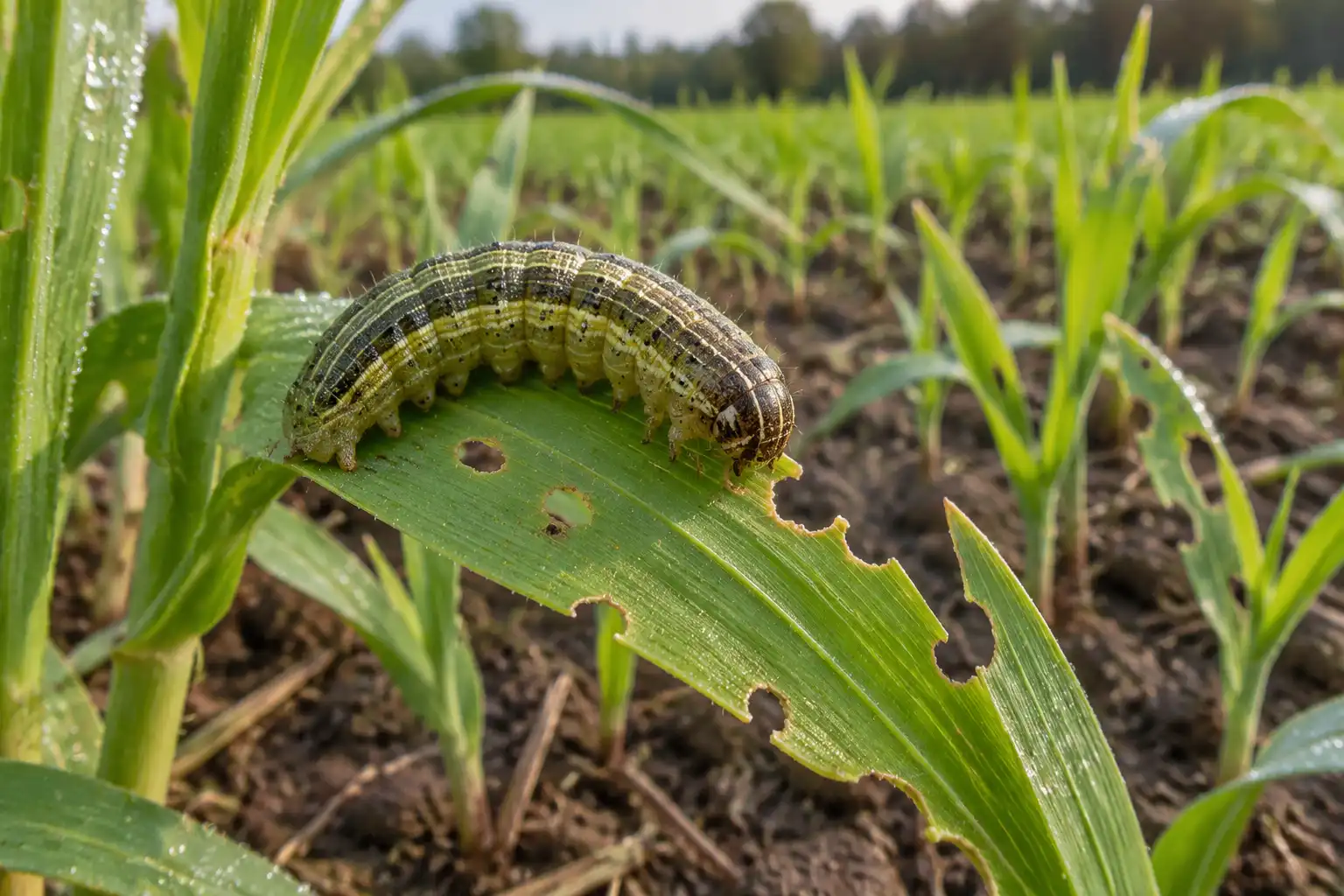
Fall armyworms. Texas A&M AgriLife Extension entomologists warn that fall armyworms hit wheat and oats in late summer and early fall. Small larvae are much easier to control than large ones. Therefore, scout new plots often during the first weeks after emergence.
Heat and dry soil. Oats are a cool-season grass, and they stall in heat. Texas A&M AgriLife ran an East Texas mix trial with oats planted August 27. The oats stayed under 2 inches tall into early October. Real oat growth started only in November. So an August plot in the Deep South may give you little more than a September plot.
Early heading. Late summer oats can joint and push a seedhead before winter, per UW Extension research. In those trials, the early grain-type cultivar Dane headed prematurely when planted in midsummer. Stemmy, headed oats offer deer less leaf than a younger stand.
The earliest date in your window, then, is not automatically the best. Aim for the middle of it. Go early only with a specific reason, such as an early archery opener and reliable rain.
How Late Can You Plant Oats for Deer?
In the Southeast, the latest published date is October 15, according to both Mississippi State and UGA. Farther north, the cutoff comes much sooner.
UW Extension research found forage establishment after about August 15 risky in central Wisconsin unless irrigation guarantees emergence. That warning is about tonnage, though. A deer plot planted a week late still greens up, just with less growth before the freeze.
Published data on deer use of late oat plots is thin. We found no extension trial comparing how often deer visit a late plot versus an on-time one. So treat any claim about late plots “working just as well” with caution.
If you are running late, these adjustments help:
- Switch to an earlier-maturing grain-type oat.
- Add winter wheat or cereal rye, which survive winter where oats do not.
- Plant just ahead of forecast rain, not into dry ground.
The first point has trial support. In UW late-planting trials, the grain-type Ogle outyielded the slow-maturing ForagePlus by over 1,100 pounds of dry matter per acre. Slow forage types simply run out of time before winter.
How Long Oats Last Before Winterkill
A northern oat plot is an early-season plot. USDA NRCS puts oat cold tolerance at 25°F and notes that oats usually winterkill in Iowa. Michigan State University Extension reports the same pattern in Michigan.
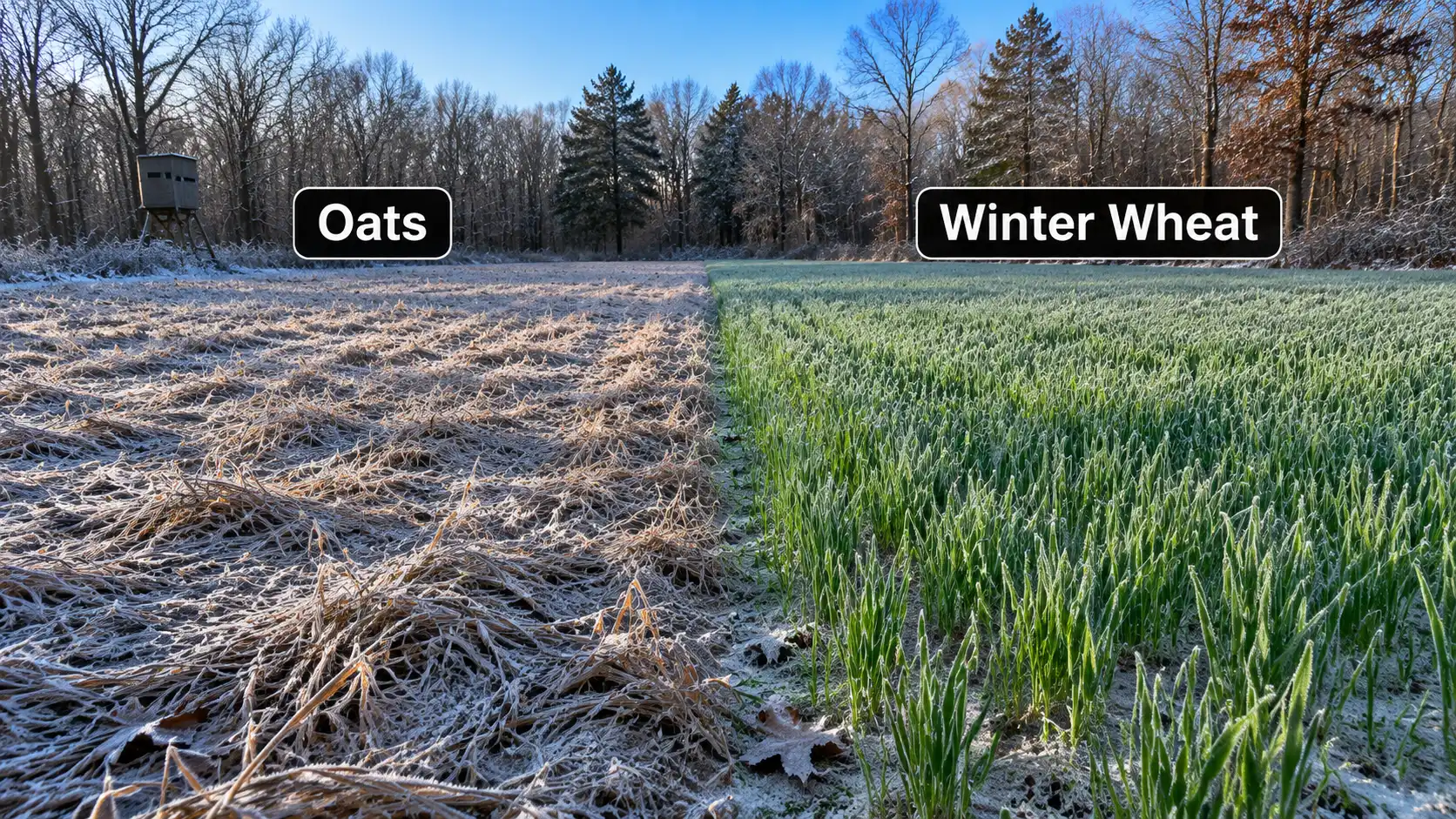
That puts oats behind the other cereal grains for cold hardiness. UW Extension research notes that oat cultivars do not survive a Wisconsin winter. Winter wheat and rye, by contrast, make most of their forage the following spring.
In the South, oats often stay green through winter. Mississippi State lists Bob Oats, Buck Forage, Coker, and Trophy Oats for Southeast deer plots. Likewise, Texas A&M AgriLife recommends a winter-hardy oat for its September deer mix.
Here the research runs thin, however. We found no extension trial testing named forage oat varieties against a specific freeze temperature. So treat “winter hardy” on a seed bag as a relative claim, not a guarantee.
The simplest hedge is a mix. A cereal grain that survives winter keeps the plot green after the oats die back.
Spring Oats for Deer
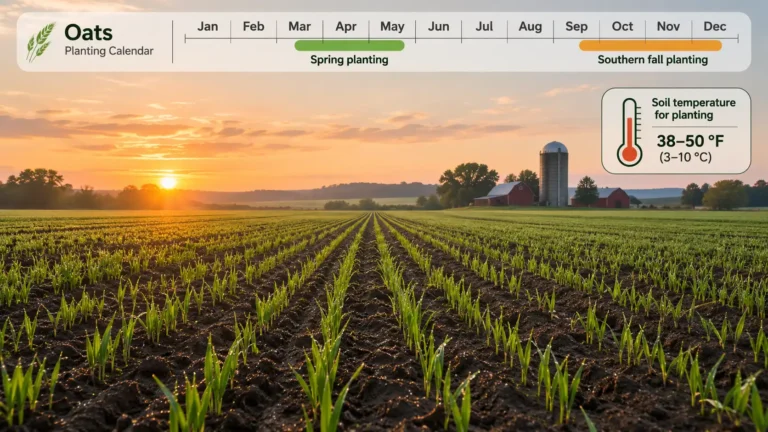
Oats also work as a spring planting, though for a different job. USDA NRCS lists a spring seeding window of early to late April in Iowa. Oats germinate at soil temperatures as low as 38°F, so they can go in early.
UW Extension places spring oats in mid April, with harvest by late June. For a deer plot, that means green forage through spring. After that, the stand heads out and loses value by early summer.
The stronger spring use is as a companion crop. UGA Extension notes that oats are used mainly alongside clover and other forages. The oats come up fast and give deer something to graze while slower clover establishes.
For summer feeding, warm-season crops do far more. The planting window for soybeans as a summer deer plot covers that season in detail.
Seeding Rates From an Acre to a Backyard Plot
Seeding rate depends on how you plant. Mississippi State University Extension recommends 90 to 100 pounds per acre drilled for oats planted alone. Broadcast, the rate rises to 120 to 150 pounds.
UGA Extension runs higher on drilled seed. It lists 3 to 4 bushels per acre drilled and 4 bushels broadcast. At 32 pounds per bushel, that equals 96 to 128 pounds drilled and 128 pounds broadcast.
The broadcast figures overlap, but the drilled figures differ. So drill at the low end into a firm, moist seedbed, and use the higher end where conditions are rough.
Plenty of hunting plots cover less than an acre. Here is the Mississippi State rate scaled down:
| Plot size | Broadcast | Drilled |
|---|---|---|
| 1,000 square feet | 2.8 to 3.4 lb | 2.1 to 2.3 lb |
| Quarter acre | 30 to 38 lb | 23 to 25 lb |
| Half acre | 60 to 75 lb | 45 to 50 lb |
| One acre | 120 to 150 lb | 90 to 100 lb |
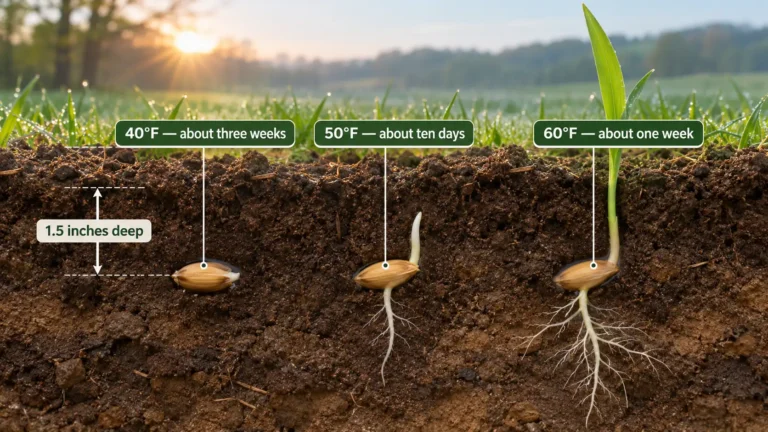
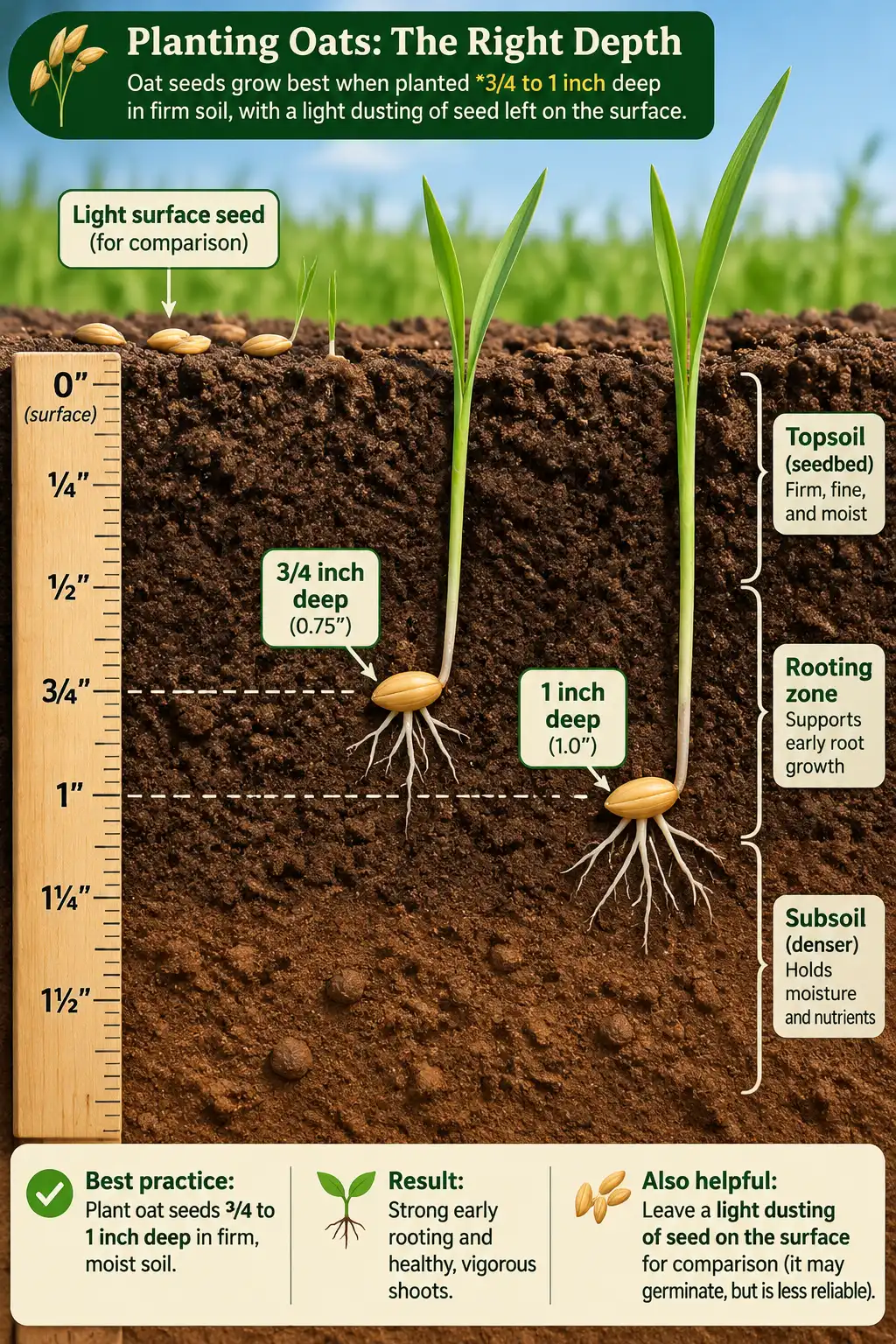
Plant seed 3/4 to 1 inch deep, per UGA Extension. Texas A&M AgriLife gives a similar depth of about 1 inch. For seedbed and equipment steps, the guide to planting oats walks through the process.
Mixes That Cover the Gaps
Oats alone give fast attraction and little else. Mixing in other species stretches the plot across more of the season.
Mississippi State suggests cutting each rate when you mix. For a 50/50 broadcast blend of oats and wheat, use 60 pounds of each per acre, or 120 pounds total. The oats draw deer early, and the wheat survives into spring.
Texas A&M AgriLife Extension tested a three-way mix in East Texas. It combined Iron and Clay cowpeas and HeavyGrazer oats at 40 pounds each per acre, plus 10 pounds of Apache arrowleaf clover. Planting took place in early September. The cowpeas fed deer first. Then oat and clover growth picked up after frost killed the peas, and the mix supplied forage into early summer.
When adding clover, plant the oats first and cover them about 1 inch deep. Next, broadcast the clover seed and drag it in lightly, as Texas A&M AgriLife advises. The same service notes that planting seed too deep has caused many food plot failures. Small clover seed is the most at risk.
For a broader comparison of the two main cereal grains, see how oats and wheat differ as crops.
Soil and Fertilizer Before You Plant
Fertility sets how much forage a plot produces. Start with a soil test well ahead of planting, then use your soil test report to set lime and fertilizer rates.
Mississippi State Extension warns against spreading a few bags of 13-13-13 without that test. It can even backfire. Lime and the right nutrient balance matter more than the bag count.
For nitrogen, UGA Extension suggests about 50 pounds of N per acre at planting for oat, wheat, or rye plots. It adds another 50 pounds in late winter. Here is the planting dose at plot scale, using urea, a 46-0-0 product:
- 1,000 square feet: 1.15 pounds of N, or about 2.5 pounds of urea
- Quarter acre: 12.5 pounds of N, or about 27 pounds of urea
- One acre: 50 pounds of N, or about 109 pounds of urea
The late-winter dose only pays where oats survive the winter. In a northern plot that winterkills, skip it.
Troubleshooting a Thin or Failing Oat Plot
Most oat plot problems trace back to one of five causes.
- Seed on the surface, patchy stand. USDA NRCS notes that broadcasting without covering the seed is less dependable than drilling. Drag, disk lightly, or cultipack after spreading.
- Ragged leaves and bare patches in September. Check for fall armyworms. Texas A&M AgriLife stresses early detection, since small larvae are easier to control.
- Stemmy oats with seedheads in October. The plot went in too early, or the cultivar matured too fast. UW research saw this with the early grain-type Dane.
- A brown plot after a cold snap. That is winterkill. USDA NRCS puts oat cold tolerance at 25°F.
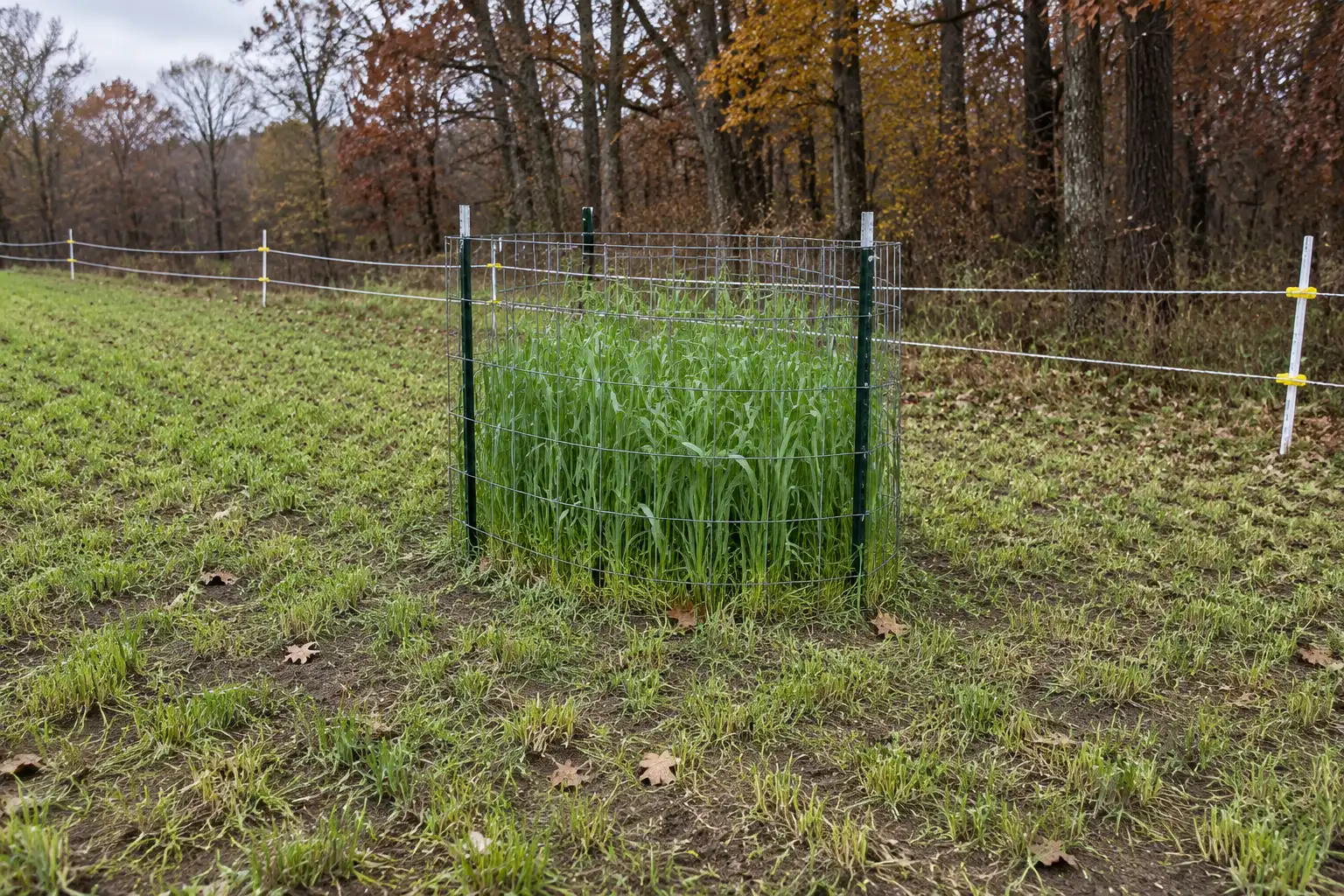
- A plot grazed down to dirt. Deer pressure outran plot size. Texas A&M AgriLife names a two-tier polywire electric fence as the most common way to protect a new plot.
An exclusion cage also helps. Texas A&M AgriLife suggests placing one inside the plot to compare protected growth against what deer are removing.
Frequently Asked Questions
Can you plant oats for deer in October?
Yes, in the Southeast, where Mississippi State and UGA both list October 15 as the last planting date. Northern plots sown in October rarely grow enough before a hard freeze.
Do oats come back the next year?
No, oats are an annual and need replanting each season. UW Extension research notes that fall oats do not survive a Wisconsin winter, so northern plots need reseeding every fall.
Should you plant oats or winter wheat for deer?
Plant both in one plot if you can afford the seed. Oats draw deer early but winterkill near 25°F, per USDA NRCS, while winter wheat survives and stays green into spring.
Can you broadcast oat seed without tilling?
You can, but stands are less reliable, since USDA NRCS rates unincorporated broadcasting below drilling. Drag, disk, or cultipack afterward to cover the seed 3/4 to 1 inch deep, per UGA.
How much oat seed do you need for a quarter acre?
Plan on about 30 to 38 pounds broadcast, or 23 to 25 pounds drilled. Those figures scale Mississippi State Extension’s per-acre rates for oats planted alone down to a quarter acre.
What oat variety is best for a deer plot?
It depends on region and planting date. Mississippi State lists Bob Oats, Buck Forage, Coker, and Trophy Oats for the Southeast, while UW trials favored ForagePlus early and Ogle late.
Bottom Line for Your Field
Pick your date from the published window for your region, then check it against your first frost. In the North, plant six to ten weeks before that frost. Expect the plot to end at the first hard freeze. In the South, wait out August heat and armyworms, and finish by October 15. Mix in wheat or clover if you want the plot to outlast the oats.