How Long Does It Take Oats to Germinate? Days by Temperature
Oat seed can sit in cold ground for one to three weeks before any green shows. That wait is normal, and it tracks temperature closely. This guide covers how long it takes oats to germinate, how to predict emergence, and when to worry.
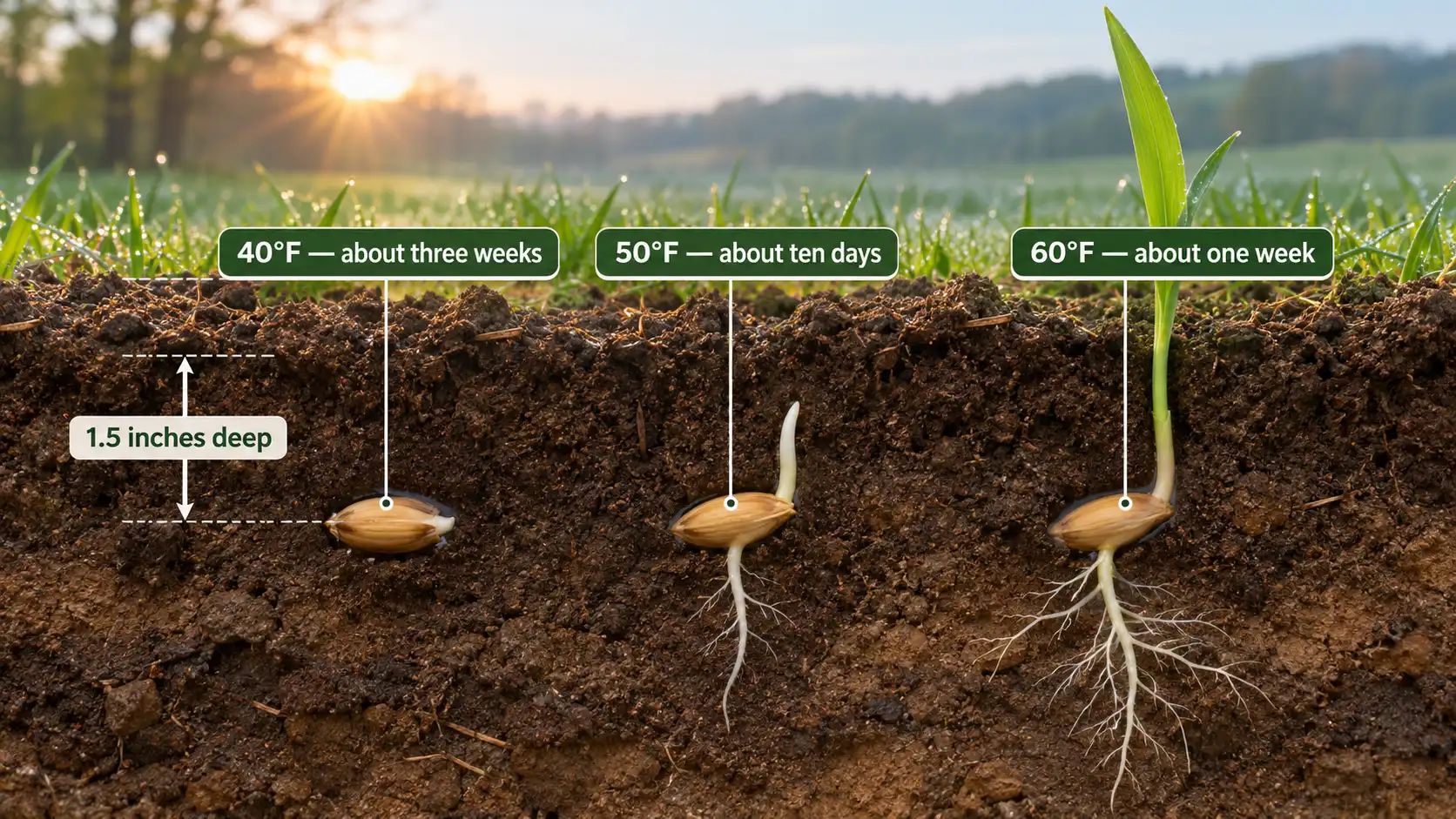
The time it takes oats to germinate and emerge depends on temperature. Under NDSU Extension’s growing degree day model, seedlings appear in 7 to 14 days when days average 45 to 60°F. Near 40°F, expect about three weeks.
Germination and Emergence Run on Two Different Clocks
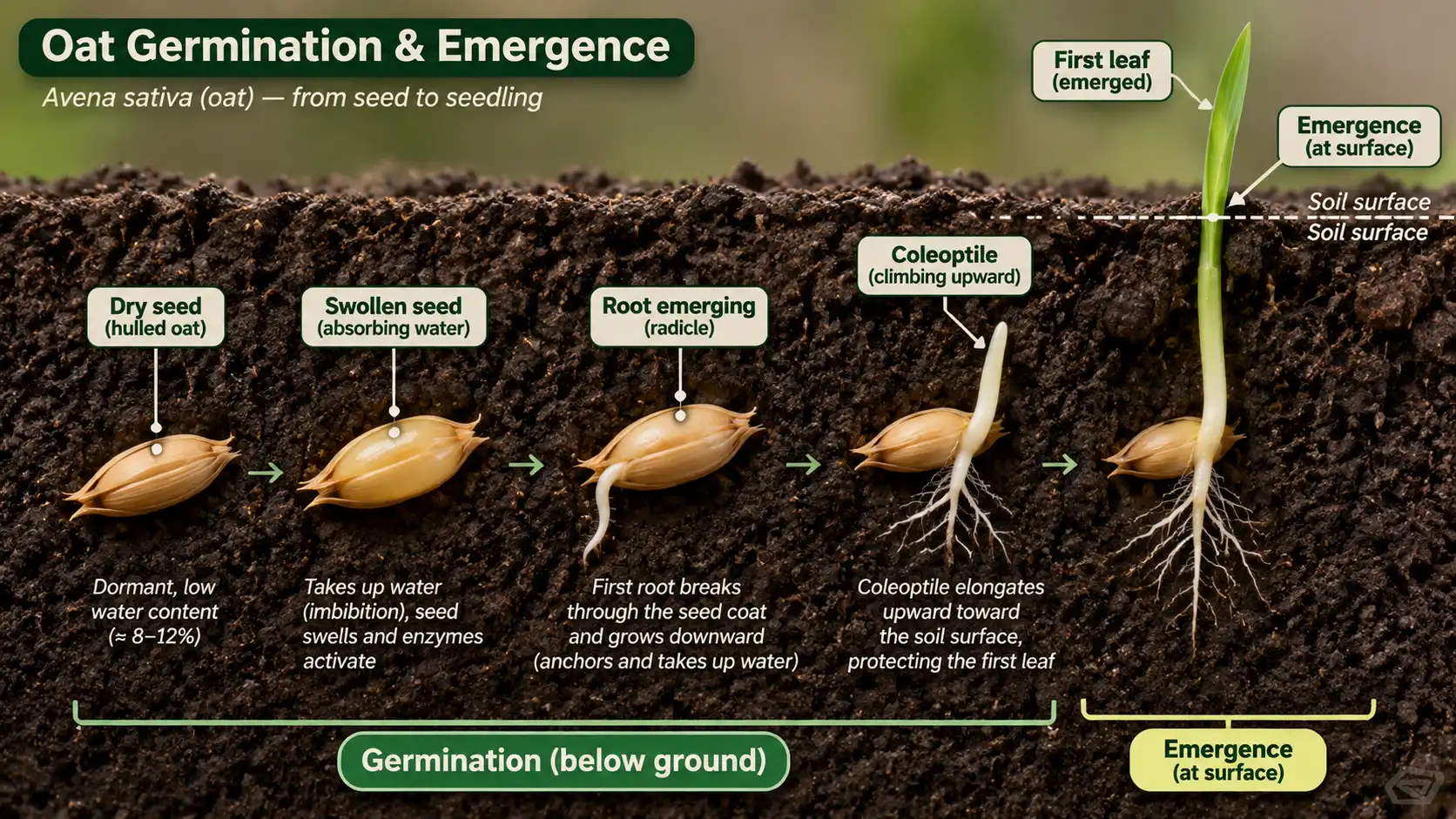
Germination happens underground and comes first. Emergence is the day the first leaf breaks the surface, and that is the part you actually see.
The process runs in three steps. First, the seed absorbs water and swells. Next, a white root pushes out of the hull. Then the coleoptile, a sheath that protects the first leaf, grows up through the soil.
That gap matters when you judge a stand. A field can look bare for a week while nearly every seed below it has already germinated. So “nothing yet” rarely means “nothing happening.”
University of Minnesota Extension adds a warning about the swelling stage. Once seed starts absorbing water, it cannot return to dormancy. As a result, a seed that swells and then sits in cold, waterlogged soil is committed. If conditions stay poor, it can rot before it ever emerges.
How Long Does It Take for Oats to Germinate at Different Temperatures?
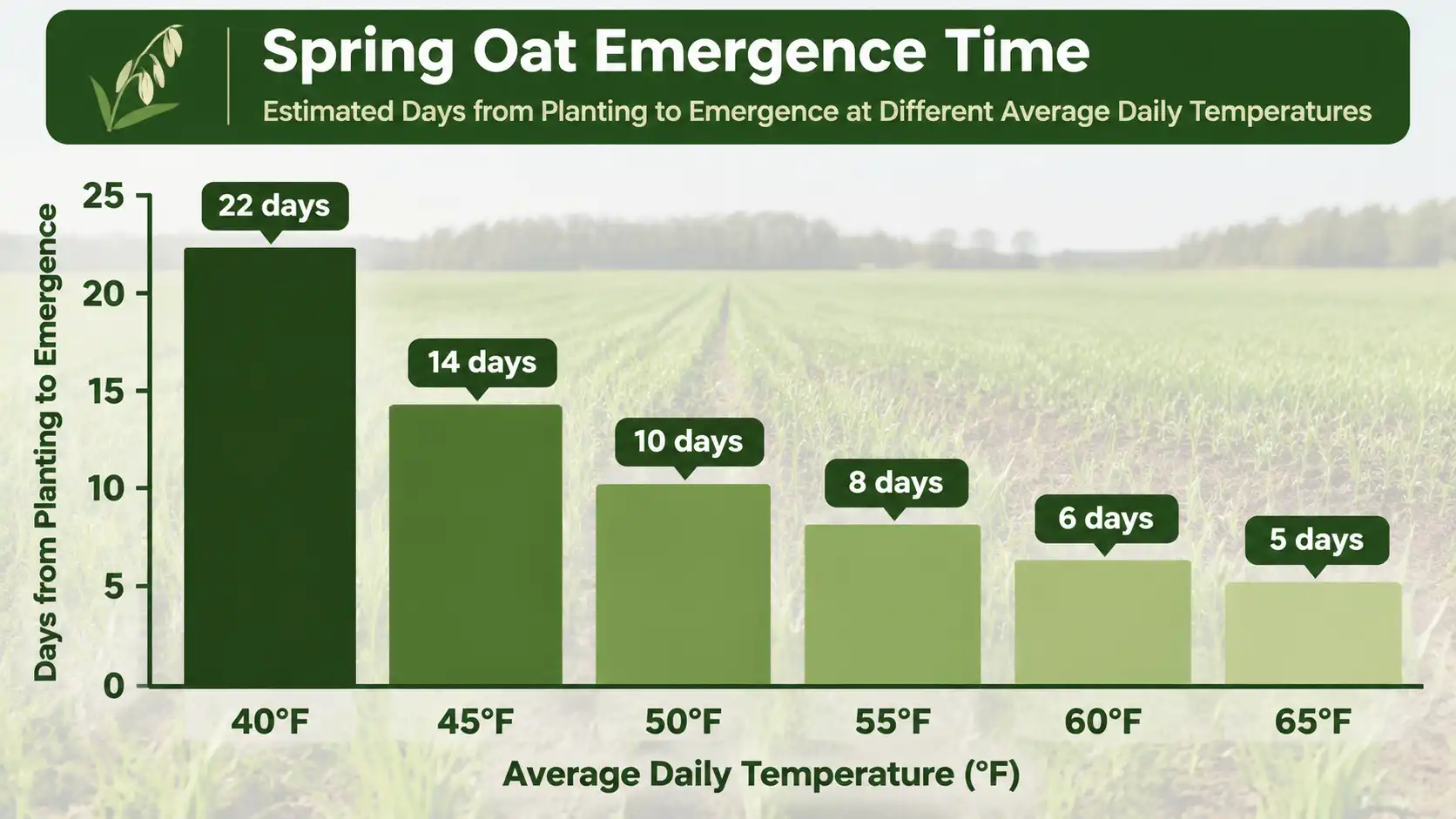
At a 50°F daily average, oats take about 10 days to emerge. Each 5°F warmer cuts a few days, while each 5°F colder adds several.
The estimates below come from NDSU Extension’s growing degree day (GDD) model. NDSU uses a 32°F base temperature for oats and puts small grains at about 180 GDD from planting to emergence.
| Average daily temperature | GDD added per day | Estimated days to emergence |
|---|---|---|
| 40°F | 8 | about 22 |
| 45°F | 13 | about 14 |
| 50°F | 18 | about 10 |
| 55°F | 23 | about 8 |
| 60°F | 28 | 6 to 7 |
| 65°F | 33 | 5 to 6 |
Treat these as upper estimates. University of Minnesota Extension notes that oats reach the one-leaf stage on slightly fewer GDD than spring wheat. The figures also assume moist soil and normal seeding depth.
Germination itself runs well ahead of these dates, because roots form before the shoot climbs.
Published oat-specific emergence figures are scarce, however. Most U.S. extension GDD models were built on wheat and barley, so the oat estimates borrow from them. Oats do share wheat’s 32°F base in NDSU’s table, which is one reason the two crops behave alike early. For more on how oats compare with wheat, see the side-by-side wheat and oats comparison.
What Soil Temperature Do Oats Need to Germinate?
Oats can start germinating in soil as cool as 35 to 40°F. Still, stands come in faster and more evenly once soil passes 45°F. Extension services draw the line in different places, mostly because each one measures something slightly different.
- Penn State Extension: at least 35°F to germinate, with soil above 45°F speeding germination and giving a vigorous stand
- University of Minnesota Extension: real germination picks up at about 40°F
- Oklahoma State Extension: oats germinate once soil holds 40 to 43°F for a couple of days
- Texas A&M AgriLife Extension: 50°F for adequate germination and stands, with some seed staying dormant in colder soil until it warms
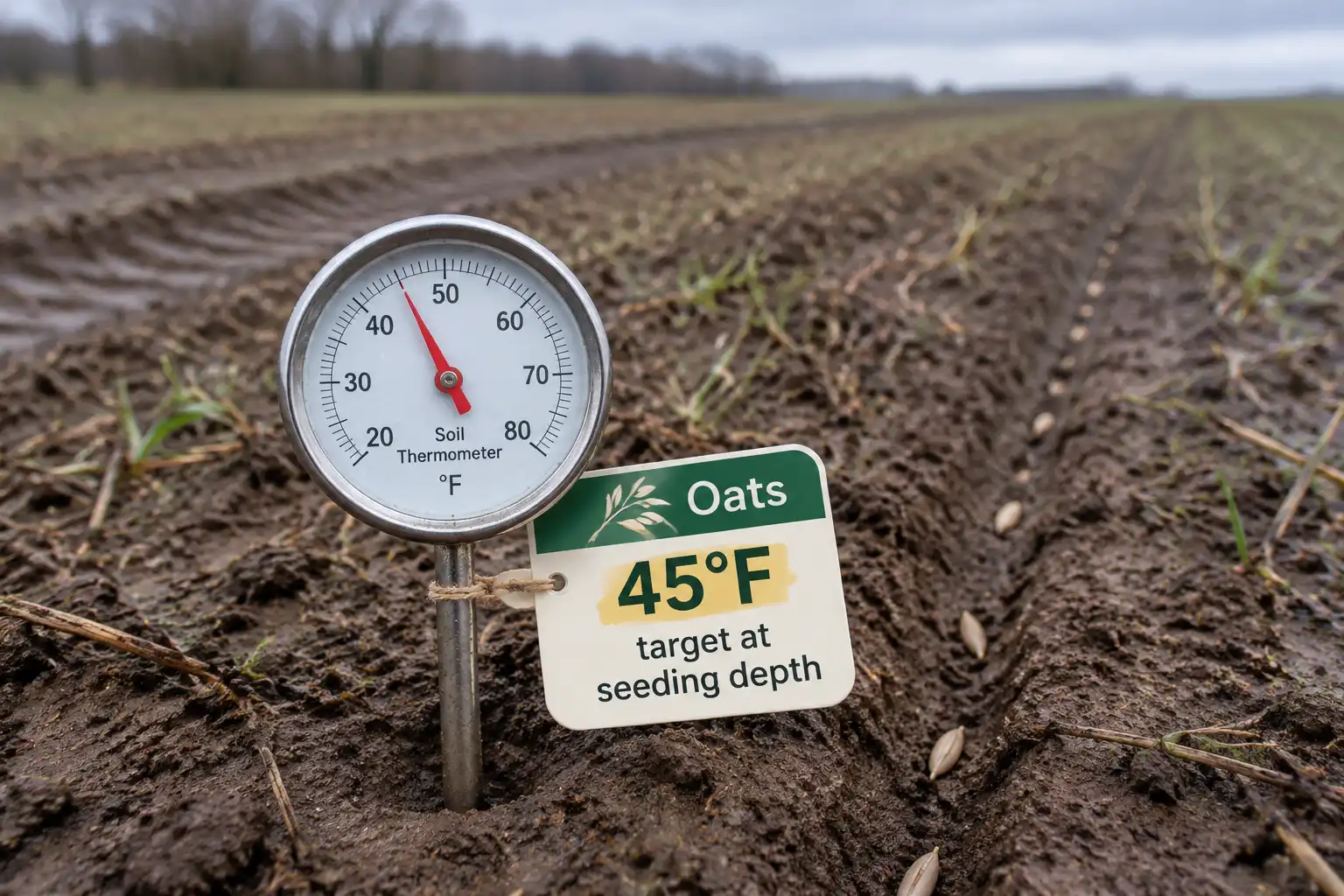
The lower figures mark when a single seed can start. The higher ones mark when a whole field comes up together. For planning, use Penn State’s rule. Wait until soil at 1.5 to 2 inches stays above 45°F for about two weeks.
Measure soil at seeding depth, not the air. A morning reading and an afternoon reading bracket the daily average.
That cool tolerance sets oats apart from warm-season crops. By contrast, soybean germination waits on far warmer soil.
How to Estimate Your Emergence Date With Growing Degree Days
You can predict emergence for your own planting date with a forecast and a calculator. NDSU Extension’s method takes four steps.
- Add each day’s high and low air temperature, then divide by 2.
- Subtract 32°F. The result is that day’s GDD. A day averaging 32°F or lower adds nothing.
- Start counting the day after planting, as NDSU specifies.
- Keep a running total until it reaches about 180. That day is your expected emergence date.
Worked example. Oats go in on April 10. The first week brings highs of 55°F and lows of 35°F. Each day averages 45°F, so each one adds 13 GDD. After seven days, the total sits at 91.
Then the weather warms to highs of 65°F and lows of 41°F. Those days average 53°F and add 21 GDD apiece. Four warm days bring the total to 175, and the fifth pushes it past 180. So emergence lands around April 22, about 12 days after planting.
For daily highs and lows, NDSU’s North Dakota Agricultural Weather Network (NDAWN) publishes station data. Many other states run similar mesonet networks.
How Seeding Depth Changes Emergence Time
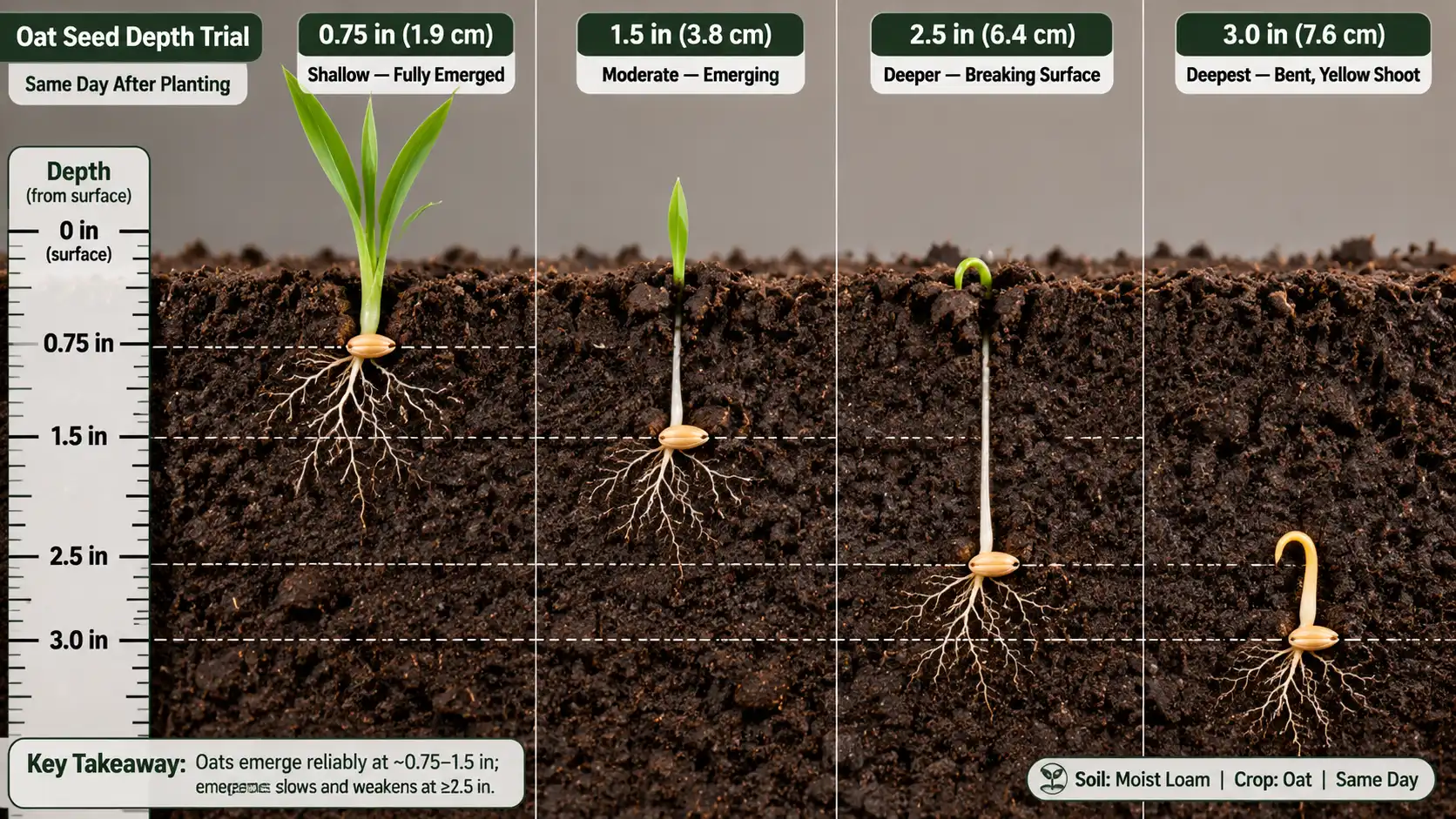
Shallower seed emerges sooner, but only when it sits in moist soil. Depth advice also varies by region and by what the oats are for.
NDSU Extension puts the best depth for grain oats in North Dakota at 1.5 to 2.5 inches. Stand loss can start as depth nears 3 inches. NDSU also notes that oats push up by stretching both the coleoptile and the first internode. That sets the crown nearer the surface than in other small grains through the three-leaf stage.
Oklahoma State Extension takes a shallower approach for spring forage oats. Its guidance allows up to 1.5 inches, yet a depth of 0.5 to 0.75 inch speeds emergence and establishment.
The difference comes down to the goal. Northern grain growers plant deeper to reach moisture in a drying spring seedbed. Southern Plains forage growers, on the other hand, want fast green cover for grazing.
For drill setup, seeding rates, and seedbed prep, see the full walkthrough on planting oats.
Moisture, Residue, and Seed Quality
Temperature sets the pace. However, four other things can stall it.
Dry topsoil. Seed cannot germinate until it absorbs water. In dry ground, oats simply wait for rain, and the GDD count means little until they get it.
Wet, cold soil. Penn State Extension warns that poorly drained soil starves seed of oxygen and can cause seed rot. Cold soil also slows seedlings and makes fungal problems worse. On top of that, University of Minnesota Extension notes that drawn-out emergence leaves seedlings open to Pythium damping-off.
Heavy residue. Straw and corn stalks keep soil cooler and wetter. For that reason, strips under thick residue often come up later than bare ground in the same field.
Seed quality. NDSU Extension notes that hull-less oat varieties can germinate poorly, because the embryo is easily damaged in harvest and handling. Freshly harvested seed can also carry some dormancy. In fact, USDA’s Federal Seed Act testing rules allow a cold prechill for oats to break it before a germination test.
Spring vs. Fall Planting: Why the Clock Changes
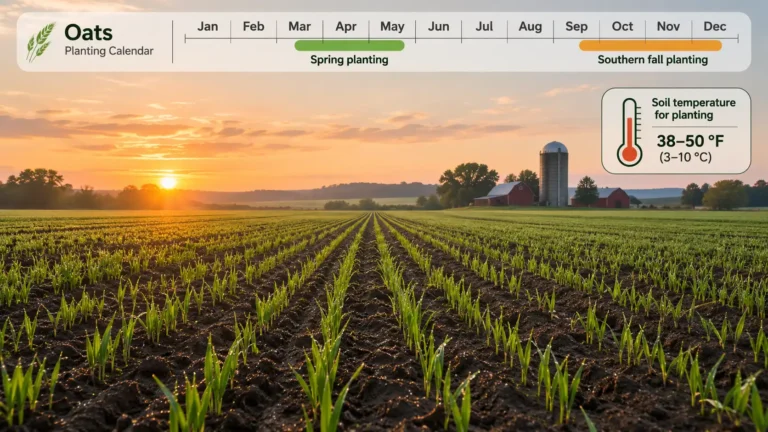
Spring oats emerge slowly because they go into cold soil on purpose. NDSU Extension notes that oats are adapted to cool seedbeds and respond to early planting with more tillers and larger panicles. They fit the same early slot as the spring wheat planting window. So a two or three week wait in a cold April is common.
Warmer spells shorten that wait fast. University of Minnesota Extension says highs in the upper 60s to low 70s bring small grains up in 8 to 10 days. That assumes nights near 40°F.
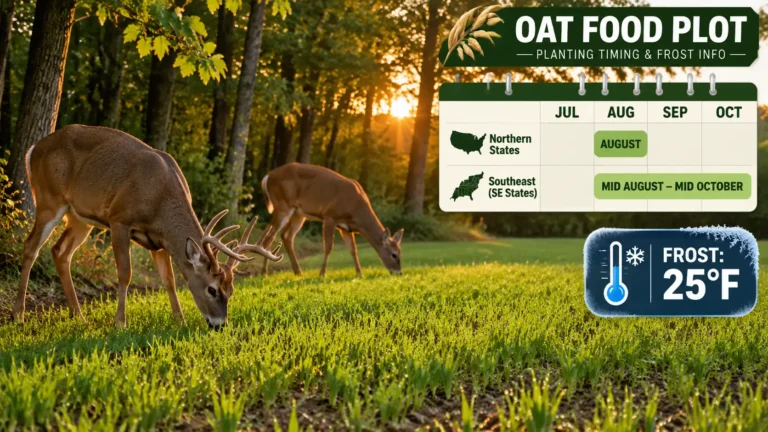
Fall-seeded oats run on a different clock. Late-summer cover crops and deer food plots go into much warmer soil. At a 65°F daily average, the GDD model points to emergence in under a week. In that case, moisture becomes the limit instead of heat.
Heat has an upper limit, too. NDSU lists 86°F as the maximum growth temperature for oats. Yet little U.S. extension research measures how very warm soil slows oat germination. So treat hot, dry fall seedings with caution and plant into moisture whenever you can.
Sprouting Oats Indoors: The Seed Lab Timeline
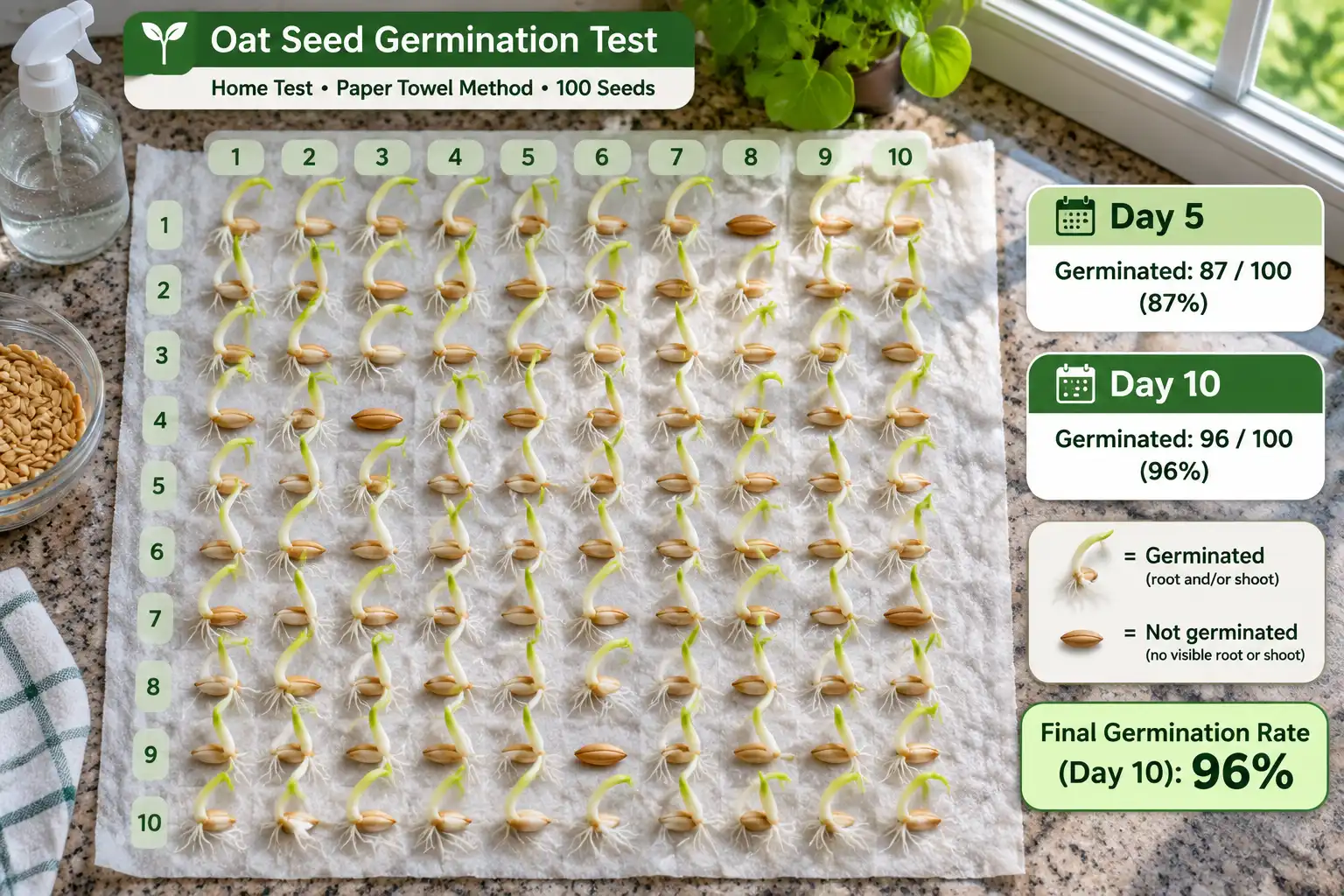
Indoors near 68°F, healthy oat seed should finish germinating within 10 days. USDA’s Federal Seed Act rules test oats at that temperature, with a first count at day 5 and a final count at day 10.
You can run the same test at home before planting:
- Count out 100 seeds from the bag.
- Spread them on a damp paper towel, roll it up, and seal it in a plastic bag.
- Keep the roll near 68°F, away from heaters and sunny windows.
- Unroll it at day 5 and count seeds with a healthy root and shoot.
- Recount at day 10. That final count is your germination percentage.
Oklahoma State Extension wants at least 85 percent germination in seed for spring forage oats. If your seed tests below that, raise the seeding rate to make up the gap or buy fresh seed.
The same timeline applies to oats sprouted in trays for cat grass or sprouts. Room-temperature seed moves much faster than seed in a 40°F field.
What Germinating and Emerging Oats Look Like
A germinated oat seed shows a white root tip pushing out from one end of the hull. Soon after, a pale shoot follows from the same end and turns upward.
That shoot is the coleoptile, a closed, pale tube. Once it reaches light, the first true leaf splits out of its tip. At this point, seedlings are thin and grasslike, so they are easy to miss in residue.
Below ground, the growing point stays about 1 inch deep through the five-leaf stage, per University of Minnesota Extension. That keeps it shielded from frost even when the leaves burn. For leaf features at each stage, see this guide to what young oat plants look like.
Why Oats Are Slow to Come Up
Most slow stands trace back to cold soil. Before you replant, dig up some seed and look.
| What you find | Likely cause | What to do |
|---|---|---|
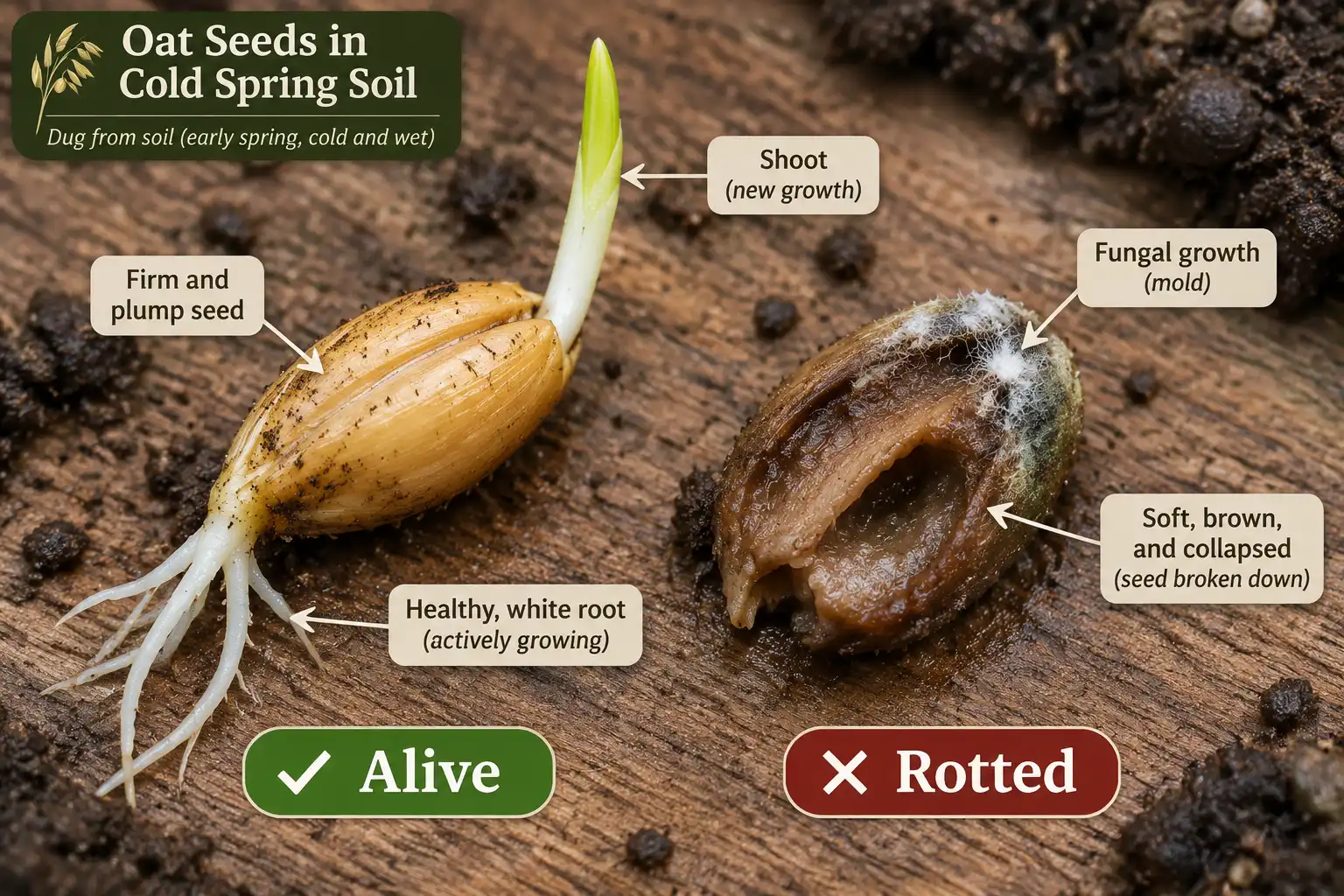
| Bare rows after two weeks, seed firm with a white root | Cold soil slowing GDD buildup | Wait and track GDD against the forecast |
| Seed soft, brown, or sour smelling | Seed rot in cold, wet soil (Penn State) | Reseed once soil drains and warms |
| Seed dry and unchanged | No moisture to start germination | Wait for rain, or water small plots |
| Shoot bent or yellow below the surface | Crusting, or seed too deep (NDSU flags losses near 3 inches) | Break a light crust and set the drill shallower next time |
| Patchy stand in low spots or residue strips | Cooler, wetter soil in those areas | Recount after those areas warm |
| Thin stand from hull-less seed | Embryo damage in handling (NDSU) | Test germination and adjust the rate |
When to Worry and When to Replant
A slow stand is not a failed stand. So dig before you decide.
Check at least 10 seeds from different parts of the field. A firm seed with a white root or shoot is alive and should still come up. A mushy, discolored seed has rotted, and those patches need reseeding. Texas A&M AgriLife Extension makes a similar point for southern growers. Seed in cool soil that is not wet enough to rot will wait, then germinate once the soil warms.
Next, count what emerges. NDSU Extension’s grain rate of 1 million pure live seeds per acre works out to about 23 seeds per square foot. In 7.5-inch drill rows, that is roughly 14 seeds per foot of row. On a 4 by 8 raised bed, it comes to about 735 seeds. By weight, that is 0.7 to 1.1 ounces at NDSU’s 60 to 90 pounds per acre. Compare your emerged count with those figures, because that gap tells you more than the calendar.
Frost rarely forces a replant. University of Minnesota Extension says small grain seedlings tolerate about 28°F and likely brief dips to 22°F. Seed that freezes while still swelling is the bigger risk, since it can rot.
From Germination to the Next Stages
After emergence, oats grow quickly in cool weather. Penn State Extension says oats reach the milk stage 55 to 65 days after germination. For that reason, a slow start in April usually delays harvest by days rather than weeks.
Frequently Asked Questions
Will oats germinate on top of the soil?
Oats can germinate on the surface if seed stays wet, but it dries fast and stands come in thin. Cover broadcast seed with a harrow or rake pass so it sits in moist soil.
Do you need to soak oats before planting?
No, field seed absorbs water from moist soil on its own. University of Minnesota Extension notes that swelling seed cannot return to dormancy, so soaked seed in dry ground is at risk.
Why are my oats not coming up after 10 days?
Cold soil is the usual reason, since emergence can take three weeks near 40°F. Dig a few seeds: firm seed with a white root is on track, while soft brown seed has rotted.
Can oats germinate in cold soil?
Yes, oats start germinating at 35 to 40°F, per Penn State and University of Minnesota Extension. Growth is slow there, though, and Texas A&M AgriLife Extension sets 50°F as the mark for good stands.
How deep should oats be planted for fast emergence?
Oklahoma State Extension says 0.5 to 0.75 inch speeds emergence for spring forage oats. For grain in drier northern seedbeds, NDSU Extension recommends 1.5 to 2.5 inches so seed reaches moisture.
Does frost kill germinating oats?
Usually not, because the growing point stays about 1 inch below ground early on. University of Minnesota Extension says seedlings tolerate about 28°F, though seed that freezes while still absorbing water can rot.
Key Points for Your Field
Expect oats to emerge in about 7 to 14 days when days average 45 to 60°F, and closer to three weeks near 40°F. Plant once soil at seeding depth holds above 45°F, and place seed in moisture. If a stand looks slow, dig and check the seed before replanting. Firm seed with a white root just needs more heat.