15-0-0 Fertilizer: What It Means, How Much to Apply, and 4 Picks

A 15-0-0 fertilizer feeds nitrogen and nothing else. That makes it right for a few jobs, like a hydroponic Part B mix or side-dressing tomatoes. It also appears on liquid weed and feed jugs. It is the wrong bag for soil short on phosphorus or potash.
If a soil test calls for nitrogen only, 15-0-0 fertilizer supplies 15% nitrogen by weight with no phosphorus or potash. Most bags are calcium nitrate with 18 to 19% calcium, while liquid weed and feed versions use urea nitrogen.
What Does 15-0-0 Fertilizer Mean?
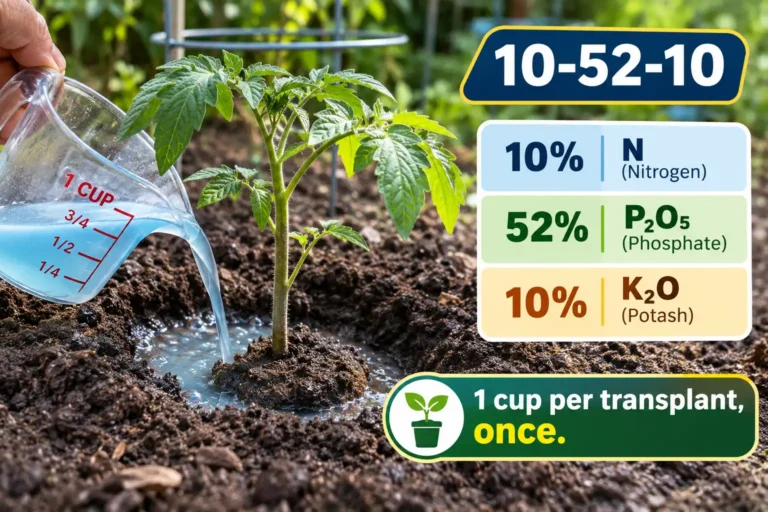
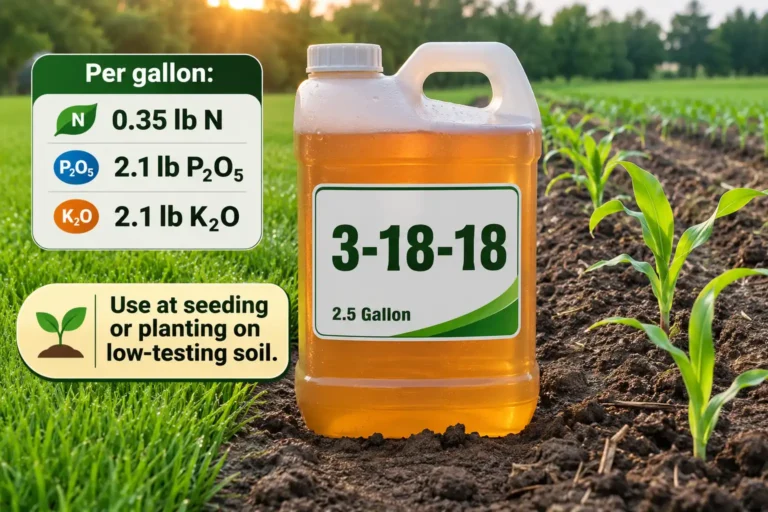
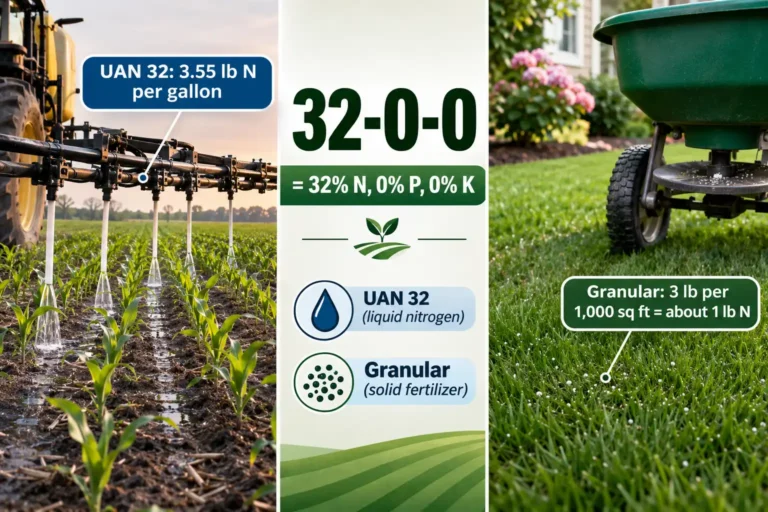
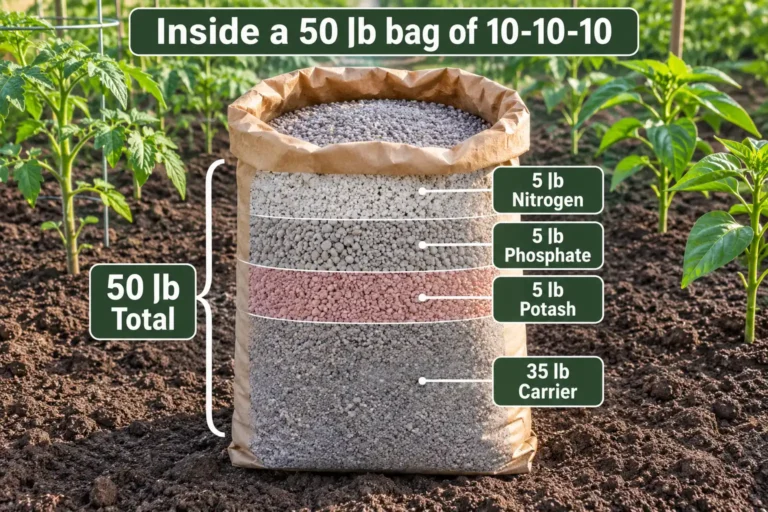
It means the product is 15% nitrogen (N) by weight, with 0% available phosphate (P2O5) and 0% soluble potash (K2O). Every US fertilizer label lists those three numbers in that order. So the grade tells you exactly what the bag can and cannot supply.
To turn the percentage into pounds, multiply the bag weight by the first number:
- 25 lb bag of 15-0-0: 25 × 0.15 = 3.75 lb of nitrogen
- 18 lb bag of 15.5-0-0: 18 × 0.155 = 2.8 lb of nitrogen
- 5 lb bag of 15.5-0-0: 5 × 0.155 = 0.78 lb of nitrogen
The grade only shows N, P, and K. Calcium nitrate also carries 18 to 19% calcium, listed on a separate line of the guaranteed analysis. Most of the remaining weight is oxygen from the nitrate and water bound into the crystal.
Read one more line before you buy. The label breaks total nitrogen into forms: nitrate, ammoniacal, or urea. That line matters more than the grade. The form decides how fast the nitrogen works and which way it pushes soil pH.
Two Different Products Share the 15-0-0 Label
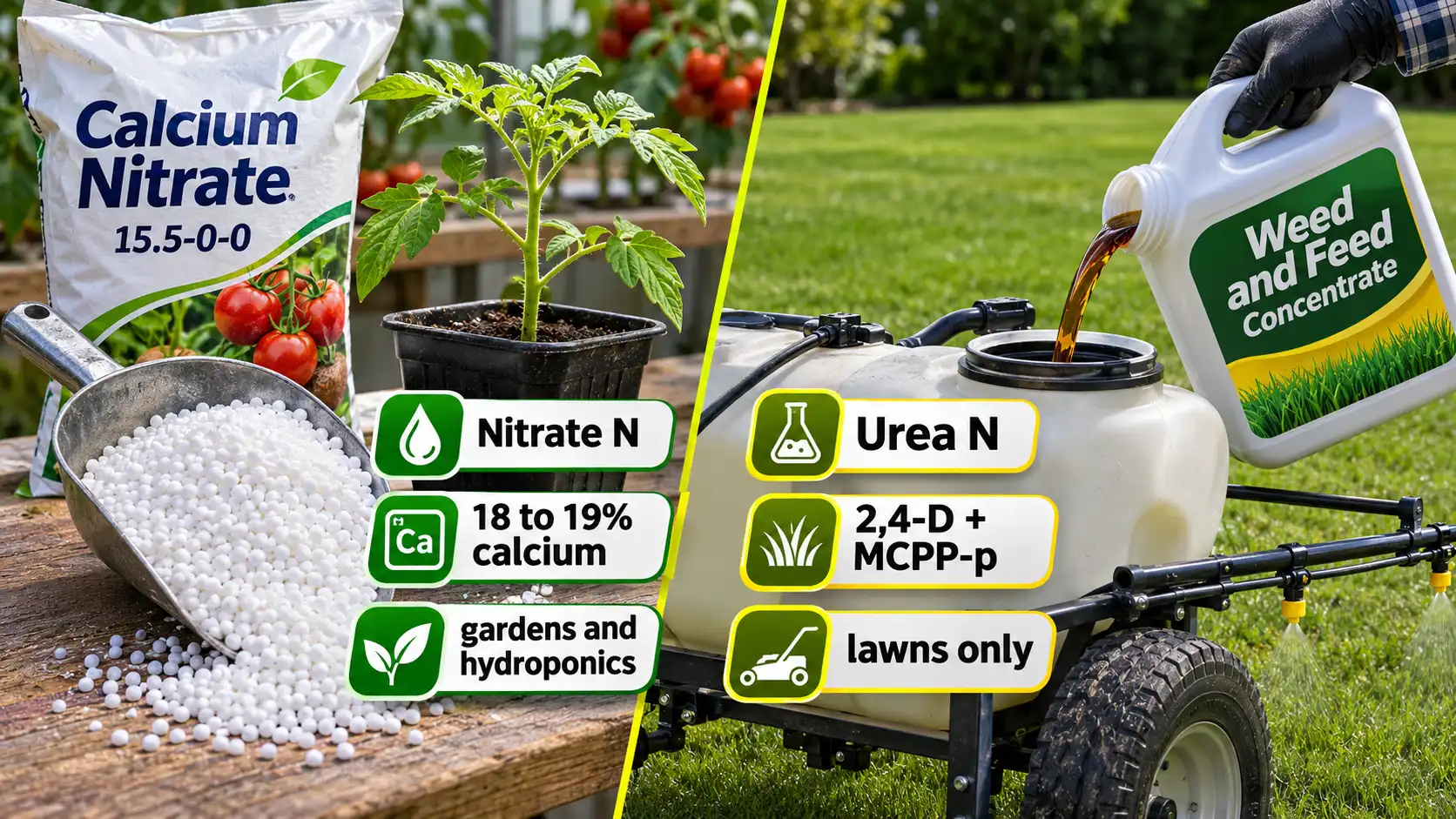
Two unrelated products carry this grade. One is dry calcium nitrate for gardens, greenhouses, and hydroponics. The other is a liquid lawn weed and feed, where 15-0-0 describes the fertilizer half of a herbicide jug.
| Feature | Calcium nitrate (15-0-0 or 15.5-0-0) | Liquid weed and feed (15-0-0) |
|---|---|---|
| Nitrogen form | Nitrate | Urea |
| Added ingredient | 18 to 19% calcium | Broadleaf herbicides (2,4-D, MCPP-p) |
| Physical form | Prills, granules, or powder | Liquid concentrate |
| Main use | Vegetables, hydroponics, fertigation | Lawns with broadleaf weeds |
| Effect on soil pH | Raises it slightly | Lowers it over time |
| Safe near vegetables | Yes, at label rates | No, drift injures broadleaf crops |
The two are never interchangeable. Calcium nitrate greens a lawn but kills no weeds. Weed and feed drift, on the other hand, can injure tomatoes and beans. That is why the Gordon’s label bars spraying near vegetables, flowers, and shrubs.
How 15-0-0 Compares With Other Nitrogen Fertilizers
Calcium nitrate is one of the weakest nitrogen sources by percentage, so you need more product per pound of nitrogen. In return, you get fast-acting nitrate, a dose of calcium, and a slight rise in soil pH.
| Fertilizer | Grade | Other nutrient | Soil pH effect (lb lime per ton) | Product for 1 lb N |
|---|---|---|---|---|
| Urea | 46-0-0 | None | Lowers (1,680) | 2.2 lb |
| Ammonium sulfate | 21-0-0 | 24% sulfur | Lowers (2,200) | 4.8 lb |
| Sodium nitrate | 16-0-0 | None | Raises (580) | 6.3 lb |
| Calcium nitrate | 15-0-0 | 19% calcium | Raises (400) | 6.7 lb |
Grade, nutrient, and pH figures come from University of Maryland Extension’s fertilizer composition table. The last column is simple division. In that table, only calcium nitrate and sodium nitrate push pH up. Ammonium sulfate pulls it down hardest.
For field crops, that calcium rarely pays for itself. Corn growers lean on urea, UAN, or anhydrous ammonia, and sidedress timing for corn matters more than the source. Calcium nitrate earns its price in vegetables, fruit, and soilless systems.
When a Nitrogen-Only Fertilizer Is the Right Call
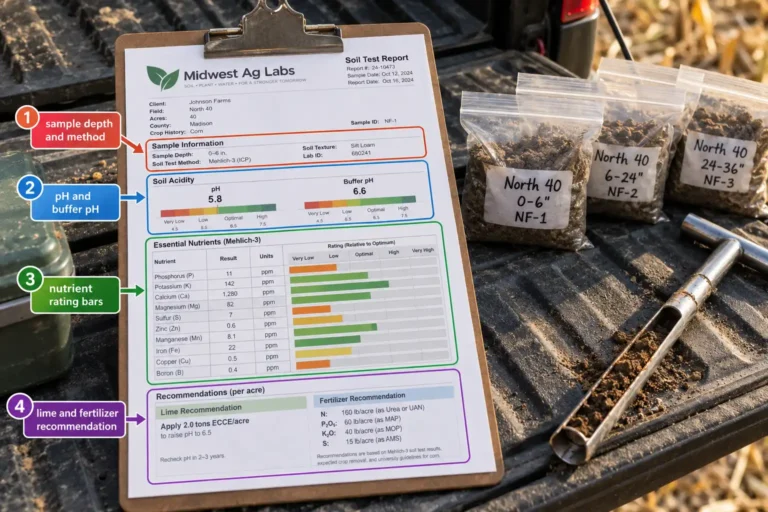
Use 15-0-0 when a soil test shows phosphorus and potassium already in the optimum range or higher. Adding more to soil that tests high wastes money, and extra phosphorus raises runoff risk. So start by reading your soil test report for the P and K ratings.
It fits these jobs well:
- Established lawns with adequate P. Minnesota restricts phosphorus on established lawns by state law, as University of Minnesota Extension notes. That is one reason so many lawn products carry a zero in the middle.
- Fruiting vegetables at first fruit set. Tomatoes and peppers use the nitrate and the calcium together.
- Two-part nutrient programs. Hydroponic and fertigation recipes keep calcium in its own Part B.
- Acidic soils. Calcium nitrate adds nitrogen without pushing pH lower.
It fits poorly where a soil test shows low phosphorus or potassium. No amount of 15-0-0 corrects those. A new bed low in P and K needs a balanced 10-10-10 blend or separate P and K sources.
How Much 15-0-0 Fertilizer to Apply
The rate comes from a nitrogen target, not from the bag. Pick the target for your crop. Then divide it by 0.15, or 0.155 for a 15.5-0-0 bag, to get pounds of product.
Lawns
University of Minnesota Extension plans each lawn feeding around 0.5 to 1.0 lb of quick-release nitrogen per 1,000 sq ft. On sandy soil, it drops that to 0.25 to 0.5 lb to limit nitrate leaching.
With a 15-0-0 product, that works out to:
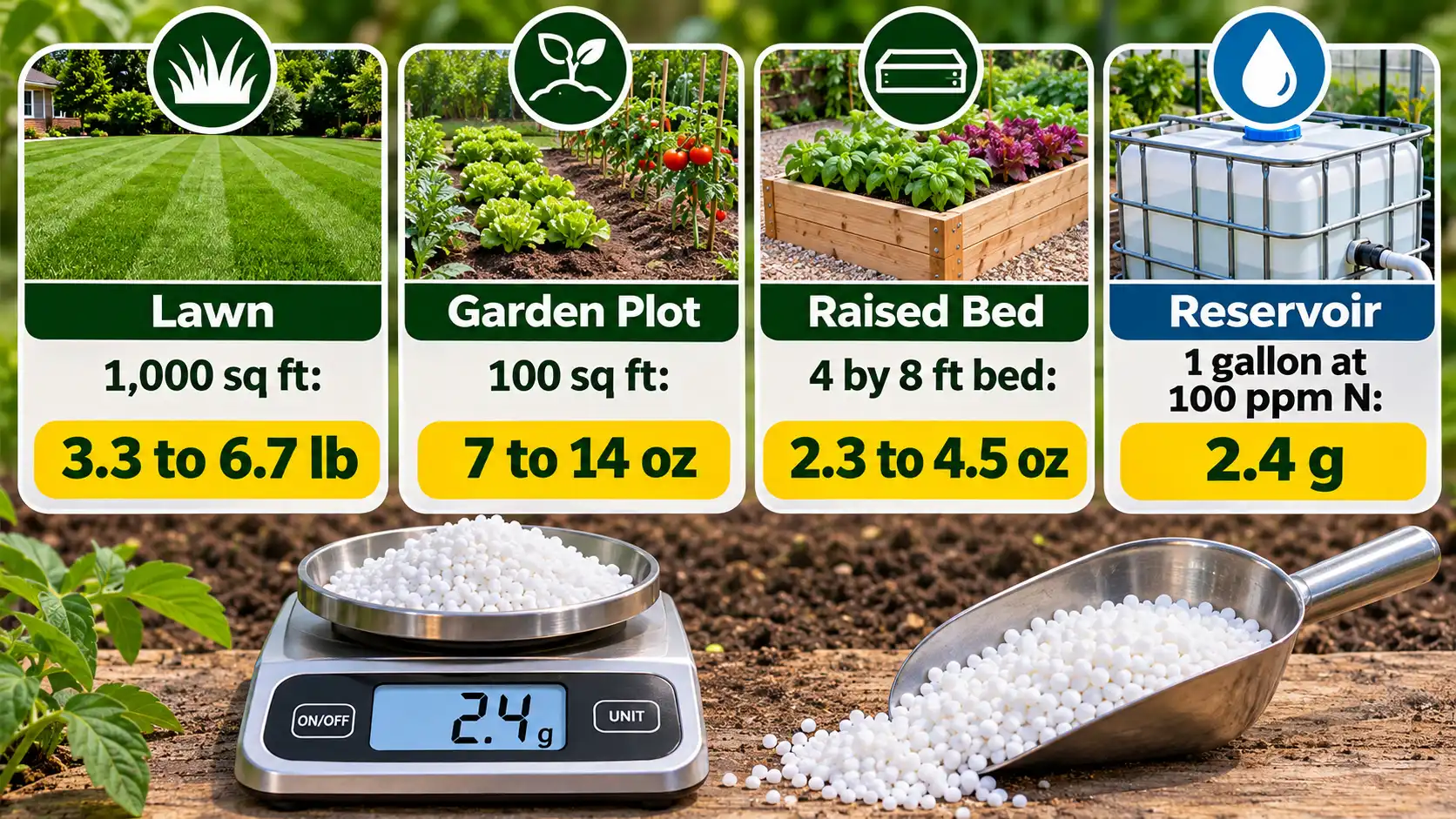
- Loam or clay lawns: 3.3 to 6.7 lb per 1,000 sq ft
- Sandy lawns: 1.7 to 3.3 lb per 1,000 sq ft
- A 5,000 sq ft lawn on loam: 17 to 33 lb per feeding
Spread it on dry grass and water it in the same day. Product labels warn against applying calcium nitrate to wet foliage, because the dissolved salt can scorch leaf blades.
Vegetable Beds and Rows
Mississippi State University Extension recommends side-dressing peppers with 30 to 60 lb of nitrogen per acre. Apply it once the first fruit reaches the size of a quarter. The same guidance names calcium nitrate as the source to choose when a field has a history of blossom end rot.
Here is that rate at garden scale with a 15.5-0-0 product:
| Area | Nitrogen at 30 to 60 lb/acre | Calcium nitrate needed |
|---|---|---|
| 1 acre | 30 to 60 lb | 194 to 387 lb |
| 1,000 sq ft | 0.69 to 1.38 lb | 4.4 to 8.9 lb |
| 100 sq ft | 0.07 to 0.14 lb | 7 to 14 oz |
| 4 by 8 ft raised bed | 0.02 to 0.04 lb | 2.3 to 4.5 oz |
Scatter the prills in a band a few inches from the stems, scratch them into the top inch of soil, and water. A 15-0-0 bag needs about 3% more product than a 15.5-0-0 bag. In a garden, that gap is too small to matter.
Hydroponics and Fertigation
The Jack’s 15-0-0 Part B label puts 8.6 oz in 100 gallons of water at 100 ppm nitrogen. That equals about 2.4 grams per gallon, or 12 grams for a 5-gallon reservoir.
For any other target, use this formula: ounces per 100 gallons = target ppm ÷ (% N × 0.75). For example, a 150 ppm solution from a 15.5-0-0 product takes 12.9 oz per 100 gallons.
JR Peters, the maker of Jack’s, publishes a 3-2-1 feeding schedule built around Part B:
| Component | Per 100 gal | Per gallon | Supplies |
|---|---|---|---|
| Part A 5-12-26 | 13.0 oz | 3.7 g | 50 ppm N, plus P and K |
| Part B 15-0-0 | 8.6 oz | 2.4 g | 100 ppm N, about 116 ppm Ca |
| Epsom salt | 3.5 oz | 1.0 g | 30 ppm Mg |
The calcium figure is our calculation from the 18% calcium on the Part B label. Dissolve each part fully, one at a time, in the full volume of water. Never combine the dry powders or their concentrated stocks. In concentrate, calcium reacts with phosphate and sulfate and settles out as a solid that clogs emitters. Weigh every dose on a gram scale. A teaspoon of fine powder and a teaspoon of coarse prills weigh different amounts.
Does Calcium Nitrate Stop Blossom End Rot?
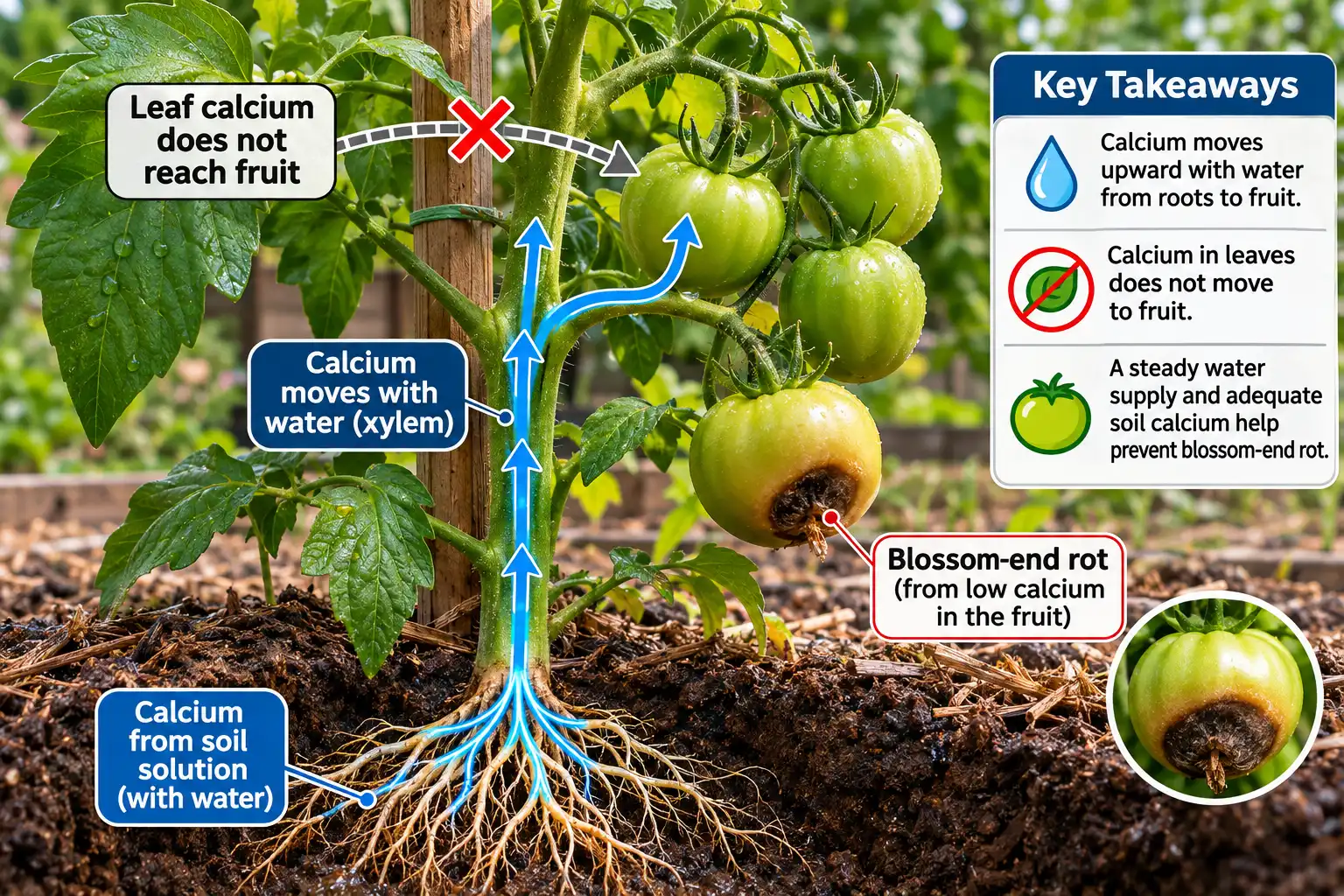
Soil-applied calcium nitrate can help where calcium supply is short, but steady watering matters more. Blossom end rot starts when too little calcium reaches the fruit. That calcium travels only in water drawn up through the roots.
Clemson Cooperative Extension says blossom end rot can appear even when soil calcium is adequate. It also states that foliar calcium sprays are not effective. Calcium in leaves cannot move into the fruit, and fruit skin cannot absorb it. Its top prevention step is uniform soil moisture.
Oregon State University Extension takes a softer line. Once symptoms appear, it suggests spraying leaves and fruit with 2 tablespoons of calcium chloride per gallon of water. Two more sprays follow at weekly intervals, while you fix soil moisture at the same time.
So both services put water first. They differ on whether a spray adds anything. Given how calcium moves, a soil application of calcium nitrate at first fruit set rests on firmer ground than a spray. Pair it with even watering and mulch. Affected fruit will not recover, so pick it off. Watering intervals, mulch depth, and pH targets for preventing blossom end rot matter more than any bag.
15-0-0 Liquid Weed and Feed for Lawns
On a lawn jug, 15-0-0 means the concentrate is 15% urea nitrogen, mixed with broadleaf herbicides. Gordon’s Liquid Weed & Feed 15-0-0 is the best-known example of a liquid lawn fertilizer and weed killer in one jug. Its label lists 2,4-D and MCPP-p as the active ingredients. Target weeds include dandelion, clover, chickweed, plantain, and knotweed.
Gordon’s directions call for 6.4 fl oz of concentrate in 1 gallon of water per 1,000 sq ft. At that rate, a 1-gallon jug treats up to 20,000 sq ft. The 2.5-gallon jug treats up to 50,000 sq ft. Because it goes on as a spray, the herbicide lands directly on weed leaves. The mixing directions suit a pump sprayer or a tow-behind rig.
How Much Nitrogen Does Gordon’s Weed and Feed Supply?
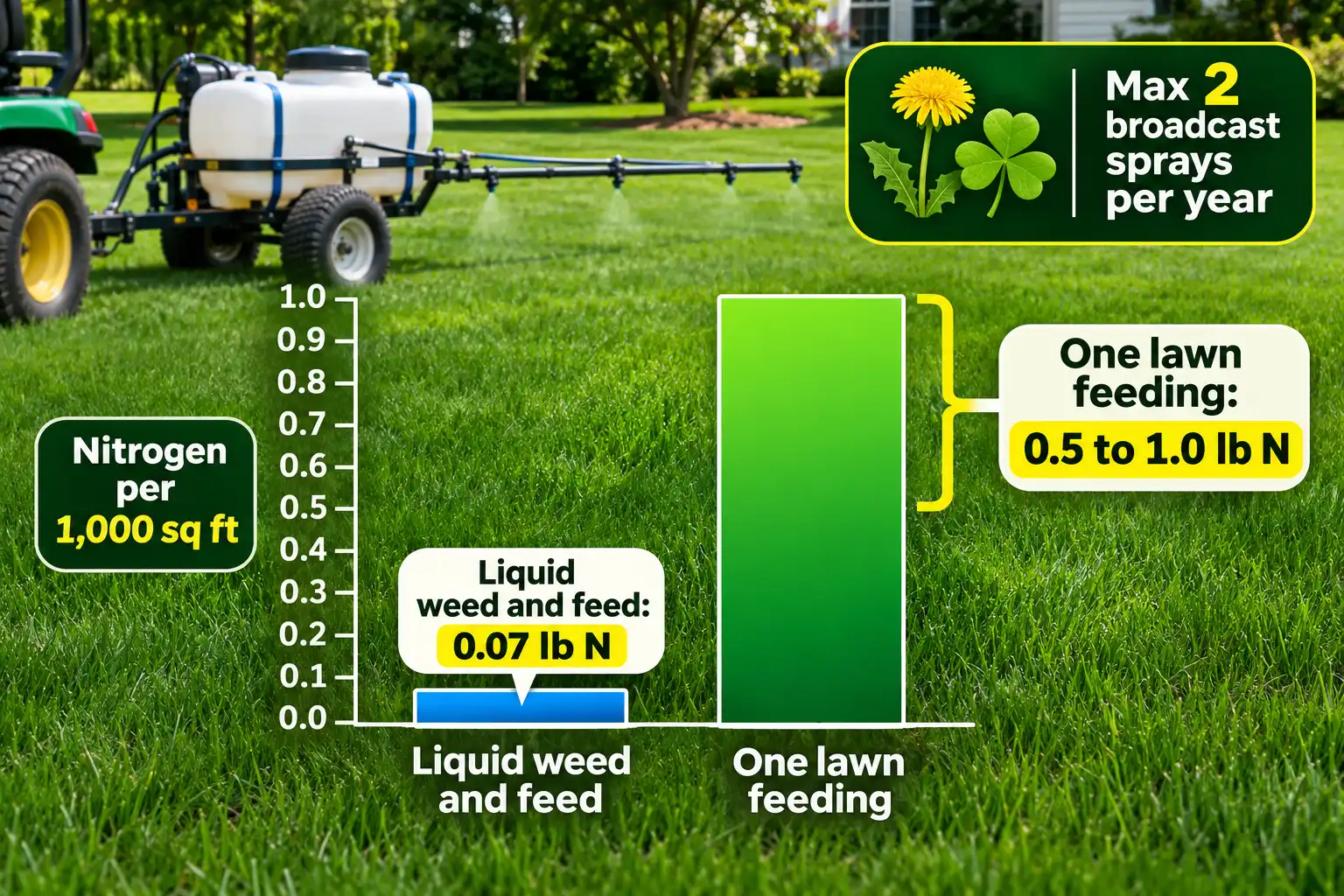
Very little. The Gordon’s label states that each application supplies 0.07 lb of nitrogen per 1,000 sq ft. University of Minnesota Extension puts one lawn feeding at 0.5 to 1.0 lb. So one pass delivers only 7 to 14% of a single feeding.
The label also caps broadcast use at two applications per year. At that limit, the product supplies 0.14 lb of nitrogen per 1,000 sq ft per season. In fact, the label itself calls for a separate fertilizer program. That program should supply at least 1 lb of nitrogen per 1,000 sq ft each season.
So treat it as a weed killer with a light green-up, not as lawn fertilizer. The pasture version, Gordon’s Pasture Pro Plus One-Step Weed & Feed 15-0-0, uses 2,4-D alone. Its label sets 16 fl oz per 1,000 sq ft, which supplies 0.17 lb of nitrogen.
Label Rules That Decide When You Can Spray
The Gordon’s label allows use on bluegrass, fescue, bermudagrass, and bentgrass lawns, with these limits:
- No spraying above 85°F or while grass is coming out of dormancy
- No use on St. Augustinegrass, centipedegrass, carpetgrass, dichondra, closely mowed bentgrass, or lawns with desirable clover
- Mow 1 to 2 days before treating, and hold off watering for 24 hours after
- Skip windy days and days with rain in the forecast
- Two broadcast applications per year at most, at least 30 days apart
- Keep spray off exposed roots and new shoots within the drip line of trees and shrubs
Is Spray Weed and Feed Worth It?
Often, a separate herbicide and fertilizer work better. Oklahoma State University Extension points out that the best times to apply herbicide and fertilizer rarely line up. It adds that combination products offer fewer herbicide choices and raise the odds of over-application. Spot treatment, it notes, is more effective and often costs less.
A combination spray fits best when broadleaf weeds cover most of the lawn and the grass is actively growing. For scattered weeds, spot-spray a straight herbicide with a battery backpack sprayer. Then feed the lawn on the schedule the grass needs.
How to Choose a 15-0-0 Fertilizer
Start with the job, because the job decides which specification matters.
- Hydroponics, drip, or fertigation: solubility governs. Choose a product labeled 100% water soluble or greenhouse grade. Dissolve a test batch in a clear jar before filling a tank.
- Side-dressing beds by hand: grade matters less. A small agricultural-grade bag works fine. At 7 to 14 oz per 100 sq ft, a 5 lb bag covers 570 to 1,140 sq ft.
- Two-part nutrient programs: match the Part B to the Part A it was written for, so the published ppm schedule holds.
- Lawns with broadleaf weeds: that job calls for liquid weed and feed, not calcium nitrate, and only on grasses the label allows.
Packaging matters too. Calcium nitrate pulls moisture from the air. A resealable pouch or airtight bin protects a bag that lasts past one season.
Two mistakes come up most. Gardeners buy calcium nitrate for blossom end rot when uneven watering is the real cause. And lawn owners expect weed and feed to fertilize, when it supplies a fraction of one feeding.
Best 15-0-0 Fertilizers Compared
All four picks are dry calcium nitrate, each suited to a different job. Specifications come from manufacturer documentation. Owner feedback reflects patterns across verified buyer reviews.
| Product | Grade | Calcium | Form | Sizes | Best for |
|---|---|---|---|---|---|
| Jack’s Nutrients 15-0-0 Part B | 15-0-0 | 18% | Powder | 25 lb, other sizes | Two-part hydroponic programs |
| Cz Garden Calcium Nitrate | 15.5-0-0 | 19% | Granules | 18 lb, 5 lb | Drip and fertigation |
| Acton Calcium Nitrate | 15.5-0-0 | 19% | Crystals | 25 lb | Soil, foliar, and hydro use |
| PowerGrow Systems Calcium Nitrate | 15.5-0-0 | 19% | Small beads | 1, 5, 25 lb | Hand side-dressing beds |
1. Jack’s Nutrients 15-0-0 Part B Calcium Nitrate
- 15-0-0 Analysis: Provides a very soluble and available source of calcium and nitrate nitrogen sources – Works in tandem …
- Water-Soluble Powder: Powdered concentrates go further than liquid fertilizers – Simply mix your measured powder with wa…
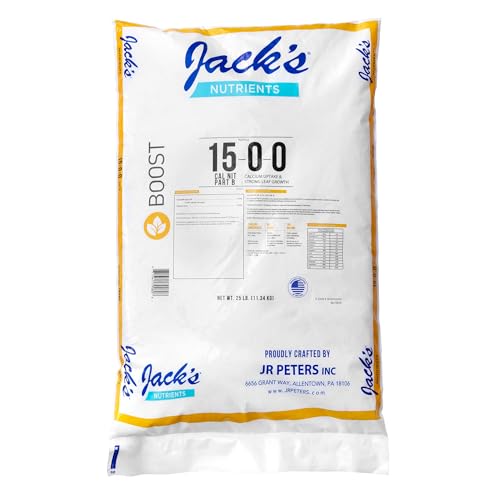
- Mixing Rate: Dissolve 8.6 ounces in 100 gallons of water to achieve a final feed strength of 100 PPM N.
Best for two-part hydroponic programs
Jack’s Part B is calcium nitrate built as the second half of the Jack’s 5-12-26 Part A system. All of its nitrogen is nitrate, with 18% calcium. The label gives a precise rate of 8.6 oz per 100 gallons for 100 ppm N. JR Peters also publishes the full 3-2-1 schedule around it, so the ppm math holds. It carries no micronutrients, so it is not a stand-alone feed.
- Pros: All-nitrate nitrogen; published ppm mixing rate; pairs with Part A; long-lasting 25 lb bag
- Cons: Clumps if moisture gets in; needs Part A for a complete feed
- Specs: 15-0-0 with 18% calcium; water-soluble powder; 25 lb; 8.6 oz per 100 gal = 100 ppm N
- Owner evidence: Buyers consistently report strong vegetable and fruit results and say a bag goes a long way.
2. Cz Garden Calcium Nitrate 15.5-0-0

- PREMIUM QUALITY INGREDIENTS – Cz Garden Calcium Nitrate 15.5-0-0 is a water soluble, high purity, premium Nitrogen + Cal…
- 100% WATER SOLUBLE – GREENHOUSE GRADE – High Purity, Premium Quality fertilizer. Beware of lower grade Agricultural Grad…
- 19% CALCIUM + 15.5% NITROGEN FERTILIZER promotes green leafy growth and hardy plants. Get lush vegetation in your home g…
Best for drip lines and fertigation
Cz Garden sells a greenhouse-grade calcium nitrate with 15.5% nitrogen and 19% calcium in an 18 lb resealable pouch. The maker targets hydroponics, drip, NFT, DWC, coco, and soil, and lists it as the Part B in 321-style schedules. Owner reports consistently note that it dissolves cleanly without a greasy film. That is the property drip emitters need most. Buyers also report fewer blossom end rot problems on raised-bed tomatoes.
- Pros: Dissolves without residue; resealable pouch; greenhouse-grade purity; made in USA
- Cons: 18 lb bag, smaller than rivals; no published insoluble-matter figure behind the grade claim
- Specs: 15.5-0-0 with 19% calcium; granules; 18 lb (5 lb also sold); manufactured in USA
- Owner evidence: Solubility and plant-growth feedback is uniformly positive, and most buyers call it worth the money.
3. Acton Calcium Nitrate 15.5-0-0
- 15.5% NITRATE NITROGEN – Provides pure nitrate-form nitrogen that plants absorb immediately for rapid green growth, vigo…
- 19% SOLUBLE CALCIUM – Delivers a readily available source of calcium to strengthen cell walls, improve fruit firmness, a…
- PREVENTS BLOSSOM END ROT – A highly effective treatment for one of the most common garden disorders; supplies calcium du…
Most complete use directions
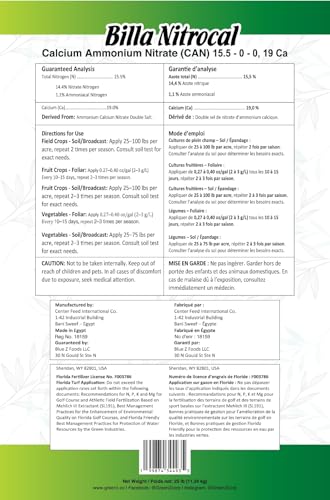
Acton’s 25 lb bag carries 15.5% nitrate nitrogen and 19% calcium as high-purity crystals. Its strength is documentation: the label gives separate rates for soil drenches, hydroponics, foliar sprays, and lawns. Its lawn rate of 2 to 5 lb per 1,000 sq ft sits at the low end of University of Minnesota’s range. However, its hydroponic rate uses teaspoons, which is coarse for ppm work. Treat its blossom end rot claims with care, since Clemson Extension finds foliar calcium sprays ineffective.
- Pros: Rates for four uses; high-purity crystals; 25 lb bulk bag; clear calcium guarantee
- Cons: Volume-based hydroponic dosing; blossom end rot claims outrun the research
- Specs: 15.5-0-0 with 19% calcium; crystals; 25 lb; derived from calcium nitrate
- Owner evidence: Thin. Too few published owner reports exist to judge long-term solubility or caking.
4. PowerGrow Systems Calcium Nitrate 15.5-0-0

- Agricultural Grade Fertilizer – Calcium Nitrate 15.5-0-0 NPK
- Calcium Nitrate is fully water soluble – easy uptake by your plants!
- High nitrogen level promotes lush green vegetative growth
Best small bag for garden beds
PowerGrow sells agricultural-grade calcium nitrate in 1, 5, and 25 lb bags. That range suits a gardener who needs one season of side-dressing rather than a bulk supply. At 7 to 14 oz per 100 sq ft, the 5 lb bag covers 570 to 1,140 sq ft. Owner reports consistently note healthy tomatoes and peppers, including on caliche soils. Solubility reports are mixed, though, so dissolve it fully before it enters any drip or hydroponic system.
- Pros: Three bag sizes; easy to pour; suited to food crops; works sprinkled or dissolved
- Cons: Mixed solubility reports; agricultural grade, not hydroponic grade
- Specs: 15.5-0-0 with 19% soluble calcium; small beads; 1, 5, or 25 lb; made in USA
- Owner evidence: Quality and ease-of-use ratings run very high, and most buyers say it eliminated blossom end rot.
Storage, Safety, and Troubleshooting
Calcium nitrate pulls moisture from the air. Seal the bag after every use and store it somewhere cool and dry. If it clumps, dissolve the clumps completely before use. Product labels warn that it irritates eyes and skin and is harmful if swallowed. Wear gloves and keep it away from children and pets. Liquid weed and feed must not freeze, per the Gordon’s label.
| Problem | Likely cause | Fix |
|---|---|---|
| White sediment or cloudy reservoir | Calcium met phosphate or sulfate in concentrate | Mix each part into the full water volume separately |
| Scorched leaf edges or lawn burn | Rate too high, or prills on wet foliage | Recheck the math, apply to dry leaves, water in |
| Lawn stays pale after weed and feed | Only 0.07 lb N per 1,000 sq ft applied | Follow with a feeding of 0.5 to 1.0 lb N |
| Blossom end rot continues | Uneven soil moisture | Water on a schedule, mulch, pick off affected fruit |
| Prills slow to dissolve | Coarse agricultural-grade beads | Use warm water, stir longer, strain before drip lines |
| Lush leaves, few fruit | Nitrogen applied too early | Hold side-dressing until first fruit set |
FAQs About 15-0-0 Fertilizer
Is 15-0-0 fertilizer good for lawns?
Yes, if the lawn already tests adequate in phosphorus and potassium. Apply 3.3 to 6.7 lb per 1,000 sq ft, which meets University of Minnesota’s 0.5 to 1.0 lb nitrogen guideline.
Is calcium nitrate 15-0-0 or 15.5-0-0?
Most brands sell calcium nitrate as 15.5-0-0 with 19% calcium. Some brands, including Jack’s Part B, label it 15-0-0 with 18% calcium, a gap too small to change garden rates.
Can I use 15-0-0 on tomatoes and peppers?
Yes, calcium nitrate is a common side-dress for both at first fruit set. Mississippi State Extension favors it for peppers with past blossom end rot, at 30 to 60 lb N per acre.
Can you mix calcium nitrate with other fertilizers?
Yes, in the final diluted solution, but never as dry products or concentrates. In concentrate, calcium binds phosphate and sulfate into solids, so dissolve each product separately in the full tank.
When is the best time to spray weed and feed?
Spray when broadleaf weeds and grass are actively growing and temperatures stay below 85°F, as the Gordon’s label requires. Skip windy days, rain forecasts, and lawns still coming out of dormancy.
Should I water or mow after spraying weed and feed?
Hold off on watering for 24 hours after spraying so the herbicide stays on the weed leaves. The Gordon’s label also says to mow 1 to 2 days before treatment for best results.
How far does a 25 lb bag of calcium nitrate go?
A 25 lb bag makes about 4,650 gallons of nutrient solution at 100 ppm nitrogen. As a side-dress at 7 to 14 oz per 100 sq ft, it covers 2,900 to 5,700 sq ft.
Putting This Into Practice
Read the grade, then read the nitrogen-form line beneath it. Buy calcium nitrate for vegetables, hydroponics, and fertigation, and size every dose from a nitrogen target. Buy liquid weed and feed only to kill broadleaf weeds on approved grasses, then fertilize the lawn separately. And if blossom end rot is the reason you are shopping, fix the watering schedule first.