
What Is Sorghum? Origin, Types, and Why It Isn’t Wheat
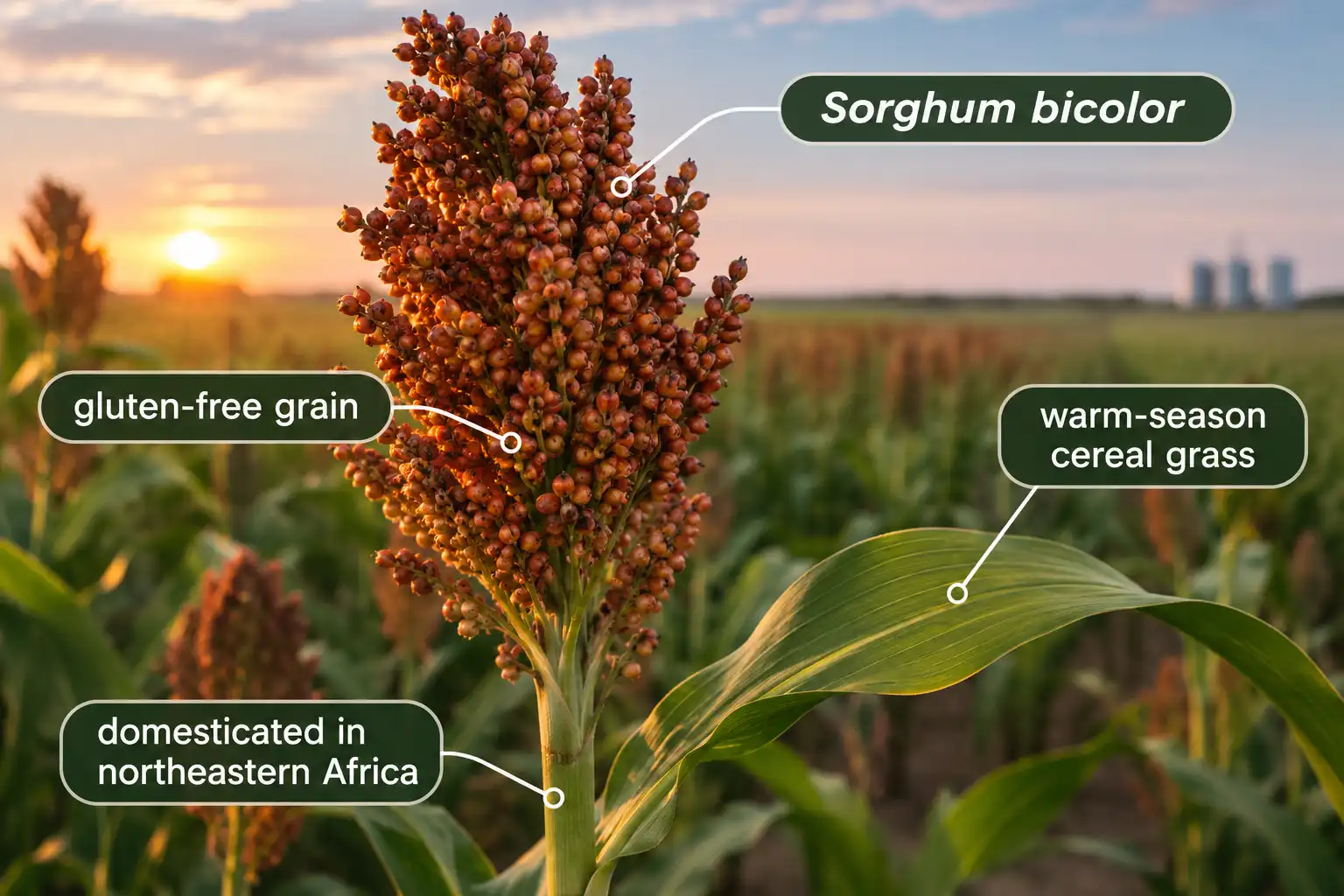
Sorghum turns up as milo at the grain elevator, as syrup on a biscuit, and as gluten-free flour on a store shelf. So what is sorghum, exactly? It is one plant with several jobs, and its history and botany explain each one.
What is sorghum? It is a warm-season cereal grass (Sorghum bicolor) grown for grain, forage, syrup, and brooms. Farmers in northeastern Africa domesticated it over 5,000 years ago. It is not wheat: sorghum is gluten-free and closer kin to corn.
What Is Sorghum? The Plant at a Glance
Sorghum is an annual grass grown mainly for the seed head that forms at the top of its stalk. Botanists call the cultivated crop Sorghum bicolor. It belongs to the grass family, along with corn, wheat, rice, and barley.
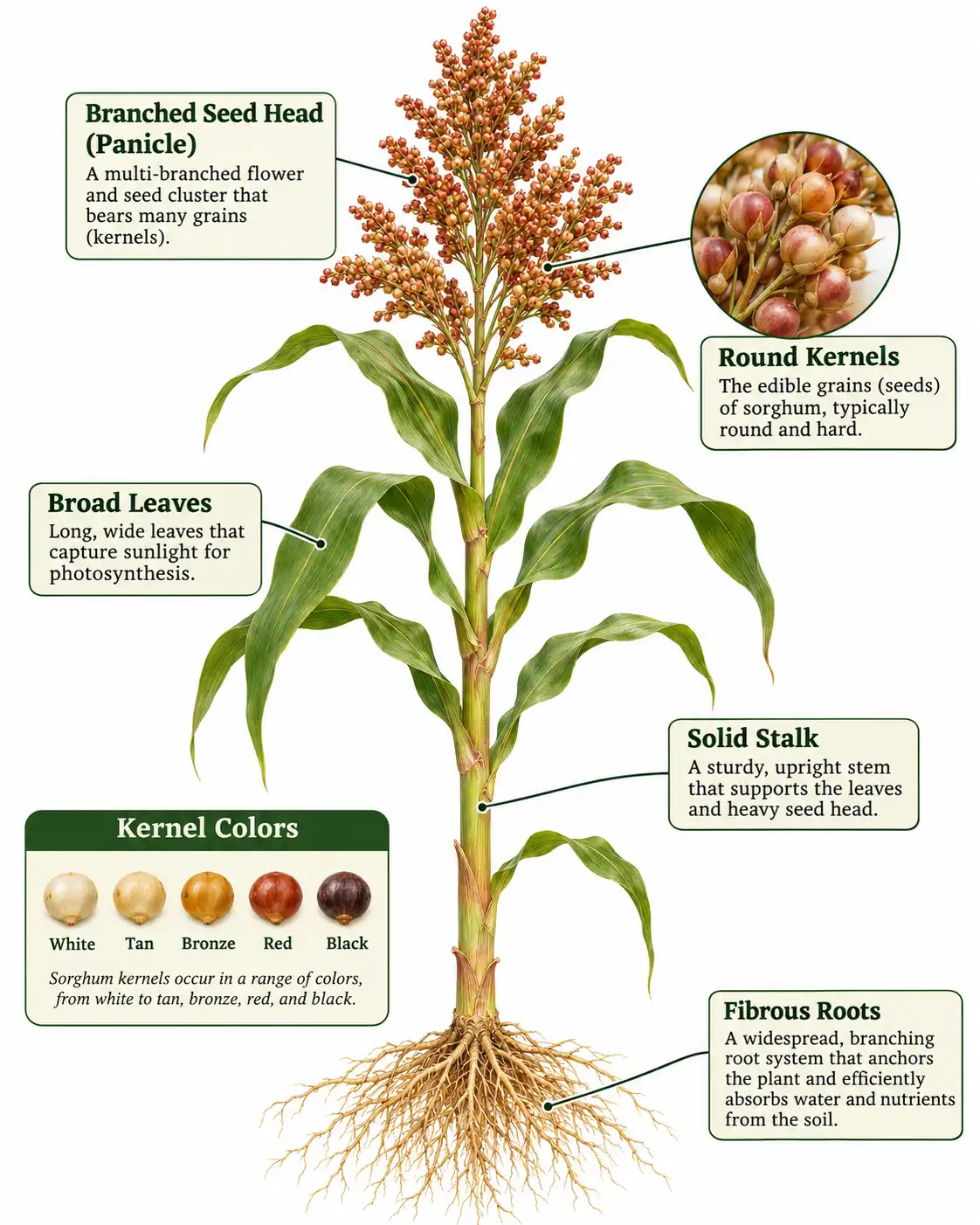
At first glance, a young sorghum field looks a lot like corn. The leaves are broad, and the stalk is solid. However, the grain forms in a different place. Instead of ears on the side of the stalk, sorghum carries a branched seed head, called a panicle, at the very top. Each head holds hundreds of small, round kernels.
Kernel color varies by type. You will find white, cream, yellow, red, bronze, brown, and even black grain.
Sorghum is also built for heat. Like corn, it uses C4 photosynthesis, which runs efficiently in hot, bright weather. Its roots also spread wide and deep. On top of that, the plant can slow its growth during drought and pick back up when rain returns. That trait explains why sorghum fills dryland acres where corn often falls short.
Height depends on the type. Grain hybrids are bred short enough to combine. Forage and sweet sorghums, by contrast, grow far taller.
Where Does Sorghum Come From?
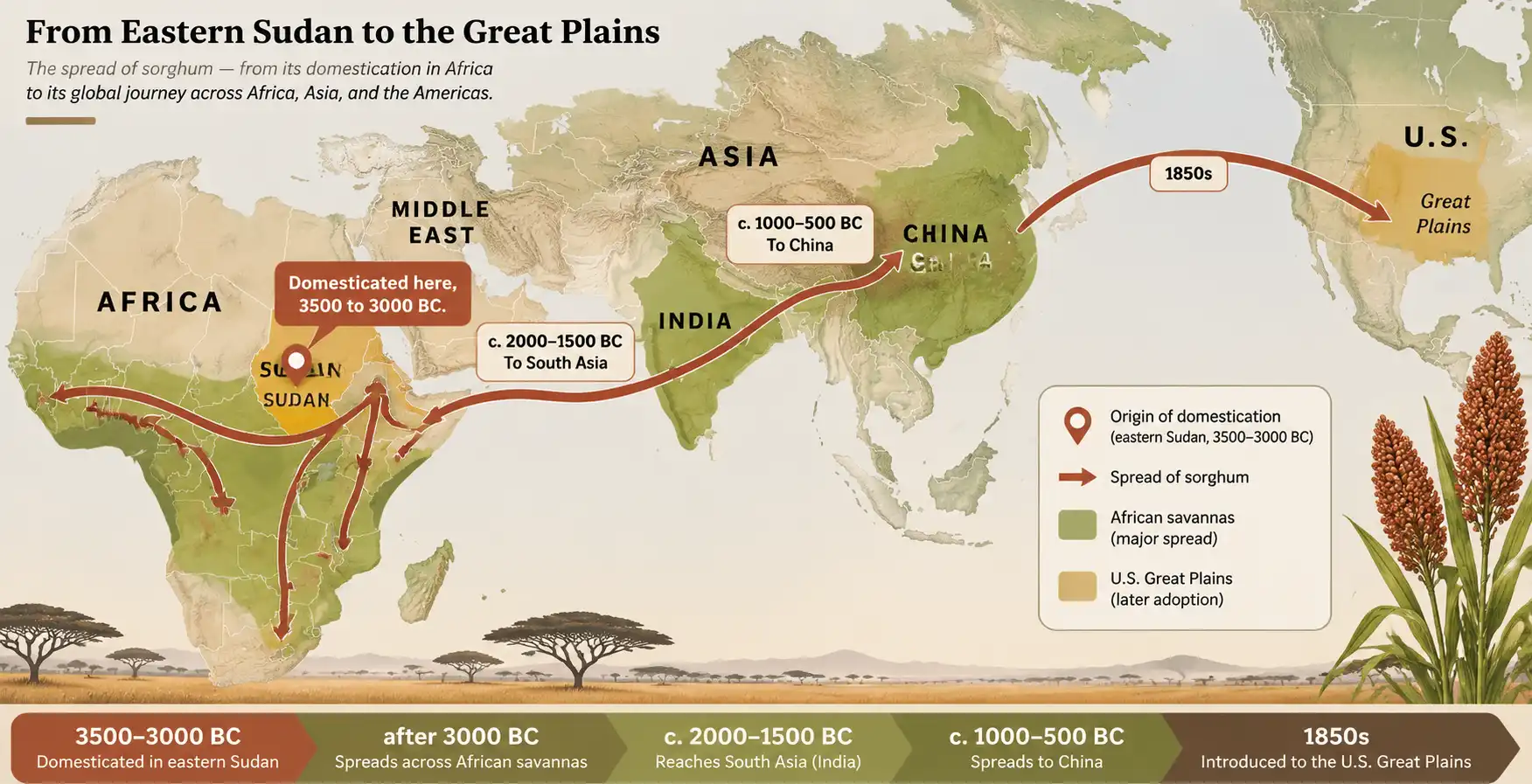
Sorghum comes from northeastern Africa. People domesticated it from wild grasses in what is now eastern Sudan, more than 5,000 years ago.
The strongest evidence sits in old pottery. A 2017 study in Current Anthropology examined plant prints pressed into clay pots from KG23, a Butana Group site near Kassala. The pots date to 3500 to 3000 BC. Some prints came from wild sorghum, while others showed domesticated traits.
So how can a print in clay reveal domestication? Wild sorghum sheds ripe grain on its own and leaves a smooth scar. Domesticated heads, by contrast, hold their grain until people thresh them. Threshing tears each grain loose and leaves a tiny stalk stub. The researchers found those stubs in the KG23 impressions.
From eastern Sudan, sorghum spread across Africa’s savannas. Later, trade carried it to India and China. Today it ranks among the world’s five most important cereals, a point the same study makes.
How Sorghum Reached the United States
Sweet sorghum arrived first. A historical K-State Agricultural Experiment Station bulletin records 16 sugar-type varieties brought into the country in 1857. Growers crushed the stalks and boiled the juice into syrup.
Grain sorghum came later in the 1800s. That same bulletin names brown and white durra as the first grain types to take hold. Then kafir and milo followed, and both found a home on the dry southern Plains.
The milo name stuck. Many Plains growers still use it for all grain sorghum, even though it began as the name of one type. Today the two names overlap almost completely, so the milo versus sorghum question comes down to history rather than botany.
Is Sorghum Wheat?
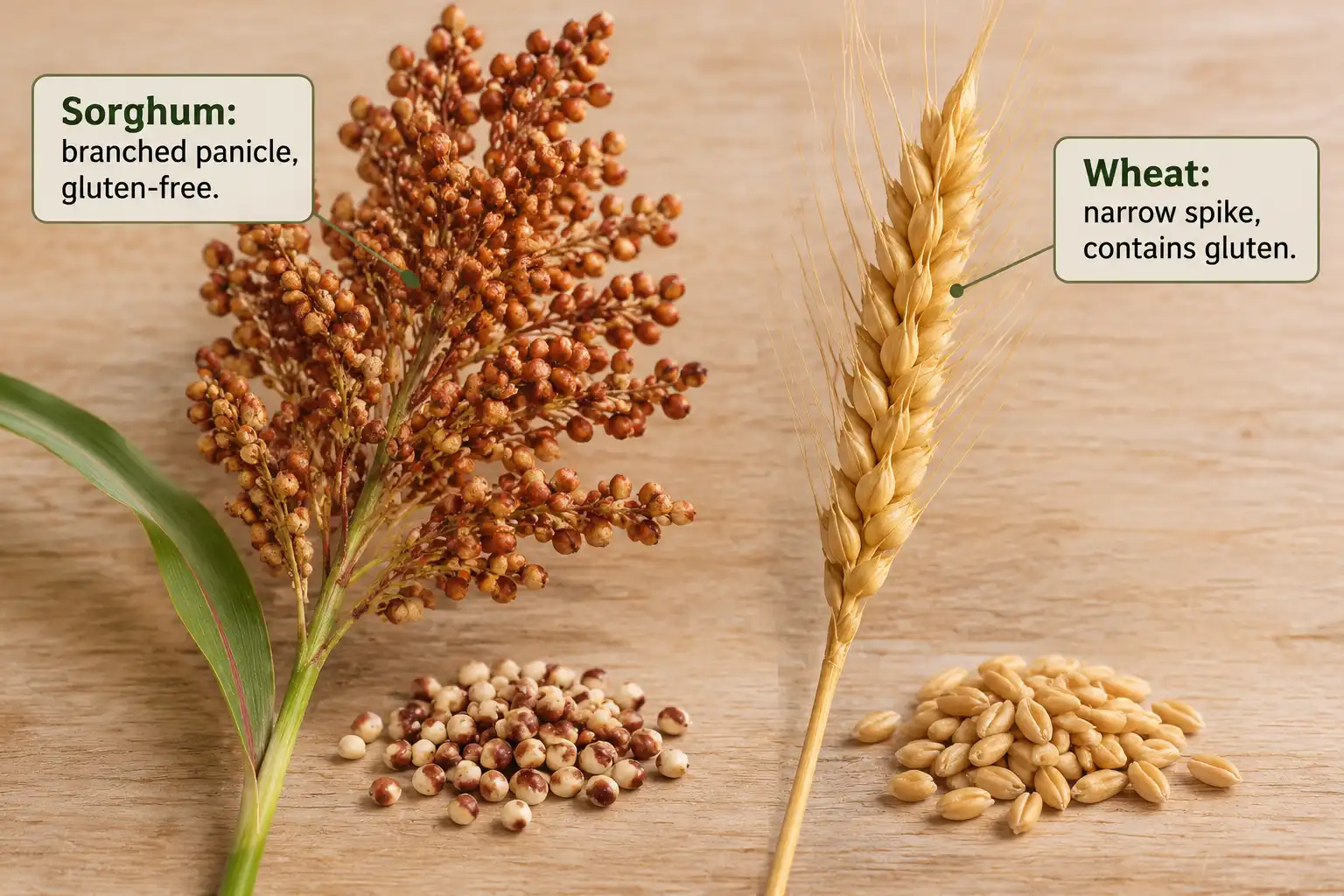
No. Sorghum and wheat are both cereal grasses. However, they sit on different branches of the grass family and grow in opposite seasons.
Botanically, sorghum belongs to the Panicoideae subfamily with corn and sugarcane. Wheat belongs to the Pooideae subfamily with barley and rye. In other words, sorghum is a much closer relative of corn than of wheat.
The seasons differ, too. Sorghum is a warm-season crop, and K-State Research and Extension ties fast, even emergence to a 70°F soil temperature. Winter wheat, by contrast, goes in the ground in fall and grows through cool weather. In short, wheat’s cool-season growing cycle runs nearly opposite to sorghum’s.
Is Sorghum Gluten-Free?
Yes. For eaters, gluten is the biggest difference from wheat. USDA ARS describes sorghum as lacking gluten, the proteins found in wheat and its close relatives, rye and barley. As a result, ARS considers sorghum safe for people with celiac disease. Still, look for a certified gluten-free label, because mills that also handle wheat can contaminate sorghum flour.
Sorghum vs. Wheat at a Glance
Nutrient values in the table come from USDA FoodData Central entries for raw sorghum grain and raw hard red winter wheat.
| Trait | Sorghum | Wheat |
|---|---|---|
| Grass subfamily | Panicoideae, with corn and sugarcane | Pooideae, with barley and rye |
| Photosynthesis | C4, suited to heat | C3, suited to cool weather |
| U.S. growing season | Late spring to fall | Fall to early summer (winter wheat) |
| Grain head | Branched panicle | Narrow spike |
| Gluten | None | Present |
| Protein per 100 g of raw grain | 10.6 g | 12.6 g (hard red winter) |
| Fiber per 100 g of raw grain | 6.7 g | 12.2 g (hard red winter) |
| Main U.S. use | Livestock feed, ethanol, export | Flour for human food |
So sorghum carries a bit less protein and about half the fiber of whole hard red winter wheat. Its food advantage is the missing gluten, not a nutrient edge.
The Main Types of Sorghum
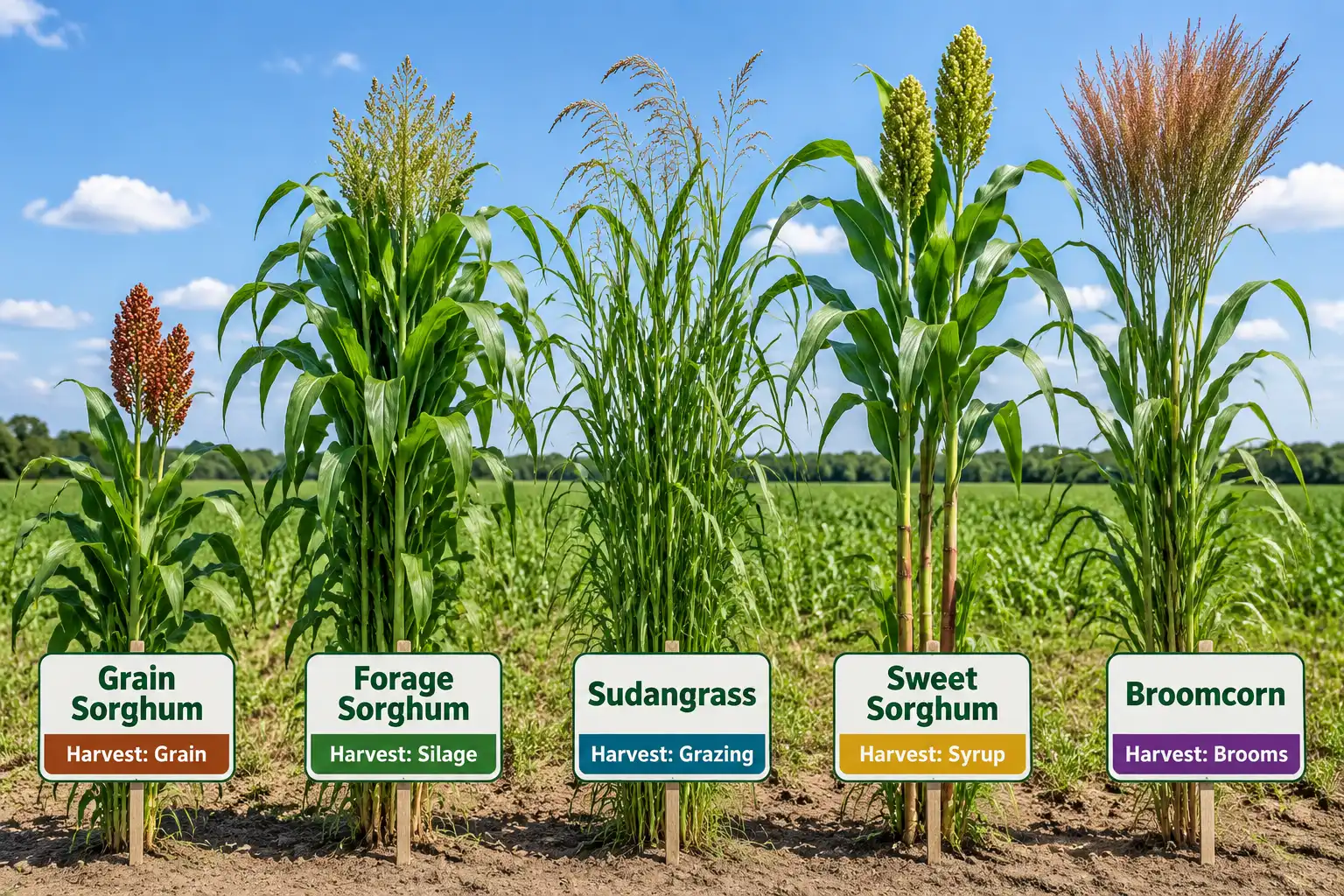
Sorghum falls into five main types, sorted by what the grower harvests from the plant.
| Type | Harvested for | What sets it apart |
|---|---|---|
| Grain sorghum (milo) | Seed for feed, food, and ethanol | Short hybrids bred for combine harvest |
| Forage sorghum | Silage | Tall, leafy plants cut once for bulk |
| Sudangrass and sorghum-sudangrass | Grazing, hay, green chop | Thin stems that regrow after each cutting |
| Sweet sorghum (sorgo) | Syrup | Juicy stalks rich in sugar |
| Broomcorn | Brooms | Long, stiff fibers in the seed head |
Within grain sorghum, food-grade hybrids form their own group. USDA ARS identifies them by their tan plants and white kernels, and these are the hybrids milled into gluten-free flour. Meanwhile, specialty black-grained lines such as Onyx black sorghum target health-food markets.
Two weedy relatives also matter. Johnsongrass and shattercane are wild sorghums that compete in crop fields. K-State Research and Extension names crop rotation as the most effective control for both.
What Is Sorghum Used For?
In the U.S., most grain sorghum goes to livestock feed, ethanol plants, and export markets. Smaller amounts become food, syrup, forage, and brooms.
- Livestock feed. Ground or steam-flaked grain goes into rations for cattle, hogs, and poultry.
- Ethanol. Distilleries ferment sorghum grain much like corn.
- Export. A large share of each U.S. crop ships overseas as whole grain.
- Food. Whole grain, flour, popped sorghum, and breakfast cereals all reach store shelves.
- Syrup. Producers cook sweet sorghum juice down into syrup. Some regions call it sorghum molasses, although true molasses is a byproduct of sugar refining.
- Forage. Silage, hay, and summer grazing carry many cattle operations through hot months.
- Brooms. Broomcorn heads still go into natural-fiber brooms.
Because one plant fills so many roles, the type you plant decides the use. For example, a grain hybrid makes poor syrup, and sweet sorghum makes a poor grain crop.
Where Sorghum Grows in the U.S.
Most U.S. sorghum grows in the Great Plains, and Kansas and Texas lead by a wide margin.
USDA NASS put the 2025 grain crop at 437 million bushels. Farmers harvested 6.02 million acres and averaged 72.6 bushels per acre. Of that total, Kansas grew 252 million bushels and Texas about 101 million. Together, the two states produced roughly four of every five bushels.
The 2026 crop is far smaller. In its October 2026 Crop Production report, NASS forecast 291 million bushels at 55.7 bushels per acre. That is about a third less grain than in 2025.
| State | 2025 production (million bu) | 2026 forecast, Oct. 1 (million bu) |
|---|---|---|
| Kansas | 252.0 | 159.3 |
| Texas | 100.7 | 79.9 |
| Colorado | 26.0 | 13.1 |
| Oklahoma | 23.5 | 13.3 |
| Nebraska | 17.8 | 14.0 |
| South Dakota | 16.8 | 11.5 |
| United States | 436.8 | 291.1 |
Why the Plains? Sorghum’s drought tolerance fits dryland fields where rain is too short or too unreliable for corn. That climate fit shows up clearly in the states that grow the most sorghum.
How Sorghum Is Grown
Sorghum goes in during late spring, once the soil warms, and grows through summer heat. Harvest follows in fall, after the grain hardens and dries.
Planting
Warm soil comes first. K-State Research and Extension ties rapid germination and emergence to a 70°F soil temperature. If you plant too early into cold soil, emergence turns slow and uneven, and the stand thins.
Depth matters too. In a K-State depth study, 1.5 inches was the optimum seed placement, compared with 0.5 and 3 inches. Timing also changes the seeding rate. K-State advises raising it 15 to 20 percent when you plant after your area’s best window. Late sorghum makes fewer tillers, so it needs more plants to fill the row.
Plant Population by Rainfall
Beyond planting dates, rainfall sets the target stand. K-State’s Kansas Sorghum Management guide scales populations from dry western ground up to irrigated fields. The table translates each per-acre target to a 4 by 8 foot raised bed, which covers 32 square feet.
| Average annual rainfall | Target plants per acre (K-State) | Plants per 4 by 8 bed |
|---|---|---|
| Under 20 inches | 23,000 to 27,000 | 17 to 20 |
| 20 to 26 inches | 25,000 to 45,000 | 18 to 33 |
| 26 to 32 inches | 35,000 to 55,000 | 26 to 40 |
| Over 32 inches | 50,000 to 90,000 | 37 to 66 |
| Irrigated | 80,000 to 110,000 | 59 to 81 |
For a watered garden bed, the irrigated row applies. A plant every 8 inches in each direction gives 2.25 plants per square foot, or 72 plants in a 4 by 8 bed. That works out to about 98,000 plants per acre, inside K-State’s irrigated range.
Harvest
Sorghum grain reaches physiological maturity at black layer. At that stage, a dark spot forms where each kernel attaches to the head. Next, the grain dries in the field. According to K-State, moisture can drop from black layer to combine-ready in three to four weeks, at less than 1 percent per day. Late-planted fields dry more slowly, sometimes under 0.5 percent per day. From there, the cutting date depends on your target moisture and storage plans, both covered under sorghum harvest timing.
Is Sorghum Safe for Livestock to Graze?
Mature, healthy sorghum makes good feed. However, young plants and frost-damaged regrowth can hold prussic acid, a cyanide compound that can kill cattle quickly.
Nebraska Extension ranks forage sorghum and grain sorghum as the highest-risk types. Sorghum-sudangrass carries less risk, and sudangrass the least, though none is risk-free. Also, heavy nitrogen fertilizer raises the danger further.
Nebraska Extension’s grazing guidelines:
- Wait until sorghum and sorghum-sudangrass reach 24 inches tall before grazing.
- Wait until sudangrass reaches 18 inches tall.
- Pull cattle off when frost is in the forecast.
- After a killing frost, wait seven days before grazing again.
Above all, frost is the main trap. Freezing damages plant cells, and compounds inside them then combine to form cyanide. If plants sit near those height limits, Nebraska Extension describes a quick in-field test. Your county extension office can help you read the result.
FAQs
Is milo the same as sorghum?
Yes, milo is a common name for grain sorghum, especially in the Great Plains. It started as the name of one imported grain type and now covers grain sorghum broadly.
Is sorghum a grain or a grass?
It is both. Sorghum is a grass whose seed is a cereal grain, in the same way that wheat, corn, rice, and barley are grasses that farmers grow for grain.
What does sorghum taste like?
Whole sorghum has a mild, slightly nutty flavor, a description USDA ARS researchers also use. Cooked whole grains turn pleasantly chewy, and the flour bakes into breads, waffles, and cookies.
Is sorghum the same as sugarcane?
No. Sweet sorghum and sugarcane both yield sweet stalk juice, but sorghum is an annual grown from seed, while sugarcane is a perennial tropical grass in a separate genus, Saccharum.
How much does a bushel of sorghum weigh?
Grain sorghum trades at 56 pounds per bushel. K-State Research and Extension builds that weight into its in-field yield estimate, and it matches the standard bushel weight for shelled corn.
Does sorghum need less water than corn?
Generally, yes. Sorghum’s extensive roots and its ability to pause growth in drought let it produce grain on dryland fields where corn often struggles, which is why it fits the drier western Plains.
Key Points for Your Field
Sorghum is a warm-season grass from northeastern Africa, not a kind of wheat. Its gluten-free grain sits closer to corn in the plant family. Choose the type by what you plan to harvest: grain, silage, grazing, syrup, or broom straw.
Then plant into 70°F soil and set the stand by your rainfall. If cattle will graze it, keep them off short or frosted regrowth. For hybrids suited to your county, start with your state extension service’s sorghum variety trials.


