When to Harvest Sorghum: Grain Moisture and Maturity Signs

Knowing when to harvest sorghum means checking grain maturity and moisture rather than relying on stalk color. Harvesting too early reduces grain quality, while excessive field drying increases the risk of bird damage, lodging, and weather-related losses.
To decide when to harvest sorghum, confirm black layer formation and measure grain moisture. Combine at approximately 17% to 20% moisture if you can dry the grain promptly. Without drying equipment, aim for about 13% moisture.
When to Harvest Sorghum Grain
Grain sorghum is ready for harvest after physiological maturity, once moisture falls to a level suitable for combining and handling.
According to K-State Research and Extension, sorghum reaches physiological maturity when a black layer forms at the kernel base. Grain moisture is usually around 30% at this stage.
However, physiological maturity does not mean the grain is dry enough to combine efficiently.
The University of Georgia Extension identifies approximately 20% moisture as a favorable harvest target when mechanical drying is available.
| Growth stage or condition | Grain moisture | Harvest decision |
|---|---|---|
| Soft dough | Usually too wet | Wait for grain filling to finish |
| Hard dough | Still drying and developing | Check for black layer |
| Physiological maturity | Around 25% to 35% | Begin regular moisture checks |
| Combining with a dryer | Approximately 17% to 20% | Harvest and dry promptly |
| Harvesting without a dryer | Around 13% | Harvest when sufficiently dry |
Harvesting grain above 25% moisture can cause poor threshing and cracked kernels.
Waiting for extremely dry grain also has costs. Heads remain exposed to birds, storms, and lodging, while overly dry kernels may crack during combining.
How to Tell When Sorghum Is Ready to Harvest
Three checks provide a reliable harvest decision: kernel maturity, grain hardness, and measured moisture.
1. Look for the black layer
Remove several kernels from different grain heads. Examine the bottom of each kernel, where it attaches to the head.
A small dark brown or black layer indicates that grain filling has ended.
Check kernels from the lower portions of the heads, not just their tops. Sorghum generally matures from the top of the head downward.
2. Check kernel firmness
Press a kernel between your fingernails.
Immature grain feels soft or doughy. Mature grain becomes firm and difficult to dent.
Kernel color alone is unreliable because sorghum varieties may produce white, cream, bronze, or red grain.
3. Measure moisture content
Collect grain from several representative locations, including later-maturing sections. Test the combined sample using a moisture meter suitable for sorghum.
Repeat measurements as harvest approaches, particularly after rainfall.
A hard kernel confirms advanced maturity, but a moisture reading determines whether the grain is ready for combining, drying, or storage.

What Month Is Sorghum Usually Harvested?
In the United States, grain sorghum harvest commonly occurs from summer through late fall, depending on planting date, region, and hybrid maturity.
The University of Georgia Extension’s row-crop planting guide lists approximately 100 to 120 days to maturity for grain sorghum in Georgia. Other hybrids and growing conditions can produce different schedules.
The following regional windows are broad planning guides, not fixed harvesting dates.
| Growing region | General harvest period | Main consideration |
|---|---|---|
| Southern Texas and Gulf Coast | Summer into fall | Early planting permits earlier harvest |
| Lower Mississippi Valley and Southeast | Late summer through fall | Rainfall and humidity can slow drying |
| Kansas and central Great Plains | September through November | Hybrid maturity and autumn temperatures |
| Northern Great Plains | Mostly fall | Early frost and slower grain drying |
The USDA National Agricultural Statistics Service publishes weekly crop progress reports showing actual sorghum harvesting activity by state.
For individual fields, monitor the hybrid’s flowering date and the grain’s maturity stage. Calendar dates alone cannot confirm readiness.
How Long After Black Layer Should You Harvest?
Harvest timing after black layer depends mainly on drying weather and the moisture target.
K-State reports that sorghum often requires several weeks to dry from physiological maturity to commercial harvest moisture.
Dry-down generally proceeds faster during warm, dry, breezy weather. Cool temperatures and high humidity slow moisture loss.
K-State’s field research near Manhattan, Kansas, reported an average dry-down rate around 0.7 percentage points per day under its study conditions. Late-planted and stressed crops may dry at less than 0.5 percentage points daily.
These rates are observations, not dependable daily forecasts.
Start checking grain moisture regularly when black layer forms. Increase checking frequency as moisture approaches your chosen harvest target.
If rainfall or high winds threaten a mature crop, compare expected field losses with available mechanical drying capacity.
How to Harvest Sorghum With a Combine
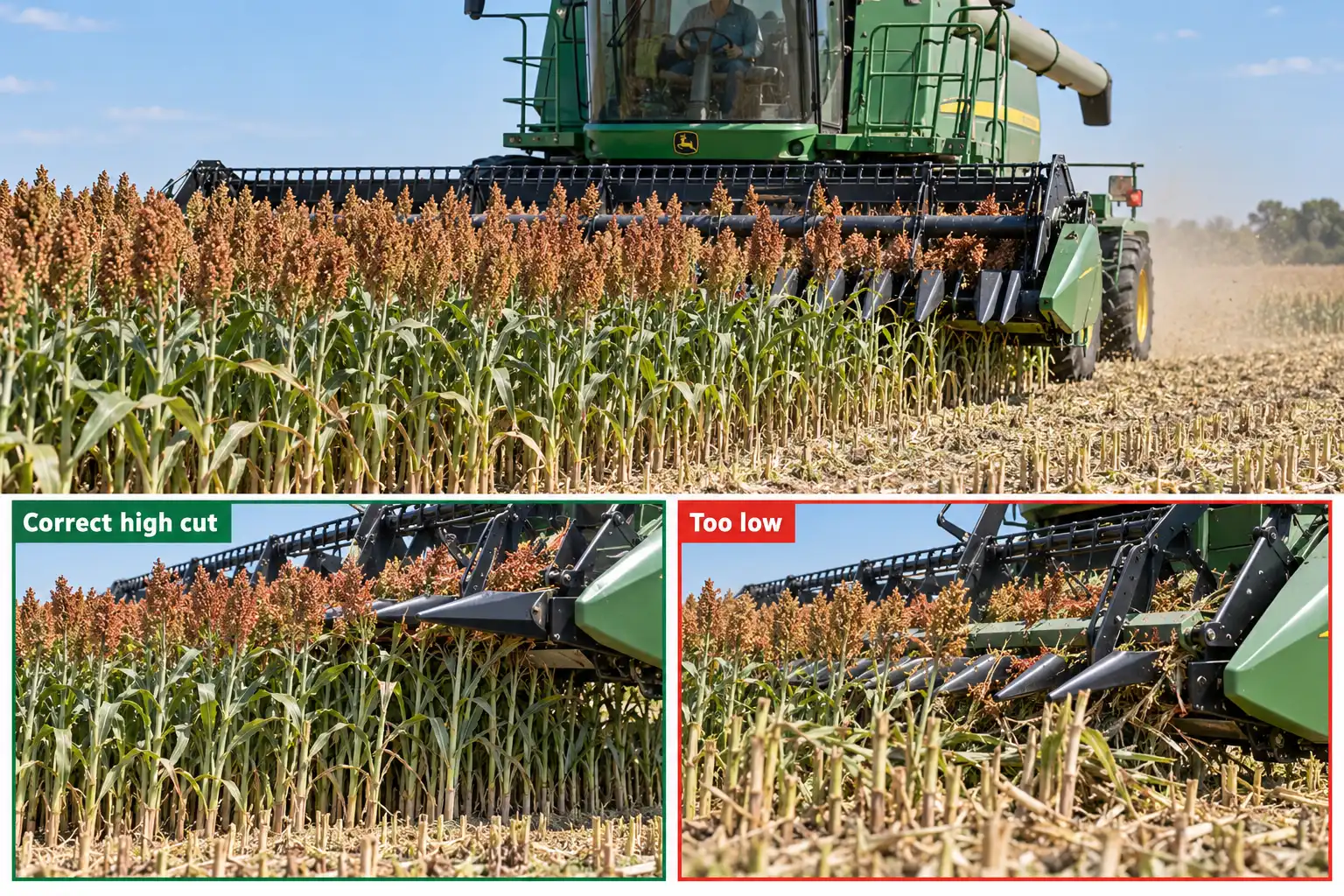
A properly adjusted combine can harvest mature grain sorghum using a rigid grain platform or compatible row-crop header.
Step 1: Set the header high
Position the cutterbar to remove the grain heads while collecting as little stalk and leaf material as possible.
Sorghum stalks may remain green and moist after the grain matures. Excess stalk material increases cleaning and drying difficulties.
Step 2: Adjust operating speed
University of Georgia Extension reports relatively low header losses at approximately 2.5 to 3 mph under suitable conditions.
Start conservatively, then adjust according to crop density and grain loss.
If using a reel, its peripheral speed should generally be slightly greater than the combine’s forward speed.
Step 3: Adjust threshing and cleaning
Set the concave and cylinder or rotor according to the combine manufacturer’s sorghum recommendations.
For conventional cylinder combines, UGA provides an approximate starting clearance of 1/2 inch at the front and 3/16 inch at the rear. Rotary combines require different settings.
Inspect the grain tank and material exiting the machine.
Step 4: Check losses
Stop periodically and examine the ground behind the combine.
Look for dropped heads, loose kernels, unthreshed grain, and cracked kernels.
Reduce forward speed or adjust the cleaning system if grain is being discharged with the chaff.
How to Harvest Sorghum by Hand
Small sorghum plots can be harvested manually once the kernels are mature and sufficiently dry.
The Food and Agriculture Organization describes hand harvesting by cutting mature sorghum heads with a sickle or similar cutting tool, followed by drying and threshing.
For a garden or small plot:
- Select mature heads. Check black layer, kernel hardness, and grain moisture before cutting.
- Cut the seed heads. Use clean pruning shears or a sharp sickle, leaving a short section of stem attached.
- Collect carefully. Place heads in breathable containers without crushing them or dropping grain.
- Dry the heads. Spread them in a thin layer on clean screens under a rainproof, well-ventilated shelter.
- Thresh the grain. Once dry, rub or gently beat the heads to separate the kernels.
- Remove chaff. Use a suitable screen or controlled airflow, then check grain moisture before storage.
Avoid leaving wet heads in closed bags or thick piles. Trapped moisture encourages heating and fungal growth.
For a small quantity intended for food, keep the grain separate from treated seed and questionable or moldy heads.
How to Harvest Forage Sorghum and Sweet Sorghum
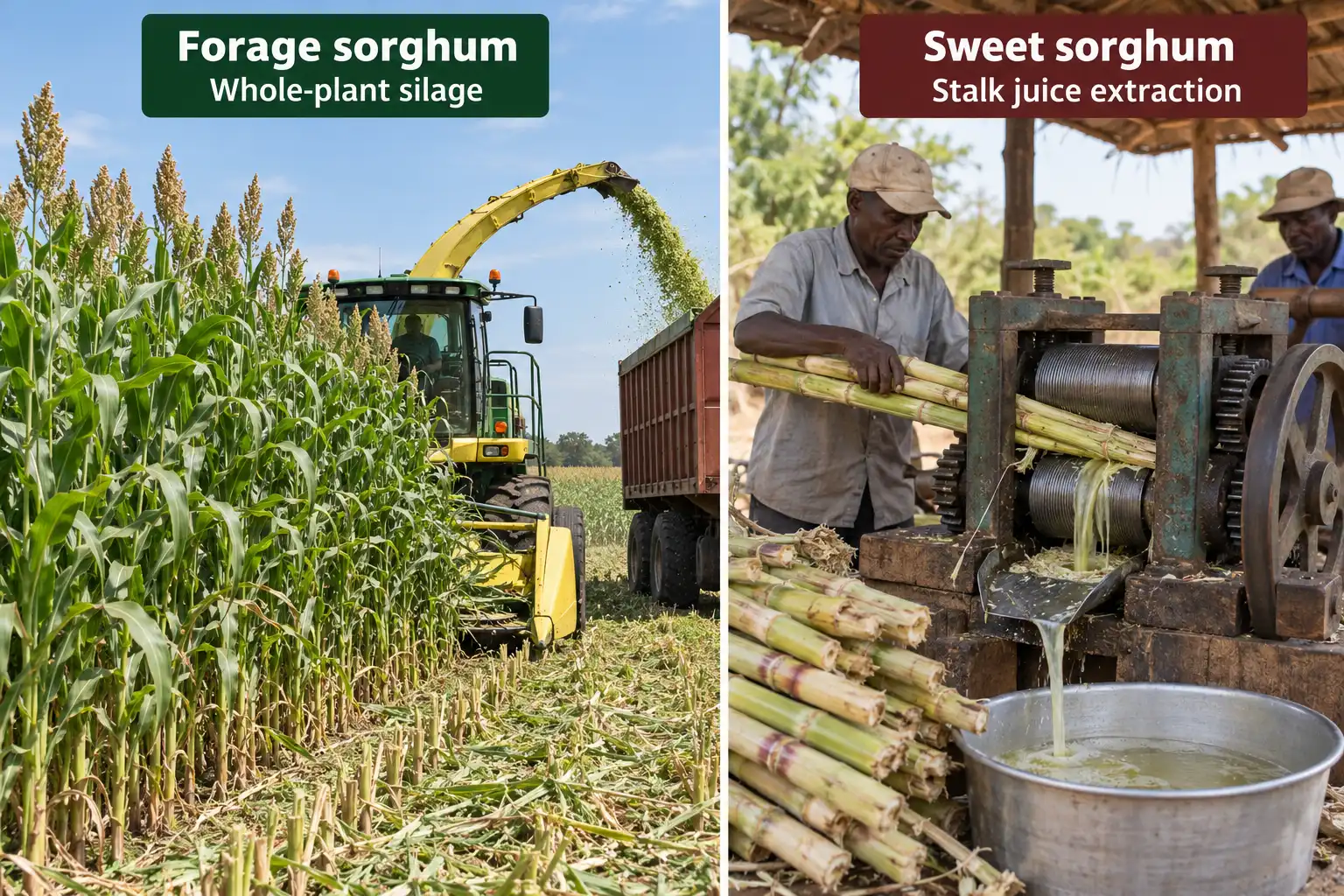
Grain, forage, and sweet sorghum require different harvesting methods because the usable portions of the plants differ.
| Sorghum type | Harvest stage | Harvested material |
|---|---|---|
| Grain sorghum | Mature, sufficiently dry kernels | Grain heads |
| Forage sorghum for silage | Usually soft dough, at suitable whole-plant moisture | Stems, leaves, and heads |
| Sweet sorghum for syrup | Usually near soft dough | Sugar-rich stalks |
Forage sorghum for silage
The UF/IFAS Extension recommends harvesting grain or forage sorghum for silage at approximately 65% to 70% whole-plant moisture, commonly around the soft-dough stage.
Use a forage harvester to chop the plants, then pack and seal the material according to the silage storage system.
Measure whole-plant moisture rather than grain moisture.
Frost and drought-stressed sorghum may accumulate prussic acid or nitrates. Arrange appropriate forage testing before feeding questionable material.
Sweet sorghum for syrup
Penn State Extension recommends harvesting sweet sorghum near the soft-dough stage, often around 120 days after planting.
Use a Brix meter to assess juice sugar concentration.
Harvest the stalks, remove unsuitable leafy and head material, and press the stalks promptly. Delayed processing can reduce juice quality.
How to Dry and Store Sorghum After Harvest
Harvested grain must be dried to a safe storage moisture level before prolonged storage.
University of Georgia Extension recommends drying sorghum below 12% moisture when it will be stored for approximately 12 months.
For shorter storage, around 12% to 13% is a conservative target, although safe moisture depends on grain temperature, storage duration, and conditions.
High-moisture grain needs immediate attention. UGA warns that sorghum near 25% moisture at grain temperatures of 80°F to 90°F should begin drying within approximately four hours.
After drying:
- Remove excess chaff, broken stalks, and fines.
- Cool the grain before extended storage.
- Use clean, dry bins with suitable aeration.
- Monitor for heating, condensation, insects, and mold.
- Keep stored grain protected from water intrusion.
Sorghum offers greater resistance to airflow than corn. Therefore, drying equipment designed for corn may need adjustments to grain depth, fan capacity, or airflow.
Never enter a grain bin with flowing grain or an unstable grain surface.
How Much Weight Does Sorghum Lose During Drying?
Moisture removal reduces harvested grain weight, even when the grain’s dry matter stays unchanged.
For example, consider 1,000 lb of sorghum harvested at 20% moisture and dried to 13%.
Dry matter:
1,000 × 0.80 = 800 lb
Final grain weight:
800 ÷ 0.87 = approximately 920 lb
The grain loses about 80 lb of water during drying. This calculation excludes additional handling losses.
For a small field section, area conversion also helps estimate harvest volume.
A 100-foot row section with 30-inch row spacing represents:
100 × 2.5 ÷ 43,560 = 0.00574 acre
At an illustrative yield of 70 bushels per acre, that row section represents approximately 0.40 bushel. Using the standard 56 lb sorghum bushel, that equals about 22.5 lb before harvest losses.
Actual field yield may differ substantially.
Common Sorghum Harvesting Problems
Most harvest losses come from incorrect timing, mechanical damage, or unfavorable field conditions.
| Problem | Possible cause | Recommended action |
|---|---|---|
| Grain heads remain unthreshed | Grain too wet or insufficient threshing | Check moisture and adjust threshing |
| Cracked kernels | Excessive cylinder or rotor speed | Reduce threshing intensity |
| Grain scattered behind combine | Header or cleaning losses | Adjust reel, fan, sieves, and speed |
| Large amounts of stalk material | Header cutting too low | Raise the header |
| Plants lodging before harvest | Wind, stalk weakness, or disease | Prioritize damaged areas |
| Grain sprouting in heads | Prolonged wet weather | Harvest mature grain when drying is available |
| Grain heating in storage | Excess moisture or poor aeration | Dry, cool, and inspect promptly |
Diseased or moldy grain should be separated and assessed before storage or use. General symptoms and prevention measures are discussed in common crop diseases.
Do not assume that drying makes moldy grain safe for food or animal feed.
FAQs About Sorghum Harvesting Guide
Can you harvest sorghum while the stalks are still green?
Yes. Grain sorghum stalks can remain green after kernels reach physiological maturity and suitable harvest moisture. Check the grain itself and keep the combine header high to reduce the amount of wet stalk material entering the machine.
Should you wait until frost to harvest sorghum?
No. Grain sorghum does not require frost before harvest, and a killing freeze before physiological maturity can stop grain filling. Harvest mature grain according to moisture readings, available drying capacity, and expected weather conditions.
Can sorghum be harvested after rainfall?
Yes, provided the field supports safe equipment operation and the grain is suitable for combining. Measure moisture again because wet weather can increase surface moisture, slow drying, and raise the risk of sprouting or spoilage.
Can you harvest sorghum with a corn header?
Some row-crop headers can harvest sorghum when compatible gathering components and adjustments are available. A grain platform is another common option, but equipment suitability depends on row spacing, crop height, lodging, and the manufacturer’s instructions.
Why are sorghum grains falling from the heads before harvest?
Kernel shattering can increase as mature heads remain exposed to drying weather, storms, and mechanical disturbance. If grain moisture permits harvesting, reduce further delays and examine header adjustments to limit additional field losses.
Can grain sorghum be harvested for seed?
Yes, but seed production requires greater attention to maturity, gentle threshing, and controlled drying temperatures. University of Georgia Extension recommends keeping drying temperatures at or below 110°F for seed sorghum to help protect germination.
Key Points for Your Sorghum Harvest
Start monitoring once black layer forms. For grain sorghum, target approximately 17% to 20% moisture when mechanical drying is available, and about 13% if drying equipment is unavailable.
Keep stalk material out of the combine, check losses during harvesting, and dry grain promptly. For silage or syrup, follow the separate maturity and moisture requirements for those products.