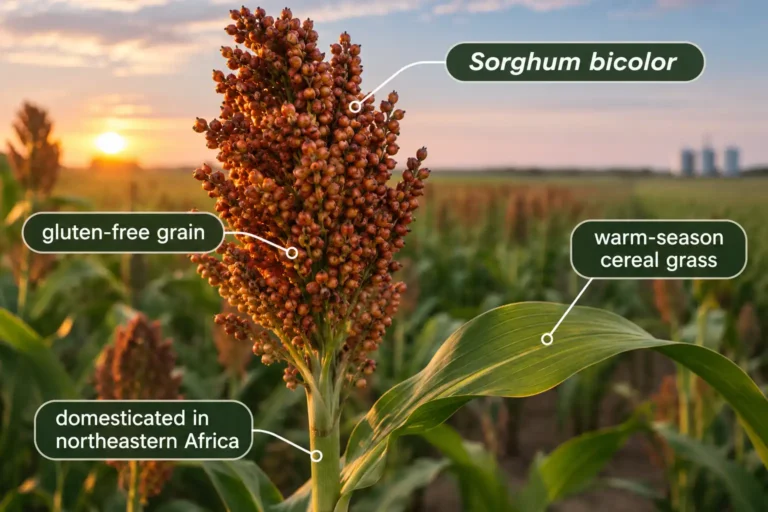
What Does Sorghum Look Like? Heads, Height, and Corn Differences
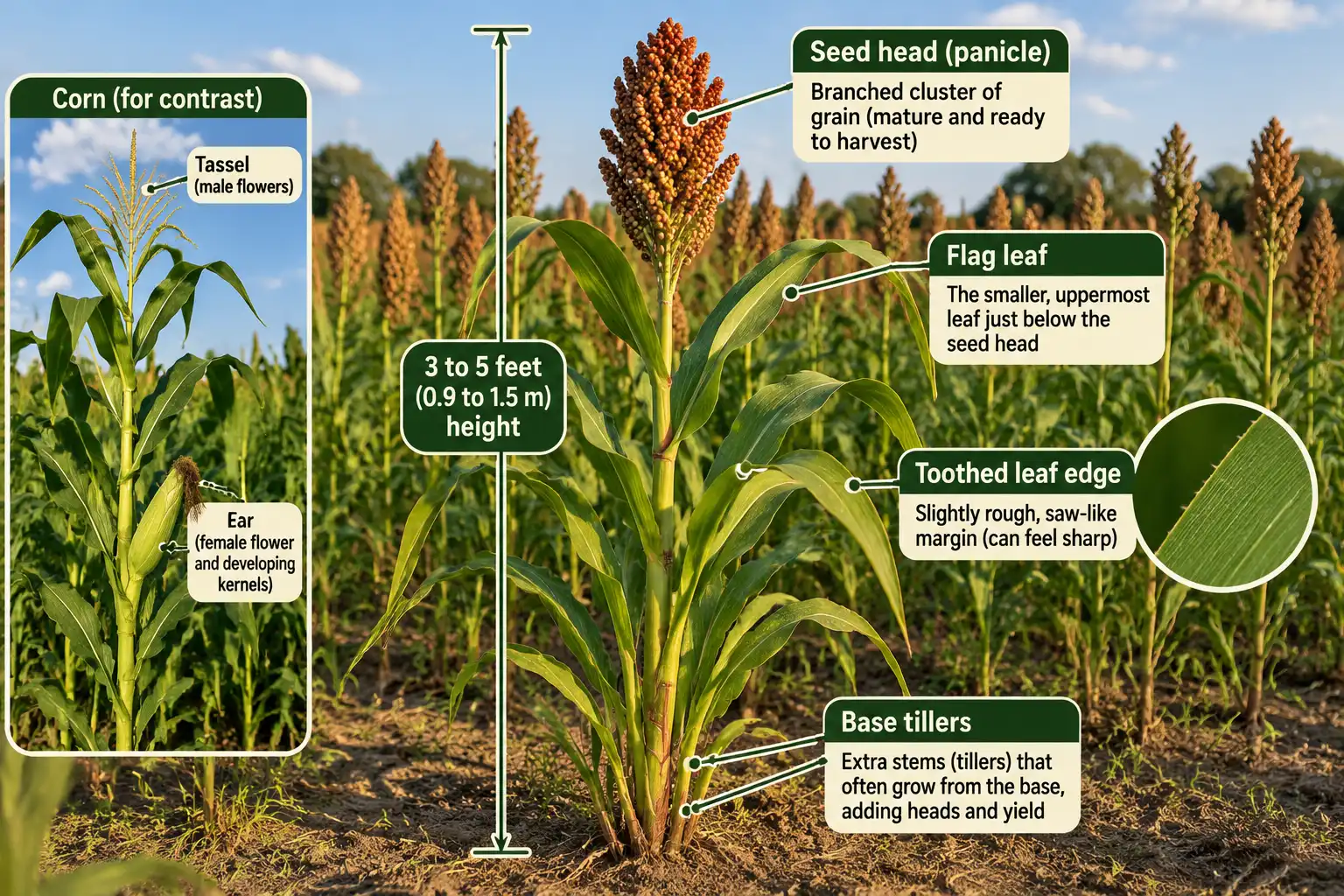
Close enough to fool most people until the seed heads appear. Height, head shape, and grain color all change by type, and two weedy relatives grow in the same fields.
Sorghum is a leafy grass with a cornlike stalk, toothed leaf edges, and one grain head on top instead of ears. Grain types stand 3 to 5 feet tall. Sweet and forage types can top 15 feet.
What Does a Sorghum Plant Look Like?
A sorghum plant looks like a leaner, leafier corn plant with a single seed head at the top. Grain sorghum, often called milo, the same crop under another name, is the short type grown for grain.
Stalk and Leaves
The stalk is solid and jointed, with one leaf at each node. UF/IFAS Extension puts stalk thickness at 0.5 to 1.5 inches. Each leaf sheath wraps the stalk and stiffens it, per Texas A&M AgriLife Extension.
Leaf count depends on maturity. Texas A&M AgriLife reports about 15 leaves on early hybrids, 17 on medium, and 19 on late ones. Still, a mature plant shows fewer, because the lowest leaves die and drop as it grows. The last leaf, the flag leaf, is noticeably smaller than the rest.
The edges are the giveaway. USDA NRCS describes sorghum leaves as wide and glossy with toothed margins, so a finger run along the edge feels scratchy. Midrib color varies too. For example, brown midrib (BMR) forage hybrids, a trait UF/IFAS lists among hybrid options, carry a brownish center vein.
Tillers and Roots
Extra stalks from the base are normal. USDA NRCS notes that basal tillering is common, and each tiller can carry its own head.
Brace roots are a weaker clue, because the sources split. UF/IFAS says prop roots often grow from the lower nodes, while the USDA NRCS identification guide lists them as lacking. In practice, a few short roots above the soil neither confirm nor rule out sorghum.
What Does a Sorghum Head Look Like?
A sorghum head is a branched cluster of grain called a panicle. It sits atop the stalk and emerges from the flag leaf sheath after boot, per Texas A&M AgriLife.
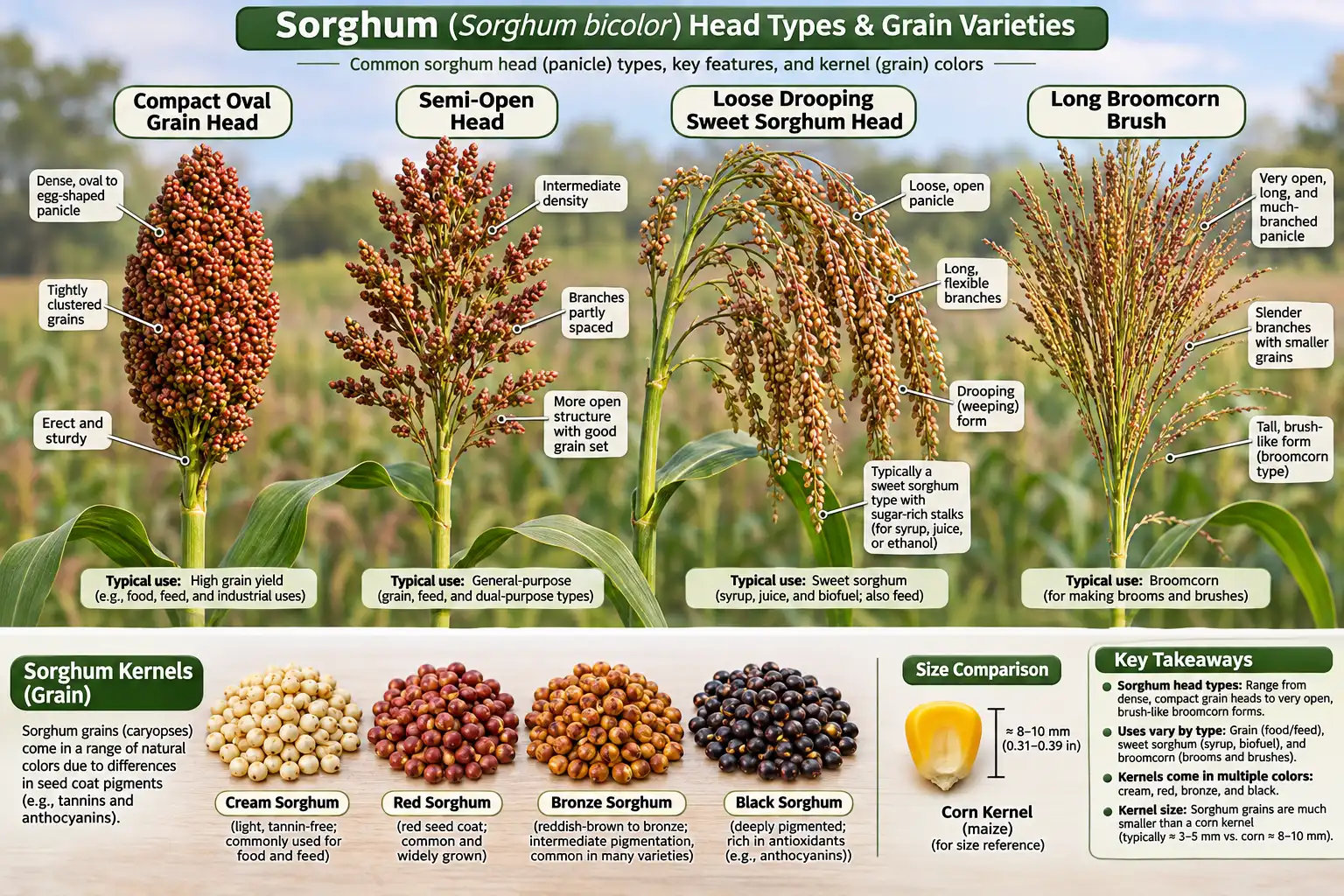
Shape runs from tight, oval clusters to loose sprays with drooping branches. Broomcorn sits at the far end, with long, stiff head branches grown for brooms. Before the head emerges, it shows only as a swollen bulge in the top leaf sheath.
Unlike corn, the head carries both male and female flower parts. UF/IFAS Extension notes that sorghum seed forms by self-pollination inside that single panicle. So there is no tassel and no silk to look for.
How Much Grain Is in One Head?
K-State Research and Extension counts 100 to 5,000 seeds per head, though most heads hold 1,500 to 2,500. K-State also puts grain sorghum at roughly 17,300 to 18,500 seeds per pound.
That makes a head easy to size at garden scale. A typical head of 1,500 to 2,500 seeds holds about 1.3 to 2.3 ounces of grain. As a result, a dozen good heads yield roughly 1 to 1.7 pounds.
What Color Is Sorghum Grain?
Sorghum grain comes in white, cream, yellow, red, bronze, brown, and even black. UF/IFAS Extension describes the seeds as small and round, in white, yellow, brown, or red. Meanwhile, the 2025 Texas A&M AgriLife hybrid trials sort grain into red, bronze, and cream classes.
Food-grade hybrids look different from feed types. Texas A&M AgriLife describes them as white or cream grain inside straw-colored glumes (the papery hulls), on tan plants. By contrast, most hybrids in the 2025 Texas trials carry a purple plant color rating.
At the dark end, Texas A&M bred the black-grained Onyx hybrid, whose bran gets its color from anthocyanins.
How Tall Does Sorghum Grow?
Most grain sorghum grows 3 to 5 feet tall, while forage and sweet types commonly reach 6 to 15 feet or more. Type sets the range first, and location moves a hybrid within it.
| Sorghum type | Typical mature height | Reported by |
|---|---|---|
| Grain sorghum (milo) | 3 to 5 ft | UF/IFAS Extension |
| Grain sorghum, 2025 Texas trials | 34 to 57 in | Texas A&M AgriLife |
| Sudangrass | 3 to 8 ft; 4 to 7 ft | Penn State Extension; USDA NRCS |
| Sorghum-sudangrass hybrid | Between sudangrass and forage sorghum | USDA NRCS |
| Forage sorghum | 6 to 15 ft; 5 to 14 ft | Penn State Extension; UF/IFAS |
| Sweet sorghum | Over 16 ft at the top end | UF/IFAS Extension |
Where two services publish different ranges, both appear above. For example, Penn State and UF/IFAS differ by about a foot at each end for forage sorghum. Read either range as a fair guide, not a hard limit.
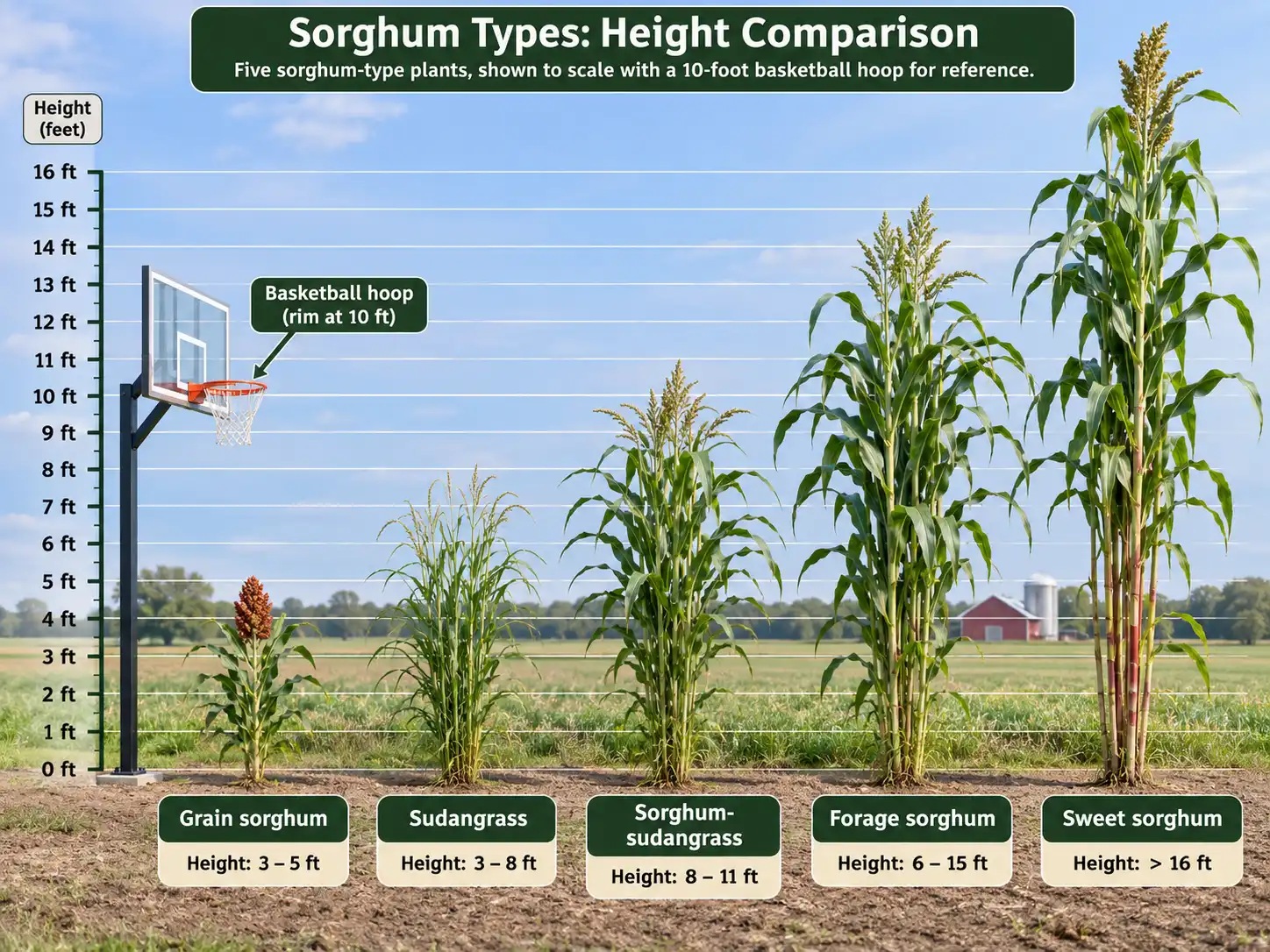
Location matters even within grain sorghum. In the 2025 Texas A&M AgriLife trials, hybrids at San Angelo averaged 37 inches. By contrast, the Rosenberg and Hillsboro sites both averaged 53 inches. Texas A&M also notes that taller hybrids generally carry higher yield potential but need more management.
For scale, a 4-foot grain hybrid reaches about waist to chest height on an adult. Meanwhile, a 15-foot forage stand clears a 10-foot basketball rim by 5 feet.
What Sorghum Looks Like at Each Growth Stage
K-State Research and Extension divides sorghum growth into 10 stages, from emergence (stage 0) to physiological maturity (stage 9). Each one has a marker you can spot in the field.
| Stage | Name | What you see | K-State marker |
|---|---|---|---|
| 0 | Emergence | Shoot breaks the soil; growth is slow | Depends on soil temperature and moisture |
| 1 | Three-leaf | Three leaves with visible collars | 10 to 20 days after emergence |
| 2 | Five-leaf | Five collared leaves; growing point still below ground | 20 to 25 days after emergence |
| 3 | Growing point differentiation | Little outward change; the growing point switches from leaves to the head | Leaf number set 30 to 40 days after emergence |
| 4 | Flag leaf visible | Final, smaller leaf shows in the whorl | About 20% of total growth done |
| 5 | Boot | Head near full size, bulging inside the flag leaf sheath | 50 to 60 days after emergence |
| 6 | Half-bloom | Head fully out; half the plants in the field blooming | About 50% of total growth done |
| 7 | Soft dough | Kernels fill fast and squeeze out soft | Grain near 50% of final dry weight |
| 8 | Hard dough | Kernels resist squeezing | Grain near 75% of final dry weight |
| 9 | Physiological maturity | Dark black layer at the base of each kernel | Maximum dry weight |
Counting leaves gets harder as the season goes on. Texas A&M AgriLife notes that one to three lower leaves may already have died and dropped. That makes leaf stages easy to misjudge, so count collars on several plants, not one.
Once the black layer forms, the kernel has stopped filling. From there, sorghum harvest timing depends on how fast the grain dries down.
What Is the Crop That Looks Like Corn?
The crop most often mistaken for corn is sorghum. USDA NRCS notes that sorghum looks much like corn through the vegetative stage, and both go into rows in late spring. Sweet sorghum, forage sorghum, sudangrass, and broomcorn are all sorghums, so any of them can cause the same mix-up.
The confusion is most common where the two crops share ground, which covers much of sorghum’s main U.S. growing range. Once heads appear, though, the question settles itself.
| Trait | Sorghum | Corn |
|---|---|---|
| Where the grain forms | One panicle at the top of each stalk | Ears on the side of the stalk |
| Flowers | Male and female parts in the same head | Tassel on top, silks on the ear |
| Leaf edges | Toothed and scratchy | Mostly smooth |
| Tillers | Common at the base | Rarely tillers |
| Brace roots | Few or none | Short brace roots at the base |
| Seed size | About 17,300 to 18,500 seeds per pound | Several times larger |
| In-row seedling spacing in Texas | As close as 3 inches | About 6 inches |
USDA NRCS supplies the leaf edge, tiller, and brace root traits. Texas A&M AgriLife supplies the spacing and seed size comparison, and K-State supplies the sorghum seed count.
Corn, by contrast, splits its flowers. A tassel on top sheds pollen onto silks from the ear. Sweet corn shares that pattern with field corn grown for grain. So a plant with a tassel is corn, and a plant with one grain head on top is sorghum.
How to Tell Young Sorghum From Corn
Check the first leaf, the leaf edge, and the seed on the roots. Texas A&M AgriLife Extension uses those cues to separate the two crops long before either one heads out.
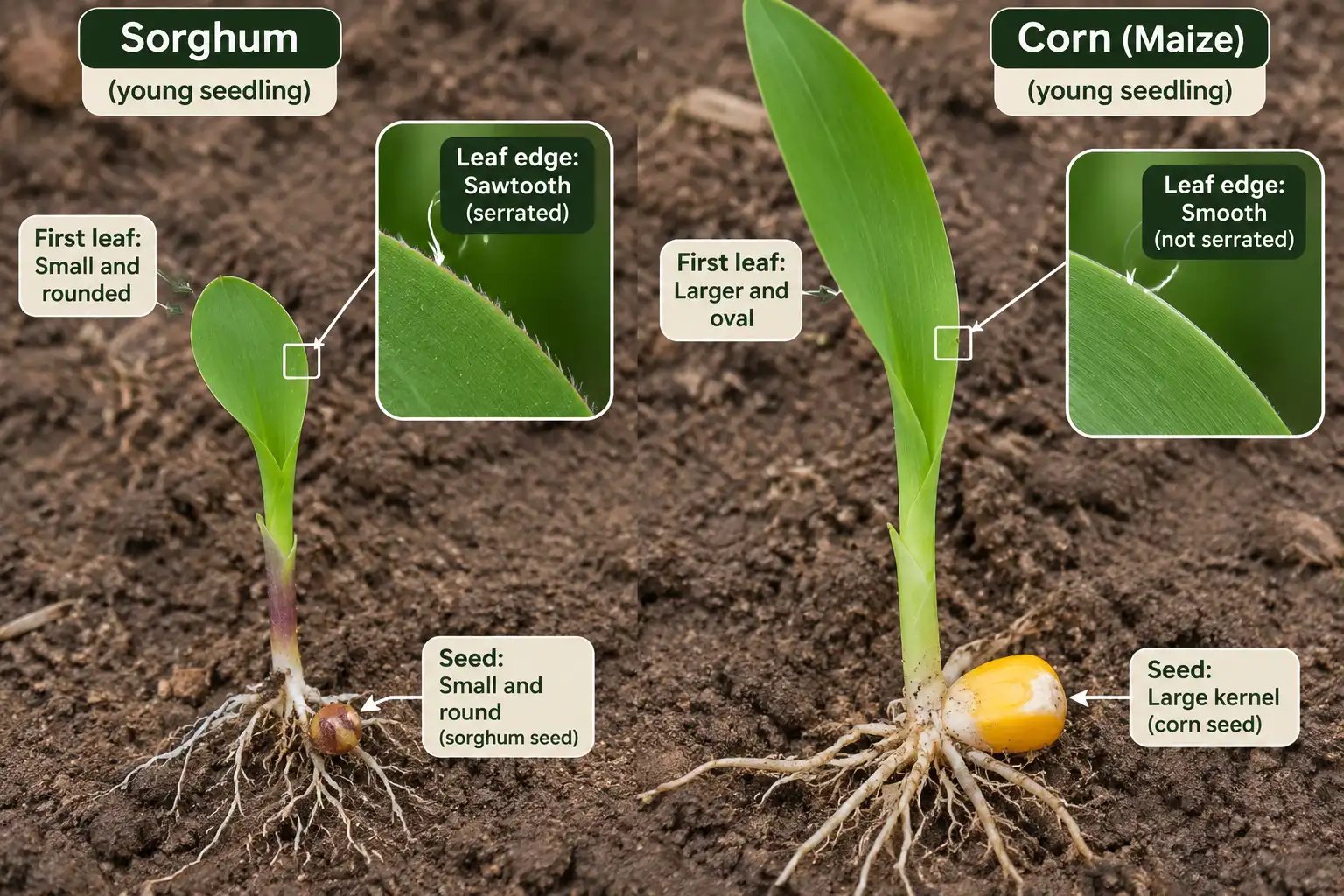
- Find the first leaf. Sorghum’s first leaf is small and rounded, tip included. Corn’s is two to four times larger and oval. A dead sorghum first leaf usually stays attached, so its shape still shows after about a month.
- Feel the leaf edge. Run a finger along the margin. Sorghum has a sawtooth edge that feels scratchy, and a hand lens shows the teeth. Corn edges feel mostly smooth.
- Dig up the seed. The original seed usually stays attached for a couple of months. Corn seed is several times larger than grain sorghum seed.
- Measure plant spacing. Sorghum seedlings can sit as close as 3 inches apart, while most Texas corn runs about 6 inches. In a 10-foot stretch of row, that works out to about 40 sorghum plants against 20 corn plants.
- Look for tillers. Most grain sorghum tillers from the base by about leaf stage 8, when plants stand 12 to 15 inches tall.
The leaf edge is the fastest test, because Texas A&M notes it holds true on every leaf at any age. However, weedy sorghum relatives pass several of these tests too. So a sorghum-like plant where none was planted needs one more check.
Johnsongrass and Shattercane: Sorghum’s Look-Alikes
Johnsongrass and shattercane are weedy sorghum relatives. Both can pass for a sorghum crop until you dig a plant or check the seed. Shattercane is the same species as grain sorghum, which is why it blends in so well.
| Trait | Shattercane | Johnsongrass |
|---|---|---|
| Species | Sorghum bicolor, weedy form | Sorghum halepense |
| Life cycle | Annual, no rhizomes | Perennial, spreads by rhizomes |
| Leaves | Up to 4 in wide; wavy and waxy | 7 to 24 in long, 0.25 to 1.25 in wide |
| Midrib | Small, v-shaped, narrow white midvein | Prominent white midrib |
| Seed head | Erect, partly open, fountain shaped, 4 to 20 in | Wide open, pyramid shaped, 4 to 20 in |
| Seed | Ovoid, usually black at maturity | Football shaped, dark red to black |
UC ANR supplies the head, seed, and shattercane leaf traits, while K-State supplies the johnsongrass leaf size.
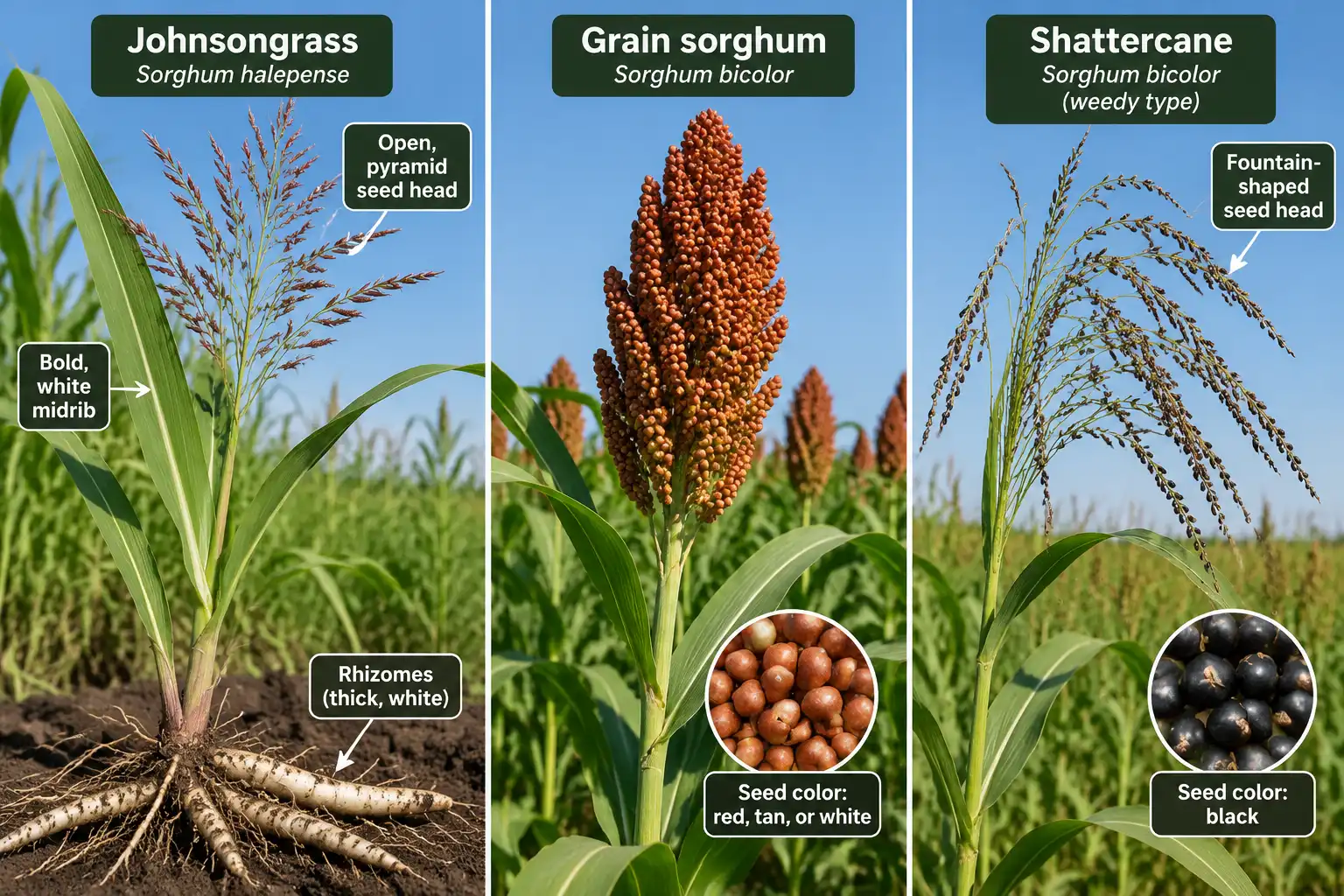
The surest test is underground. K-State Research and Extension advises digging plants, because rhizomes point to johnsongrass and shattercane never forms them. On seedlings, the attached seed helps too, since shattercane seed is rounder and less red. At maturity, shattercane drops its seed early, as the name suggests, while crop sorghum holds grain in the head.
FAQs About Sorghum Identification
Is sorghum the same as corn?
No, they are separate grass species, Sorghum bicolor and Zea mays. They look alike as seedlings, but sorghum grows one grain head on top, while corn grows ears along the stalk.
Does sorghum grow ears like corn?
No, sorghum never forms an ear or silks. All of its grain sits in one head at the top of each stalk or tiller, and that head self-pollinates, per UF/IFAS Extension.
What does sorghum look like when it is ready to harvest?
Ripe grain sorghum has hard kernels with a dark black layer at the base of each seed. Leaves can stay green past that point, because K-State marks maturity by the kernel, not the foliage.
How tall does sweet sorghum grow?
Sweet sorghum is among the tallest types, topping 16 feet at the high end, per UF/IFAS Extension. That is roughly three to five times the height of a 3 to 5 foot grain hybrid.
What does a sorghum seed look like?
A sorghum seed is a small, round kernel in white, yellow, brown, or red, per UF/IFAS Extension. At about 17,300 to 18,500 seeds per pound, according to K-State, it is far smaller than corn.
Does sorghum come back every year?
Grain, sweet, and forage sorghum grow as annuals in most of the U.S. A sorghum-like plant that returns each spring from underground runners is likely johnsongrass, which spreads by rhizomes, per K-State.
Key Points to Carry Into the Field
Look up first. One seed head on top and no ears means sorghum. Then look closer: toothed leaf edges, base tillers, and a small round seed on the roots confirm it in a young stand.
For height, expect 3 to 5 feet from grain hybrids and 6 feet or more from forage and sweet types. Finally, dig any sorghum-like plant growing where none was planted. Rhizomes mean johnsongrass, and that calls for a control plan, not a harvest plan.