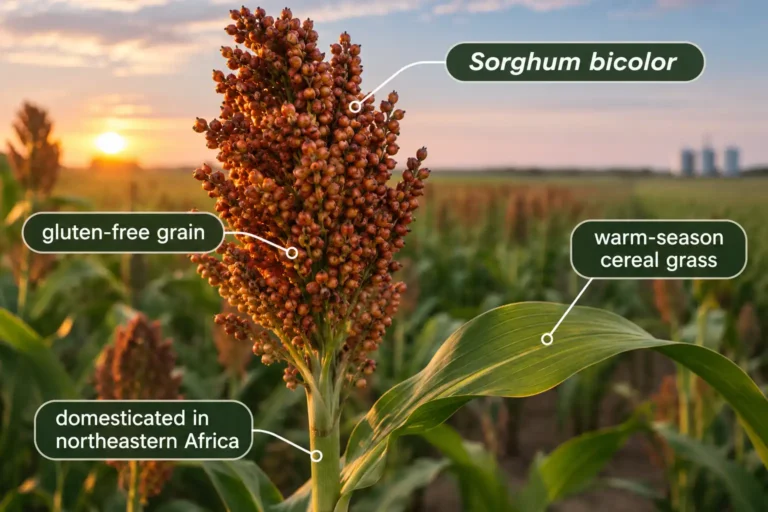
How to Grow Sorghum: Planting Dates, Seeding Rates, and Harvest
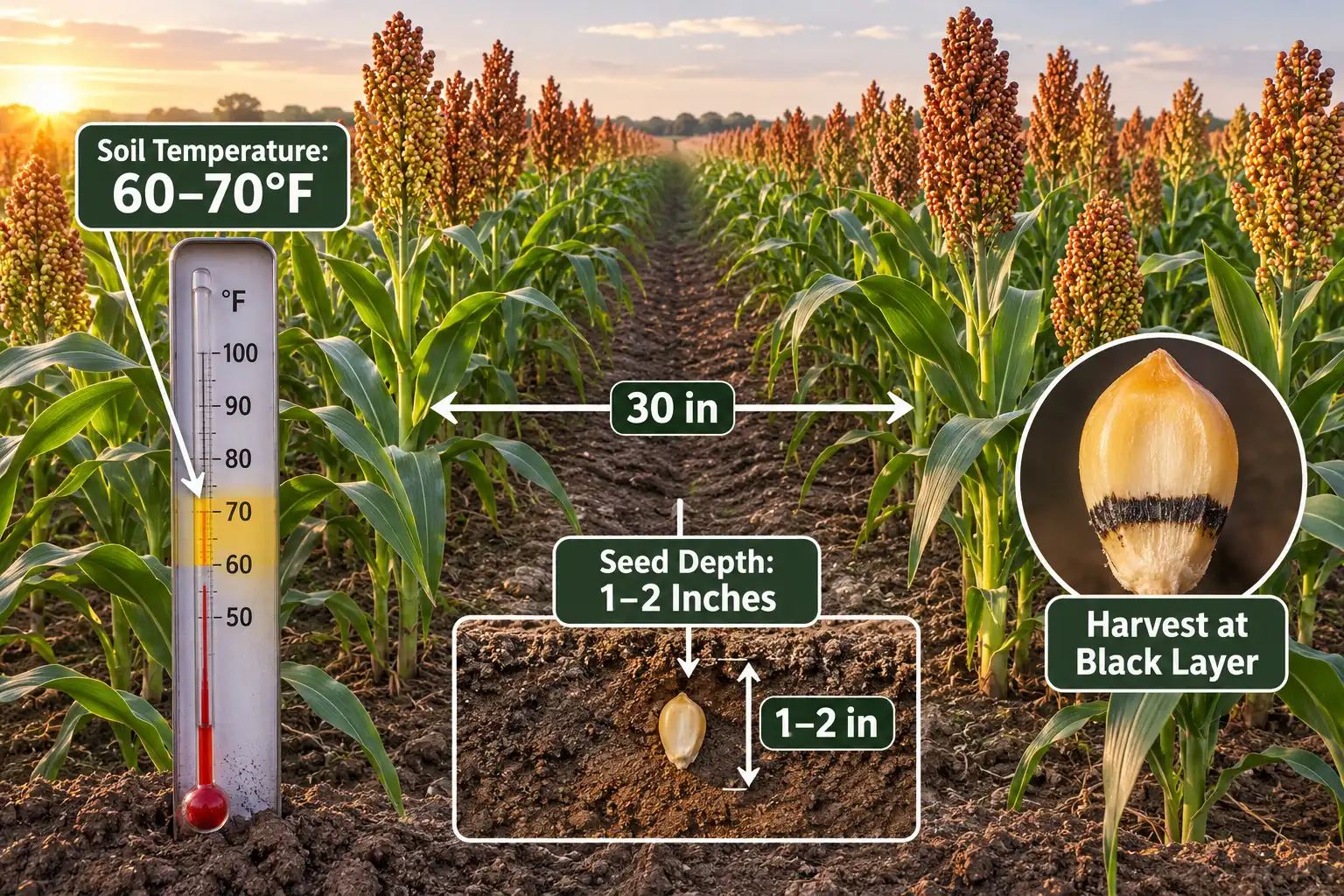
Learning how to grow sorghum comes down to matching planting date, plant population, and hybrid maturity to the water your field holds. Extension services publish the temperatures, rates, and thresholds. The figures here run from field scale down to a single raised bed.
To grow sorghum, plant 1 to 2 inches deep once soil reaches 60 to 70°F, at a seeding rate matched to your rainfall. Keep weeds out through the five-leaf stage, protect moisture at boot and flowering, and harvest after black layer.
Which Type of Sorghum Should You Grow?
Grow grain sorghum if you want a harvested seed crop. It is the type most growers mean when they say milo, and it covers most U.S. sorghum acres. Other types fit other jobs:
- Forage sorghum: tall, leafy hybrids chopped for silage.
- Sorghum-sudangrass: fine-stemmed crosses cut for hay or grazing.
- Sweet sorghum: juicy stalks pressed and cooked down for syrup.
- Specialty food grains: colored or high-tannin types grown under contract for food makers.
Black-grained Onyx sorghum, bred by Texas A&M AgriLife Research for the health food market, is one example of that last group. Forage and sweet types use different populations and harvest timing. So the rates that follow apply to grain sorghum.
Where Does Sorghum Grow Best?
Sorghum grows best where summers run hot and rainfall is uneven. That is why most U.S. acres sit in the Great Plains, and the leading sorghum states stretch from South Texas into Nebraska. USDA NASS put the 2025 U.S. grain crop at 437 million bushels. Growers harvested 6.02 million acres for grain and averaged 72.6 bushels per acre, up 11.3 bushels from 2024.
For a field or a garden spot, check three things first:
- Sun: full sun for most of the day.
- Drainage: no standing water a day after heavy rain.
- Rooting depth: deep, fine-textured soil stores more water for a dryland crop.
Then pull a soil test. K-State Research and Extension notes that grain sorghum is very efficient at using leftover nitrate in the soil profile. A 24-inch sample shows how much is there, and that number can trim your nitrogen bill.
When to Plant Sorghum
Plant sorghum when soil at seed depth stays at 60°F or warmer, and expect the fastest emergence near 70°F. The published floors differ slightly. Texas A&M AgriLife Extension puts the minimum for germination and emergence near 55°F at planting depth. Nebraska Extension gives 55 to 60°F. K-State adds that emergence is rapid at 70°F, while early planting into cold soil leaves slow, uneven stands. So treat 60°F as the practical floor.
The calendar matters at the other end, too. K-State advises timing planting so flowering misses the hottest, driest weeks of summer, yet the crop still matures before frost.
| Region | Typical planting window | Source |
|---|---|---|
| Rio Grande Valley, Texas | January to February | Texas A&M AgriLife |
| Central Texas | Mid to late March | Texas A&M AgriLife |
| Texas Low Rolling Plains | Late April to mid July | Texas A&M AgriLife |
| Texas High Plains | Late May to mid June | Texas A&M AgriLife |
| Kansas | May 15 to June 10 or June 20, by zone | K-State |
| Nebraska | Late May to early June | Nebraska Extension |
On the Texas High Plains, early May plantings often flower in July, the hottest month. For that reason, Texas A&M AgriLife suggests late May to mid June, which moves bloom away from peak heat.
How to Plant Sorghum
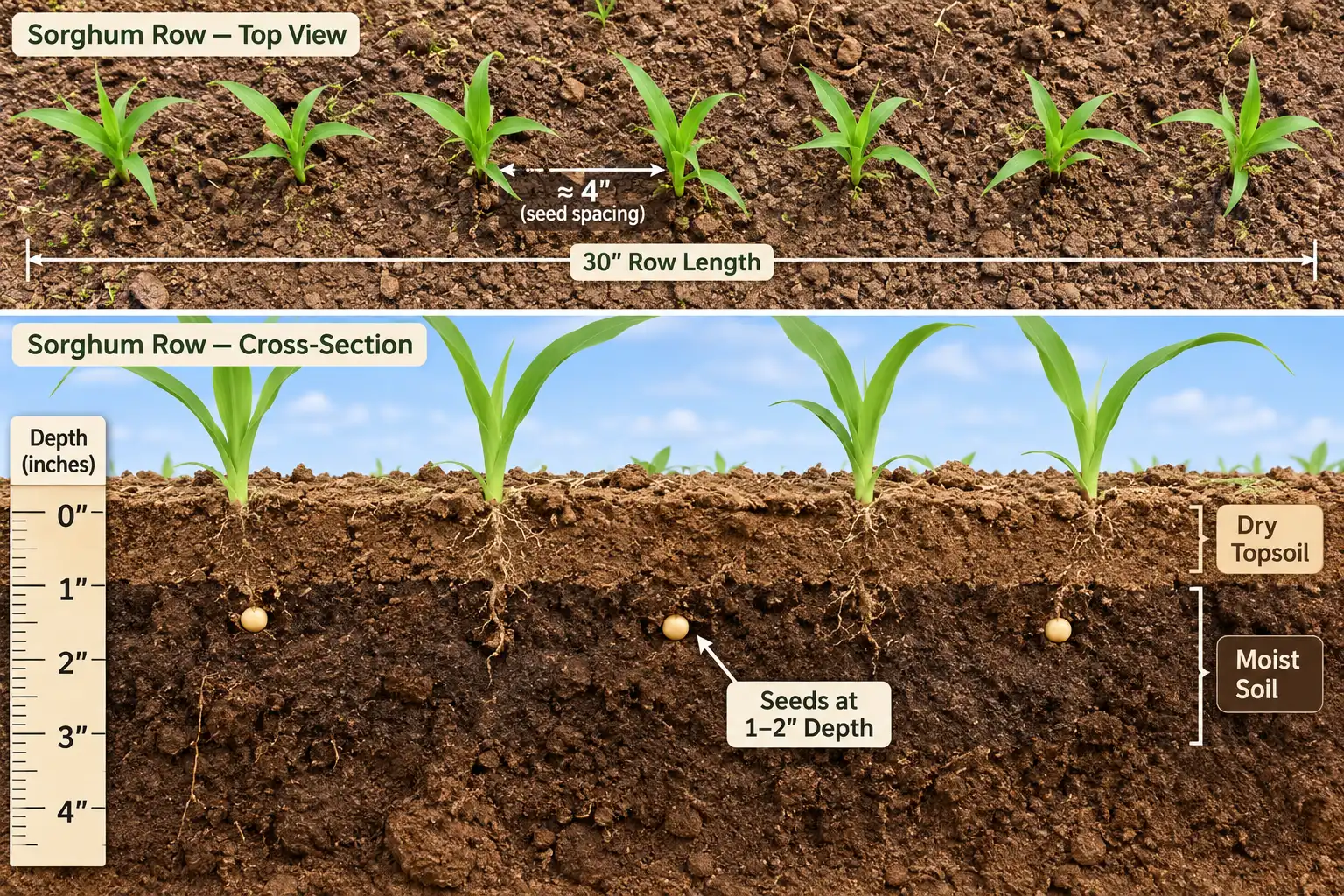
Plant sorghum seed 1 to 2 inches deep into firm, moist soil, the placement range K-State Research and Extension gives. Stay near 1 inch in warm, moist ground. Go deeper only to reach moisture, because the seedling still has to push all the way up.
- Start clean. Kill emerged weeds with tillage or a burndown first. Sorghum seedlings grow slowly, and Texas A&M AgriLife Extension warns that poor early weed control can seriously cut yield.
- Check soil temperature at seed depth. Read it in the early morning, when soil is coolest, for several days in a row.
- Calibrate by seed count. Texas A&M AgriLife tells growers to set planters for seeds per acre, not pounds, because seed size varies widely among hybrids.
- Place seed into uniform moisture. Even depth gives even emergence across the row.
- Close the furrow without packing it. Nebraska Extension advises against extra closing-wheel pressure in tacky soil, since it causes sidewall compaction.
- Count the stand at three-leaf. That stage arrives about 10 days after emergence, per K-State, while the growing point is still below ground.
Most fields use 30-inch rows, which match common corn and soybean equipment. K-State reports that narrow rows have not given consistent yield gains in its tests. Still, narrow rows shade the ground sooner, cut evaporation, and help suppress late-emerging weeds.
Sorghum Seeding Rate by Rainfall and Irrigation
Match the seeding rate to the water the crop will actually get. Extra plants on dry ground draw down soil moisture before grain fill. That is why Texas A&M AgriLife notes that a thinner stand on droughty ground carries less risk than a thick one.
K-State ties its rates to average annual rainfall in Kansas Sorghum Management:
| Annual rainfall | Target plants per acre | Seeds per acre | Seed spacing in 30-inch rows | Plants per 4×8 ft bed |
|---|---|---|---|---|
| Under 20 in | 23,000 to 27,000 | 30,000 to 35,000 | 6 to 7 in | 17 to 20 |
| 20 to 26 in | 25,000 to 45,000 | 35,000 to 64,000 | 3 to 6 in | 18 to 33 |
| 26 to 32 in | 35,000 to 55,000 | 50,000 to 80,000 | 3 to 4 in | 26 to 40 |
| Over 32 in | 50,000 to 90,000 | 70,000 to 125,000 | 2 to 3 in | 37 to 66 |
| Irrigated | 80,000 to 110,000 | 110,000 to 150,000 | 1 to 2 in | 59 to 81 |
K-State’s seed figures assume 70% emergence. We converted the bed column from its plant targets.
Texas A&M AgriLife sets rates by stored soil water at planting instead. In the Low Rolling Plains, dryland fields with over 4 inches of available soil water get 30,000 to 35,000 seeds per acre. With 2 to 4 inches, that drops to 25,000 to 30,000. Fully irrigated fields get about 80,000 seeds on June 1, rising to 100,000 to 110,000 for non-tillering hybrids planted in July.
The two services also expect different stands. K-State plans on 70% emergence. Texas A&M expects about 90% germination, with 80 to 90% of those seedlings establishing. It also suggests a slightly higher rate when establishment looks difficult. Planting late? K-State adds 15 to 20% past the suggested window, because late sorghum forms fewer tillers.
How to Convert Seeding Rates to Your Row or Bed
Divide seeds per acre by the feet of row in an acre. At 30-inch spacing, one acre holds 17,424 feet of row (43,560 square feet divided by 2.5 feet).
For example, 50,000 seeds per acre divided by 17,424 equals 2.9 seeds per foot. That works out to one seed about every 4 inches.
Next, convert seeds to pounds. Seed size swings widely, so pounds alone mislead. K-State’s How a Sorghum Plant Develops shows 4 pounds of seed delivering anywhere from 52,900 to 95,500 seeds per acre. So read the seeds-per-pound figure on the bag tag. At 15,000 seeds per pound, 50,000 seeds per acre takes 3.3 pounds.
For a raised bed, work in square feet. K-State’s irrigated target of 80,000 to 110,000 plants per acre equals 1.8 to 2.5 plants per square foot. In a watered 4 by 8 bed, that means two 8-foot rows thinned to about 3 inches apart, or roughly 64 plants. If the bed relies on rain in a humid region with over 32 inches a year, thin to 4 to 5 inches instead.
How to Choose a Sorghum Hybrid Maturity
Choose the longest maturity your water supply and frost date allow, and no longer. Texas A&M AgriLife lists the trade-off for Texas High Plains hybrids:
| Maturity class | Days to half bloom | Season water need |
|---|---|---|
| Early | 50 to 59 | 10 to 14 in |
| Medium-early | 60 to 65 | 14 to 16 in |
| Medium | 66 to 69 | 16 to 18 in |
| Medium-long | 70 or more | 18 to 20 in |
Then run a frost check. K-State’s growth guide puts half bloom at about two-thirds of the time from planting to physiological maturity. So multiply days to half bloom by 1.5 for a rough season length. A medium hybrid at 68 days needs about 102 days, which means a June 20 planting matures near September 30. Compare that date with your average first fall freeze.
For late plantings, K-State suggests a shorter-season hybrid. The cutoff falls in mid June for northwest and north central Kansas. It moves to late June in the south central and southwest, and to July in the east. Also check state hybrid trials for lodging scores and sugarcane aphid tolerance, not just yield.
How Much Fertilizer Does Sorghum Need?
Plan on about 1.2 pounds of nitrogen per bushel of expected yield, minus what the soil already supplies. Texas A&M AgriLife uses that rule of thumb, along with roughly 0.4 pound of P2O5 and 0.3 pound of K2O per bushel. It pairs those figures with a recent soil test.
After that, the services part ways on method:
- K-State divides the 1.2 pounds by a fertilizer efficiency factor: 0.55 for broadcast or fall-applied nitrogen, 0.65 for injected or split applications. It then subtracts profile nitrate, 20 pounds per 1% organic matter, and previous-crop credits.
- Nebraska Extension adds grain and fertilizer prices to its equation, so its rate shifts with the market. It also uses a separate equation when sorghum follows soybeans.
- Texas A&M AgriLife keeps the per-bushel rule simple and balances it against soil test levels.
Phosphorus and potassium follow your soil test results. K-State recommends no P2O5 once Mehlich-3 phosphorus tests above 20 ppm, and no K2O above 130 ppm. On very low soils, its rates run 45 to 65 pounds of P2O5 per acre. Potassium runs 75 to 100 pounds of K2O, and both rise with yield goal.
How to Calculate Your Sorghum Nitrogen Rate
Start from a realistic yield goal, then subtract every credit. Here is K-State’s nitrogen method for a 100-bushel goal with injected nitrogen after wheat:
- Crop need: 1.2 ÷ 0.65 × 100 = 185 pounds of N.
- Profile nitrate credit: 0.3 × 24-inch sample × 6 ppm = 43 pounds.
- Organic matter credit: 1.5% × 20 = 30 pounds.
- Previous crop credit: 0 pounds after wheat.
- Recommendation: 185 minus 43 minus 30 = about 111 pounds of N per acre.
After soybeans, subtract another 40 pounds for about 71. Even so, K-State recommends at least 30 pounds of N for early growth.
On a 4 by 8 raised bed, 111 pounds per acre equals about 1.3 ounces of actual nitrogen. That is roughly 2.8 ounces of urea (46-0-0). Per 100 square feet, use about 4.1 ounces of N, or 9 ounces of urea.
Timing counts as much as rate. K-State wants nitrogen available between the five-leaf and boot stages, with sidedressing done no later than shortly after five-leaf. On sandy soils, Nebraska Extension advises applying most nitrogen after plants reach 1 foot tall. Up to a third can go on at or before planting.
How Much Water Does Sorghum Need?
Most grain sorghum hybrids need 10 to 20 inches of water across the season, depending on maturity, per Texas A&M AgriLife. In the Low Rolling Plains, the same service estimates that 6 to 8 inches brings the crop to first grain. Each added inch then yields 350 to 425 pounds.
Run a Quick Water Budget
- Stored water: Texas A&M lists about 1 inch per foot of sandy soil, 1.5 inches for silt loams and clay loams, and 2 inches for clays.
- Total supply: 4 feet of moist silt loam holds 6 inches. Add 8 inches of expected in-season rain for 14 inches.
- Low estimate: (14 minus 8) × 350 = 2,100 pounds, or about 38 bushels at 56 pounds per bushel.
- High estimate: (14 minus 6) × 425 = 3,400 pounds, or about 61 bushels.
That 38 to 61 bushel range makes a realistic yield goal for the nitrogen math. On irrigated ground, estimating crop water needs from daily evapotranspiration gives a tighter number.
Timing matters more than the total. Texas A&M AgriLife names the 10 days from boot through flowering as the most sensitive window. Heat then can cut yield 54 to 87% even with adequate moisture, and pollen damage starts above about 97°F. So with limited irrigation, save water for growing point differentiation through half bloom. In a garden, 1 inch of water on a 4 by 8 bed is about 20 gallons.
How to Control Weeds in Sorghum
Keep sorghum weed-free from planting through the five-leaf stage, about 20 to 25 days after emergence. K-State Research and Extension marks that stretch as the time to minimize weed competition. After growing point differentiation, plants compete better on their own.
Start with a soil-applied grass herbicide. Group 15 products such as S-metolachlor, dimethenamid-P, and acetochlor require seed treated with Concep III safener, per K-State. So check the seed tag before you buy.
For postemergence passes, K-State advises spraying small weeds within 21 days after planting. Herbicide-tolerant traits widen the options:
- Inzen: allows Zest (nicosulfuron) over the top.
- igrowth: allows Imiflex (imazamox) before or after emergence.
- Double Team: allows FirstAct (quizalofop), which misses broadleaves and carries no label for johnsongrass or shattercane.
Never spray these products on sorghum that lacks the matching trait. Growth-regulator herbicides carry height limits, too. Texas A&M AgriLife allows 2,4-D only on plants 5 to 15 inches tall, with drop nozzles once plants pass 8 inches. Dicamba goes on before sorghum reaches 15 inches. Always follow the product label.
In a garden, hoe shallowly. K-State notes that the root system expands rapidly by the five-leaf stage, so deep cultivation cuts roots.
Sorghum Growth Stages and What to Do at Each
K-State’s 10-stage scale works as a field calendar. The days below come from a medium hybrid at Manhattan, Kansas, and K-State notes they shift with hybrid, planting date, and season.
| Stage | Name | Days after emergence | What to do |
|---|---|---|---|
| 0 | Emergence | 0 | Confirm an even stand |
| 1 | Three-leaf | 10 | Count plants; hail leaf loss rarely kills them |
| 2 | Five-leaf | 20 | Finish weed control and sidedress nitrogen |
| 3 | Growing point differentiation | 30 | Switch to drop nozzles; nutrient uptake peaks |
| 4 | Flag leaf visible | 40 | Keep water and nutrients steady |
| 5 | Boot | 50 | Guard against drought; head size is set |
| 6 | Half bloom | 60 | Scout for sorghum midge; heat risk peaks |
| 7 | Soft dough | 70 | Scout for headworms |
| 8 | Hard dough | 85 | Head insects no longer cause economic loss |
| 9 | Physiological maturity | 95 | Black layer forms; plan harvest |
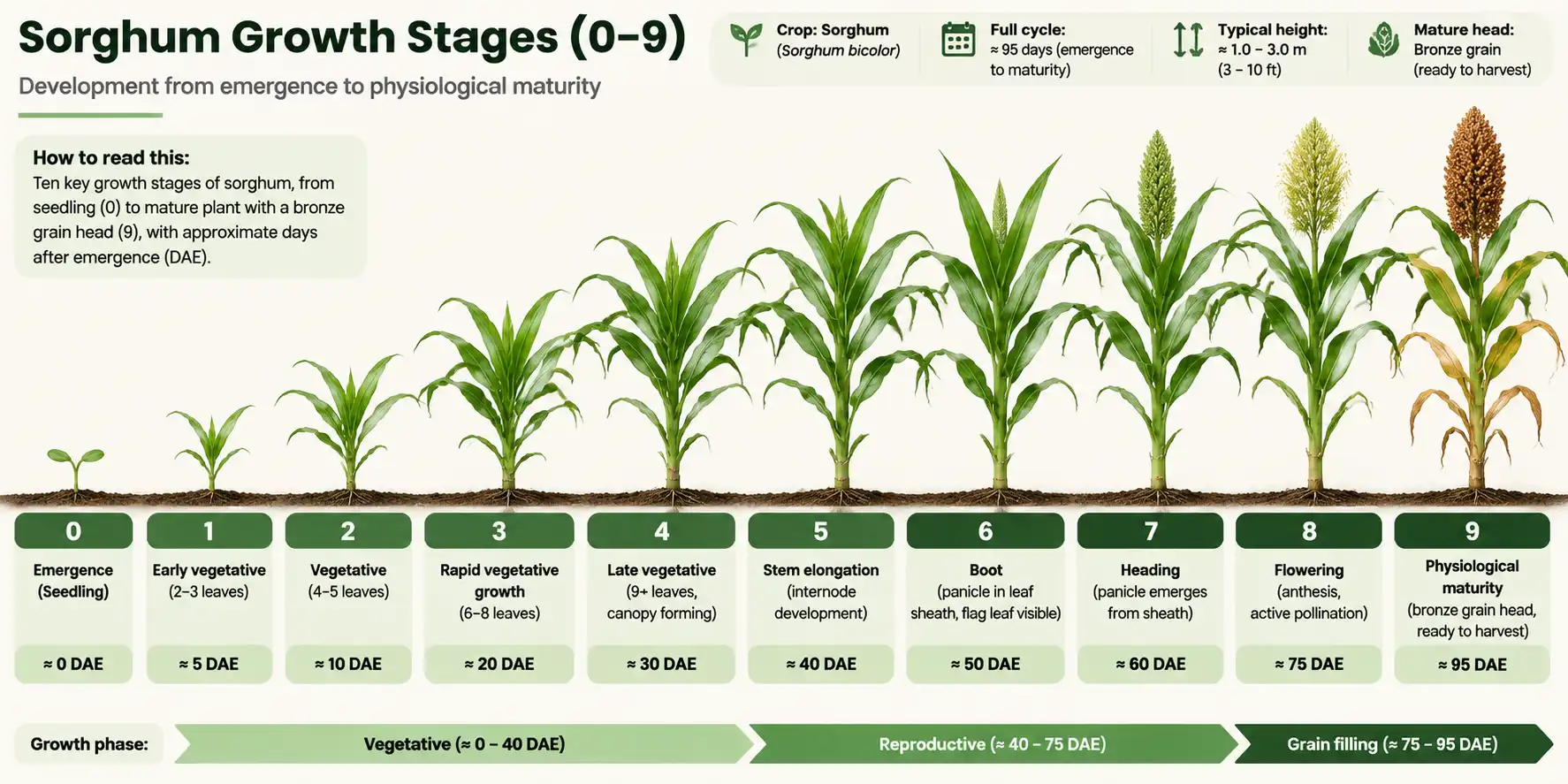
Uptake runs ahead of growth. Texas A&M AgriLife’s version of the same guide notes that at half bloom, the plant holds about half its final weight. Yet it has already taken up nearly 70% of its nitrogen and 80% of its potassium. That is why nutrients need to be in place by boot.
Insects and Diseases to Scout For
Sugarcane Aphid
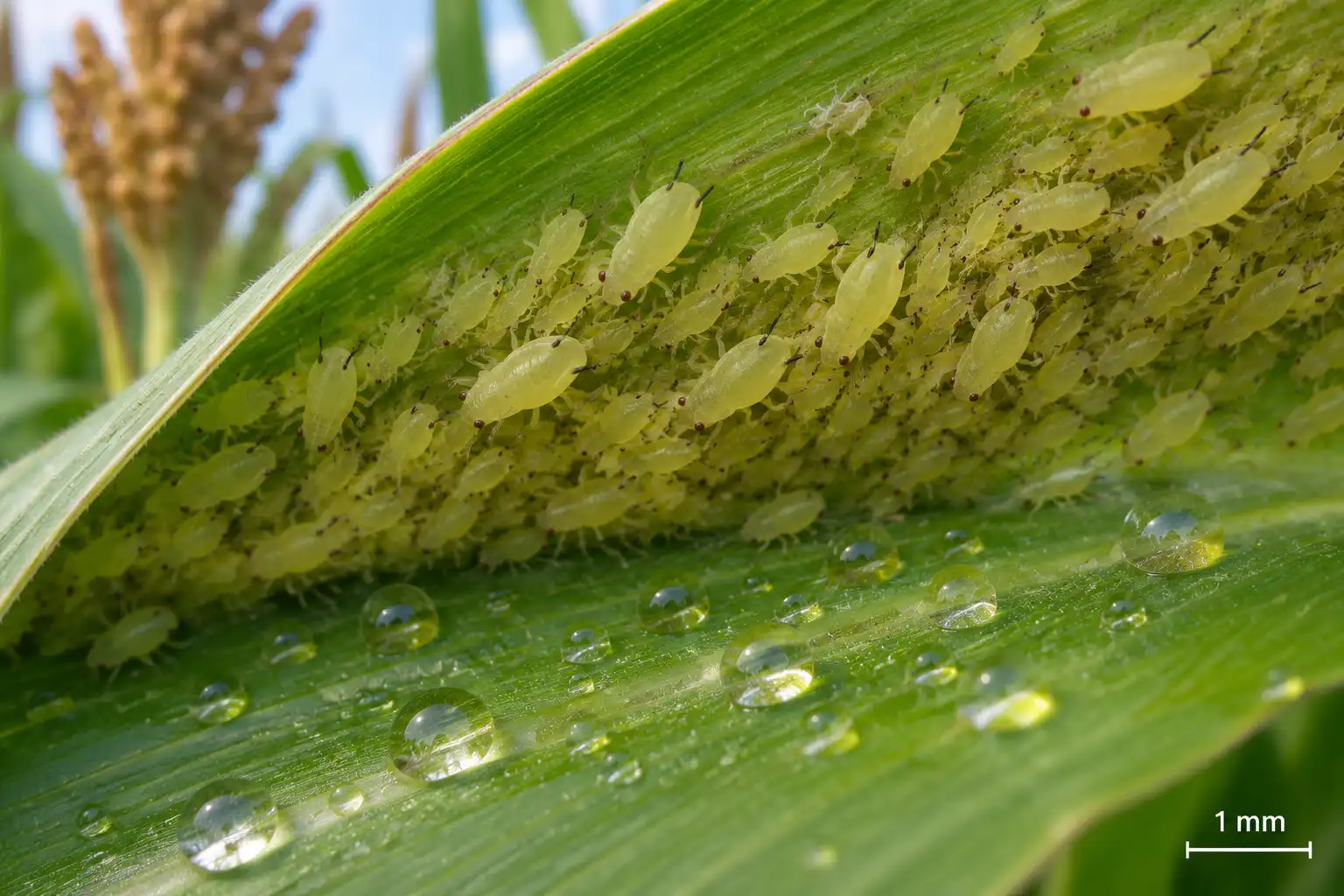
Scout weekly once sugarcane aphids show up in your area, and look for shiny honeydew on lower leaves. Texas A&M AgriLife sets a threshold of 50 aphids per leaf, averaged across 40 leaves from four spots in the field. Its growth-stage threshold is simpler. Treat when 20% of plants carry 50 or more aphids at preboot or boot, or 30% from flowering through milk. Tolerant hybrids slow the buildup but still need scouting.
Headworms and Sorghum Midge
Headworms, the larvae of corn earworm and fall armyworm, feed on soft kernels. K-State estimates about 5% grain loss per worm per head. Texas A&M AgriLife sets the soft-dough threshold at one worm per head. So beat 10 heads into a white bucket, and treat if 10 or more worms drop out. Sorghum midge attacks during bloom instead. Texas A&M AgriLife uses one midge per head as its threshold. It suggests checking blooming heads every 3 days, between 10 a.m. and 2 p.m.
Stalk Rots
Stalk rot is a common cause of late-season lodging, and K-State estimates it costs at least 5% of the sorghum crop each year. Charcoal rot favors soil above 90°F with low moisture during grain fill. Fusarium stalk rot shows up more with alternating wet and dry spells. Both are stress diseases, so balanced fertility, populations matched to water, and early harvest of weak fields all cut losses.
When and How to Harvest Sorghum
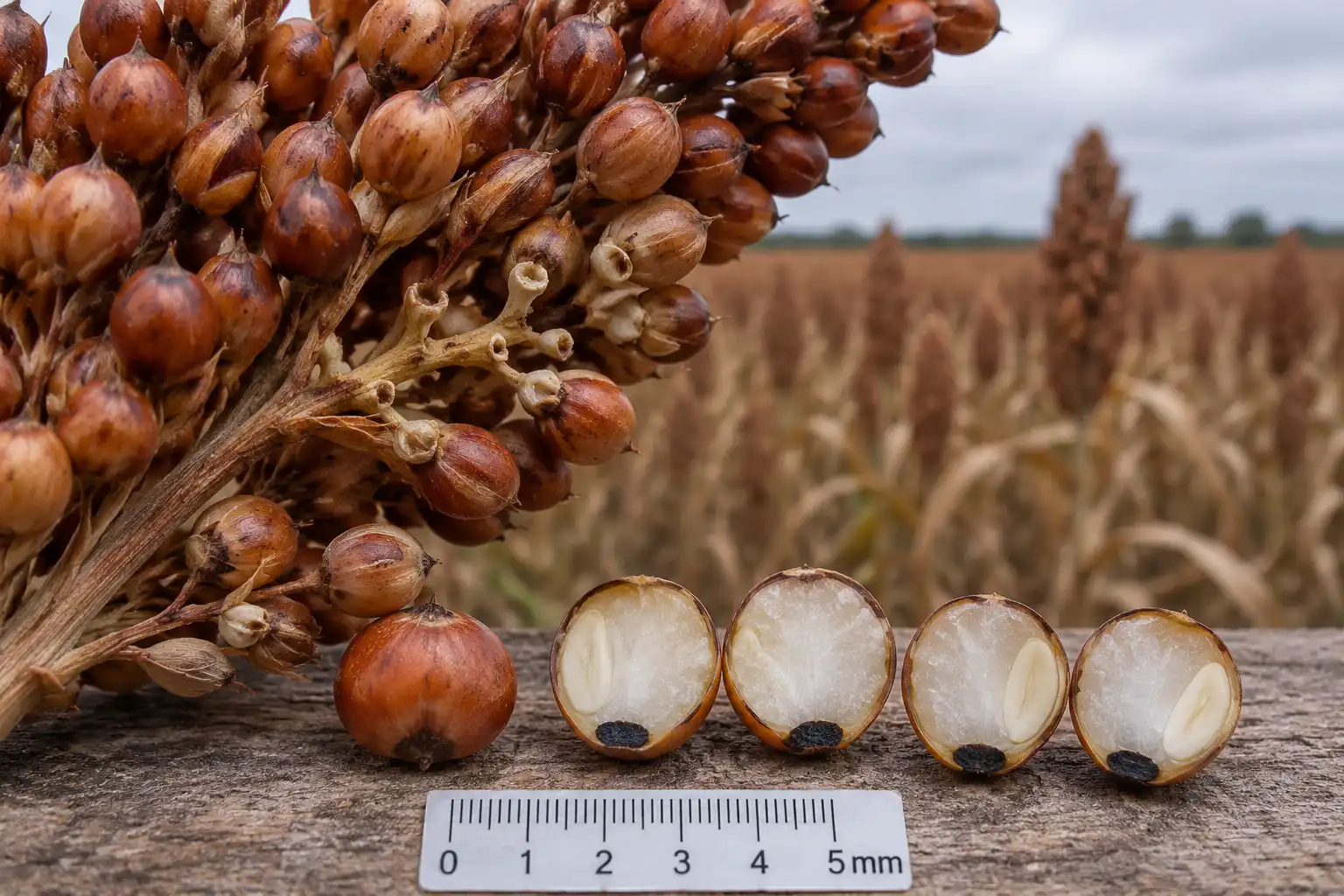
Harvest sorghum after black layer, once grain dries to a moisture your storage can handle. At physiological maturity, a dark spot forms on the kernel opposite the embryo. K-State puts grain moisture at that point between 25 and 35%, so the grain still needs field drying. That gap is why sorghum harvest timing depends on dry-down more than the calendar.
K-State measured dry-down at roughly 0.7% per day after black layer, and slower for late plantings. At that pace, grain at 34% needs about 24 days to reach 17%. A desiccant applied at black layer speeds drying without hurting yield, per K-State.
Before storage, dry the grain further. Purdue Extension advises 15% moisture for storage up to six months and 13% for six months to a year or longer.
On small plots, birds can strip maturing heads quickly. Slip a paper bag over each head after bloom, then cut heads with pruners once kernels are hard. Afterward, rub the dried heads over a coarse screen to thresh them.
How to Estimate Sorghum Yield Before Harvest
K-State’s field method works 3 to 4 weeks after flowering:
- Count heads longer than 3 inches in 17.4 feet of one 30-inch row. That length covers 1/1,000 acre.
- Estimate seeds per head. K-State’s examples use 2,500 for a good crop and 900 for a very poor one.
- Multiply heads × seeds per head × 1,000, then divide by seeds per pound. K-State lists about 17,700 in a good year and 18,500 in a very poor one.
- Divide by 56 pounds per bushel.
For example, 62 heads × 2,500 seeds × 1,000 ÷ 17,723 ÷ 56 = 156 bushels per acre. Repeat the count in several spots, because stands vary across a field.
Common Sorghum Problems and Their Causes
Most sorghum problems trace back to planting date, population, or stress around bloom.
| Problem | Likely cause | What to do |
|---|---|---|
| Slow, patchy emergence | Cold soil at planting | Wait for 60°F or warmer at seed depth |
| Seedling injury after a grass herbicide | Group 15 product on unsafened seed | Buy Concep III-treated seed |
| Head stuck in the boot | Severe drought or herbicide injury at boot | Protect moisture at boot; follow label height limits |
| Light, chaffy grain | Heat or drought from bloom to soft dough | Shift planting date or maturity so bloom misses peak heat |
| Sticky, shiny leaves | Sugarcane aphid honeydew | Check leaf undersides against thresholds |
| Stalks lodging before harvest | Charcoal rot or Fusarium stalk rot | Harvest weak fields first; match population to water |
FAQs About How to Grow Sorghum
How long does sorghum take to mature?
A medium hybrid reaches physiological maturity about 95 days after emergence in K-State’s Manhattan, Kansas data. Early hybrids reach half bloom in 50 to 59 days, per Texas A&M AgriLife, so they finish sooner.
How late can you plant grain sorghum?
In the Texas Low Rolling Plains, Texas A&M AgriLife sets the last date at June 30 for medium hybrids and July 15 for early ones. Farther north, K-State shifts to shorter-season hybrids once planting runs past mid to late June.
Is sorghum more drought tolerant than corn?
Yes, within limits: Texas A&M AgriLife reports grain sorghum makes its first bushel on about 2 to 3 inches less water than corn. Still, drought or heat from boot through flowering cuts yield sharply.
How many pounds of sorghum seed do you plant per acre?
Plant by seed count, not weight, because seed size varies widely. K-State shows 4 pounds delivering anywhere from 52,900 to 95,500 seeds, so divide your target seeds per acre by the seeds per pound on the tag.
Does sorghum need nitrogen after soybeans?
Yes, but less: K-State subtracts a 40-pound nitrogen credit per acre after soybeans and keeps a 30-pound minimum for early growth. Nebraska Extension uses a separate equation for sorghum after soybeans.
Can you grow sorghum in a small garden?
Yes, and a watered 4 by 8 bed holds about 60 to 80 plants at K-State’s irrigated density. Thin two rows to about 3 inches apart, and bag the heads after bloom to keep birds off.
Key Points for Your Field
Plant by soil temperature and bloom timing, not by the calendar. Set seeds per acre from your rainfall or stored soil water, then calibrate the planter by seed count. Build the nitrogen rate from a realistic yield goal and a 24-inch soil test. After that, the season turns on two windows: weed control through five-leaf, and stress protection from boot through flowering. For hybrid picks and local rates, your county extension office knows your ground best.