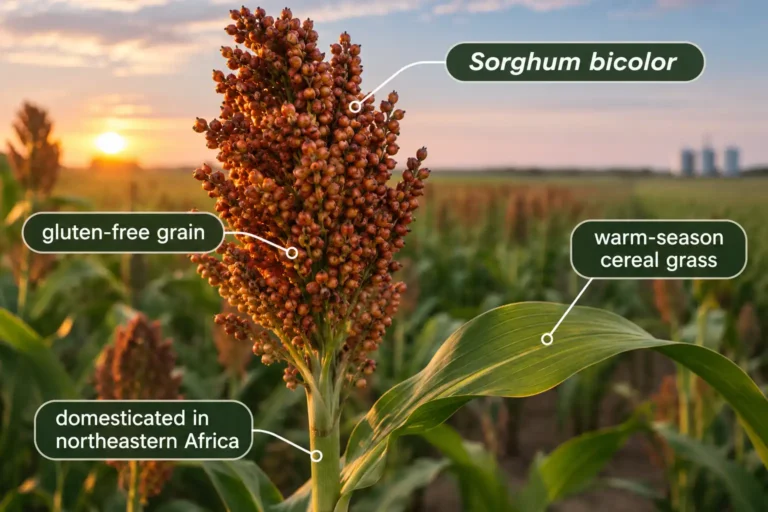
Where Is Sorghum Grown? Top U.S. States and World Regions

Heat, rainfall, frost risk, and the intended harvest help explain its distribution. Sorghum is an important grain and forage crop across the United States, Africa, Asia, and other agricultural regions.
Sorghum grows mainly in warm, often semi-arid regions across every inhabited continent. In the United States, Kansas and Texas lead grain production. Globally, major producers include the United States, Brazil, Nigeria, India, and Ethiopia, with extensive acreage throughout Africa.
Where Is Sorghum Grown in the United States?
Most U.S. grain sorghum grows in the Great Plains, particularly Kansas and Texas.
This growing region is commonly called the Sorghum Belt. It extends from South Dakota and Nebraska through Kansas and Oklahoma into Texas. Eastern Colorado is another important production area.
According to the USDA National Agricultural Statistics Service, U.S. farmers harvested approximately 6.02 million acres of grain sorghum in 2025, producing nearly 437 million bushels.
Largest Sorghum-Producing States
The table shows finalized 2025 grain production, not forage sorghum or the still-developing 2026 harvest.
| State | Grain harvested acres | Production (bushels) |
|---|---|---|
| Kansas | 2,800,000 | 252 million |
| Texas | 1,900,000 | 100.7 million |
| Colorado | 500,000 | 26 million |
| Oklahoma | 405,000 | 23.5 million |
| Nebraska | 205,000 | 17.8 million |
| South Dakota | 210,000 | 16.8 million |
| United States | 6,020,000 | 436.8 million |
Kansas produced about 58% of the nation’s grain sorghum in 2025. Texas contributed approximately 23%.
Production does not follow harvested acreage exactly. Nebraska produced more bushels than South Dakota despite harvesting slightly fewer acres.
Where Within These States Is Sorghum Common?
- Kansas: Central and western farming districts, with both dryland and irrigated fields.
- Texas: The Panhandle, South Plains, Central Texas, and southern coastal growing areas.
- Colorado: Primarily the eastern plains.
- Oklahoma: Especially western and central agricultural regions.
- Nebraska and South Dakota: Warmer growing districts where suitable hybrids mature before damaging fall frost.
These concentrations reflect climate and cropping systems, not fixed boundaries. Grain sorghum also grows outside these six states on a smaller scale.
Where Is Sorghum Grown Around the World?
Sorghum is cultivated throughout Africa, Asia, North America, South America, and Australia, with smaller production areas in Europe.
The USDA Foreign Agricultural Service estimates global sorghum production at approximately 63.1 million metric tons for the 2025/26 marketing year.
Top 10 Sorghum-Producing Countries
| Country | 2025/26 production, million metric tons |
|---|---|
| United States | 11.10 |
| Brazil | 7.00 |
| Nigeria | 6.50 |
| India | 4.36 |
| Ethiopia | 3.90 |
| Mexico | 3.40 |
| China | 3.10 |
| Sudan | 3.00 |
| Australia | 2.50 |
| Argentina | 2.40 |
These figures describe the 2025/26 season. Country rankings can change as production and yields change.
The country with the most sorghum acreage is not necessarily the largest producer.
For example, USDA FAS estimates Sudan harvested about 6 million hectares, equivalent to 14.8 million acres, in 2025/26. The United States harvested approximately 2.4 million hectares, or 5.9 million acres, yet produced considerably more grain.
The difference reflects higher average grain yields in the United States.

Major Sorghum Growing Regions by Continent
Although sorghum grows across several continents, its role differs between agricultural regions.
Africa: Staple Food and Rainfed Farming
Africa has some of the world’s largest sorghum-growing areas, particularly across the Sahel and eastern Africa.
Major producing countries include Nigeria, Sudan, Ethiopia, Niger, Burkina Faso, and Mali.
Sorghum is important in areas with seasonal rainfall, high temperatures, and limited irrigation infrastructure. Farmers grow it for porridge, flour, traditional foods, livestock feed, and household food supplies.
In many African regions, production depends heavily on rainfall during the growing season.
Asia: India and China’s Growing Areas
India is a major sorghum producer, where the grain is commonly known as jowar.
Sorghum grows in Maharashtra, Karnataka, Rajasthan, Telangana, and other states.
India has two important production seasons:
- Kharif: Sorghum grown during the monsoon season.
- Rabi: Sorghum grown after the monsoon, often using moisture stored in the soil.
The Indian Council of Agricultural Research identifies Maharashtra as an important region for both seasonal production systems.
China also grows sorghum, particularly in its warmer northern agricultural regions, where it is used for food, feed, and processing.
South America: Brazil and Argentina
Brazil is a major sorghum producer, particularly in Goiás, Minas Gerais, and surrounding farming regions.
Sorghum often serves as a second crop following soybeans. This allows growers to use remaining seasonal moisture when planting another corn crop becomes less attractive.
A USDA FAS report on Brazilian sorghum identifies this second-crop system as an important driver of sorghum cultivation.
Argentina also produces grain sorghum, mainly for livestock feed and commercial grain markets.
Australia and Other Regions
Australia grows sorghum mainly in its warm eastern agricultural areas, especially Queensland and northern New South Wales.
Mexico is another important producer, with grain grown for livestock feed and industrial uses.
Smaller commercial and experimental plantings occur across parts of Europe, although cooler growing seasons limit production in many locations.
Why Is Sorghum Grown in Hot and Dry Regions?
Sorghum performs well in warm growing conditions and generally tolerates water shortages better than corn.
Its ability to withstand temporary drought makes it attractive in areas with unreliable summer rainfall. However, drought tolerance does not mean the crop can produce profitable grain without adequate moisture.
Temperature Requirements
Sorghum needs warm soil for reliable germination.
Texas A&M AgriLife recommends a five-day average soil temperature of at least 60°F at a depth of 2 inches for good emergence.
By comparison, Kansas State University Extension lists 65°F to 70°F as a minimum planting temperature for grain sorghum.
These recommendations differ by growing environment. Cooler spring soils justify a more cautious planting threshold.
Rainfall and Soil Conditions
Sorghum can grow on rainfed fields, but available moisture remains important during heading, flowering, and grain development.
Texas A&M AgriLife reports that crop water use can reach approximately 0.30 to 0.35 inches per day during periods of high demand. Moisture shortages around flowering can sharply reduce yield.
You can calculate crop water requirements to compare expected demand with rainfall, stored soil moisture, and available irrigation.
Warm weather, adequate drainage, sufficient soil moisture, and a long enough frost-free period all influence where sorghum succeeds.

Where Are Different Types of Sorghum Grown?
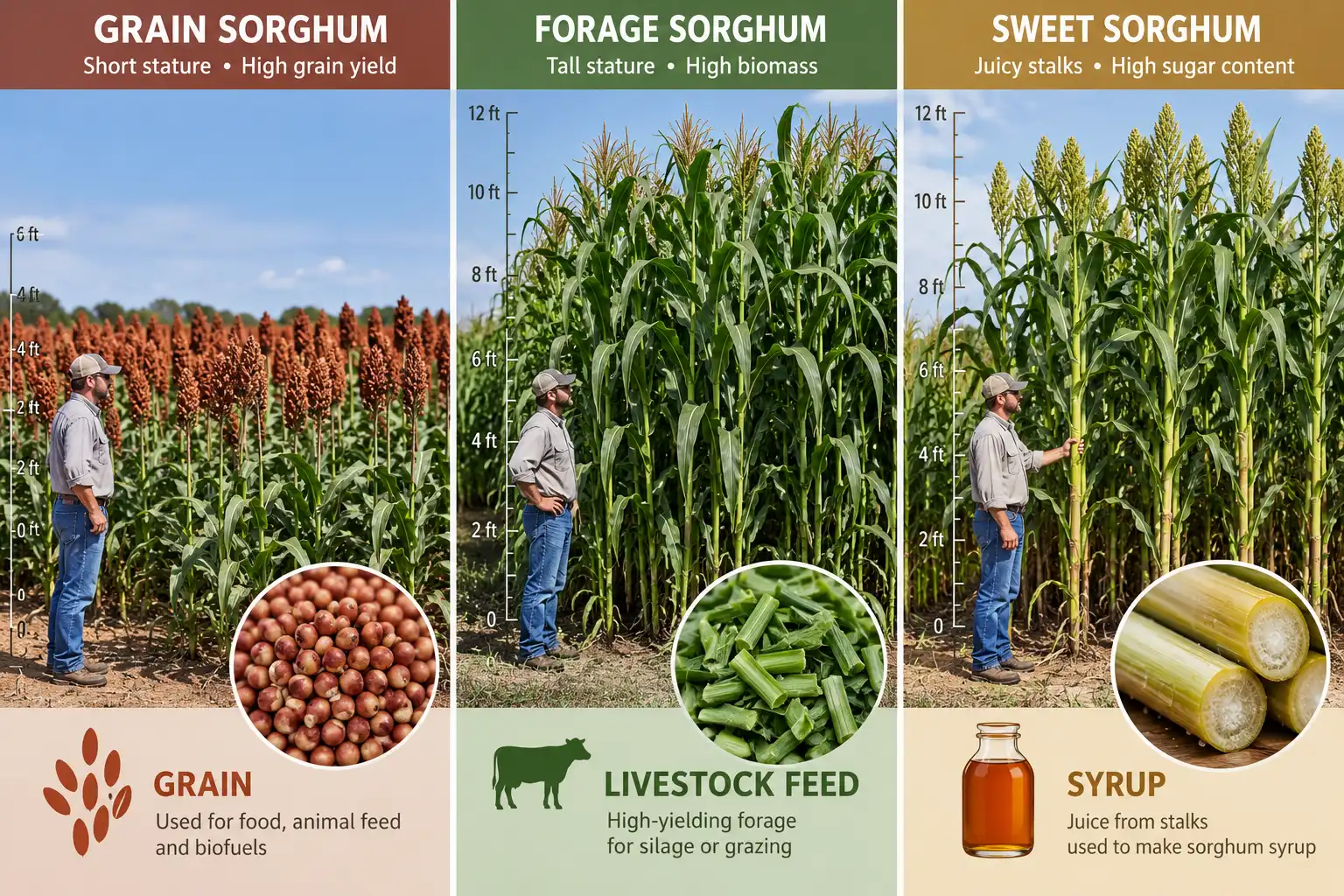
Not every sorghum field produces grain. Different types grow across overlapping regions but serve different purposes.
| Sorghum type | Common growing areas | Main use |
|---|---|---|
| Grain sorghum (milo) | Great Plains, Africa, India, Brazil, Australia | Grain for food, feed, and processing |
| Forage sorghum | Plains, Southern U.S., and livestock-producing regions | Silage and livestock feed |
| Sorghum-sudangrass hybrids | Upper Midwest, Plains, and Southern U.S. | Summer grazing, hay, and green chop |
| Sweet sorghum | Warmer regions, including Southern U.S. states | Syrup and sweet stalk juice |
The University of Wisconsin-Madison Extension distinguishes grain sorghum from taller forage types and sorghum-sudangrass hybrids.
Grain sorghum commonly reaches around 3 to 5 feet tall, while forage sorghum often grows approximately 8 to 13 feet.
A brown midrib (BMR) sorghum-sudangrass hybrid is a forage example bred for improved fiber digestibility, not high grain production.
This distinction matters when interpreting production maps. Grain statistics do not capture all sorghum grown for livestock or syrup.
When Is Sorghum Grown in Different Regions?
Planting and harvesting seasons vary because sorghum depends on warm conditions rather than a single worldwide calendar.
| Growing region | Typical planting period | Harvest period |
|---|---|---|
| Kansas and central Great Plains | Late spring to early summer | Fall |
| Southern Texas | Late winter to spring | Summer to early fall |
| Northern Plains | Late spring to early summer | Late summer to fall |
| Upper Midwest forage systems | Late spring to summer | Summer to early fall |
| India, Kharif crop | Monsoon season | After seasonal crop maturity |
| India, Rabi crop | Post-monsoon season | Following winter or spring |
| Brazil, major second-crop areas | After the preceding soybean harvest | Following second-crop maturity |
These are broad seasonal patterns, not statewide planting-date recommendations.
A Kansas grain hybrid and a South Texas hybrid may require different maturity periods. Likewise, forage hybrids may be harvested before reaching the grain maturity stage.
Can Sorghum Grow Outside the Main Sorghum Belt?
Yes. Sorghum can grow outside the Great Plains wherever temperatures, water, and growing-season length support the selected type.
However, successful cultivation and profitable commercial production are different questions.
Northern United States
Shorter growing seasons and cool spring soils make grain production more difficult in some northern areas.
Early-maturing hybrids may help, but temperature and fall frost remain limiting factors.
In Wisconsin and Minnesota, sorghum-sudangrass is also used as a warm-season forage crop.
Southeastern United States
The Southeast provides enough summer warmth for sorghum.
Higher humidity, frequent rainfall, and disease pressure can affect grain production. Forage and sweet sorghum may fit particular livestock or specialty operations.
Southwestern United States
Warm temperatures favor sorghum in the Southwest, but extremely low rainfall can restrict yields.
Stored soil moisture and supplemental irrigation may determine whether grain production is practical.
Before selecting a field, compare water availability, growing-season length, soil characteristics, and market access. The crop-selection factors used for other grains also apply to sorghum.
What Conditions Can Limit Sorghum Production?
Sorghum’s drought tolerance has limits. Several conditions can prevent reliable establishment or reduce grain yield:
- Cold soil: Slow germination increases the risk of poor emergence.
- Short frost-free season: Late-maturing hybrids may not complete grain filling.
- Drought near flowering: Water stress reduces seed formation and final yield.
- Prolonged wet conditions: Poor drainage and persistent humidity can create disease problems.
- Unsuitable crop type: A late-maturing forage hybrid may not produce harvestable grain before frost.
- Limited market access: A suitable climate alone does not guarantee a profitable crop.
Check soil pH and nutrient availability before planting. A soil test report helps identify fertility constraints that drought tolerance cannot overcome.
FAQs About Sorghum Grown
Is sorghum mainly grown in dry places?
Much commercial grain sorghum grows in semi-arid areas because it tolerates heat and intermittent drought better than corn. However, sorghum also grows in wetter locations when drainage, disease management, and crop selection are suitable.
Which part of Africa grows the most sorghum?
Important sorghum-growing areas include the West African Sahel, Nigeria, Sudan, and Ethiopia. Nigeria is a leading African producer by grain volume, while Sudan has especially extensive harvested acreage, according to USDA FAS estimates.
Does sorghum grow in northern U.S. states?
Yes, but cooler temperatures and earlier fall frost can limit grain maturity in northern growing areas. Producers may choose earlier-maturing grain hybrids or sorghum-sudangrass hybrids grown primarily as summer forage.
Can sorghum grow without irrigation?
Yes, grain sorghum is commonly grown on rainfed land across the Great Plains and in other semi-arid regions. However, adequate stored moisture and rainfall near flowering still matter greatly for grain yield.
Is milo the same as sorghum?
Milo is a common name for grain sorghum, particularly in the United States. However, sorghum also includes types grown for silage, grazing, and sweet stalk juice, so not every sorghum crop is milo.
Can sorghum grow in a home garden?
Yes, you can grow grain or sweet sorghum in a sunny garden with sufficiently warm soil and a suitable growing season. Choose a variety that matches your climate and intended harvest.
Key Points for Understanding Sorghum Growing Regions
Sorghum is most widely associated with warm agricultural regions where summer moisture can be limited.
In the United States, Kansas and Texas dominate grain production. Globally, sorghum has a much broader role, supporting commercial grain markets and staple-food production across several continents.
For an individual field, the deciding conditions are soil warmth, seasonal moisture, frost risk, crop type, and access to a suitable market.