How Deep to Plant Wheat: 1 to 1.5 Inches and When to Change It
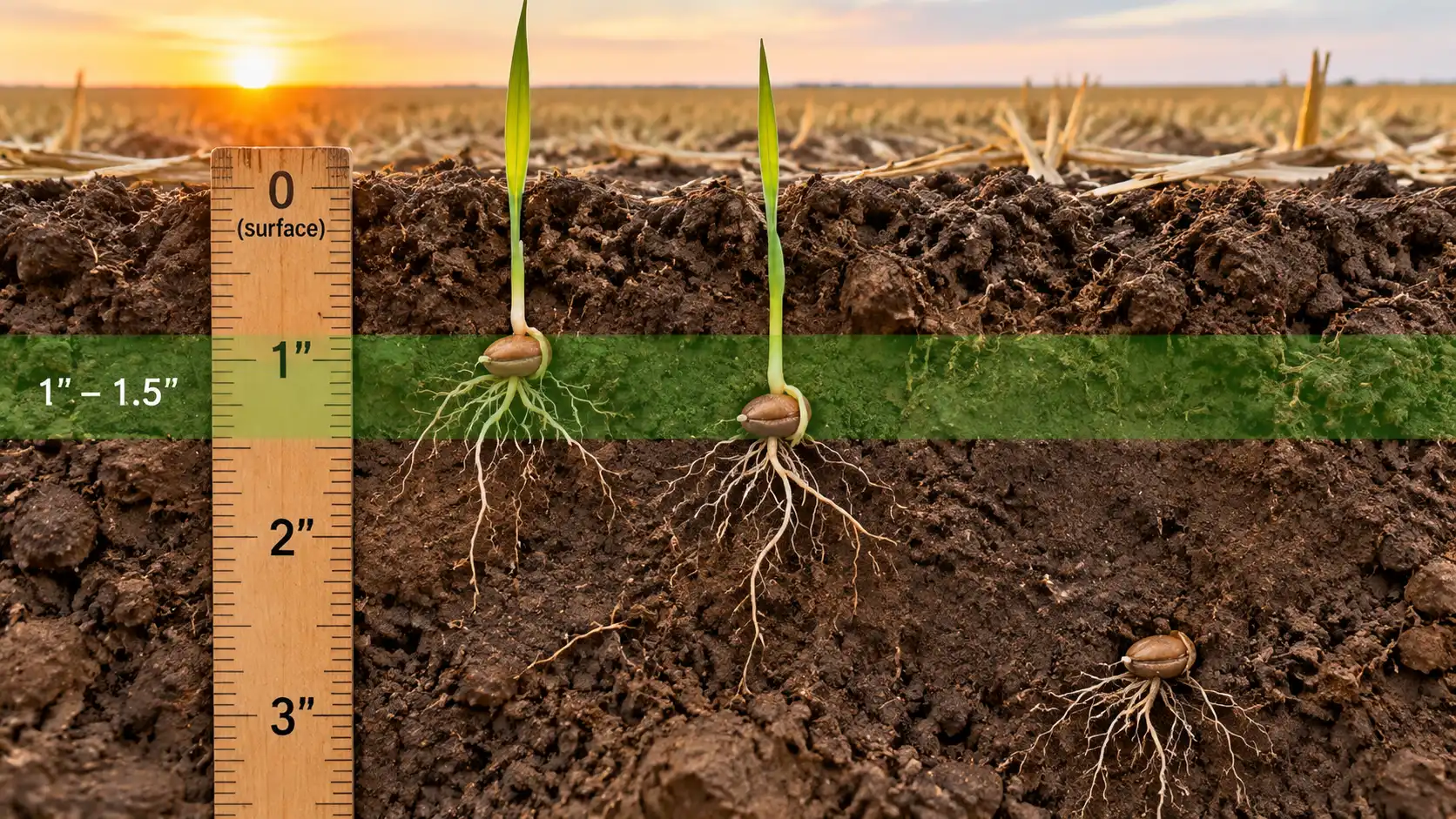
Planting depth decides whether a wheat stand comes up even or patchy. How deep to plant wheat comes down to one plant part, the coleoptile. After that, soil temperature, moisture, wheat class, and your planting setup move the target.
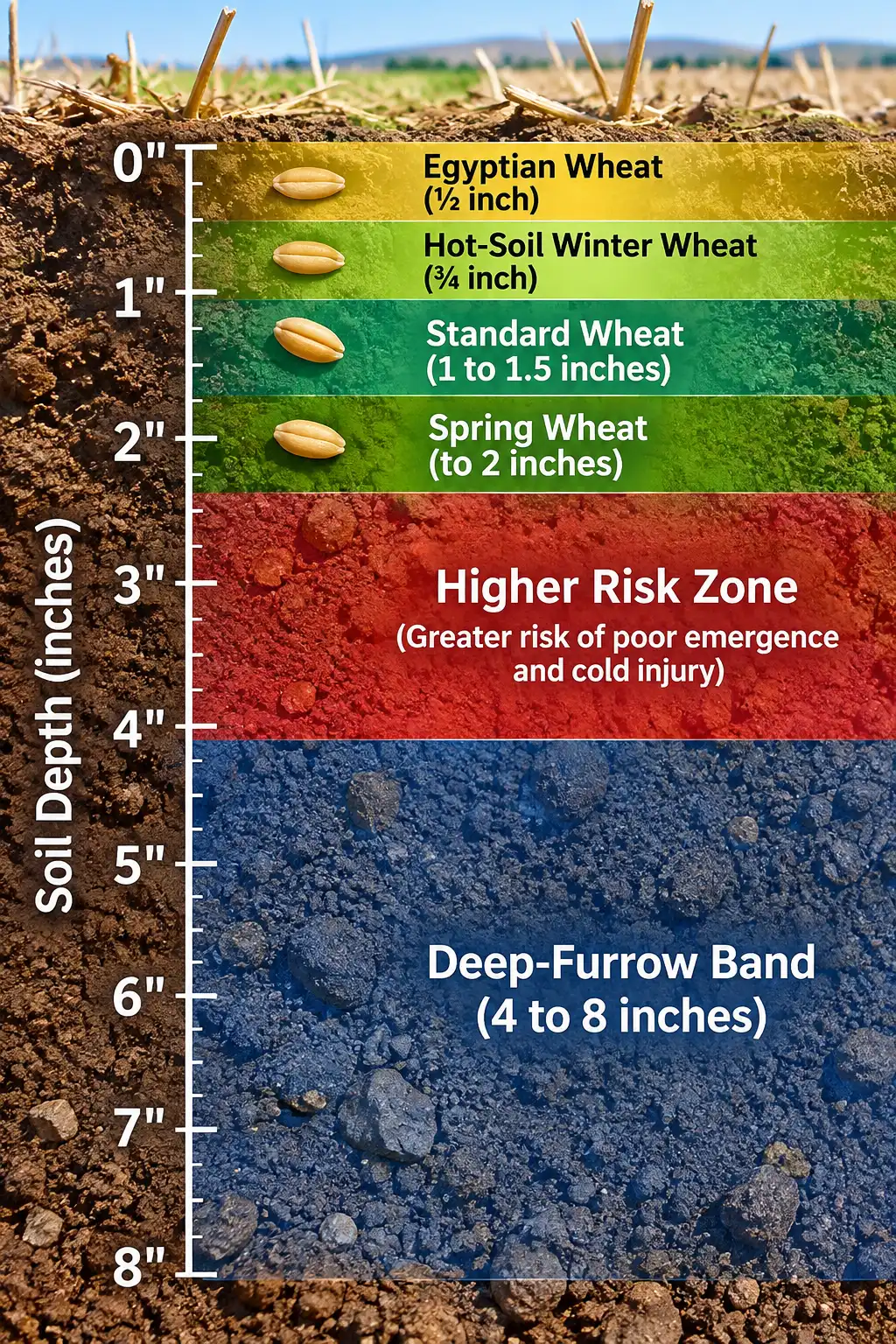
Plant wheat 1 to 1.5 inches deep in most fields. K-State Research and Extension warns that seeding deeper than 2 inches raises the risk of poor emergence and thin stands, because the coleoptile can stop short of the surface.
How Deep Does Wheat Need to Be Planted?
Wheat needs to go deep enough to sit in moist soil, and no deeper than its coleoptile can reach. K-State Research and Extension notes that coleoptile length differs by variety, but most wheat belongs about 1 to 1.5 inches deep.
Oklahoma State University Extension sets a similar ceiling. Its guidance says most modern varieties can safely go as deep as 1.5 inches.
Past that, the risk climbs quickly. K-State reports that wheat planted deeper than 2.5 inches may not emerge at all.
So the target band is narrow. If seed goes in too shallow, it dries out or sits in loose soil. If it goes in too deep, the seedling uses up its energy underground. A few conditions shift the target, and one region plants much deeper on purpose.
Why the Coleoptile Sets the Depth Limit
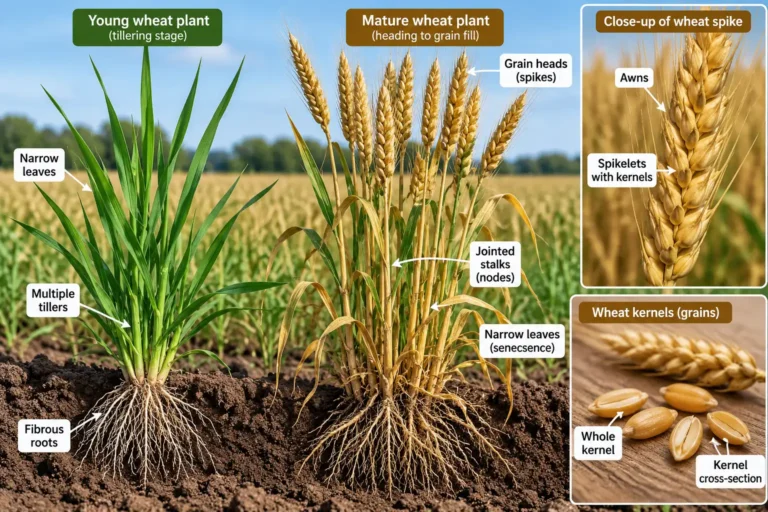
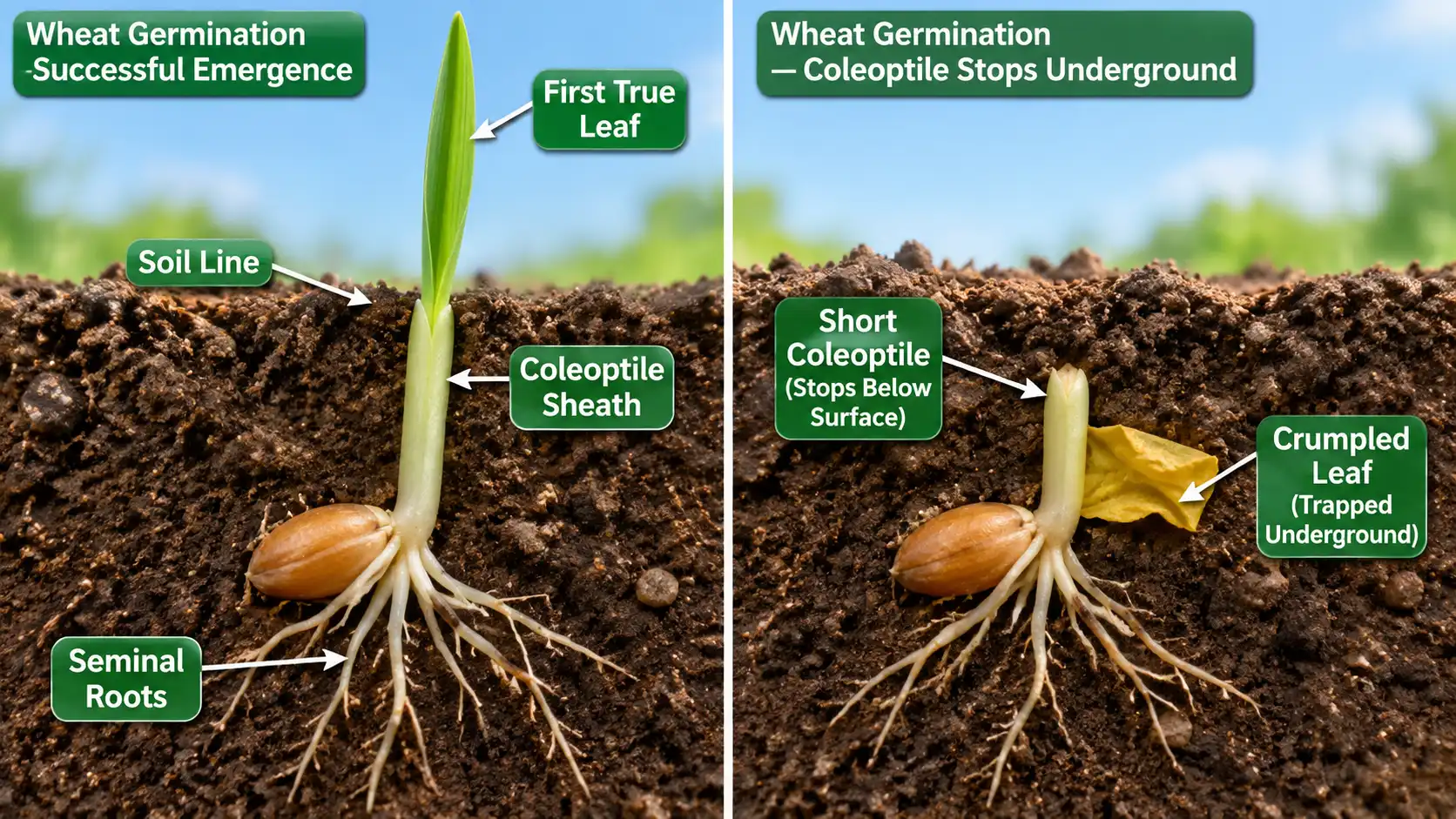
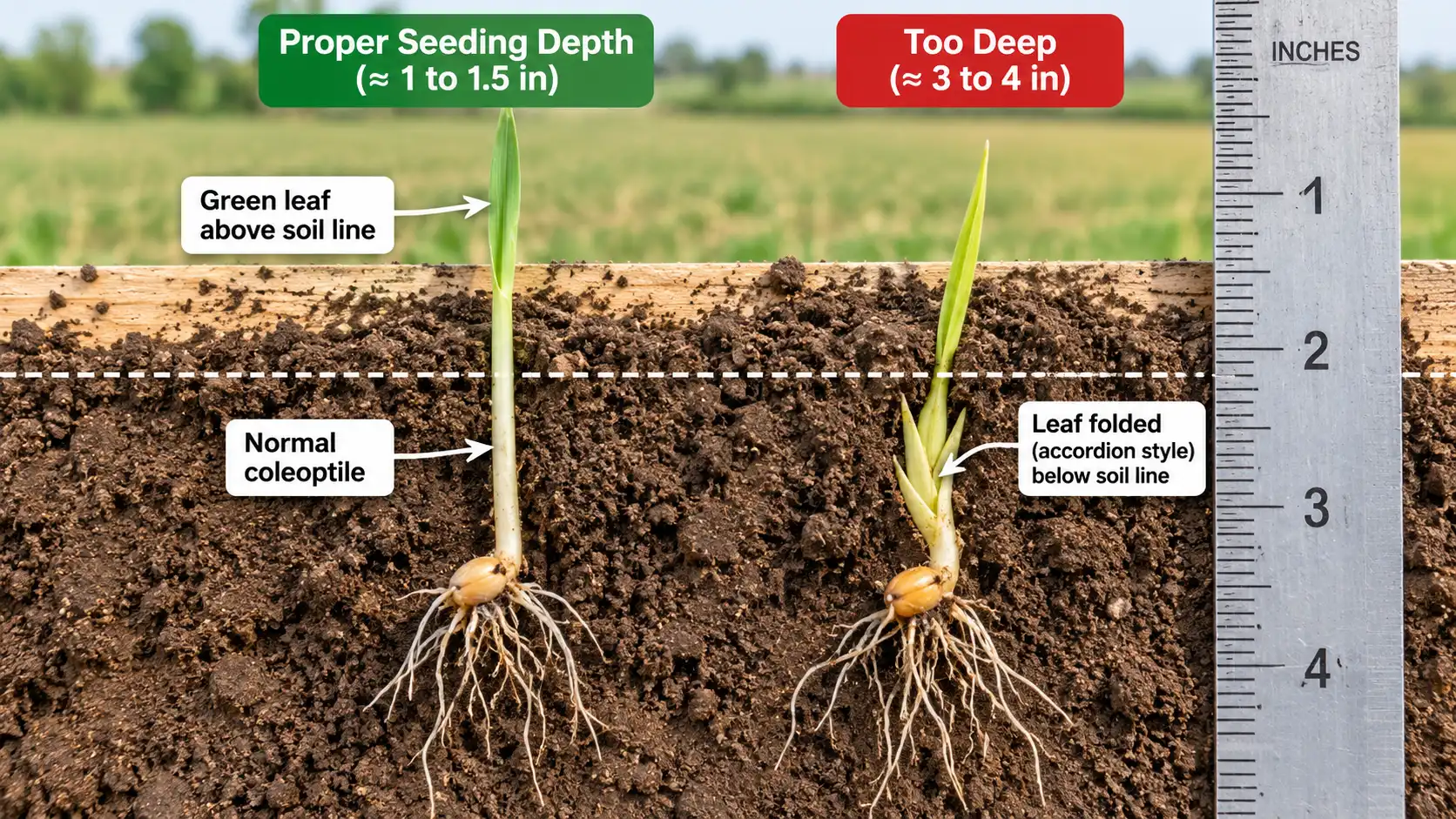
The coleoptile is a stiff sheath that protects the first shoot as it pushes up through the soil. Once it reaches the surface it stops growing, and the first true leaf comes out through it. If the coleoptile runs out of length first, that leaf unfolds underground. K-State describes the buried leaf as crumpled like an accordion. It turns yellow, and the plant usually dies.
Coleoptile length is not fixed. Oklahoma State notes that it tracks mature plant height, so modern semi-dwarf varieties have shorter coleoptiles than older tall types.
Temperature also changes it. K-State reports that high temperatures can cut coleoptile length by as much as 60 percent. Coleoptiles also come up shorter when soil is colder than the ideal range. That means a depth that works in October can fail in early September.
Check your variety’s rating before you set the drill. K-State publishes coleoptile length groupings for winter wheat varieties in MF3612. Oklahoma State’s variety comparison chart scores coleoptile length from 1 (relatively long) to 5 (relatively short).
How Deep to Plant Winter Wheat
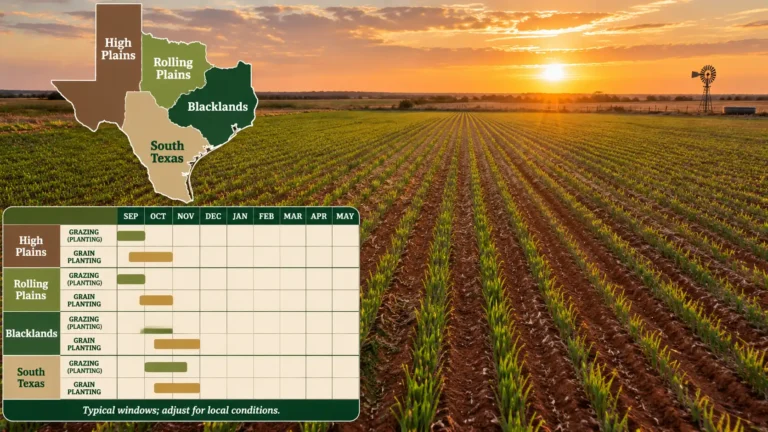
Plant winter wheat 1 to 1.5 inches deep under normal fall conditions, then adjust for soil heat and moisture. Depth and timing work together, so match the depth to your winter wheat planting window.
Normal Fall Planting
When the soil has cooled and moisture sits near the surface, use the K-State target of 1 to 1.5 inches. Oklahoma State gives wheat a germination range of 40°F to 99°F, with 54°F to 77°F as the best band. In Oklahoma, soils are usually cool enough by October 1 for most hard red winter varieties to germinate fully.
Cold soil also shortens the coleoptile, so a late seeding gains nothing from extra depth. If you are planting winter wheat late, stay at the shallow end of the band.
Early Planting Into Hot Soil
Dual-purpose wheat for fall grazing often goes in during September, when soils are still hot. In that case, plant shallower. K-State recommends 3/4 to 1 inch in warmer soils, even when the top layer is dry. Oklahoma State adds that many varieties fail to emerge when seeded deeper than an inch into hot soil.
Variety choice matters here too. K-State notes that some varieties will not germinate in soil warmer than 85°F.
Dry Topsoil: Dust In or Chase Moisture?
Dry topsoil tempts growers to plant deeper to reach moisture. Oklahoma State found that dusting early-sown wheat in shallow and waiting for a cool rain often gives more even emergence than planting deeper to reach moisture.
Some dryland fields still need depth. In western Kansas, where growers often plant down to subsoil moisture, K-State advises choosing varieties with longer coleoptiles.
Deep-Furrow Planting in the Pacific Northwest
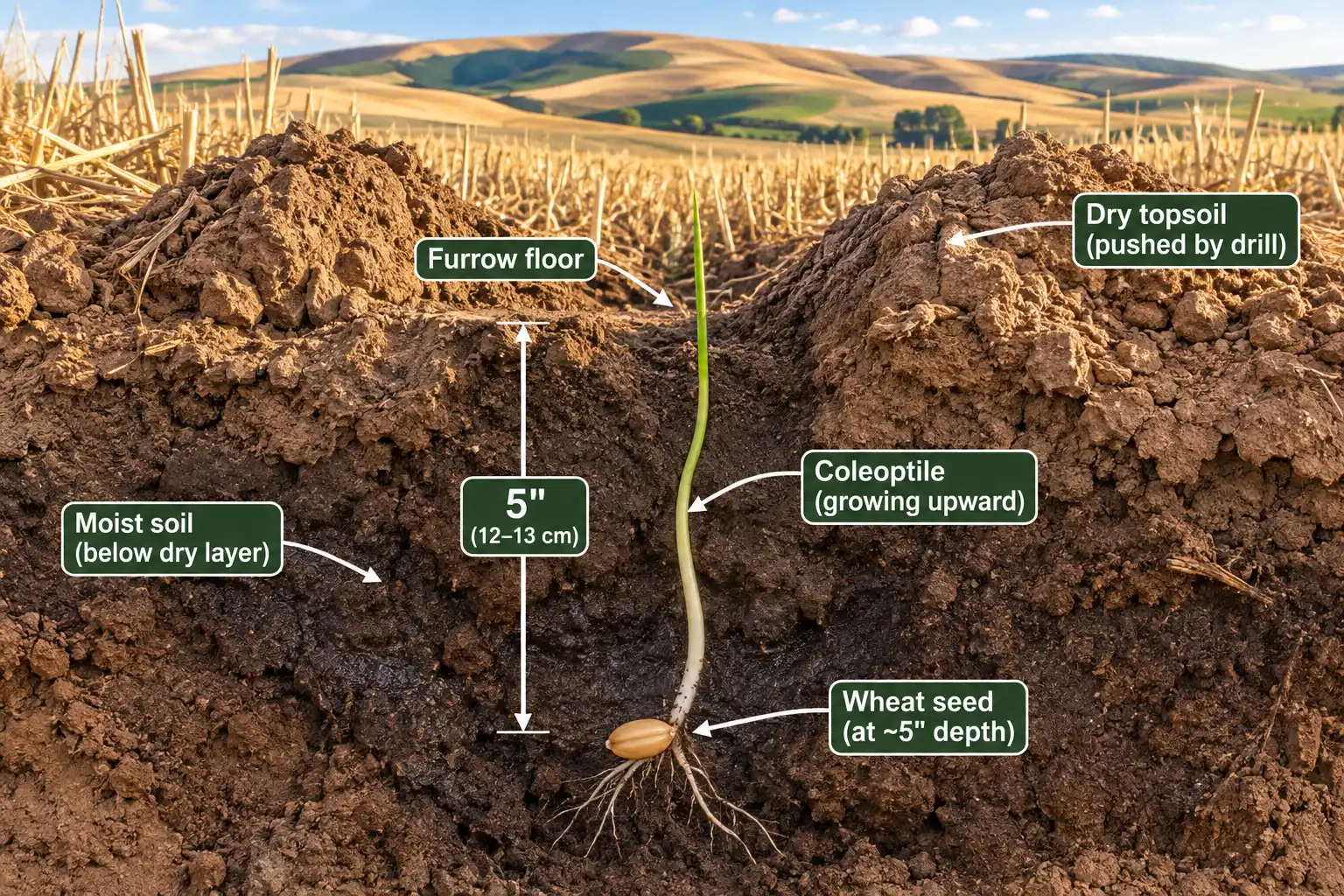
One region breaks the 1.5-inch rule on purpose. In the low-rainfall wheat and fallow country of the inland Pacific Northwest, growers use deep-furrow drills to place winter wheat 4 to 8 inches below the surface, per Washington State University research.
The drills push dry surface soil into ridges, which puts seed into moist soil and thins the layer the seedling must push through. Even so, WSU researchers note that 12 to 15 cm of soil, about 5 to 6 inches, still routinely covers the seed.
Only long-coleoptile varieties handle that. When WSU tested a worldwide collection, coleoptile lengths ran from 34 to 114 mm, roughly 1.3 to 4.5 inches. Emergence from deep planting ranged from zero to 66 percent at 21 days. The old soft white winter variety Moro stayed widely planted in these dry areas because it emerges so well, despite weak disease resistance and modest yield potential.
Outside this system, do not copy these depths. K-State photographed wheat sown about 4 inches deep near Hutchinson, where a plant’s first true leaf came out below the soil surface.
How Deep to Plant Spring Wheat
Plant spring wheat 1 to 2 inches deep. The two Dakota extension services draw that band a little differently.
SDSU Extension recommends 1 to 2 inches and warns that seed placed shallower than an inch risks poor seed-to-soil contact and poor emergence, especially in a rough seedbed. NDSU Extension puts the optimum at 1.5 to 2 inches and notes that some newer varieties are sensitive to seeding depth.
The gap between them is small, and it comes down to the seedbed. In a firm, moist seedbed, 1 to 1.5 inches works well. In a loose or drying seedbed, the 1.5 to 2 inch end keeps seed in moisture. Either way, cold spring soil shortens the coleoptile, so going past 2 inches buys little. Pair the depth with your state’s spring wheat seeding dates.
Wheat Planting Depth by Situation
Use this table to match depth to the field in front of you. Then confirm the result against your variety’s coleoptile rating.
| Situation | Target depth | Source |
|---|---|---|
| Winter wheat, cool moist soil | 1 to 1.5 in | K-State |
| Winter wheat, warm soil, early grazing | 3/4 to 1 in | K-State |
| Upper safe limit, most modern varieties | 1.5 in | Oklahoma State |
| Higher stand risk | Deeper than 2 in | K-State |
| Emergence may fail | Deeper than 2.5 in | K-State |
| Spring wheat | 1 to 2 in (SDSU); 1.5 to 2 in (NDSU) | SDSU, NDSU |
| Inland PNW deep-furrow, long-coleoptile variety | 4 to 8 in | WSU |
| Delayed preemergence Zidua planned | No deeper than 1.5 in | K-State |
| Linex (linuron) planned | At least 1 in | PNW Weed Management Handbook |
| Egyptian wheat (a sorghum) | 1/2 to 3/4 in | Seed-company spec sheets |
Herbicide Labels Can Set the Depth for You
If you plan to use a soil-applied herbicide, the label may override the agronomy. Several wheat herbicides depend on soil cover between the chemical and the seed.
K-State says wheat should not be seeded deeper than 1.5 inches ahead of a delayed preemergence Zidua application. The PNW Weed Management Handbook says linuron (Linex 4L) goes only on wheat seeded at least 1 inch deep. Its winter wheat section also lists a minimum of 1.5 inches for Axiom.
Label wording can vary by state supplement, so read the label you actually have before setting the drill. A field seeded at 3/4 inch for a hot-soil start may rule out a product you were counting on.
How Deep to Plant Wheat Seeds in a Garden Bed
Depth does not change with scale. Wheat seeds in a raised bed go 1 to 1.5 inches deep, the same as in a large field. What changes is how you place them and how many you need.
Broadcasting and raking leaves seed at every depth from the surface to 3 inches. Instead, press a board edge or hoe corner into the soil to make furrows 1 inch deep. Drop the seed, cover it, and firm the soil with the back of a rake. Firming fixes the seed-to-soil contact problem that SDSU flags with shallow seeding.
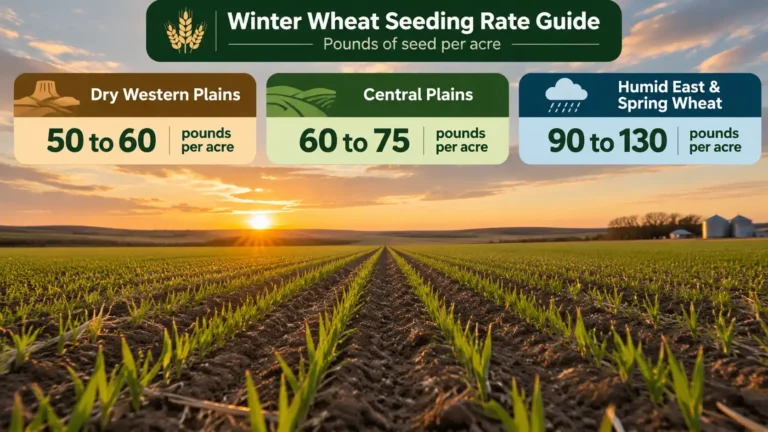
Seed quantity scales down easily. K-State’s seeding rate for central Kansas is 900,000 to 1,250,000 seeds per acre. That works out to about 21 to 29 seeds per square foot, so a 4 by 8 bed (32 square feet) needs about 660 to 920 seeds. K-State uses 15,000 seeds per pound as a working figure when the seed count is unknown. At that count, the bed needs roughly 0.7 to 1 ounce of seed. In rows 6 inches apart, drop 10 to 15 seeds per row foot.
The rest of the season, from tillering to harvest, is in our wheat growing guide.
How to Check Seeding Depth Behind the Drill
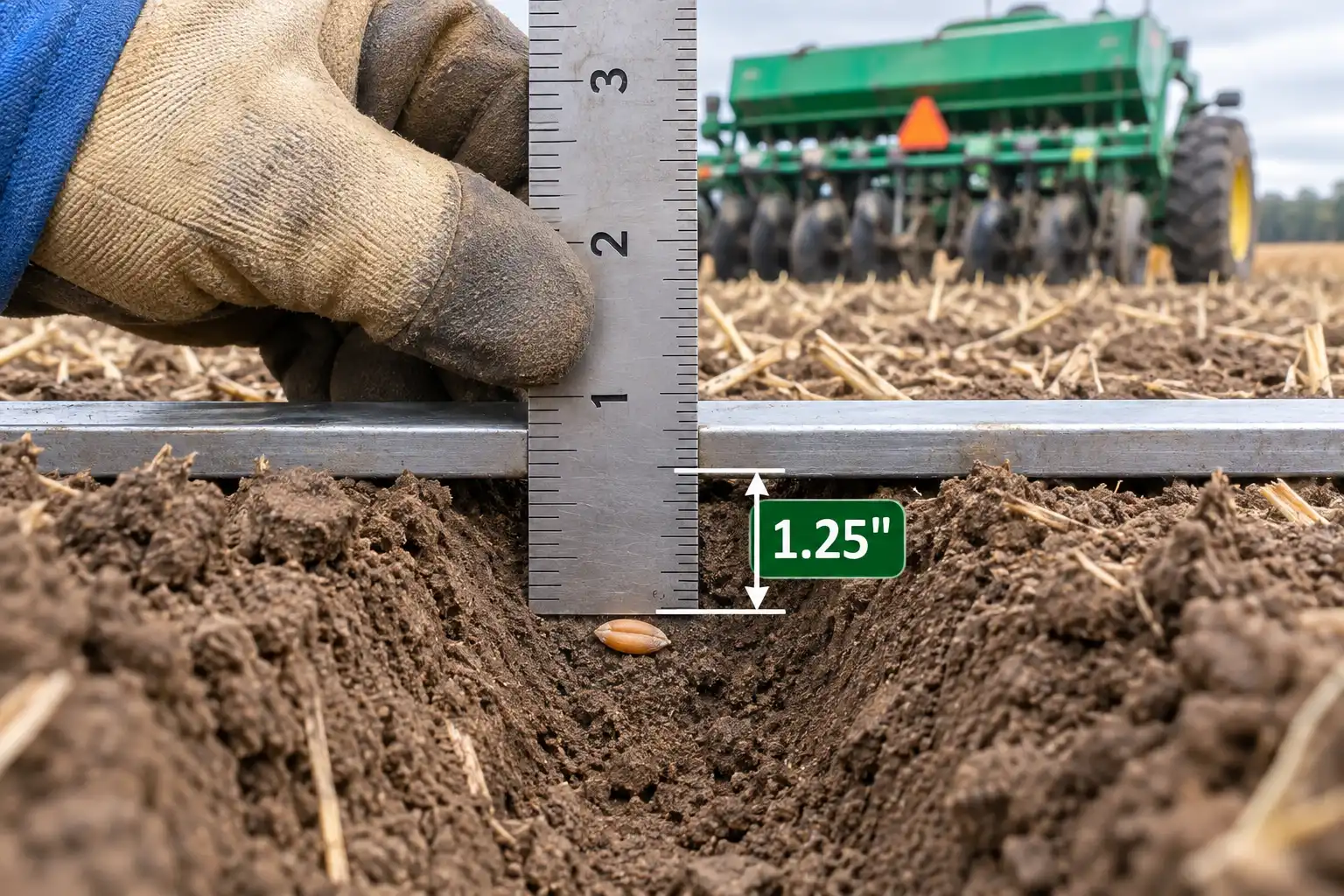
Check depth in the field rather than trusting the drill setting. Soil texture, moisture, and residue all change where the seed actually lands.
- Stop after the first 100 feet. A mistake caught early costs one pass, not a whole field.
- Dig across the row, not along it. Lift the soil sideways with a knife or trowel until a seed shows, so you do not knock seeds out of place.
- Measure the soil above the seed. Lay a straightedge across the row and measure from the seed to the surface. In no-till, measure from the soil, not from the top of the residue.
- Allow for ridges. Furrow ridges slump in after rain and add cover. So a seed under a tall ridge ends up deeper than it measured at planting.
- Check several openers. Openers that run in tractor tire tracks or sit at the drill ends often place seed at a different depth.
- Recheck when the field changes. Moving from sandy ground to clay, or from bare soil into heavy residue, shifts depth with it.
Signs Wheat Went In Too Deep (or Too Shallow)
Dig up a few weak or missing plants before you blame the seed. The cause usually shows in the soil. K-State lists deep planting first among common causes of poor emergence, along with a plugged drill, poor seed, dry soil, crusting, and false wireworms. It also advises looking for field patterns.
Too Deep
Look for a crumpled, yellow first leaf that unfolded below the surface. Emergence is slow and staggered, and the seed is often spent.
Crusting
K-State notes that heavy rain after planting can crust the surface hard enough to stop the coleoptile. Deep seed fares worst here, because the coleoptile has little length left by the time it reaches the crust.
Too Shallow
Seed is visible or sits within 1/2 inch of the surface. The stand comes up unevenly after a dry spell. You may also see herbicide injury where a label’s minimum depth was missed.
Not a Depth Problem
A plugged opener leaves a straight, empty row. False wireworms, yellowish to orange larvae up to 1.5 inches long, can also thin a stand.
How Deep to Plant Egyptian Wheat
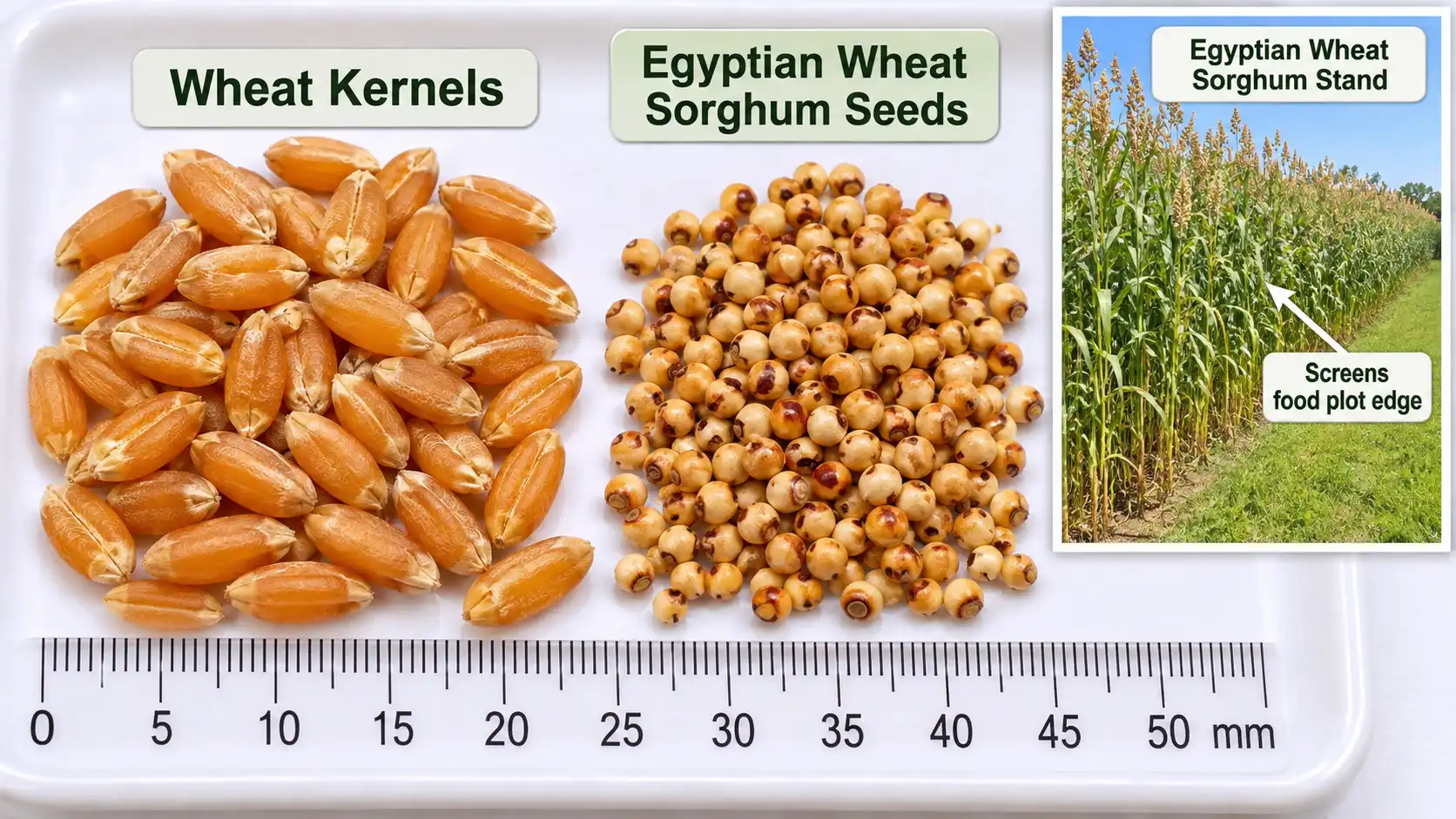
Plant Egyptian wheat 1/2 to 3/4 inch deep. Despite the name, it is not wheat. It is a tall sorghum, also called shallu or chicken corn. It is grown mostly as wildlife cover and food plot screening, and it reaches 8 to 12 feet.
The seed is small. One seed-company specification sheet lists about 25,000 seeds per pound and a seeding depth of 1/2 to 3/4 inch. That compares with roughly 15,000 per pound for wheat. Another seed sheet calls for drilling at 0.5 to 0.75 inch and advises against broadcasting without incorporating the seed.
Published extension trial data on Egyptian wheat seeding depth is limited. Treat these figures as seed-trade specifications, not trial results.
Timing follows sorghum, not wheat. Plant after the last chance of spring frost for a summer plot. Seedbed preparation and fertility match grain sorghum closely, so the steps for growing sorghum apply.
Frequently Asked Questions
Can you plant wheat 3 inches deep?
Only with a long-coleoptile variety in cool, moist soil, and even then emergence is risky. K-State warns that most wheat planted deeper than 2.5 inches may never reach the surface.
Is it better to plant wheat too shallow or too deep?
Slightly shallow is usually the safer miss, since a seedling cannot recover once its coleoptile stops underground. Below 1 inch, though, SDSU Extension warns of poor seed-to-soil contact and uneven emergence.
How deep do you plant wheat with a no-till drill?
Aim for the same 1 to 1.5 inches, measured from the soil surface rather than the top of the residue. Make sure the opener closes the slot, since NDSU Extension notes that drills leaving a deep, open seed furrow raise the risk of herbicide injury.
How deep should wheat be planted for a deer food plot?
Use the same 1 to 1.5 inches as a grain field. Food plot wheat is still wheat, so the coleoptile limit applies, and a cultipacker pass afterward firms soil around the seed.
Why did my wheat come up in patches?
Patchy stands usually come from planting depth, a plugged drill, crusting, or insects. K-State recommends digging in the gaps and reading the field pattern, because a plugged opener leaves a straight empty row.
Does Egyptian wheat grow like regular wheat?
No. Egyptian wheat is a warm-season sorghum planted in late spring, while wheat is a cool-season grass. It grows 8 to 12 feet tall and mainly serves as wildlife cover.
Key Points for Your Field
Set the drill for 1 to 1.5 inches, then dig behind the first pass to confirm it. Go shallower, about 3/4 to 1 inch, when you plant early into hot soil. Go deeper only with a variety rated for a long coleoptile, and never past what that variety can reach. Also read herbicide labels before planting, since some set the depth for you. For current coleoptile ratings on the varieties you grow, check with your county extension office.