What Do Lettuce Seedlings Look Like? A Visual Identification Guide
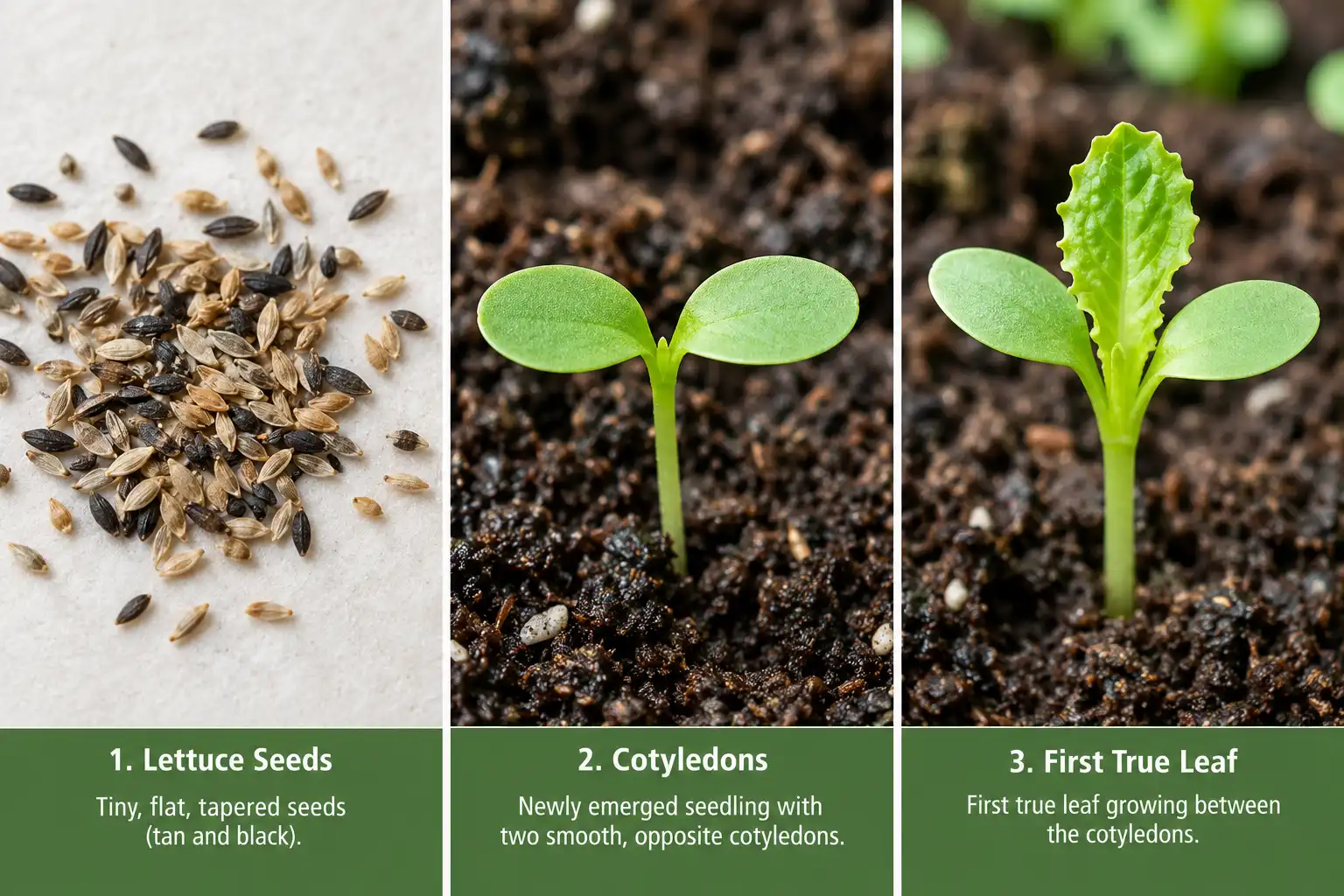
Their earliest leaves look surprisingly different from mature lettuce. Recognizing these small sprouts helps you distinguish lettuce from weeds, monitor germination, and avoid removing healthy plants while thinning.
Lettuce seedlings first appear as two small, smooth, oval leaves growing opposite each other on a slender stem. These are cotyledons. The first true leaf emerges between them, gradually developing the broader shape, texture, and color of mature lettuce.
What Does a Lettuce Seed Look Like?
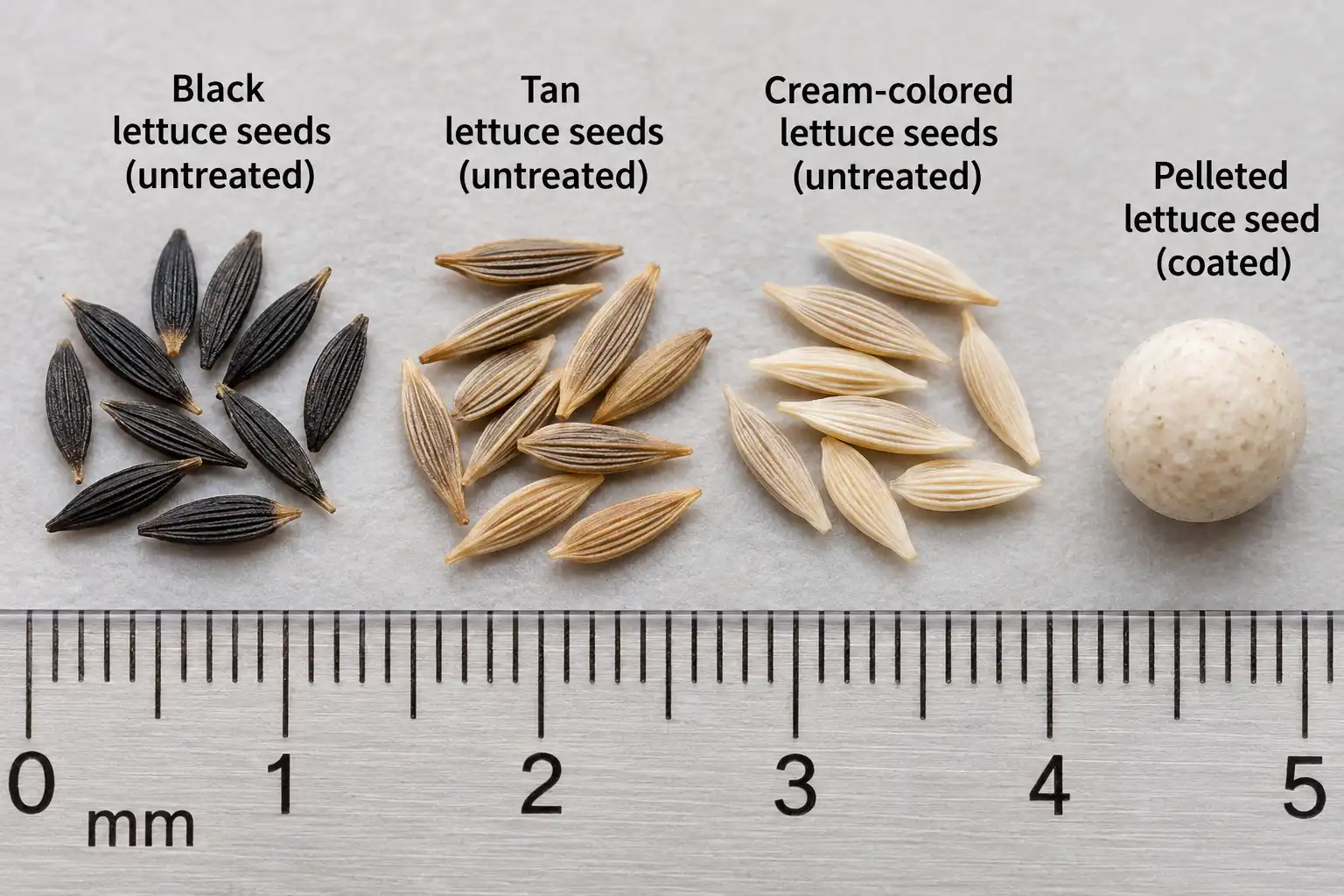
Lettuce seeds are tiny, narrow, and flattened, resembling miniature grains of rice with tapered ends. Most are approximately 1/8 inch long.
Their natural colors range from pale straw or cream to brown and nearly black. Under magnification, the surface may show fine lengthwise ridges.
The University of Florida’s lettuce identification guide confirms that lettuce seeds have tapered ends and may be straw-colored or black.
Not every lettuce seed looks like this. Commercially pelleted seeds have an added coating that makes them larger and rounder. They may also be brightly colored.
Illinois Extension explains that pelleting makes small seeds easier to handle and space accurately.
Seed color alone cannot identify the lettuce variety or predict the color of its mature leaves.
What Do Lettuce Seedlings Look Like When They First Sprout?
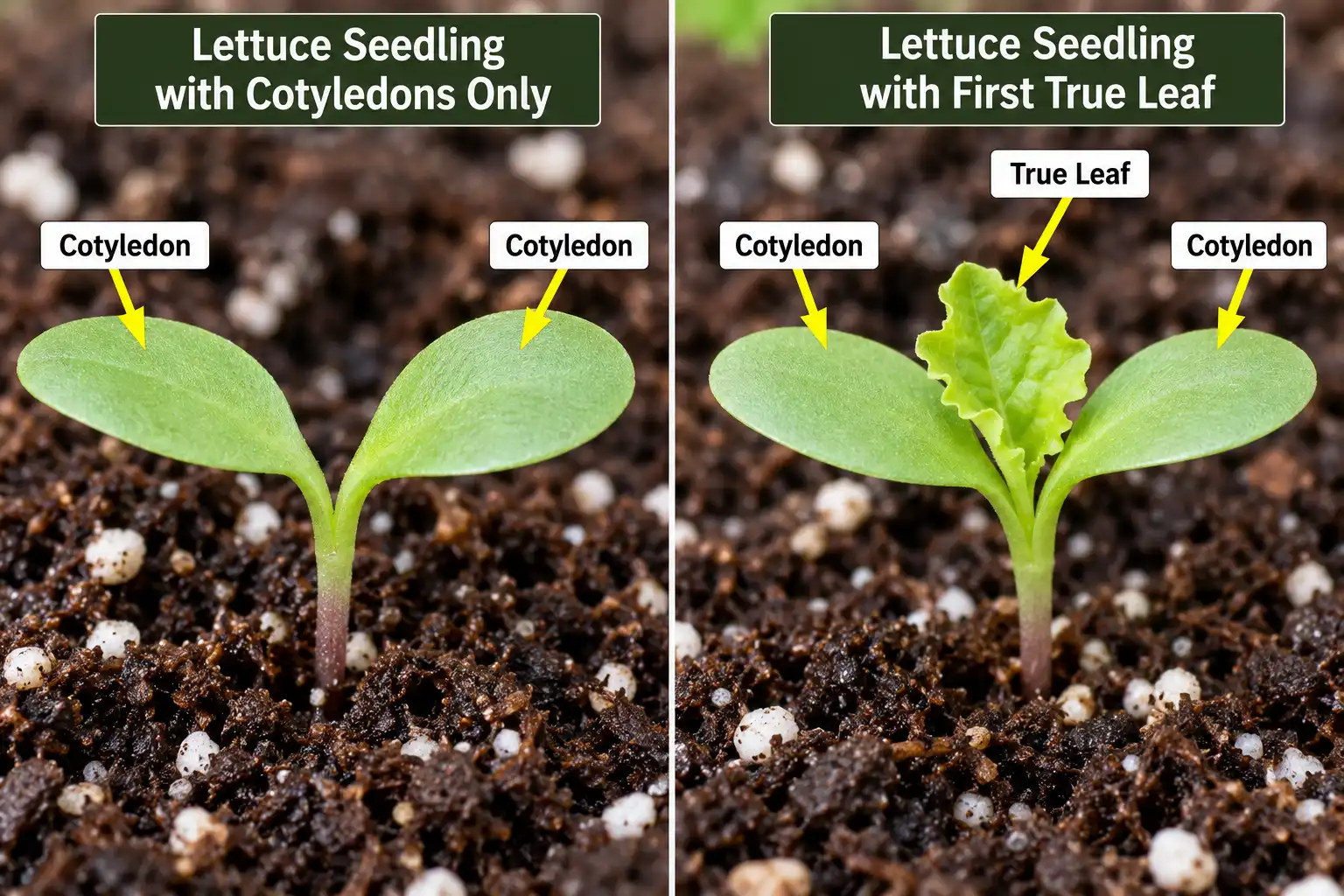
Newly emerged lettuce seedlings have two smooth seed leaves, called cotyledons, supported by a thin stem.
These leaves usually have:
- Shape: Oval, oblong, or slightly spoon-shaped.
- Edges: Smooth, without the pronounced ruffles of mature lettuce.
- Color: Usually light to medium green, sometimes with reddish pigmentation.
- Arrangement: Two leaves growing opposite each other.
- Stem: Thin, tender, and generally pale green.
The cotyledons often resemble tiny paddles rather than familiar lettuce leaves. Their appearance is similar across romaine, butterhead, iceberg, and looseleaf lettuce.
What Do the First True Leaves Look Like?
The first true leaf grows from the center between the two cotyledons.
It usually has a broader shape and more noticeable surface texture. Depending on the variety, its edges may be smooth, gently wavy, toothed, or slightly lobed.
Additional true leaves form a low-growing cluster called a rosette. As these leaves expand, the cotyledons eventually yellow and die back naturally.
Lettuce Seedling Growth Stages: What to Expect
Lettuce generally sprouts within 7 to 10 days under favorable conditions, although cooler soil can delay emergence.
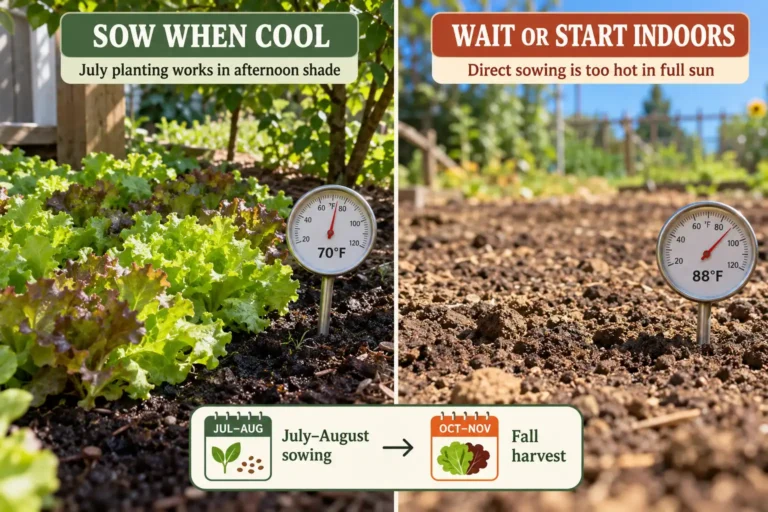
According to Utah State University Extension, lettuce seeds germinate best at soil temperatures of 55-65°F. Temperatures above 80°F reduce germination.
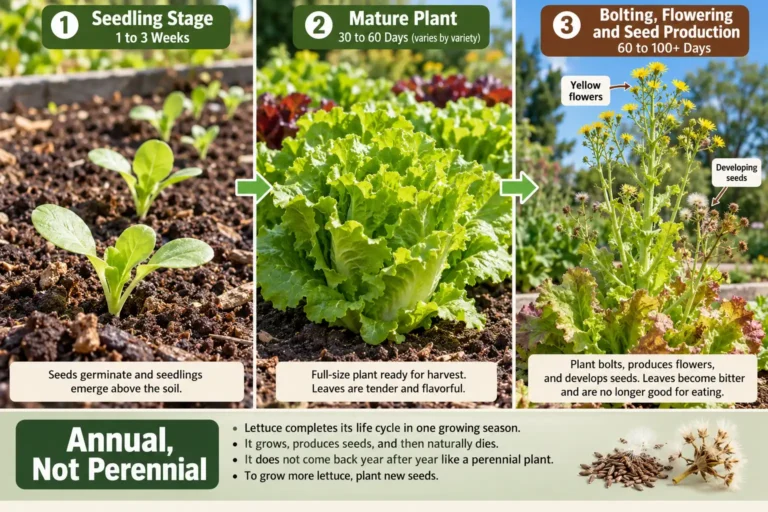
| Growth stage | Approximate timing | What you should see |
|---|---|---|
| Germination | First several days | A tiny root develops below the soil before the shoot emerges. |
| Cotyledon stage | Around 7-10 days after sowing | Two small, smooth, oval leaves open above the surface. |
| First true leaves | During the following days to weeks | New, broader leaves emerge between the cotyledons. |
| Established transplant | Often 5-6 weeks after sowing | Four to six mature leaves and a developed root system. |
These times are guides, not fixed deadlines. Seed freshness, moisture, light, and temperature affect development.
For identification, leaf stage is more useful than seedling height or age.
Do Different Lettuce Varieties Look Different as Seedlings?
Most lettuce types look alike until their true leaves begin developing.
As additional foliage appears, the variety’s characteristic leaf shape and pigmentation become easier to recognize.
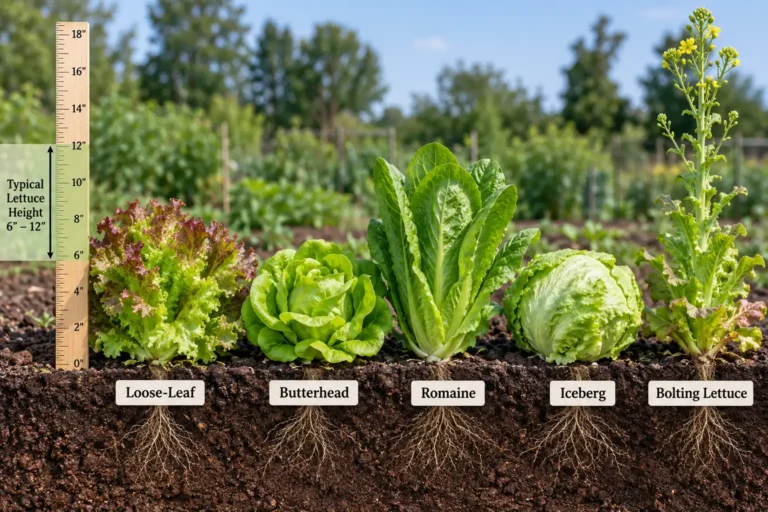
| Lettuce type | Appearance as true leaves develop |
|---|---|
| Romaine | More elongated leaves that gradually develop an upright growth habit. |
| Butterhead | Broad, soft-looking, rounded leaves forming a loose rosette. |
| Looseleaf | Open growth with leaves that may become wavy, frilled, or deeply lobed. |
| Crisphead (iceberg) | Broad green leaves that eventually form a compact, overlapping head. |
| Red-leaf lettuce | Green to reddish or bronze foliage, often becoming more colorful with growth. |
For example, ‘Black Seeded Simpson’ develops light-green, frilled foliage, while ‘Red Sails’ produces bronze-red, ruffled leaves. ‘Buttercrunch’ forms a soft butterhead.
These varieties appear in Utah State University’s lettuce recommendations and Mississippi State University Extension’s descriptions.
However, you cannot reliably identify an exact cultivar from cotyledons alone.
How Can You Tell Lettuce Seedlings From Weeds?
Lettuce seedlings are easiest to identify by combining leaf shape, planting location, and the first true leaves.
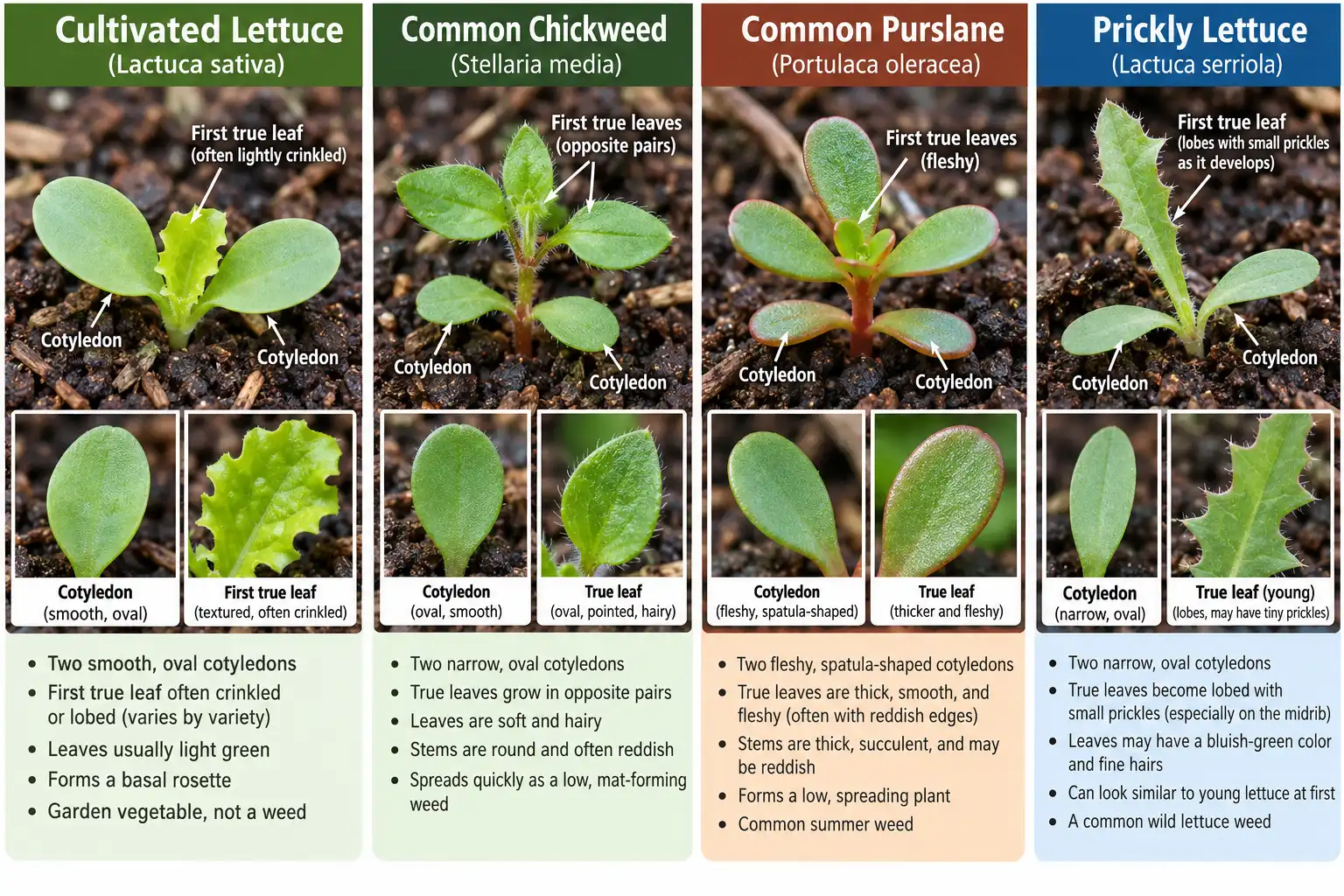
Weed seedlings may also produce two smooth seed leaves. Therefore, cotyledons alone are not definitive proof.
Use this comparison before removing an unfamiliar sprout.
| Plant | Key identifying features |
|---|---|
| Cultivated lettuce | Two oval cotyledons, followed by broader true leaves forming a central rosette. |
| Common chickweed | Pointed seed leaves, opposite pairs of true leaves, and a fine line of stem hairs. |
| Common purslane | Thick, succulent seed leaves, sometimes reddish, followed by fleshy foliage. |
| Prickly lettuce | Very similar to cultivated lettuce early on; older rosette leaves develop stiff bristles underneath the central vein. |
| Grass weeds | Usually emerge with one narrow, blade-like seed leaf rather than an oval pair. |
The University of California’s IPM weed identification resources document the characteristics of wild prickly lettuce, a particularly difficult look-alike.
A Simple Identification Method
First, check whether the seedling is growing exactly where you planted lettuce.
Next, examine the two seed leaves and wait for true leaves to emerge.
Finally, compare the developing foliage with the labeled variety. If identity remains uncertain, leave the plant until additional leaves develop.
This prevents accidental crop removal, especially in beds containing mixed salad greens.
What Does a Healthy Lettuce Seedling Look Like?
Healthy lettuce seedlings have firm stems, expanding leaves, and steady new growth.
Their leaves should appear open rather than severely curled or wilted. The stems should support the foliage without collapsing.
Compare these symptoms before making changes.
| Appearance | Possible cause | What to do |
|---|---|---|
| Long, thin, stretched stems | Insufficient light | Increase light intensity and keep appropriate grow lights near the foliage. |
| Seedlings fall over with pinched, dark stems | Damping-off disease | Remove affected seedlings and improve drainage and sanitation. |
| Yellowing cotyledons but healthy new leaves | Normal aging | Leave the plant alone if new foliage remains healthy. |
| Yellowing true leaves and consistently wet soil | Root stress or poor drainage | Check moisture and drainage before adding fertilizer. |
| Seedlings emerge unevenly | Variable moisture, temperature, or seed viability | Check seedbed conditions and use fresh seed when needed. |
The University of Minnesota Extension’s damping-off guidance describes water-soaked, narrowed stems and seedling collapse as typical disease symptoms.
To prevent these problems, use clean seed-starting mix, drainage holes, and controlled watering. Indoor seedlings generally benefit from 12-16 hours of suitable artificial light daily.
A seedling that collapses because its stem has rotted usually will not recover. Healthy but slightly stretched seedlings may improve with stronger lighting.
When Should Lettuce Seedlings Appear in Different US Regions?
Lettuce germination depends more on soil temperature than the calendar or USDA hardiness zone.
In the Upper Midwest and other northern regions, spring planting takes advantage of cool soil and moderate temperatures. Fall sowing also works when plants have sufficient time to develop before persistent freezing weather.
In Southern states such as Mississippi, spring and fall are generally more suitable than midsummer. Mississippi State University Extension recommends these cooler growing periods.
In hot Southwestern locations, late-summer soil temperatures can remain too high for reliable germination even when fall planting is approaching.
For every region, measure the seedbed temperature rather than relying only on air temperature. Once established, hot weather can also cause lettuce to bolt. Plan later plantings with lettuce bolting prevention in mind.
What Should You Do After Lettuce Seedlings Appear?
Once the cotyledons open, give seedlings adequate light, steady moisture, and room to develop.
Follow these steps:
- Check light: Move indoor trays under suitable grow lights promptly. Follow the fixture’s recommended distance from the foliage.
- Control moisture: Keep the growing mix evenly moist, not saturated. Use gentle watering to avoid disturbing young roots.
- Watch true leaves: Wait for recognizable foliage before removing unidentified sprouts.
- Thin crowded seedlings: Utah State Extension recommends thinning when lettuce has three to four true leaves. Snip unwanted seedlings at soil level to protect neighboring roots.
- Prepare transplants: Move established seedlings with four to six mature leaves into the garden after gradually acclimating them to outdoor conditions.
Final plant spacing depends on the lettuce type. Mississippi State Extension recommends at least 4 inches for leaf lettuce, 6 inches for butterhead, and 10-12 inches for crisphead.
For a 10-foot row, those distances allow approximately 30, 20, and 10-12 plants, respectively.
Avoid heavy watering simply because seedlings appear small. As plants develop, calculate crop water needs using weather, growing area, and soil conditions.
Likewise, do not assume yellow seedlings always need fertilizer. For established outdoor beds, use soil test results to guide fertility decisions instead of applying nutrients without a diagnosis.
FAQs about Lettuce Seedling Stages
Can lettuce seedlings be red or purple?
Yes, some red-leaf lettuce cultivars develop reddish, bronze, or purple pigmentation as their true leaves expand. Check the variety label and overall plant health before assuming this natural coloration indicates a nutrient deficiency.
What if my lettuce seedling has only one leaf?
A newly emerging lettuce seedling may temporarily show one visible cotyledon before the second opens, or one may be damaged. Wait for the central true leaf to develop before deciding whether the plant is abnormal.
Why are my lettuce seedlings so small after one week?
Small seedlings after one week are normal when emergence has only recently occurred, especially in cooler soil. Look for healthy cotyledons and new growth rather than expecting a particular height within seven days.
Should I remove the first two leaves from lettuce seedlings?
No, the cotyledons help support early growth and should remain attached while the true leaves develop. They eventually yellow and die back naturally, so removing healthy cotyledons offers no benefit to the young plant.
Why are my lettuce seeds not sprouting?
Poor germination can result from old seed, irregular moisture, unsuitable temperatures, or excessive planting depth. Illinois Extension also notes that some light-sensitive lettuce varieties should be pressed onto prepared soil rather than buried, so follow your seed packet.
Can you eat lettuce seedlings after thinning?
Yes, young thinnings from positively identified edible lettuce can be used as tender greens when grown with food-safe materials. Avoid eating unidentified seedlings, diseased plants, or seedlings grown from seed treated with chemicals not intended for edible sprouts.
Key Points for Identifying Young Lettuce
Look for two opposite, smooth, oval cotyledons first. Then watch for broader true leaves emerging from the center.
Use planting location and developing leaf characteristics to separate lettuce from weeds. Keep seedlings evenly moist, provide adequate light, and avoid thinning unfamiliar plants until you can identify them confidently.