How Deep Do Lettuce Roots Grow? Depth by Type and Soil
The answer depends on whether you mean the main feeding zone or the deepest root. That difference affects how much soil, water, and growing space your lettuce needs.
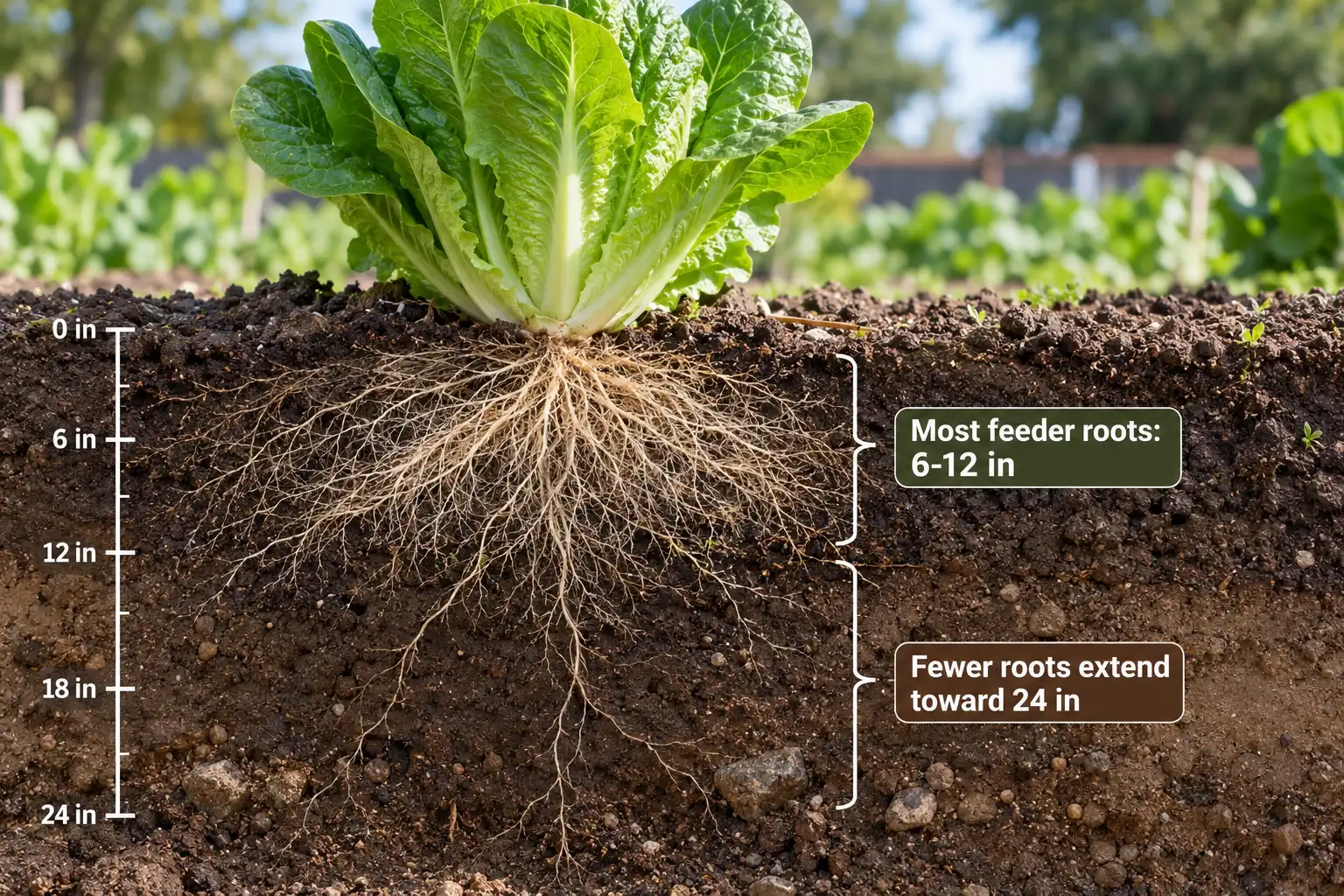
Most lettuce roots grow within the top 6 to 12 inches of soil. Mature field-grown plants can also draw moisture from 12 to 24 inches deep. For containers, 6 to 8 inches of soil can support leaf lettuce, while 9 to 12 inches provides more room and moisture storage.
How Deep Do Lettuce Roots Grow in Garden Soil?
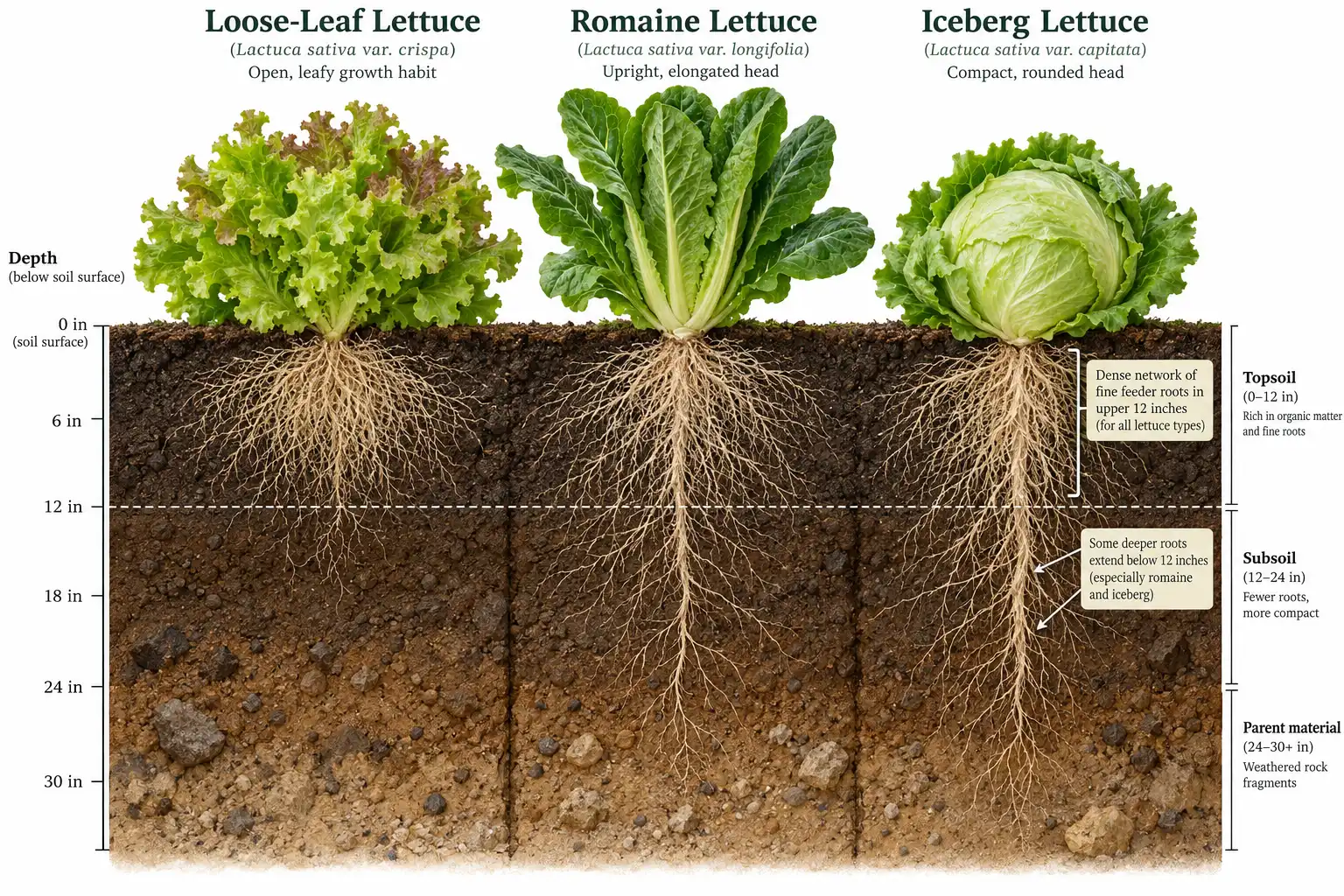
Most lettuce roots remain in the upper 6 to 12 inches of soil, although individual roots can extend considerably deeper.
Utah State University Extension classifies lettuce as a shallow-rooted vegetable with an effective rooting depth of 6 to 12 inches.
Effective rooting depth means the soil layer containing most of the roots. It does not mean that every root stops at 12 inches.
Lettuce develops a central taproot with smaller lateral roots branching into the surrounding soil. These fine roots absorb much of the plant’s water and nutrients.
According to the University of California’s lettuce irrigation guidance, most roots remain within the upper foot of soil. However, mature field-grown lettuce can also extract substantial moisture from the 12 to 24-inch layer.
Therefore, distinguish between:
- 6 to 12 inches: The main root zone used for routine watering and nutrient uptake.
- 12 to 24 inches: A deeper soil layer that some mature plants can access under favorable field conditions.
You do not need 24 inches of potting mix to grow healthy lettuce in a container.
Do Leaf Lettuce, Romaine, and Iceberg Have Different Root Depths?
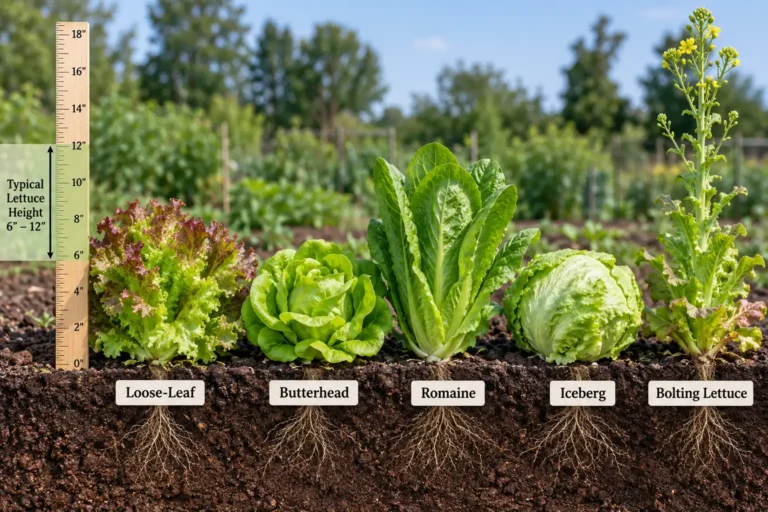
All common lettuce types have shallow root systems, but romaine and iceberg generally develop deeper roots than loose-leaf varieties.
UC IPM notes that romaine and iceberg tend to have deeper roots than leaf lettuce, particularly as plants mature.
| Lettuce type | Typical root distribution | Practical container soil depth |
|---|---|---|
| Loose-leaf lettuce | Most active roots in the upper 6-12 inches when mature | 6-8 inches |
| Butterhead lettuce | Most roots concentrated near the surface | 8-12 inches |
| Romaine lettuce | Most roots in the upper 12 inches; some extend deeper in fields | 9-12 inches |
| Crisphead (iceberg) lettuce | Mainly shallow roots, with deeper moisture uptake possible at maturity | 9-12 inches |
Container depths are practical growing recommendations, not measured root lengths for each lettuce type.
For example, ‘Salad Bowl’ is a loose-leaf cultivar often grown for repeated leaf harvests. ‘Parris Island Cos’ is a larger romaine cultivar generally grown toward a full-sized head. Utah State Extension identifies both cultivars in its lettuce variety guidance.
The harvest stage often matters more than the cultivar name. Lettuce harvested young has less time to develop an extensive root system.
How Does Lettuce Root Depth Change as Plants Grow?
Lettuce roots expand throughout the growing period. Young seedlings use a much smaller soil volume than plants approaching harvest.
During germination and early growth
New seedlings have short, developing roots concentrated near the surface.
Keep the seedbed evenly moist because these roots cannot reach deeper water reserves.
Avoid strong watering that washes seeds away or forms a hard soil crust.
During leaf development
The root network spreads downward and sideways as leaves expand.
Most established plants increasingly use the upper 6 to 12 inches of soil. Utah State Extension notes that directly seeded crops tend to develop deeper roots than transplanted crops.
Protect the root ball when transplanting lettuce so the plant can establish without unnecessary injury.
During heading and maturity
The root system becomes more extensive as the plant approaches harvest.
Mature romaine and head lettuce may access moisture below 12 inches when soil conditions allow.
However, deeper roots do not eliminate the need for moisture near the surface. Water demand also increases during rapid leaf expansion and heading.
How Deep Should Soil Be for Lettuce in Pots and Raised Beds?
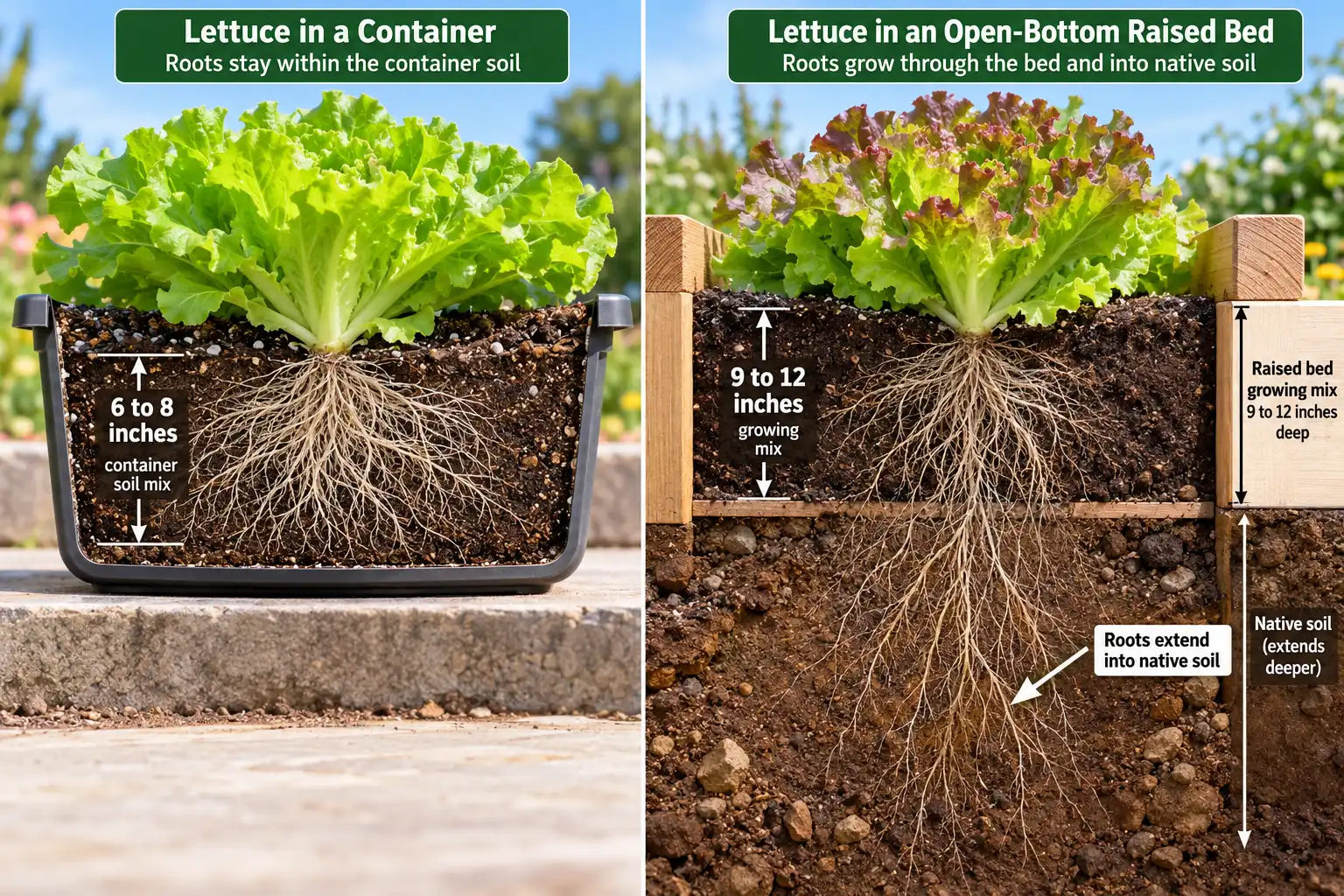
Use at least 6 to 8 inches of potting mix for lettuce. A deeper container gives full-sized plants more moisture storage and reduces how quickly the soil dries.
Growing lettuce in containers
NC State Extension’s container gardening guidance recommends a minimum of 6 to 8 inches of potting mix for lettuce.
Meanwhile, UC Master Gardeners of Contra Costa County recommends 9 to 12 inches for shallow-rooted vegetables, including lettuce.
These recommendations serve different purposes. The smaller depth is a workable minimum. The deeper range provides additional growing space and moisture storage.
Choose a container with drainage holes and enough width for the mature leaves. Avoid adding gravel underneath the potting mix, since it does not improve drainage.
Growing lettuce in raised beds
A raised bed containing 8 to 12 inches of loose, well-drained soil is a practical choice for most lettuce.
If the bed sits directly over healthy native soil, roots may continue growing below the frame.
However, a raised bed placed on concrete or another solid barrier must provide all usable rooting depth within the bed itself.
Measure the actual soil depth, not just the height of the raised-bed frame.
How to Water Lettuce Based on Its Root Depth
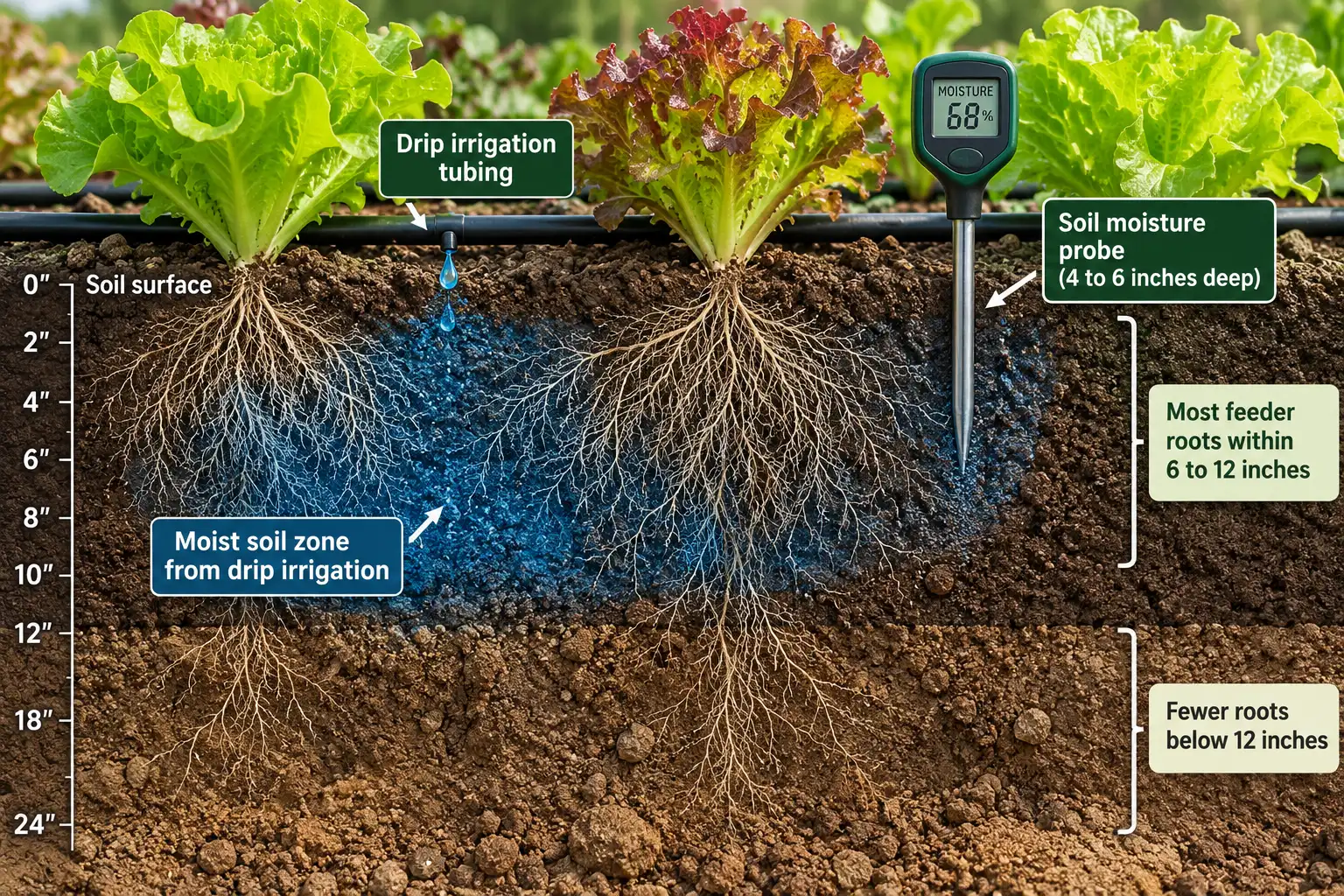
Water lettuce so moisture reaches the active root zone rather than wetting only the soil surface.
Because the roots are relatively shallow, lettuce can suffer water stress before deeper-rooted vegetables show symptoms.
Use these checks to guide watering:
- Check moisture 4 to 6 inches deep. Use a trowel or soil probe near the plants without cutting through the root crown.
- Water when the root zone starts drying. Apply enough water to moisten the soil below the immediate surface.
- Check the wetting depth afterward. Established lettuce should have accessible moisture throughout much of its active root zone.
- Avoid prolonged saturation. Roots also need oxygen, so waterlogged soil can restrict growth.
University of Minnesota Extension uses about 1 inch of rainfall per week as a guideline for lettuce in Minnesota gardens. Sandy soils may need more frequent watering.
That amount is a regional starting point, not a fixed irrigation requirement everywhere.
How much water is one inch?
One inch of water spread evenly across a growing area equals approximately:
| Growing area | Water equivalent |
|---|---|
| 4 × 8-foot bed | 20 gallons |
| 100 square feet | 62 gallons |
| 1 acre | 27,154 gallons |
These are water-volume conversions, not instructions to apply the full amount in one irrigation.
For field production, use weather conditions, rainfall, soil moisture, and crop water requirement calculations to adjust irrigation.
Drip irrigation can help maintain moisture near lettuce roots while limiting unnecessary wetting between rows. Check that the wet soil actually reaches the root zone.
What Affects Lettuce Root Depth in Different Growing Regions?
Soil structure, temperature, and moisture availability affect lettuce root development more directly than USDA hardiness zones.
Upper Midwest and northern states: Lettuce often grows during cooler spring and fall conditions. Soil can retain moisture longer than during hot summer periods. However, sandy beds still need frequent checks.
California Central Coast: Mild coastal conditions can reduce water demand compared with warmer inland production areas. UC IPM recommends adjusting irrigation to local weather and soil conditions.
Southwest and other dry regions: High temperatures, wind, and rapid evaporation increase moisture stress. A shallow root zone makes regular soil moisture monitoring especially useful.
Southeastern states: Sandy soils can drain quickly, while heavier soils may remain wet longer. NC State Extension’s lettuce production guidance emphasizes frequent, moderate irrigation on well-drained sandy soils.
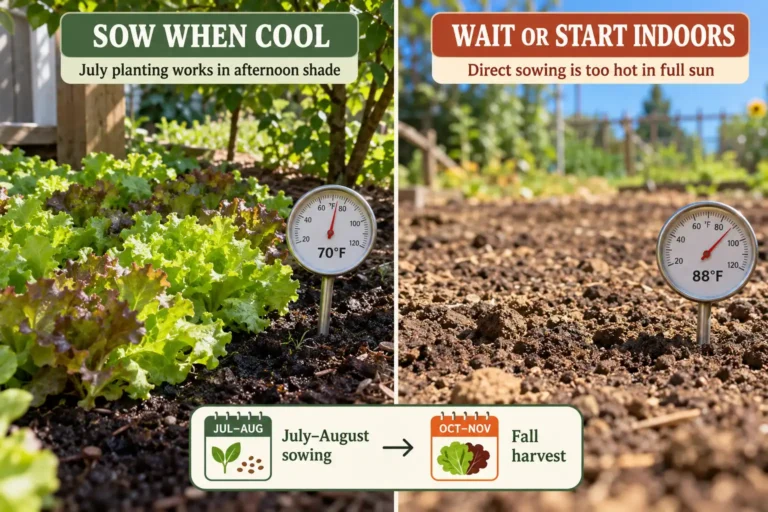
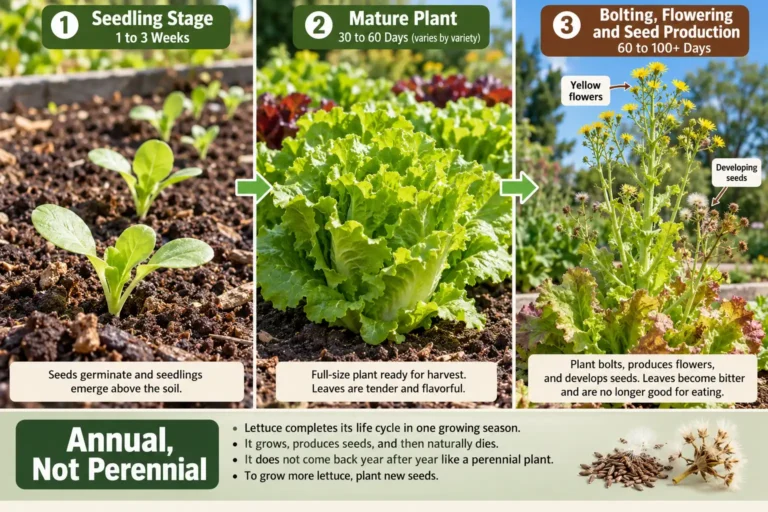
Hot weather can also trigger flowering before harvest. Maintaining moisture supports growth, but it cannot fully prevent heat-induced bolting. In warmer regions, choose a suitable planting season and follow lettuce bolting prevention practices.
How to Protect Lettuce Roots When Planting, Weeding, and Feeding
Lettuce roots are easily disturbed because many fine feeder roots grow close to the soil surface.
Plant at the correct depth and spacing
Do not confuse seed planting depth with root depth.
University of Illinois Extension recommends sowing lettuce seeds 1/4 to 1/2 inch deep. It also suggests thinning leaf lettuce to 4 inches, cos and butterhead to 6 to 8 inches, and crisphead to 10 to 12 inches.
For larger, fully developed leaf plants, Minnesota Extension recommends wider spacing of 10 to 12 inches.
Select spacing based on whether you want young leaves or mature plants. Crowded lettuce competes for moisture, nutrients, and light.
Cultivate shallowly
NC State Extension’s lettuce weed management guide recommends cultivation no deeper than about 1.5 inches.
Pull weeds carefully near established crowns. Avoid digging deeply between closely spaced plants.
Before planting, improve compacted soil and incorporate finished organic matter as needed. The guidance on improving soil fertility with organic amendments can help with bed preparation.
Base fertilizer applications on a soil test rather than assuming slow growth means nutrient deficiency. Use a soil test interpretation guide to identify actual nutrient needs.
Why Are Lettuce Roots Small or Not Growing Well?
Poor root growth may result from limited moisture, saturated soil, restricted space, or disease. Root depth alone cannot identify the cause.
| What you notice | Possible cause | What to check |
|---|---|---|
| Wilting and dry soil several inches down | Water shortage | Moisture through the active root zone |
| Slow growth in dense, hard soil | Compaction | Soil resistance and drainage |
| Yellowing plants in constantly wet soil | Poor aeration or root disease | Drainage and root condition |
| Roots circling inside the pot | Restricted growing space | Container size and root ball |
| Brown, rough, cracked roots | Possible corky root disease | Root symptoms and crop history |
Corky root deserves special attention in affected lettuce-growing areas.
UC IPM’s corky root guidance describes yellow bands that progress into brown, rough, cracked roots. Severe infections can reduce feeder roots and cause stunting or wilting.
However, yellow leaves or wilting alone do not confirm corky root. Water stress, nutrient problems, and other diseases can produce similar aboveground symptoms.
Check soil moisture and drainage first. If roots show unusual discoloration, cracking, or decay, seek a diagnosis through your local Extension service before choosing a treatment.
FAQs about Lettuce Root Depth
Can lettuce grow in only 4 inches of soil?
A four-inch container might produce a brief baby-leaf harvest, but it provides little room or moisture storage for mature lettuce. For more dependable growth, use at least 6 to 8 inches of well-drained potting mix.
How far do lettuce roots spread sideways?
Lettuce produces lateral roots that spread outward from its central root into nearby soil. Their exact reach varies with plant age and growing conditions, so provide enough spacing for the mature lettuce type rather than relying on one fixed root diameter.
Can you transplant lettuce without damaging its roots?
Yes, lettuce usually transplants successfully when you preserve the root ball and avoid tearing young roots. Water after transplanting, keep the original root plug at an appropriate planting depth, and protect seedlings from excessive heat while they establish.
Do lettuce roots continue growing after you harvest leaves?
Yes, roots remain active when you remove outer leaves and leave the growing crown intact. Continued leaf production depends on healthy roots, suitable temperatures, adequate moisture, and enough nutrients to support new growth.
Does hydroponic lettuce need 12 inches of soil depth?
No, hydroponic lettuce grows without soil when its roots receive sufficient water, nutrients, and oxygen. The 6 to 12-inch effective rooting depth applies to soil-based production and does not specify the required depth of a hydroponic reservoir.
Key Points for Your Lettuce Bed
Plan around the upper 6 to 12 inches of soil, where lettuce develops most of its active roots. Choose at least 6 to 8 inches of potting mix for leaf lettuce and consider 9 to 12 inches for larger heads or faster-drying conditions.
Keep that soil evenly moist, ensure adequate drainage, and avoid disturbing shallow roots. These steps matter more than trying to make lettuce roots grow as deeply as possible.