Why Are Rice Paddies Flooded? The Weed Control Advantage
Rice fields often look like shallow lakes, yet the standing water serves several farming purposes. Why are rice paddies flooded when most crops grow in drained soil? The answer involves weed control, rice’s unusual tolerance for waterlogged conditions, and moisture management.
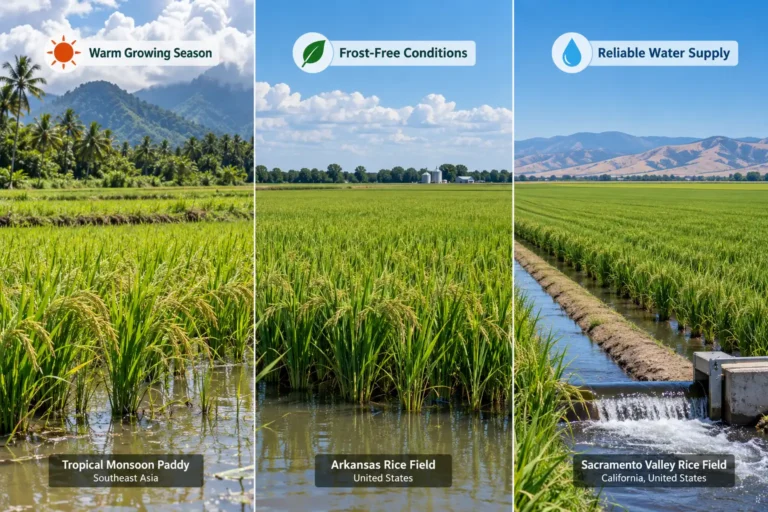
Rice paddies are flooded to suppress weeds and keep soil moist. Rice plants move oxygen from above-water shoots to roots through air-filled tissue. Flooding is useful, but rice can grow unflooded with reliable irrigation and weed control.
Why Are Rice Paddies Flooded? Three Main Reasons
Flooding gives rice a growing advantage that most competing plants cannot tolerate.
1. Floodwater Suppresses Weeds
Weed control is the main practical advantage of flooding rice fields.
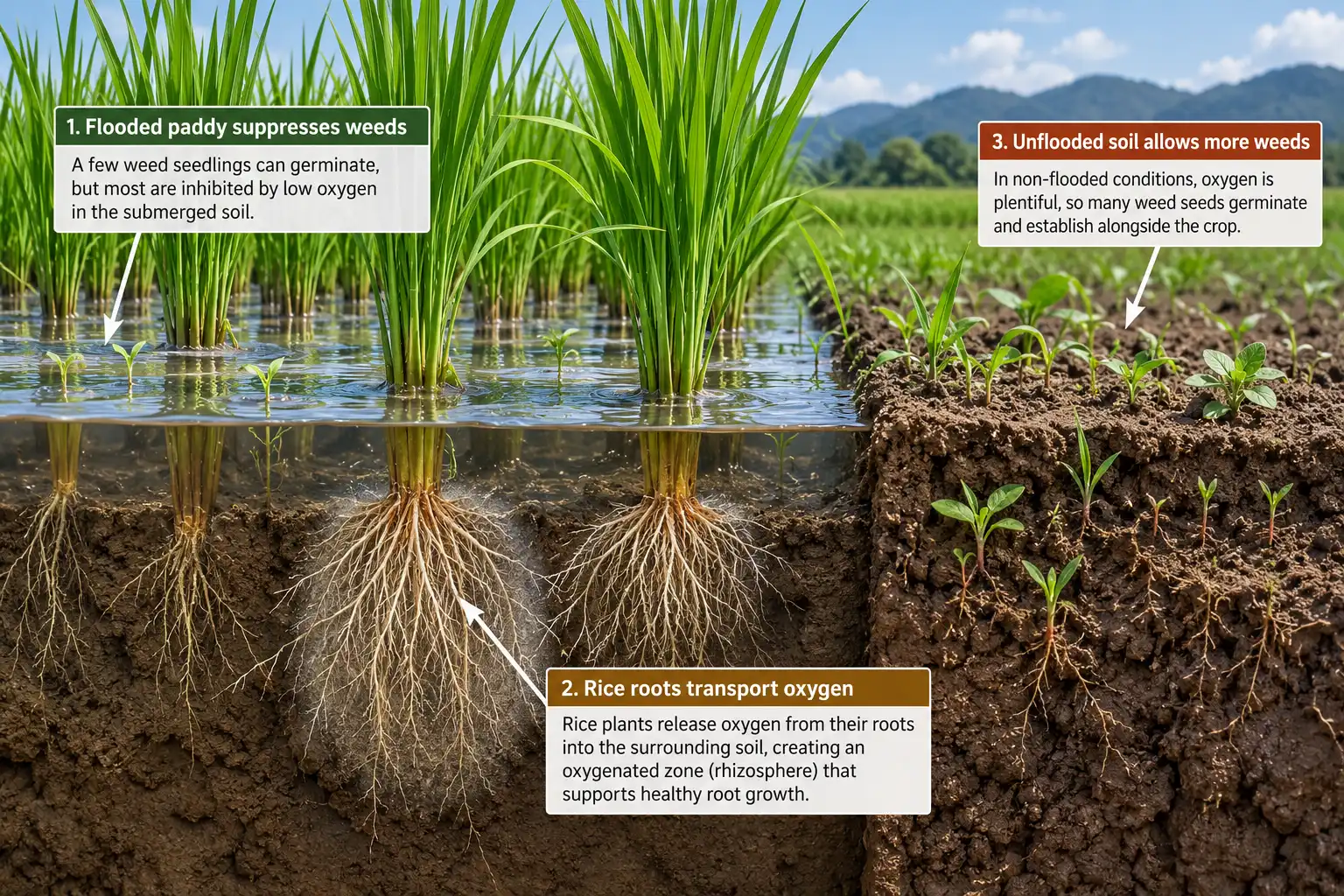
Standing water limits oxygen movement into the soil. Many weed seeds need oxygen to germinate and establish roots.
Rice tolerates these conditions better than most dryland weeds.
According to the University of California’s Integrated Pest Management Program, maintaining an appropriate flood depth restricts weed germination and growth.
Flooding does not eliminate every weed. Aquatic weeds and some adapted grasses can survive.
2. Flooding Maintains Soil Moisture
Rice needs dependable moisture, especially as its reproductive structures develop.
A shallow flood keeps the soil saturated between rainfall or irrigation events. This reduces the chance of moisture stress and uneven growth.
However, standing water is not the same as water absorbed by the crop. Much of the flood serves as a managed water reserve above the soil.
3. Flooding Creates a Consistent Growing Environment
A level flooded field has more uniform soil moisture than a field with wet and dry patches.
Flooding also changes soil chemistry and nutrient availability. These changes can benefit rice growth but create particular fertilizer-management requirements.
How Can Rice Survive in Flooded Soil?
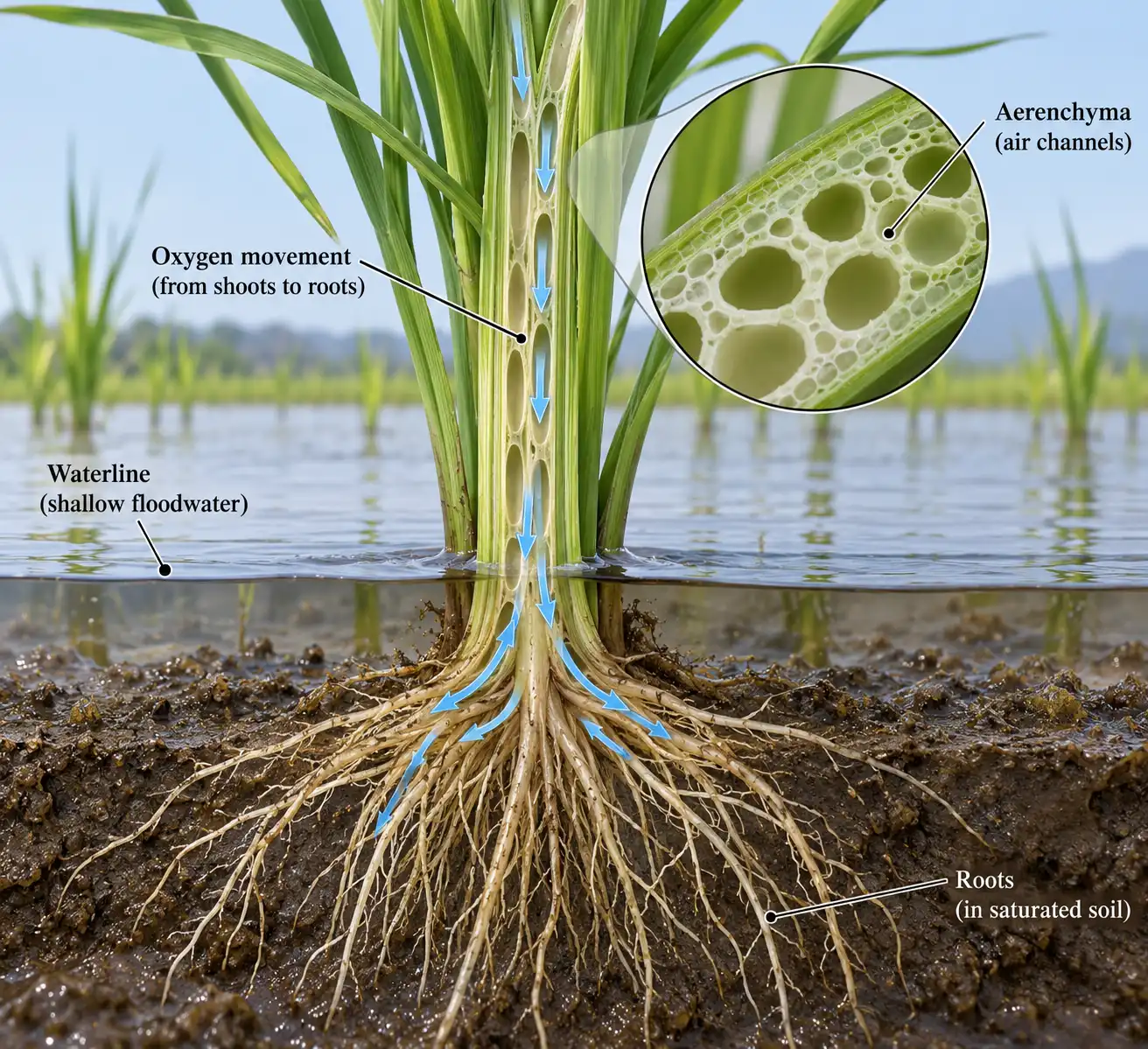
Rice survives waterlogged soil because it has specialized air-filled tissues called aerenchyma.
Most crops depend on oxygen entering the soil through air spaces. When soil remains underwater, those spaces fill with water and oxygen becomes scarce.
Rice has a different adaptation.
Its leaves and stems contain interconnected air spaces that transport oxygen down toward the roots.
The University of Arkansas explains that this internal oxygen transport helps rice survive conditions that suppress many competing plants.
However, rice is not completely aquatic.
The leaves normally remain above the floodwater, where they receive sunlight and exchange gases with the atmosphere.
Deep water that submerges the plant can still cause injury or death.
When Are Rice Paddies Flooded and Drained?
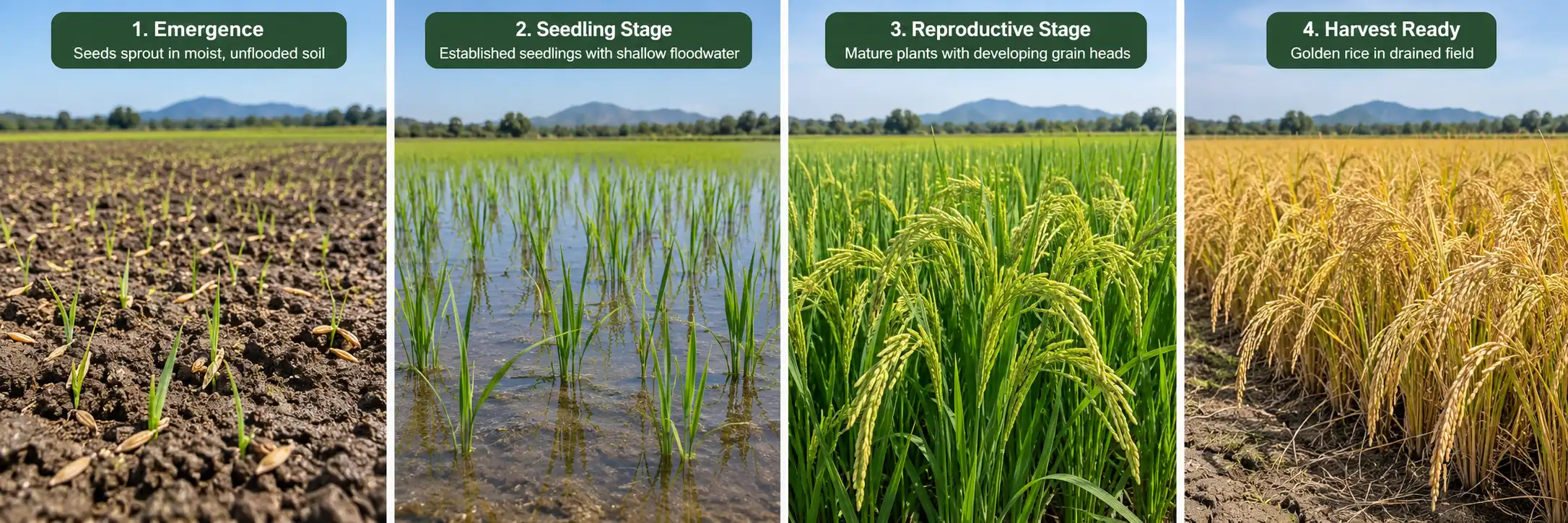
Flooding schedules depend on how the rice is planted, its growth stage, and the irrigation system.
Some rice fields contain water before planting. Others are planted dry and flooded only after seedlings become established.
| Growth stage | Typical water management | Main purpose |
|---|---|---|
| Planting and emergence | Moist soil or shallow flooding, depending on planting method | Establish healthy seedlings |
| Early vegetative growth | Establish and manage a shallow flood | Suppress weeds and maintain moisture |
| Panicle development and flowering | Maintain adequate root-zone moisture | Prevent reproductive water stress |
| Grain filling | Continue irrigation according to crop needs | Support grain development |
| Before harvest | Stop irrigation and allow fields to drain | Prepare soil for harvesting machinery |
These stages are general, not a universal irrigation calendar.
For example, Mississippi State Extension reports that Mid-South rice is commonly drill-seeded and initially grown without standing water.
California water-seeded systems follow different early-season practices.
Draining is usually planned around crop maturity, soil conditions, and harvest access rather than a fixed date everywhere.
How Deep Is the Water in a Rice Paddy?
Most managed rice fields hold only a few inches of water above the soil.
The intended depth varies by region and production system.
According to Mississippi State University Extension’s April 2026 report, traditional flooded rice systems commonly maintain about 2 to 4 inches of standing water.
California’s UC IPM guidance describes permanent floods around 4 to 5 inches in certain rice-management systems.
These are regional practices, not interchangeable recommendations.
Water that is too shallow can expose soil and encourage weeds. Excessive depth can weaken or submerge seedlings.
A level field makes maintaining a consistent depth easier.
How Much Water Does a Flooded Rice Field Hold?
A shallow flood can contain a substantial amount of water because rice fields cover large areas.
The U.S. Geological Survey reports that 1 inch of water covering 1 acre equals approximately 27,154 gallons.
For a 3-inch flood:
| Field size | Water volume |
|---|---|
| 100 square feet | 187 gallons |
| 1,000 square feet | 1,870 gallons |
| 1 acre | 81,462 gallons |
| 5 acres | 407,310 gallons |
| 10 acres | 814,620 gallons |
Calculation: Acres × water depth in inches × 27,154 = gallons.
These figures describe the standing water volume over a level surface. They do not represent the total water needed for a growing season.
Water also leaves through evaporation, plant transpiration, seepage, and drainage.
Rainfall can replace some irrigation. Soil texture and field construction determine how much water escapes.
For seasonal planning, calculating crop water requirements helps separate plant water use from the additional water required to maintain a flooded field.
Why Do U.S. Rice Flooding Practices Differ by Region?
Rice-growing regions use different water-management systems because their soils, planting methods, and water supplies differ.
California
Much of California’s commercial rice production uses water seeding in leveled basins.
Fields are flooded around planting, and prepared rice seed is distributed into the water.
Growers manage water depth to establish seedlings and control weeds. Some programs require temporary drainage for establishment or specific herbicide applications.
Arkansas and the Mid-South
Dry-seeded rice is common across Arkansas, Mississippi, and neighboring rice-producing areas.
Fields begin without a permanent flood. Growers establish it after rice has developed sufficiently.
Mississippi State Extension describes a common system in which rice grows unflooded for roughly six weeks, followed by flooding for approximately 10 to 14 weeks.
These timings vary with planting conditions and management.
Water-Limited Growing Areas
Where irrigation is expensive or groundwater is limited, growers may use intermittent flooding or furrow irrigation.
These systems require closer attention to soil moisture and weed pressure.
Before selecting rice for a new field, evaluate water availability, soil characteristics, and drainage alongside other crop selection considerations.
Can Rice Be Grown Without Continuous Flooding?
Yes. Rice can grow without a permanent layer of standing water.
Three approaches illustrate the differences.
| Method | How water is managed | Main tradeoff |
|---|---|---|
| Continuous flooding | Shallow standing water maintained during much of the season | Reliable weed suppression, but higher irrigation demand |
| Alternate wetting and drying (AWD) | Floodwater recedes to a monitored level before reflooding | Water savings, but closer monitoring is necessary |
| Furrow-irrigated rice | Water moves through furrows rather than covering the entire field | Less standing water, but different weed and fertilizer needs |
AWD is receiving particular attention in U.S. rice production.
In a three-year research comparison, Mississippi State University found that AWD maintained typical yields when water levels were not allowed to fall more than 4 inches below the soil surface.
Under that research treatment, irrigation water use fell by 23% to 39%.
These results are encouraging, but they do not establish one safe drying threshold for every soil or rice variety.
Water management must still protect the crop during flowering and grain filling.
What Are the Disadvantages of Flooding Rice Fields?
Flooding supports rice production, but continuous saturation has environmental and management costs.
High Irrigation Demand
Maintaining standing water requires replacing losses from evaporation, seepage, and crop use.
Pumping costs can become substantial where fields depend on groundwater.
Methane Emissions
Flooded soils contain little available oxygen.
Under these conditions, certain microorganisms break down organic matter and produce methane, a greenhouse gas.
Changes in Arsenic Availability
Flooding can increase the availability of naturally occurring arsenic in some soils, allowing rice plants to absorb more of it.
The USDA Agricultural Research Service reports that alternate wetting and drying can reduce grain arsenic concentrations and methane emissions, although results depend on soil conditions and drying schedules.
More Complex Water Management
Flooding requires levees, controlled outlets, irrigation equipment, and monitoring.
Poor water control can waste water, encourage weed escapes, or damage rice plants.
Common Rice Paddy Flooding Problems and Their Causes
Flooding problems often begin with uneven depth, poor timing, or uncontrolled water loss.
| Problem | Likely cause | What to check |
|---|---|---|
| Weeds growing in patches | Exposed soil or shallow water | Field level and flood depth |
| Weak or submerged seedlings | Flood established too deeply or early | Planting method and seedling stage |
| Water disappearing quickly | Seepage, leaks, or excessive drainage | Levees, gates, and soil permeability |
| Rice showing drought stress | Insufficient soil moisture during a sensitive stage | Root-zone water level and irrigation delivery |
| Uneven crop growth | Differences in soil depth, moisture, or fertility | Field leveling and soil-test results |
Flooding also alters nutrient behavior, so interpreting your soil test results remains useful for identifying fertility concerns.
For unexpected deep flooding, the University of Arkansas Extension emphasizes that rice survival depends on growth stage, submergence duration, and water conditions.
FAQs About Flood Rice Fields
Are Rice Paddies Naturally Flooded?
Some lowland paddies collect seasonal rainfall or river water, but many commercial rice fields depend on managed irrigation. Pumps, channels, levees, and drainage gates allow growers to maintain water depths more consistently than rainfall alone.
Why Are Rice Fields Separated by Small Earthen Walls?
The earthen walls, called levees or bunds, divide fields into smaller water-holding basins. They help maintain controlled flooding across sloping land while preventing upper sections from drying and lower sections from collecting excessively deep water.
Can Rice Grow in Ordinary Garden Soil Without Flooding?
Yes, rice can grow in moist garden soil without standing water when temperatures and the growing season suit the variety. Consistent irrigation and weed control become especially important because flooding no longer suppresses competing plants.
Does Flooding Kill Every Weed in a Rice Paddy?
No, flooding suppresses many terrestrial weeds but cannot eliminate aquatic weeds and certain adapted grasses. Successful rice weed management can also require leveling, crop rotation, cultivation, or properly labeled herbicides, depending on the production system.
What Happens if a Storm Completely Submerges Rice?
Complete submergence can damage rice, especially when muddy or stagnant water covers leaves for an extended period. Survival depends on crop stage, water temperature, depth, and duration, so removing excess water may improve recovery.
Key Points for Rice Fields
Rice paddies are flooded mainly because water helps control weeds and maintain dependable soil moisture.
Rice tolerates flooded soil through specialized oxygen-carrying tissues, but it does not require permanent standing water to survive.
For growers, the choice is not simply whether to flood. It is how to match water depth, timing, soil conditions, and weed management to the production system.