How to Grow Wild Rice in Ponds, Lakes, and Backwaters

Wild rice grows in shallow freshwater, where its roots anchor in underwater sediment and its stems rise above the surface. Learning how to grow wild rice starts with choosing suitable water, planting viable seed, and maintaining stable conditions during spring growth.
To grow wild rice, choose a sheltered freshwater pond, lake bay, or backwater with soft sediment and roughly 6 to 36 inches of stable water. Broadcast locally sourced, unprocessed seed in fall so it overwinters underwater and germinates in spring.
What Is Wild Rice, and Which Type Should You Grow?
Wild rice is an annual aquatic grass in the genus Zizania, not the same species as ordinary cultivated rice (Oryza sativa).
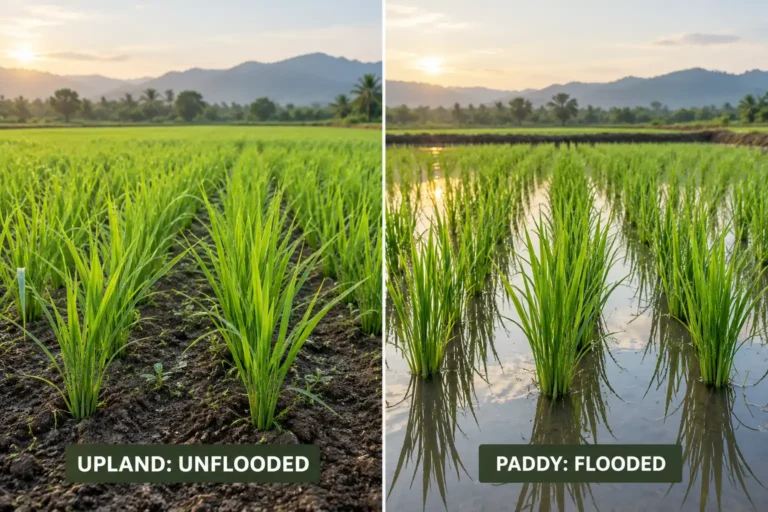
Unlike upland grains, wild rice needs flooded soil during active growth. Its roots develop in submerged sediment, while its leaves eventually extend above the water.
Two North American species are especially relevant:
- Northern wild rice (Zizania palustris): The main grain-producing species in northern Minnesota, Wisconsin, and surrounding Great Lakes waters.
- Southern wild rice (Zizania aquatica): Generally taller, with smaller grains, and associated with rivers, wetlands, and warmer portions of eastern North America.
The U.S. Fish and Wildlife Service identifies shallow lakes, river backwaters, and slow streams as natural habitats for northern wild rice.
For natural planting, choose a locally adapted species and seed source. Avoid introducing unfamiliar seed into established aquatic ecosystems.
Cultivated varieties such as K2 were developed for managed paddies. They are not automatic substitutes for native wild rice in lakes.
Where Does Wild Rice Grow Best?
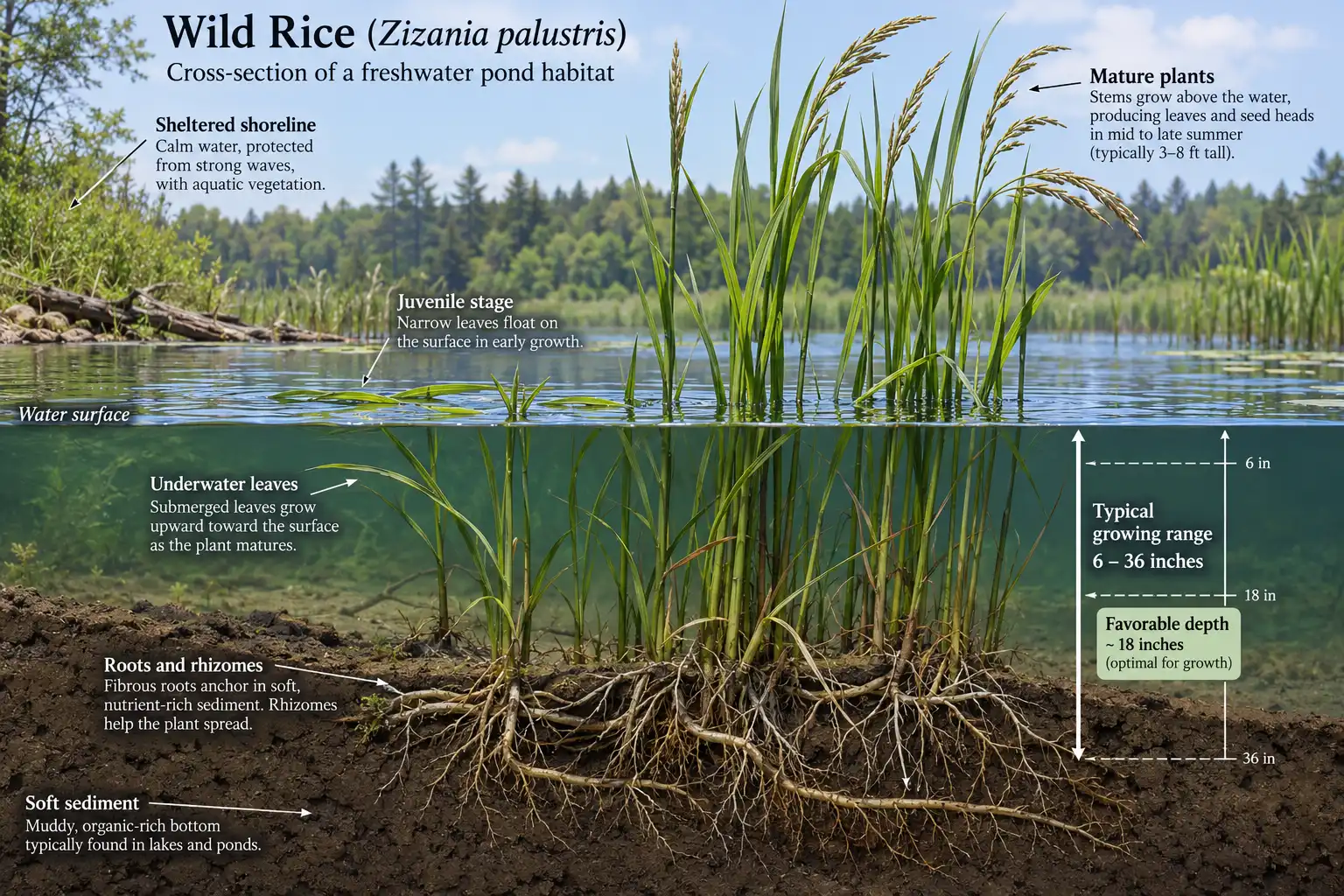
Wild rice grows best in sheltered freshwater with consistent water levels, adequate sunlight, and sediment that supports root growth.
The Minnesota Board of Water and Soil Resources identifies water depths of 6 to 36 inches as suitable for establishment, with approximately 18 inches often favorable.
Wild Rice Growing Requirements
| Growing factor | Preferred conditions | Conditions to avoid |
|---|---|---|
| Water depth | Generally 6 to 36 inches | Deep water with limited light |
| Water movement | Still to gently flowing | Strong currents and repeated waves |
| Sediment | Soft muck, silt, or suitable sandy sediment | Rock, compacted gravel, or unstable sludge |
| Sunlight | Open, well-lit water | Heavy shade and dense floating vegetation |
| Water quality | Freshwater with limited sediment pollution | Saline water and heavily polluted runoff |
| Water level | Relatively stable through spring and summer | Rapid flooding or complete drying |
A pond does not need a thick peat layer. Wild rice can establish in several sediment types.
However, a deep, unconsolidated sludge bed may offer poor anchorage. Check whether seedlings can develop secure roots.
Check Planting Permissions Before Adding Wild Rice
Get permission before introducing wild rice into public waters, managed wetlands, or waters where you do not control the bed.
Owning shoreline property does not necessarily mean you can introduce aquatic vegetation.
The Minnesota DNR aquatic plant management program requires permits to collect or plant aquatic plants in public waters.
Wisconsin regulations differ. The Wisconsin DNR advises obtaining permission from landowners or managers where private waterbeds are involved.
Before seeding:
- Confirm who manages the waterbody and whether planting approval is required.
- Ask whether locally sourced seed or particular species are required.
- Check for protected native vegetation and existing wild rice populations.
- Avoid moving aquatic weeds, animals, or untreated water between waterbodies.
Wild rice, known as manoomin in Ojibwe, also has substantial cultural importance. Respect tribal management, treaty rights, and local harvesting rules.
When Should You Plant Wild Rice?
Fall is generally the best planting season for northern wild rice because its seeds need a prolonged cold, wet period before germination.
In natural stands, ripe seeds fall into water during late summer and remain submerged through winter.
The following spring, they begin germinating as water temperatures rise.
According to the University of Wisconsin-Madison wild rice production guide, northern wild rice requires at least about three months of moist, near-freezing conditions to break seed dormancy.
Regional Planting Considerations
| Region or growing system | Planting guidance |
|---|---|
| Minnesota, Wisconsin, Upper Michigan | Broadcast fresh seed from late-summer ripening through fall, before ice formation |
| Other Great Lakes and northern inland waters | Favor fall seeding where local species and winter conditions are suitable |
| Northeastern and Mid-Atlantic backwaters | Match the locally native species and water-level cycle; confirm seasonal timing with local conservation staff |
| Western commercial paddies | Follow regional paddy production guidance for seed treatment, flooding, and planting |
| Mild-winter regions | Natural winter chilling may be insufficient; use properly cold-conditioned seed and regional guidance |
USDA hardiness zones alone do not determine suitability. Wild rice responds strongly to water depth, winter chilling, summer temperature, and day length.
Can You Plant Wild Rice in Spring?
Yes, but spring planting requires seed that has already completed cold, wet dormancy treatment.
Keep seed submerged in clean water at approximately 33 to 35°F for at least three months before sowing.
Spring planting is less convenient because improperly stored seed can lose viability. For natural ponds and lakes, fall broadcasting is generally the simpler choice.
How to Choose and Store Wild Rice Seed
Use fresh, mature, unprocessed wild rice seed intended for planting.
Commercially packaged wild rice sold as food is commonly dried, parched, or otherwise processed. Such grain is unsuitable for germination.
The Wisconsin DNR specifically recommends unfinished rice for planting natural waters and advises against using commercially grown paddy rice for that purpose.
Choosing Seed
Select seed that meets these requirements:
- Identified as Zizania palustris or the locally appropriate Zizania species.
- Collected from a suitable, authorized source.
- Unprocessed and maintained under wet storage conditions.
- Free of unwanted aquatic vegetation and visible contamination.
- Accompanied by seed-source information.
Lake-origin seed is preferable for lake restoration when a suitable local source is available. River-origin seed may be better suited to comparable flowing-water habitats.
Storing Seed Without Losing Germination
Wild rice seed must remain wet.
For temporary storage, place it in a breathable mesh bag submerged in clean water.
For longer controlled storage, the University of Wisconsin-Madison guide describes maintaining seed in water at approximately 33 to 35°F. It recommends changing storage-tank water every three to four weeks.
Do not let the seed dry out or freeze solid.
For a stored batch, a small germination test can help identify problems before large-scale planting. Cold-conditioned seed can be placed in warmer water and checked for germination.
How Much Wild Rice Seed Do You Need?
A reference rate for establishing wild rice in natural aquatic habitat is 50 pounds of viable seed per acre.
The Minnesota Board of Water and Soil Resources gives this rate for restoration seeding. It also recommends testing small areas before expanding planting.
This is not a universal rate for every species or commercial paddy. Adjustments may be needed for seed quality and site conditions.
Wild Rice Seed Rate Calculator
Use the actual shallow-water planting area, not the entire pond or lake surface.
Seed needed (lb) = Planting area (sq ft) ÷ 43,560 × 50
| Planting area | Seed at 50 lb/acre |
|---|---|
| 200 sq ft | 0.23 lb (3.7 oz) |
| 500 sq ft | 0.57 lb |
| 1,000 sq ft | 1.15 lb |
| 0.25 acre | 12.5 lb |
| 1 acre | 50 lb |
For example, a shallow planting strip measuring 20 feet by 50 feet covers 1,000 square feet.
That area needs approximately 1.15 pounds of seed at the reference rate.
Natural plantings do not require fixed row spacing. Even broadcasting across suitable habitat is more relevant than arranging individual plants.
Avoid increasing the seed rate simply because an unsuitable site has failed before.
How to Plant Wild Rice in Ponds, Lakes, and Backwaters
Plant wild rice by broadcasting viable seed into shallow water during fall and allowing it to settle naturally into the sediment.
Step 1: Select a Suitable Planting Area
Choose a sheltered location with soft sediment, open sunlight, and consistent seasonal water depth.
Measure water depth at several points. Mark the shallow area that remains flooded during spring and summer.
Avoid strong currents and exposed shorelines.
Step 2: Prepare the Planting Location
Remove floating trash where permitted. Avoid unnecessary excavation or disturbance of established native plants.
If dense vegetation occupies the site, seek appropriate management guidance before making changes.
Do not automatically remove water lilies, cattails, or other native aquatic plants.
Step 3: Keep the Seed Wet
Transport the seed in a water-filled container or submerged mesh bag.
Drain excess water only when ready to distribute the seed. Do not leave wet seed exposed to drying conditions.
Step 4: Broadcast the Seed Evenly
Scatter small handfuls across the selected planting area.
For larger permitted areas, distribute the seed from a canoe or other suitable watercraft while avoiding disturbance of existing vegetation.
The Minnesota Board of Water and Soil Resources notes that fully ripe seeds naturally sink. Mixing them into mud balls is unnecessary.
Step 5: Leave the Sediment Undisturbed
Allow seeds to settle and overwinter underwater.
Do not rake or deeply bury seeds in a natural lakebed. Avoid activities that disturb the planting area.
Record the date, seed source, planting area, and approximate water depth. These details help explain the following spring’s results.
Planting Wild Rice in Different Waterbodies
Ponds, lakes, and backwaters can all support wild rice, but each presents different water-management problems.
Growing Wild Rice in a Pond
Start along a shallow, sunny pond margin where water remains present throughout the growing season.
A pond with an inlet, outlet, or groundwater movement may provide better conditions than an isolated basin with poor water exchange.
A small test planting is preferable to broadcasting seed across the entire pond.
Watch for falling water levels during dry summer periods. Young plants cannot survive extended exposure to dry sediment.
Growing Wild Rice in a Lake
Choose sheltered bays rather than open, wind-exposed shorelines.
Protected areas near gentle inlets and outlets often provide favorable conditions.
Check seasonal depth before planting. A site that looks shallow during autumn may become too deep during spring runoff.
Avoid boating routes where repeated wakes can damage floating young leaves.
Growing Wild Rice in Backwaters
Select quiet side channels, river-edge wetlands, or sheltered backwater basins with slow water movement.
A gentle current can support suitable growing conditions. Strong floodwater can displace seed or uproot seedlings.
Evaluate both spring flooding and late-summer drawdown.
Backwaters with repeated rapid changes in water depth are less dependable than stable, sheltered areas.
How to Care for Wild Rice After Planting
The most important growing-season task is maintaining relatively stable water depth, especially while young leaves float on the surface.
Wild rice does not need frequent handling in a suitable natural wetland.
Protect the Floating-Leaf Stage
Early leaves develop underwater and then spread across the surface.
During this period, roots are not yet strongly anchored.
A sudden increase in water depth can submerge floating leaves and interfere with growth. Falling water levels may leave young plants exposed.
Avoid unnecessary boating, sediment disturbance, and sudden water-level adjustments.
Manage Competing Vegetation
Watch for thick growth of water lilies, pondweeds, or invasive plants that block sunlight.
Competition is especially harmful while wild rice seedlings are small.
Do not use aquatic herbicides without confirming current label permissions and obtaining required waterbody approvals.
Avoid Unnecessary Fertilization
Do not add fertilizer to a natural pond or lake simply to stimulate wild rice growth.
Added nutrients can increase algal growth and reduce underwater light.
Managed agricultural paddies require a separate fertility plan based on soil testing and local recommendations.
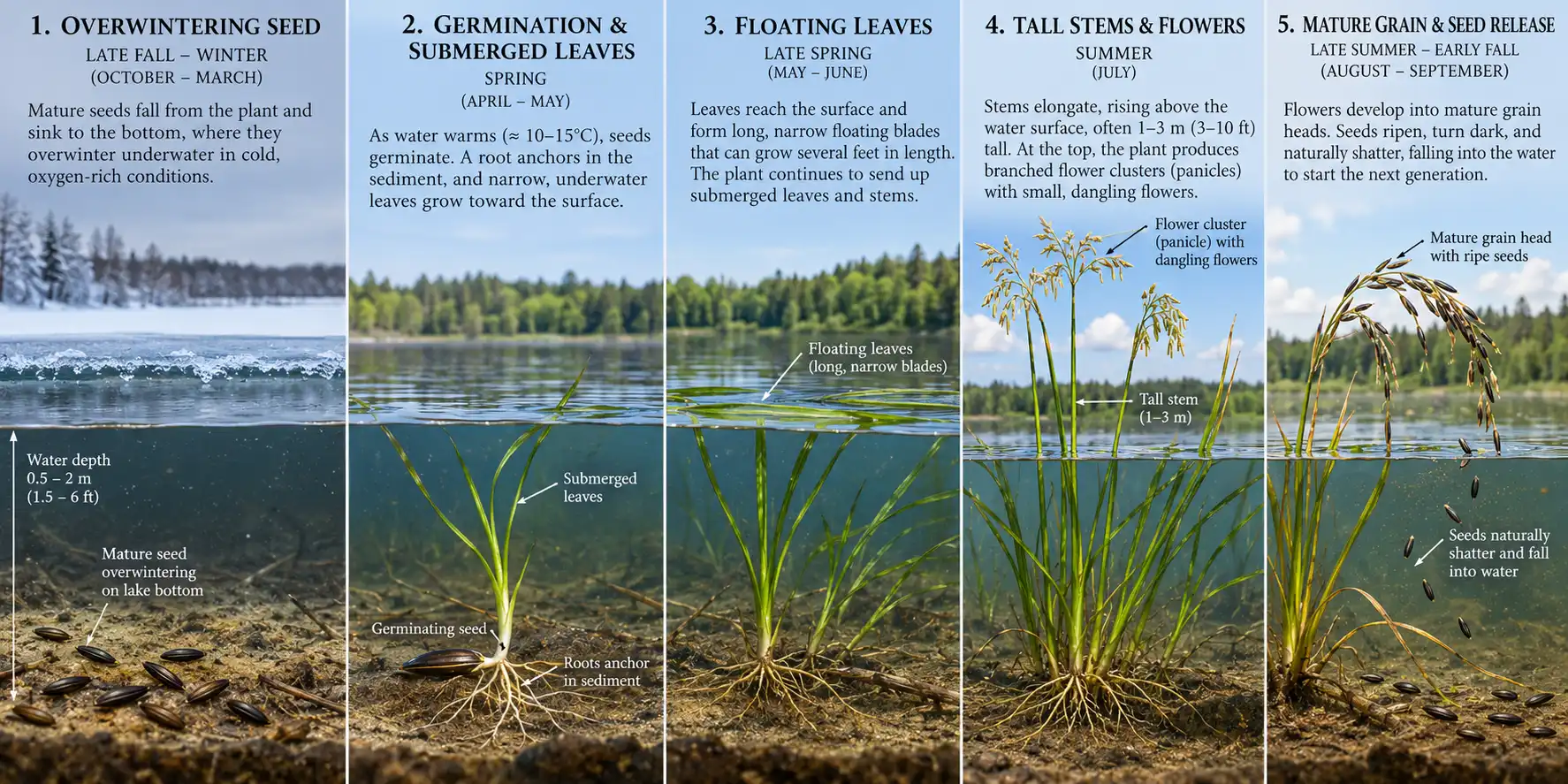
Wild Rice Growth Stages and Seasonal Timing
Wild rice completes its life cycle within one growing season after seed dormancy has been satisfied.
The University of Wisconsin-Madison guide describes approximately 110 days to maturity under Minnesota growing conditions.
Actual timing changes with weather, species, water depth, and latitude.
| Growth stage | Typical northern seasonal timing | What happens |
|---|---|---|
| Seed dormancy | Fall through winter | Seed remains submerged and undergoes cold conditioning |
| Germination | Spring, often around 42 to 45°F water temperature | Roots and underwater leaves develop |
| Floating-leaf stage | Late spring to early summer | Long leaves spread across the water surface |
| Upright growth | Early to midsummer | Stems and leaves extend above the surface |
| Flowering | Summer | Flowering heads develop and wind pollination occurs |
| Seed ripening | Late August through September | Mature grains gradually loosen and fall |
These dates describe common Upper Midwest patterns, not fixed planting or harvest dates for every region.
How to Prevent Common Wild Rice Growing Problems
Most establishment failures begin with unsuitable water conditions, nonviable seed, or competition during early growth.
Check the growing environment before planting additional seed.
| Problem | Likely causes | What to check or change |
|---|---|---|
| No seedlings appear | Dried or processed seed, insufficient chilling, unsuitable habitat | Confirm seed viability and winter storage |
| Seedlings appear, then disappear | Sudden flooding, strong waves, grazing | Check water-level records and disturbance |
| Plants become yellow and stunted | Exposure of flooded roots, nutrient imbalance, unsuitable sediment | Check water depth and growing conditions |
| Floating leaves remain weak | Poor light, excessive depth, dense competing plants | Evaluate shade and spring water levels |
| Stems fall over | Deep or changing water, weak rooting, disease | Examine sediment, water history, and stems |
| Brown spots develop on leaves | Possible brown spot disease | Inspect lesions and obtain a reliable diagnosis |
Brown spot can affect cultivated wild rice. University of Wisconsin-Madison describes small brown oval lesions, often with yellow margins.
For help distinguishing disease from nutrient or water damage, use a crop disease identification guide and confirm unfamiliar symptoms with local extension staff.
Do not apply a fungicide or other pesticide to aquatic habitat without a current legal label and necessary authorization.
Can You Grow Wild Rice in a Managed Paddy?
Yes. Wild rice can be grown in diked, flooded agricultural fields, but paddy production requires different planting and water-management practices.
A managed paddy allows growers to control water depth, prepare soil, and manage crop density.
Natural Waterbody vs. Managed Paddy
| Practice | Natural pond or lake | Managed paddy |
|---|---|---|
| Establishment | Broadcast into suitable water | Broadcast or drill into prepared soil |
| Seed rate | About 50 lb/acre as a restoration reference | Typically 30 to 45 lb/acre in the UW production guide |
| Seed placement | Allow seed to settle naturally | Incorporate approximately 1 to 3 inches deep when seeding drained soil |
| Water depth | Usually 6 to 36 inches | Commonly about 6 to 14 inches |
| Water control | Mostly determined by natural hydrology | Managed with water supply and drainage structures |
| Fertility | Avoid routine nutrient additions | Soil-test-based nutrient management |
The paddy rates come from the University of Wisconsin-Madison production guide and should not be substituted automatically for natural habitat restoration.
Commercial paddies also require substantial water-management capacity.
For scale, raising the water level by one inch across 1,000 square feet requires approximately 623 gallons, excluding seepage and other losses.
Use crop water requirement calculations when planning water supplies, and interpret soil test results before developing a fertility program.
When and How Should You Harvest Wild Rice?
Wild rice is ready when mature grains detach easily from the seed heads.
In Minnesota and Wisconsin, natural wild rice commonly ripens from late August through September.
Not every grain matures simultaneously. A seed head may contain ripe grain alongside younger kernels.
Recognizing Mature Wild Rice
Mature grains become darker and loosen from the plant.
Grain that remains firmly attached is generally not ready.
The Wisconsin DNR describes traditional gathering from a canoe using smooth wooden sticks. Harvesters gently bend stalks and tap ripe grain into the boat.
Some ripe seeds should remain or fall naturally into the water to support future growth.
Follow Harvest Rules
Harvesting in public waters may require licenses, approved methods, and compliance with regulated opening dates.
The Great Lakes Indian Fish and Wildlife Commission provides guidance for tribal treaty harvesting in designated Great Lakes territories.
Rules differ for other harvesters and jurisdictions. Verify the requirements for the specific waterbody before collecting grain.
Processing Harvested Wild Rice
Freshly harvested wild rice is not the same as finished grain sold for cooking.
Edible grain generally requires drying, parching, hulling, and winnowing. An experienced local processor can help prepare a food harvest.
Keep viable planting seed separate from grain intended for food processing.
How to Maintain a Wild Rice Stand Year After Year
Wild rice is an annual, but an established stand can return through natural reseeding.
Mature plants release grain that sinks into the sediment. Some seeds germinate the following spring, while others remain dormant longer.
The Minnesota Board of Water and Soil Resources recommends considering repeated seeding over three years to develop a sustainable seed bank.
However, reseeding cannot correct poor habitat.
If an established bed disappears, investigate changing water levels, sediment conditions, and competing vegetation first.
Monitor new plantings across several growing seasons rather than judging success from one harvest.
FAQs About Plant Wild Rice
Can wild rice grow in a small backyard pond?
Yes, wild rice can grow in a small backyard pond if it has suitable freshwater depth, light, and sediment. A shallow planting shelf is preferable to a deep ornamental basin with unstable water levels.
Can you grow wild rice without a pond?
Wild rice requires flooded conditions, so ordinary dry garden soil is unsuitable. A properly constructed, water-controlled paddy can replace a natural pond, but it needs dependable water supplies and suitable soil.
Will wild rice return every year without replanting?
Yes, wild rice can return naturally when mature plants produce viable seeds and habitat remains suitable. Individual plants die after their annual cycle, so future stands depend on successful germination from the seed bank.
Can you plant wild rice purchased from a grocery store?
Usually not. Grocery-store wild rice is generally dried or processed for eating, which prevents successful germination. Purchase viable, unprocessed planting seed from an appropriate local source and keep it wet until sowing.
Should wild rice seed be mixed into mud balls?
No, mud balls are unnecessary for ordinary natural-water broadcasting. Fully ripe wild rice seeds generally sink through calm water and settle into bottom sediment, as described by Minnesota’s Board of Water and Soil Resources.
Does wild rice need moving water?
Not always. Wild rice can grow in sheltered ponds and lakes, but gentle water movement often supports favorable growing conditions. Strong currents, heavy waves, and abrupt water-level changes can interfere with establishment.
Key Points for Your Wild Rice Planting
Successful wild rice establishment begins with a suitable freshwater habitat, not simply a higher seeding rate.
Choose locally appropriate seed, broadcast it in fall, and protect the shallow planting area from sudden water changes. Start with a manageable test section, then expand only where plants establish and produce viable grain.