What Is Regenerative Rice? Practices, Benefits, and Limits
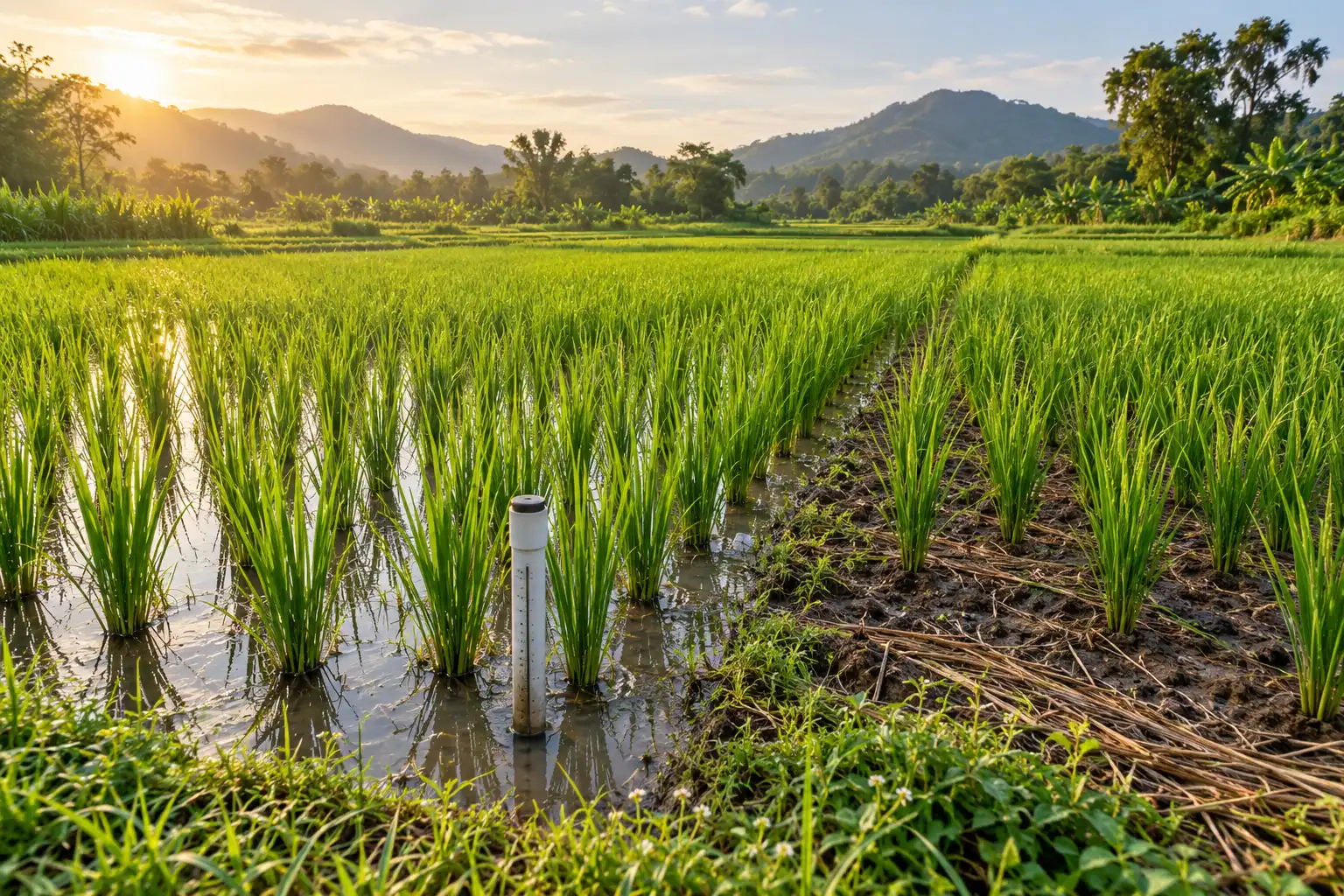
Regenerative rice refers to rice grown using methods that aim to restore soil health, conserve resources, and reduce environmental impacts. Unlike a specific rice variety, it describes how the crop is managed. The practices differ by climate, soil type, and production system.
Regenerative rice is rice grown with practices intended to improve soil health, conserve water, support wildlife, and reduce greenhouse gas emissions while maintaining production. It is not a special variety or a single USDA-defined farming standard.
What Is Regenerative Rice?
Regenerative rice is a farming approach that aims to improve the condition of rice fields while producing a dependable grain crop.
Instead of focusing only on harvest yield, the approach considers how rice cultivation affects soil, water, biodiversity, and greenhouse gas emissions.
Regenerative rice production commonly emphasizes:
- Improving soil health through crop rotation, organic matter management, and suitable cover crops.
- Managing irrigation to reduce unnecessary water use and methane emissions.
- Reducing unnecessary soil disturbance where practical.
- Applying fertilizers according to crop needs and soil conditions.
- Supporting beneficial organisms and wildlife habitats.
- Maintaining productive yields over multiple growing seasons.
These practices are not exclusive to regenerative farming. Conventional and organic rice growers may already use many of them.
According to Oklahoma State University Extension, regenerative agriculture has no universally accepted definition. Some programs emphasize specific practices, while others focus on measurable environmental improvements.
For rice, the stronger evidence comes from changes in soil condition, irrigation requirements, greenhouse gas emissions, and crop performance.
How Is Regenerative Rice Grown?
Regenerative rice farming combines water, soil, nutrient, and habitat management rather than requiring one specific planting technique.
The methods depend on field drainage, local weather, rice variety, and available equipment.
| Farming practice | Regenerative approach | Intended benefit |
|---|---|---|
| Irrigation | Alternate wetting and drying or carefully timed drainage | Reduce methane and potentially save water |
| Soil management | Reduce unnecessary tillage and maintain suitable soil cover | Protect soil structure and organic matter |
| Crop rotation | Rotate rice with compatible crops where practical | Increase diversity and disrupt some pest cycles |
| Fertilization | Use soil tests and field-specific nutrient recommendations | Improve nutrient efficiency |
| Crop residue | Manage rice straw and off-season vegetation | Support nutrient cycling and soil protection |
| Pest management | Combine scouting, cultural practices, and targeted treatments | Reduce avoidable pesticide use |
1. Managing Water Through Alternate Wetting and Drying
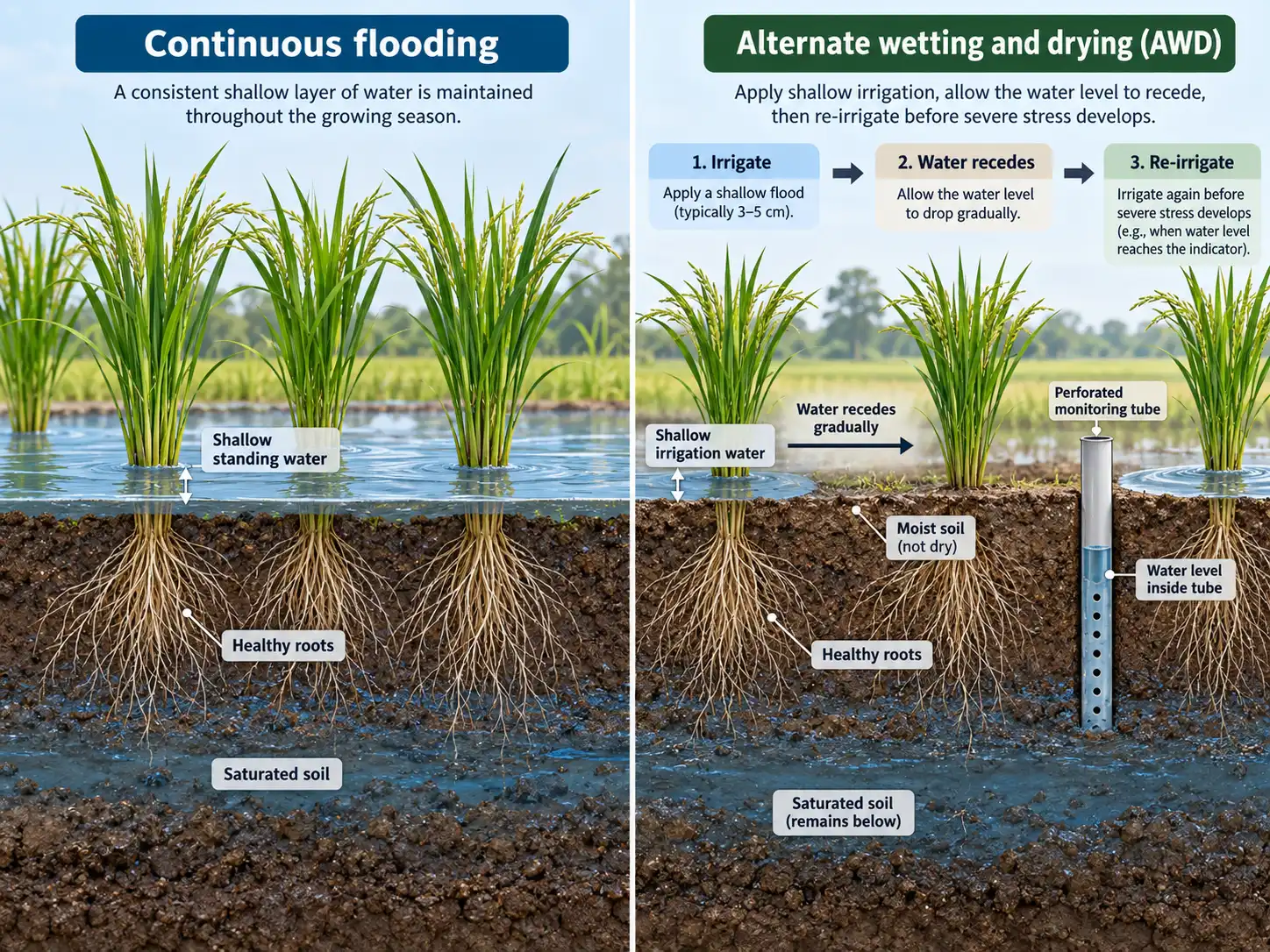
Alternate wetting and drying (AWD) allows standing floodwater to subside before the field is irrigated again.
Conventional flooded rice fields remain underwater for substantial portions of the growing season. These oxygen-poor conditions favor microbes that produce methane.
Carefully timed drainage introduces oxygen into the soil and can suppress methane production.
The International Rice Research Institute describes AWD as a method that can reduce irrigation water consumption by approximately 30% and methane emissions by 30% to 70% under suitable conditions.
However, those figures are not guaranteed for every field.
Growers must follow local irrigation guidance because excessive drying can reduce yields, interfere with weed management, and increase nitrogen losses.
2. Maintaining Soil Health With Cover Crops and Residue
Regenerative rice systems seek to protect soil and maintain biological activity between growing seasons.
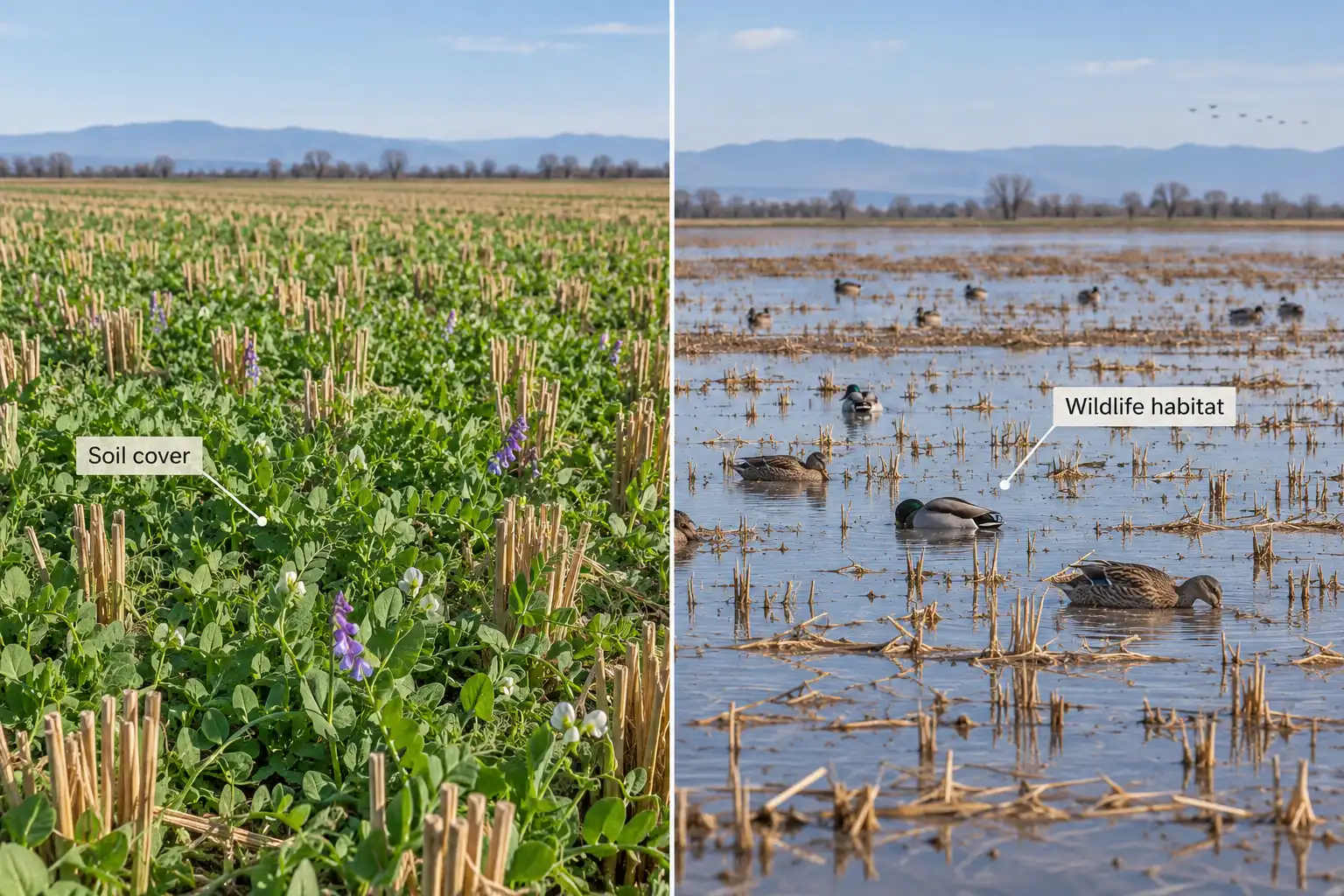
Suitable cover crops can add organic matter, reduce exposed soil, and retain nutrients that might otherwise be lost.
In California rice systems, winter vetch, winter peas, and bell beans are examples of legume cover crops. Their suitability depends on drainage, rainfall, and planting schedules.
Rice straw can also return organic material and nutrients to the soil.
However, residue management requires care. Fresh organic material decomposing under prolonged flooding can contribute to methane production.
Cover cropping is not practical in every rice field, especially where heavy clay soils remain waterlogged.
For long-term soil management, improving soil fertility through appropriate amendments and organic matter provides a useful foundation. Nutrient applications should still reflect rice-specific soil requirements.
3. Using Crop Rotation and Targeted Nutrient Management
Rice growers can improve field diversity by rotating with compatible crops where soil and drainage conditions allow.
Rice and soybean rotations are one option in parts of the southern United States.
Rotation may interrupt some pest and disease cycles while creating opportunities to manage nutrients differently.
However, growing rice regeneratively does not mean eliminating fertilizers.
The goal is to avoid unnecessary inputs while supplying enough nitrogen, phosphorus, potassium, zinc, and other nutrients for productive growth.
Before changing fertilizer rates, use soil test results to guide nutrient decisions and apply local rice recommendations.
What Are the Benefits of Regenerative Rice Farming?
The potential benefits include lower methane emissions, improved soil management, better irrigation efficiency, and greater habitat diversity.
However, each benefit depends on the actual practices and field conditions.
Lower Methane Emissions
Methane reduction is among the best-supported environmental benefits of improved rice irrigation.
A 2026 USDA Agricultural Research Service study compared continuous flooding with AWD over three years in Arkansas.
The researchers reported:
- Approximately 71% lower methane emissions under AWD.
- Similar grain yields between continuous flooding and AWD treatments.
- Yield differences among the rice cultivars tested.
The study included the inbred cultivar CL151 and several hybrids, including XP753.
These findings support carefully managed AWD as a methane-reduction strategy. They do not mean that every field will achieve a 71% reduction.
Drying also changes soil nitrogen processes and may increase nitrous oxide emissions under some conditions.
Better Water Management
Regenerative irrigation can reduce pumping requirements when fields are suitable for intermittent flooding.
However, water savings vary substantially.
Fields with greater seepage or percolation losses may benefit more than heavy clay fields that retain water naturally.
The distinction matters in California, where certain methane-reduction practices can produce little irrigation savings.
Water savings should be measured rather than assumed from adopting AWD.
Improved Soil and Wildlife Conditions
Cover crops, carefully managed residue, and vegetated field borders may improve soil protection and provide habitat.
Rice fields also serve an ecological role beyond grain production.
In California, winter-flooded harvested fields can provide feeding and resting areas for migratory waterfowl.
The challenge is balancing wildlife benefits against the water requirements and methane associated with flooded conditions.
A field may provide valuable habitat while still having opportunities to reduce its climate impact.
Regenerative Rice vs. Organic Rice: What Is the Difference?
Regenerative rice emphasizes improved agricultural outcomes, while certified organic rice must meet specific production standards.
The terms can overlap, but they are not interchangeable.
| Rice designation | Main meaning | Certification requirement |
|---|---|---|
| Conventional rice | Rice grown using permitted standard agricultural methods | No special regenerative certification |
| Regenerative rice | Rice grown using practices intended to improve environmental performance | No single universal certification |
| USDA Organic rice | Rice produced under USDA organic production requirements | USDA-accredited organic certification |
| Regenerative Organic Certified rice | Organic rice meeting additional soil health and social standards | Independent certification under the ROC program |
| AWD-grown rice | Rice cultivated using intermittent flooding | AWD itself is a method, not a certification |
The USDA Agricultural Marketing Service regulates the use of the USDA Organic label.
By comparison, the term “regenerative” alone does not establish that synthetic fertilizers or pesticides are prohibited.
The Regenerative Organic Alliance operates the Regenerative Organic Certified program. It uses organic certification as a baseline and adds requirements covering soil health, farmer and worker fairness, and applicable animal welfare standards.
Therefore, regenerative rice can be organic, but not all regenerative rice is certified organic.
How Do Regenerative Rice Practices Differ Across U.S. Regions?
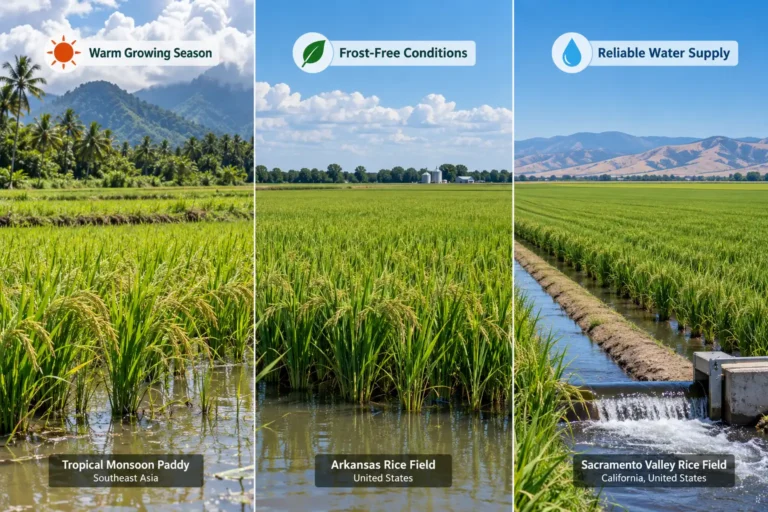
Arkansas and California demonstrate why regenerative rice management cannot follow one universal irrigation schedule.
Arkansas and the Mid-South
Arkansas rice production includes water-management systems that can accommodate AWD and furrow irrigation.
The University of Arkansas Division of Agriculture’s 2026 Rice Management Guide recommends:
- Maintaining the established flood for 21 days before beginning AWD.
- Keeping soil wet or damp at the upper part of the paddy and the lower portion flooded.
- Reflooding before the water level in a monitoring tube falls more than 2 inches below the soil surface.
- Maintaining adequate moisture during internode elongation, flowering, and grain filling.
The guide also states that AWD does not automatically change nitrogen fertilizer recommendations.
These limits differ from the international AWD guidance that commonly describes reflooding when the monitored water level reaches approximately 6 inches below the soil surface.
Use the locally recommended threshold, not a deeper dry-down copied from another rice-growing region.
California’s Sacramento Valley
California rice systems commonly have heavy clay soils, which influence drainage and irrigation decisions.
UC Cooperative Extension’s 2025 guidance on AWD in California rice identifies a possible midseason drainage window about 35 to 50 days after planting.
Its research describes a single soil dry-down lasting approximately 7 to 10 days, rather than repeated drainage cycles.
The reported methane reductions were approximately 40% to 60%.
However, the guidance warns against poorly timed drainage during sensitive crop stages, including booting and flowering.
It also notes that heavy clay soils may provide little irrigation water savings from this approach.
How Can Farmers Start Regenerative Rice Production?
The safest transition is to begin with a manageable field, establish baseline measurements, and evaluate one or two changes at a time.
Step 1: Assess the Field
Record soil texture, drainage, pH, soil-test nutrients, irrigation capacity, weed history, and existing crop rotation.
Choose a field where water levels can be controlled and measured reliably.
Step 2: Select Suitable Practices
Start with changes that address a known problem.
For example, a field with excessive pumping requirements may benefit from improved irrigation scheduling. A field with declining organic matter may need more attention to crop rotation or off-season soil cover.
Step 3: Develop a Regional Irrigation Plan
Review local extension recommendations before introducing AWD or midseason drainage.
Plan reflooding around crop growth stages, nitrogen applications, water availability, and weather conditions.
Step 4: Monitor Soil and Crop Performance
Track irrigation volume, fertilizer rates, grain yield, production costs, and soil-test changes.
Use the same soil sampling depth and methods over time to make comparisons more meaningful.
Step 5: Compare Results Before Expanding
Evaluate water use and harvest results against previous records or a suitable comparison field.
Do not assume that adopting a practice proves greater soil carbon storage or lower total greenhouse gas emissions.
Independent emissions measurement or a validated monitoring method is needed to support specific emissions claims.
How Much Irrigation Water Could a Rice Field Save?
The actual amount depends on the reduction in applied irrigation depth and the acreage managed.
The U.S. Geological Survey gives approximately 27,154 gallons as the volume of one acre-inch of water.
Use this calculation:
Gallons saved = Irrigation depth reduction (inches) × Acres × 27,154
For example, suppose irrigation records show a 2-inch reduction in applied water across 40 acres.
2 × 40 × 27,154 = 2,172,320 gallons
That equals approximately 54,308 gallons saved per acre.
This example demonstrates the calculation, not a predicted AWD savings rate.
Track actual irrigation using flow meters and field records. The crop water requirements calculation guide can help put water demand and applied irrigation into context.
What Are the Main Challenges of Regenerative Rice Farming?
Regenerative practices can introduce management difficulties if they do not match the rice production system.
| Potential problem | Why it happens | Practical response |
|---|---|---|
| Yield loss from excessive drying | Moisture stress during sensitive growth stages | Follow regional reflooding limits |
| Nitrogen losses | Changing soil oxygen and nitrogen conditions | Coordinate fertilization with irrigation |
| Increased weed pressure | Floodwater no longer suppresses some weeds | Maintain scouting and integrated weed management |
| Poor cover crop establishment | Saturated soil or inadequate drainage | Select suitable species and planting windows |
| Slow straw decomposition | Insufficient residue contact with moist soil | Adjust residue management to field conditions |
| Unverified environmental claims | No baseline or monitoring records | Measure outcomes before making claims |
AWD also requires dependable irrigation access. A field that cannot be reflooded promptly may not be a good candidate.
Similarly, avoiding tillage at all costs can interfere with essential field preparation, weed control, and drainage maintenance.
Regenerative management should address the field’s limitations rather than require every possible practice.
How Can Consumers Identify Genuine Regenerative Rice?
A regenerative claim is more meaningful when it is supported by a recognized standard or documented farming practices.
When comparing rice products, look for:
- Specific certification: A recognized third-party certification, such as Regenerative Organic Certified, provides defined requirements.
- Production details: Information about irrigation, soil management, biodiversity, and chemical input practices.
- Measurable outcomes: Documented water savings, greenhouse gas reductions, or soil improvements, with a clear comparison method.
- Traceability: Information identifying the production operation or verified supply chain.
A package labeled “regeneratively grown” may reflect meaningful practices, but the wording alone does not establish how those practices were evaluated.
Likewise, regenerative labeling does not guarantee superior flavor, higher nutrient levels, or lower contaminant concentrations.
Those characteristics require separate evidence.
FAQs About Regenerative Rice
Can regenerative rice grow without standing water?
Yes. Some regenerative rice systems use direct seeding, intermittent irrigation, or other water-management methods that avoid continuous flooding. However, standing water may still be needed during certain growth stages or for weed control.
Is regenerative rice necessarily pesticide-free?
No. The regenerative label alone does not prohibit all pesticides or synthetic fertilizers. Specific certification programs can impose additional restrictions, so consumers and growers should check the applicable standards rather than assume identical requirements.
Does regenerative rice taste different from regular rice?
Not necessarily. Regenerative production describes the farming method rather than a distinctive flavor or grain type. Rice variety, grain processing, storage, and cooking methods have more direct effects on taste and texture.
Can regenerative rice contain less arsenic?
Potentially. USDA ARS research published in 2026 found lower grain arsenic in Arkansas rice fields with multiple aeration events. However, the regenerative label does not guarantee a lower arsenic concentration in any particular product.
Is direct-seeded rice automatically regenerative?
No. Direct seeding describes planting seeds directly into the field instead of transplanting seedlings. It can support some regenerative production systems, but planting method alone does not demonstrate improved soil health or lower emissions.
How long does it take to improve soil health under regenerative rice farming?
There is no fixed period. Soil organic matter and biological changes depend on soil type, drainage, crop rotation, and management history. Consistent sampling across multiple seasons provides better evidence than a single test.
Key Points for Regenerative Rice Production
Regenerative rice is best understood as a production approach focused on better soil, water, and environmental management.
Water control offers strong opportunities to reduce methane emissions. Cover crops, nutrient planning, and habitat management can provide additional benefits where conditions permit.
For growers, the practical starting point is to identify one field limitation, choose an appropriate management change, and measure the results. The goal is sustained improvement, not simply applying a regenerative label.