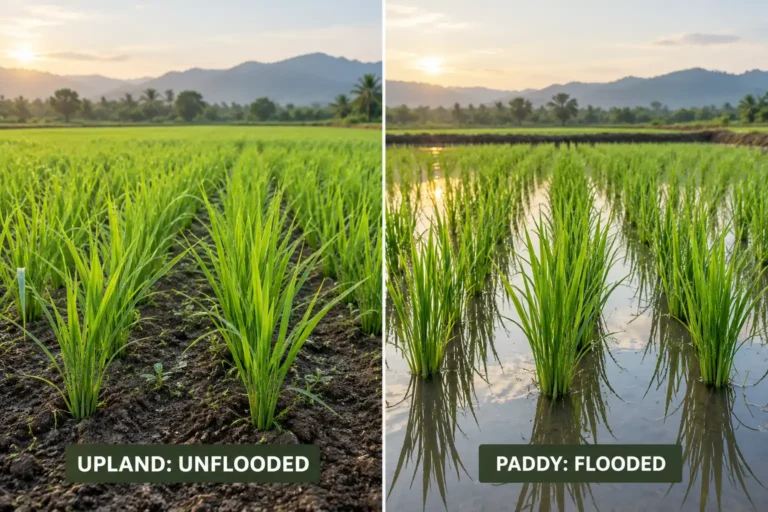
What Climate Does Rice Grow In? Temperature and Water Needs
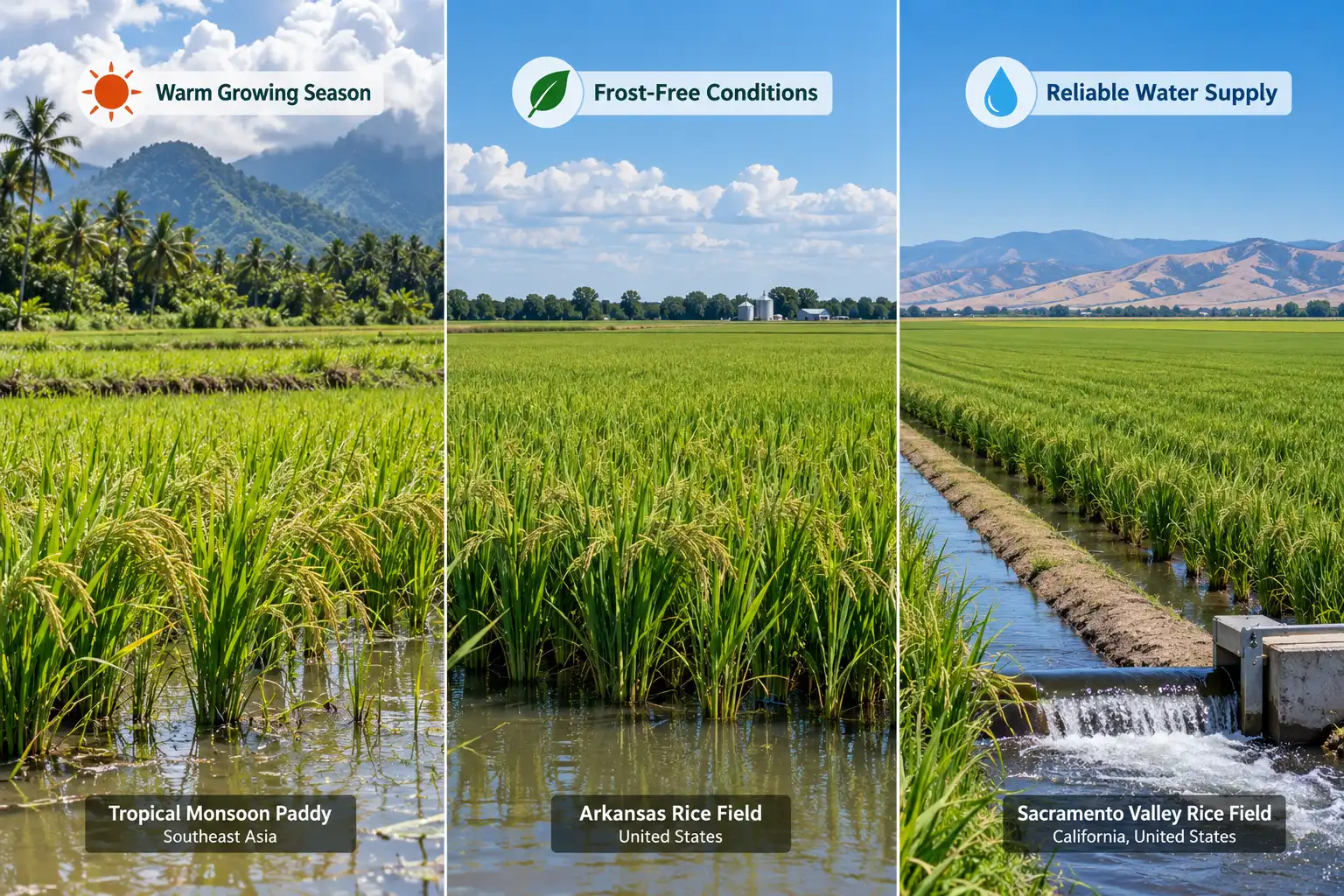
Rice is associated with hot, rainy regions, but it also grows in places with relatively dry summers. So, what climate does rice grow in? The answer depends on growing-season temperatures, water availability, sunlight, and the weather during flowering.
Rice grows best in warm, sunny climates with a frost-free growing season and dependable water. Tropical and subtropical climates are naturally favorable, but rice also grows in temperate regions with warm summers and sufficient irrigation.
What Climate Does Rice Grow In Best?
Rice grows particularly well in tropical, subtropical, and warm temperate climates. However, it does not require tropical weather throughout the year.
The USDA Economic Research Service identifies high daytime temperatures, cooler nights, and reliable water supplies as favorable conditions for commercial rice production.
The main climate requirements are:
| Climate factor | Suitable growing conditions |
|---|---|
| Temperature | Warm summer weather, with limited extreme heat during flowering |
| Growing season | Approximately four months of favorable temperatures for many U.S. varieties |
| Frost | No damaging frost during active growth or grain development |
| Rainfall | Consistent seasonal moisture or sufficient irrigation |
| Sunlight | Full sun, especially during grain formation |
| Humidity | Humid conditions are common but not mandatory |
| Soil moisture | Reliable moisture throughout growth, particularly during reproductive stages |
These conditions explain why rice grows across several climate types.
Tropical regions often provide warmth and seasonal rainfall. Subtropical regions offer long summers, while temperate regions can support rice during their warmest months.
The difference is often the amount of water growers must supply.
What Temperature Does Rice Need to Grow?
Rice needs warm conditions, but its temperature requirements change with each growth stage.
According to the USDA Agricultural Research Service, rice generally completes its growth cycle in approximately four months under typical U.S. growing conditions. Weather and variety selection can shorten or extend that period.
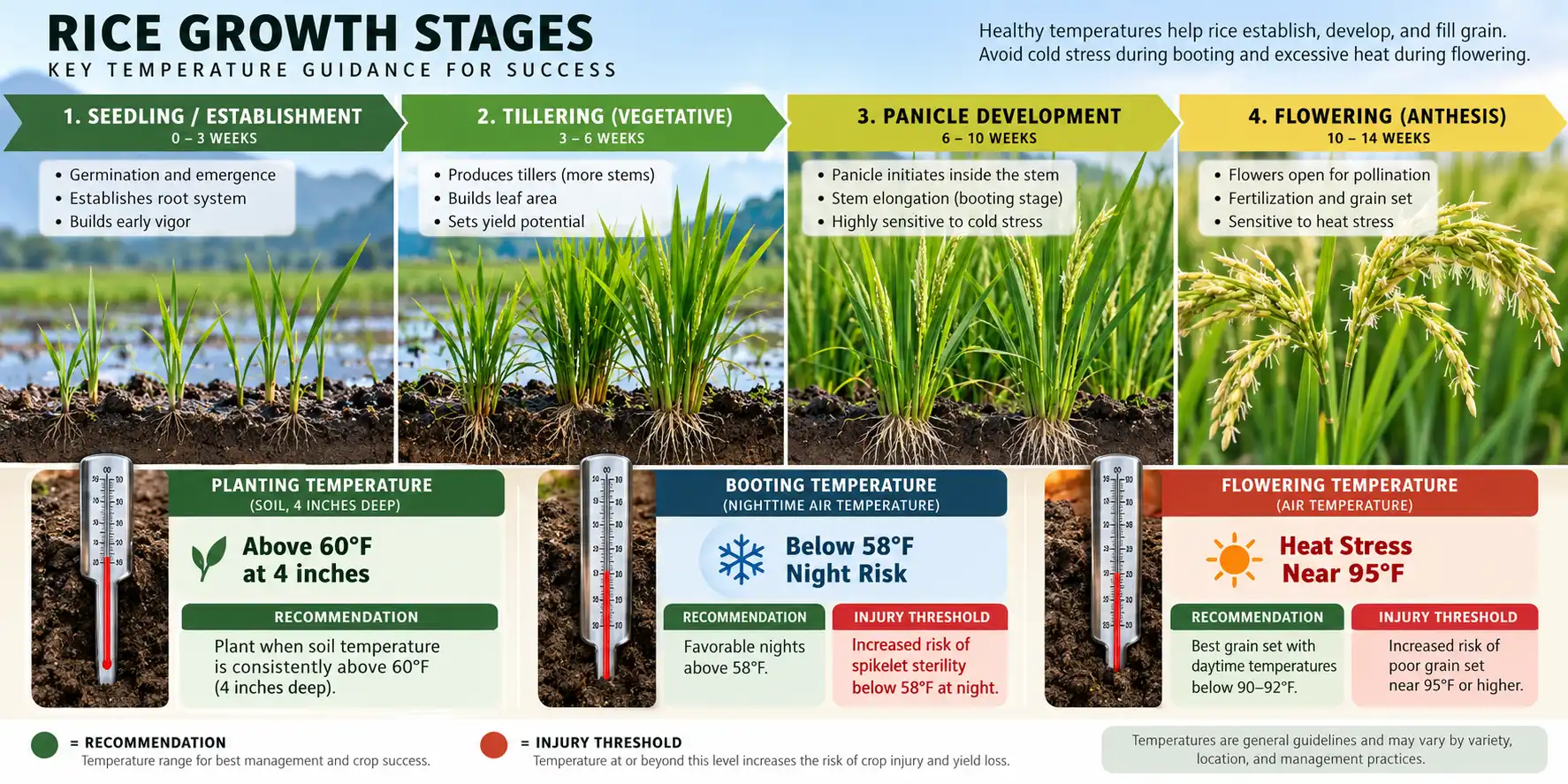
The most useful temperature thresholds concern germination, pollen formation, and flowering.
| Growth stage | Temperature guidance | Possible problem |
|---|---|---|
| Planting and germination | Soil above 60°F at a 4-inch depth is a practical Arkansas planting guideline | Slow or uneven emergence |
| Vegetative growth | Warm, sunny conditions support leaf and tiller development | Cool weather slows growth |
| Booting and pollen formation | Nights below 58°F can cause sterility in California rice | Empty grains |
| Flowering | Sustained daytime temperatures near 95°F or higher can increase sterility risk | Poor grain formation |
| Grain filling | Continued warmth and adequate moisture | Slow ripening or reduced grain weight |
These are stage-specific guides, not universal minimum and maximum temperatures.
How warm should the soil be before planting?
The University of Arkansas Extension Rice Production Handbook recommends planting when average soil temperatures at a 4-inch depth exceed 60°F.
Its research-based emergence estimates illustrate the difference:
- At 60°F, emergence takes approximately 20 days.
- At 65°F, emergence takes approximately 14 days.
- At 70°F, emergence takes approximately 8 days.
These estimates assume sufficient soil moisture. Cold, saturated soil can also increase seedling disease risk.
Why are flowering temperatures especially important?
Rice becomes sensitive to temperature extremes while producing pollen and flowering.
UC Agriculture and Natural Resources reports that nighttime temperatures below 58°F during booting can cause blanking, or grains that fail to fill.
Heat creates another problem. Its rice heat-stress guidance describes reproductive injury from high temperatures, including exposure near 95°F.
The severity depends on the variety, exposure duration, and developmental stage.
Does Rice Need Heavy Rainfall or High Humidity?
Rice requires dependable moisture, but heavy natural rainfall is not necessary when irrigation supplies enough water.
The distinction is between the crop’s water requirements and the climate’s rainfall.
The International Rice Research Institute explains that rice-field water demand includes evaporation, plant transpiration, seepage, and percolation. These losses vary with soil, weather, and management.
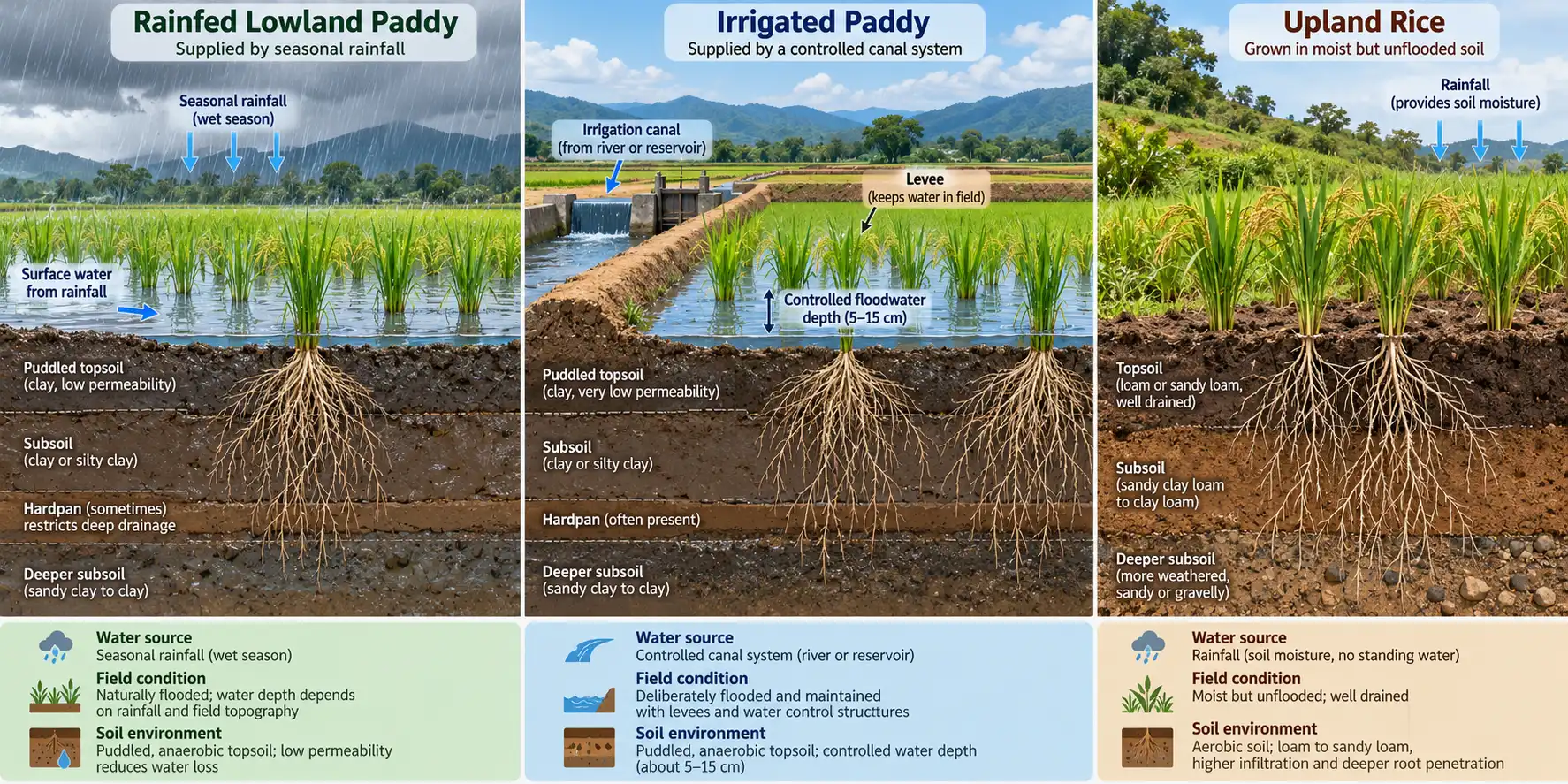
Three common rice-growing systems illustrate the difference.
| Growing system | Main water source | Typical environment |
|---|---|---|
| Rainfed lowland rice | Seasonal rainfall | Tropical monsoon regions |
| Irrigated lowland rice | Controlled irrigation, sometimes supplemented by rain | Southern U.S. and California |
| Upland rice | Rainfall or irrigation maintaining moist, unflooded soil | Suitable upland environments |
A tropical monsoon climate can support rainfed rice when rainfall arrives throughout the growing season.
California’s Sacramento Valley receives little summer rainfall, yet irrigation supports extensive rice production.
High humidity is therefore not a requirement by itself. Water availability and soil moisture matter more.
How Much Water Does Rice Need in Different Climates?
Rice irrigation requirements vary widely because temperature, evaporation, rainfall, and soil permeability affect water demand.
For example, University of Arkansas Extension reports approximately 30 acre-inches of seasonal irrigation for traditional flooded rice fields under a common Arkansas production setup.
By comparison, UC Davis rice research guidance reports deliveries of roughly 4 to 7.7 acre-feet per acre, equivalent to 48 to 92 inches, across California production situations.
These are not interchangeable crop requirements. California’s dry growing season, field drainage, seepage, and irrigation management contribute to the difference.
How much water does a flooded area hold?
Use this simple calculation:
Water volume in gallons = area in square feet × water depth in inches × 0.6234
| Area | Water depth | Approximate volume |
|---|---|---|
| 4 × 8 ft garden bed | 2 inches | 40 gallons |
| 100 sq ft plot | 2 inches | 125 gallons |
| 1 acre | 2 inches | 54,300 gallons |
These volumes represent one layer of standing water, not an entire season’s irrigation.
Arkansas Extension commonly recommends maintaining a shallow flood of 2 to 4 inches during established conventional rice production. Other management systems may use different depths or intermittent flooding.
Before planting, calculate the crop’s irrigation demand using local weather, soil characteristics, and available water.
Where Does Rice Grow in the United States?
Commercial U.S. rice production is concentrated in the South and California, where warm growing seasons combine with established irrigation systems.
According to the USDA Economic Research Service, four regions account for nearly all U.S. rice production.
| Growing region | Climate characteristics | Rice production |
|---|---|---|
| Arkansas Grand Prairie | Hot, humid summers | Primarily irrigated long-grain rice |
| Mississippi Delta, including Arkansas, Mississippi, Missouri, and Louisiana | Humid subtropical conditions and warm summers | Primarily irrigated long-grain rice |
| Gulf Coast, including Texas and southwest Louisiana | Long, warm growing season with humid weather | Irrigated rice, with ratoon cropping possible in suitable areas |
| Sacramento Valley, California | Hot, relatively dry summers and cooler nights | Irrigated medium-grain and short-grain rice |
The differences are significant.
In Arkansas and the Mississippi Delta, summer heat supports development, but irrigation helps cover rainfall shortages.
In California, irrigation replaces much of the missing summer rainfall. However, cool nights can still threaten developing pollen.
These regional differences also influence variety selection.
UC ANR’s 2026 statewide rice variety results show that M-206 performs particularly well in cooler Sacramento Valley locations. M-209 generally performs better in warmer locations than in the valley’s cooler southern areas.
Thus, even within one rice-producing region, the local climate affects which variety is suitable.

Can Rice Grow in Cooler Temperate Climates?
Yes. Rice can grow in temperate regions when summer temperatures and the frost-free growing period support the selected variety.
Temperate rice production is associated particularly with japonica varieties, which are widely grown in countries such as Japan and South Korea.
However, a frost-free season alone does not guarantee success. The crop also needs enough accumulated warmth for heading, pollination, and grain filling.
A short-season variety may mature where a longer-season cultivar cannot.
Cool nights during booting remain a concern, even when daytime temperatures are warm.
In California, UC ANR sometimes recommends deeper floodwater during the cold-sensitive stage to help protect developing panicles. That practice is specific to local production systems and should not be treated as a universal flooding recommendation.
For cooler U.S. locations, evaluate the variety’s maturity period before committing a large planting.
How Can You Tell Whether Your Climate Is Suitable for Rice?
Check the local growing season, planting temperature, and available water before selecting a rice variety.
A practical assessment includes four steps.
1. Check frost-free dates. Use NOAA climate records to examine typical spring and fall freeze dates. Allow enough time for the crop to mature before cold autumn weather.
2. Measure soil temperature. For Arkansas-style direct seeding, use the Extension guideline of an average temperature above 60°F at a 4-inch depth. Other regions may require different planting decisions.
3. Evaluate summer water availability. Compare expected rainfall with your irrigation capacity. Consider how quickly the soil loses water through drainage and seepage.
4. Choose a locally adapted cultivar. Compare maturity time, cold tolerance, and heat tolerance. Use regional variety trials instead of selecting only by grain length.
For example, an area with warm days but frequent cool nights during pollen formation may favor a more cold-tolerant variety.
An area with a short summer may need an earlier-maturing cultivar.
Climate suitability should also guide your broader crop selection decisions, especially where irrigation is limited.
What Climate Problems Can Reduce Rice Yield?
Cold conditions, excessive heat, inadequate water, and prolonged humid weather can each affect rice differently.
| Weather problem | Possible field symptoms | Practical response |
|---|---|---|
| Cold soil during planting | Slow, patchy emergence | Delay planting until soil temperatures improve |
| Cold nights during booting | Empty grains or blanking | Use regionally adapted cold-tolerant cultivars |
| High heat during flowering | Poor pollination and unfilled grains | Select suitable varieties and planting windows |
| Water shortages during reproductive growth | Reduced grain formation or filling | Maintain an adequate water supply through sensitive stages |
| Extended humid, wet conditions | Increased risk of certain fungal diseases | Scout regularly and use resistant varieties where available |
Excessive humidity deserves attention because warm, wet conditions can encourage rice blast.
The UC Statewide Integrated Pest Management Program identifies prolonged leaf moisture, high humidity, and favorable nighttime temperatures as conditions associated with rice blast infections.
However, empty grains can also result from temperature injury without disease.
Check symptoms carefully before assuming a fungal infection. The common crop disease identification guide provides additional context for separating disease symptoms from other growing problems.
FAQs About Climate Does Rice Grow In
Can rice grow in USDA Hardiness Zone 5?
Rice may grow in Zone 5 where summer warmth and the frost-free period are sufficient. However, hardiness zones describe winter minimum temperatures, not growing-season heat, so choose a short-season variety and assess local weather carefully.
Can rice grow in a desert climate?
Yes. Rice can grow in dry climates when suitable temperatures and sufficient irrigation are available. However, high evaporative demand, water scarcity, and saline soils may limit production or make irrigation economically impractical.
Does rice need to grow in standing water?
No. Upland rice can grow without continuous flooding when soil moisture remains adequate. Flooding is common in lowland production because it supports water management and weed suppression, but water requirements depend on the growing system.
How much sunlight does rice need?
Rice generally performs best in full sunlight throughout its growing season. Strong light supports photosynthesis and grain development, while prolonged cloudiness during important growth stages can reduce the energy available for productive tillers and grain filling.
Is wild rice grown in the same climate as ordinary rice?
Not necessarily. Wild rice belongs to the genus Zizania, while ordinary cultivated rice belongs to Oryza. Their growing environments and adaptation differ, so planting recommendations for ordinary rice should not automatically be applied to wild rice.
Choosing the Right Rice Climate
Rice performs best when warm weather, dependable moisture, and the variety’s growing period match the local conditions.
Tropical rainfall is helpful but not mandatory. Before planting, confirm soil warmth, the available frost-free season, and irrigation capacity. Pay particular attention to nighttime cold during booting and excessive heat during flowering.